Follow Up Email Etiquette: Timing, Cadence, and Tone Rules
Most reps lose deals in the follow-up, not the first email. Here are the timing, cadence, and wording rules that keep you persistent without getting blocked.
TL;DR
- Follow up email etiquette is mostly about spacing, value, and exit — not about how politely you say "just checking in."
- Three to five follow-ups over 14–21 business days is the range where reply rate climbs without complaint rate following it.
- Every follow-up needs a reason to exist. A bump with no new information trains the recipient to ignore your thread.
- Reply-all bumps, read receipts, guilt lines ("I guess this isn't a priority"), and midnight sends are the four fastest ways to get filtered.
- Bad data causes half of what looks like rudeness: if 20% of your list bounces, your sender reputation punishes the follow-ups you did get right.
What is follow up email etiquette, exactly?#
Follow up email etiquette is the set of unwritten rules that decide whether your second, third, and fourth email read as diligent or desperate. It covers four things: when you send, how often you send, what you say when the prior email got no response, and how you stop.
Here is the useful analogy: a follow-up sequence is like knocking on a neighbor's door. Knocking twice is normal. Knocking every ninety seconds for an hour is a police matter. The knock itself never changed — the spacing and the intent did. Email works the same way, except the "police" is a spam filter, and the sentence it hands down is invisible: your future messages quietly land in Promotions or Junk and nobody tells you.
The stakes went up because buyers got harder to reach. Gartner's research on the B2B buying journey found buyers spend only about 17% of their purchase process meeting with potential suppliers — and that time is split across every vendor in the deal. You are not competing for attention against silence. You are competing against four other sequences hitting the same inbox this week.
How many follow-up emails are appropriate?#
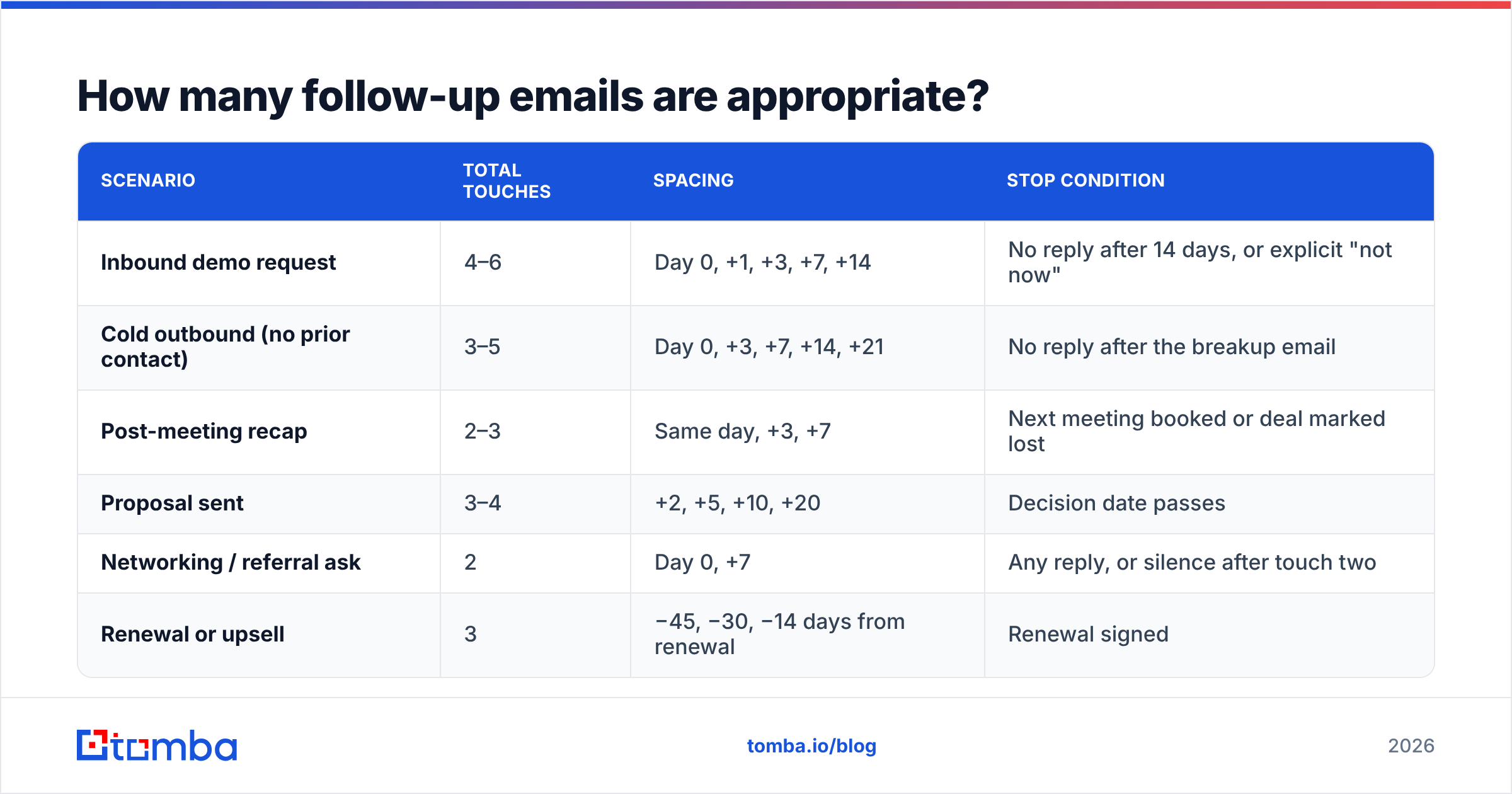
The honest answer: three to five total touches on the same thread, spread over roughly three weeks, then stop or switch channels.
Below the floor of two follow-ups, you leave replies on the table — a large share of positive responses arrive after the first message, not on it. Above five, you are usually not persuading anyone; you are generating annoyance and, eventually, spam complaints. The complaint rate is the number that matters, because mailbox providers weigh it heavily and it is nearly impossible to unwind once it climbs.
Cadence should also flex by context. A warm inbound lead who filled out a demo form tolerates a much tighter rhythm than a cold prospect who has never heard your company name.
| Scenario | Total touches | Spacing | Stop condition |
|---|---|---|---|
| Inbound demo request | 4–6 | Day 0, +1, +3, +7, +14 | No reply after 14 days, or explicit "not now" |
| Cold outbound (no prior contact) | 3–5 | Day 0, +3, +7, +14, +21 | No reply after the breakup email |
| Post-meeting recap | 2–3 | Same day, +3, +7 | Next meeting booked or deal marked lost |
| Proposal sent | 3–4 | +2, +5, +10, +20 | Decision date passes |
| Networking / referral ask | 2 | Day 0, +7 | Any reply, or silence after touch two |
| Renewal or upsell | 3 | −45, −30, −14 days from renewal | Renewal signed |
Two rules that hold across every row:
- Widen the gaps as you go. Day 0, +3, +7, +14 mirrors how attention decays. Four emails on four consecutive days does not.
- Send during the recipient's business hours, in their timezone. A 2 a.m. local send says "automation" louder than any signature ever could.
What are the core rules of follow up email etiquette?#
These are the nine rules that separate a sequence people answer from one people report.
- Every follow-up carries new information. A customer story, a relevant benchmark, a competitor announcement, a new integration — something that did not exist in email one. "Bumping this to the top of your inbox" is not information; it is a demand for free labor.
- Reply in the same thread, not a fresh one. Threading gives context and keeps your history in one place. Starting a new thread each time reads as if you forgot you already wrote.
- Keep follow-ups shorter than the original. Touch one can be six sentences. Touch four should be two. Length signals effort in the wrong direction when nobody has replied yet.
- Never guilt-trip. "I've reached out three times" and "I guess this isn't a priority for you" both put the recipient on trial for a crime they did not commit. Silence is not rudeness; it is triage.
- Ask one question, and make it answerable in a word. "Is this worth 15 minutes, or should I close the file?" outperforms "Let me know your thoughts."
- Skip read receipts and open-tracking pixels on executive threads. Senior buyers notice, and some security tools flag them. The information you gain is worth less than the trust you spend.
- Never reply-all to bump. Adding a VP to the CC line to pressure a champion is the single most reliable way to lose the champion.
- Make the exit graceful and real. A breakup email should actually end the sequence. If you write "I'll stop reaching out" and then email again in ten days, you have taught them your word is worthless.
- Verify the address before you send five times to it. Repeated hard bounces to the same invalid mailbox damage your domain reputation faster than almost anything else. Running the list through an email verifier before the sequence starts is table stakes, not a nice-to-have.
What should you actually write in a follow-up?#
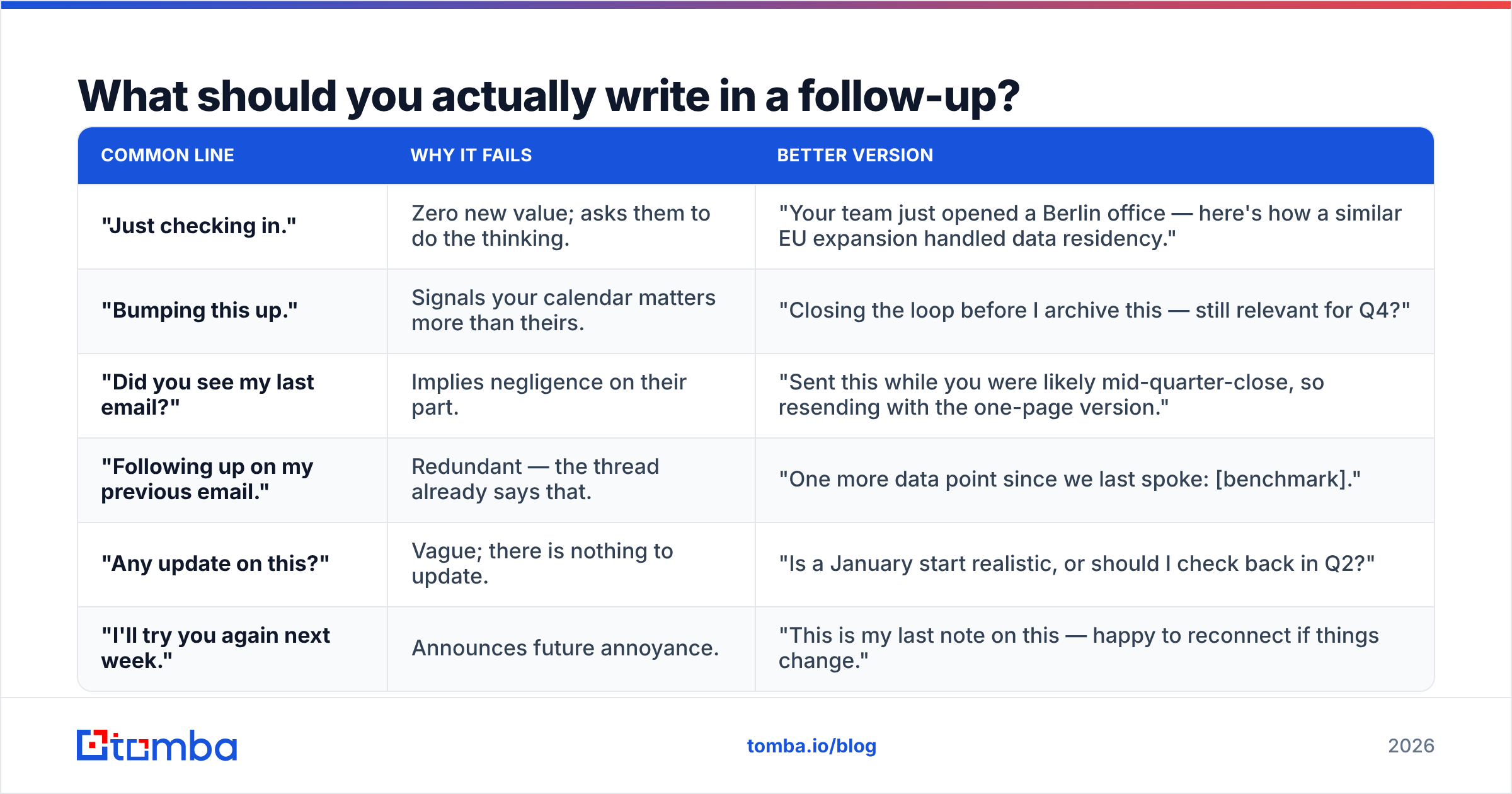
Replace the filler phrases with a reason. The pattern is: reference something specific → add one new thing → ask one small question.
| Common line | Why it fails | Better version |
|---|---|---|
| "Just checking in." | Zero new value; asks them to do the thinking. | "Your team just opened a Berlin office — here's how a similar EU expansion handled data residency." |
| "Bumping this up." | Signals your calendar matters more than theirs. | "Closing the loop before I archive this — still relevant for Q4?" |
| "Did you see my last email?" | Implies negligence on their part. | "Sent this while you were likely mid-quarter-close, so resending with the one-page version." |
| "Following up on my previous email." | Redundant — the thread already says that. | "One more data point since we last spoke: [benchmark]." |
| "Any update on this?" | Vague; there is nothing to update. | "Is a January start realistic, or should I check back in Q2?" |
| "I'll try you again next week." | Announces future annoyance. | "This is my last note on this — happy to reconnect if things change." |
The breakup email deserves its own note, because it is the highest-performing message in most sequences and the one people write worst. Keep it to three sentences, remove all pressure, and give an easy door back in: "I'm assuming the timing isn't right, so I'll stop here. If sequencing changes in Q1, reply with a single word and I'll pick it back up. Either way, good luck with the migration." No guilt, no "final chance," no fake scarcity.
For starting points you can adapt rather than write from scratch, the library of cold email templates covers most of these sequence positions.
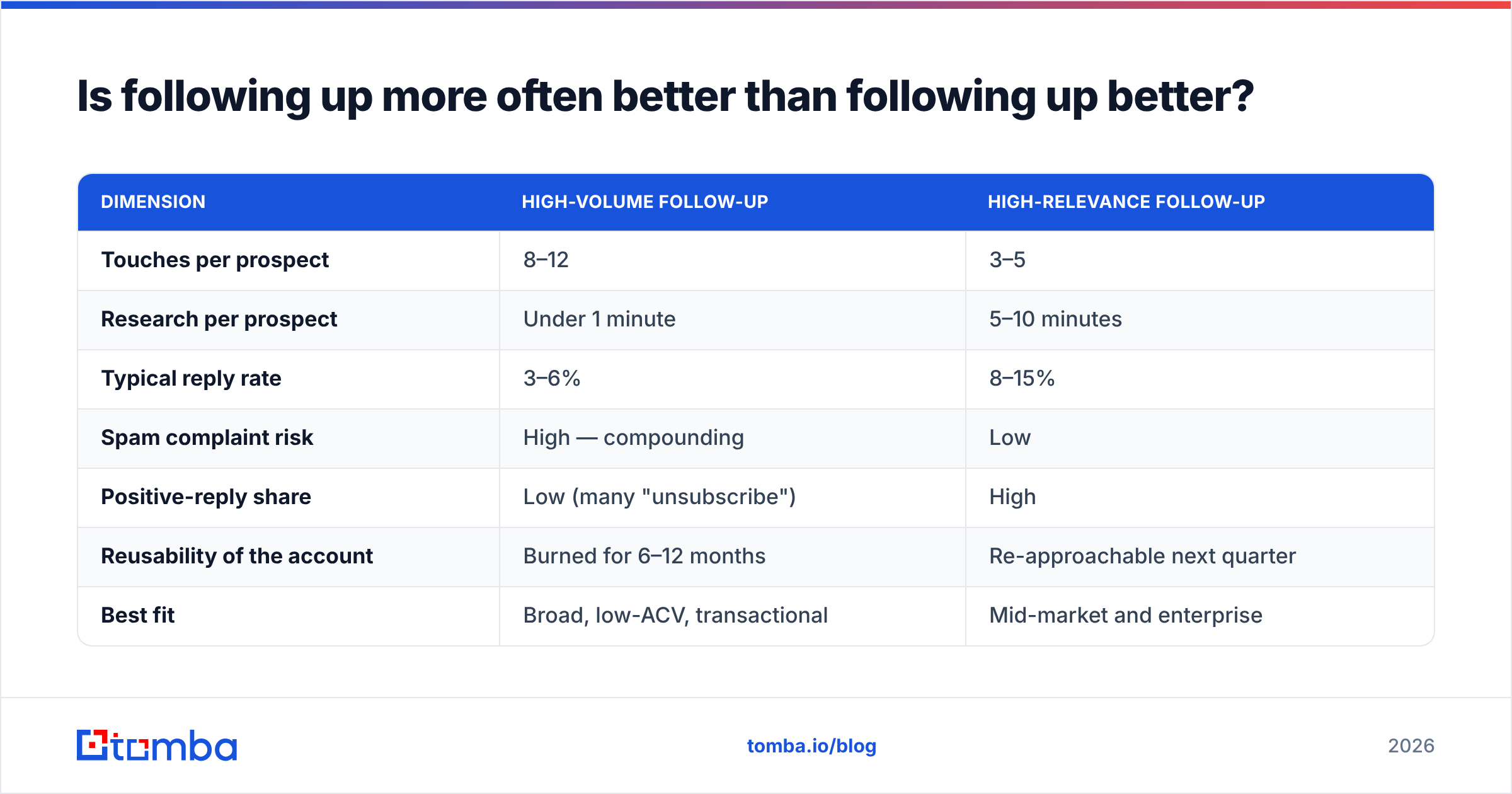
Is following up more often better than following up better?#
No — and this is where most teams get the tradeoff backwards.
Volume feels productive because it is measurable. You can see "12 touches sent" in the CRM. You cannot see the four buyers who quietly moved you to a filter rule. So teams optimize the number they can see, and the number they cannot see gets worse.
The math is unkind to volume. If a 4-touch sequence pulls a 7% response rate and an 8-touch version pulls 8%, you gained one point of reply — and doubled the number of people who saw you as spam. Some of them work at accounts you will want in eighteen months, and their filter rule will still be there.
Compare the two approaches directly:
| Dimension | High-volume follow-up | High-relevance follow-up |
|---|---|---|
| Touches per prospect | 8–12 | 3–5 |
| Research per prospect | Under 1 minute | 5–10 minutes |
| Typical reply rate | 3–6% | 8–15% |
| Spam complaint risk | High — compounding | Low |
| Positive-reply share | Low (many "unsubscribe") | High |
| Reusability of the account | Burned for 6–12 months | Re-approachable next quarter |
| Best fit | Broad, low-ACV, transactional | Mid-market and enterprise |
What are the legal and deliverability limits you can't ignore?#
Etiquette is the social layer. Underneath it sits a compliance layer that does not care about your tone.
- Honor opt-outs immediately. Under the CAN-SPAM Act in the US, opt-out requests must be processed within 10 business days, and there is no follow-up exception. Under GDPR, an EU recipient's objection ends the sequence on the spot.
- Include a real physical address and a working unsubscribe path, even in one-to-one-looking outreach sent at scale.
- Do not disguise the sender or subject. Fake "Re:" prefixes on a thread that never existed is deception, not cleverness — and buyers recognize it instantly.
- Watch your bounce rate. Sustained bounce rates above roughly 2–3% put your domain in throttling territory with major mailbox providers. Follow-ups multiply the damage: one bad address in a five-touch sequence is five bounces, not one.
- Warm the domain before you scale the cadence. A brand-new sending domain firing 500 follow-ups on day one gets treated exactly like a spammer, because that is what spammers do.
Deliverability is why data hygiene is an etiquette issue and not just an ops issue. When your reputation slips, the polite, well-researched follow-up you wrote for your best account lands in Junk alongside the junk. HubSpot's sales resources and peer reviews on G2 both reinforce the same point from different angles: the sequence quality ceiling is set by list quality.
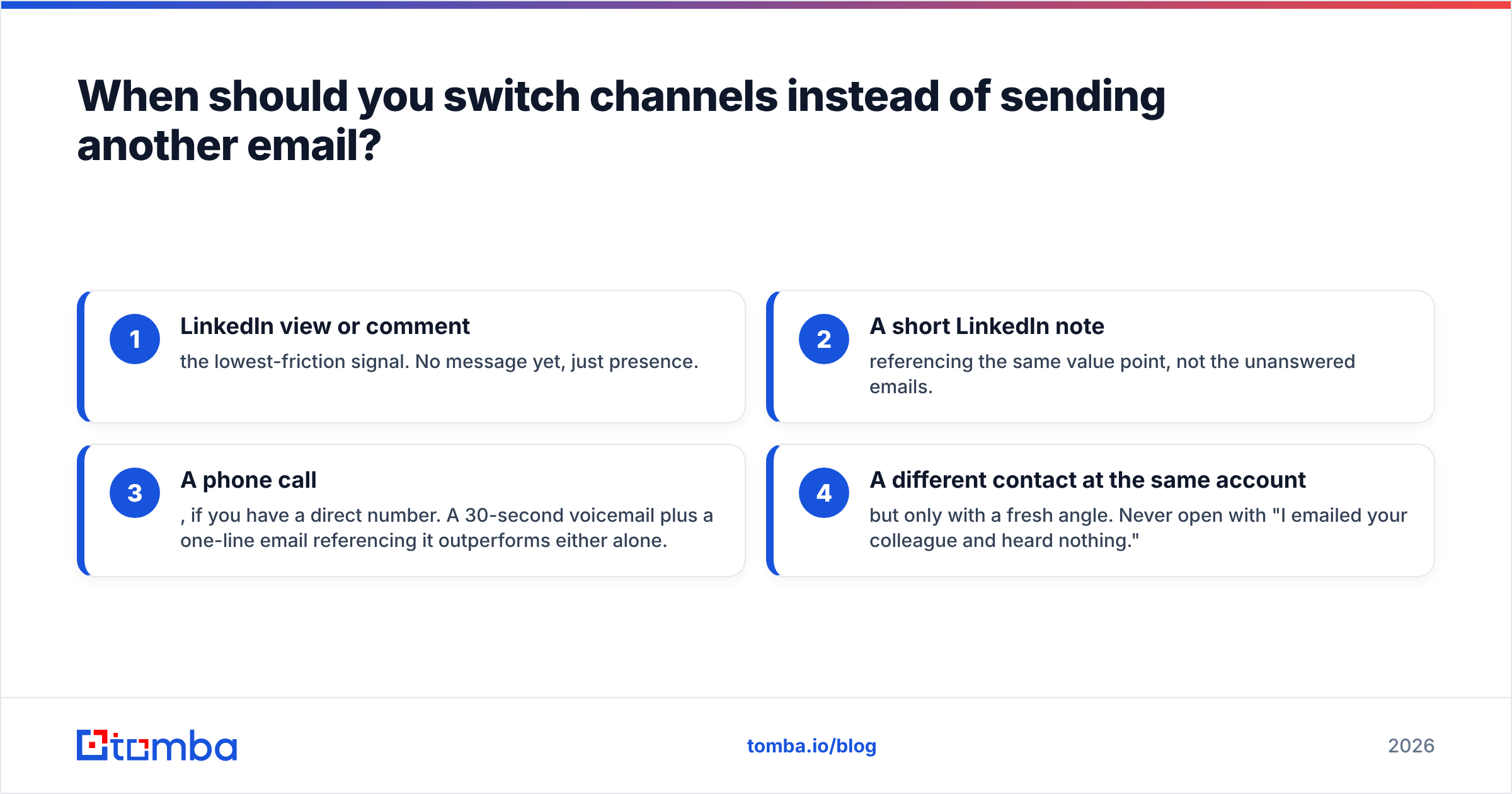
When should you switch channels instead of sending another email?#
After touch three with no engagement at all — no opens, no clicks, no reply — the channel is the problem, not the copy. Rewriting email four in a channel that is not reaching them is a rounding error.
Switch in this order:
- LinkedIn view or comment — the lowest-friction signal. No message yet, just presence.
- A short LinkedIn note referencing the same value point, not the unanswered emails.
- A phone call, if you have a direct number. A 30-second voicemail plus a one-line email referencing it outperforms either alone.
- A different contact at the same account — but only with a fresh angle. Never open with "I emailed your colleague and heard nothing."
That last step depends entirely on your data. If you only have one contact per company, you have no second move. A domain search that returns the full mapped team — with roles and verified addresses — turns a dead thread into a live account again without the reply-all escalation that kills relationships.
What does a clean 21-day follow-up sequence look like?#
Here is a cold-outbound skeleton that respects every rule above:
- Day 0 — Opener. One specific observation about their business, one hypothesis, one small ask. Six sentences maximum.
- Day 3 — Proof. Same thread. A customer example from their segment. Two sentences plus a link.
- Day 7 — Reframe. Different angle on the same problem, in case the first framing missed. Ask the one-word question.
- Day 14 — Resource. Send something useful with no ask attached — a benchmark, a checklist, a teardown. This is the touch that most often earns a reply.
- Day 21 — Breakup. Three sentences. Close the loop, leave the door open, then actually stop.
If nothing lands, mark the account for a 90-day re-approach with a genuinely new trigger — funding, a hire, a product launch. Re-approaching on a real event is welcome. Re-approaching because your quarter reset is not.
Get the data right before you get the cadence right#
The best-written follow-up in the world fails if it goes to jsmith@company.com when the mailbox is john.smith@company.com. Most "they ignored me" stories are actually delivery stories.
Start each sequence from verified, correctly-formatted contacts: use the Tomba Email Finder to pull the right address by name and domain, confirm it before the first send, and keep your bounce rate low enough that touches two through five actually reach the inbox. The free tier covers 25 searches a month if you want to test the workflow on a single account list, and paid plans start at $49/mo — see Tomba pricing for the full breakdown. Fix the deliverability floor first, and your follow-up etiquette finally gets a chance to work.
Related guides#
Ready to find emails that actually work?
Join 150,000+ professionals who stopped guessing and started sending. Free credits on signup — no credit card required.
Get the Tomba newsletter
Practical outbound tactics and product updates — once every two weeks.
About the author