Follow Up Email Examples That Actually Get Replies in 2026
Most deals die in the follow-up gap, not the first email. Here are 12 follow up email examples with the cadence, timing, and reply-rate data behind each one.
TL;DR
- Around 80% of closed deals need five or more touches, yet most reps stop after two. The gap between touch two and touch five is where your pipeline leaks.
- The best follow up email examples don't say "just checking in." They add a new reason to reply: a resource, a data point, a specific question, or a graceful exit.
- Cadence beats cleverness. A 3-day / 5-day / 7-day / 14-day spacing over four touches outperforms daily nagging every time.
- Reply in the same thread for touches 2–3, then break to a fresh subject line for touch 4. Threading signals continuity; a new subject resets attention.
- Follow-ups only work if the address is real. A bounced touch 3 poisons the whole domain — verify before you send, not after.
Why do follow up emails matter more than the first email?#
Because the first email is a coin flip, and the follow-up is where you earn the read.
Think of it like knocking on a door. The first knock might land while someone's in the shower. The second knock proves you meant it. Most people stop after one knock and assume nobody's home — that's the entire follow-up problem in one sentence.
The numbers back this up. Analysis published across sales-productivity research consistently shows the majority of reps send one or two touches and quit, while most closed-won deals took five or more. You're not competing on message quality against other vendors so much as on persistence against your own patience.
There's a second, less obvious reason: follow-ups are where personalization actually pays. Your first email is written before you have any signal. Your third email can reference the fact that they opened twice, clicked the pricing page, or replied to a colleague. That's information the cold email never had.
What makes a follow up email get a reply?#
Four things, and none of them are "sounding polite."
- A new reason to exist. If your follow-up contains no information that wasn't in the last one, it is a nag. Add a case study, a benchmark, a relevant news item, or a sharper question.
- One ask, phrased as a low-cost yes. "Worth 15 minutes Thursday?" beats "Let me know if you'd like to explore this further." Ambiguous asks get ambiguous silence.
- Short enough to read on a phone. Follow-ups should be shorter than the original — 40 to 90 words is the working range. Touch 4 can be one sentence.
- Correct timing. Same-day follow-ups read as desperate. Three-week gaps read as automated. The sweet spot compounds: 3 days, then 5, then 7, then 14.
- A clean send. Bounced follow-ups damage your domain reputation faster than cold sends do, because you're hitting the same dead address repeatedly. Run the list through an email verifier before touch one.
- A graceful exit built in. The breakup email works precisely because it removes pressure. It converts at surprisingly high rates because it triggers loss aversion without demanding anything.
Which follow up email examples work for cold outreach?#
These are the four touches that cover roughly 90% of cold sequences. Copy them, then rewrite the specifics — verbatim templates get flagged by spam filters and by humans.
Example 1 — The value-add bump (Day 3)#
Subject: Re: [original subject]
Hi [Name] — following up on the note below.
Since I sent it, [Competitor/Peer Company] published their Q3 numbers showing [specific metric]. Thought it was relevant to the [specific problem] you're likely dealing with heading into planning season.
Still worth a 15-minute look at how we'd handle it on your side?
[Your name]
Why it works: it references something that happened after the first email, which proves you're paying attention rather than running a timer.
Example 2 — The single-question follow-up (Day 8)#
Subject: Re: [original subject]
[Name] — quick one so I stop guessing:
Is [specific problem] actually on your roadmap this quarter, or is it parked behind something bigger?
Either answer is useful. If it's parked, I'll check back in Q2.
[Your name]
Why it works: it gives them a two-word exit. "Parked" is an easy reply, and a reply is a conversation.
Example 3 — The social-proof pivot (Day 15)#
Subject: how [Similar Company] cut [metric] by 34%
Hi [Name],
Dropping the pitch and just sharing this: [Similar Company], same size and same stack as you, cut [specific metric] by 34% in nine weeks. The short version is [one-sentence mechanism].
Full breakdown here if useful: [link]
If the timing's wrong, no reply needed.
[Your name]
Why it works: new subject line resets attention after two threaded touches, and "no reply needed" lowers the cost of engaging.
Example 4 — The breakup (Day 29)#
Subject: closing the loop
[Name] — I've reached out a few times about [topic] and haven't heard back, which usually means it's not a priority right now. Totally fair.
I'll stop here. If [problem] moves up the list in the next few months, reply to this email and I'll pick it back up.
All the best,
[Your name]
Why it works: it's the only email in the sequence that asks for nothing. That's exactly why it gets answered.
What are the best follow up email examples for warm and inbound leads?#
Warm follow-ups need faster timing and less selling. Someone who downloaded your report 20 minutes ago is in a different state than a cold prospect on day 15.
Example 5 — Post-demo, no decision#
Subject: Re: [Company] demo — the two open questions
Hi [Name],
Two things were still open when we wrapped: [Question 1] and [Question 2].
Answers: [one line each].
What's the next step you'd want internally — a security review, a pricing sheet for [Stakeholder], or a second call with the team?
[Your name]
Example 6 — Post-event / conference#
Subject: the [topic] thing we talked about at [Event]
[Name] — good talking at [Event]. You mentioned [specific detail they said].
Here's the resource I promised: [link].
Worth 20 minutes next week to go deeper?
Example 7 — Content download nurture#
Subject: the part of [Report Name] most people skip
Hi [Name] — you grabbed [Report Name] last week. Most readers stop at the summary, but page 12 has the piece that usually changes people's minds: [one-sentence insight].
Curious — is [problem] something you're actively working on, or research for later?
Example 8 — Reply revival after a stall#
Subject: Re: [thread]
[Name] — this thread went quiet after [last event]. Guessing [likely reason]?
If it helps, here's the one-pager your CFO would want: [link].
Happy to pause until [month] if that's cleaner.
Example 9 — The referral redirect#
Subject: wrong person?
Hi [Name] — I may have the wrong contact. If [topic] sits with someone else on your team, could you point me at them? I'll stop emailing you either way.
Nine times out of ten this either gets a name or gets a "no, it's me, but bad timing" — both are wins over silence. When you get a name but no address, a domain search fills the gap in seconds.
How should you time a follow up email sequence?#
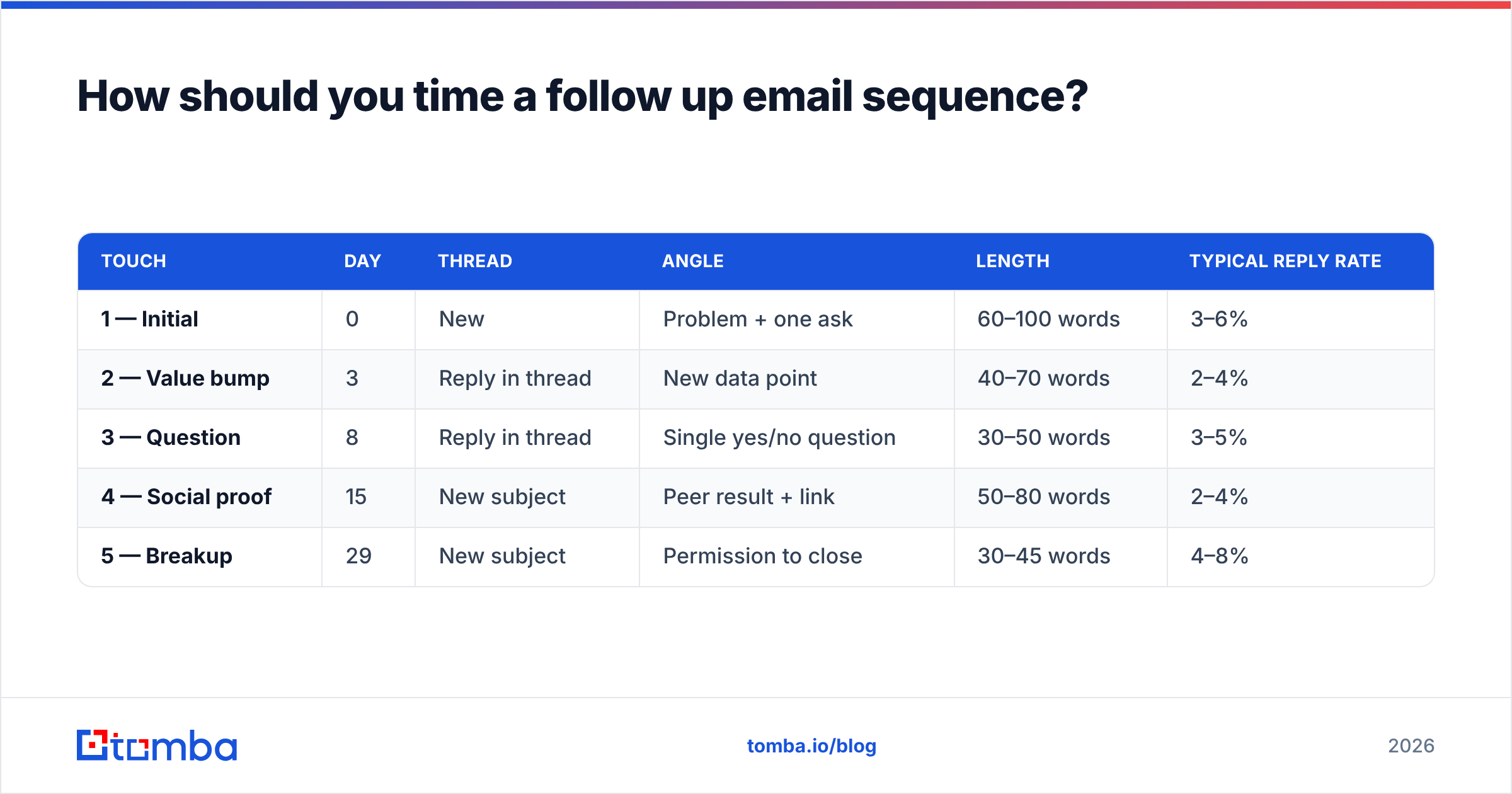
Here's the cadence table most teams converge on after a few hundred sequences, mapped to when each touch actually makes sense.
| Touch | Day | Thread | Angle | Length | Typical reply rate |
|---|---|---|---|---|---|
| 1 — Initial | 0 | New | Problem + one ask | 60–100 words | 3–6% |
| 2 — Value bump | 3 | Reply in thread | New data point | 40–70 words | 2–4% |
| 3 — Question | 8 | Reply in thread | Single yes/no question | 30–50 words | 3–5% |
| 4 — Social proof | 15 | New subject | Peer result + link | 50–80 words | 2–4% |
| 5 — Breakup | 29 | New subject | Permission to close | 30–45 words | 4–8% |
Two things to notice. First, the breakup often outperforms every touch except the initial send — do not skip it. Second, the cumulative reply rate across five touches lands far above what any single email produces, which is the whole argument for sequencing.
Some practical timing rules that survive contact with reality:
- Never follow up within 24 hours of the previous send. It reads as automation, because it usually is.
- Tuesday through Thursday, 7–10am local time for the recipient still tests best across most B2B datasets, though the edge is smaller than vendor blog posts claim.
- Stop the sequence on any reply, including out-of-office. Nothing kills goodwill faster than touch 4 arriving after someone told you they're on leave.
- Cap at five touches per quarter for a given contact, then re-enter them 90 days later with a genuinely new angle.
How do the main follow-up tools compare?#
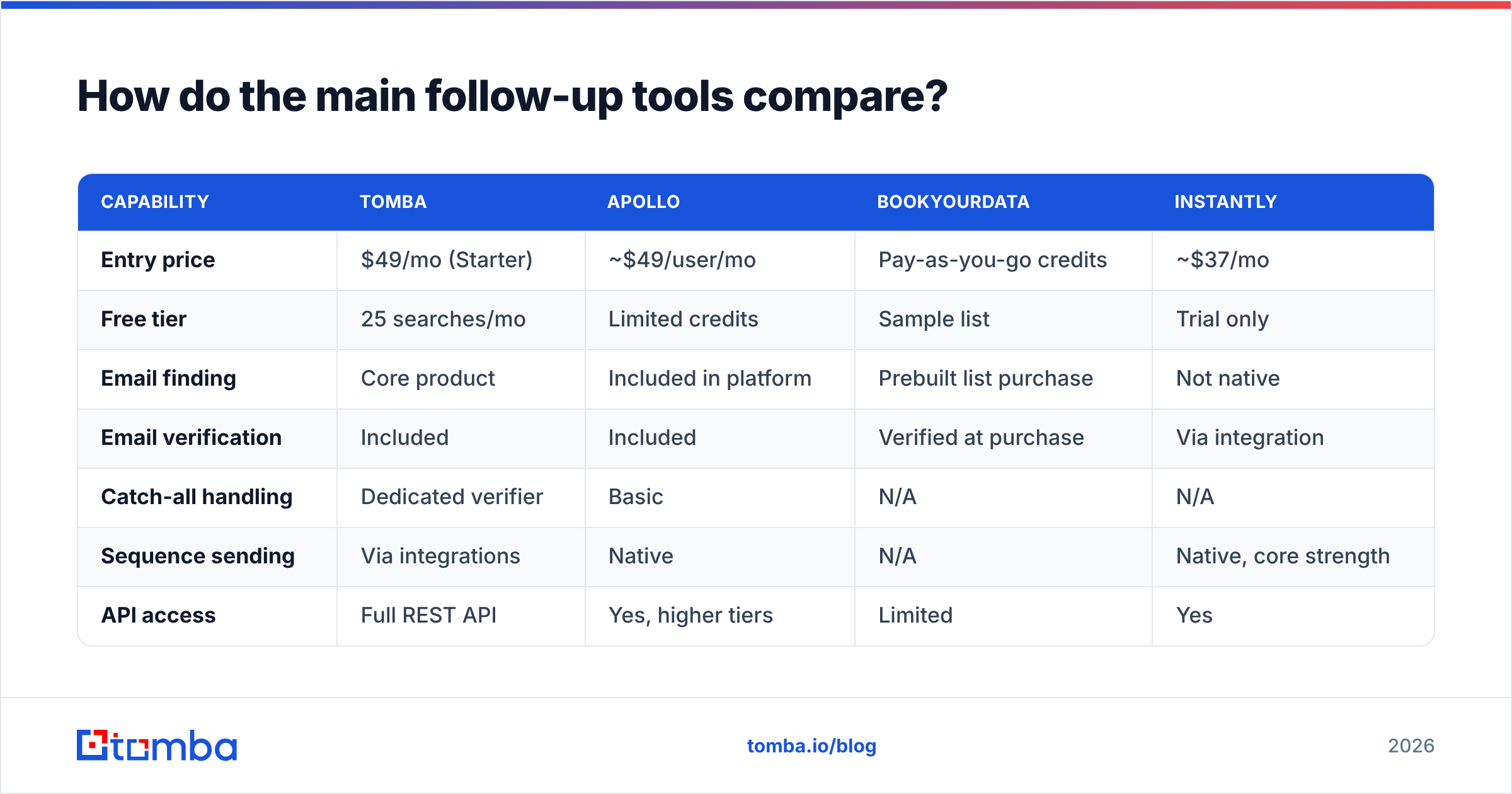
Your follow-up sequence has two dependencies: accurate contact data going in, and reliable sending coming out. Most teams end up with a data layer plus a sending layer rather than one tool doing both well.
| Capability | Tomba | Apollo | BookYourData | Instantly |
|---|---|---|---|---|
| Entry price | $49/mo (Starter) | ~$49/user/mo | Pay-as-you-go credits | ~$37/mo |
| Free tier | 25 searches/mo | Limited credits | Sample list | Trial only |
| Email finding | Core product | Included in platform | Prebuilt list purchase | Not native |
| Email verification | Included | Included | Verified at purchase | Via integration |
| Catch-all handling | Dedicated verifier | Basic | N/A | N/A |
| Sequence sending | Via integrations | Native | N/A | Native, core strength |
| API access | Full REST API | Yes, higher tiers | Limited | Yes |
| Best for | Accurate data + enrichment | All-in-one GTM stack | Instant verified lists | High-volume sending |
The honest read: Instantly is built for sending volume and warmup, Apollo bundles data and sequencing into one subscription, BookYourData is strong when you want a verified list delivered rather than built, and Tomba focuses on being the accurate data layer feeding whichever sender you already use. Cross-check any vendor's claims on G2 before committing — category averages move fast.
What kills follow-up sequences?#
Five failure modes account for most dead sequences.
- Bounces on touch 2 and 3. If your address was wrong on touch 1, every subsequent send hammers the same invalid mailbox and drags your sender reputation down with it. Verify first.
- "Just checking in." It's the phrase equivalent of an empty subject line. If you can't articulate why this email exists, don't send it.
- Escalating guilt. "I've reached out three times now" makes the recipient the villain. Nobody replies to feel bad.
- Wall-of-text touch 4. Follow-ups should shrink, not grow. If touch 4 is longer than touch 1, you've lost the plot.
- No exit ramp. Sequences without a breakup email just trail off, and the contact stays technically open in your CRM forever, poisoning your pipeline math.
One more, less discussed: sending follow-ups to catch-all domains without checking them. Catch-all servers accept everything, so a "delivered" status means nothing. Run those through a catch-all verifier before you commit four touches to an address that may not resolve to a human.
How do you personalize follow-ups at scale without sounding like a robot?#
Personalize the reason for the follow-up, not the greeting.
Merge-tag personalization ("Hi {{first_name}}, I saw {{company}} is doing great things") is transparently automated and everyone knows it. What isn't automated-feeling is a follow-up that references something time-bound: a funding round, a job posting, a product launch, a LinkedIn post from last Tuesday.
A workable system:
- Segment by trigger, not by industry. Build cadences for "hiring for this role," "just raised," "using competitor X" — each gets its own touch-2 angle.
- Write one variable line per touch. Everything else is fixed template. One genuinely specific sentence carries more weight than four half-personalized ones.
- Enrich before you write. Pulling title, seniority, and company size via data enrichment gives you the raw material for that variable line.
- Batch by trigger, send by person. Write ten variable lines in one sitting for ten prospects sharing a trigger. Ten minutes total, and none of them read as templated.
- Kill any template that drops below a 2% reply rate over 200 sends. Templates decay. Rotate quarterly.
Frequently asked questions#
How many follow-up emails is too many? Five touches over roughly 30 days is the ceiling for most B2B contexts. Beyond that you're generating spam complaints, not pipeline. Re-enter the contact after a 90-day cooldown with a new angle.
Should I follow up in the same thread or start a new one? Both. Threading touches 2 and 3 keeps context; breaking to a new subject for touches 4 and 5 resets attention when the thread has gone stale in their inbox.
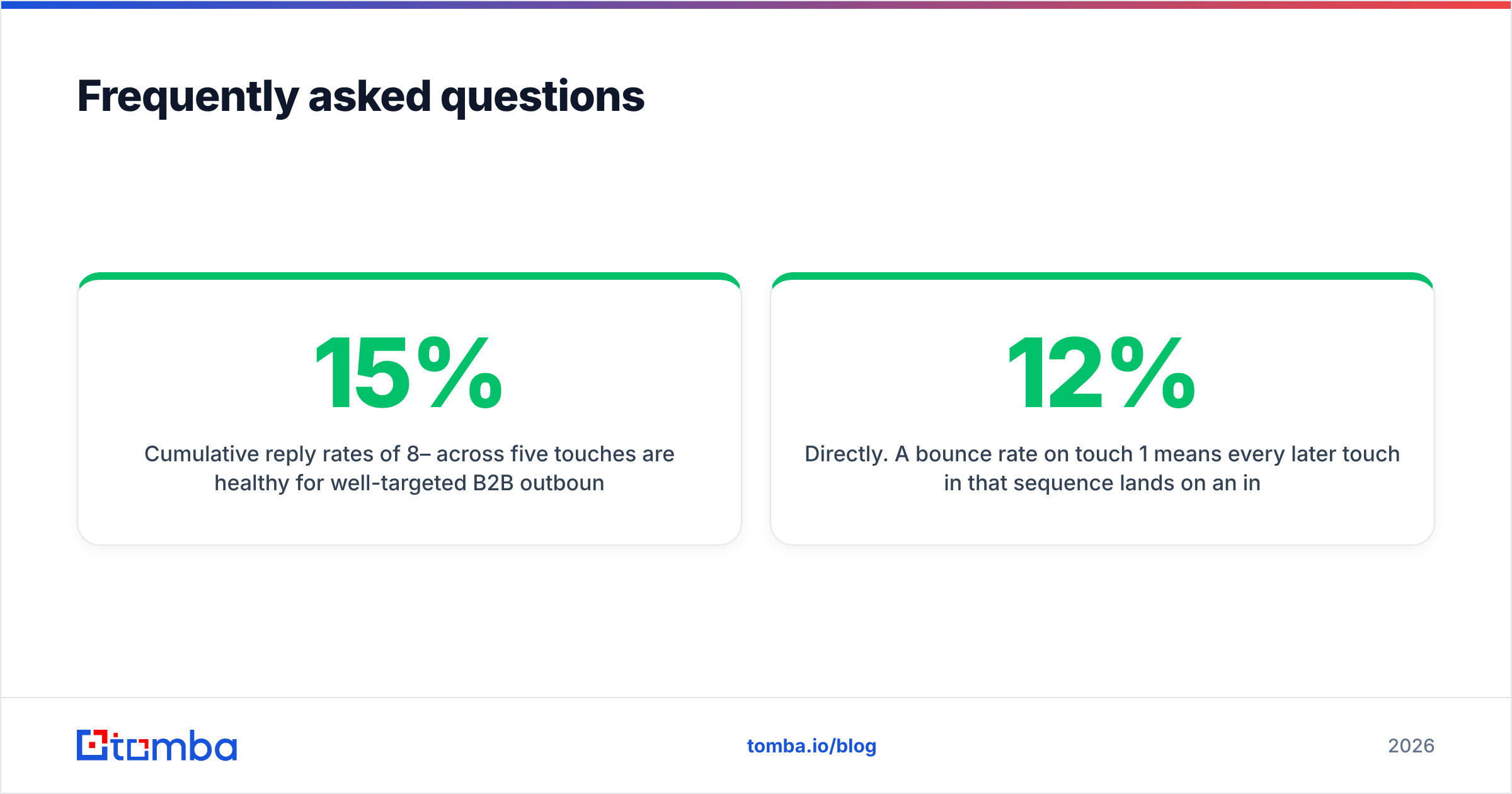
What's a good reply rate for a follow-up sequence? Cumulative reply rates of 8–15% across five touches are healthy for well-targeted B2B outbound. Under 5% cumulative usually means a targeting problem, not a copy problem.
Do breakup emails actually work? Consistently, yes. They often pull the second-highest reply rate in a sequence because they remove the obligation to buy and trigger a mild loss aversion. Just don't fake them — if you say you're stopping, stop.
Does verifying emails really change follow-up performance? Directly. A 12% bounce rate on touch 1 means every later touch in that sequence lands on an inbox provider that already flagged you. Cleaning the list before the sequence starts usually lifts deliverability on every subsequent touch.
Where should you start?#
Pick two examples from this post — the value-add bump and the breakup — and add them to your next sequence. Those two touches alone typically capture the majority of the reply lift from a full cadence.
Then fix the input. Every follow-up example here assumes the address is real and the person still works there. If that assumption breaks, the best copy in the world lands in a void. Start with Tomba Email Finder to build the list, verify it in the same workflow, and check Tomba pricing — the free tier gives you 25 searches a month to test the data quality against your current source before you commit to anything.
Related guides#
Ready to find emails that actually work?
Join 150,000+ professionals who stopped guessing and started sending. Free credits on signup — no credit card required.
Get the Tomba newsletter
Practical outbound tactics and product updates — once every two weeks.
About the author