Follow Up Email Examples After No Response: 12 Templates
Twelve copy-paste follow-up emails for prospects who went quiet, plus the cadence, subject lines, and data checks that decide whether your bump ever reaches an inbox.
TL;DR
- Most replies to cold outreach come from follow-ups, not the first email — plan four to six touches before you write anything.
- The best follow up email examples after no response add new information. "Just checking in" adds nothing and gets deleted in under two seconds.
- Space touches 2–3 days apart at first, then widen to 5–7 days. Sending daily reads as desperation and burns your domain.
- Silence is often a data problem, not a copy problem. If the address is invalid or catch-all, no template on earth will save it.
- Twelve ready-to-use templates below, grouped by scenario: post-cold-email, post-demo, post-proposal, post-event, and the graceful breakup.
Why do prospects ignore your first email?#
Assume nothing personal happened. The three most common reasons a first email dies are boring, and none of them are "your product is bad."
One: it never arrived. Bounces, spam-folder placement, and stale addresses eat a meaningful chunk of every list. If you scraped or bought contacts without running them through an email verifier, part of your "no response" bucket is really a "no delivery" bucket.
Two: it arrived at the wrong moment. Your prospect opened it in a meeting, thought "I'll come back to this," and didn't. This is the single largest category. It's also the easiest to fix — a bump three days later catches the same person in a different mental state.
Three: your ask was too big. "Do you have 30 minutes Thursday?" is a real commitment from someone who doesn't know you. A follow-up that shrinks the ask ("worth a 2-line reply?") converts people who ignored the calendar invite.
None of those require you to rewrite your value proposition. They require you to send again, differently.
Actually, here it is rendered properly:
How many follow up emails should you send after no response?#
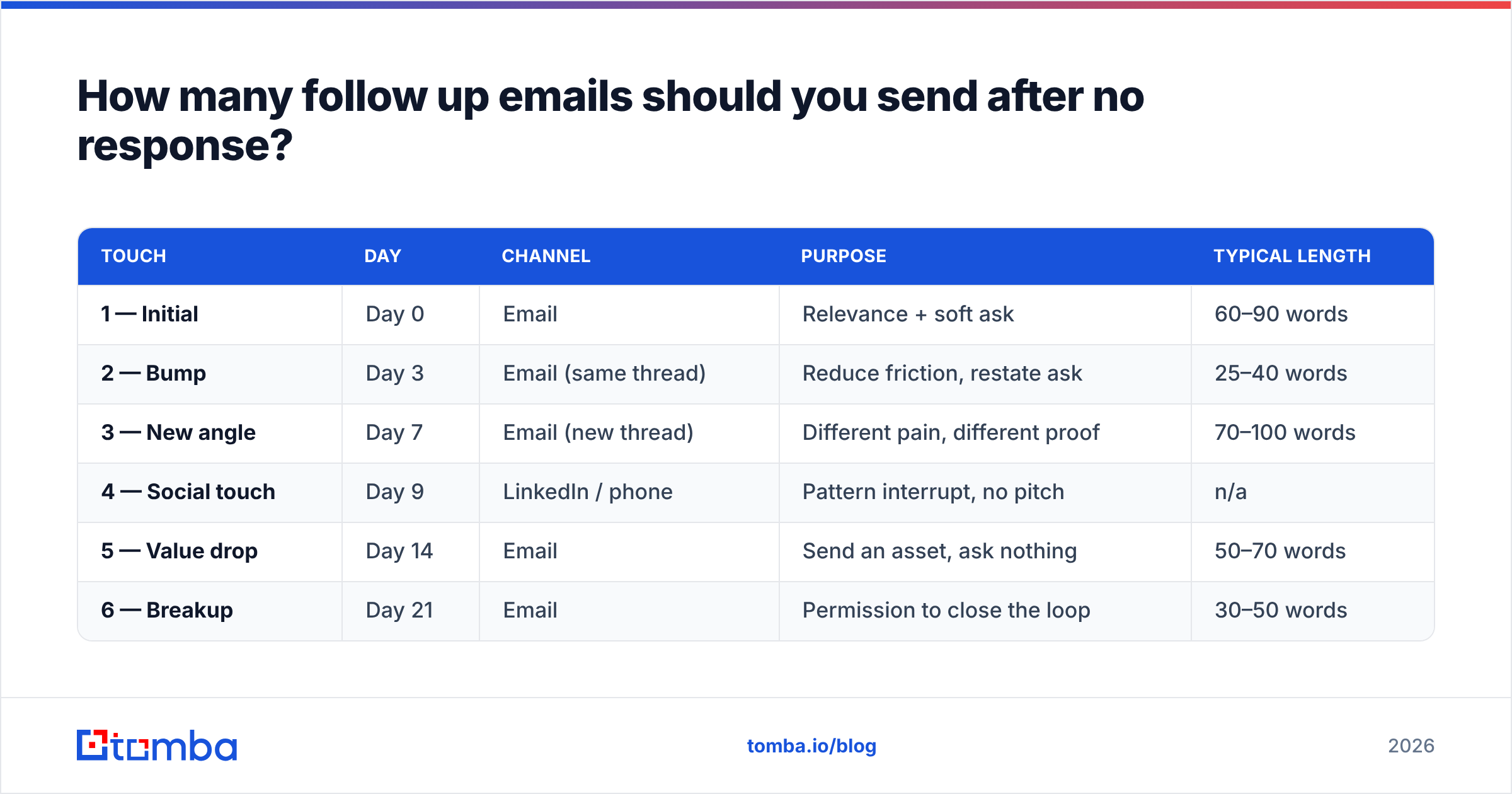
Four to six total touches, spread over roughly three weeks. Below that you leave replies on the table; above that you start generating spam complaints, which hurt your sender reputation for every future campaign.
Here's a cadence that works for mid-market B2B outbound without looking aggressive:
| Touch | Day | Channel | Purpose | Typical length |
|---|---|---|---|---|
| 1 — Initial | Day 0 | Relevance + soft ask | 60–90 words | |
| 2 — Bump | Day 3 | Email (same thread) | Reduce friction, restate ask | 25–40 words |
| 3 — New angle | Day 7 | Email (new thread) | Different pain, different proof | 70–100 words |
| 4 — Social touch | Day 9 | LinkedIn / phone | Pattern interrupt, no pitch | n/a |
| 5 — Value drop | Day 14 | Send an asset, ask nothing | 50–70 words | |
| 6 — Breakup | Day 21 | Permission to close the loop | 30–50 words |
Two rules govern that table. First, at least two of the six touches must contain something the prospect did not already receive — a benchmark, a customer story, a teardown of their pricing page. Second, the gaps widen as you go. Days 0, 3, 7, 9, 14, 21 is a decelerating curve, which reads as persistence. Days 0, 1, 2, 3, 4, 5 reads as a bot.
What separates a follow-up that gets replies from one that gets deleted?#
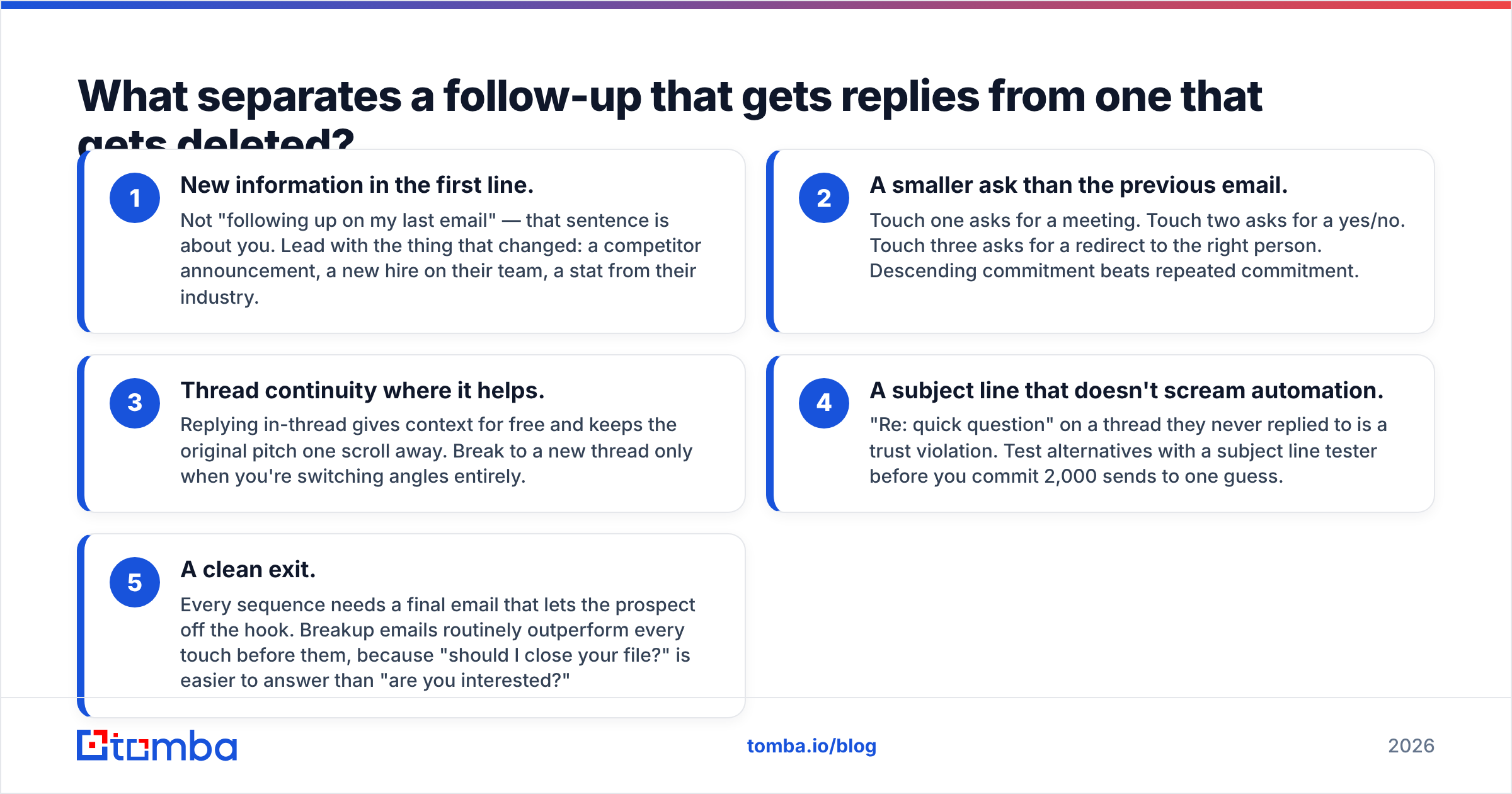
Five things, in rough order of impact:
- New information in the first line. Not "following up on my last email" — that sentence is about you. Lead with the thing that changed: a competitor announcement, a new hire on their team, a stat from their industry.
- A smaller ask than the previous email. Touch one asks for a meeting. Touch two asks for a yes/no. Touch three asks for a redirect to the right person. Descending commitment beats repeated commitment.
- Thread continuity where it helps. Replying in-thread gives context for free and keeps the original pitch one scroll away. Break to a new thread only when you're switching angles entirely.
- A subject line that doesn't scream automation. "Re: quick question" on a thread they never replied to is a trust violation. Test alternatives with a subject line tester before you commit 2,000 sends to one guess.
- A clean exit. Every sequence needs a final email that lets the prospect off the hook. Breakup emails routinely outperform every touch before them, because "should I close your file?" is easier to answer than "are you interested?"
What are the best follow up email examples after no response?#
Twelve templates, grouped by what happened before the silence. Swap the bracketed variables and delete anything that doesn't sound like you.
After a cold email with no reply#
1. The 24-word bump (Day 3)
Subject: Re: [their company] + [your company]
Hi [First name] — bumping this in case it slipped past.
Worth a 2-minute look, or is [problem] not a priority this quarter?
[Your name]
Why it works: binary question, zero pressure, and "not a priority this quarter" gives them a legitimate, face-saving no.
2. The new-angle restart (Day 7)
Subject: [Competitor] just moved to [thing]
Hi [First name] — noticed [competitor] rolled out [change] last week.
We helped [similar company] handle the same shift and cut [metric] by [number]% in [timeframe]. Happy to send the one-page breakdown — no call needed.
Want it?
Why it works: the ask is "want a PDF," not "give me 30 minutes." Low friction, and the reply opens a thread you can escalate.
3. The wrong-person redirect (Day 9)
Subject: Should this go to someone else?
Hi [First name] — I may have aimed this at the wrong desk.
If [problem area] sits with someone else on your team, point me at them and I'll stop cluttering your inbox.
Why it works: it's easier to forward an email than to evaluate one. Redirects are a win — you get a warm intro and an accurate org map.
4. The proof drop (Day 14)
Subject: [Number] benchmark for [their industry]
Hi [First name] — we pulled [metric] data from [number] [industry] teams this quarter. Median was [number]; top quartile hit [number].
Link's here: [URL]. No form, no follow-up sequence attached to it.
Thought it might be useful either way.
Why it works: "no follow-up sequence attached" is a small honesty signal that buys disproportionate goodwill.
After a demo or discovery call with no reply#
5. The recap-with-a-deadline
Subject: [Their project name] — next step?
Hi [First name] — following our call on [date], you flagged [pain] and [pain] as the two blockers.
Our [quarter] onboarding slots close [date]. If [project] is still targeting a [month] launch, we'd need to kick off by [date].
Still on track, or has the timeline shifted?
6. The internal-blocker probe
Subject: Anything stuck on your side?
Hi [First name] — no pressure at all, but I've seen this pattern before: the champion likes it, then it stalls on [procurement / security review / budget].
If that's where this is, tell me which one and I'll send exactly what your reviewer needs.
7. The three-option close
Subject: Where should I file this?
Hi [First name] — pick a number and I'll act accordingly:
- Still interested, just buried — I'll follow up in [month].
- Interested, need [X] first.
- Not moving forward — I'll close the file.
After a proposal or quote with no reply#
8. The scope-flex
Subject: Smaller version of the [proposal]?
Hi [First name] — if the [dollar amount] number is the sticking point, there's a smaller starting scope: [reduced scope] at [lower amount], with the rest phased in [timeframe].
Want me to send that version?
9. The risk-reversal
Subject: De-risking the [project] decision
Hi [First name] — silence usually means "the downside of being wrong is bigger than the upside of being right."
If that's the case here: we can run [pilot scope] for [timeframe] with [exit condition]. If it doesn't hit [metric], you walk.
10. The competitive-context nudge
Subject: One thing before you decide
Hi [First name] — if you're comparing us to [alternative], the honest difference is [specific, true differentiator]. They're better at [thing they're genuinely better at].
Worth 10 minutes to pressure-test which side of that line you're on?
Volunteering a competitor's genuine strength is the fastest credibility shortcut in B2B sales. It also survives the reference call.
After an event, webinar, or content download#
11. The specific-moment recall
Subject: Your question about [topic] at [event]
Hi [First name] — you asked about [specific question] during [session]. I gave a partial answer; here's the full one: [2 sentences].
Does that match what you're seeing at [their company]?
The breakup#
12. The permission-to-close
Subject: Closing your file
Hi [First name] — I've sent a few notes about [problem] and haven't heard back, which is a perfectly good answer.
I'll stop here. If [problem] moves up the list in [quarter], my line's open.
Either way, good luck with [specific thing they're working on].
No guilt, no "I'm assuming you're not interested" passive aggression. Roughly a quarter of the replies to a well-run sequence land on this email.
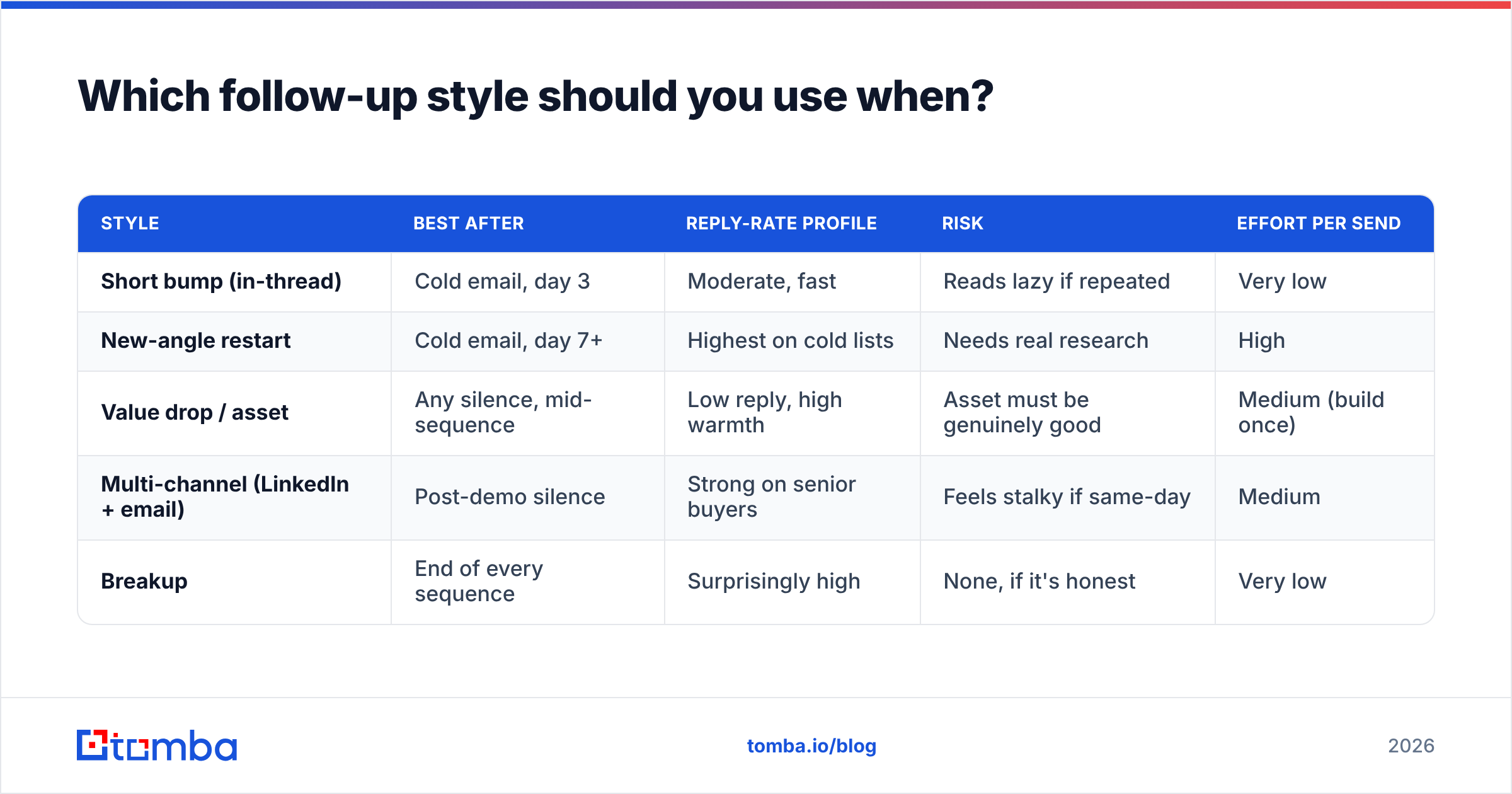
Which follow-up style should you use when?#
Different silences call for different bumps. This is the shortest way to decide:
| Style | Best after | Reply-rate profile | Risk | Effort per send |
|---|---|---|---|---|
| Short bump (in-thread) | Cold email, day 3 | Moderate, fast | Reads lazy if repeated | Very low |
| New-angle restart | Cold email, day 7+ | Highest on cold lists | Needs real research | High |
| Value drop / asset | Any silence, mid-sequence | Low reply, high warmth | Asset must be genuinely good | Medium (build once) |
| Multi-channel (LinkedIn + email) | Post-demo silence | Strong on senior buyers | Feels stalky if same-day | Medium |
| Breakup | End of every sequence | Surprisingly high | None, if it's honest | Very low |
If you only implement two rows from that table, make them the new-angle restart and the breakup. They sit at opposite ends of the sequence and they carry most of the reply volume between them.
Is your silence a copy problem or a data problem?#
Before you rewrite the templates for the fourth time, check whether your emails are being read at all.
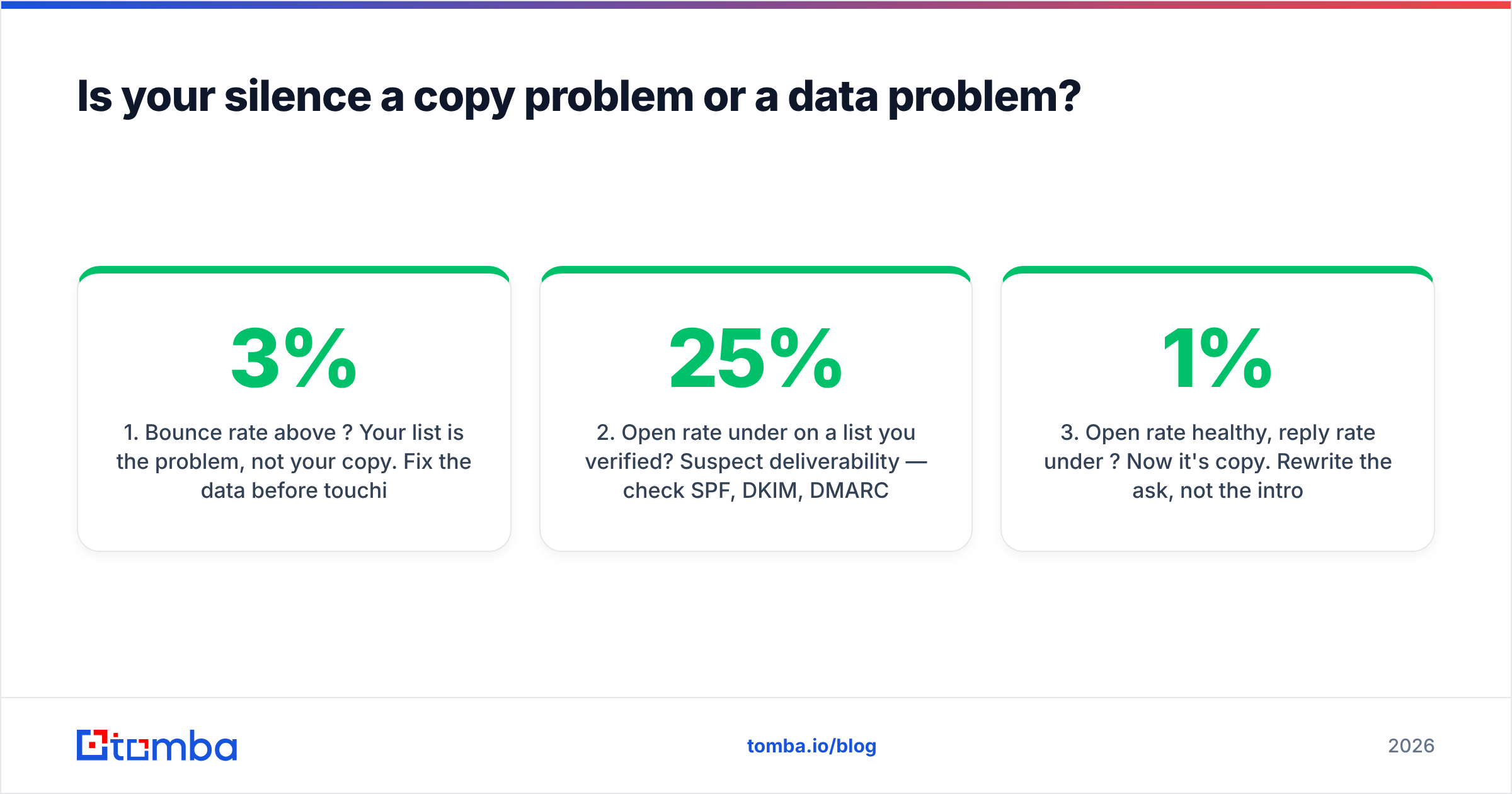
Run this diagnostic in order:
- Bounce rate above 3%? Your list is the problem, not your copy. Fix the data before touching the sequence.
- Open rate under 25% on a list you verified? Suspect deliverability — check SPF, DKIM, DMARC, and whether your domain is on a blocklist.
- Open rate healthy, reply rate under 1%? Now it's copy. Rewrite the ask, not the intro.
- Replies coming, but all "not now"? Targeting problem. Your message works; you're aiming it at people without the pain.
Most teams skip straight to step three and burn weeks rewriting emails that never reached a human. Catch-all domains make this worse — they accept everything at the SMTP layer and silently drop unknown mailboxes, so your bounce rate looks clean while your replies stay at zero. A dedicated catch-all verifier is the only way to separate the real mailboxes from the black holes.
For a broader view of how outbound teams instrument this, G2's sales engagement category is a reasonable place to compare tooling, and HubSpot's sales blog publishes regular benchmark data on cadence length and reply rates. If you're sending at volume in the US, read the CAN-SPAM Act requirements once — the unsubscribe and identification rules apply to cold B2B email too.
What mistakes kill follow-up reply rates?#
- "Just checking in" / "circling back" / "touching base." Three phrases that signal you have nothing new to say. Cut them permanently.
- Guilt-tripping. "I've reached out three times now" makes the prospect the villain. They owe you nothing.
- Fake urgency. "Last chance" on touch two, followed by touch three, destroys every claim you make afterwards.
- Identical asks every time. If touches 1 through 5 all say "30 minutes?", you've sent one email five times.
- Ignoring the signal in the silence. Someone who opened your email nine times and never replied needs a different message than someone who never opened it once.
- No exit. Sequences that just stop leave the relationship in limbo. End every one.
Track your response rate per touch, not just per campaign. The touch-level view tells you which template to kill; the campaign-level view tells you nothing actionable.
How do you scale this without sounding like a robot?#
Personalize the first line and the ask; template everything between. That's the whole trick. A 90-word email with one genuinely researched sentence outperforms a 200-word email with five merge tags.
Practically:
- Build a research snippet library — one line per account, written once, reused across all six touches.
- Keep a tested cold email template set as your base, and version them so you know which variant produced which reply rate.
- Verify addresses before the sequence starts, not after the bounces come in. Re-verify anything older than 90 days; B2B contact data decays fast as people change jobs.
- Cap daily volume per sending mailbox. More mailboxes beats more sends per mailbox.
Ready to stop following up with addresses that never existed?#
The best follow-up sequence in the world fails against a bad address. Start with contacts you can trust: Tomba Email Finder locates verified professional emails by name, company, or domain, with confidence scores and source citations on every result — so you know whether silence means "not interested" or "never delivered." The free tier covers 25 searches per month, and paid plans start at $49/mo on Tomba pricing if you're running outbound at real volume.
Verify first. Then follow up like you mean it.
Related guides#
Ready to find emails that actually work?
Join 150,000+ professionals who stopped guessing and started sending. Free credits on signup — no credit card required.
Get the Tomba newsletter
Practical outbound tactics and product updates — once every two weeks.
About the author