Follow Up Email for Contract Signing: Templates That Close
The contract is sent, the deal is verbally won, and then nothing. Here are the exact follow-up email sequences, timing windows, and escalation paths that get unsigned contracts back — without sounding desperate.
TL;DR
- Most contracts don't stall because the buyer changed their mind — they stall because the document landed in a queue nobody owns. Your follow-up's job is to find that owner.
- Send follow-up #1 at 48 hours, not day 7. The signature-rate curve drops hard after the first week.
- Every follow-up email for contract signing should contain exactly one ask, one deadline anchor, and one removal of friction. Three "just checking in" notes will not do the work of one specific question.
- Multithread by follow-up #3. If you only have the champion's email, you have one point of failure — pull in legal, procurement, and the economic buyer.
- Cap the sequence at 5–6 touches over 21 days, then move to a formal close-out email. Ambiguity costs more than a clean "no."
Why do signed-and-agreed contracts still go silent?#
Because "yes" from your champion is not "yes" from the company.
Think of it like handing someone a package at the front desk of a large office building. The person accepted it happily. But the package now has to travel through mailrooms, approval desks, and a legal review queue you can't see. Your contact isn't ignoring you — they genuinely don't know where the package is either.
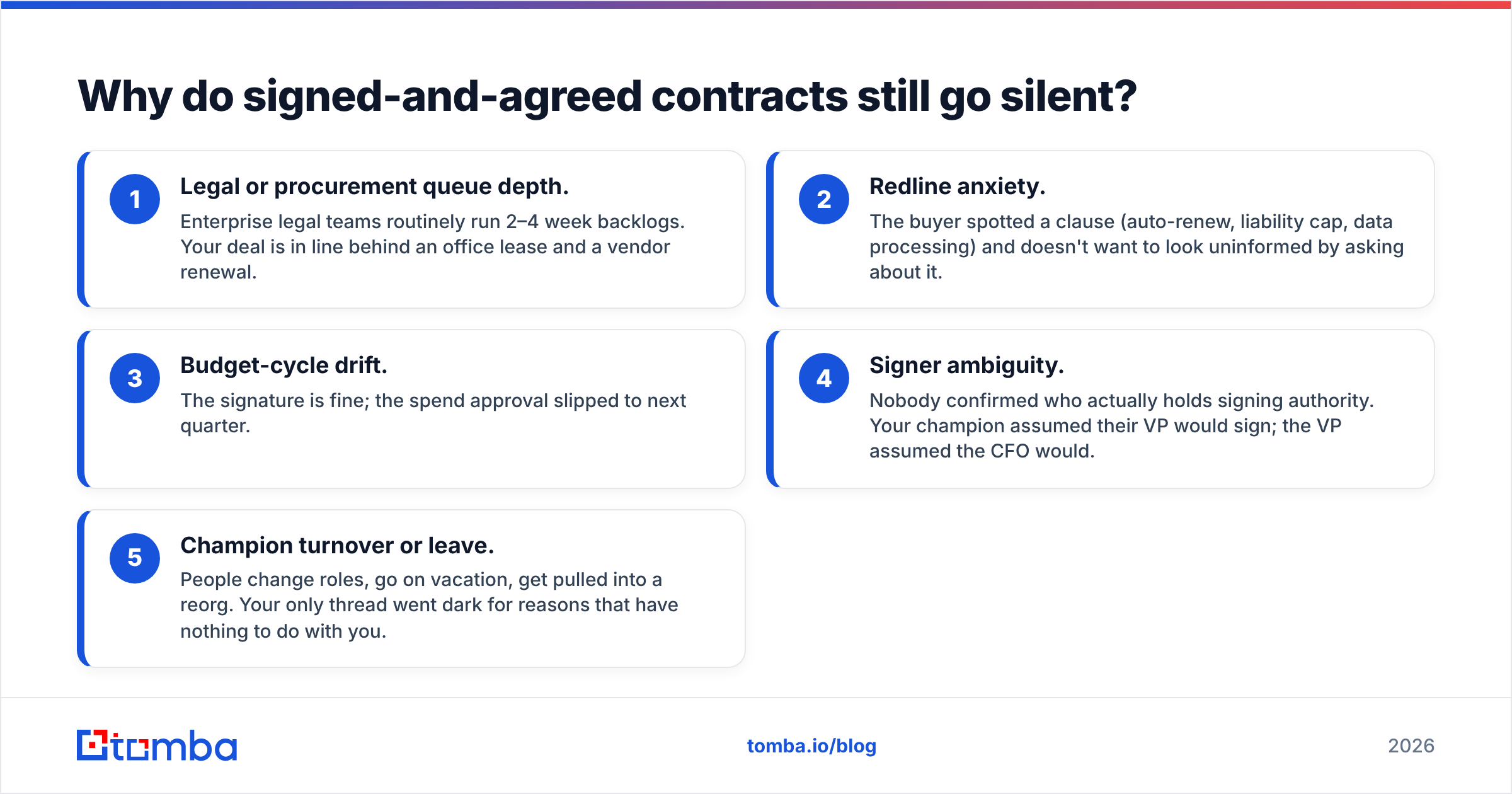
In practice, unsigned contracts stall for five recurring reasons:
- Legal or procurement queue depth. Enterprise legal teams routinely run 2–4 week backlogs. Your deal is in line behind an office lease and a vendor renewal.
- Redline anxiety. The buyer spotted a clause (auto-renew, liability cap, data processing) and doesn't want to look uninformed by asking about it.
- Budget-cycle drift. The signature is fine; the spend approval slipped to next quarter.
- Signer ambiguity. Nobody confirmed who actually holds signing authority. Your champion assumed their VP would sign; the VP assumed the CFO would.
- Champion turnover or leave. People change roles, go on vacation, get pulled into a reorg. Your only thread went dark for reasons that have nothing to do with you.
Notice that only one of those five is about the deal itself. This matters enormously for how you write. A follow-up that says "have you had a chance to review?" addresses reason #2 at best and none of the others. A follow-up that says "should I send a clean copy directly to your legal team, or does procurement need to log it first?" addresses reasons #1, #4, and #5 at once.
Sorry — corrected placement below.
What makes a follow up email for contract signing actually work?#
Four components, in this order. Anything else is padding.
- A concrete reference point. Not "our recent conversation" — "the MSA I sent Tuesday the 4th, covering the 40-seat Growth plan at the rate we agreed on our call."
- One single ask. "Can you confirm who signs on your side?" is one ask. "Can you review, confirm the signer, and let me know about the start date?" is three, which means the reply gets postponed until they have time for all three. They never do.
- A friction removal. Offer to do the annoying part yourself: resend a clean PDF, jump on a 10-minute call with legal, pre-fill the vendor onboarding form, or redline the clause you suspect is the blocker.
- A soft time anchor. Not a fake scarcity deadline. Something real: an implementation slot, a pricing validity window, a quarter-end onboarding cohort, a security-review lead time.
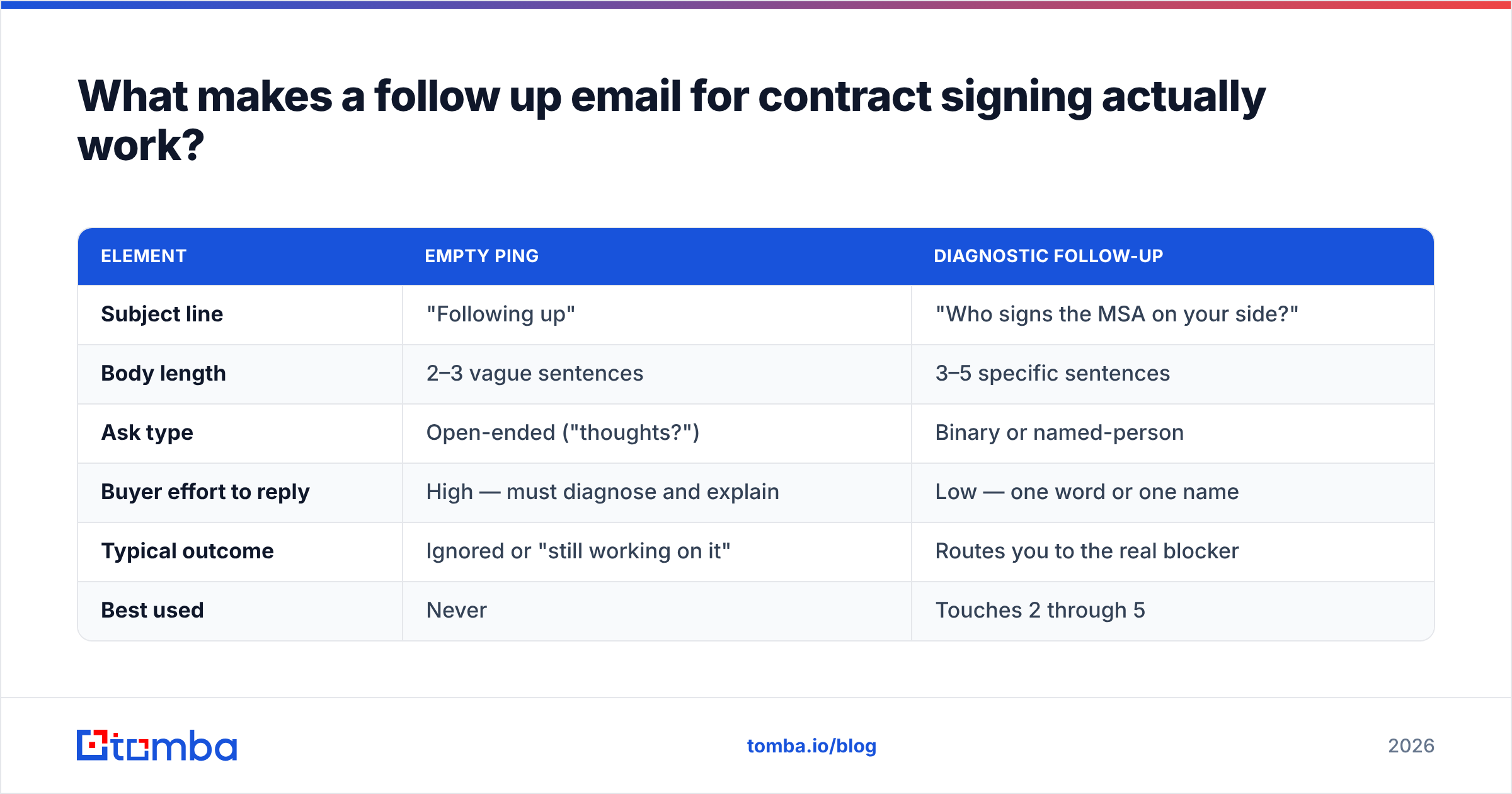
The failure mode almost every rep falls into is what you might call the empty ping — "just following up," "bumping this," "circling back." These emails ask the buyer to do the diagnostic work of figuring out why they haven't signed and then explain it to you. That's work, and work gets deferred.
Compare the two shapes:
| Element | Empty ping | Diagnostic follow-up |
|---|---|---|
| Subject line | "Following up" | "Who signs the MSA on your side?" |
| Body length | 2–3 vague sentences | 3–5 specific sentences |
| Ask type | Open-ended ("thoughts?") | Binary or named-person |
| Buyer effort to reply | High — must diagnose and explain | Low — one word or one name |
| Typical outcome | Ignored or "still working on it" | Routes you to the real blocker |
| Best used | Never | Touches 2 through 5 |
The second column works because it converts an open question into a closed one. Closed questions get answered from a phone, in a hallway, between meetings. Open questions get starred and forgotten.
What is the right follow-up cadence and timing?#
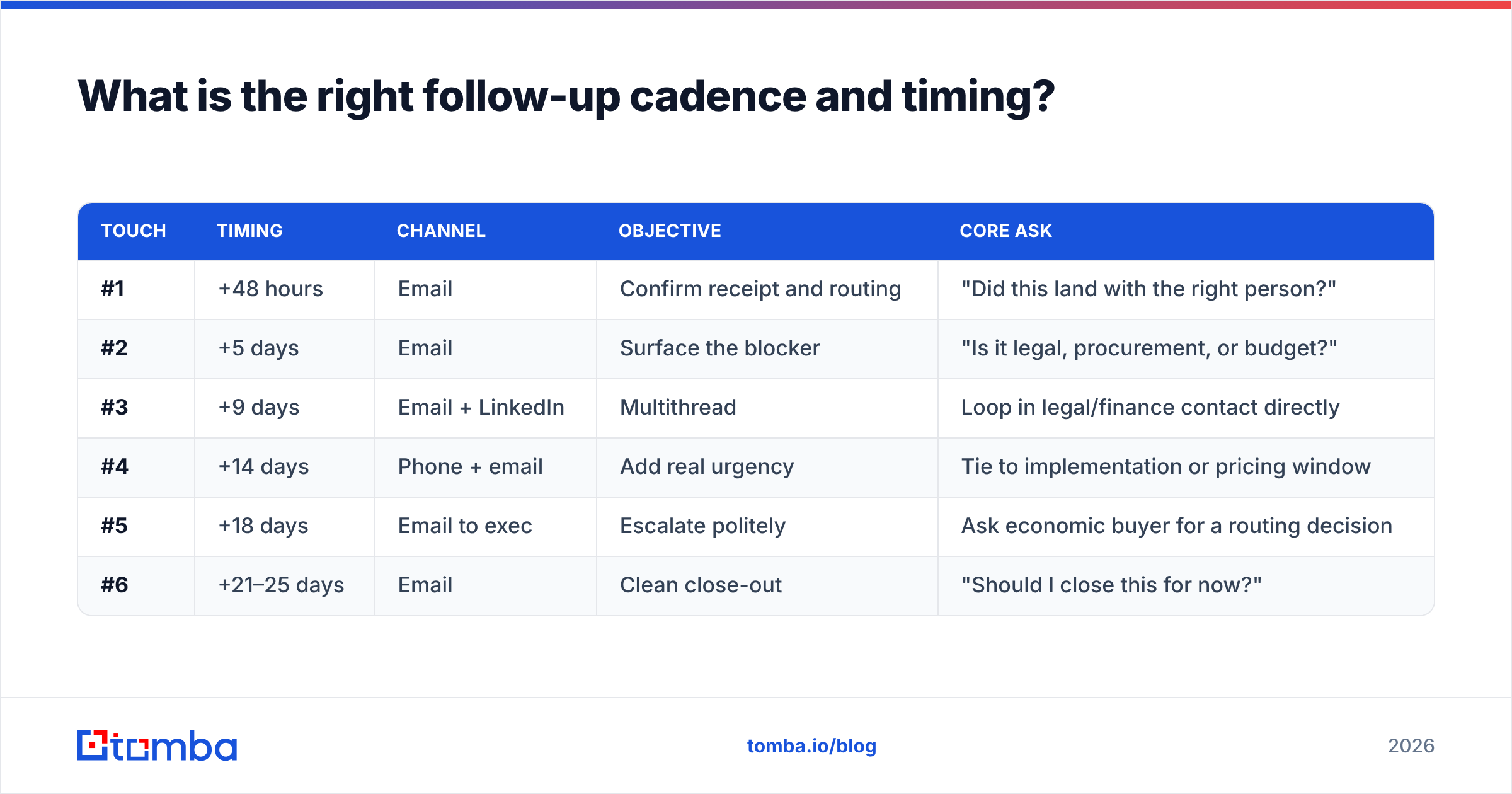
Front-load it. The probability of getting a contract signed decays fast, and the biggest drop happens in the first ten days — while the deal is still emotionally warm and the champion still remembers why they wanted it.
Here's a cadence that holds up across mid-market and enterprise cycles:
| Touch | Timing | Channel | Objective | Core ask |
|---|---|---|---|---|
| #1 | +48 hours | Confirm receipt and routing | "Did this land with the right person?" | |
| #2 | +5 days | Surface the blocker | "Is it legal, procurement, or budget?" | |
| #3 | +9 days | Email + LinkedIn | Multithread | Loop in legal/finance contact directly |
| #4 | +14 days | Phone + email | Add real urgency | Tie to implementation or pricing window |
| #5 | +18 days | Email to exec | Escalate politely | Ask economic buyer for a routing decision |
| #6 | +21–25 days | Clean close-out | "Should I close this for now?" |
Two rules govern this table.
Rule one: never send two consecutive emails in the same channel with the same ask. If email #2 asked about legal and got no reply, email #3 must change something — the recipient, the channel, or the question. Repeating yourself trains the buyer that ignoring you is free.
Rule two: escalation requires a reason the buyer can respect. Going over your champion's head to their VP without warning burns the relationship. Going to the VP after telling your champion "if I don't hear back by Thursday I'll check with Dana on routing, just so this doesn't stall" is collaborative. Tell them first. Every time.
If you're working accounts where you only have one contact, this cadence exposes the weakness immediately. That's the point. Before you send a contract at all, you should have direct contact details for the champion, the likely signer, and someone in finance or legal. Tools like a domain search or a phone finder exist precisely for this — building the second and third thread before you need them, not after the deal goes quiet.
Which follow-up templates should you actually send?#
Seven templates, mapped to the cadence above. Adapt the specifics; keep the structure.
1. The 48-hour receipt check
Subject: MSA sent Tuesday — did it reach the right desk?
Hi Priya,
Sent the MSA over Tuesday for the 40-seat Growth plan. Before it gets buried: does this go to your legal team directly, or does procurement log it first?
Happy to send a clean copy to whoever owns it so you're not the middle-man on this.
— Marcus
2. The blocker diagnostic
Subject: Legal, procurement, or timing?
Hi Priya,
No pressure on the MSA — I just want to make sure I'm helping with the right thing. Is the holdup legal review, procurement, or budget timing?
If it's legal, I can get our counsel on a 15-minute call this week. If it's procurement, send me the vendor form and I'll fill it out. If it's timing, tell me the month and I'll stop pestering you.
— Marcus
3. The redline pre-empt
Subject: The auto-renewal clause — happy to change it
Hi Priya,
Nine times out of ten when an MSA sits, it's section 8 (auto-renewal) or section 12 (liability cap). If either is the issue, say the word — we've adjusted both before and it's a same-day turnaround.
If it's neither, ignore this and I'll assume we're just in the queue.
— Marcus
4. The multithread introduction
Subject: Intro — contract routing for the Q3 rollout
Hi Dana,
Priya and I finalized terms for the 40-seat Growth plan two weeks ago and the MSA is with your team. Copying you in case it's easier to handle routing directly rather than through Priya.
Anything you need from our side — W-9, security questionnaire, SOC 2 report — I can have over within the hour.
— Marcus
5. The real-deadline anchor
Subject: Implementation slot — Sept 8 or Oct 6
Hi Priya,
Our onboarding team runs cohorts every four weeks. The Sept 8 slot needs a signature by the 1st; after that the next one is Oct 6.
Not trying to rush you — just want you to have the calendar reality so you can decide which one to aim for.
— Marcus
6. The executive escalation
Subject: Quick routing question on the Growth agreement
Hi Tom,
Priya and I agreed terms in July and the MSA has been in review since. She's been great; I think it's just queue depth on your side.
One question only: is this still a priority for this quarter? If yes, I'll keep helping push it through. If it's slipped, I'd rather know so I can plan around it.
— Marcus
7. The clean close-out
Subject: Closing this out?
Hi Priya,
I've sent a few notes on the MSA and haven't wanted to keep filling your inbox. I'm going to assume the timing isn't right and close this out on my side.
If that's wrong, one reply gets us back on track. If it's right, no hard feelings — I'll check back in January.
— Marcus
That last one works disproportionately well. Something about a graceful exit prompts replies that four "checking in" emails never did. HubSpot's sales research has documented this pattern repeatedly across follow-up sequences: the breakup email reliably outperforms the fourth reminder.

How do you multithread before the contract stalls?#
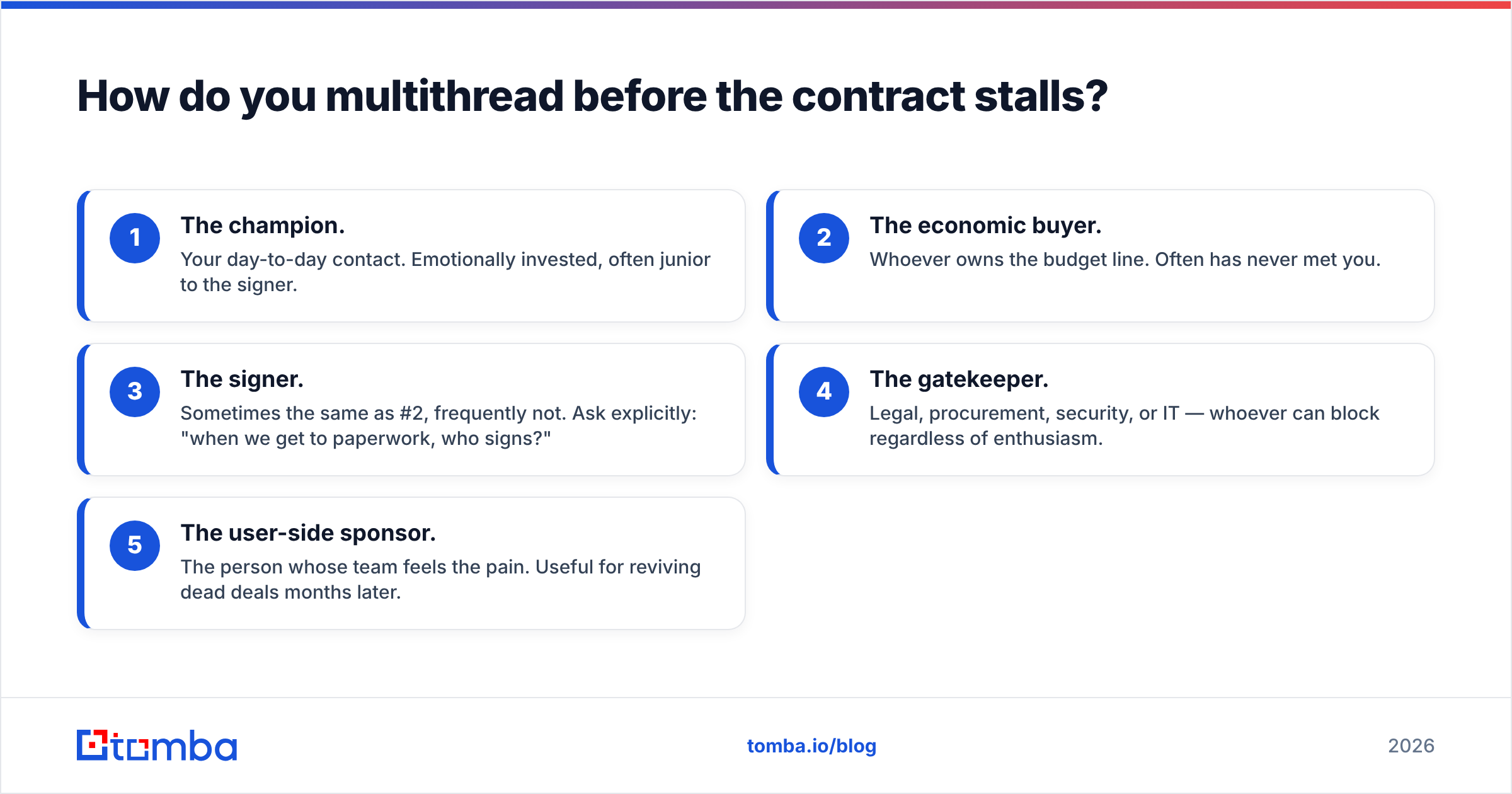
The best follow-up sequence is the one you never have to send, because you built three threads into the deal before the paperwork went out.
Practically, that means at proposal stage — not signature stage — you should have:
- The champion. Your day-to-day contact. Emotionally invested, often junior to the signer.
- The economic buyer. Whoever owns the budget line. Often has never met you.
- The signer. Sometimes the same as #2, frequently not. Ask explicitly: "when we get to paperwork, who signs?"
- The gatekeeper. Legal, procurement, security, or IT — whoever can block regardless of enthusiasm.
- The user-side sponsor. The person whose team feels the pain. Useful for reviving dead deals months later.
Getting contact details for people you haven't been introduced to is where most reps stop. It shouldn't be. If you know the company domain and a name from LinkedIn, a LinkedIn finder or email finder will give you a verifiable work address in seconds. Run it through an email verifier first — bouncing an escalation email to a CFO is a worse outcome than not sending it, because bounces damage your sender reputation right when you need deliverability most.
A note on tone when you multithread: you are not going around your champion, you are reducing their workload. Frame it that way, out loud, in writing. "Priya, I don't want you playing switchboard between me and legal — mind if I email Dana directly and copy you?" Almost nobody says no to that.
What should you never do in a contract follow-up?#
A short list, all of which reliably lose deals that were otherwise won:
- Fake urgency. "This pricing expires Friday" is transparent when it's the third Friday you've said it. Once a buyer catches one manufactured deadline, every real one you cite afterwards is discounted.
- Guilt. "I've reached out three times now" makes their silence the subject. Nobody signs a contract to relieve your frustration.
- The forwarded thread with nothing added. Sending "any update?" on top of a 6-message chain is the laziest possible touch and reads exactly that way.
- Ambiguous asks disguised as questions. "Let me know your thoughts" is not a question. It's a hope.
- Silent escalation. Emailing the VP without telling your champion first will get the contract signed roughly never, and will cost you the internal advocate you spent months building.
- Over-sending. Six touches in 21 days is assertive. Fifteen touches in 21 days is a deliverability problem and a reputation problem. If your emails start landing in spam, none of your templates matter — check your email deliverability fundamentals before blaming the copy.
One more: don't renegotiate on your own. A stalled contract tempts reps to offer a discount unprompted, hoping price is the blocker. It usually isn't — and you just taught the buyer that waiting silently earns money. Diagnose first. Concede only against a stated objection.
How do you know when to stop?#
When you've asked a direct routing question twice, escalated once with your champion's knowledge, and sent a close-out email — you're done. Anything past that is noise that costs you inbox reputation and costs them goodwill.
Set the deal to a dated re-engagement rather than leaving it open in your pipeline. Ninety days is a reasonable default; align it to their budget cycle if you know it. Log the actual reason it stalled, not "no response" — "legal queue, 6-week backlog" and "budget slipped to FY27" call for completely different re-entry emails.
And use the pause productively. A stalled deal with a full contact map is a warm account, not a dead one. Enrich the record while it's cold: refresh titles, catch the champion's job change, add the two people who joined the buying committee since. Contact enrichment turns a stale CRM row into a live re-entry point, and job-change alerts on a former champion are among the highest-converting outbound triggers in B2B. Independent review data on G2 consistently ranks data freshness above raw database size for exactly this reason.
Ready to build the threads that keep contracts moving?#
Contract stalls are almost always a routing problem, and routing problems are contact-data problems. If your only line into an account is one champion's inbox, every delay is invisible and every escalation is a guess.
Start by mapping the full buying committee before you send paperwork. Tomba Email Finder gives you verified work emails for the signer, the legal contact, and the economic buyer from nothing more than a company domain and a name — with a free tier of 25 searches a month to test it against accounts you already know, and paid plans from $49/mo when you're ready to run it across the pipeline. Full Tomba pricing is public, no sales call required.
Build the second thread before you need it. The follow-up email you never have to send is the one that closes fastest.
Related guides#
Ready to find emails that actually work?
Join 150,000+ professionals who stopped guessing and started sending. Free credits on signup — no credit card required.
Get the Tomba newsletter
Practical outbound tactics and product updates — once every two weeks.
About the author