Follow Up Email On Request: Templates That Get Replies
Someone asked you for pricing, a demo, or a deck — then went quiet. Here is the exact follow-up email cadence, timing, and template set that turns requested-but-stalled conversations into replies.
TL;DR
- A follow up email on request is not a cold email. The prospect asked for something — pricing, a deck, an intro, a demo slot — so your job is to reduce friction, not re-sell the meeting.
- Send the requested item within 4 business hours. After that, reply rates drop sharply and the request goes cold in the prospect's memory.
- Use a 4-touch cadence over 12 days: deliver, nudge with new value, escalate to a decision question, then close the loop with a permission-to-close email.
- Never write "just following up" or "bumping this to the top of your inbox." Every touch must carry a new reason to reply — a document, a number, a question, or a deadline.
- Bad email data kills more follow-ups than bad copy. If your reply rate on requested follow-ups is under 20%, verify the address before you rewrite the subject line.
What Is a Follow Up Email on Request?#
A follow up email on request is the message you send after someone explicitly asked you for something — and then stopped responding. The trigger is theirs, not yours. That single fact changes the entire structure of the email.
Think of it like a restaurant order. A cold email is you walking up to a stranger's table and offering them a dish. A follow up email on request is you walking back to a table that already ordered — the customer wanted this, they just got distracted by a phone call. You don't re-pitch the menu. You put the plate down and ask if they need anything else.
That distinction matters because the two email types have opposite failure modes:
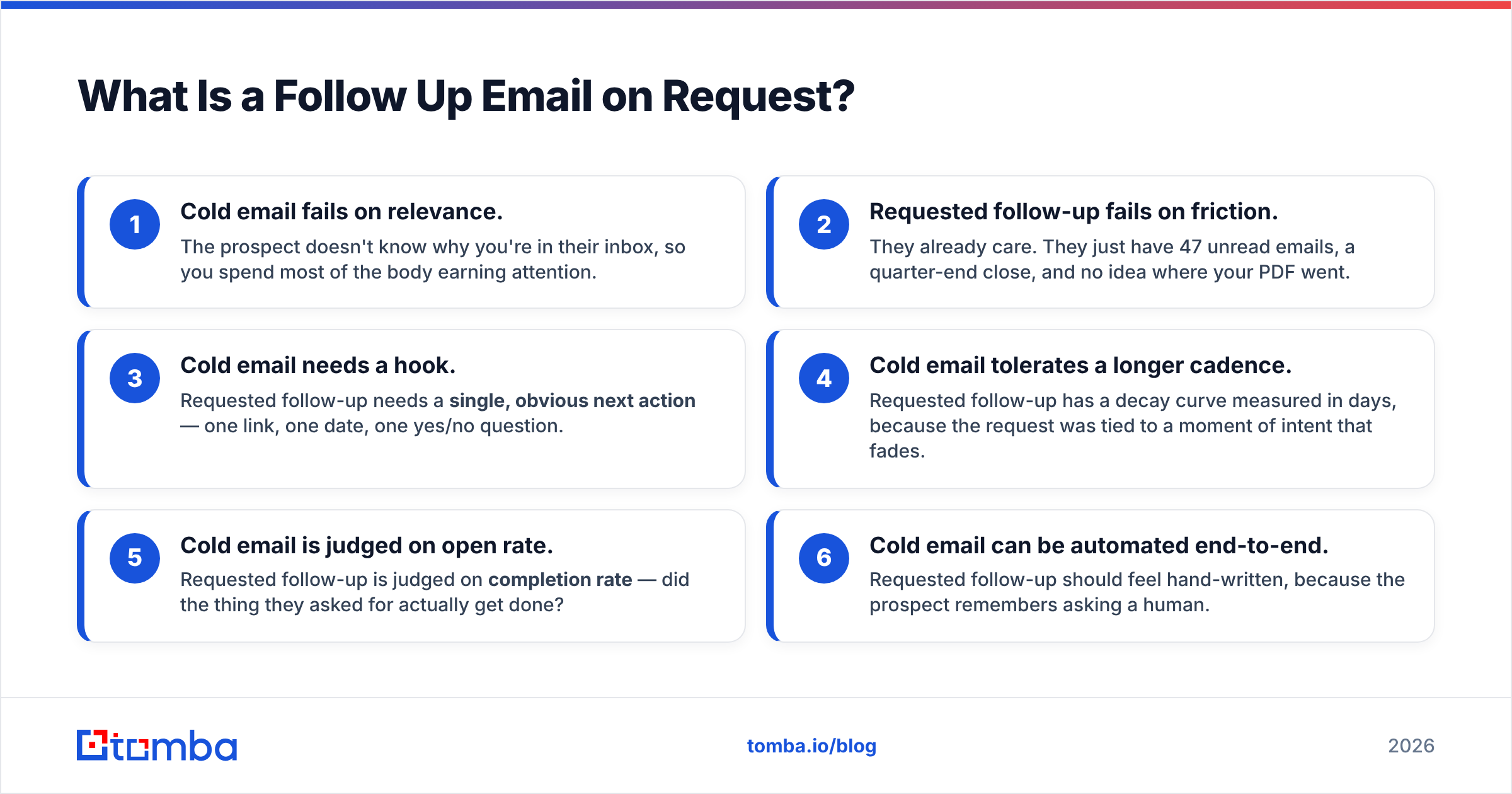
- Cold email fails on relevance. The prospect doesn't know why you're in their inbox, so you spend most of the body earning attention.
- Requested follow-up fails on friction. They already care. They just have 47 unread emails, a quarter-end close, and no idea where your PDF went.
- Cold email needs a hook. Requested follow-up needs a single, obvious next action — one link, one date, one yes/no question.
- Cold email tolerates a longer cadence. Requested follow-up has a decay curve measured in days, because the request was tied to a moment of intent that fades.
- Cold email is judged on open rate. Requested follow-up is judged on completion rate — did the thing they asked for actually get done?
- Cold email can be automated end-to-end. Requested follow-up should feel hand-written, because the prospect remembers asking a human.
The most common mistake: treating a requested follow-up like sequence step 3 of a cold campaign. You drop it into an automated tool, the prospect gets a templated "circling back," and the warmth you earned evaporates.
Why Do Prospects Ghost After Requesting Something?#
They rarely ghost because they changed their mind. In most stalled B2B deals the request was real and the silence is logistical. The four patterns you'll see over and over:
The request was reflexive. "Send me pricing" is often a polite exit line, the B2B equivalent of "let's grab coffee sometime." It buys the prospect a graceful end to the call. You can spot these because the request has no attached constraint — no budget number, no timeline, no named stakeholder.
The requester isn't the decider. An analyst asked for a deck to bring to a director. Your email is now sitting in a queue behind that internal meeting, which slipped two weeks. Nothing is wrong; you're just early.
Your reply created work. If your response to "can you send pricing" was a 900-word email with three tiers, a feature matrix, and two questions, you handed them homework. Homework gets postponed.
The email never arrived. This one is more common than anyone admits. Typo'd addresses from a phone call, an alias that bounces silently, a corporate filter that quarantined your PDF attachment. Before you assume disinterest, confirm the message was deliverable — run the address through an email verifier and check whether the domain is a catch-all that accepts everything and delivers nothing.
How Fast Should You Send the First Follow Up?#
Within four business hours of the request. That's the whole rule.
Intent decays. When a prospect asks for something on a Tuesday call, the mental context — why they asked, what problem it maps to, who else they mentioned it to — is intact for the rest of that afternoon. By Thursday it's a vague memory. By the following Monday your email reads like an interruption from a stranger.
Here's how the timing tiers actually play out in practice:
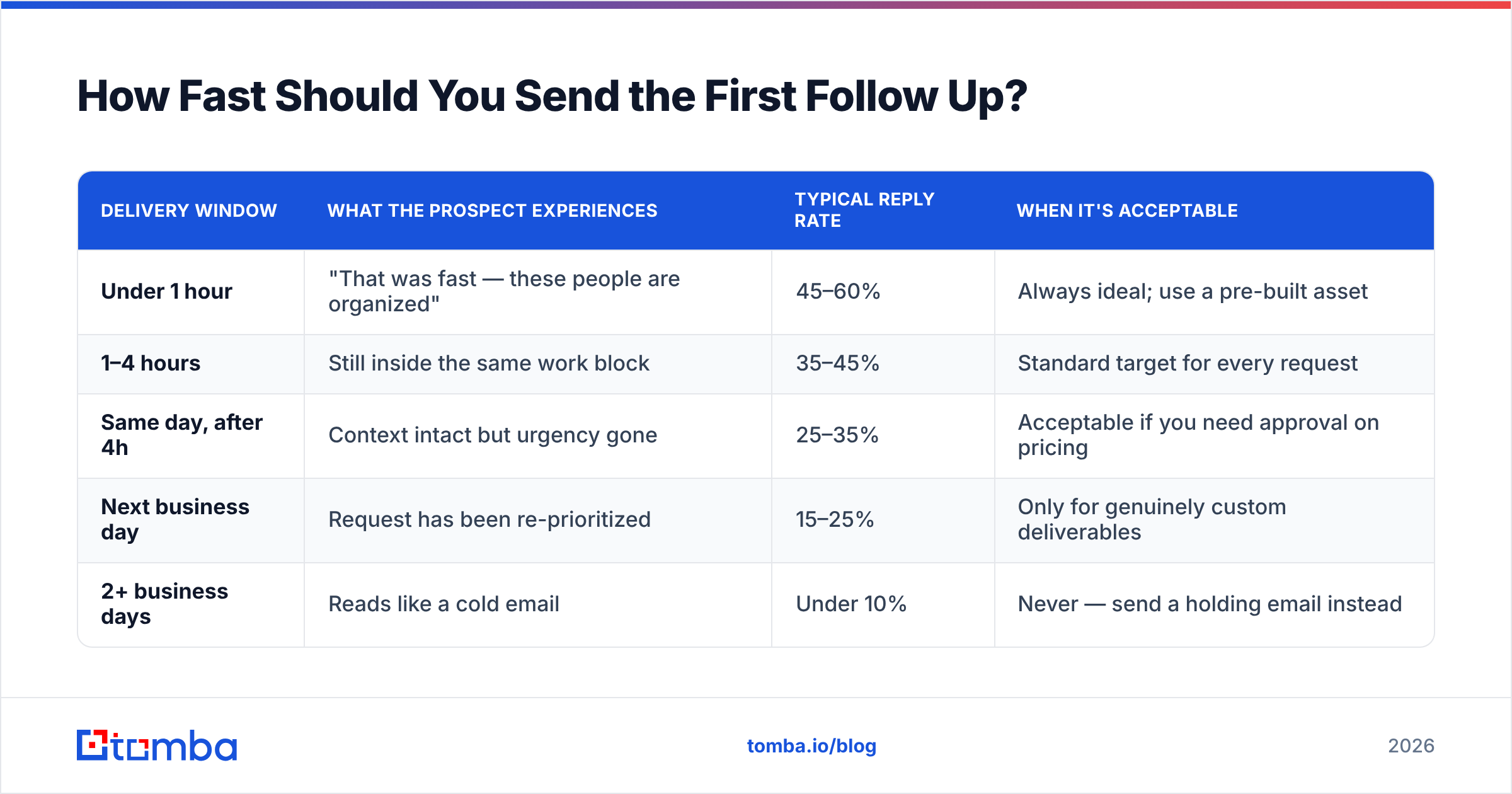
| Delivery window | What the prospect experiences | Typical reply rate | When it's acceptable |
|---|---|---|---|
| Under 1 hour | "That was fast — these people are organized" | 45–60% | Always ideal; use a pre-built asset |
| 1–4 hours | Still inside the same work block | 35–45% | Standard target for every request |
| Same day, after 4h | Context intact but urgency gone | 25–35% | Acceptable if you need approval on pricing |
| Next business day | Request has been re-prioritized | 15–25% | Only for genuinely custom deliverables |
| 2+ business days | Reads like a cold email | Under 10% | Never — send a holding email instead |
The fix for slow deliverables is the holding email. If the prospect asked for something you can't produce in four hours — a custom ROI model, a security questionnaire response, a tailored proposal — send a two-line acknowledgement immediately:
"Got it — pulling the security doc together now. You'll have it Thursday morning. If anything else needs to go in the same packet for your team, tell me before Wednesday EOD."
That email costs 30 seconds and buys you three days of goodwill. It also does something sneaky and useful: it invites a reply, which keeps the thread alive in their inbox and in Gmail's own prioritization.
What Does an Effective Follow Up Cadence Look Like?#
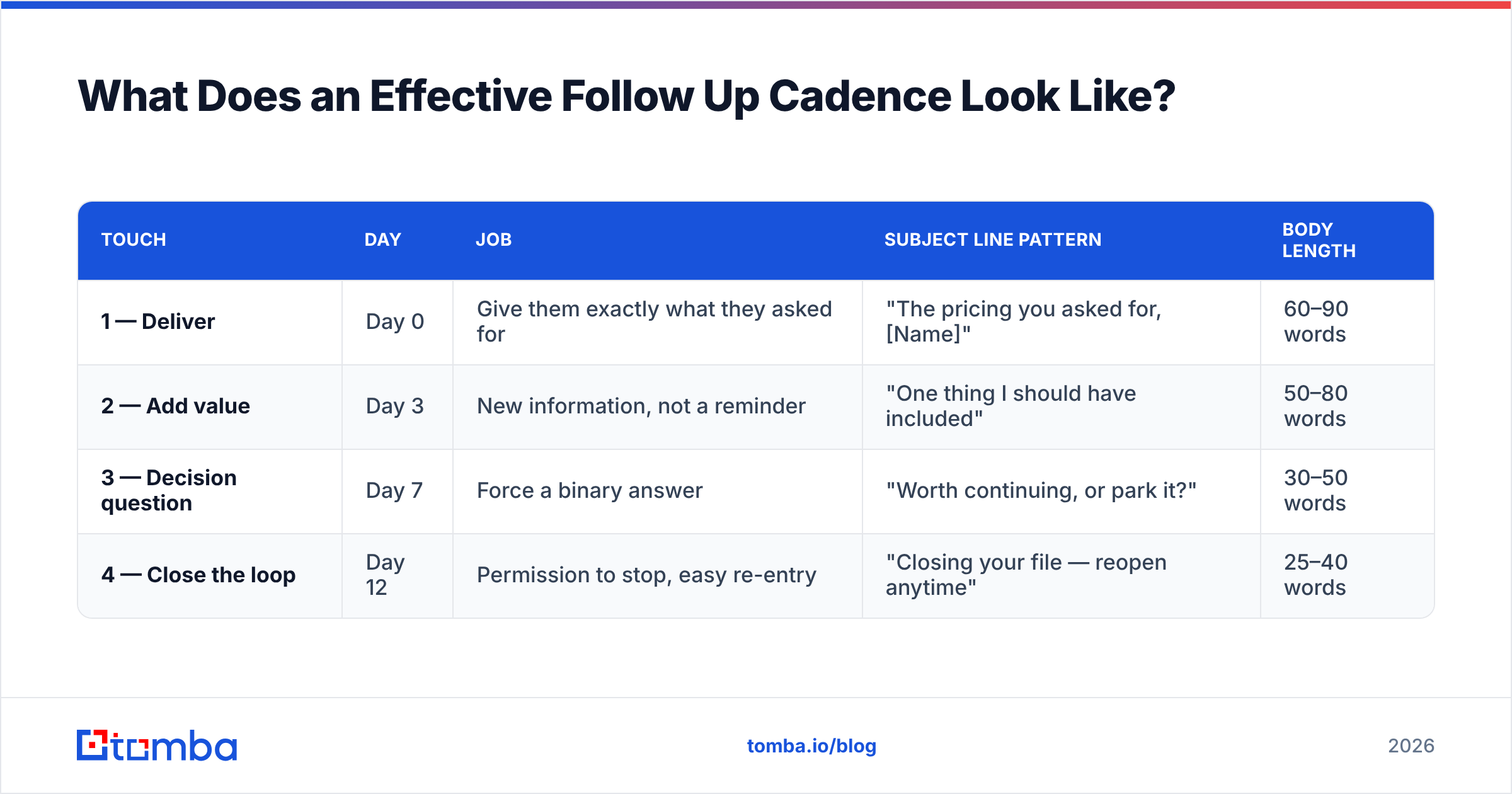
Four touches over twelve days. Each one carries a different job. If two consecutive emails do the same job, delete one.
| Touch | Day | Job | Subject line pattern | Body length |
|---|---|---|---|---|
| 1 — Deliver | Day 0 | Give them exactly what they asked for | "The pricing you asked for, [Name]" | 60–90 words |
| 2 — Add value | Day 3 | New information, not a reminder | "One thing I should have included" | 50–80 words |
| 3 — Decision question | Day 7 | Force a binary answer | "Worth continuing, or park it?" | 30–50 words |
| 4 — Close the loop | Day 12 | Permission to stop, easy re-entry | "Closing your file — reopen anytime" | 25–40 words |
Notice what's missing: there is no touch whose only content is "checking in." Every step delivers something the previous one didn't.
Touch 1 — Deliver. Attach or link the requested item above the fold. Restate the request in their words so the email is self-explanatory when it's forwarded internally. End with one question that is easy to answer from a phone.
Touch 2 — Add value. This is where most reps fail. Three days later, send something new: a customer example in their industry, a benchmark number, an answer to a question they didn't ask but will. The email should be readable as a standalone message, not as a nag.
Touch 3 — Decision question. By day seven you need to know if this is real. Ask a question that has only two answers. "Is this still on your roadmap for Q4, or has it moved?" gives them permission to say no, which is worth more than another week of ambiguity.
Touch 4 — Close the loop. The famous "breakup email," but written without passive aggression. State that you're closing the file, tell them the door is open, and give them one link to reopen it. Done well, this touch alone recovers 10–15% of stalled threads — people respond to the removal of an obligation.
What Should Each Follow Up Email Actually Say?#
Templates below. Replace the brackets, keep the structure. Every one of these is under 100 words on purpose — a requested follow-up that scrolls is a requested follow-up that waits.
Touch 1 — Deliver (Day 0)
Subject: The [thing] you asked for on our call
[Name] — here's the [pricing sheet / deck / integration doc] we talked about.
[Link]
You mentioned [their exact words about the problem]. Page 2 is the part that maps to that; the rest you can skip.
One question so I can tailor the next step: is [specific constraint — headcount, budget cycle, current tool] still the deciding factor?
[Your name]
Touch 2 — Add value (Day 3)
Subject: One thing I should have included
[Name] — I left something out of Tuesday's doc.
[Similar company] ran the same migration last quarter and their blocker wasn't pricing, it was [specific technical or process issue]. Here's how they handled it: [one sentence].
If that's not a concern on your side, ignore this. If it is, I can send the two-page write-up.
[Your name]
Touch 3 — Decision question (Day 7)
Subject: Worth continuing, or park it?
[Name] — no pressure either way, but I'd rather know than guess.
Is [project] still live for this quarter, or has it moved down the list?
Either answer is genuinely fine — I just don't want to keep landing in your inbox if the timing's wrong.
[Your name]
Touch 4 — Close the loop (Day 12)
Subject: Closing your file — reopen anytime
[Name] — I'm going to stop here so I'm not adding to the pile.
Everything we discussed is in [link]. If [trigger event — new fiscal year, headcount change, tool renewal] happens, reply to this thread and we'll pick it straight back up.
Good luck with [specific thing they mentioned].
[Your name]
Two rules that apply to all four. First, reply within the original thread for touches 2 and 3 — the prospect gets the full context and your deliverable stays one scroll away. Break to a new thread only for touch 4, where a fresh subject line does the work. Second, strip every tracking pixel and link wrapper from these emails. Requested follow-ups often get forwarded internally, and a mangled tracking URL in a forwarded email looks like spam to the person who didn't ask for it.
How Does This Compare to Standard Cold Email Follow-Ups?#
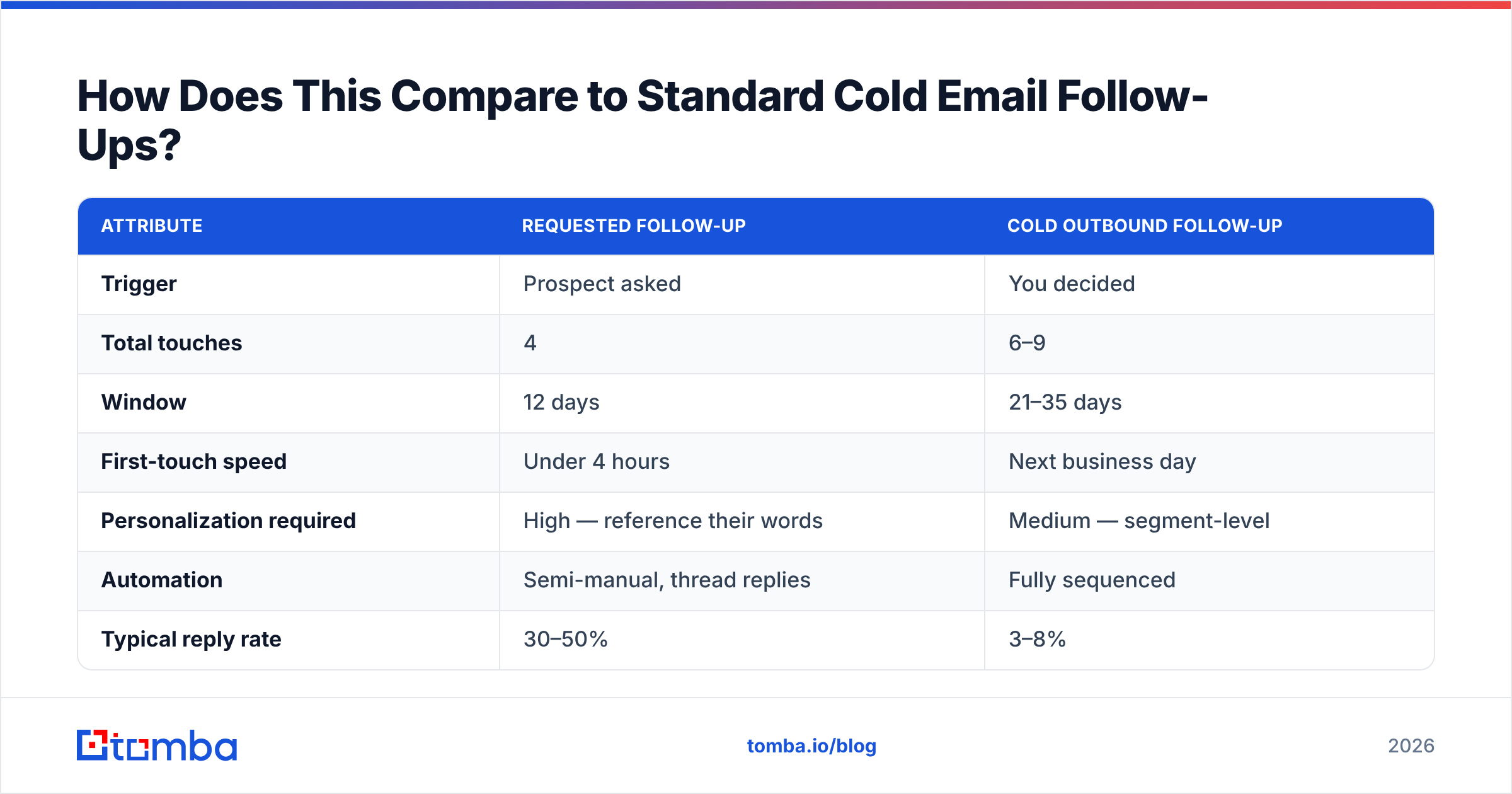
The cadences look superficially similar and behave completely differently. Getting the two confused is why so many reps run a nine-touch sequence on a warm request and burn the relationship.
| Attribute | Requested follow-up | Cold outbound follow-up |
|---|---|---|
| Trigger | Prospect asked | You decided |
| Total touches | 4 | 6–9 |
| Window | 12 days | 21–35 days |
| First-touch speed | Under 4 hours | Next business day |
| Personalization required | High — reference their words | Medium — segment-level |
| Automation | Semi-manual, thread replies | Fully sequenced |
| Typical reply rate | 30–50% | 3–8% |
| Best channel mix | Email only, phone at touch 3 | Email + LinkedIn + phone |
| Breakup email effect | Recovers 10–15% | Recovers 2–4% |
The practical takeaway: a requested follow-up deserves ten times the personalization budget per email and one third of the volume. If you're using an automation platform, pull these threads out of the main sequence entirely. Tools like Instantly or Reply.io are built for volume cadences; a warm request should be handled in your inbox with a snippet, not in a campaign builder.
Phone deserves a mention at touch 3. If the request came from a real conversation, a 20-second voicemail on day seven ("left you a note in email, no need to call back, just wanted to make sure it didn't get buried") lifts email reply rates on the same day measurably. If you don't have the number, a phone finder will usually pull a direct line from the domain and name you already have.
What Kills Follow Up Emails Before Anyone Reads Them?#
Copy gets all the blame. Infrastructure deserves most of it.
The address is wrong. Requests captured verbally — on a call, at a conference, in a hallway — are typo magnets. "It's j-dot-smith" becomes jsmith@, which bounces or, worse, lands in a catch-all void where nothing bounces and nothing arrives. Run every hand-captured address through verification before the first send. Tomba's catch-all verifier exists specifically for the domains that accept all mail and confirm nothing, which is where a surprising share of "ghosted" follow-ups actually die.
The attachment triggered a filter. Corporate mail gateways are hostile to attachments from external senders with no prior thread history. Link, don't attach — a hosted doc link is more deliverable and gives you engagement data without a tracking pixel.
Your domain reputation is mediocre. A follow-up to a warm request is the worst possible email to have land in spam, and it happens when the same domain is also blasting cold volume. Check your sender reputation and keep warm-thread replies on a domain that isn't carrying your outbound load. Google's own sender guidelines spell out the authentication and complaint-rate thresholds that decide this.
You wrote a subject line that looks automated. "Following up," "Touching base," "Quick question," and "Re: our conversation" are all pattern-matched by both humans and filters. Name the deliverable instead — "The pricing you asked for" gets opened because it's a promise, not a process.
You gave them two next steps. A follow-up with a calendar link and a document and a question is three decisions. Pick one per email. If you're not sure which, ask yourself what you'd want if the deal closed tomorrow, and cut the rest.
How Do You Scale This Without Making It Robotic?#
The honest answer: you accept a ceiling. Requested follow-ups don't scale the way cold sequences do, because their entire advantage is that they feel like a person remembering a promise.
What you can systematize:
- Pre-build the deliverables. The reason follow-ups go out on day two instead of hour two is that nobody has a pricing one-pager ready. Build five — pricing, security, integration, case study, implementation timeline — and the four-hour window becomes trivial.
- Snippet the structure, write the specifics. Keep the four templates above as text expander snippets. The bracketed parts get typed fresh every time. That's roughly 40 seconds of real writing per email.
- Automate the data, not the words. Enrichment, verification, and contact lookup are where automation belongs. Use data enrichment to fill in the company context before you write, so the "one thing I should have included" email has something real to include.
- Log the trigger, not just the task. When you close a loop at touch 4, record the re-entry trigger in your CRM — renewal date, funding round, headcount threshold. Those closed files are the highest-converting pipeline you own next quarter.
- Measure completion, not activity. Track what percentage of requests got delivered inside four hours and what percentage reached a yes-or-no answer within twelve days. Reply rate is a vanity metric here; resolution rate is the real one.
Reviews of prospecting stacks on G2 consistently show the same split — teams rate sequencing tools well on volume and poorly on warm-thread handling. That's not a product flaw. It's a signal that warm requests belong in a different workflow.
The Bottom Line#
A follow up email on request is the easiest email in B2B sales to get right and the one teams most reliably fumble. The prospect already raised their hand. All you have to do is deliver fast, add something new at day three, ask a real question at day seven, and let them off the hook at day twelve — with clean, deliverable data underneath all four.
Start with the data. If your carefully written follow-up is going to an address you transcribed off a Zoom call, no template will save it. Use the Tomba Email Finder to confirm the exact address from a name and domain before touch 1 goes out, and check Tomba pricing — the free tier covers 25 searches a month, which is enough to clean up every warm request a single rep handles in a week. Plans start at $49/mo when you need the volume.
Fast delivery, one clear ask, verified address. That's the whole system.
Related guides#
Ready to find emails that actually work?
Join 150,000+ professionals who stopped guessing and started sending. Free credits on signup — no credit card required.
Get the Tomba newsletter
Practical outbound tactics and product updates — once every two weeks.
About the author