Follow Up Email Reply Rates: What Actually Works in 2026
Most follow-up sequences die at touch two — not because the prospect said no, but because the message added nothing. Here's the cadence, timing, and template set that actually pulls answers.
TL;DR
- A follow up email reply is won or lost on new information, not persistence. "Just bumping this" adds zero reasons to respond and trains people to ignore your thread.
- Touches 2 through 4 produce the majority of replies in most B2B sequences. Stopping after one email throws away roughly half your pipeline.
- Spacing matters more than volume: 2–3 business days between early touches, widening to 5–7 days by the end, beats a daily drip every time.
- The "breakup" email is the single highest-reply-rate template in most sequences — because it reverses the ask instead of repeating it.
- Before you blame your copy, check the address. A bounced or catch-all address produces the same silence as bad writing, and no rewrite fixes it.
What counts as a follow up email reply?#
A follow up email reply is any response you get to a message sent after your initial outreach — positive, negative, or a redirect to someone else. That last category matters more than people think: a "wrong person, talk to Dana" is a reply, and it's often worth more than a lukewarm yes because it hands you an internal referral.
Most teams measure only positive replies and conclude their follow-ups don't work. They do work; they just produce a mix. In a healthy sequence, expect roughly 40–55% of replies to be "not now," 20–30% to be referrals or routing, and the remainder genuine interest. If you're getting near-zero of all three, the problem is upstream of your copy — either the list, the targeting, or deliverability.
The mental model that helps: a cold sequence is not a series of reminders, it's a series of different arguments for the same meeting. A reminder gives the recipient no new data to act on. A different argument gives them a second, third, and fourth chance to find one that matches what's actually on their plate this quarter.
Why do most follow-up emails never get a reply?#
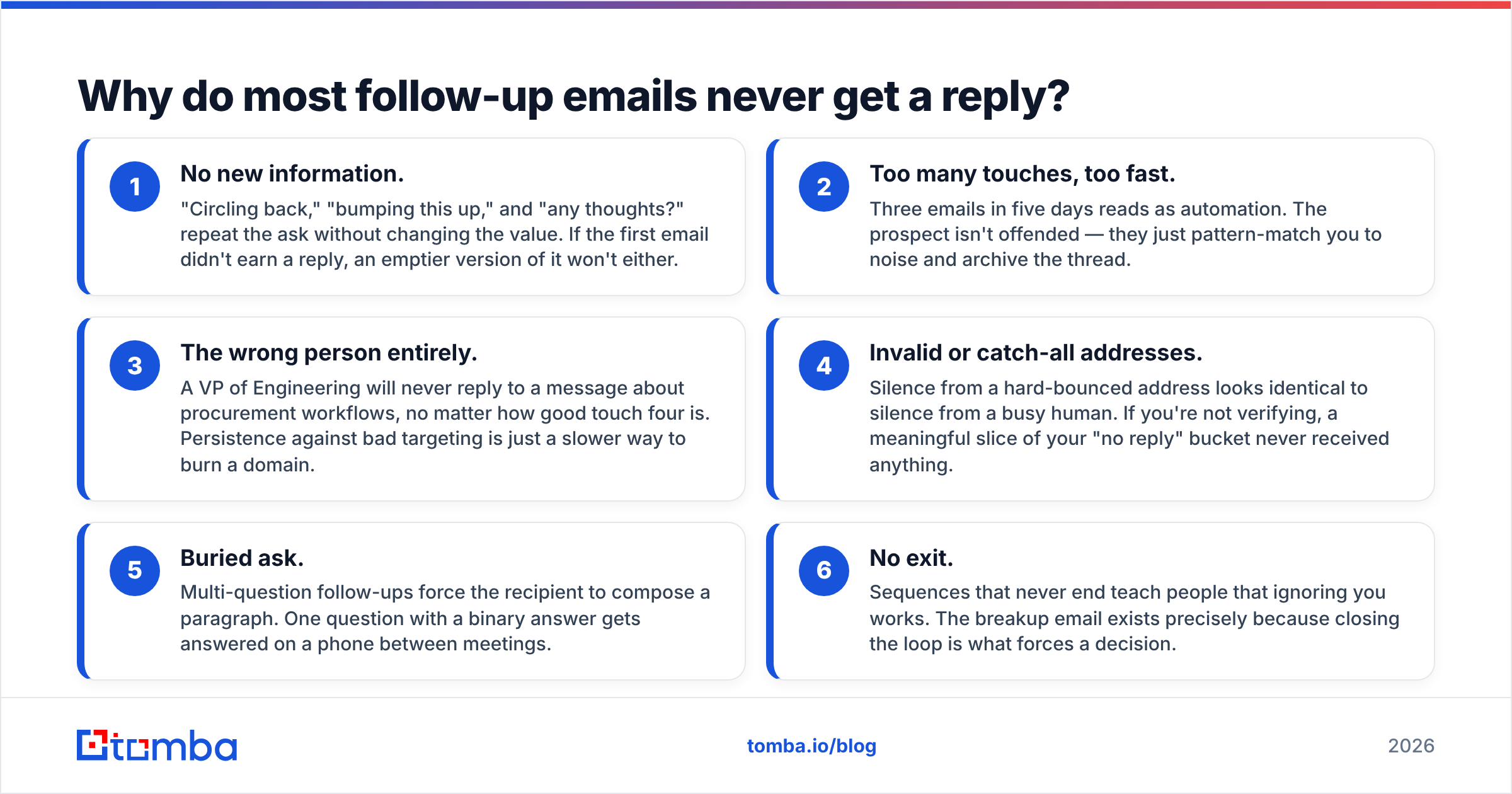
Six failure modes account for almost every dead sequence. Fix these before you touch subject lines.
- No new information. "Circling back," "bumping this up," and "any thoughts?" repeat the ask without changing the value. If the first email didn't earn a reply, an emptier version of it won't either.
- Too many touches, too fast. Three emails in five days reads as automation. The prospect isn't offended — they just pattern-match you to noise and archive the thread.
- The wrong person entirely. A VP of Engineering will never reply to a message about procurement workflows, no matter how good touch four is. Persistence against bad targeting is just a slower way to burn a domain.
- Invalid or catch-all addresses. Silence from a hard-bounced address looks identical to silence from a busy human. If you're not verifying, a meaningful slice of your "no reply" bucket never received anything.
- Buried ask. Multi-question follow-ups force the recipient to compose a paragraph. One question with a binary answer gets answered on a phone between meetings.
- No exit. Sequences that never end teach people that ignoring you works. The breakup email exists precisely because closing the loop is what forces a decision.
How many follow-ups should you send, and when?#
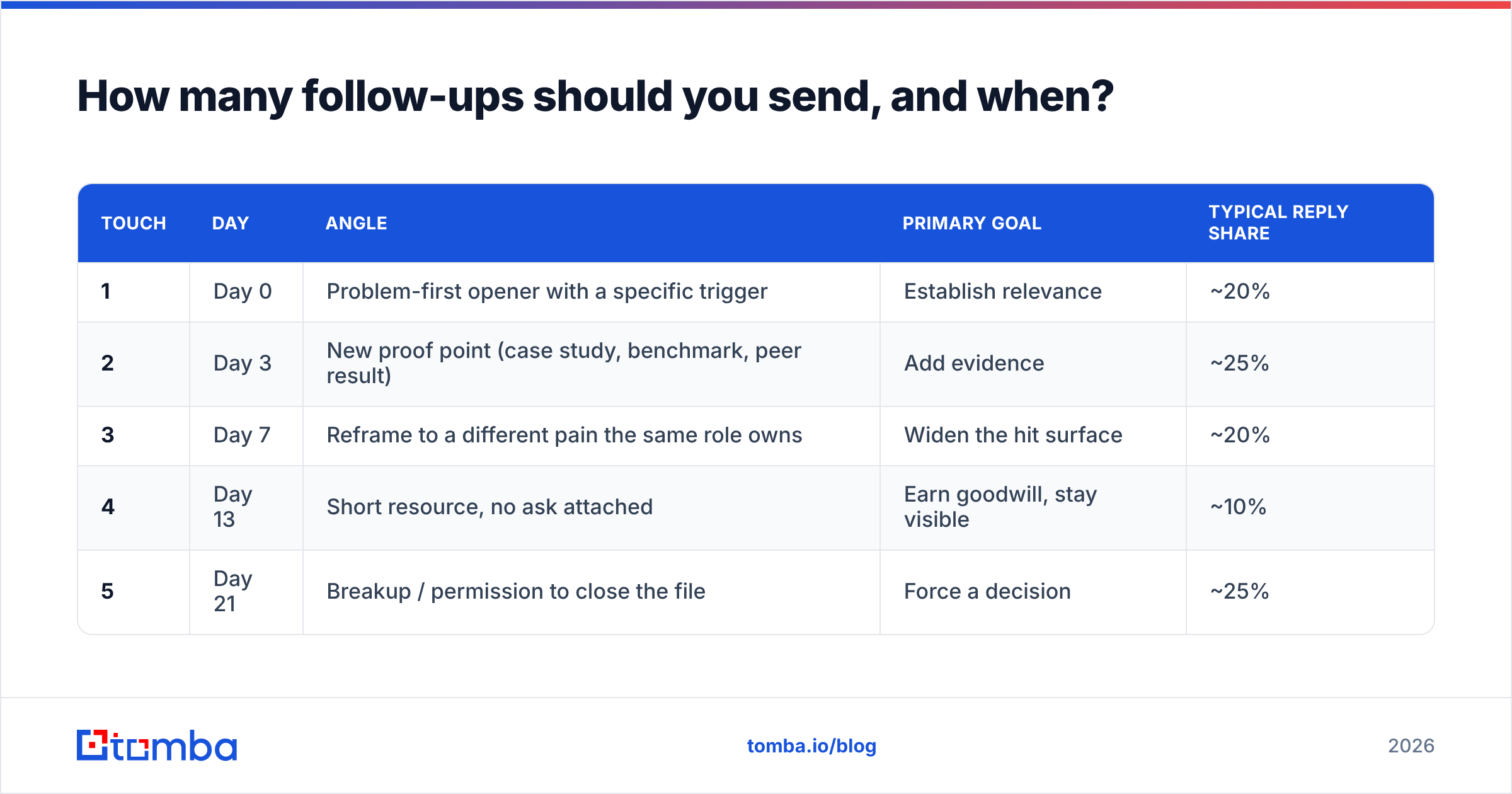
Five touches over roughly three weeks is the range where reply volume and domain safety intersect for most B2B teams. Here's the cadence that holds up across industries — each touch carries a distinct job, not a rephrased version of the last one.
| Touch | Day | Angle | Primary goal | Typical reply share |
|---|---|---|---|---|
| 1 | Day 0 | Problem-first opener with a specific trigger | Establish relevance | ~20% |
| 2 | Day 3 | New proof point (case study, benchmark, peer result) | Add evidence | ~25% |
| 3 | Day 7 | Reframe to a different pain the same role owns | Widen the hit surface | ~20% |
| 4 | Day 13 | Short resource, no ask attached | Earn goodwill, stay visible | ~10% |
| 5 | Day 21 | Breakup / permission to close the file | Force a decision | ~25% |
Two things to read off that table. First, touch five is not a throwaway — it routinely matches touch two for reply volume because loss aversion does the work your pitch couldn't. Second, the spacing widens deliberately. Tight early spacing keeps the original context alive; wider late spacing signals a human working a list, not a cron job.
If your sequence runs longer than seven touches, you've stopped prospecting and started harassing. The marginal reply rate after touch six is close enough to zero that the deliverability cost outweighs it.
Which follow-up format gets the highest reply rate?#
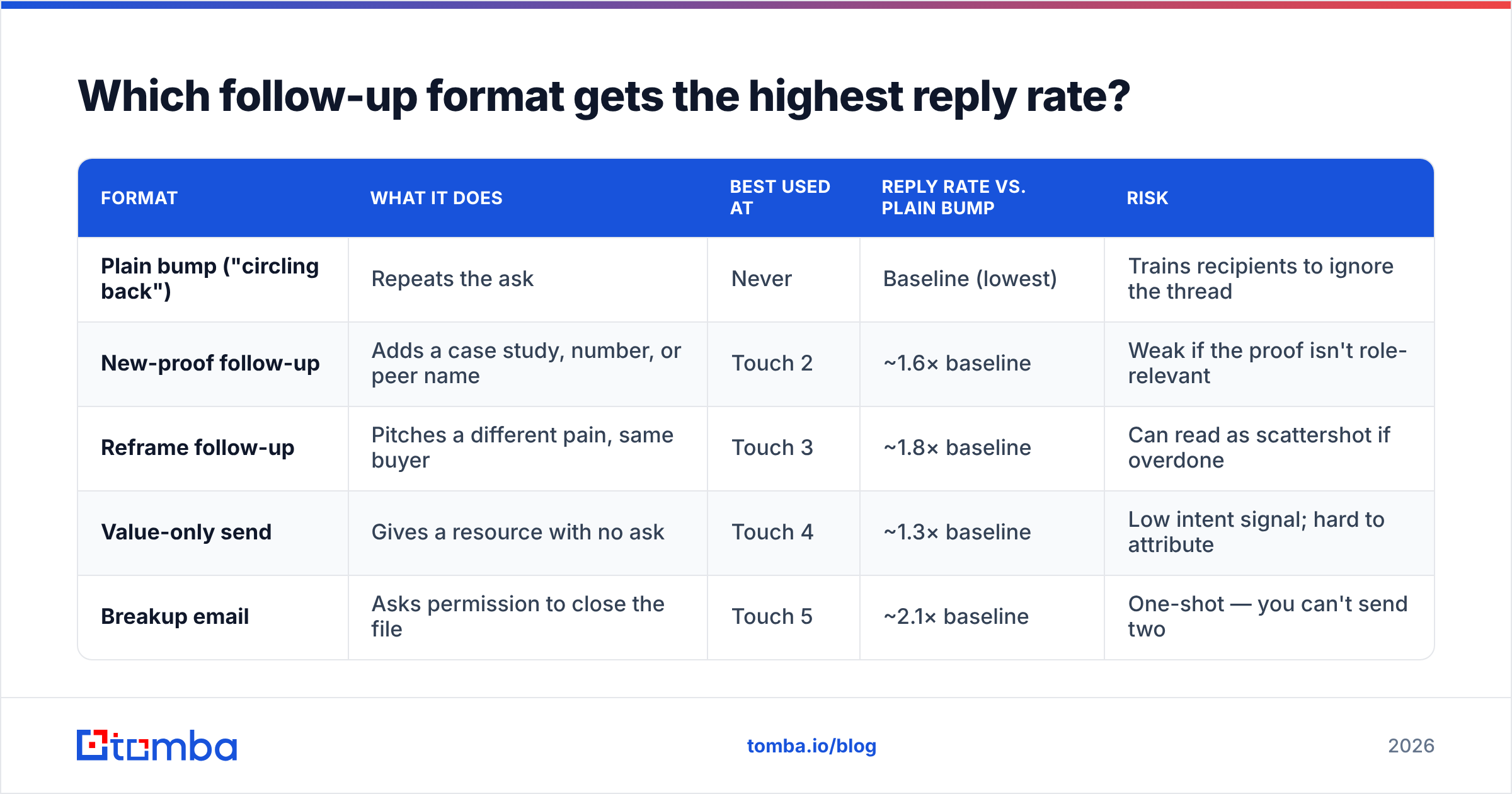
Not all follow-ups are the same instrument. Here's how the four common formats actually compare on the dimensions that matter.
| Format | What it does | Best used at | Reply rate vs. plain bump | Risk |
|---|---|---|---|---|
| Plain bump ("circling back") | Repeats the ask | Never | Baseline (lowest) | Trains recipients to ignore the thread |
| New-proof follow-up | Adds a case study, number, or peer name | Touch 2 | ~1.6× baseline | Weak if the proof isn't role-relevant |
| Reframe follow-up | Pitches a different pain, same buyer | Touch 3 | ~1.8× baseline | Can read as scattershot if overdone |
| Value-only send | Gives a resource with no ask | Touch 4 | ~1.3× baseline | Low intent signal; hard to attribute |
| Breakup email | Asks permission to close the file | Touch 5 | ~2.1× baseline | One-shot — you can't send two |
The reframe and the breakup carry the sequence. If you only have bandwidth to write two good follow-ups, write those two and let the rest be short.
One nuance on the breakup: it works because it hands control back. "I'll assume this isn't a priority and close the file — happy to be wrong" gets replies that "just following up one last time" never will. What kills it is insincerity. If you send a breakup and then keep emailing, you've burned the mechanism permanently.
What should a follow up email reply template look like?#
Short, one ask, one new fact. Here are four you can lift and adapt — each maps to a touch in the cadence above.
Touch 2 — new proof
Subject: (reply on the same thread)
Hi Dana — one data point in case it's useful: a team about your size at [Peer Co] cut list-building time from 6 hours a week to about 40 minutes by pulling verified contacts straight into their CRM.
Worth 15 minutes to see whether the same math holds for you?
Touch 3 — reframe
Hi Dana — I pitched this as a list-building problem last week. Talking to a few other RevOps leads this month, the sharper pain has been bounce rates wrecking domain reputation before a campaign even ramps.
Is that closer to what your team is dealing with?
Touch 4 — value only
Hi Dana — no ask here. We benchmarked reply rates across 40 outbound teams and the spacing data surprised us. Two-page summary attached in case it's useful for your Q3 planning.
Touch 5 — breakup
Hi Dana — I'll close the file on this one so I stop cluttering your inbox. If timing changes in the next quarter, reply "later" and I'll circle back then. Otherwise, all the best with the rollout.
Notice what's absent: no "I wanted to reach out," no three-sentence company boilerplate, no calendar link dumped in the first line. Every template is under 60 words, and every one ends in a question with a one-word answer available. If you want a starting library to edit rather than write from scratch, the cold email templates collection covers the common role and industry variants, and a subject line generator helps when you're breaking out of the thread for a fresh angle.
Should you reply on the same thread or start a new one?#
Same thread for touches 2 through 4; new thread with a new subject for touch 5. That split is the practical compromise between context and visibility.
Threading keeps the original message one scroll away, which matters when your value prop needs the setup. It also looks like normal human correspondence to filters. The cost is that a thread the recipient has already mentally filed as "ignore" stays filed — your fourth message inherits the fate of the first.
Breaking the thread at the breakup stage resets that. A new subject line lands as a new decision rather than an old obligation, which is part of why the breakup over-performs. Just don't break the thread three times; each reset that fails makes the next one weaker.
How do deliverability and data quality change your reply rate?#
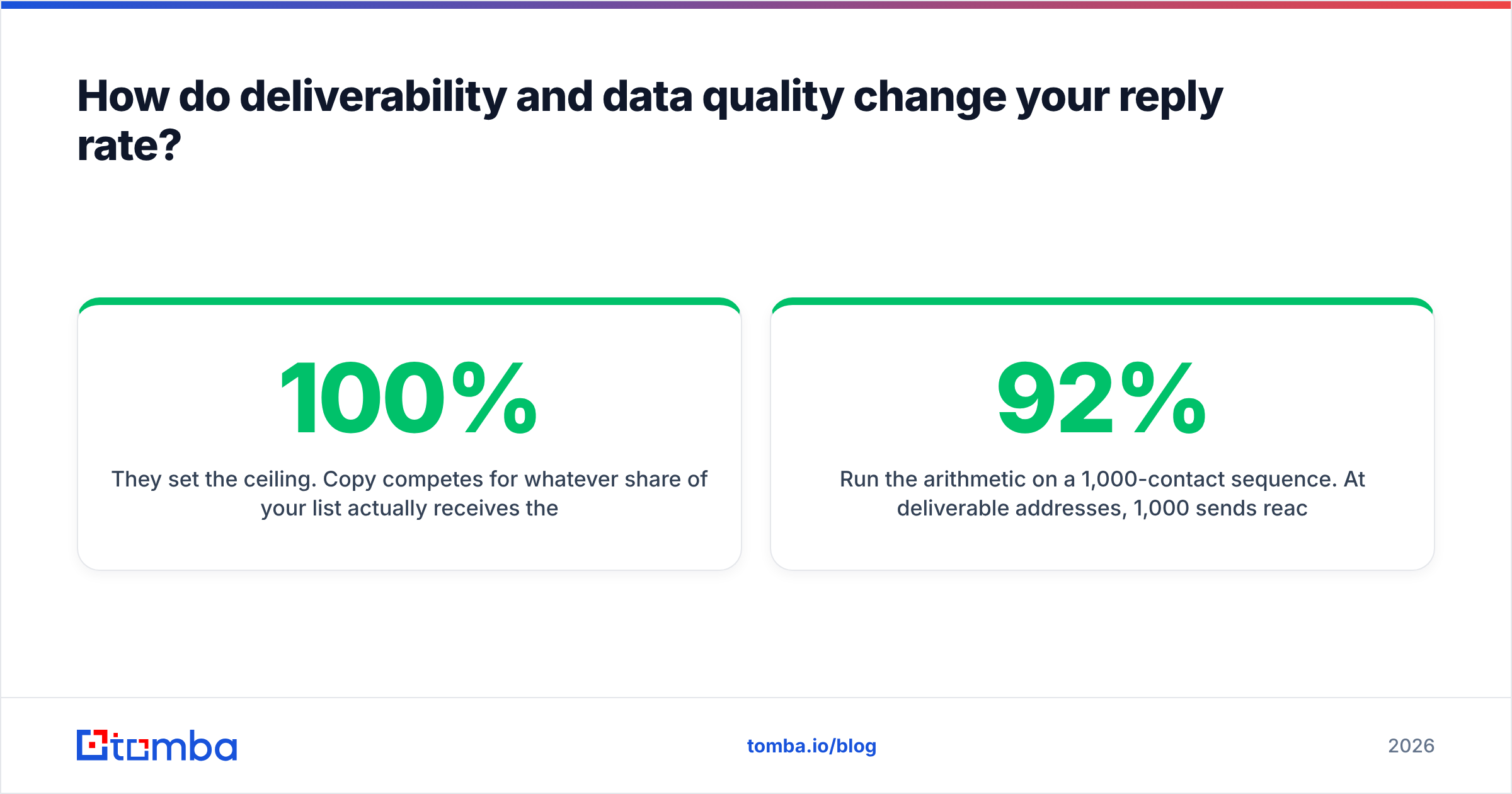
They set the ceiling. Copy competes for whatever share of your list actually receives the message, and that share is often far below 100%.
Run the arithmetic on a 1,000-contact sequence. At 92% deliverable addresses, 1,000 sends reach 920 inboxes. At 78% — a realistic number for a scraped or year-old list — you reach 780, and the 220 bounces push your bounce rate past the threshold where mailbox providers start throttling the rest. A 3% reply rate on a verified list beats a 3% reply rate on an unverified one by a wide margin, because the denominators aren't the same and the second one is actively degrading your sender reputation.
Three checks worth running before a sequence goes live:
- Verify every address, including the ones your CRM has held for two years. Job changes alone invalidate roughly a quarter of a B2B list annually. An email verifier pass takes minutes and removes the largest source of false "no reply."
- Handle catch-all domains separately. They accept everything at the SMTP layer and silently drop what doesn't exist, so they pass naive validation and still produce nothing. Route them through a catch-all verifier or segment them into a lower-volume track.
- Track reply rate per touch, not per sequence. A single blended number hides the fact that touch three is doing all the work — or none of it. Definitions matter here; if your team disagrees on what counts, the response rate definition is a useful common baseline.
For a broader view of how deliverability interacts with campaign design, HubSpot's sales blog publishes ongoing benchmark work, and G2's sales engagement category is a reasonable place to compare how vendors handle sequence analytics before you commit to one. The mechanics of what mailbox providers actually filter on are summarized well in the email deliverability overview if you want the underlying model rather than vendor framing.
How do you handle each type of reply you get?#
Getting the reply is half the job. Mishandling it wastes the entire sequence.
- "Not now, ask me in Q4." Take the date literally, log it, and send one line back confirming you'll follow up then. Do not pitch again in the same reply — you asked for a decision, you got one.
- "We already use [competitor]." The wrong move is a feature-by-feature rebuttal. The right one is a single question about what they'd change if they could. That either surfaces a gap or ends the conversation cleanly.
- "Send me more info." Often a soft brush-off. Send something specific and small, then propose a time. If the second message goes unanswered, treat it as a no rather than starting a new sequence.
- "Wrong person — talk to Dana." Reply to thank them, then open a fresh thread to Dana citing the internal referral by name. This is the highest-converting path in the whole flow and most reps waste it by CC'ing everyone.
- A hard no. Suppress the contact, keep the domain. Companies change buyers; a clean no today protects the next rep who works the account.
What does a good follow-up program look like end to end?#
Working backwards from the reply: you need the right person, a reachable address, five distinct arguments, disciplined spacing, and a real exit. Miss any one and the rest underperforms.
Most teams over-invest in the copy layer and under-invest in the two layers beneath it. Rewriting touch three for the fourth time returns less than verifying the list once. Targeting returns more than either. Sequence the work accordingly: fix data, fix targeting, then optimize copy — and measure per touch so you know which change actually moved the number.
The other discipline is stopping. A sequence with a defined end produces cleaner data, a healthier domain, and a list you can re-approach in two quarters without being remembered as the person who sent nine emails.
Start with addresses that actually deliver#
Your follow-up cadence can only convert the people who receive it. If a chunk of your list is guessed, stale, or catch-all, you're optimizing copy against a broken denominator — and no template in this post will fix that.
Build the list on verified data first. The Tomba Email Finder returns professional addresses by domain, name, or company with a confidence score attached, so you know which contacts are worth a five-touch sequence and which to drop before touch one. The free tier covers 25 searches a month if you want to test the accuracy on your own accounts; paid plans start at $49/mo, with full Tomba pricing laid out per credit volume. Verify the list, then send the five emails that deserve to be sent.
Related guides#
Ready to find emails that actually work?
Join 150,000+ professionals who stopped guessing and started sending. Free credits on signup — no credit card required.
Get the Tomba newsletter
Practical outbound tactics and product updates — once every two weeks.
About the author