Follow Up Email Reply Rate: Benchmarks and Fixes for 2026
Most cold email replies never come from the first send. Here are realistic follow-up reply rate benchmarks, the sequence lengths that hold up, and the fixes that actually move the number.
TL;DR
- Your follow up email reply rate is replies divided by delivered follow-ups — track it per touch, not as one blended number, or you will optimize the wrong email.
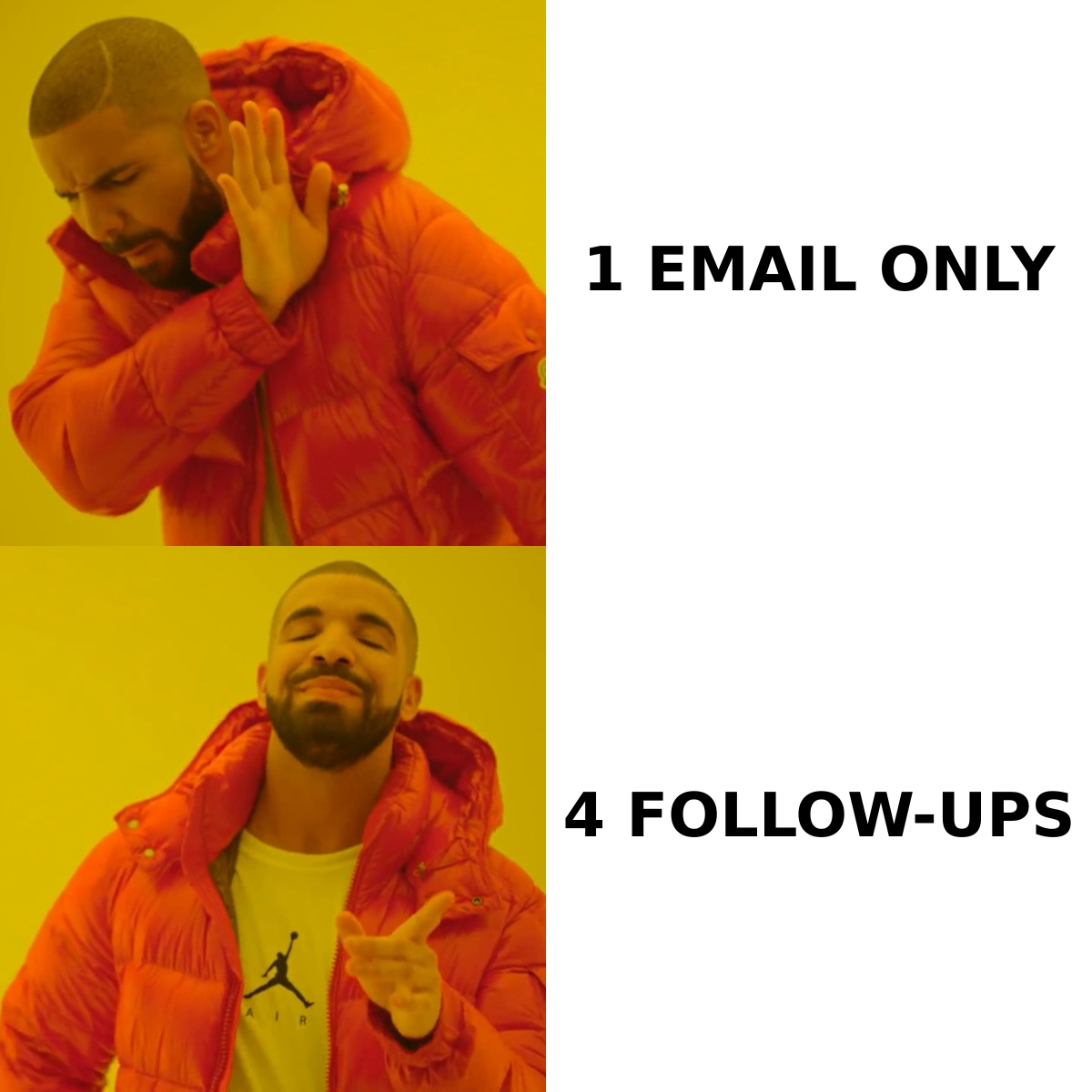
- Across most B2B outbound programs, touch 1 lands somewhere in the 2-5% reply range, and touches 2-4 add another 3-7% combined. Sequences that stop at one email leave roughly half their replies on the table.
- Reply rate collapses fastest from three causes: bad addresses, a follow-up that adds nothing new, and sending five touches in eight days.
- A 4-touch sequence spread over 14-18 business days, where each touch changes the angle rather than repeating the ask, is the most reliable structure we see hold up.
- Verify the list before you sequence it. A 12% bounce rate does not just cost you 12% of your sends — it degrades sender reputation and drags every later touch into spam.
What is a follow up email reply rate, and how do you calculate it?#
Reply rate is the percentage of delivered emails that get a human response. The formula is boring:
Reply rate = (unique replies ÷ delivered emails) × 100
Two words in that formula do all the damage.
Delivered, not sent. If you send 1,000 emails and 140 bounce, your denominator is 860. Tools that quietly use "sent" inflate your numbers by 10-20% and hide a list-quality problem you need to see.
Unique, not total. One prospect replying three times is one reply. Sequencing platforms that count thread messages will flatter you.
Now the part most teams skip: calculate it per touch, not per campaign.
A campaign-level reply rate of 6% tells you nothing actionable. Split it out and you might find touch 1 at 3.1%, touch 2 at 1.9%, touch 3 at 0.7%, and touch 4 at 0.3%. That distribution tells you exactly where to spend your rewriting time — and whether touch 4 is earning its place or just burning goodwill.
Also separate positive reply rate from raw reply rate. "Not interested, remove me" is a reply. A sequence that generates 9% replies where two-thirds are opt-outs is worse than one at 5% where half are conversations. Most teams should be tracking:
- Delivery rate — the ceiling on everything else.
- Total reply rate — engagement signal, including negatives.
- Positive reply rate — replies that continue the conversation.
- Meeting-booked rate — the only number your CRO cares about.
- Opt-out rate — the cost side of the ledger; above ~1.5% per campaign, your targeting is off.
What is a good follow up email reply rate in 2026?#
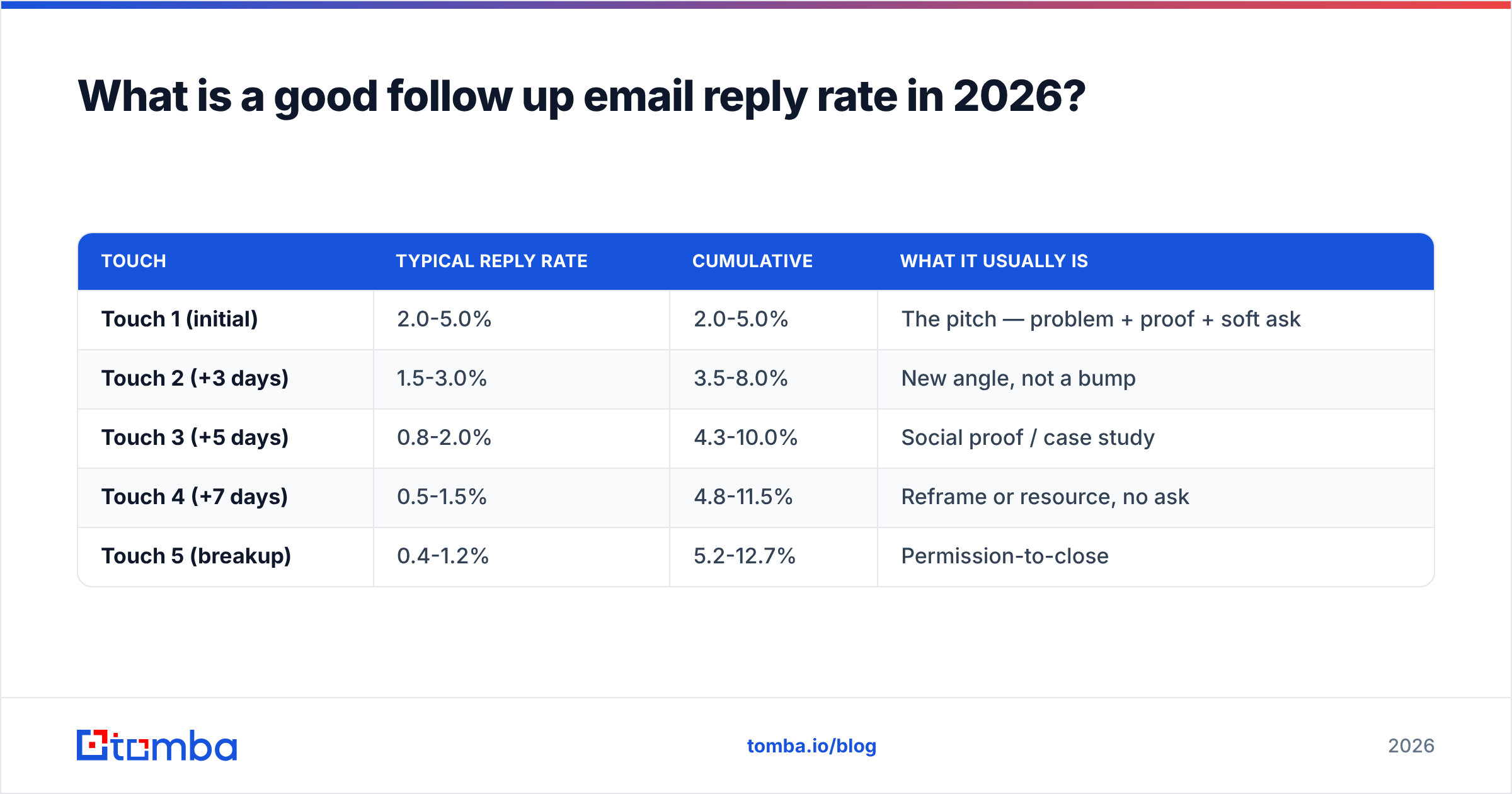
There is no single benchmark, because reply rate is mostly a function of list relevance, not copy quality. But here is a realistic band structure based on what well-run outbound programs report and what vendors like HubSpot publish in their sales benchmark research.
| Touch | Typical reply rate | Cumulative | What it usually is |
|---|---|---|---|
| Touch 1 (initial) | 2.0-5.0% | 2.0-5.0% | The pitch — problem + proof + soft ask |
| Touch 2 (+3 days) | 1.5-3.0% | 3.5-8.0% | New angle, not a bump |
| Touch 3 (+5 days) | 0.8-2.0% | 4.3-10.0% | Social proof / case study |
| Touch 4 (+7 days) | 0.5-1.5% | 4.8-11.5% | Reframe or resource, no ask |
| Touch 5 (breakup) | 0.4-1.2% | 5.2-12.7% | Permission-to-close |
Read the cumulative column carefully. If you send one email and stop, your ceiling is about 5%. Run four more touches and you can roughly double it. That is the entire economic argument for follow-ups — you are not being persistent for its own sake, you are compounding a small per-touch probability across a window in which the prospect's situation can change.
Two caveats that keep this honest:
- Founder-led and tightly-niched outbound beats these numbers badly. A 200-contact list where you genuinely know the buying trigger can hit 15-25% reply rates. That is not a benchmark, it is a different sport.
- Broad, generic sequences underperform them badly. A 40,000-contact blast to "VPs of anything at companies 50-5000" will sit under 1% no matter how good your copy is.
Why do follow-ups outperform the first email so consistently?#
Because the first email is competing against a full inbox, and every one after it is competing against a thread the prospect has already seen.
Four mechanics do the work:
- Recall and familiarity. By touch 2 or 3, your name is no longer cold. The sender line reads as "that person again" rather than "unknown vendor." Recognition lowers the cost of opening.
- Timing roulette. A prospect on PTO, in a board week, or mid-migration during touch 1 is a different buyer during touch 3. You are not persuading harder, you are sampling their calendar more times.
- Thread position. Replies in an existing thread often surface higher in an inbox and carry an implicit "you owe a response" weight that a fresh cold email does not.
- Angle diversification. Your touch-1 hypothesis about their pain is probably wrong. Each new touch is a cheap second guess at what they actually care about.
Mechanic 4 is the one teams waste. If every follow-up repeats the touch-1 pitch in shorter form, you get mechanics 1-3 and throw away the most valuable one.
How many follow-ups should a sequence have?#
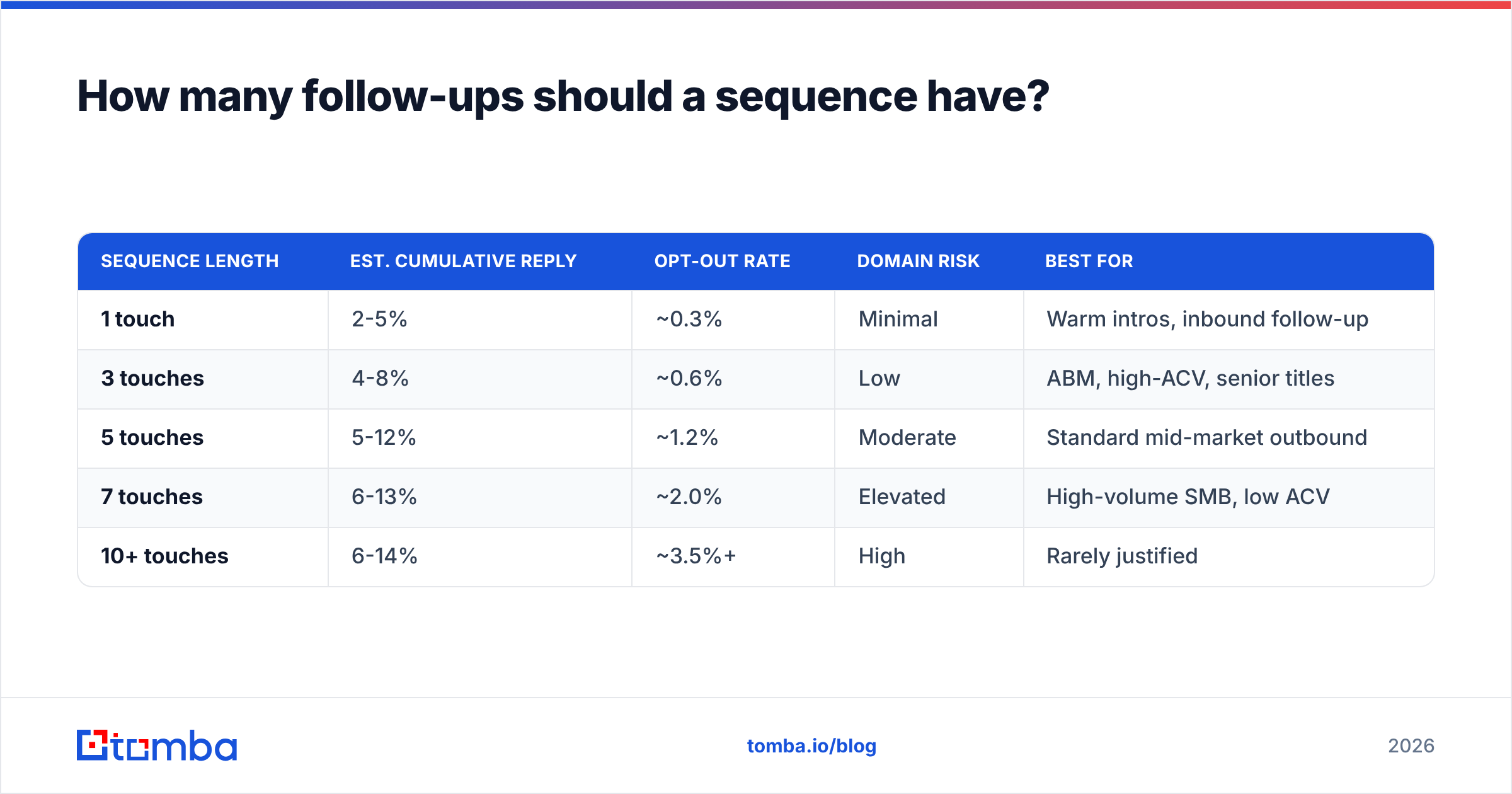
Between three and five for most B2B motions. Here is the trade-off in concrete terms.
| Sequence length | Est. cumulative reply | Opt-out rate | Domain risk | Best for |
|---|---|---|---|---|
| 1 touch | 2-5% | ~0.3% | Minimal | Warm intros, inbound follow-up |
| 3 touches | 4-8% | ~0.6% | Low | ABM, high-ACV, senior titles |
| 5 touches | 5-12% | ~1.2% | Moderate | Standard mid-market outbound |
| 7 touches | 6-13% | ~2.0% | Elevated | High-volume SMB, low ACV |
| 10+ touches | 6-14% | ~3.5%+ | High | Rarely justified |
The curve flattens hard after touch 5. Touches 6-10 typically add one or two points of reply rate while roughly tripling your opt-out and spam-complaint exposure. Since complaint rate is the metric mailbox providers weigh most heavily, buying 1.5 points of reply rate with 2 points of opt-outs is usually a bad trade for the next campaign, even if it looks fine on this one.
Adjust for deal size. A $200k ACV enterprise deal justifies more touches across more channels than a $99/month product. A $99/month product justifies fewer emails and a better landing page.
What should each follow-up actually say?#
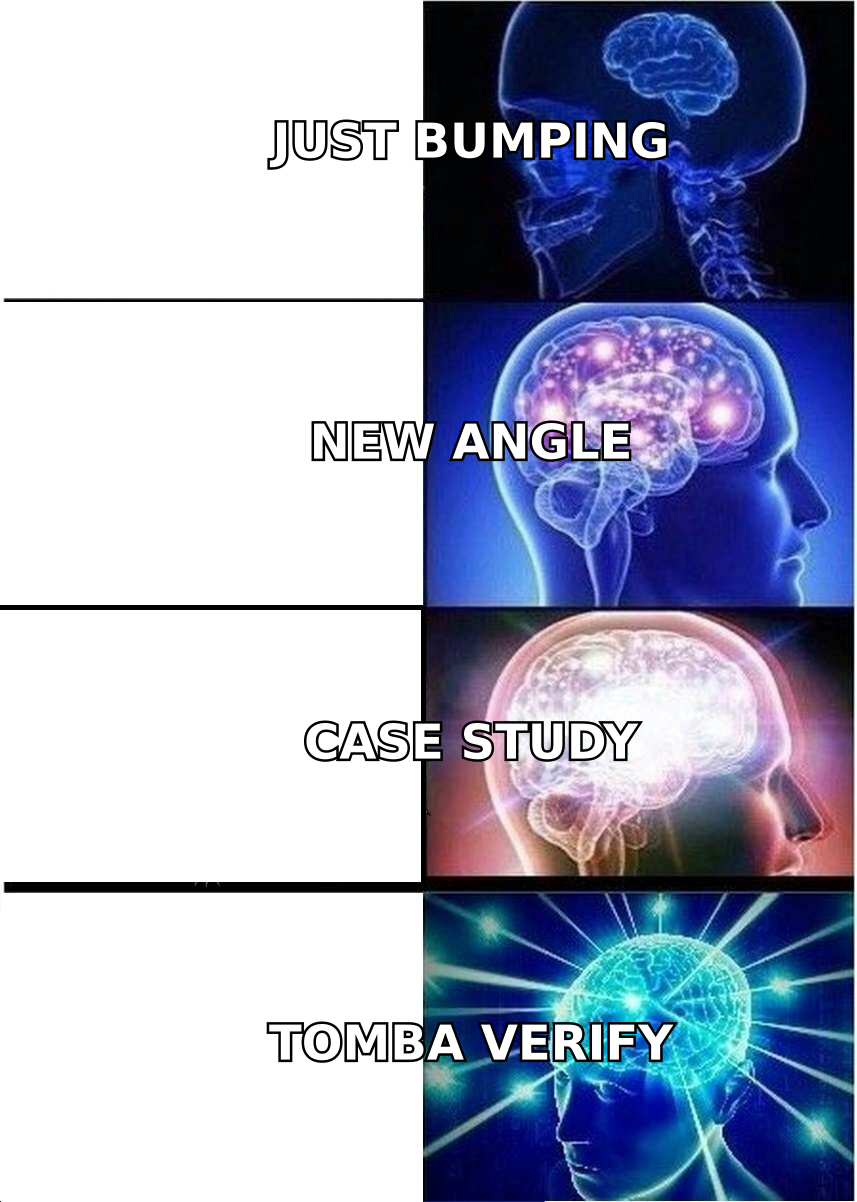
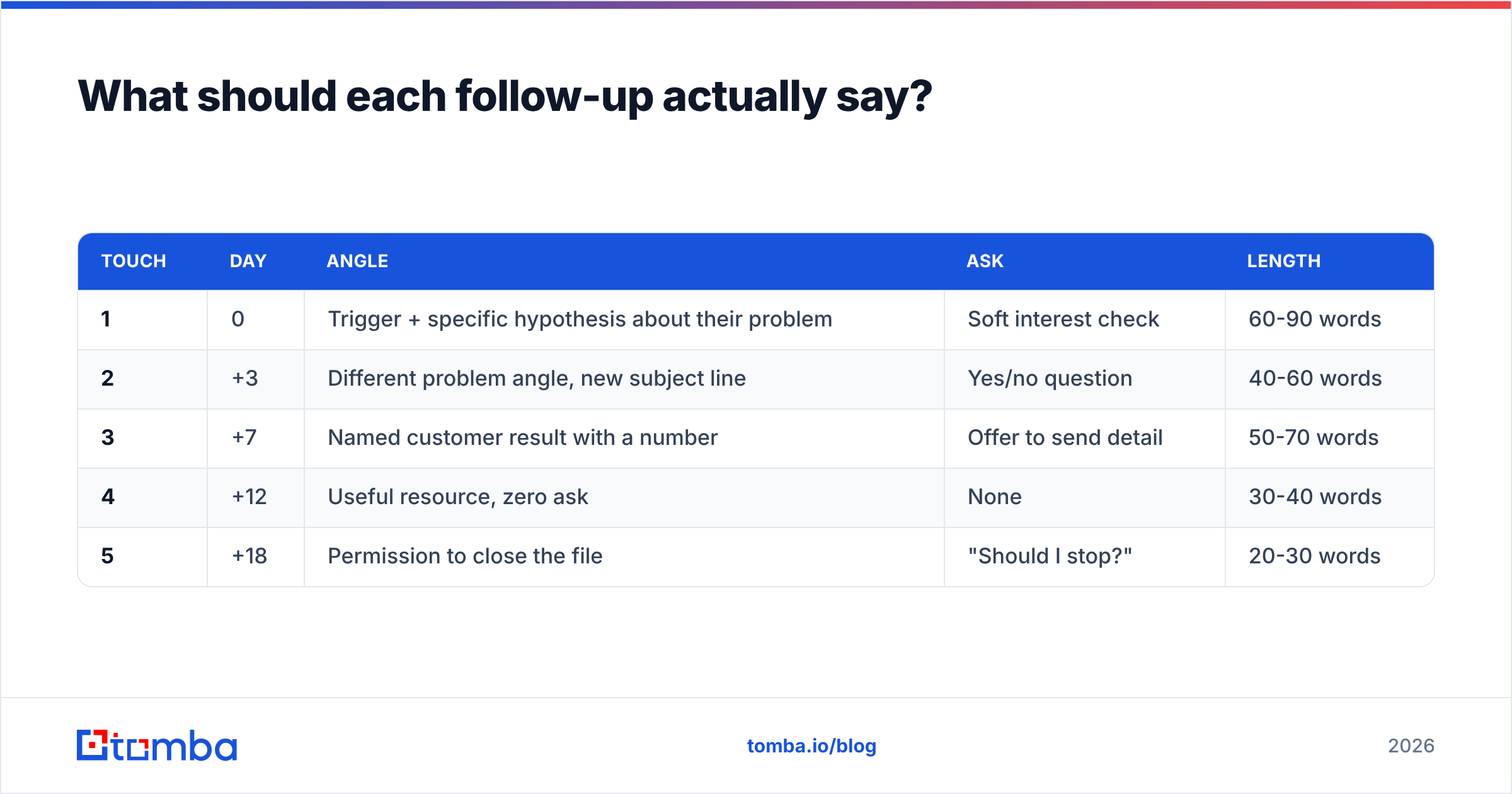
Change the angle every time. Here is a sequence skeleton that avoids the "just bumping this" trap.
| Touch | Day | Angle | Ask | Length |
|---|---|---|---|---|
| 1 | 0 | Trigger + specific hypothesis about their problem | Soft interest check | 60-90 words |
| 2 | +3 | Different problem angle, new subject line | Yes/no question | 40-60 words |
| 3 | +7 | Named customer result with a number | Offer to send detail | 50-70 words |
| 4 | +12 | Useful resource, zero ask | None | 30-40 words |
| 5 | +18 | Permission to close the file | "Should I stop?" | 20-30 words |
Rules that consistently matter more than clever copy:
- Kill "just following up," "circling back," and "bumping this to the top of your inbox." They signal that the email contains no new information — because it usually doesn't.
- Shorten as you go. Touch 1 earns 90 words. Touch 5 earns 25. Length signals effort, and effort late in a sequence reads as desperation.
- Break the thread once. Around touch 3, start a fresh thread with a new subject line. Some prospects have mentally archived the original.
- One ask per email. Two questions halves your reply rate, because the prospect now has to decide which one to answer.
- Make the negative reply easy. "If this isn't a priority, reply 'no' and I'll close it out." Negative replies are cheap, fast, and clean your pipeline. They also train the mailbox provider that people engage with your mail.
For copy starting points, the cold email templates library is a reasonable place to steal structure from, and the subject line tester will catch the spam-trigger words that quietly cut your delivery before reply rate ever enters the picture.
Does send timing actually change reply rate?#
Less than the internet claims, but not zero.
Day-of-week and hour-of-day effects are real and small — typically a 10-20% relative swing, meaning a 4.0% reply rate might become 4.6% or 3.4%. Tuesday through Thursday, 7-10am in the recipient's timezone, is the conventional window, and it is conventional because everyone sends there, which is also the argument for testing the edges.
The timing variable that matters far more is interval spacing.
- Too tight (1-2 days between touches): reads as automation, drives opt-outs, and stacks multiple unread messages that make you easier to ignore in bulk.
- Too loose (14+ days): the recall benefit evaporates and each touch functions as a fresh cold email.
- The zone: 3-5 business days early in the sequence, widening to 6-8 days at the tail.
One practical detail: if your sequencing tool sends touch 2 automatically at the same clock minute as touch 1, you are advertising the automation. Randomize the send window by 30-90 minutes.
How does list quality cap your reply rate?#
This is the section most reply-rate articles skip, and it is the one with the largest effect size.
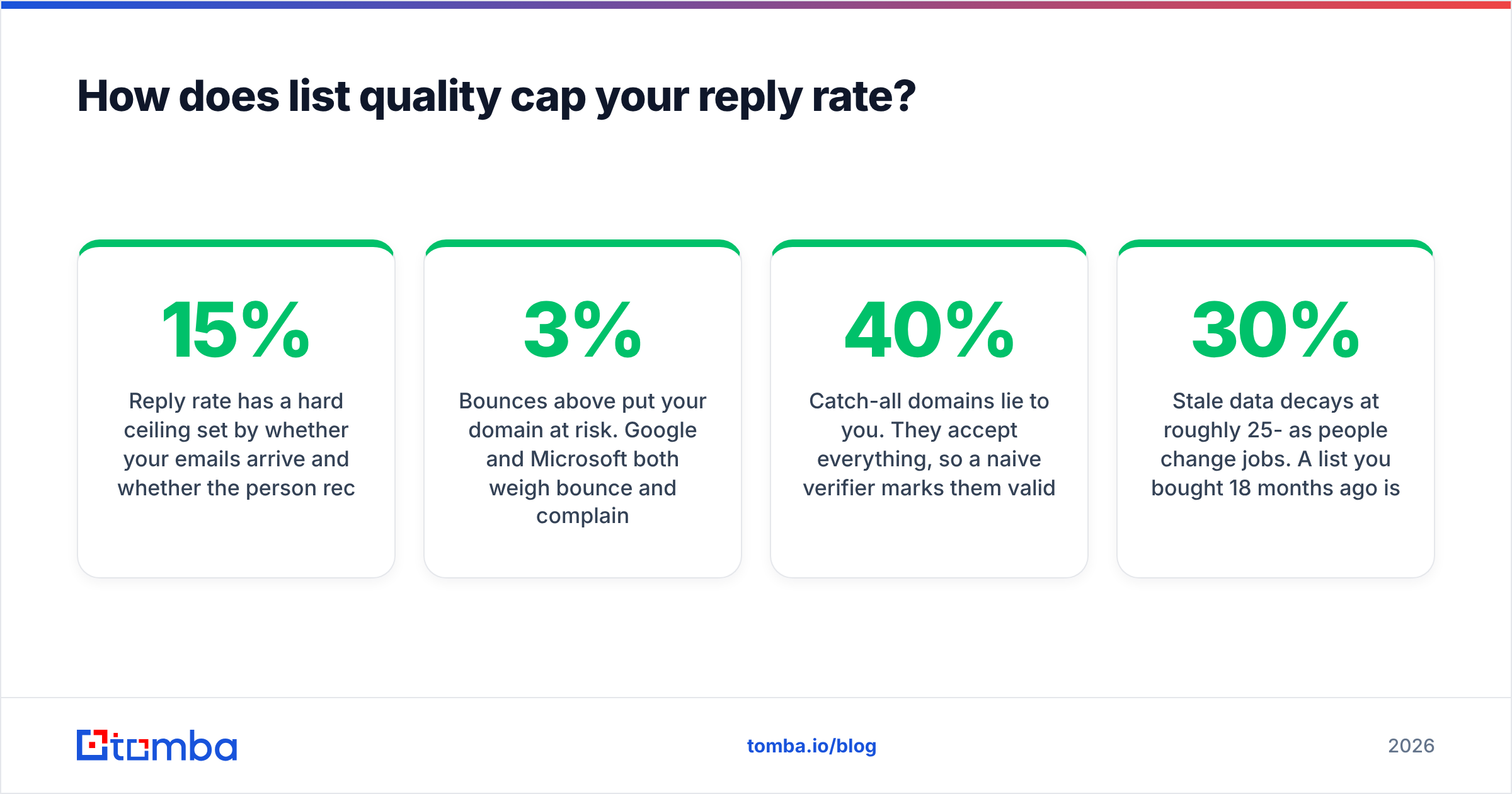
Reply rate has a hard ceiling set by whether your emails arrive and whether the person receiving them is plausibly a buyer. Copy optimization operates below that ceiling. You cannot A/B test your way past a list where 15% of the addresses are dead and 40% of the titles are wrong.
Concretely:
- Bounces above 3% put your domain at risk. Google and Microsoft both weigh bounce and complaint signals when deciding whether to inbox you. A campaign with a 12% bounce rate does not lose 12% of its opportunity — it loses that plus the deliverability of every subsequent send from that domain.
- Catch-all domains lie to you. They accept everything, so a naive verifier marks them valid. They can be 20-40% of a B2B list. Treat them as a separate risk bucket and use a dedicated catch-all verifier rather than assuming the standard check covered it.
- Role addresses (info@, sales@, support@) reply at near zero and complain at above-average rates. Strip them.
- Stale data decays at roughly 25-30% per year as people change jobs. A list you bought 18 months ago is closer to a liability than an asset.
The workflow that protects your reply rate looks like this: source contacts with an email finder, run the full list through an email verifier before it enters the sequencer, quarantine catch-alls into a lower-volume segment, and re-verify anything older than 90 days. Independent review sites like G2's sales engagement category are useful for comparing how different platforms handle that verification step, since the accuracy claims vendors publish about themselves rarely survive contact with a real list.
If you want the underlying definition of the metric itself, the response rate glossary entry covers the variants and how they get miscounted.
What kills follow-up reply rates fastest?#
Ranked by how much damage they do per unit of effort to fix:
- Unverified lists. Biggest lever, cheapest fix. Nothing else you do matters if 1 in 8 emails bounces.
- No new information per touch. If touch 3 is touch 1 with fewer words, delete touch 3.
- Wrong persona. A perfect email to someone with no budget authority and no stake in the problem replies at zero. Analyst firms including Gartner have documented B2B buying groups averaging six to ten stakeholders — which means picking the single right contact is genuinely hard, and picking randomly is genuinely fatal.
- Volume from one domain. Above roughly 50 cold sends per mailbox per day, deliverability degrades regardless of copy. Add mailboxes, not throughput.
- Multi-question emails. Every additional decision you force cuts response probability.
- Links and images in touch 1. They add spam-filter weight for very little persuasive gain. Save the link for touch 3 or 4.
- Sequences that never end. A prospect who has ignored eight emails is telling you something. Believe them.
How do you test follow-ups without fooling yourself?#
Reply rates are low-frequency events, which makes them statistically brutal to test. Moving from a 3% to a 4% reply rate is a 33% relative improvement, but detecting it reliably needs roughly 2,000-3,000 sends per variant. Most teams call a winner at 200 sends and 4 replies versus 2, which is noise.
Practical rules:
- Test one variable at a time. Subject line or opening line or CTA. Not a rewrite.
- Set the sample size before you look. Decide "3,000 per arm" up front, then check.
- Test high-leverage variables first. Segment definition beats sequence length beats CTA phrasing beats subject line. Most teams test in exactly the reverse order.
- Use open rate as a debugging tool, not a KPI. Since Apple Mail Privacy Protection, open rates are inflated and unreliable for measuring interest — but a sudden collapse still flags a deliverability problem worth investigating.
- Hold a control. Keep 10% of volume on last quarter's best sequence so you can tell whether the market moved or your copy did.
The takeaway#
Your follow up email reply rate is mostly a data problem wearing a copywriting costume. Four to five touches, spaced 3-7 days apart, each carrying a genuinely different angle, will roughly double the replies a single email produces. But that entire structure sits on top of one assumption: that the addresses are real and the people behind them are plausible buyers.
Fix the list first. Then fix the sequence.
Start by finding accurate, verified contacts with the Tomba Email Finder — it returns a confidence score and verification status with every address, so you know your bounce exposure before you load a single contact into a sequencer. The free tier includes 25 searches a month, and paid plans start at $49/month; full details are on Tomba pricing.
Related guides#
Ready to find emails that actually work?
Join 150,000+ professionals who stopped guessing and started sending. Free credits on signup — no credit card required.
Get the Tomba newsletter
Practical outbound tactics and product updates — once every two weeks.
About the author