Follow Up Email Template After No Response: 7 That Work
Silence is not a no. It is usually a timing problem, a routing problem, or a bad email address. Here are seven follow-up templates, the cadence behind them, and the point where you should stop sending.
TL;DR
- Most replies to cold outreach come from follow-ups two through five, not the first email. Sending once and stopping is the single most expensive habit in outbound.
- A follow-up email template after no response should add a new angle every time — new proof, new use case, new question. Never "just bumping this up."
- Four to six touches over 14–21 days is the sweet spot for cold prospects. Warm inbound and post-meeting follow-ups run tighter: 2–4 touches over 7–10 days.
- Before you blame your copy, check the address. A silent inbox and a dead mailbox look identical in your sequencing tool.
- Close every sequence with a clean permission-to-close email. It converts better than any of the middle touches and protects your sender reputation.
Why do prospects go silent after the first email?#
Silence almost never means "no." It means your email arrived at a moment when replying cost more than ignoring.
Think of a prospect's inbox like a restaurant host stand on a Friday night. Your email is a walk-in with no reservation. The host isn't rejecting you — they're triaging. If you come back at 9:40 pm when three tables just cleared, you get seated. Same request, different moment.
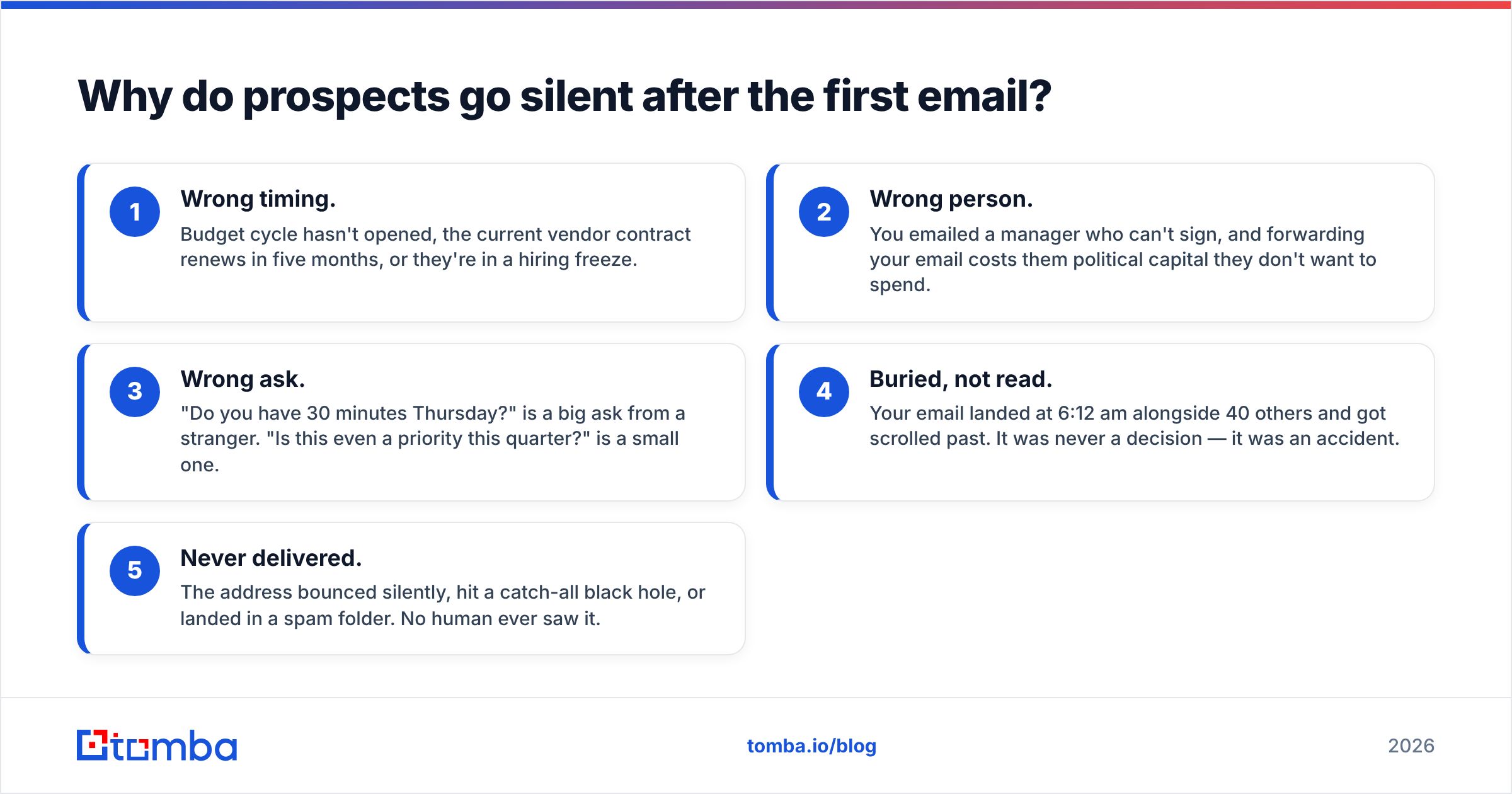
The concrete reasons behind the silence usually fall into five buckets:
- Wrong timing. Budget cycle hasn't opened, the current vendor contract renews in five months, or they're in a hiring freeze.
- Wrong person. You emailed a manager who can't sign, and forwarding your email costs them political capital they don't want to spend.
- Wrong ask. "Do you have 30 minutes Thursday?" is a big ask from a stranger. "Is this even a priority this quarter?" is a small one.
- Buried, not read. Your email landed at 6:12 am alongside 40 others and got scrolled past. It was never a decision — it was an accident.
- Never delivered. The address bounced silently, hit a catch-all black hole, or landed in a spam folder. No human ever saw it.
Only bucket three is a copy problem. That's why "rewrite the email harder" is usually the wrong fix — and why a follow-up sequence, which attacks timing and framing at once, outperforms a single perfect email almost every time.

How many follow-up emails should you send after no response?#
Four to six total touches for cold prospects, spread across 14 to 21 days. Two to four for warm or post-meeting scenarios, spread across 7 to 10 days.
The reason is simple math. If each individual email has a 5% chance of catching someone at a moment they can act, five spaced emails give you a meaningfully higher cumulative shot than one — as long as each one is genuinely worth opening. That last clause is where most sequences break. Five copies of "circling back" does not equal five chances; it equals one chance and four annoyances.
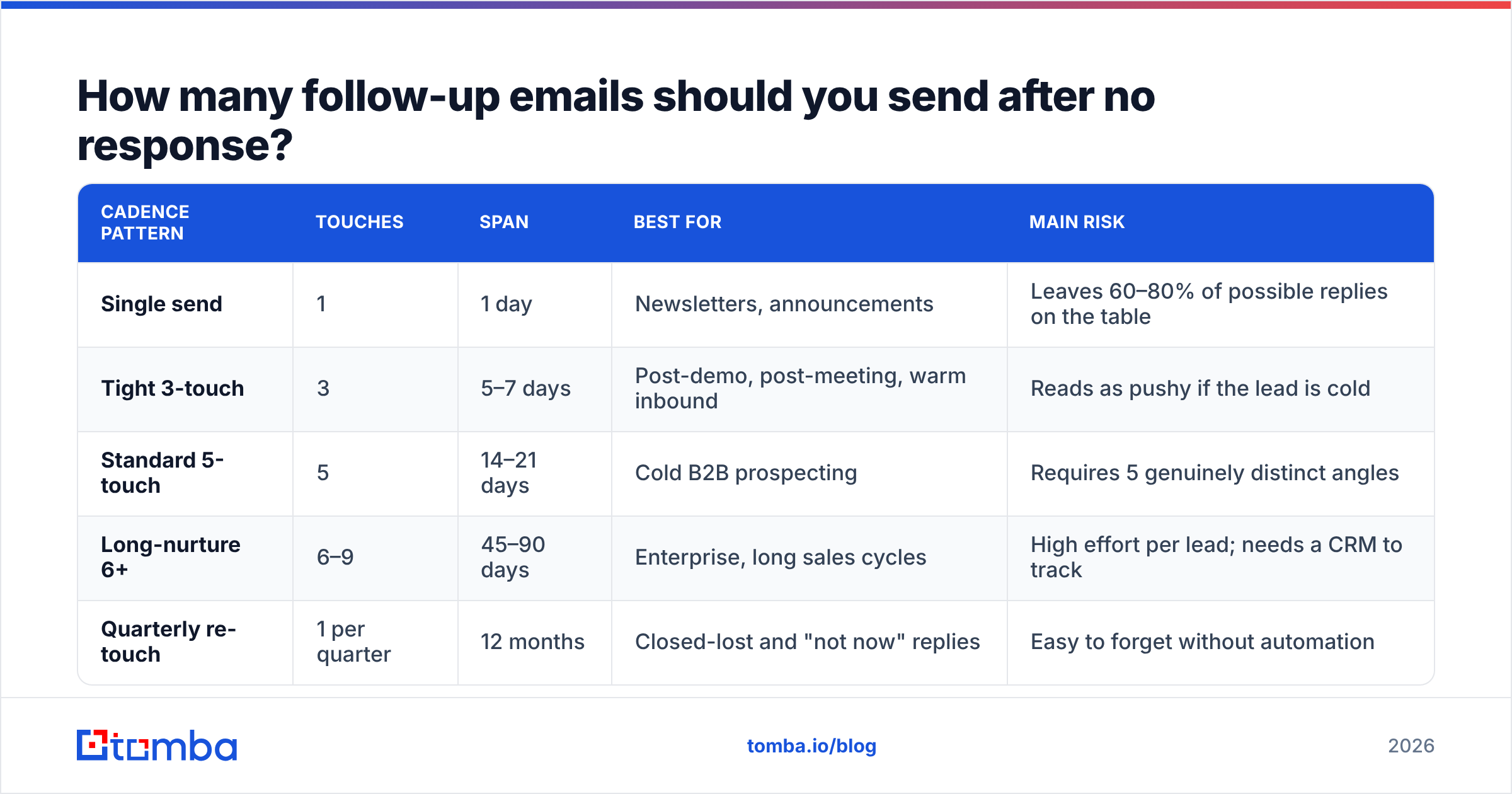
Here's how the common cadence patterns compare in practice:
| Cadence pattern | Touches | Span | Best for | Main risk |
|---|---|---|---|---|
| Single send | 1 | 1 day | Newsletters, announcements | Leaves 60–80% of possible replies on the table |
| Tight 3-touch | 3 | 5–7 days | Post-demo, post-meeting, warm inbound | Reads as pushy if the lead is cold |
| Standard 5-touch | 5 | 14–21 days | Cold B2B prospecting | Requires 5 genuinely distinct angles |
| Long-nurture 6+ | 6–9 | 45–90 days | Enterprise, long sales cycles | High effort per lead; needs a CRM to track |
| Quarterly re-touch | 1 per quarter | 12 months | Closed-lost and "not now" replies | Easy to forget without automation |
Two rules that matter more than the exact numbers:
- Space intervals should widen, not stay flat. Day 0, day 3, day 7, day 14, day 21. Compressing everything into a week reads as desperation; stretching everything to monthly loses the thread.
- Every touch must survive the "would I open this?" test. If the answer is no, don't send it. A skipped touch costs you nothing. A bad touch costs you the whole thread and sometimes the domain reputation.
What does a follow-up email template after no response actually need?#
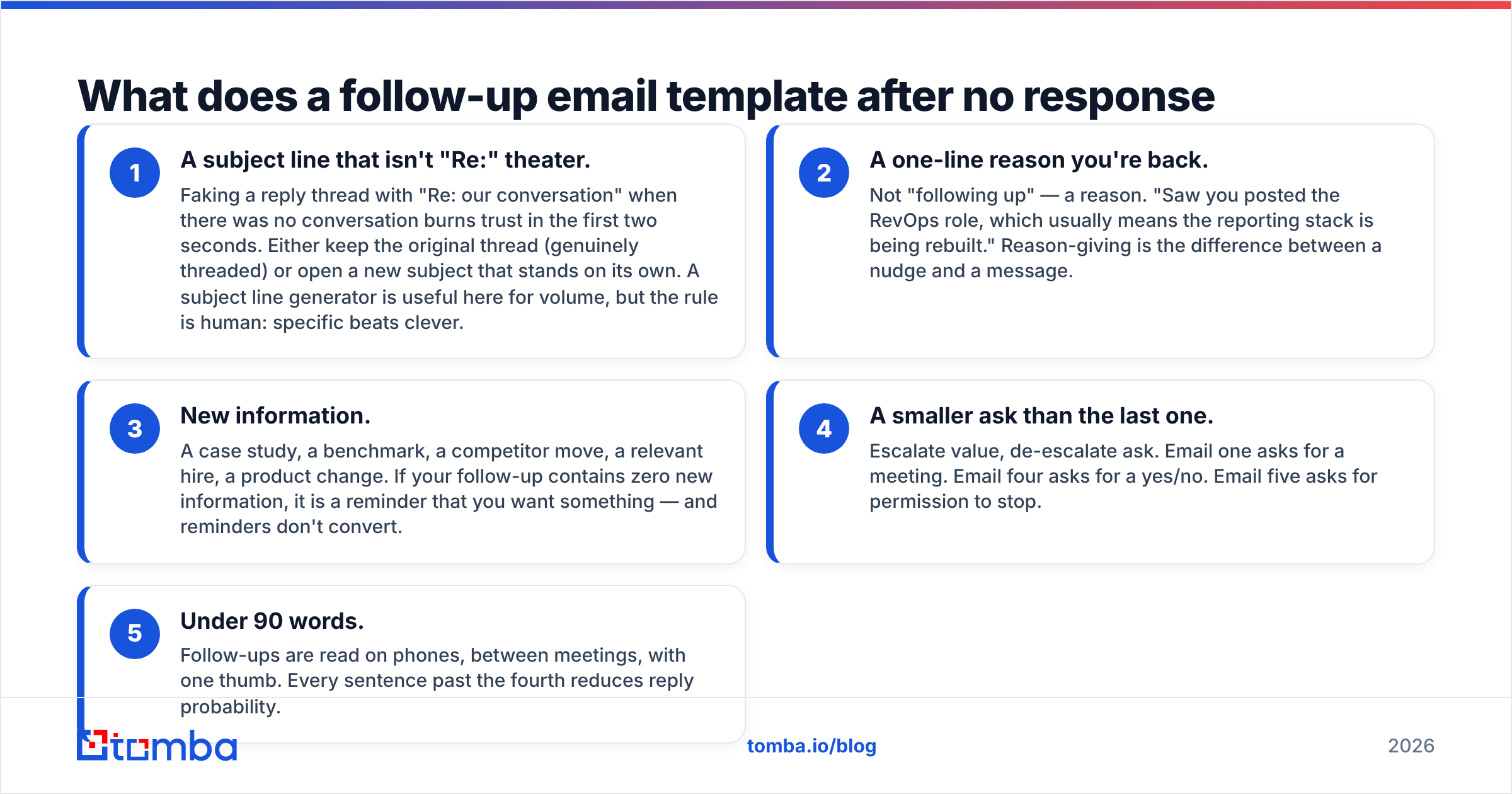
Five components. Miss any one and the reply rate drops off a cliff.
- A subject line that isn't "Re:" theater. Faking a reply thread with "Re: our conversation" when there was no conversation burns trust in the first two seconds. Either keep the original thread (genuinely threaded) or open a new subject that stands on its own. A subject line generator is useful here for volume, but the rule is human: specific beats clever.
- A one-line reason you're back. Not "following up" — a reason. "Saw you posted the RevOps role, which usually means the reporting stack is being rebuilt." Reason-giving is the difference between a nudge and a message.
- New information. A case study, a benchmark, a competitor move, a relevant hire, a product change. If your follow-up contains zero new information, it is a reminder that you want something — and reminders don't convert.
- A smaller ask than the last one. Escalate value, de-escalate ask. Email one asks for a meeting. Email four asks for a yes/no. Email five asks for permission to stop.
- Under 90 words. Follow-ups are read on phones, between meetings, with one thumb. Every sentence past the fourth reduces reply probability.
Keep the structure fixed and vary only the angle. That's what makes a template a template instead of a script you're embarrassed to send.
What are the 7 best follow-up email templates after no response?#
Copy these, then replace every bracket with something only you could know about that specific account. Generic personalization ("love what you're doing at [Company]") is worse than none.
1. The value-add bump (day 3)
Subject: one more thing on [specific problem]
[Name] — forgot to include this. [Link/attachment: a benchmark, teardown, or short case] covers how [similar company] handled [problem] without [common objection].
Worth 4 minutes even if we never talk. Should I send the 2-line version instead?
2. The reframe (day 7)
Subject: wrong angle on my part
I pitched [your framing] last week. Reading your [job post / product update / annual report] again, the sharper angle is probably [new framing].
Is [new framing] actually a priority this quarter, or is it a 2027 problem?
3. The social proof drop (day 10)
Subject: what [Peer Company] did about [problem]
[Peer Company] had the same [constraint]. They [specific action] and [specific, non-inflated result] in [timeframe].
Happy to send the two-paragraph breakdown — no call needed. Yes or no?
4. The single-question email (day 14)
Subject: quick one
[Name] — who owns [specific process] at [Company] these days? If it isn't you, I'll stop filling your inbox.
5. The permission-to-close (day 21)
Subject: closing the loop
I've sent a few notes about [topic] and haven't heard back, which usually means it's not a priority right now — totally fair.
I'll close the file unless you tell me otherwise. If timing changes in Q[X], reply "later" and I'll come back then.
6. The post-meeting no-show recovery (same day)
Subject: missed you at [time]
Rough calendar days happen. Here's the 3-slide version of what I was going to walk through: [link].
Want to re-book, or should I just send the pricing sheet and let you self-serve?
7. The re-engagement after "not now" (90 days)
Subject: you said Q[X] — it's Q[X]
You mentioned revisiting [topic] this quarter. [One thing that changed since: a feature, a price, a benchmark].
Still relevant, or has the plan changed?
Template five does more work than people expect. Loss-aversion is real: telling someone you're about to stop often produces the reply that four value-adds couldn't. Just don't fake it — if you say you're closing the file, close it.
Should you follow up by email, LinkedIn, or phone?#
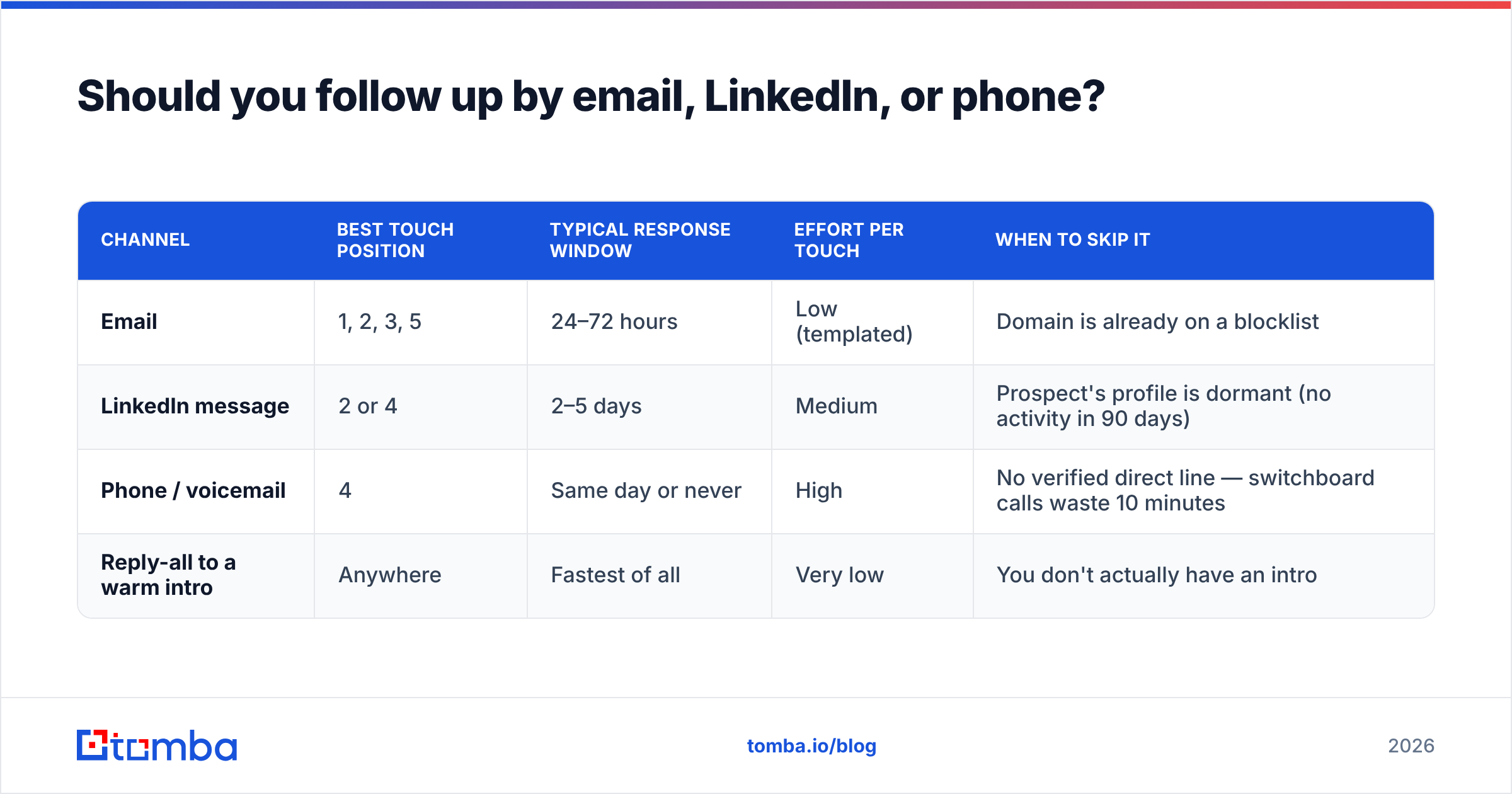
All three, in that order of volume, with email as the spine. Multichannel sequences consistently beat single-channel ones because each channel fails differently — a full inbox and a full voicemail box are rarely full on the same day.
| Channel | Best touch position | Typical response window | Effort per touch | When to skip it |
|---|---|---|---|---|
| 1, 2, 3, 5 | 24–72 hours | Low (templated) | Domain is already on a blocklist | |
| LinkedIn message | 2 or 4 | 2–5 days | Medium | Prospect's profile is dormant (no activity in 90 days) |
| Phone / voicemail | 4 | Same day or never | High | No verified direct line — switchboard calls waste 10 minutes |
| Reply-all to a warm intro | Anywhere | Fastest of all | Very low | You don't actually have an intro |
A practical pattern: email on day 0, email on day 3, LinkedIn connect with no pitch on day 5, email on day 7, call on day 10, permission-to-close email on day 14. If you don't have direct dials, a phone finder fills that gap without buying an entire sales-engagement suite.
How do you know the silence isn't just a bad email address?#
Check the data before you rewrite the copy. This is the step most teams skip, and it quietly ruins their conclusions.
Your sequencing tool reports the same thing for four different realities: the person read it and didn't care, the person never saw it because of spam filtering, the mailbox is a catch-all that accepts everything and delivers nothing, and the address was never valid. If 30% of your list falls into the last three categories, your "reply rate problem" is a data problem wearing a copy costume.
Three checks, in order:
- Verify before send, not after bounce. Run the list through an email verifier so hard bounces never reach your sending domain. Bounce rates above roughly 3% start dragging your sender reputation down, which suppresses delivery for the good addresses too.
- Handle catch-all domains separately. Catch-all servers accept mail for any address at the domain, so standard verification returns "unknown." Segment them into a lower-volume track rather than treating them as verified, and use a dedicated catch-all verifier to score them properly.
- Confirm you have the right person, not just a valid address. A valid
info@address is worse than no address. Use domain search to pull the actual role owner, and confirm the pattern matches other employees at that company.
For the underlying deliverability mechanics — SPF, DKIM, DMARC, and how mailbox providers score senders — the CAN-SPAM Act overview on Wikipedia covers the compliance floor, and HubSpot's sales blog publishes regular benchmark data on cadence and reply rates worth checking against your own numbers.
What mistakes kill follow-up emails after no response?#
- "Just bumping this to the top of your inbox." It tells the reader you have nothing new. Delete this sentence from your organization permanently.
- Guilt framing. "I've reached out three times now" makes the silence the prospect's fault. It isn't, and they will not reward you for pointing it out.
- Stacking the same ask. Four consecutive "15 minutes Thursday?" emails is one email sent four times.
- Sending at 9:00 am sharp. So does every other sequencer. Off-peak windows — 7:15 am, 1:40 pm, 4:50 pm — face less competition.
- No stop condition. If your sequence has no defined end, you are running a spam program with a CRM attached. Every sequence needs a template five.
- Ignoring the reply that isn't a yes. "Not now" is a qualified lead with a date attached. Route it to a 90-day re-touch, not the trash.
If you want a starting library rather than building from scratch, the cold email templates collection covers the first-touch variants that these follow-ups are designed to sit behind, and reviews on G2's sales engagement category are a reasonable place to sanity-check which sequencing tool actually fits your volume.
How do you measure whether your follow-ups are working?#
Track four numbers per sequence step, not per campaign:
- Reply rate by touch number. If touch four outperforms touch one, your first email is the weak link, not your persistence.
- Positive reply share. Replies that aren't "unsubscribe" or "wrong person." A 12% reply rate with 2% positive is a targeting failure.
- Bounce rate by list source. Segment by where the contacts came from. One bad source can poison an entire month.
- Meetings per 100 verified contacts. Verified is the key word — measuring against raw list size flatters bad data.
Benchmarking these against your own previous quarter beats benchmarking against public averages, since response rate varies enormously by industry, seniority, and list quality.
Where should you start?#
Fix the list before the copy. A perfect follow-up email template after no response still gets zero replies if it's landing on addresses that don't resolve to a real, current human — and you'll spend weeks A/B testing subject lines to discover a data problem.
Start by pulling verified, role-matched contacts with the Tomba Email Finder. It resolves addresses by domain, name, or company, flags catch-all domains instead of guessing, and runs verification in the same pass — so the only variable left in your sequence is the writing. The free tier gives you 25 searches a month to test the workflow; Starter is $49/mo and Growth is $99/mo if you're running real volume. Full Tomba pricing is on the site, and the Tomba API covers it if you'd rather wire enrichment straight into your sequencer.
Then send template five. It works more often than it should.
Related guides#
Ready to find emails that actually work?
Join 150,000+ professionals who stopped guessing and started sending. Free credits on signup — no credit card required.
Get the Tomba newsletter
Practical outbound tactics and product updates — once every two weeks.
About the author