Follow Up Email to a Busy Person: Templates That Get Replies
Busy executives are not ignoring you on purpose — your follow-up is just too expensive to answer. Here are the timing rules, templates, and sequence structure that get replies from people with 200 unread emails.
TL;DR
- A busy person is not deciding against you. They are deferring you, because replying costs more effort than skipping. Every fix below reduces that cost.
- The single highest-leverage change: replace "just following up" with a question answerable in under ten seconds — a yes/no, a date, or a name.
- Send follow-ups 3, 7, and 14 days apart, at most 4 total, and change the angle each time. Same-thread beats new-thread for the first two.
- Reply rates collapse when the address is wrong, not when the copy is wrong. Verify before you sequence — bounces on an executive domain damage your sending reputation fast.
- Break-up emails still work, but only the honest version: state you are closing the loop, leave one door open, and actually stop.
Why does a busy person ignore your follow-up email?#
Because answering you is work, and you did not do that work for them.
Think of an executive inbox like a hospital triage desk. Nobody reads charts front to back. They scan for one thing: can this be handled in under fifteen seconds, or does it need a block of time I don't have? Anything in the second bucket gets pushed to "later," and later is a landfill.
Most follow-ups land in that second bucket for boring, fixable reasons:
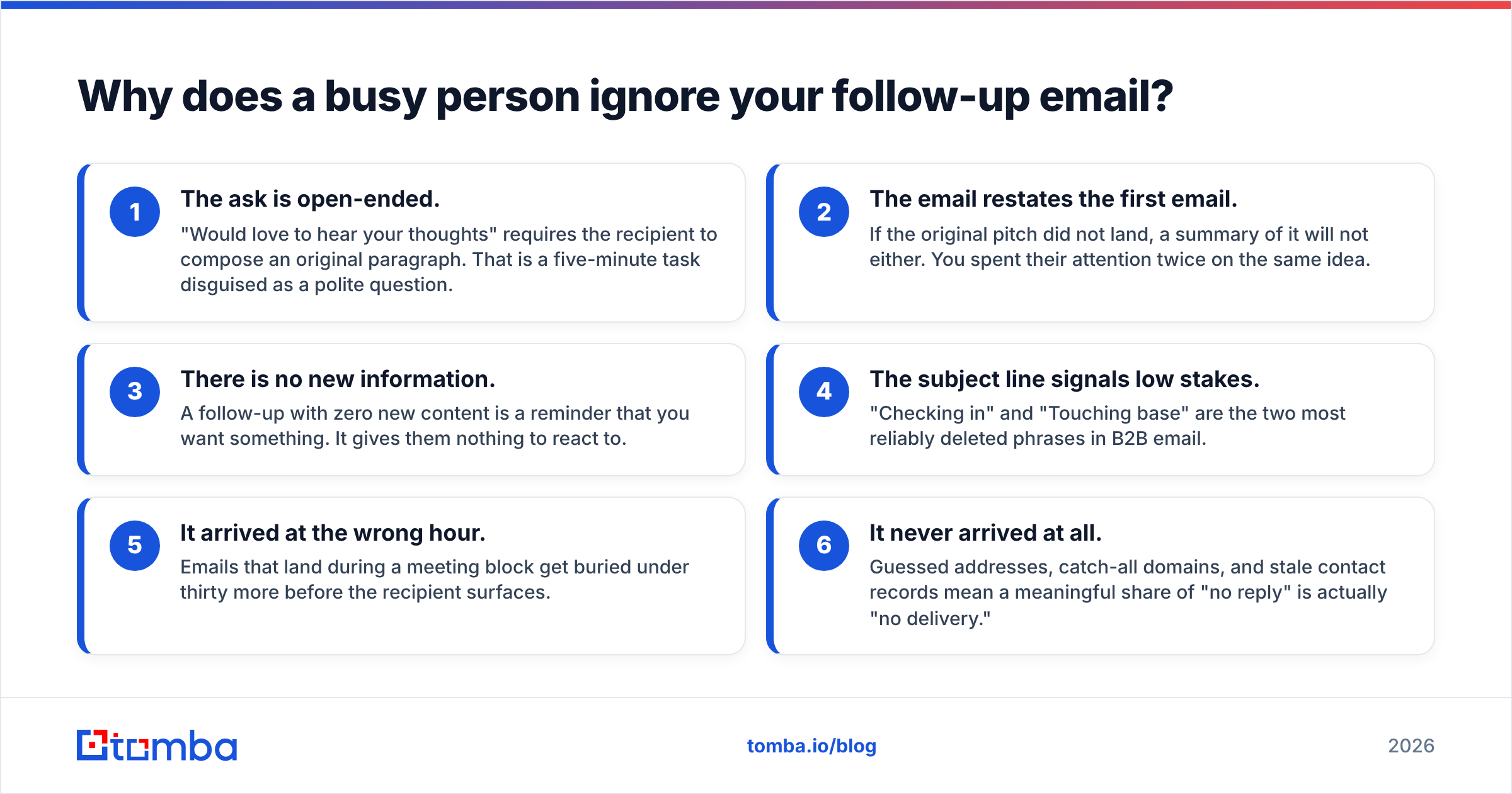
- The ask is open-ended. "Would love to hear your thoughts" requires the recipient to compose an original paragraph. That is a five-minute task disguised as a polite question.
- The email restates the first email. If the original pitch did not land, a summary of it will not either. You spent their attention twice on the same idea.
- There is no new information. A follow-up with zero new content is a reminder that you want something. It gives them nothing to react to.
- The subject line signals low stakes. "Checking in" and "Touching base" are the two most reliably deleted phrases in B2B email.
- It arrived at the wrong hour. Emails that land during a meeting block get buried under thirty more before the recipient surfaces.
- It never arrived at all. Guessed addresses, catch-all domains, and stale contact records mean a meaningful share of "no reply" is actually "no delivery."
That last one matters more than most people admit. If you are following up on an address you inferred from a naming pattern, silence tells you nothing about your copy.

What makes a follow-up email to a busy person actually work?#
Four properties, in order of impact.
Cheap to answer. The reply should be possible from a phone, one-handed, in a hallway. "Is this a Q3 problem or a next-year problem?" costs three words to answer. "What are your current priorities around data infrastructure?" costs a paragraph.
New in some way. Every follow-up should carry something the previous one did not: a customer result from their industry, a relevant news item about their company, a shorter version of the offer, a different stakeholder angle. New information is what makes reading it a decision rather than a chore.
Short enough to read in the preview pane. Aim for 40-90 words in the body. On mobile, that's roughly what fits without scrolling. Anything longer gets deferred, and deferred means dead.
Respectful of the actual power dynamic. You are asking for their time; they owe you nothing. That doesn't mean grovelling — it means removing guilt-trip phrasing ("I've reached out three times now"), fake urgency, and false familiarity.
Here is what that looks like side by side.
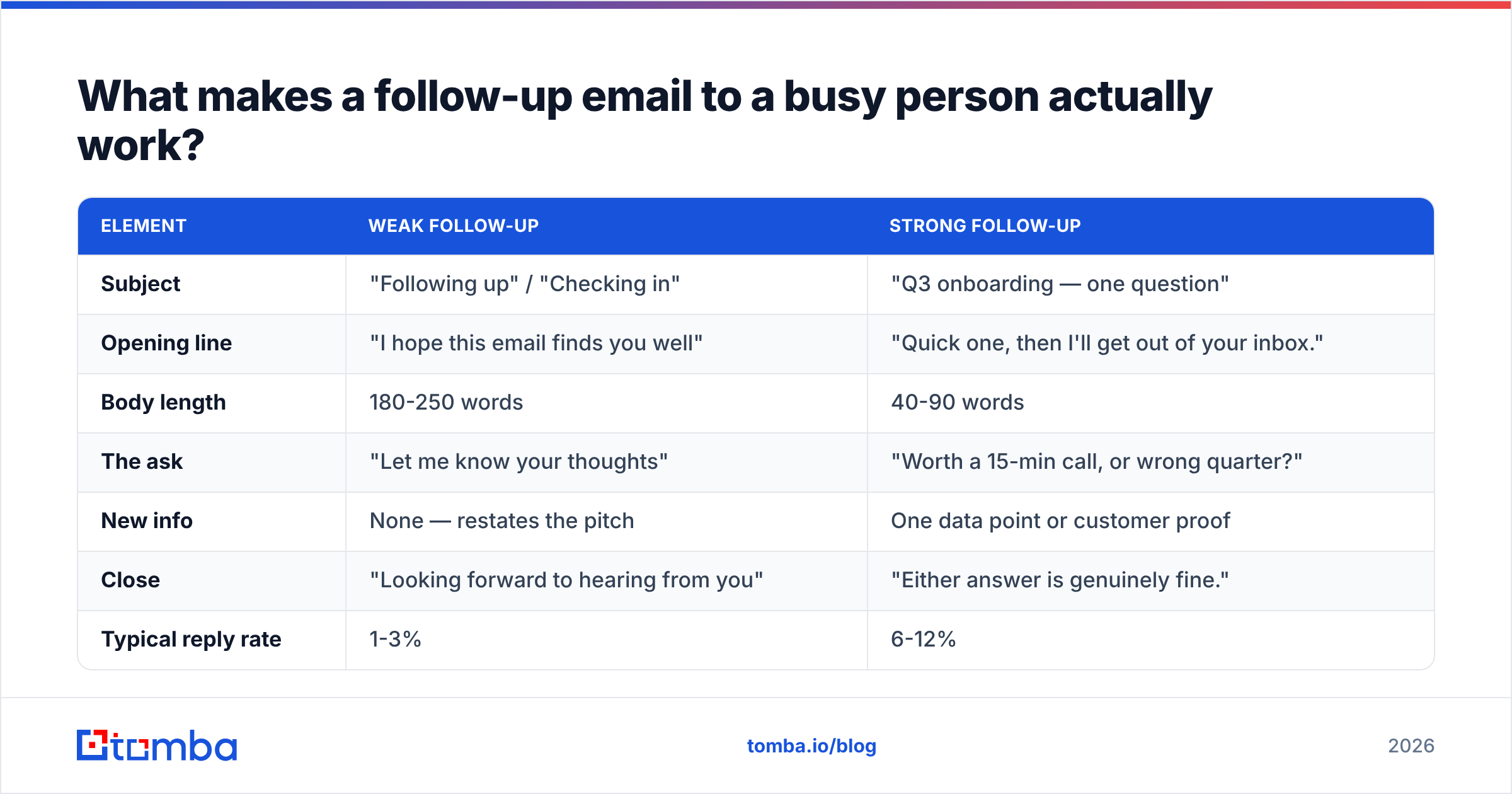
| Element | Weak follow-up | Strong follow-up |
|---|---|---|
| Subject | "Following up" / "Checking in" | "Q3 onboarding — one question" |
| Opening line | "I hope this email finds you well" | "Quick one, then I'll get out of your inbox." |
| Body length | 180-250 words | 40-90 words |
| The ask | "Let me know your thoughts" | "Worth a 15-min call, or wrong quarter?" |
| New info | None — restates the pitch | One data point or customer proof |
| Close | "Looking forward to hearing from you" | "Either answer is genuinely fine." |
| Typical reply rate | 1-3% | 6-12% |
The right column is not cleverer writing. It is less work for the reader.
How long should you wait before following up?#
Three days for the first follow-up, then widen the gaps.
There's no universal law here, but the practical logic is straightforward: a same-day or next-day follow-up reads as pressure, and a two-week gap means they've forgotten you exist. Three business days is long enough to clear a normal inbox backlog and short enough that your first email is still faintly familiar.
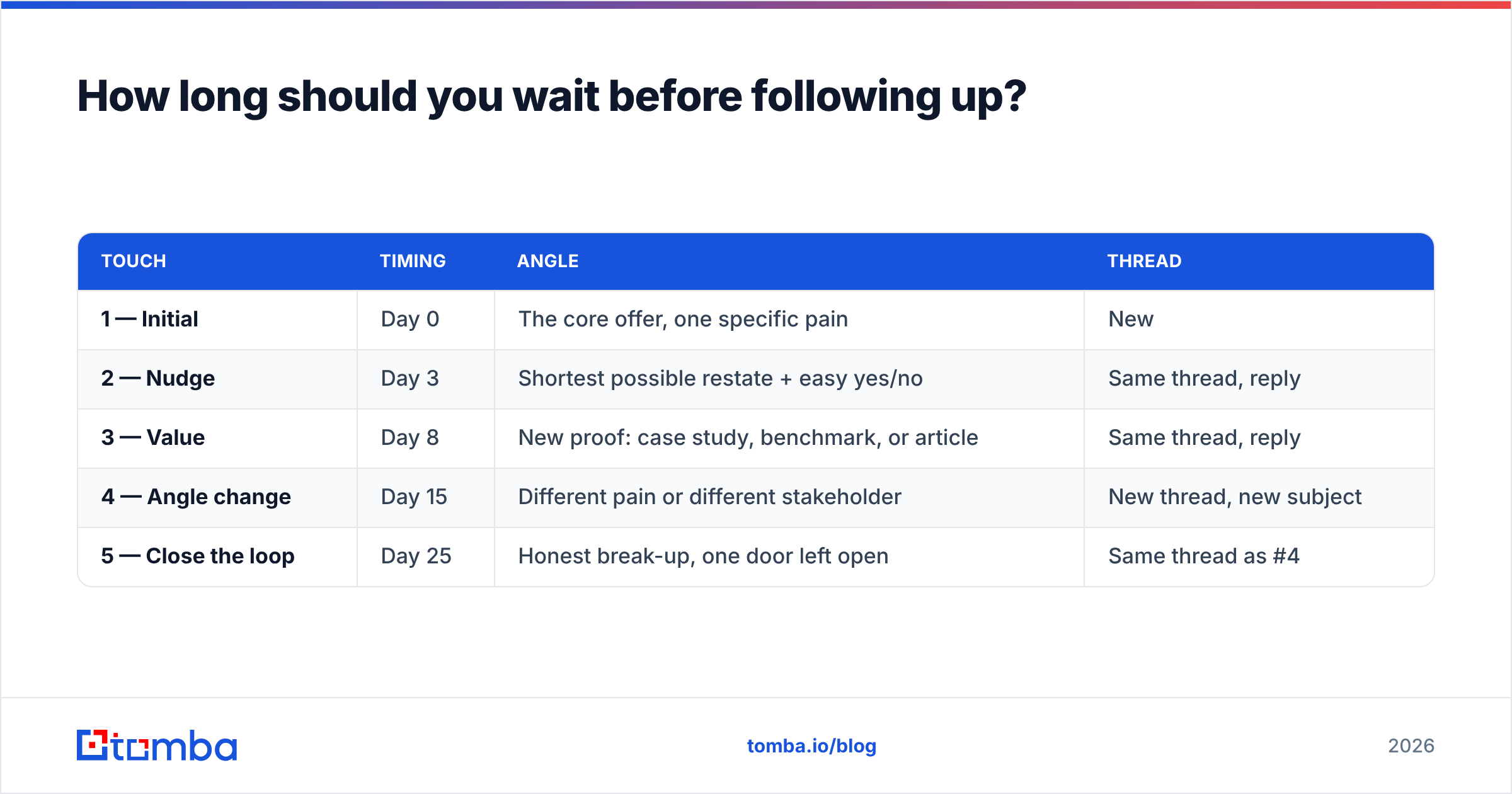
| Touch | Timing | Angle | Thread |
|---|---|---|---|
| 1 — Initial | Day 0 | The core offer, one specific pain | New |
| 2 — Nudge | Day 3 | Shortest possible restate + easy yes/no | Same thread, reply |
| 3 — Value | Day 8 | New proof: case study, benchmark, or article | Same thread, reply |
| 4 — Angle change | Day 15 | Different pain or different stakeholder | New thread, new subject |
| 5 — Close the loop | Day 25 | Honest break-up, one door left open | Same thread as #4 |
Four to five touches total is the sweet spot for most B2B outbound. Past that, marginal reply rate drops sharply and unsubscribe/spam complaints climb — which quietly damages your sender reputation across every other campaign you're running.
Two timing details that matter more than people expect:
- Avoid Monday mornings and Friday afternoons. Monday morning is triage. Friday afternoon is checkout. Tuesday through Thursday, 7-9am in the recipient's timezone, tends to land at the top of the stack.
- Match their rhythm, not yours. If you're emailing a CFO in the last two weeks of a quarter, you are competing with close. Shift the sequence or acknowledge it directly: "Assuming quarter-close is eating everything — should I circle back in three weeks?"
What should you actually write? (5 templates)#
Copy these, then strip out anything that isn't specific to your prospect.
1. The ten-second question
Subject: Quick one on [specific process]
[Name] — one question, then I'm done.
Is [specific problem] something your team owns, or does it sit with [other department]?
If it's not you, a name is all I need and I'll stop bothering you.
[Your name]
Why it works: the escape hatch. "Not my area" is an easy reply, and it usually comes with a referral.
2. The new-information nudge
Subject: [Competitor] just published their numbers
Saw [Competitor] moved to [approach] last month — same shift you'd mentioned considering on your [podcast/blog post/earnings call].
We ran the same play at [Similar Company] and cut [metric] by [number].
Worth 15 minutes, or is this a next-year problem?
[Your name]
Why it works: it earns the interruption. You're bringing something, not asking for something.
3. The shrink-the-ask
Subject: Re: [original subject]
[Name] — I'll assume a call is too much right now.
Instead: can I send a two-paragraph summary of how [Similar Company] handled [problem]? No deck, no call, just the summary.
Yes or no is a complete answer.
[Your name]
Why it works: it downgrades the commitment instead of repeating it. A "yes" here restarts the conversation at zero risk to them.
4. The referral pivot
Subject: Wrong person?
[Name] — I've probably got the wrong desk.
If [problem area] belongs to someone else on your team, point me at them and I'll take it from there.
Thanks either way.
[Your name]
Why it works: it reframes silence as a routing error rather than a rejection, which is face-saving for both of you. Pair it with a phone finder lookup if the referral goes to someone who lives on their mobile instead of in email.
5. The honest break-up
Subject: Re: [original subject]
[Name] — closing the loop on this one so I stop cluttering your inbox.
If [problem] becomes a priority in the next couple of quarters, my line is open. Otherwise, I'll leave you to it.
Genuinely, thanks for the time you did spend reading these.
[Your name]
Why it works: it is the only follow-up with no ask, which is exactly why it gets replies. Do not weaponise it by sending another email three days later — that turns a graceful exit into a bait-and-switch.
Does the channel matter, or just the copy?#
It matters, and the effect is bigger than most copy tweaks.
A follow-up that arrives in a second channel gets read because it's unexpected. Someone who has trained themselves to ignore your emails hasn't trained themselves to ignore your LinkedIn message. Practical rotation:
- Touches 1-2: email only. Establish the thread, keep it low-friction.
- Touch 3: LinkedIn view + a short comment on their recent post. No pitch. This is pattern recognition, not outreach — when your next email lands, the name is familiar. Our notes on LinkedIn outreach go deeper on sequencing this without looking desperate.
- Touch 4: email, new subject line. Different angle, different pain.
- Touch 5: phone or voicemail, then the break-up email. For senior buyers, a 20-second voicemail referencing the email thread lifts email reply rates on its own, even when they don't call back.
One caution: multichannel amplifies whatever your baseline is. If your targeting is wrong, you'll just be annoying in three places instead of one.
How does data quality change your follow-up strategy?#
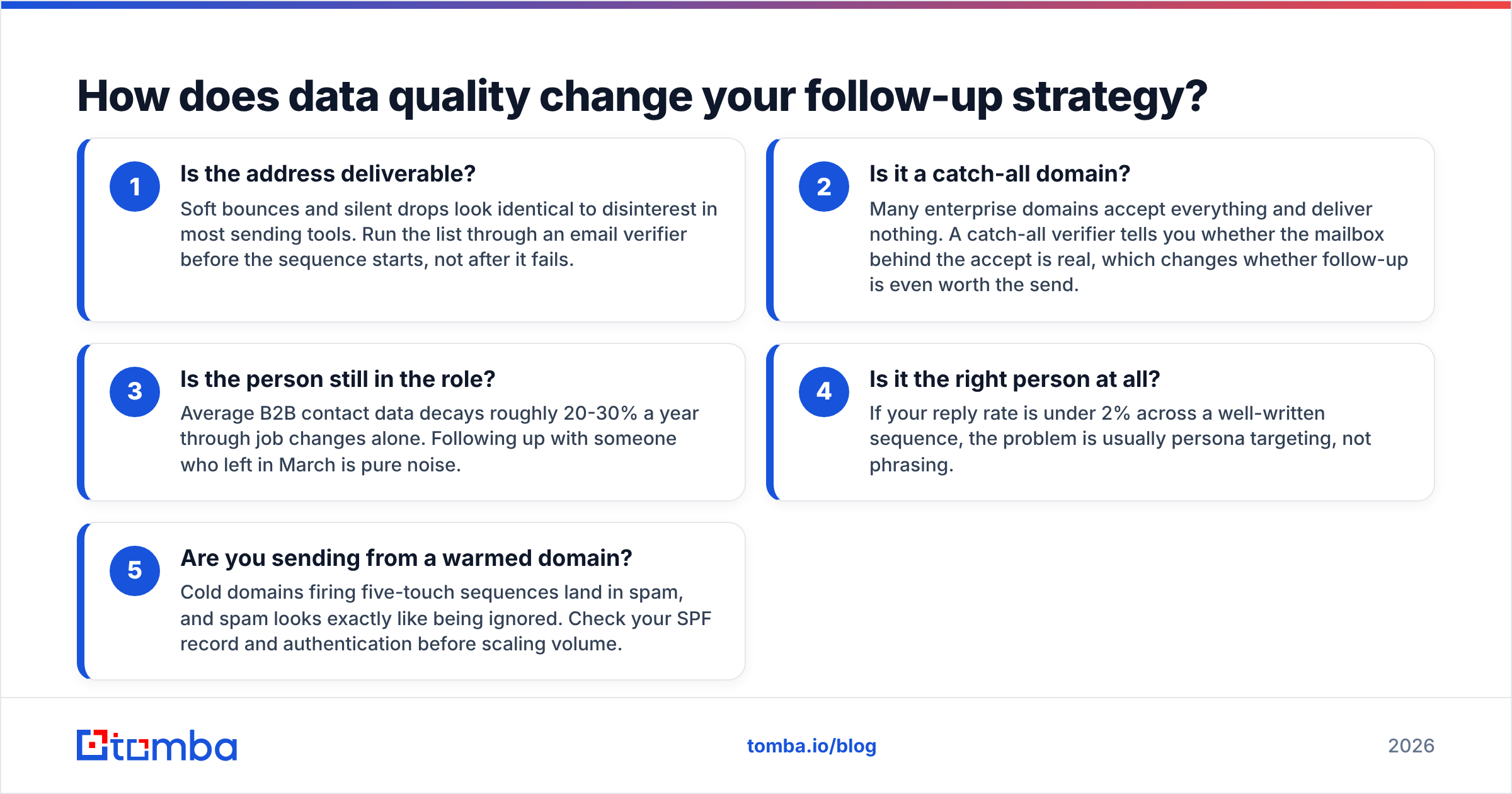
It changes the diagnosis. Without clean data, you cannot tell the difference between "bad copy" and "wrong address," and you'll rewrite templates that were never the problem.
Run this check before you blame the writing:
- Is the address deliverable? Soft bounces and silent drops look identical to disinterest in most sending tools. Run the list through an email verifier before the sequence starts, not after it fails.
- Is it a catch-all domain? Many enterprise domains accept everything and deliver nothing. A catch-all verifier tells you whether the mailbox behind the accept is real, which changes whether follow-up is even worth the send.
- Is the person still in the role? Average B2B contact data decays roughly 20-30% a year through job changes alone. Following up with someone who left in March is pure noise.
- Is it the right person at all? If your reply rate is under 2% across a well-written sequence, the problem is usually persona targeting, not phrasing.
- Are you sending from a warmed domain? Cold domains firing five-touch sequences land in spam, and spam looks exactly like being ignored. Check your SPF record and authentication before scaling volume.
For sourcing the contacts in the first place, a domain search that returns verified addresses per company beats guessing patterns with a permutator — permutated addresses are the single biggest source of phantom "no replies" in outbound. G2's sales intelligence category is a reasonable place to compare vendors on data freshness rather than feature count.
What do the numbers say about follow-up frequency?#
Roughly: most replies come after the first email, and most people stop before collecting them.
The pattern reported consistently across outbound teams is that touches 2 and 3 generate a meaningful share of total replies, and that reply volume falls off a cliff after touch 5. HubSpot's sales research and similar vendor studies land in the same territory — the exact percentages vary by industry and list quality, so treat them as direction, not gospel.
Two practical implications:
- Sending one email and stopping wastes most of your prospecting effort. The address, the research, and the personalisation are already paid for. Not following up throws that away.
- Sending eight emails is worse than sending four. You collect almost no incremental replies and a lot of incremental spam complaints, which taxes email deliverability for every campaign that follows.
The honest framing: follow-up frequency is a floor-raising tactic, not a ceiling-raising one. It rescues deals your first email nearly landed. It will not rescue a message sent to the wrong person about a problem they don't have.
What are the most common follow-up mistakes?#
- Guilt-tripping. "This is my fourth attempt" tells them you're keeping score. It also tells them your process matters more to you than their outcome.
- Fake urgency. "Prices go up Friday" from a stranger reads as a discount pitch, and senior buyers have seen it a thousand times.
- Bumping your own thread with one word. "Bump." "Thoughts?" "Any update?" These are the emails that get people marked as spam.
- Attaching a deck to a follow-up. Attachments from unknown senders hurt deliverability and nobody opens a PDF from someone they haven't replied to.
- Personalising the opener and nothing else. A custom first line followed by a generic pitch is more transparent than no personalisation at all.
- Never actually stopping. If you promise a break-up and keep emailing, you've taught them your word means nothing. Send the break-up, then honour it.
Where should you start?#
Fix the sequence in this order: verify the address, shrink the ask, add new information, then rotate channels. Copy is the last thing to optimise, not the first — a beautifully written email to a dead mailbox reads exactly like a badly written one.
If your follow-ups are landing on addresses you guessed rather than confirmed, that's where the leak is. The Tomba Email Finder returns verified professional addresses by name and domain, with confidence scoring so you know whether silence is a copy problem or a delivery problem. The free tier covers 25 searches a month if you want to sanity-check a handful of stalled threads first; paid plans start at $49/mo on Starter and $99/mo on Growth, with full Tomba pricing published per tier. Verify the list, then rewrite the templates — in that order.
Related guides#
Ready to find emails that actually work?
Join 150,000+ professionals who stopped guessing and started sending. Free credits on signup — no credit card required.
Get the Tomba newsletter
Practical outbound tactics and product updates — once every two weeks.
About the author