Follow Up Email to Client After Quotation: 7 Templates That Close
Most quotes don't get rejected — they get forgotten. Here's the timing, structure, and seven copy-paste templates for following up with a client after you send a quotation, plus the mistakes that kill deals.
TL;DR
- Most quotations don't lose — they stall. Silence usually means internal review, budget timing, or your email reached the wrong person, not "no."
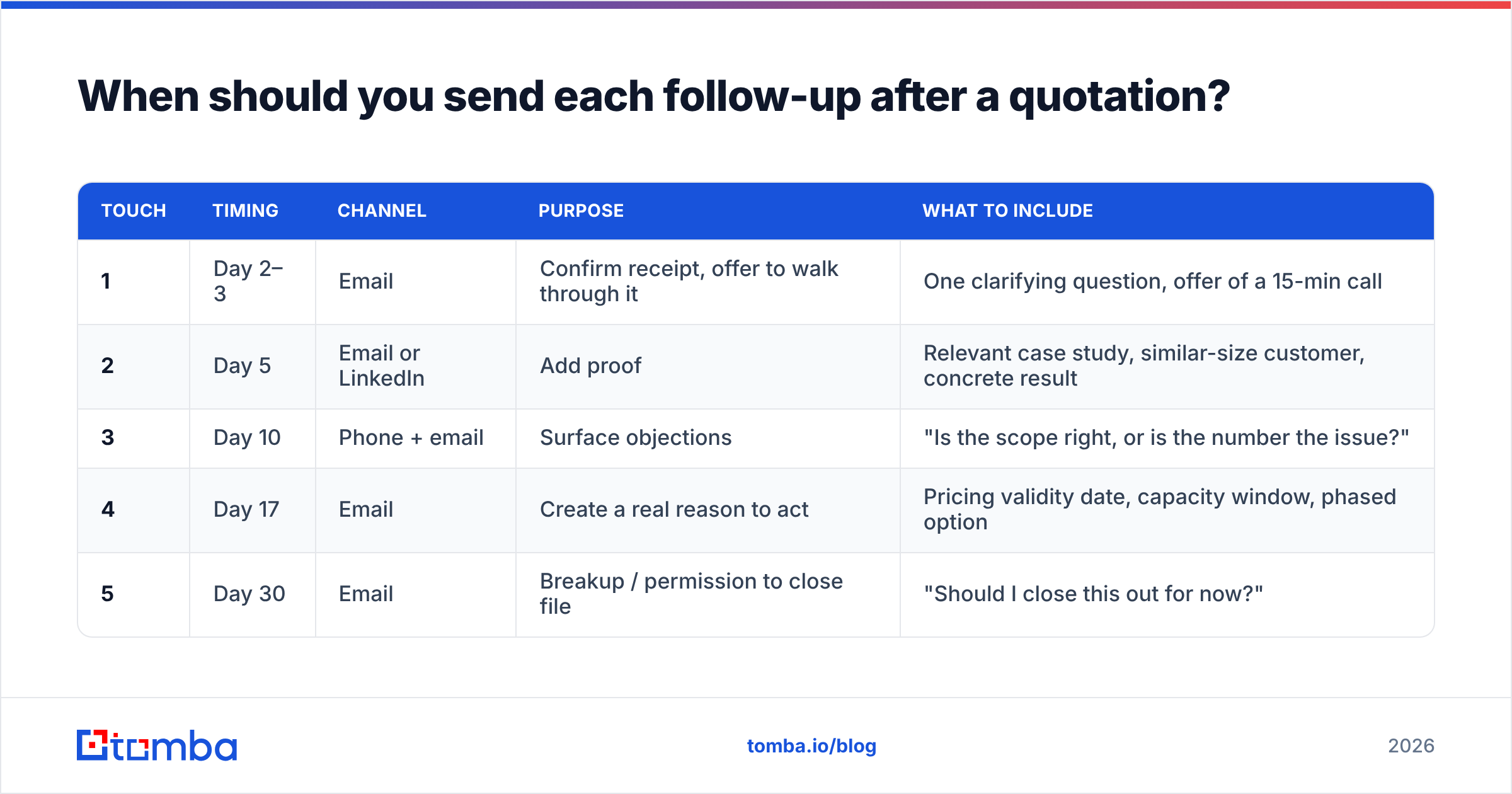
- Send the first follow-up 48–72 hours after the quote, then space touches at day 5, day 10, day 17, and a breakup at day 30. Five touches over a month beats eleven touches over a week.
- Every follow-up must add something: a case study, a revised scope option, a deadline, an answer to an objection they haven't voiced yet. "Just checking in" is a wasted send.
- Verify the address and confirm you have the actual decision-maker before you blame the prospect. A quote sitting in a bounced inbox looks identical to a quote being ignored.
- Track reply rate per touch, not just open rate. If touch 3 outperforms touch 1, your first email is the problem — not your persistence.
What is a follow-up email to a client after a quotation?#
A follow-up email to a client after a quotation is a short, specific message sent after you deliver pricing, designed to move the deal from "received" to a decision — yes, no, or a defined next step. It is not a reminder that you exist. It is a piece of sales collateral that does work the quote itself couldn't do: reframe price against value, surface hidden objections, and give the buyer a reason to reply today rather than "sometime."
The distinction matters because the two versions look almost identical on the surface and perform completely differently. A reminder says "following up on the quote I sent." A follow-up says "I noticed your renewal with your current vendor lands in March — here's what the transition timeline would look like if we started in January."
Think of it like a restaurant check. Dropping the bill on the table and walking away isn't service; you've handed over a number with no context. The follow-up is the server coming back to say the dessert is on the house if they're staying — a reason to keep the conversation going instead of quietly leaving.
Technically, the follow-up sequence is the highest-leverage stage of the pipeline, because the expensive work is already done. You've qualified, discovered, scoped, and priced. The marginal cost of one more well-written email is minutes; the marginal value is a deal you already paid to create.
Why do clients go silent after receiving a quote?#
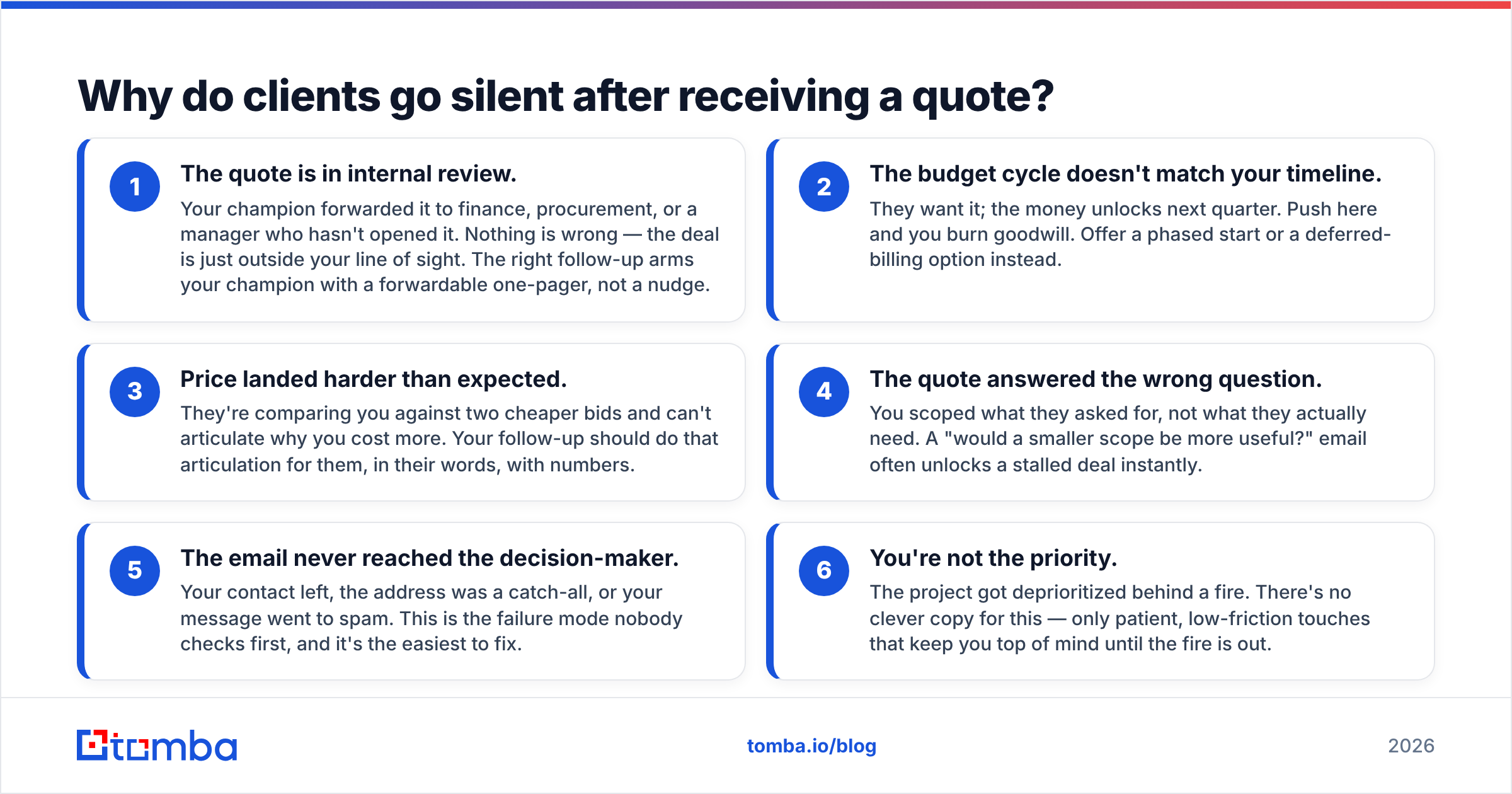
Silence is rarely rejection. In B2B, a quotation typically triggers an internal process the buyer never narrates back to you. Understanding which flavor of silence you're dealing with changes the email you send next.
- The quote is in internal review. Your champion forwarded it to finance, procurement, or a manager who hasn't opened it. Nothing is wrong — the deal is just outside your line of sight. The right follow-up arms your champion with a forwardable one-pager, not a nudge.
- The budget cycle doesn't match your timeline. They want it; the money unlocks next quarter. Push here and you burn goodwill. Offer a phased start or a deferred-billing option instead.
- Price landed harder than expected. They're comparing you against two cheaper bids and can't articulate why you cost more. Your follow-up should do that articulation for them, in their words, with numbers.
- The quote answered the wrong question. You scoped what they asked for, not what they actually need. A "would a smaller scope be more useful?" email often unlocks a stalled deal instantly.
- The email never reached the decision-maker. Your contact left, the address was a catch-all, or your message went to spam. This is the failure mode nobody checks first, and it's the easiest to fix.
- You're not the priority. The project got deprioritized behind a fire. There's no clever copy for this — only patient, low-friction touches that keep you top of mind until the fire is out.
Assume the boring explanations first. Most reps assume rejection, get defensive, and write emails with a faint apologetic tone that signals weakness. The data doesn't support the pessimism: HubSpot's sales statistics consistently show that a large share of closed deals require five or more touches, while most reps stop after two.
When should you send each follow-up after a quotation?#
Cadence beats cleverness. The single most common mistake is following up too fast, too often, with too little variation — six emails in nine days, all saying the same thing in different words.
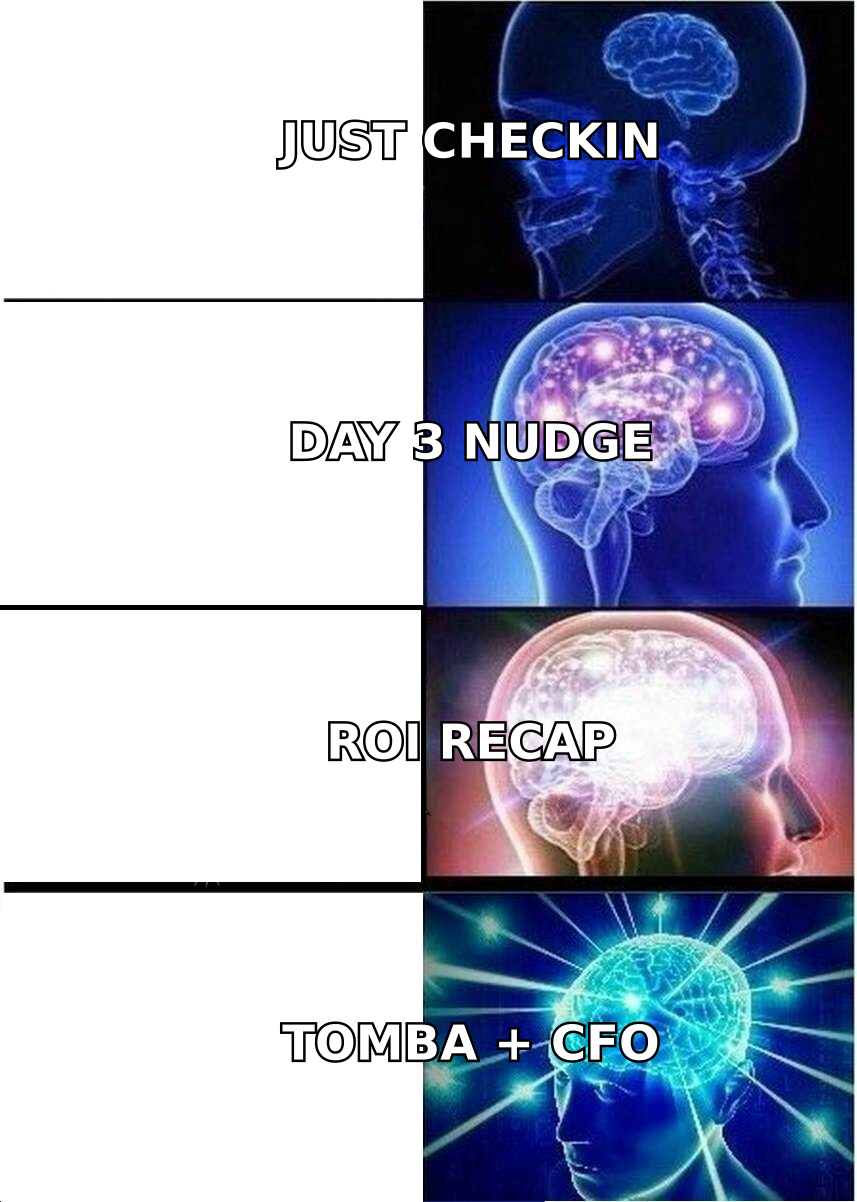
Here is a cadence that works across most B2B deal sizes. Compress it for transactional sales under $2,000; stretch it for enterprise deals with procurement involved.
| Touch | Timing | Channel | Purpose | What to include |
|---|---|---|---|---|
| 1 | Day 2–3 | Confirm receipt, offer to walk through it | One clarifying question, offer of a 15-min call | |
| 2 | Day 5 | Email or LinkedIn | Add proof | Relevant case study, similar-size customer, concrete result |
| 3 | Day 10 | Phone + email | Surface objections | "Is the scope right, or is the number the issue?" |
| 4 | Day 17 | Create a real reason to act | Pricing validity date, capacity window, phased option | |
| 5 | Day 30 | Breakup / permission to close file | "Should I close this out for now?" |
Two rules govern the table. First, never send two consecutive touches with the same message shape — if touch 1 was a question, touch 2 should be an asset. Second, if the buyer gives you a date ("we decide after the board meeting on the 14th"), throw the cadence away and follow their calendar. Nothing damages trust like a nudge that ignores what they already told you.
The breakup email deserves special mention. Done right, it's the highest-reply-rate message in the sequence, because it releases pressure instead of applying it. Done wrong — passive-aggressive, guilt-tripping, "I guess you're not interested" — it torches a relationship you spent weeks building.
What should a follow-up email after a quotation actually contain?#
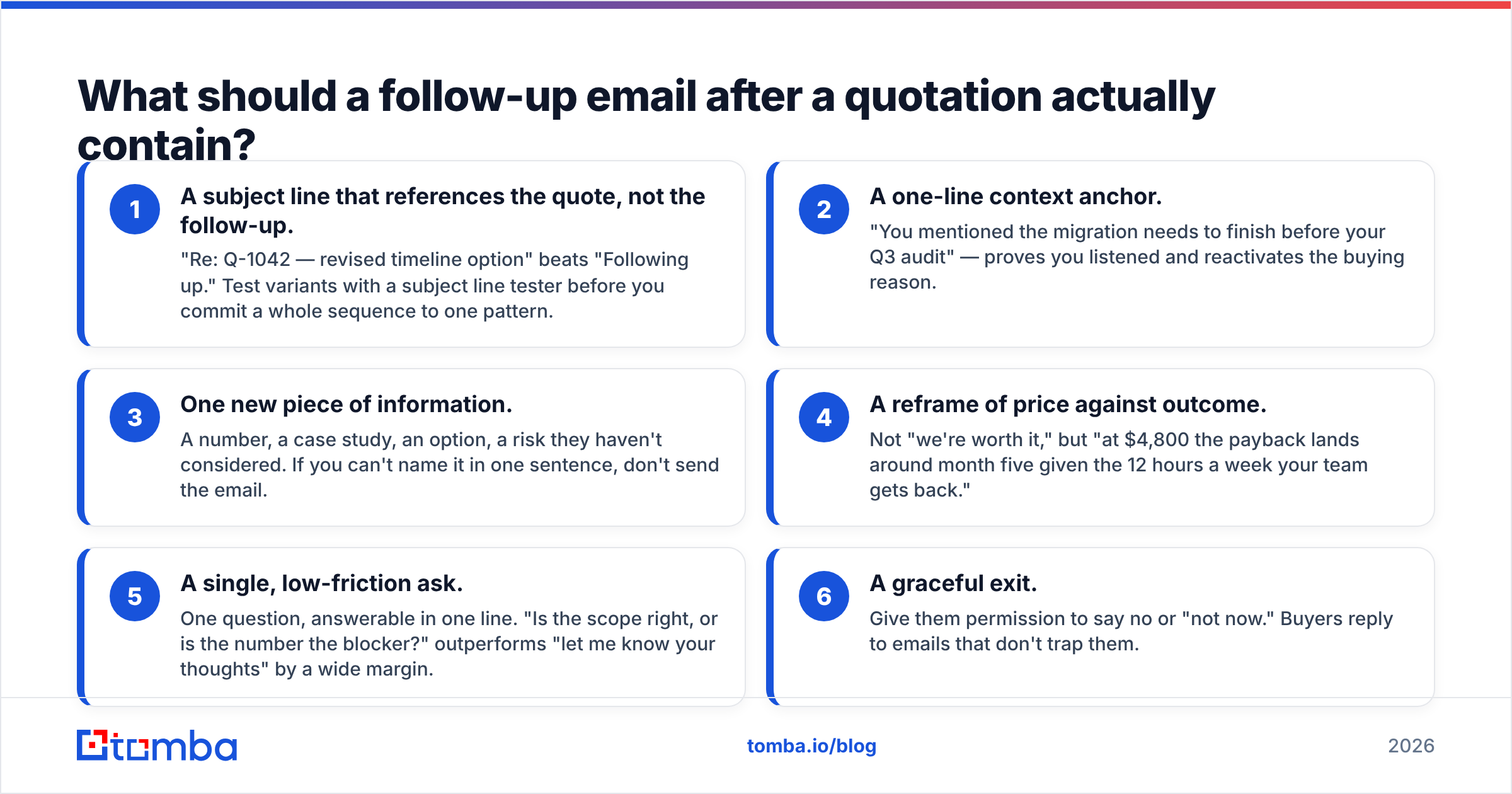
Six components, in roughly this order. Every one of your emails should contain at least four of them.
- A subject line that references the quote, not the follow-up. "Re: Q-1042 — revised timeline option" beats "Following up." Test variants with a subject line tester before you commit a whole sequence to one pattern.
- A one-line context anchor. "You mentioned the migration needs to finish before your Q3 audit" — proves you listened and reactivates the buying reason.
- One new piece of information. A number, a case study, an option, a risk they haven't considered. If you can't name it in one sentence, don't send the email.
- A reframe of price against outcome. Not "we're worth it," but "at $4,800 the payback lands around month five given the 12 hours a week your team gets back."
- A single, low-friction ask. One question, answerable in one line. "Is the scope right, or is the number the blocker?" outperforms "let me know your thoughts" by a wide margin.
- A graceful exit. Give them permission to say no or "not now." Buyers reply to emails that don't trap them.
Keep the whole thing under 120 words. The quote already contains the detail; the follow-up exists to get a reply, not to re-argue the proposal.
What do the templates look like?#
Seven templates covering the situations you'll actually hit. Adapt the specifics — generic sends get generic results.
1. The 48-hour receipt check
Subject: Re: [Quote #] — one quick question
Hi [Name], sent the quote over on Tuesday. Before it goes further internally: did I scope the [specific deliverable] the way you'd want it presented to [stakeholder]? Happy to adjust the breakdown so it's easier to approve. Worth 15 minutes Thursday?
2. The proof drop
Subject: [Similar company] had the same timeline problem
Hi [Name], [Company] came to us with the same [problem] and a similar headcount. They went live in six weeks and cut [metric] by [number]. Two-page summary attached in case it's useful for your internal review. Anything in the quote you'd want re-cut before that conversation?
3. The champion enabler
Subject: Forwardable summary for [stakeholder]
Hi [Name], guessing this needs sign-off beyond you. I put the quote into a one-page version with the cost, the timeline, and the risk of doing nothing — built to forward, not to read twice. Want me to send it, or would you rather I join the call and answer finance's questions directly?
4. The objection surfacer
Subject: Scope or number?
Hi [Name], I'd rather know than guess: is the hesitation the scope or the price? If it's scope, I can re-cut it. If it's the number, I have a phased version that starts at roughly 60% of the original. Either is a fine answer.
5. The deadline (only if real)
Subject: Quote [#] pricing holds through [date]
Hi [Name], the pricing on [Quote #] is valid through [date], and our [month] implementation slots are down to two. Not trying to rush the decision — just don't want you to find out after the fact. Should I hold a slot provisionally?
6. The value re-anchor
Subject: The math on [Quote #]
Hi [Name], quick arithmetic in case it helps the internal case: at [price], and with [X hours/week] recovered across [team size], the break-even lands around [month]. Everything after that is margin. Want me to build that into a short ROI sheet for [stakeholder]?
7. The breakup
Subject: Should I close this out?
Hi [Name], I haven't heard back on [Quote #], which usually means priorities shifted — completely understandable. I'll close the file for now unless you'd like me to keep it warm. If timing changes in [quarter], reply here and I'll reopen it at the same pricing.
For more starting points across the funnel, Tomba maintains a library of cold email templates you can adapt to your own voice.
Should you follow up by email, phone, or LinkedIn?#
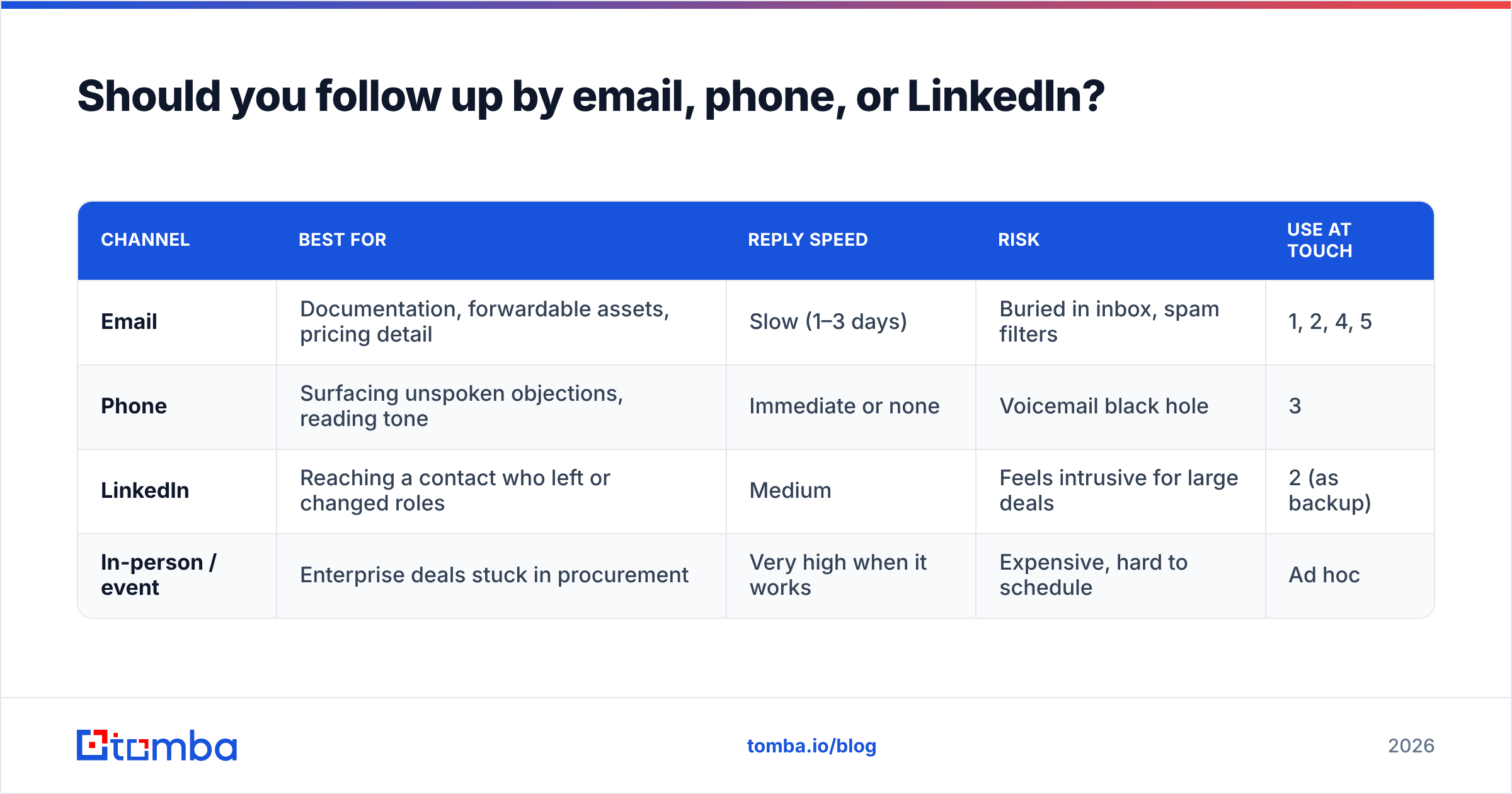
All three, in that order of volume. Channel choice depends on what you're trying to accomplish, not on personal preference.
| Channel | Best for | Reply speed | Risk | Use at touch |
|---|---|---|---|---|
| Documentation, forwardable assets, pricing detail | Slow (1–3 days) | Buried in inbox, spam filters | 1, 2, 4, 5 | |
| Phone | Surfacing unspoken objections, reading tone | Immediate or none | Voicemail black hole | 3 |
| Reaching a contact who left or changed roles | Medium | Feels intrusive for large deals | 2 (as backup) | |
| In-person / event | Enterprise deals stuck in procurement | Very high when it works | Expensive, hard to schedule | Ad hoc |
The phone call at touch 3 is where most stalled quotes actually break open. Email is a monologue; buyers rarely type out "your price is 30% above the other bid" but they'll say it out loud in twenty seconds. If you only have appetite for one non-email touch in the whole sequence, make it that call.
How do you keep follow-ups from disappearing entirely?#
Before you rewrite your copy for the fourth time, rule out the mechanical failures. A meaningful share of "ignored" quotes were never delivered, never opened by the right person, or landed with someone who left the company two months ago.
- Verify the address. Run the contact through an email verifier before the sequence starts. A soft bounce on touch 1 poisons deliverability for touches 2 through 5.
- Confirm you have the decision-maker, not just the requester. If your champion is a coordinator, find the budget owner and CC them by touch 3. A domain search surfaces the other stakeholders at the account in seconds.
- Watch for role changes. In fast-moving companies, the person who requested your quote may not be there when it's decided.
- Check your sender health. Long threads with attachments and repeated sends trip spam filters more often than reps assume. Ryan on your team getting replies while you get silence is usually a deliverability problem, not a talent gap.
- Reply in-thread. Keeping the follow-up on the original quote thread preserves context and improves the odds it's read.
Once mechanics are clean, benchmark your response rate per touch. Vendor review sites like G2 and CRM vendors including Salesforce publish sequence benchmarks worth comparing against — but your own touch-by-touch numbers are more useful than any industry average.
How many follow-ups is too many?#
The honest answer: it's not the count, it's the ratio of value to noise. Five emails that each add something land better than three that don't. Ten identical nudges in two weeks will get you blocked.
Three practical stopping rules:
- Stop when they say no. Not "no for now" — an actual no. Then ask one question: what would have had to be different? That answer is worth more than the deal.
- Stop after the breakup email if there's no reply. Move the contact to a quarterly nurture list. Reopening a warm file in three months beats grinding a cold one today.
- Stop when your last three touches added nothing new. That's a signal you've run out of angle, not that they've run out of interest. Go find a new angle — a trigger event, a new case study, a product change — and restart cleanly.
One more thing worth saying plainly: persistence is not the same as pressure. The reps who close stalled quotes are the ones who stay useful for six weeks, not the ones who send the most emails in six days.
Ready to make sure your quotes reach the right inbox?#
The best follow-up sequence in the world fails if it's aimed at the wrong person. Before your next quotation goes out, confirm you have the decision-maker's real, verified address — not a role alias or a guess from a permutation tool. Tomba's Email Finder locates professional email addresses by name, company, or domain, with verification built in, so your follow-ups land where decisions actually get made. Start free with 25 searches a month, or check Tomba pricing — plans begin at $49/mo for teams running quotes at volume.
Related guides#
Ready to find emails that actually work?
Join 150,000+ professionals who stopped guessing and started sending. Free credits on signup — no credit card required.
Get the Tomba newsletter
Practical outbound tactics and product updates — once every two weeks.
About the author