Follow Up Email To Client After Sending Proposal: 2026 Guide
Most proposals die in silence, not rejection. Here are the timing windows, templates, and sequence structure that get clients to reply after you send a proposal.
TL;DR
- Send the first follow up email to client after sending proposal 2–3 business days after delivery — not the same day, not a week later.
- Silence almost never means rejection. It means your proposal is sitting behind a budget review, a competing priority, or a stakeholder who hasn't seen it yet.
- The highest-reply follow-ups add something: a case study, a revised timeline, an answer to an objection they haven't voiced yet. "Just checking in" is the lowest-performing opener in B2B.
- Plan a 5-touch sequence over 3 weeks, then a clean breakup email. Most closed proposals need 3+ touches.
- Verify the decision-maker's address before you send. Bouncing on touch two after a perfect proposal is an unforced error.
Why do clients go silent after receiving a proposal?#
Because your proposal entered a queue you can't see.
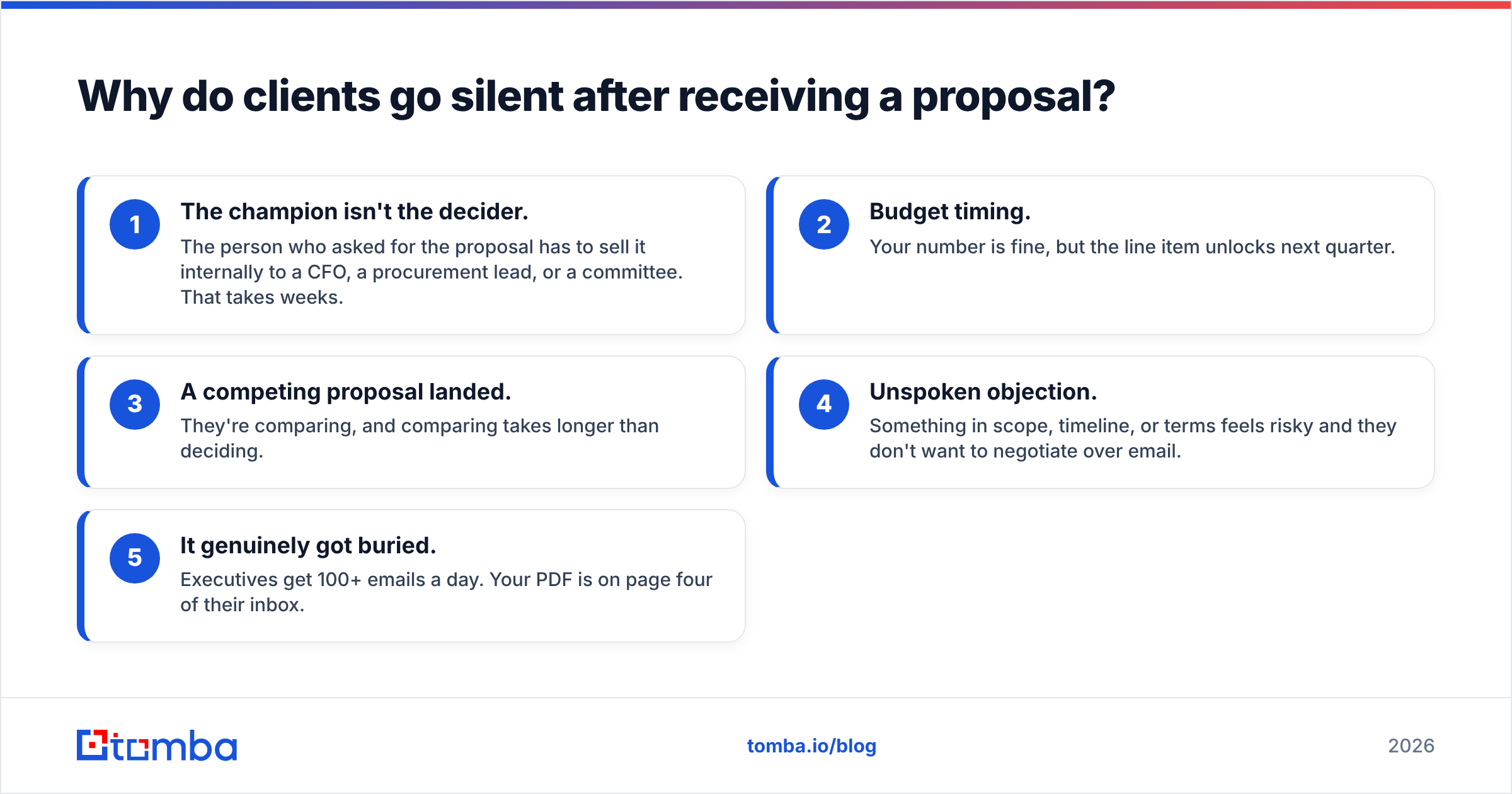
Think of it like handing a resume to a hiring manager who just got pulled into a reorg. Nothing about your resume changed. The room around it did. Proposals stall for reasons that have almost nothing to do with your pricing:
- The champion isn't the decider. The person who asked for the proposal has to sell it internally to a CFO, a procurement lead, or a committee. That takes weeks.
- Budget timing. Your number is fine, but the line item unlocks next quarter.
- A competing proposal landed. They're comparing, and comparing takes longer than deciding.
- Unspoken objection. Something in scope, timeline, or terms feels risky and they don't want to negotiate over email.
- It genuinely got buried. Executives get 100+ emails a day. Your PDF is on page four of their inbox.
Only one of those five is "they hate the price." That's why the follow-up matters more than the proposal edit you're tempted to make.
When should you send the first follow up email after a proposal?#
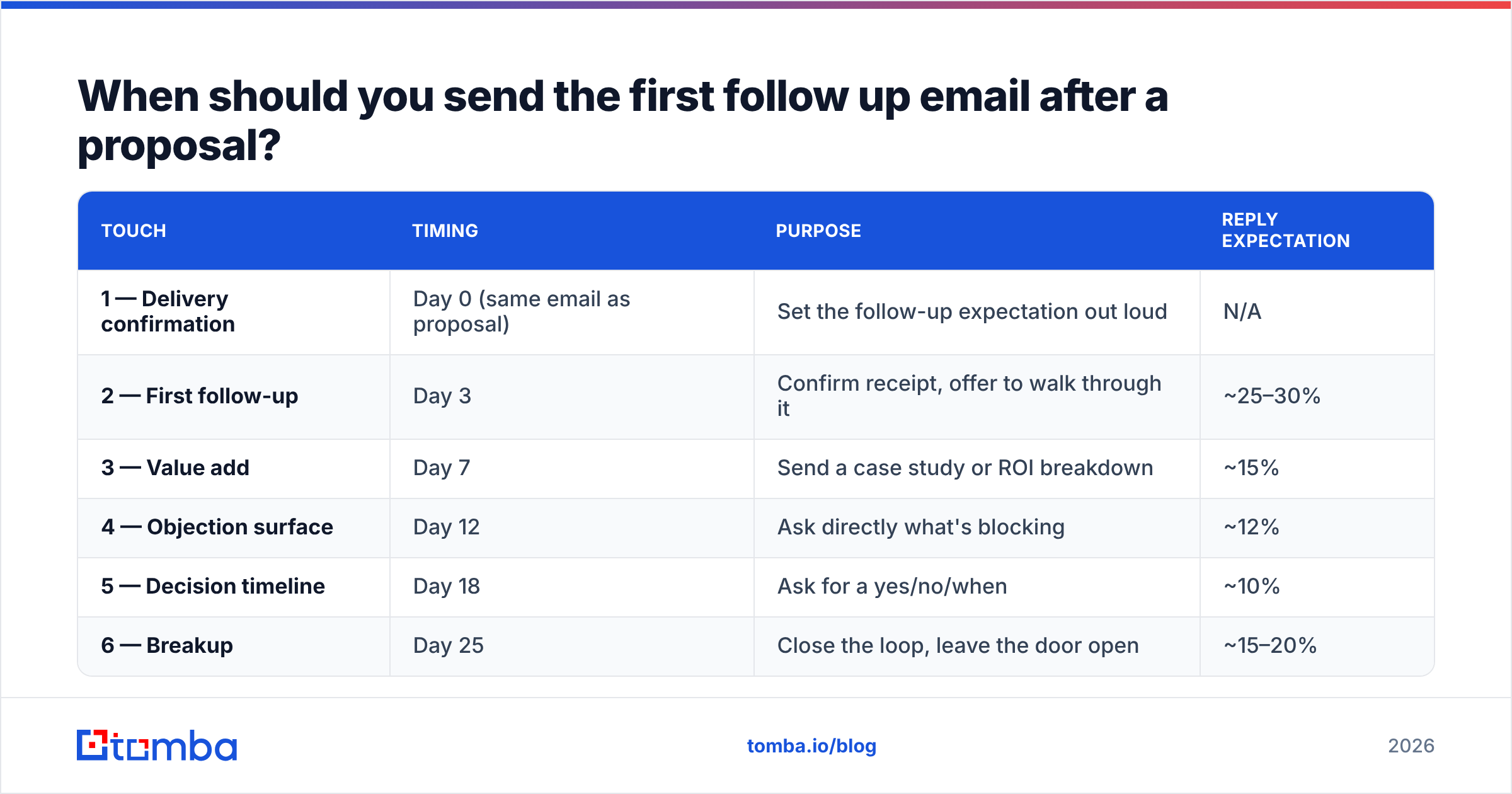
Two to three business days after delivery. That window is long enough that you're not hovering, short enough that the proposal is still in working memory.
Here's the cadence that works for most B2B deals in the $5k–$100k range:
| Touch | Timing | Purpose | Reply expectation |
|---|---|---|---|
| 1 — Delivery confirmation | Day 0 (same email as proposal) | Set the follow-up expectation out loud | N/A |
| 2 — First follow-up | Day 3 | Confirm receipt, offer to walk through it | ~25–30% |
| 3 — Value add | Day 7 | Send a case study or ROI breakdown | ~15% |
| 4 — Objection surface | Day 12 | Ask directly what's blocking | ~12% |
| 5 — Decision timeline | Day 18 | Ask for a yes/no/when | ~10% |
| 6 — Breakup | Day 25 | Close the loop, leave the door open | ~15–20% |
The counterintuitive number is the last one. Breakup emails routinely outperform touches three and four because they remove pressure and trigger loss aversion at the same time.
The single biggest lever, though, is touch one. In the same email where you attach the proposal, write: "I'll follow up Thursday if I haven't heard back — feel free to beat me to it." You've now converted your next email from an interruption into a kept promise.
What should a follow up email to a client after sending a proposal actually say?#
Every effective proposal follow-up does one of four jobs. Pick one per email — never all four.
- Confirm and offer access. "Did it land? Happy to walk your team through section 3 live."
- Add new information. A relevant case study, a competitor benchmark, an updated timeline, a revised option at a lower scope.
- Surface the objection. Give them a low-cost way to say the hard thing.
- Force a decision. Not aggressively — just ask for a real date.
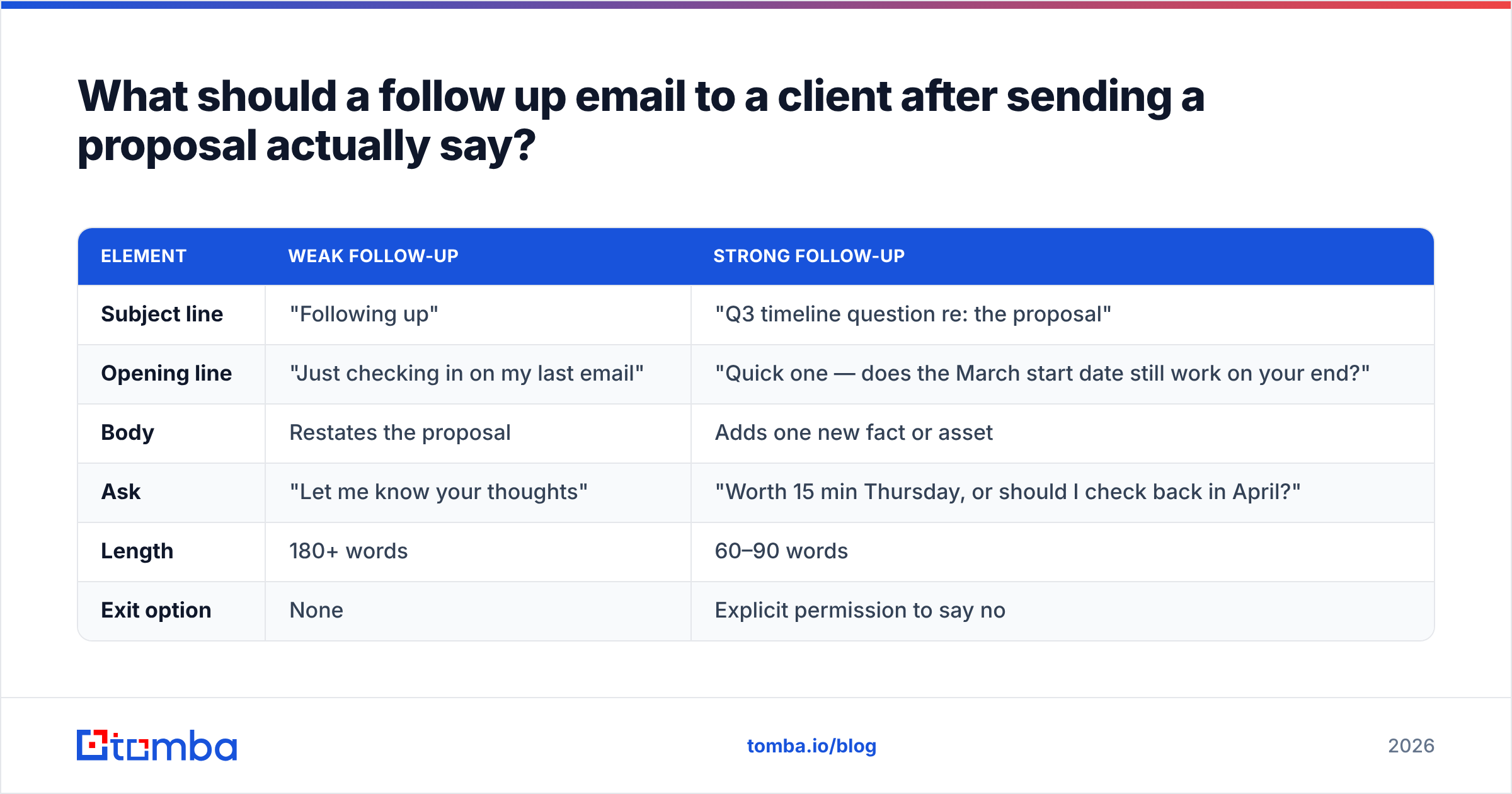
Here's the structural difference between a follow-up that gets ignored and one that gets a reply:
| Element | Weak follow-up | Strong follow-up |
|---|---|---|
| Subject line | "Following up" | "Q3 timeline question re: the proposal" |
| Opening line | "Just checking in on my last email" | "Quick one — does the March start date still work on your end?" |
| Body | Restates the proposal | Adds one new fact or asset |
| Ask | "Let me know your thoughts" | "Worth 15 min Thursday, or should I check back in April?" |
| Length | 180+ words | 60–90 words |
| Exit option | None | Explicit permission to say no |
The "explicit permission to say no" row is the one most reps skip. Giving a prospect a graceful out increases reply rates because replying no longer requires them to disappoint you.
What templates work best for proposal follow-ups?#
Four templates covering the sequence. Adapt the specifics — the structure is what carries.
Template 1 — Day 3, receipt confirmation
Subject: The Acme proposal — one thing I should clarify
Hi Dana,
Sent the proposal Tuesday. One thing I under-explained: the onboarding in Phase 1 runs in parallel with your existing workflow, so there's no downtime window to plan around.
Does the scope in Section 2 match what you had in mind, or should I put together a leaner option?
— Sam
Why it works: it isn't a check-in. It's a clarification, which gives you a legitimate reason to be in their inbox and pre-empts the "this looks disruptive" objection.
Template 2 — Day 7, value add
Subject: How Northwind handled the same rollout
Hi Dana,
Northwind had the same 40-seat constraint you flagged. Short version: they staged it across two months and hit full adoption in week six. Two-page write-up attached in case it's useful for your internal conversation.
No response needed if the timing's just not right yet.
— Sam
Why it works: it arms your champion with something they can forward. The "no response needed" line is not weakness; it lowers the cost of reading and often produces a reply anyway.
Template 3 — Day 12, objection surface
Subject: Reading the tea leaves
Hi Dana,
Usually when a proposal goes quiet it's one of three things: price, timing, or someone internally isn't sold yet. Which one is it here? I'd rather fix the real problem than send you another email.
— Sam
Why it works: naming the silence directly is disarming, and the multiple-choice format takes 10 seconds to answer.
Template 4 — Day 25, breakup
Subject: Closing the file on this one
Hi Dana,
I'll stop chasing. I'm assuming this isn't a priority right now, which is completely fair.
If that changes — this quarter or next year — the proposal stands and I'll pick it right back up. Reply "later" and I'll check back in Q1 instead.
— Sam
Why it works: it's final without being resentful, and the one-word reply option converts a dead thread into a scheduled re-engagement.
Need more starting points across the funnel? The cold email templates library covers openers, re-engagement, and referral asks you can adapt to post-proposal sequences.
How many follow-ups is too many?#
Five to six touches over roughly a month is the ceiling for most B2B proposal cycles. Past that, you're not persistent — you're noise.
But volume isn't the real risk. Repetition is. Six emails that each say something new reads as diligence. Three emails that all say "just circling back" reads as desperation, and it trains the prospect to ignore your name in the sender column.
Three rules to keep the cadence honest:
- One new idea per email. If you can't name what's new, don't send it.
- Vary the channel. Email, then LinkedIn, then a call, then email. HubSpot's sales research consistently finds multi-channel sequences outperform single-channel ones — see their sales follow-up research for current benchmarks.
- Shorten as you go. Touch two can be 90 words. Touch five should be 30.
If you're layering LinkedIn into the sequence, keep the messaging consistent across both — mismatched tone between an email and a connection request reads as automation. Our notes on LinkedIn outreach cover how to sequence the two without duplicating yourself.
What kills proposal follow-ups before they're read?#
Three things, in order of damage.
1. The email never arrives. You had one good address for your champion, and now you're emailing the CFO whose address you guessed from a pattern. A bounce on touch three doesn't just fail — it dents your sender reputation and can route the rest of your thread to spam. Run any address you didn't get directly from the prospect through an email verifier before it enters a sequence.
2. You're following up with the wrong person. If your champion has gone quiet for two weeks, the deal has probably moved to someone you haven't met. Finding the actual budget holder is a research problem, not a persistence problem. A domain search on the client's company surfaces the finance and ops contacts who tend to sit on the approval side of a proposal.
3. Attachment-heavy sends. Large PDFs and multiple attachments raise spam scores, and some corporate filters strip them silently. Host the proposal at a link where you can also see whether it was opened. If you must attach, keep it under 2 MB and never attach on a first touch to a new address.
A fourth, quieter killer: sending from a domain with no SPF or DMARC alignment. If your proposal follow-ups are landing in Promotions or spam, that's a email deliverability problem, not a copy problem, and no template will fix it.
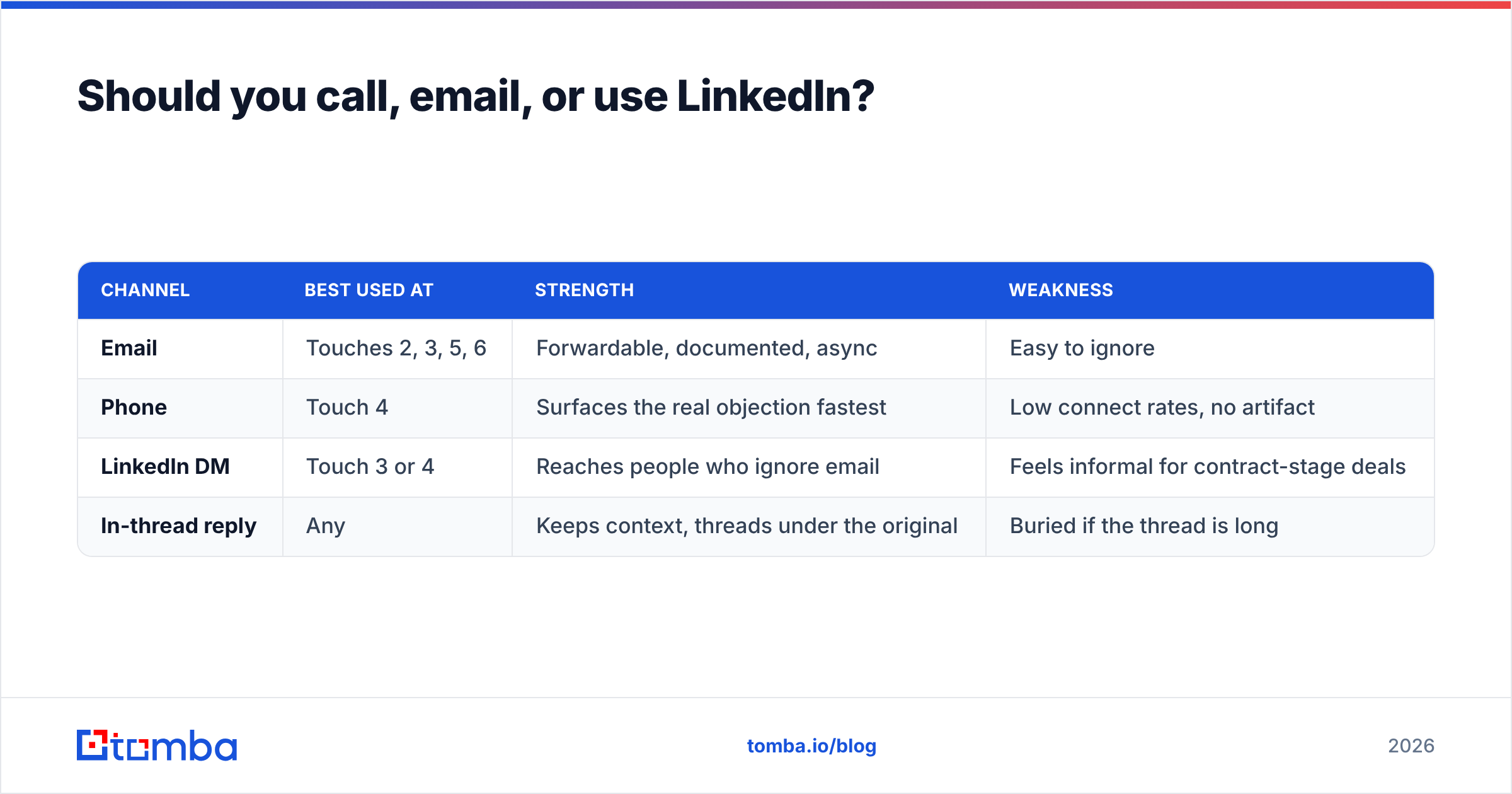
Should you call, email, or use LinkedIn?#
All three, staged — but email carries the proposal thread because it's the only channel with a paper trail your champion can forward internally.
| Channel | Best used at | Strength | Weakness |
|---|---|---|---|
| Touches 2, 3, 5, 6 | Forwardable, documented, async | Easy to ignore | |
| Phone | Touch 4 | Surfaces the real objection fastest | Low connect rates, no artifact |
| LinkedIn DM | Touch 3 or 4 | Reaches people who ignore email | Feels informal for contract-stage deals |
| In-thread reply | Any | Keeps context, threads under the original | Buried if the thread is long |
The practical pattern: keep every email in the original proposal thread so the client can scroll one place and see the whole history. Break out into a fresh subject line only for the breakup email — you want that one to look different in the inbox.
For the phone touch, you need a direct line, not a switchboard. If your CRM record only has a main number, a phone finder fills that gap faster than digging through the company site.
How do you track whether your follow-ups are working?#
Track three numbers per sequence, not per email:
- Reply rate by touch number. If touch two outperforms touch four by 3x, your middle-sequence emails aren't adding value. Rewrite them.
- Time-to-first-reply. If your average is 11 days, your day-3 email is too early for this segment. Shift the whole cadence.
- Proposal-to-close rate segmented by follow-up count. Most teams find deals closed with 3–5 touches convert meaningfully better than deals closed on one. That number is your argument for building the sequence in the first place.
G2's buyer behavior reports are a reasonable outside reference point for how long B2B software evaluations actually run — see G2's research library — and they'll usually tell you your cadence is too short, not too long.
Log everything against the opportunity in your CRM rather than in your sent folder. A follow-up sequence you can't audit is a sequence you can't improve.
What does a good proposal follow-up system look like end to end?#
Five components, in order:
- Verified contact data for your champion and at least one adjacent stakeholder, captured before the proposal goes out.
- A stated follow-up promise in the delivery email so touch two is expected.
- A written 5-touch sequence with a specific job per touch, drafted before you send the proposal — not improvised at day 12 when you're already anxious.
- A channel plan that puts one call and one LinkedIn touch inside the email cadence.
- A breakup email with a re-engagement hook so dead deals become Q1 pipeline instead of nothing.
Build that once and it works across every proposal you send. Improvising it deal by deal is why most reps stop at two touches and lose deals that were 80% won.
Get the right address before you build the sequence#
Every template above assumes one thing: your email reaches a real human at the client's company. When a champion goes quiet and you need the ops lead, the finance approver, or the exec sponsor who was cc'd once and never replied, guessing the address format is how a good follow-up sequence dies in a bounce.
Use the Tomba Email Finder to pull verified professional addresses by name and company domain, then run them through verification before they enter your cadence. The free tier covers 25 searches a month, and paid plans start at $49/mo — see Tomba pricing for the full breakdown. Find the decision-maker, then send the follow-up that actually says something.
Related guides#
Ready to find emails that actually work?
Join 150,000+ professionals who stopped guessing and started sending. Free credits on signup — no credit card required.
Get the Tomba newsletter
Practical outbound tactics and product updates — once every two weeks.
About the author