Follow Up Email to Potential Client: Templates That Convert
Most deals die in the gap between the first email and the fifth. Here is the follow-up cadence, timing, and templates that actually get replies from potential clients in 2026.
TL;DR
- Between 40% and 60% of closed deals in most B2B pipelines come from follow-up touches, not the first email. Stopping at two attempts is the single most expensive habit in outbound.
- The best-performing cadence for a potential client is 5 to 7 touches over 21 to 30 days, each one carrying a new piece of value — not a "just checking in" nudge.
- Timing beats volume: day 3, day 7, day 14, day 21, then a breakup. Same-day double-taps read as desperate and get you filtered.
- Every follow-up should be able to stand alone. Assume your prospect never opened the first one, because roughly two-thirds of them didn't.
- None of it matters if the address is wrong. Bounced follow-ups quietly torch your sender reputation and make the next 500 emails land in spam.
Why do follow up emails to potential clients matter so much?#
Because the first email is a coin flip and the follow-up is the actual sale.
Think of it like a restaurant reservation. You call once, the line's busy, and you assume the place is full. Anyone who calls back at 4 p.m. gets a table. Your first cold email arrives during a meeting, a fire drill, or a 300-message inbox morning. It isn't rejected — it's buried. The follow-up is the callback.
The data backs this up consistently across vendors. HubSpot's sales research has repeatedly found that a large share of reps stop after one or two attempts, while the majority of positive replies arrive on touch three or later. That mismatch is the entire opportunity: your competitors quit at attempt two, and the buyer's actual "yes" window opens at attempt four.
There's a second, less obvious reason. A well-spaced follow-up sequence is a filtering mechanism. It sorts your list into three buckets — interested, wrong timing, and genuinely not a fit — without you having to guess. A prospect who ignores five value-carrying emails has told you something useful. A prospect who ignores one email has told you nothing at all.
What makes a follow up email to potential client actually work?#
Five elements separate a follow-up that gets replies from one that gets archived:
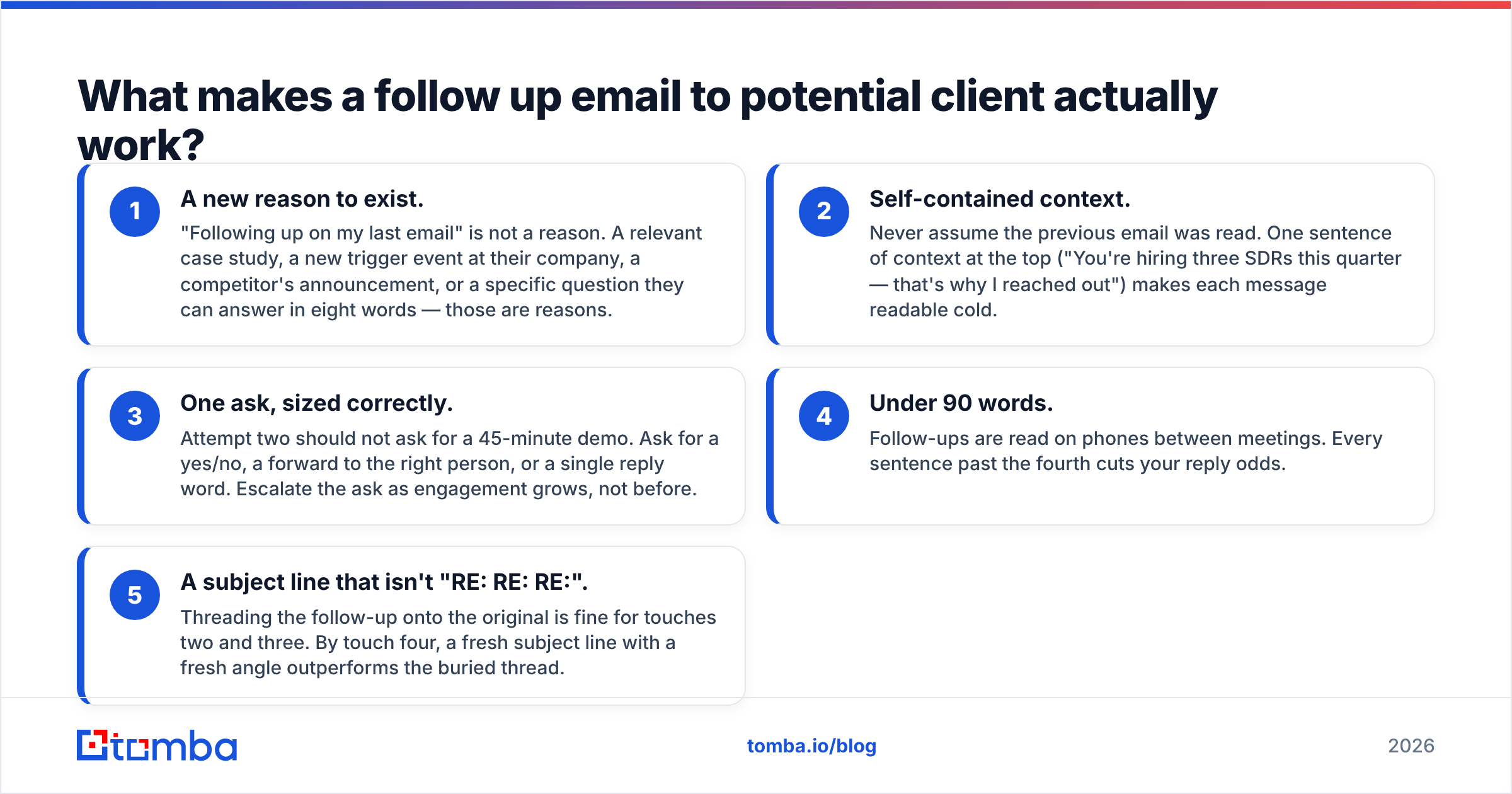
- A new reason to exist. "Following up on my last email" is not a reason. A relevant case study, a new trigger event at their company, a competitor's announcement, or a specific question they can answer in eight words — those are reasons.
- Self-contained context. Never assume the previous email was read. One sentence of context at the top ("You're hiring three SDRs this quarter — that's why I reached out") makes each message readable cold.
- One ask, sized correctly. Attempt two should not ask for a 45-minute demo. Ask for a yes/no, a forward to the right person, or a single reply word. Escalate the ask as engagement grows, not before.
- Under 90 words. Follow-ups are read on phones between meetings. Every sentence past the fourth cuts your reply odds.
- A subject line that isn't "RE: RE: RE:". Threading the follow-up onto the original is fine for touches two and three. By touch four, a fresh subject line with a fresh angle outperforms the buried thread.
The failure mode almost every team falls into is the polite nudge — a 40-word note that says nothing except "please respond." It costs you nothing to send, which is exactly why it's dangerous: it burns a touch, trains the prospect to ignore your name, and adds zero information.
How many follow up emails should you send, and when?#
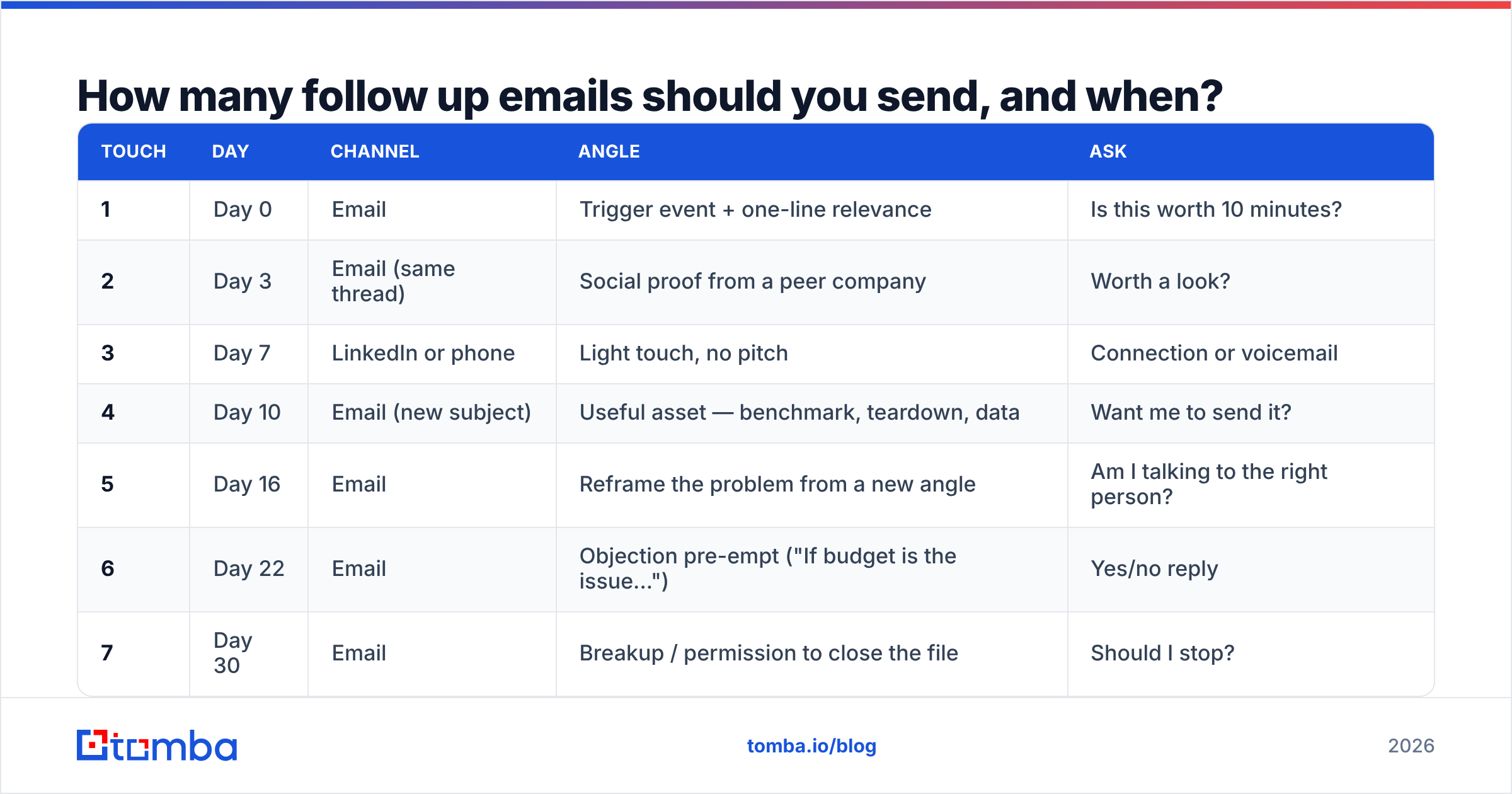
Five to seven touches over three to four weeks, with widening gaps. Here's the cadence that holds up across most B2B motions:
| Touch | Day | Channel | Angle | Ask |
|---|---|---|---|---|
| 1 | Day 0 | Trigger event + one-line relevance | Is this worth 10 minutes? | |
| 2 | Day 3 | Email (same thread) | Social proof from a peer company | Worth a look? |
| 3 | Day 7 | LinkedIn or phone | Light touch, no pitch | Connection or voicemail |
| 4 | Day 10 | Email (new subject) | Useful asset — benchmark, teardown, data | Want me to send it? |
| 5 | Day 16 | Reframe the problem from a new angle | Am I talking to the right person? | |
| 6 | Day 22 | Objection pre-empt ("If budget is the issue...") | Yes/no reply | |
| 7 | Day 30 | Breakup / permission to close the file | Should I stop? |
Three rules govern that table.
Widen the gaps. Day 0 → 3 → 7 → 10 → 16 → 22 → 30. Compressed cadences (every other day for two weeks) get flagged by both humans and spam filters. Widening gaps signal patience, which reads as confidence.
Mix channels by touch three. Email-only sequences plateau. A LinkedIn view or a voicemail between emails raises name recognition so touch four lands on a warm-ish name instead of a stranger. If you're layering calls in, having verified B2B phone numbers attached to the same contact record keeps the cadence from breaking.
Stop at the breakup. The seventh email — "I'll assume the timing isn't right and close your file" — is consistently one of the highest-reply messages in any sequence, because it hands control back to the prospect. Send it, then actually stop. Re-entering the same contact three weeks later without a new trigger is how you end up on a blocklist.
Which follow up email templates should you steal?#
Seven templates mapped to the cadence above. Adjust the specifics; keep the structure.
Template 1 — The 3-day bump (same thread)
Subject: RE: [original subject]
Hi [Name] — adding one thing to my note below. [Peer company] had the same problem with [specific issue] and cut it by [number] in [timeframe]. Happy to send the one-page breakdown if it's useful. Worth a look?
Template 2 — The value drop (new subject, day 10)
Subject: Benchmark data for [their industry]
Hi [Name] — we pulled reply-rate benchmarks across 400 [industry] teams this quarter. [Their segment] is sitting at [number], which surprised us. Want me to send the two-page version? No pitch attached.
Template 3 — The right-person check (day 16)
Subject: Wrong person?
[Name] — I may have aimed this at the wrong desk. If [problem] sits with someone else on your team, could you point me at them? If it sits with you and it's just not a priority, that's a completely fine answer too.
Template 4 — The objection pre-empt (day 22)
Subject: Guessing on budget
Hi [Name] — I'll guess: budget is locked until [quarter]. If that's it, I'd rather send you the [asset] now and circle back when planning opens. If it's something else — fit, timing, we're just not interesting — tell me which and I'll stop.
Template 5 — The trigger-event restart
Subject: Saw the [funding round / hire / launch]
[Name] — saw you [specific event]. That usually means [predictable consequence]. When [peer company] hit that stage, [outcome]. Worth 10 minutes now that the context has changed?
Template 6 — The post-meeting follow-up
Subject: Next steps from Tuesday
[Name] — recap: you flagged [problem 1] and [problem 2]. I've attached [asset] covering the first. On the second, the honest answer is [candid take]. Next step on my side is [action] by [date]. Anything I've got wrong?
Template 7 — The breakup (day 30)
Subject: Closing the file
[Name] — I've sent a few notes and haven't heard back, which usually means this isn't a priority. I'll close the file. If that's wrong, reply with a date and I'll pick it back up. Either way, good luck with [specific initiative].
If you want more starting points, our cold email templates library covers first-touch structures, and the subject line generator is useful when you're stuck on touch four's fresh angle.
How do manual follow-ups compare to sequenced ones?#
The real choice isn't "template vs. personal." It's how much of the cadence you automate and where a human intervenes.
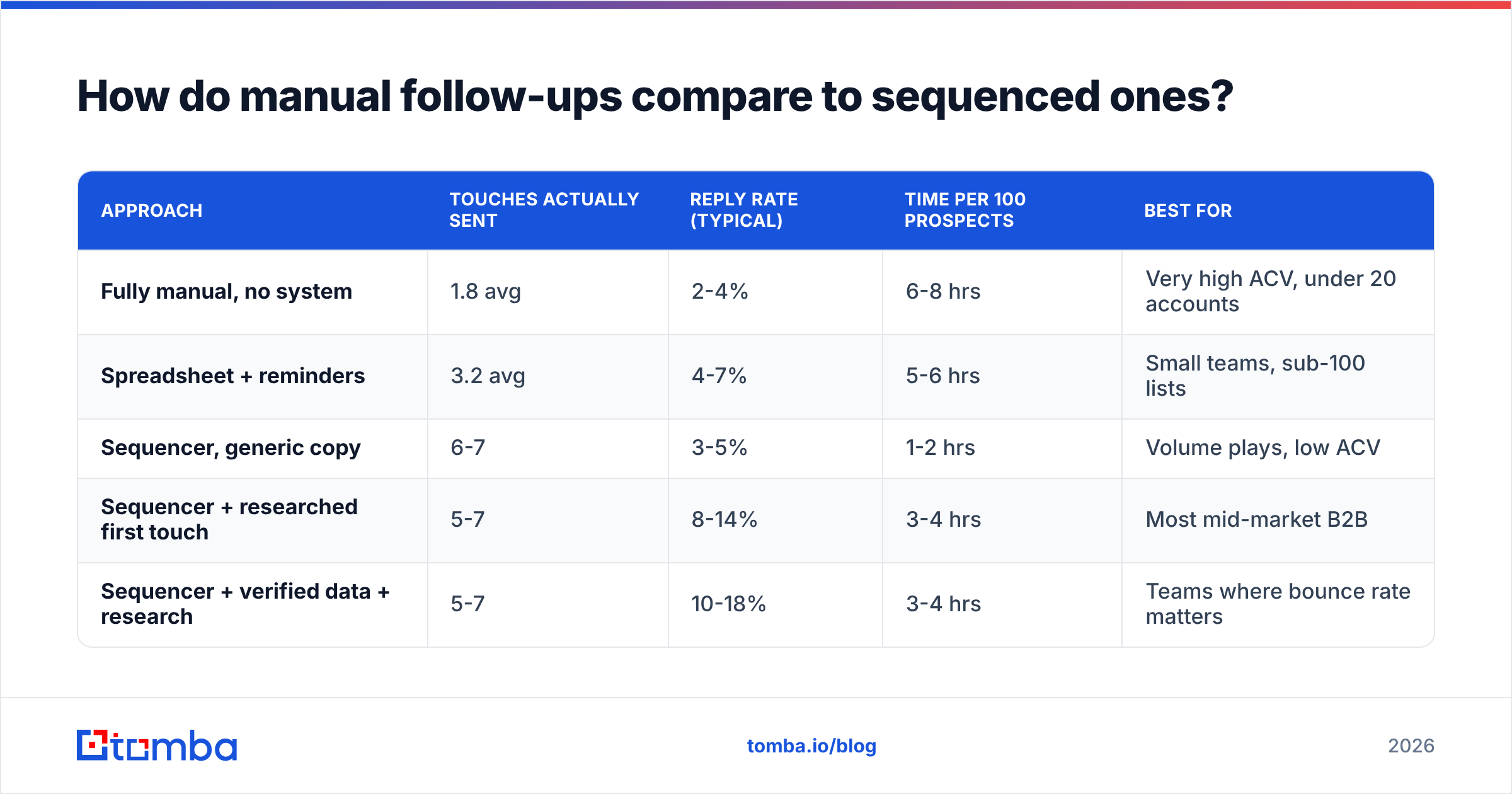
| Approach | Touches actually sent | Reply rate (typical) | Time per 100 prospects | Best for |
|---|---|---|---|---|
| Fully manual, no system | 1.8 avg | 2-4% | 6-8 hrs | Very high ACV, under 20 accounts |
| Spreadsheet + reminders | 3.2 avg | 4-7% | 5-6 hrs | Small teams, sub-100 lists |
| Sequencer, generic copy | 6-7 | 3-5% | 1-2 hrs | Volume plays, low ACV |
| Sequencer + researched first touch | 5-7 | 8-14% | 3-4 hrs | Most mid-market B2B |
| Sequencer + verified data + research | 5-7 | 10-18% | 3-4 hrs | Teams where bounce rate matters |
The pattern is blunt: automation fixes the "I forgot to follow up" problem, which is worth 2-4x on its own. But automation with generic copy underperforms a disciplined manual rep. The winning row is the last one — sequenced timing, human-written angles, and a clean list underneath.
That last variable gets ignored most often. A 12% bounce rate doesn't just lose you 12 prospects; it drags your sender reputation down far enough that the other 88% start landing in Promotions. Google and Microsoft both tightened bulk-sender requirements in 2024, and Google's sender guidelines now put a hard spam-rate ceiling on anyone sending at volume. Running your list through an email verifier before a seven-touch sequence is the cheapest insurance in the stack — you're about to multiply every bad address by seven.
What mistakes kill follow up emails to potential clients?#
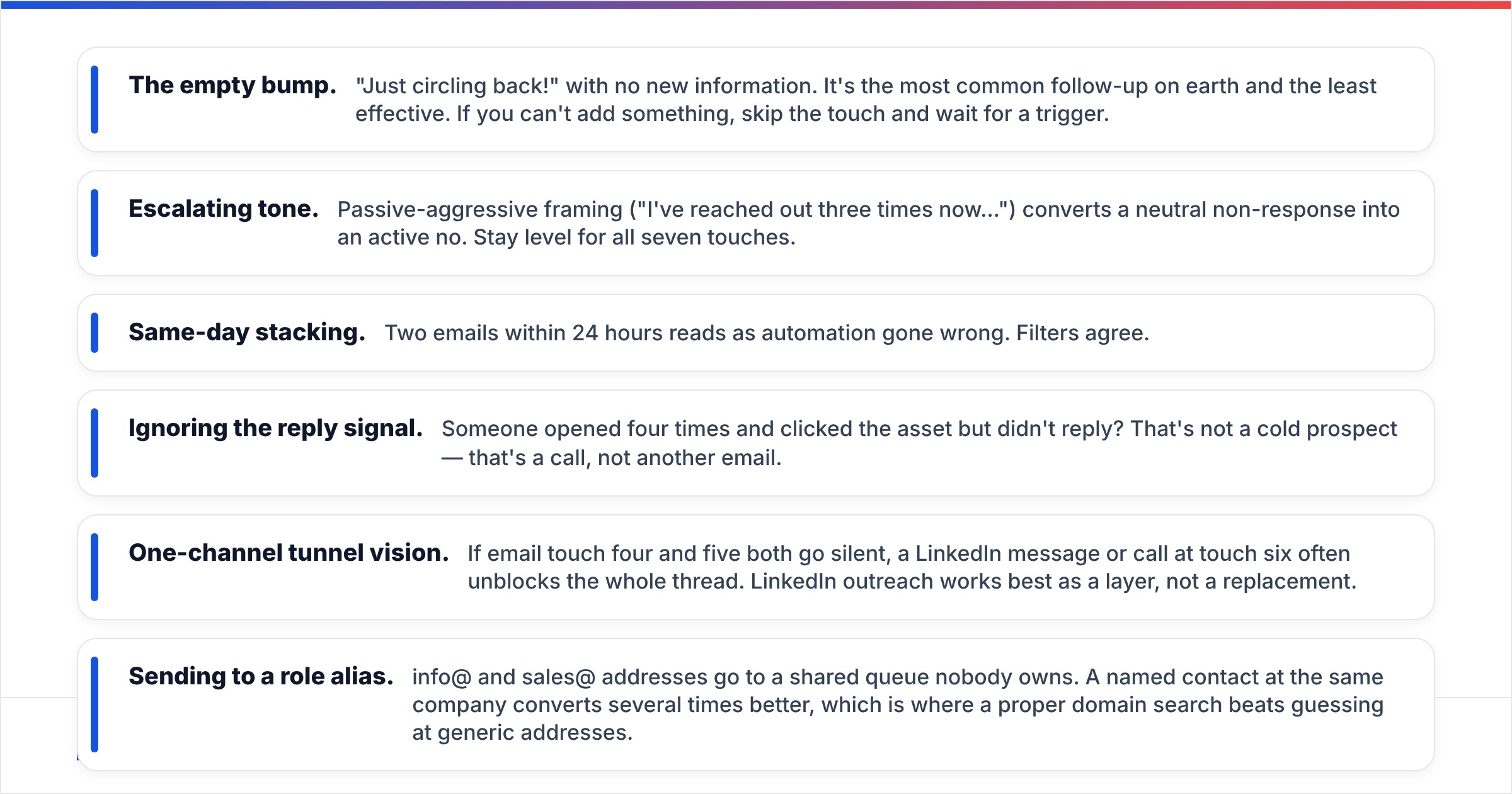
- The empty bump. "Just circling back!" with no new information. It's the most common follow-up on earth and the least effective. If you can't add something, skip the touch and wait for a trigger.
- Escalating tone. Passive-aggressive framing ("I've reached out three times now...") converts a neutral non-response into an active no. Stay level for all seven touches.
- Same-day stacking. Two emails within 24 hours reads as automation gone wrong. Filters agree.
- Ignoring the reply signal. Someone opened four times and clicked the asset but didn't reply? That's not a cold prospect — that's a call, not another email.
- One-channel tunnel vision. If email touch four and five both go silent, a LinkedIn message or call at touch six often unblocks the whole thread. LinkedIn outreach works best as a layer, not a replacement.
- Sending to a role alias. info@ and sales@ addresses go to a shared queue nobody owns. A named contact at the same company converts several times better, which is where a proper domain search beats guessing at generic addresses.
- No stop condition. Sequences that never end train prospects to permanently filter your domain. The breakup email exists for a reason.
How do you personalize follow-ups at scale without sounding robotic?#
Personalize the reason, not the greeting. Nobody has ever replied because you spelled their city right.
Three tiers, ranked by effort-to-return:
- Trigger-based (highest return). New funding, new exec hire, a product launch, a job posting for a role your product touches. One sentence referencing a real event outperforms three paragraphs of flattery. These are also the only legitimate reason to restart a closed sequence.
- Segment-based (best ratio). Write one strong angle per segment of 25-50 companies rather than one per prospect. A follow-up written specifically for "Series B fintechs hiring their first RevOps lead" feels personal without being individually written.
- Individual research (reserve it). Deep personalization is worth it for your top 20 accounts and wasteful below that. Spending 15 minutes per prospect on a $4k ACV deal is a losing trade.
Practically, the workflow is: build the list, enrich it so you know role, seniority, and company stage, verify the addresses, then write two or three segment angles and let the sequencer handle timing. Contact enrichment is what makes tier two possible — you can't segment by "hiring their first RevOps lead" if all you have is a name and an email.
One more thing worth flagging: track reply rate by touch number, not just overall. If touch two outperforms touch one, your first email is the weak link, not your follow-up game. If everything after touch four flatlines, your angles are repeating and you need new material — not more sends. Watching response rate per position in the sequence tells you exactly which email to rewrite.
What should you do next?#
The follow-up structure above is portable. The cadence works, the templates work, the timing works — as long as the emails reach a real person at a real address.
That's the part most teams get backwards. They spend two weeks perfecting sequence copy on a list where one in eight addresses is dead, then blame the copy when replies don't come. Seven touches against a bad list is seven bounces, and bounces compound into deliverability problems that outlast the campaign.
Start with the data layer. Use the Tomba Email Finder to pull verified, named contacts by company domain instead of shipping your best follow-up sequence to info@. The free tier gives you 25 searches a month to test the workflow, and paid plans start at $49/mo on Starter with transparent pricing as you scale. Get the addresses right first — then let the seven-touch cadence do what it's good at.
Related guides#
Ready to find emails that actually work?
Join 150,000+ professionals who stopped guessing and started sending. Free credits on signup — no credit card required.
Get the Tomba newsletter
Practical outbound tactics and product updates — once every two weeks.
About the author