Follow Up Email Wording: 2026 Guide with 12 Examples
Most follow-ups die because of the first eight words, not the offer. Here's the exact wording that earns replies in 2026 — plus 12 copy-paste examples and the phrases to delete today.
TL;DR
- Follow up email wording fails at the opening line far more often than at the offer. "Just checking in" and "circling back" signal that you have nothing new to say.
- The highest-performing pattern is new information + single question. Every follow-up should carry one fresh input the prospect did not have before.
- Change the wording by position in the sequence: follow-up #1 adds context, #2 adds proof, #3 adds a decision-easing option, #4 closes the loop.
- Shorter wins. Follow-ups under 60 words consistently outperform the original email they follow.
- Wording cannot rescue a bad address. If your follow-ups bounce or land in spam, no phrasing fixes that — verify first, write second.
What is follow up email wording, and why does it decide the reply?#
Follow up email wording is the specific language you use in the second, third, and fourth message of a sequence — the opening line, the ask, and the sign-off. It matters disproportionately because a follow-up is read in a fundamentally different context than a first email.
Think of it like knocking on a door twice. The first knock is neutral: the person inside doesn't know who you are. The second knock carries information — you are still there, and you want something. If the second knock sounds identical to the first, it reads as impatience. If it carries something new ("I left the package by the side gate"), it reads as helpfulness.
That's the whole game. Your prospect's inbox does not evaluate your follow-up on politeness. It evaluates it on one question, answered within about two seconds of the preview text loading: does this contain anything I didn't already ignore once?
Most follow-ups fail that test. They restate the original ask in softer words and add an apology for the intrusion. The wording problem and the strategy problem are the same problem.
Why do most follow-ups get ignored?#
Three failure modes account for the overwhelming majority of dead follow-up threads:
- The empty-bump opening. "Just following up," "circling back," "bumping this to the top of your inbox," "wanted to make sure you saw my last email." These phrases tell the reader that the message contains zero new content. You have volunteered that information in the first six words.
- The guilt frame. "I know you're busy, but…" "Sorry to bother you again." "Not sure if you got my last message." Each of these positions the sender as a nuisance and invites the reader to agree. Apology openings also front-load the message with words that carry no information.
- The compound ask. A follow-up that asks for a call, a referral to the right person, and a document review gives the reader three decisions to make. Three decisions cost more effort than "ignore," so ignore wins.
There's a fourth, quieter killer: the follow-up that never arrives. If the original address was guessed rather than verified, follow-ups #2 through #5 pile onto a bouncing mailbox and quietly degrade your sender reputation while you blame your copy. Check the delivery layer before you rewrite a single sentence.
What should the first line of a follow-up actually say?#
Open with the new thing. Not context, not apology, not a pleasantry — the new input.
Compare the two shapes:
Weak: "Hi Dana, just circling back on my note from Tuesday about our onboarding platform. Did you get a chance to look?"
Strong: "Hi Dana — your careers page went live with three CS roles this week. That's usually when onboarding docs start breaking. Worth 10 minutes?"
The second version does four things in 28 words: it proves you looked at the company, it names a specific symptom, it implies timing relevance, and it asks one question with a defined cost. Nothing in it references the earlier email, because referencing the earlier email adds nothing the reader wants.
A practical rule: if you delete your first sentence and the email still makes sense, that sentence was filler. Run that test on every follow-up you write.
Which follow up email wording patterns actually get replies?#
Here are the six patterns that hold up across industries, ranked roughly by how reliably they produce a response. Each is a wording structure, not a script — swap the specifics.
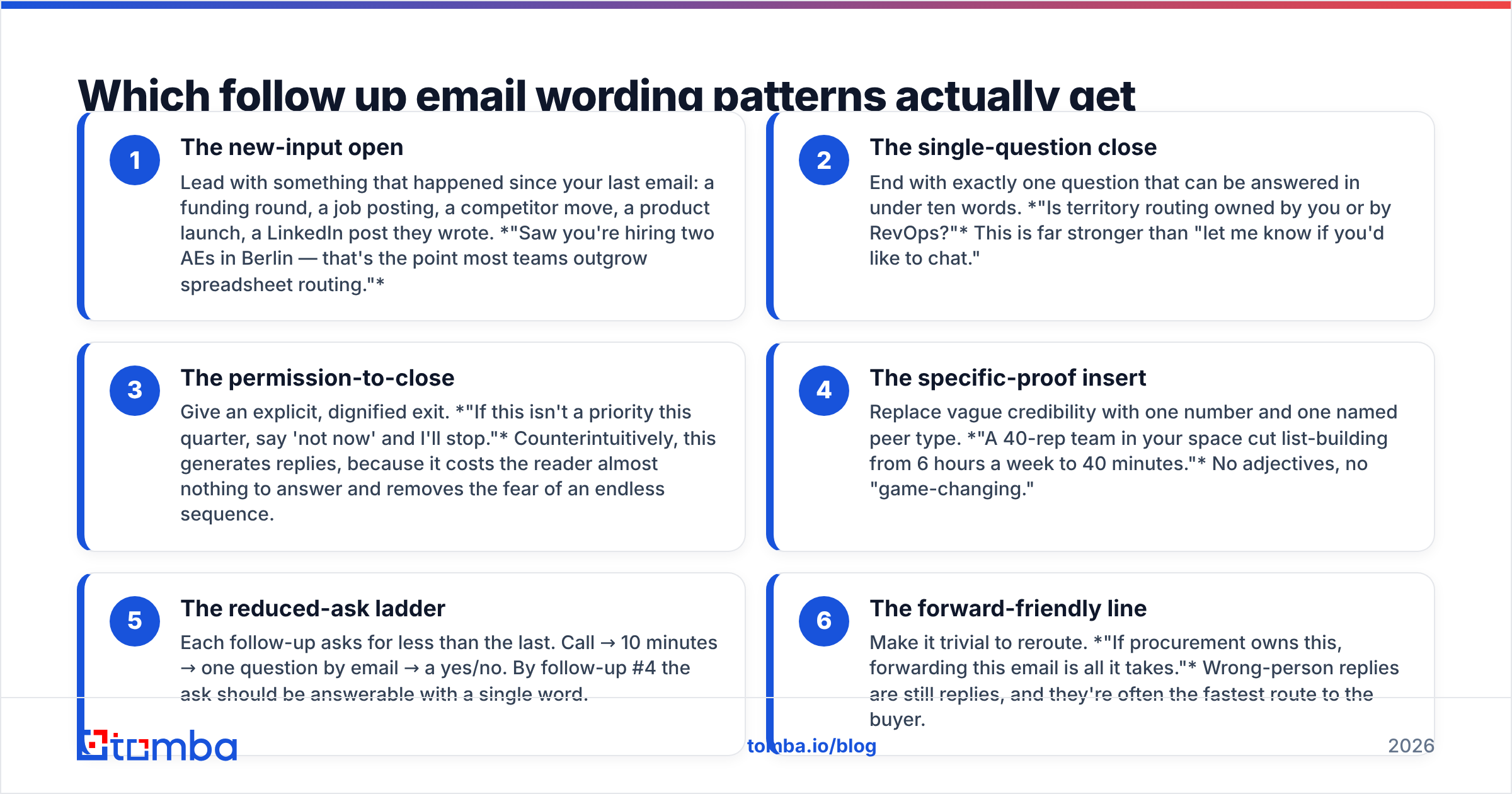
- The new-input open — Lead with something that happened since your last email: a funding round, a job posting, a competitor move, a product launch, a LinkedIn post they wrote. "Saw you're hiring two AEs in Berlin — that's the point most teams outgrow spreadsheet routing."
- The single-question close — End with exactly one question that can be answered in under ten words. "Is territory routing owned by you or by RevOps?" This is far stronger than "let me know if you'd like to chat."
- The permission-to-close — Give an explicit, dignified exit. "If this isn't a priority this quarter, say 'not now' and I'll stop." Counterintuitively, this generates replies, because it costs the reader almost nothing to answer and removes the fear of an endless sequence.
- The specific-proof insert — Replace vague credibility with one number and one named peer type. "A 40-rep team in your space cut list-building from 6 hours a week to 40 minutes." No adjectives, no "game-changing."
- The reduced-ask ladder — Each follow-up asks for less than the last. Call → 10 minutes → one question by email → a yes/no. By follow-up #4 the ask should be answerable with a single word.
- The forward-friendly line — Make it trivial to reroute. "If procurement owns this, forwarding this email is all it takes." Wrong-person replies are still replies, and they're often the fastest route to the buyer.
How should the wording change across a follow-up sequence?#
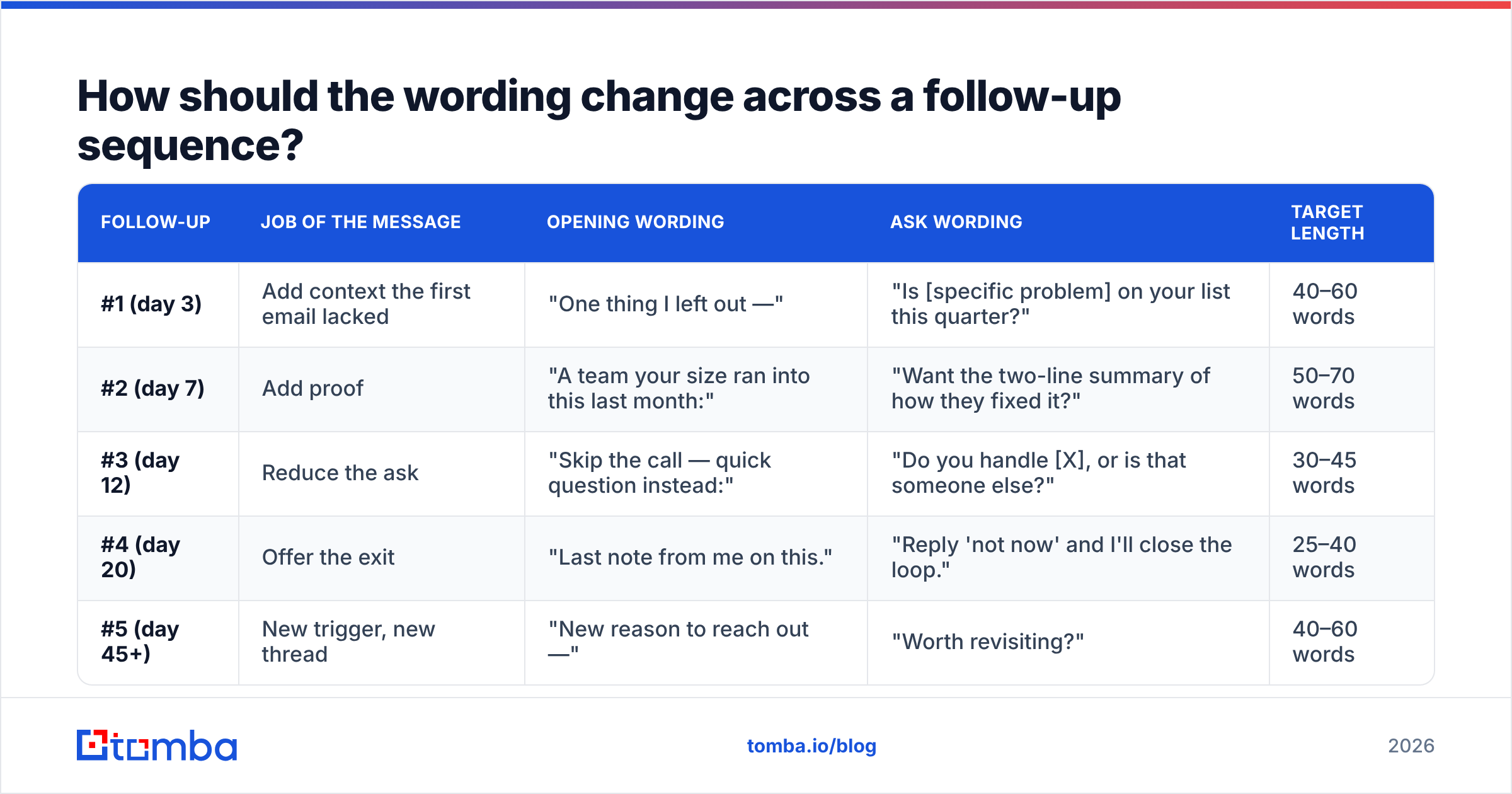
Every message in the sequence needs a distinct job. Repeating the same wording with different pleasantries is what makes a sequence feel like nagging.
| Follow-up | Job of the message | Opening wording | Ask wording | Target length |
|---|---|---|---|---|
| #1 (day 3) | Add context the first email lacked | "One thing I left out —" | "Is [specific problem] on your list this quarter?" | 40–60 words |
| #2 (day 7) | Add proof | "A team your size ran into this last month:" | "Want the two-line summary of how they fixed it?" | 50–70 words |
| #3 (day 12) | Reduce the ask | "Skip the call — quick question instead:" | "Do you handle [X], or is that someone else?" | 30–45 words |
| #4 (day 20) | Offer the exit | "Last note from me on this." | "Reply 'not now' and I'll close the loop." | 25–40 words |
| #5 (day 45+) | New trigger, new thread | "New reason to reach out —" | "Worth revisiting?" | 40–60 words |
Notice the word count shrinks as the sequence progresses. That's deliberate. Attention you haven't earned should not be spent on paragraphs. By message four, you're writing a text message with a signature.
Notice also that message five is a new thread, not a fifth bump. Reviving a dead thread requires a genuinely new trigger — a funding announcement, a leadership change, a product release. Without one, stop.
What words and phrases kill reply rates?#
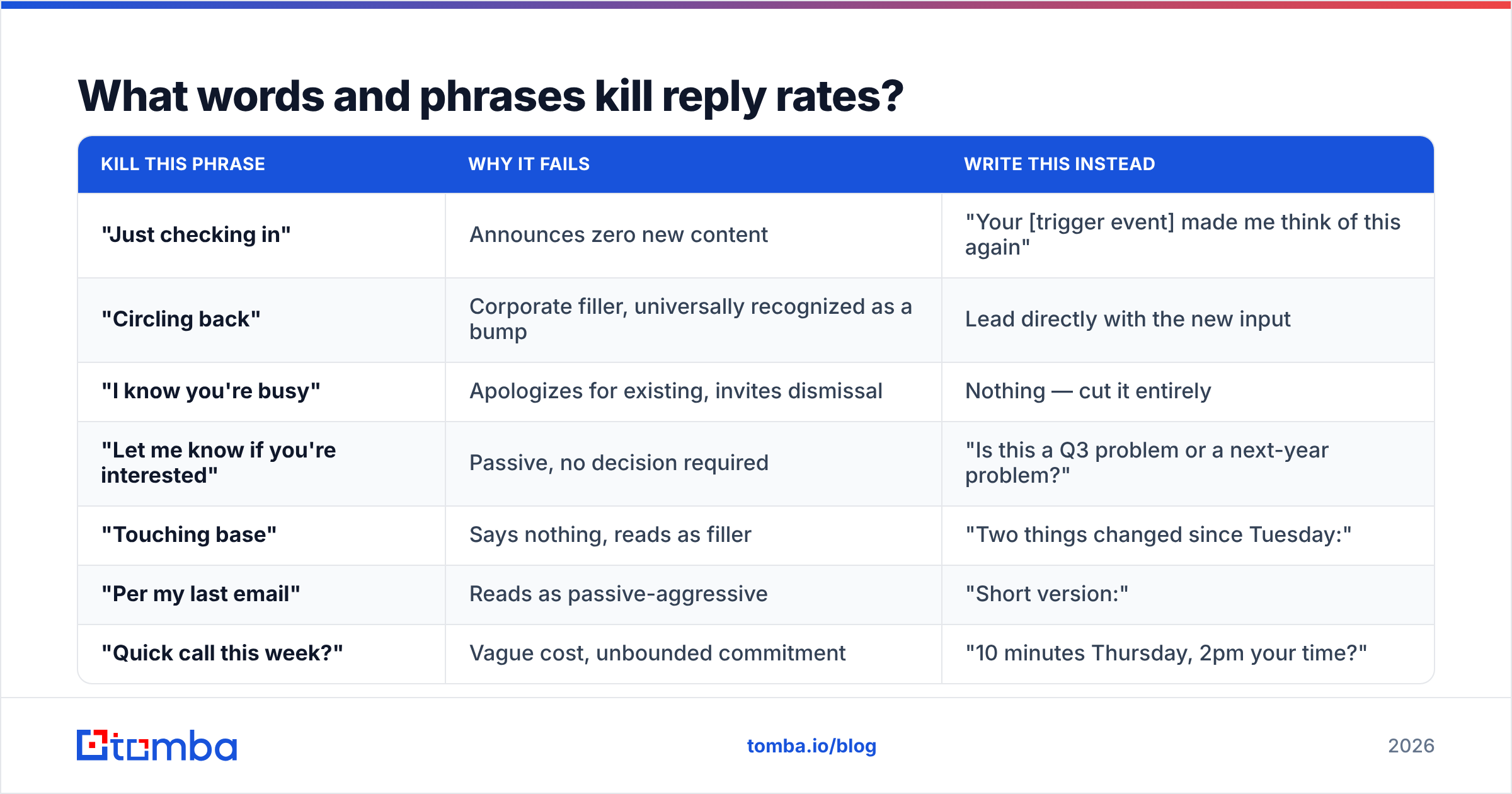
Some phrasing is so common that it now functions as a spam signal to human readers, independent of any filter. Delete these and replace them with the alternatives:
| Kill this phrase | Why it fails | Write this instead |
|---|---|---|
| "Just checking in" | Announces zero new content | "Your [trigger event] made me think of this again" |
| "Circling back" | Corporate filler, universally recognized as a bump | Lead directly with the new input |
| "I know you're busy" | Apologizes for existing, invites dismissal | Nothing — cut it entirely |
| "Let me know if you're interested" | Passive, no decision required | "Is this a Q3 problem or a next-year problem?" |
| "Touching base" | Says nothing, reads as filler | "Two things changed since Tuesday:" |
| "Per my last email" | Reads as passive-aggressive | "Short version:" |
| "Quick call this week?" | Vague cost, unbounded commitment | "10 minutes Thursday, 2pm your time?" |
| "Hope this finds you well" | Zero information in the highest-value line | Use the line for the trigger event |
The pattern behind the whole table: every phrase on the left costs the reader attention and returns nothing. Every phrase on the right either delivers information or requests a cheap, specific decision. HubSpot's sales blog has published similar findings across large samples of outbound data — specificity beats politeness, consistently.
How do you word a follow-up after no response?#
The no-response follow-up is the most-searched variant and the most-botched. The instinct is to acknowledge the silence. Don't. Silence is not an event worth referencing.
Template 1 — trigger-based (best default)
Subject: your Q3 hiring push
Hi Marcus — you posted three SDR roles this week. Ramp time is usually where teams feel the data problem first.
We cut list-building from 5 hours a week to under 1 for a 25-rep team last quarter.
Is ramp speed something you own, or does enablement?
Template 2 — reduced ask
Subject: one question instead
Skipping the meeting request. One question:
Are you currently buying contact data, or building lists in-house?
Either answer is useful — I'll only follow up if it's relevant.
Template 3 — permission to close
Subject: closing the loop
Last note from me on this, Marcus.
If data quality isn't a 2026 priority, reply "not now" and I'll stop here — no hard feelings.
If it is, Thursday at 2pm works on my end.
Each template is under 60 words. Each asks exactly one thing. None mentions the previous email.
How should the wording differ after a meeting or a proposal?#
Post-meeting and post-proposal follow-ups are a different genre. Here the reader already knows you, so the job shifts from earning attention to removing friction.
After a meeting, lead with the summary, not the thanks. Open with three bullets: what you agreed, what you owe them, what they owe you. One sentence each. Then a dated next step: "I'll send the security doc by Friday; you'll confirm whether Priya joins the technical review." Thanks belongs in the sign-off, if anywhere.
After a proposal, the deadliest wording is "any thoughts on the proposal?" It hands the reader an open-ended essay assignment. Replace it with a closed question about the specific blocker: "Is pricing the open question, or is it the migration timeline?" Naming the two likeliest objections makes replying a one-word task.
After a demo with no decision, use the reduced-ask ladder and offer an internal-selling asset instead of another meeting: "Want a one-pager your CFO can read in two minutes?" This converts far better than another calendar link, and it identifies the real decision-maker for you.
For more structures you can adapt, our library of cold email templates covers the openers, and a subject line generator helps you avoid the eight subject lines everyone else is sending this quarter.
Does wording matter more than deliverability?#
No — and this is the uncomfortable part of every copywriting guide.
Wording controls the reply rate among emails that get read. Deliverability controls how many get read at all. If 18% of your list is invalid, your follow-up sequence sends four messages to each dead address, drives your bounce rate past the threshold mailbox providers tolerate, and pushes your valid contacts into spam. At that point the difference between "just checking in" and a perfectly crafted trigger line is zero, because nobody sees either.
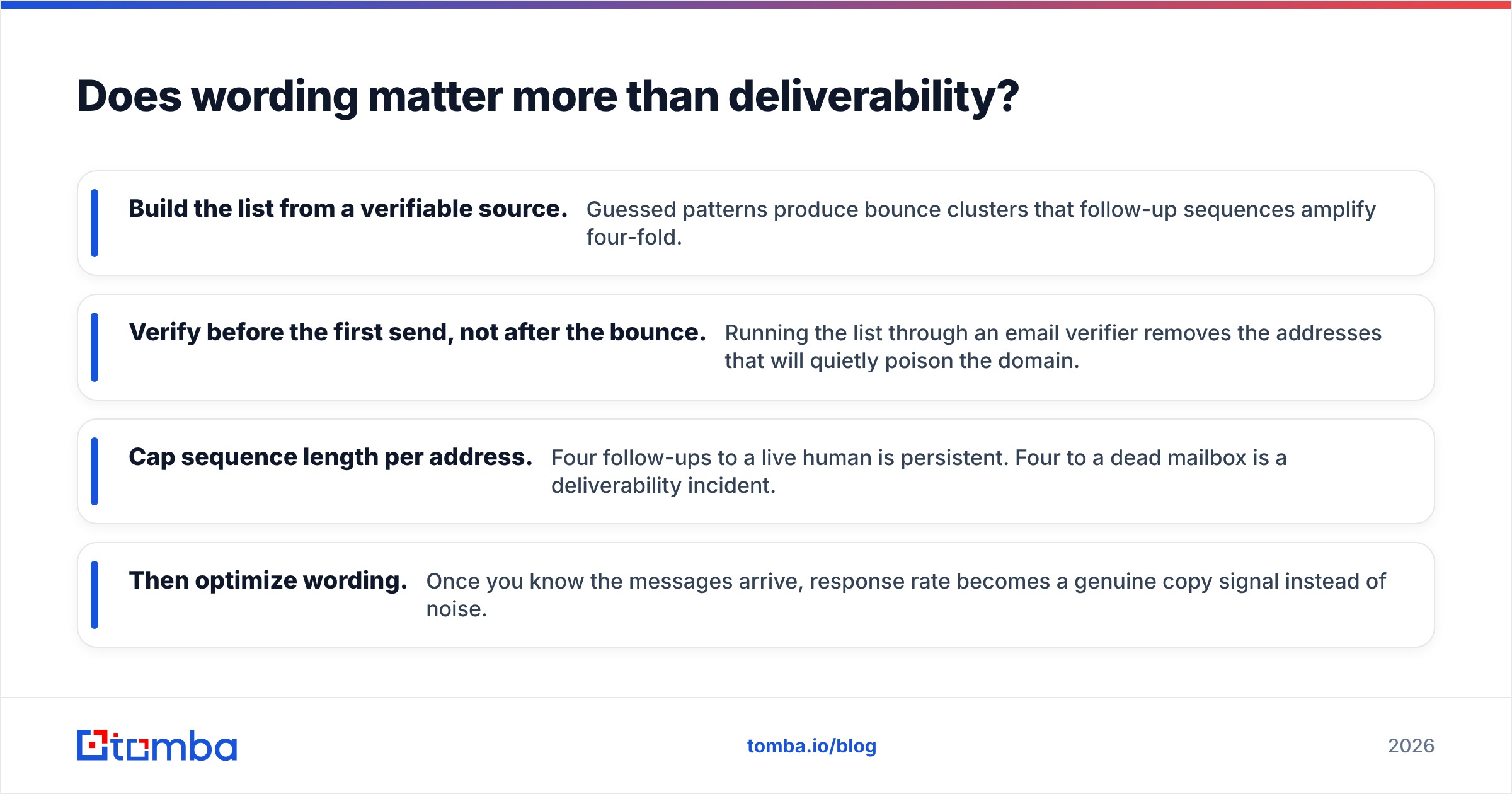
The order of operations that actually works:
- Build the list from a verifiable source. Guessed patterns produce bounce clusters that follow-up sequences amplify four-fold.
- Verify before the first send, not after the bounce. Running the list through an email verifier removes the addresses that will quietly poison the domain.
- Cap sequence length per address. Four follow-ups to a live human is persistent. Four to a dead mailbox is a deliverability incident.
- Then optimize wording. Once you know the messages arrive, response rate becomes a genuine copy signal instead of noise.
Vendors and analysts converge on this ordering. Salesforce's sales resources and buyer-review data on G2 both point the same way: data hygiene sits upstream of message optimization, and teams that invert the order spend months A/B testing subject lines against an audience that never received them.
How do you test follow-up wording without guessing?#
Test one variable per sequence, and give it enough volume to mean something.
- Test the opening line first. It carries more weight than the subject line in a follow-up, because the reader already recognizes the thread.
- Use reply rate, not open rate. Open tracking has been unreliable since privacy-protection features started pre-fetching images. Replies are the only honest metric left.
- Set a floor of roughly 200 sends per variant before drawing conclusions. Below that you're reading noise.
- Track "not now" replies as wins. They clear your pipeline and often convert on a re-touch two quarters later.
- Log the wording that produced meetings, verbatim, in a shared doc. Winning phrasing is company IP, not individual craft.
The bottom line#
Good follow up email wording is mostly subtraction. Cut the apology, cut the bump language, cut the second and third ask, cut the paragraph about your company. What remains — one new input, one specific question, one easy exit — is the message that gets answered.
But copy only compounds when it reaches a real inbox. Before you rewrite your sequence, make sure every address in it belongs to a real person at a real company. Start with the Tomba Email Finder to build the list from verified sources, run it through verification, and then let your wording do the job it was written for. The free tier covers 25 searches a month; paid plans start at $49/mo, with full Tomba pricing laid out by volume if you're sequencing at scale.
Related guides#
Ready to find emails that actually work?
Join 150,000+ professionals who stopped guessing and started sending. Free credits on signup — no credit card required.
Get the Tomba newsletter
Practical outbound tactics and product updates — once every two weeks.
About the author