Follow Up in Marketing: The 2026 Guide to Sequences That Convert
Most marketing teams stop after two touches — which is exactly where the replies start. Here's the cadence, channel mix, and measurement framework that makes follow-up the highest-ROI work in your funnel.
TL;DR
- Follow up in marketing is the structured set of touches after the first contact — and it is where the majority of pipeline actually gets created, not in the opener.
- Most teams quit at touch two. The compounding reply curve doesn't flatten until touch six to eight in B2B.
- A working cadence mixes channels (email, LinkedIn, phone, retargeting) and changes the angle each time, not just the subject line.
- Bad data kills follow-up faster than bad copy: every bounce in a sequence damages the sender reputation that carries the next nine emails.
- Measure per-touch reply lift, not campaign-level reply rate. Campaign averages hide the fact that touch four is doing all the work.
What Is Follow Up in Marketing?#
Follow up in marketing is every deliberate contact you make with a prospect after the first message, mapped to a schedule and a purpose. It is not "checking in." It is a sequence where each touch carries a different reason to respond.
Think of it like watering a plant. The first pour runs straight off the dry soil — it looks like nothing happened. The second and third soak in. Marketers who judge a campaign by the first pour conclude the soil is dead and stop.
Here's what a real follow-up system contains:
- A trigger — what put this person in the sequence (downloaded a guide, visited pricing, matched an ICP filter, replied to a survey). The trigger dictates the tone of every subsequent touch.
- A cadence — the spacing between touches. Not arbitrary: tight early (day 0, 2, 5) then widening (day 10, 18, 30) to mirror how buying attention decays.
- A channel mix — email plus LinkedIn plus phone plus paid retargeting. Single-channel sequences cap out fast because you're competing with yourself in one inbox.
- An angle ladder — each touch introduces new information: a case study, a data point, a relevant trigger event, a different persona pain. Never a repeat of the last message with "bumping this."
- An exit condition — reply, meeting booked, unsubscribe, or sequence completion. Without explicit exits you get the classic disaster of a prospect receiving touch five after they've already booked a demo.
- A measurement loop — per-touch open, reply, positive-reply, and unsubscribe rates, reviewed monthly so you can cut the touch that's only generating opt-outs.
Miss any one of those and you don't have follow-up. You have nagging with a calendar attached.
Why Do Most Marketing Follow-Ups Fail?#
Three reasons, in order of how much damage they do.
Reason one: the team stops too early. Internal urgency is not buyer urgency. Your prospect's inbox is not a priority queue sorted by your quota. Sales and marketing orgs consistently report that a large share of closed deals required five or more touches, while most reps stop at two. That gap is not a copy problem — it's an operations problem.
Reason two: every touch says the same thing. "Just following up on my last email" gives the reader zero new reason to act. The message adds no information, so the rational response is to keep ignoring it. Compare that to touch three saying: "Your competitor just launched a self-serve tier — here's how three companies in your space priced against that move." Different information, different decision.
Reason three: the list is decaying underneath the sequence. B2B contact data goes stale at roughly 2-3% per month as people change jobs. Run a nine-touch sequence over six weeks against a list built four months ago and a meaningful slice of it is now bouncing. Those bounces hit your domain reputation, and the reputation hit degrades inbox placement for the valid addresses in the same campaign. You end up punishing your good contacts for the sins of your dead ones.
The fix for reason three is boring and mechanical: verify before you send, not after you bounce. Running the list through an email verifier at the start of a campaign — and again before any re-engagement push — costs a fraction of what a reputation rebuild costs.
How Many Follow-Ups Should You Send?#
Depends on deal size and intent level, and anyone who gives you one number is selling something. Here's the practical mapping:
| Scenario | Total touches | Window | Channel mix | Typical stop point |
|---|---|---|---|---|
| Inbound demo request | 4-5 | 10 days | Email + phone | Reply or explicit no |
| Content download (MQL) | 5-7 | 4 weeks | Email + retargeting | Sequence end, move to nurture |
| Cold outbound, SMB | 6-8 | 5 weeks | Email + LinkedIn | Sequence end |
| Cold outbound, enterprise | 9-12 | 10-12 weeks | Email + LinkedIn + phone + ads | Sequence end, re-enter in 2 quarters |
| Closed-lost reactivation | 3-4 | 3 weeks | Email + phone | Reply or 2nd no |
| Event/webinar attendee | 3-5 | 8 days | Email + LinkedIn | Reply or booking |
Two rules that survive across all six rows:
Front-load the value, back-load the ask. Touches one through three should be predominantly about them — trigger events, benchmarks, a teardown of something they published. The direct ask lives in touch four and beyond, once you've earned attention.
Widen the gaps as you go. Day 0, 2, 5, 10, 18, 32 outperforms a flat every-four-days rhythm because it mimics natural human persistence rather than a metronome. Metronomes read as automation, and automation gets filtered.
What Should Each Follow-Up Actually Say?#
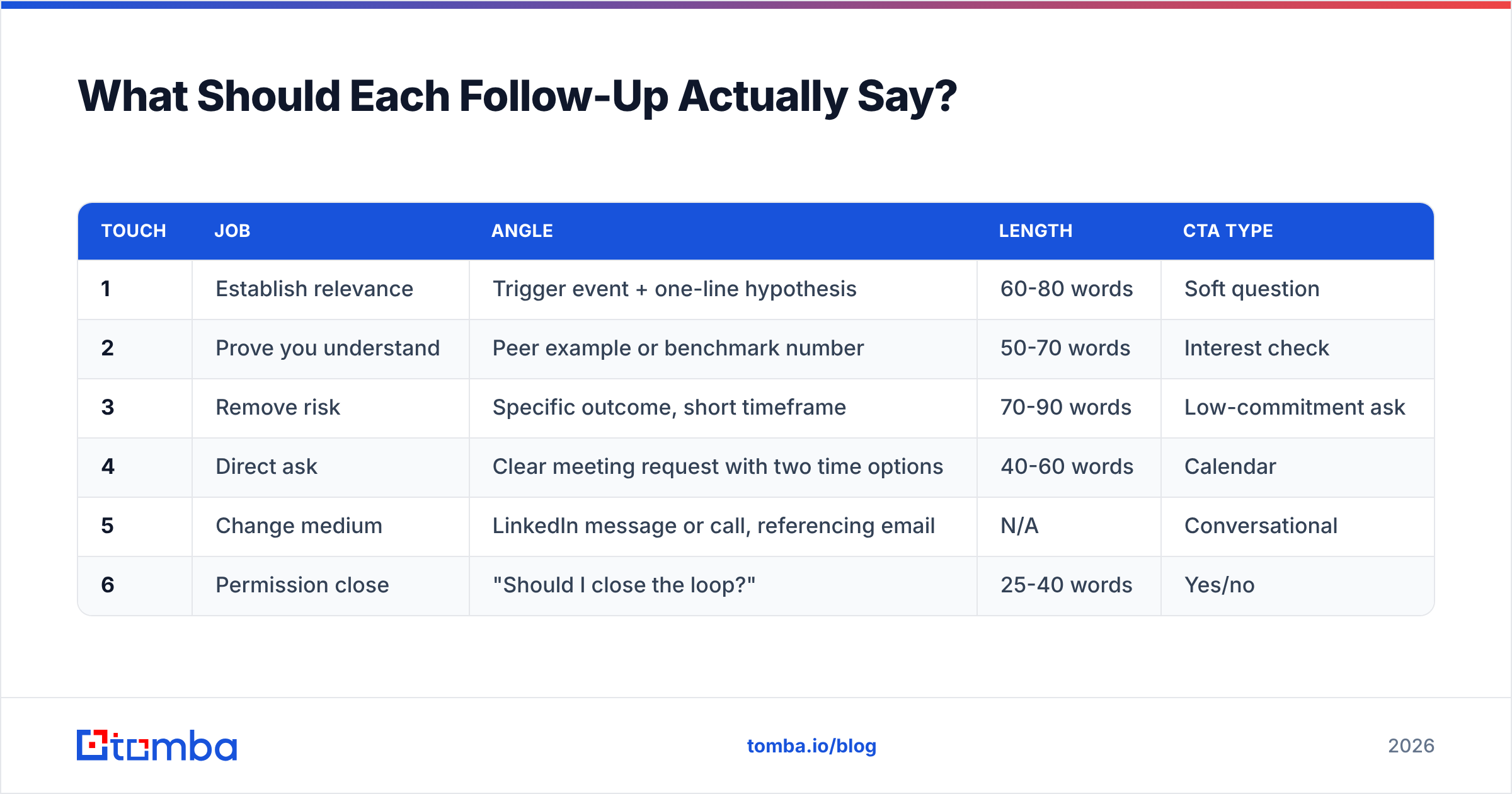
Give each touch a job. If two touches share a job, delete one.
| Touch | Job | Angle | Length | CTA type |
|---|---|---|---|---|
| 1 | Establish relevance | Trigger event + one-line hypothesis | 60-80 words | Soft question |
| 2 | Prove you understand | Peer example or benchmark number | 50-70 words | Interest check |
| 3 | Remove risk | Specific outcome, short timeframe | 70-90 words | Low-commitment ask |
| 4 | Direct ask | Clear meeting request with two time options | 40-60 words | Calendar |
| 5 | Change medium | LinkedIn message or call, referencing email | N/A | Conversational |
| 6 | Permission close | "Should I close the loop?" | 25-40 words | Yes/no |
The permission close on touch six is the highest-reply single message in most B2B sequences, and it's the one teams skip because it feels like giving up. It isn't. It converts silence into a decision, which is the entire point.
A note on subject lines: keep them lowercase, under five words, and never re-use the same thread subject more than twice. If you want to pressure-test yours before sending, run them through a subject line tester rather than guessing from the seat of your pants. HubSpot's sales blog maintains a useful running library of follow-up frameworks if you want more angle inspiration.
Email, LinkedIn, or Phone — Which Follow-Up Channel Wins?#
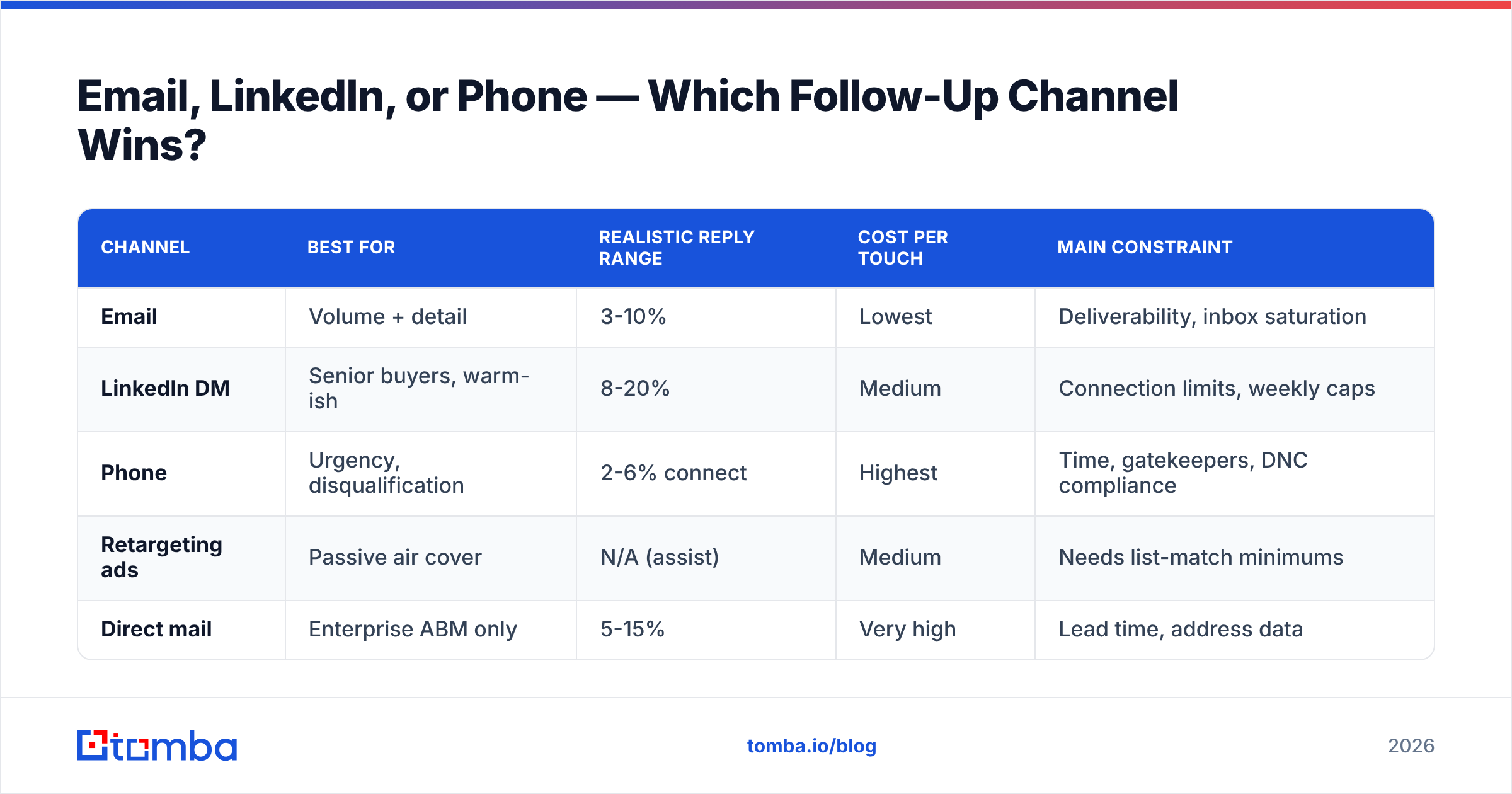
None of them alone. The winning pattern in 2026 is channel rotation, where the same message thread appears in a second place before the prospect has consciously decided to ignore you.
| Channel | Best for | Realistic reply range | Cost per touch | Main constraint |
|---|---|---|---|---|
| Volume + detail | 3-10% | Lowest | Deliverability, inbox saturation | |
| LinkedIn DM | Senior buyers, warm-ish | 8-20% | Medium | Connection limits, weekly caps |
| Phone | Urgency, disqualification | 2-6% connect | Highest | Time, gatekeepers, DNC compliance |
| Retargeting ads | Passive air cover | N/A (assist) | Medium | Needs list-match minimums |
| Direct mail | Enterprise ABM only | 5-15% | Very high | Lead time, address data |
Phone is the most underrated follow-up channel precisely because it's the least crowded. It's also the channel where most teams have the worst data — you need direct dials, not switchboards. If you're adding calls to a sequence, source numbers through a proper phone finder rather than scraping company contact pages, and validate before your SDRs burn an hour dialing disconnected lines.
Retargeting deserves a mention as air cover. It won't produce a reply on its own, but a prospect who has seen your brand three times in their feed opens touch four at a noticeably higher rate. Treat it as a multiplier on your email sequence, not a channel with its own attribution.
Which Follow-Up Tools Are Worth It in 2026?#
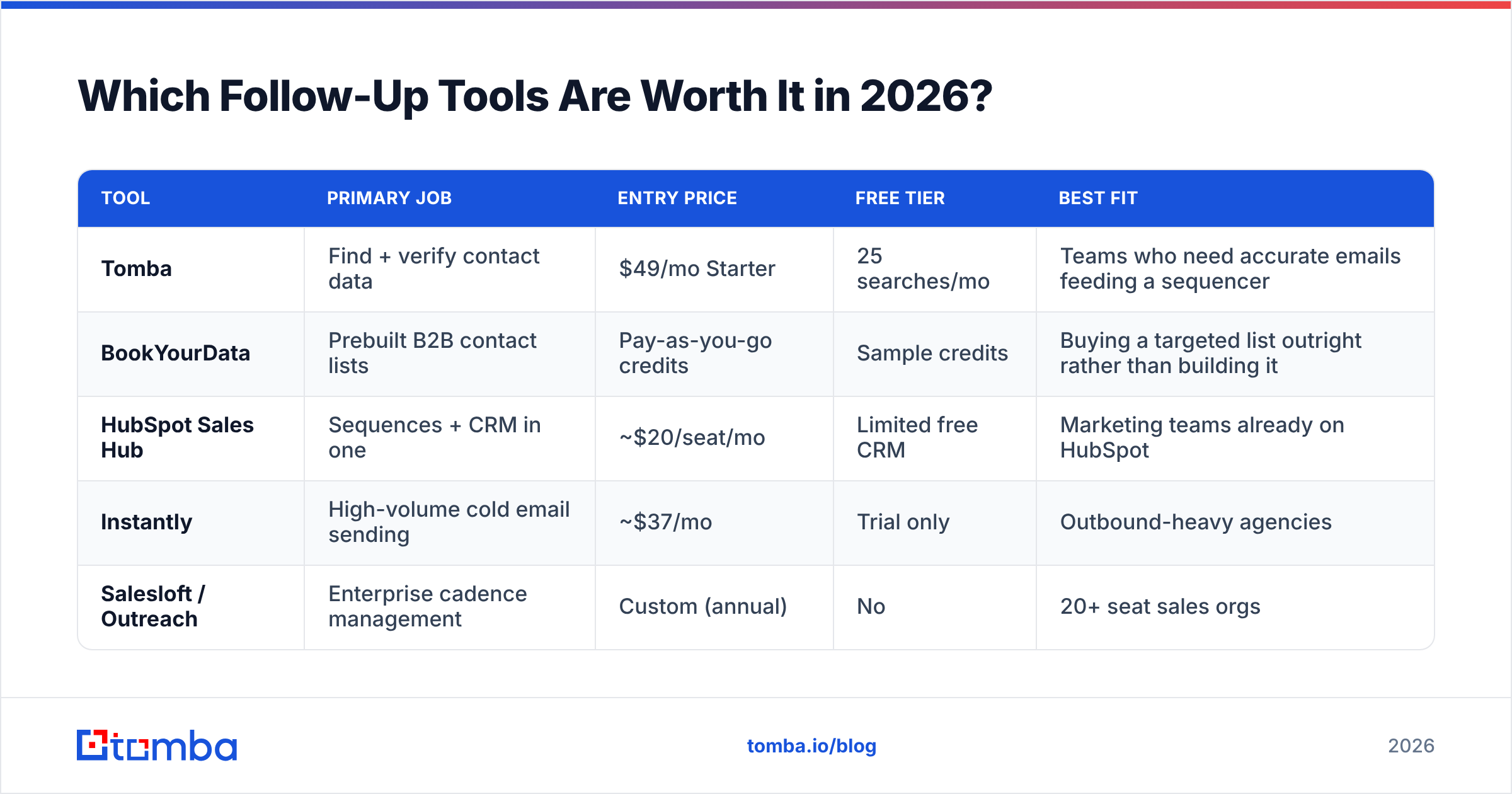
Follow-up tooling splits into three jobs: find and verify the contact, send and sequence, and track and route the reply. Most teams overbuy on sequencing and underbuy on data, which is backwards — a perfect sequence sent to a wrong address converts at zero.
| Tool | Primary job | Entry price | Free tier | Best fit |
|---|---|---|---|---|
| Tomba | Find + verify contact data | $49/mo Starter | 25 searches/mo | Teams who need accurate emails feeding a sequencer |
| BookYourData | Prebuilt B2B contact lists | Pay-as-you-go credits | Sample credits | Buying a targeted list outright rather than building it |
| HubSpot Sales Hub | Sequences + CRM in one | ~$20/seat/mo | Limited free CRM | Marketing teams already on HubSpot |
| Instantly | High-volume cold email sending | ~$37/mo | Trial only | Outbound-heavy agencies |
| Salesloft / Outreach | Enterprise cadence management | Custom (annual) | No | 20+ seat sales orgs |
Prices are list prices at time of writing — check each vendor's page before budgeting, since B2B SaaS pricing moves constantly. G2's category pages are a reasonable place to sanity-check current tiers and read unfiltered reviews.
The pattern that works for most mid-market teams: a data layer (Tomba or BookYourData, depending on whether you build or buy your lists) feeding a sequencer (HubSpot or Instantly), with the CRM as the source of truth for exits. See Tomba pricing if you're sizing the data layer specifically — the $49/mo Starter tier covers most single-SDR or founder-led motions, and Growth at $99/mo handles a small pod.
If you're running follow-up at list scale rather than one prospect at a time, the bulk email finder workflow matters more than any individual lookup: upload the account list, get verified contacts back, push to the sequencer, done. That's the part that determines whether your cadence runs on real people or on guesses.
How Do You Measure Follow-Up Performance?#
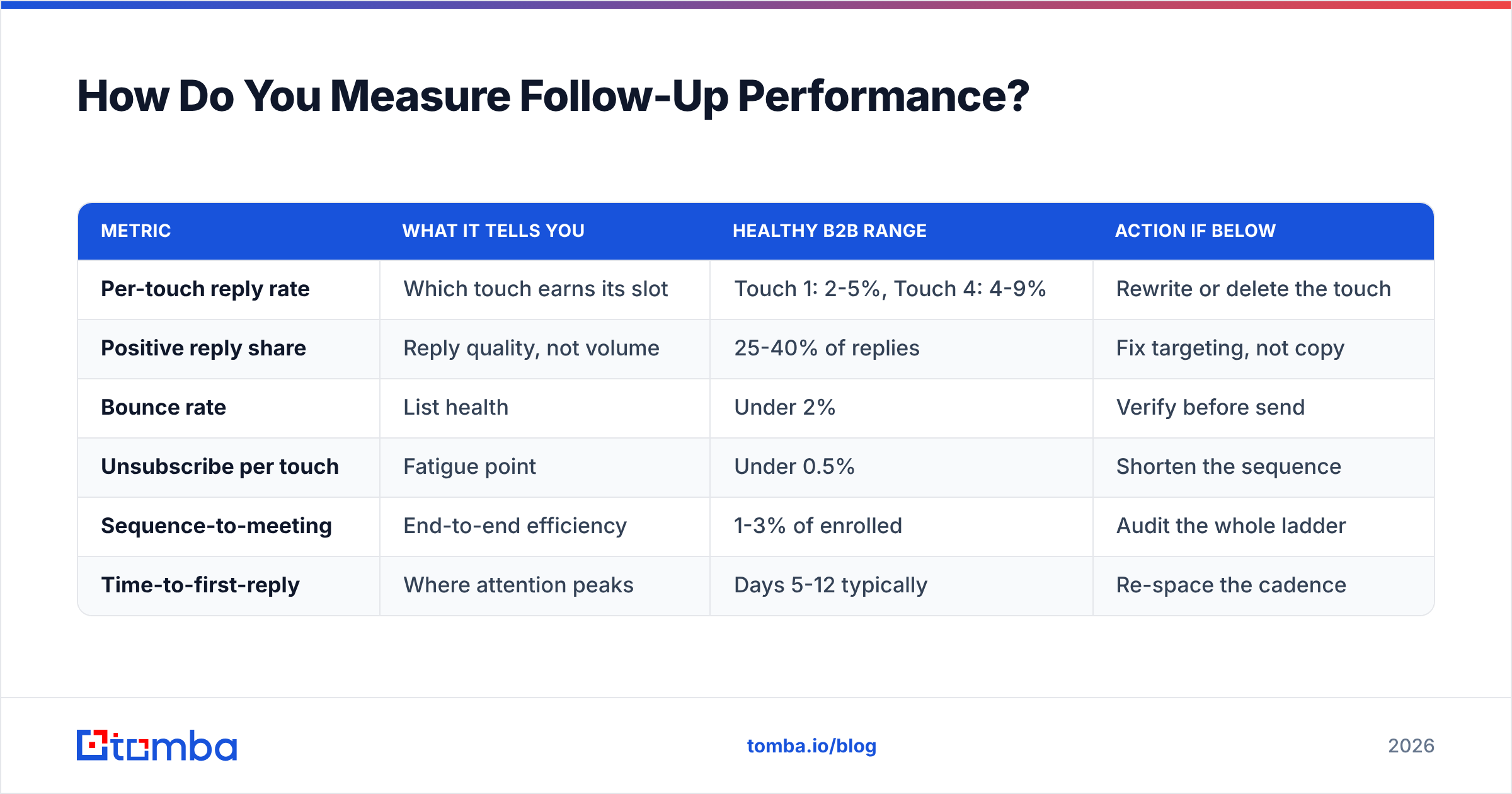
Campaign-level reply rate is a vanity metric. It averages a touch that pulls 9% with a touch that pulls 0.4% and tells you the campaign "did 3%." Useless for decisions.
Track these instead:
| Metric | What it tells you | Healthy B2B range | Action if below |
|---|---|---|---|
| Per-touch reply rate | Which touch earns its slot | Touch 1: 2-5%, Touch 4: 4-9% | Rewrite or delete the touch |
| Positive reply share | Reply quality, not volume | 25-40% of replies | Fix targeting, not copy |
| Bounce rate | List health | Under 2% | Verify before send |
| Unsubscribe per touch | Fatigue point | Under 0.5% | Shorten the sequence |
| Sequence-to-meeting | End-to-end efficiency | 1-3% of enrolled | Audit the whole ladder |
| Time-to-first-reply | Where attention peaks | Days 5-12 typically | Re-space the cadence |
The single most useful chart you can build: reply rate by touch number, plotted across your last ten campaigns. It will almost certainly show a peak somewhere between touch three and five — and it will show you exactly where the curve dies, which is where your sequence should end. Most teams discover their touch seven and eight generate more unsubscribes than replies and cut them the same afternoon.
For definitions and benchmark context on the underlying metric, the response rate entry in Tomba's glossary is a decent baseline. And if you want a broader view of how buying committees actually consume vendor outreach, Gartner's B2B buying research is the most-cited source in the category.
What Kills Follow-Up Deliverability?#
Follow-up is where deliverability problems compound, because a sequence multiplies every mistake by the number of touches.
- Bounces early in the sequence. A 6% bounce on touch one means touches two through six arrive with degraded reputation. Verify first.
- Identical templates at volume. Sending the same 80-word block to 4,000 people flags as bulk. Vary at least 30% of the body via merge fields and conditional blocks.
- No unsubscribe path on marketing follow-ups. In most jurisdictions this is a legal issue, not just a filter issue.
- Sending all touches from one domain. Spread across subdomains for volume, but keep authentication tight — SPF, DKIM, and DMARC aligned on every sending domain.
- Ignoring engagement signals. If a contact hasn't opened touches one through four, touch five is unlikely to be the breakthrough. Suppress and re-enter later.
The reputation math is unforgiving: it takes days to damage a sending domain and weeks to repair one. Front-loading verification is not a nice-to-have in a follow-up program — it's the load-bearing wall.
Where Should You Start?#
Pick one sequence you already run, pull the per-touch reply data, and do three things this week: delete the worst-performing touch, add a permission close at the end, and verify the list before the next send. That's a day of work and it typically moves sequence-to-meeting rate more than a full copy rewrite would.
Then fix the input. Follow-up only compounds if the contacts are real. If your sequences are running on guessed addresses, permutated patterns, or a list you bought in 2024, the cadence isn't your bottleneck — the data is. Start with the Tomba Email Finder to build a verified contact layer under your sequences: free tier gives you 25 searches a month to test the accuracy on your own accounts, and Starter at $49/mo covers a working outbound motion. Get the addresses right, and every touch after the first one starts doing the job it was designed to do.
Related guides#
Ready to find emails that actually work?
Join 150,000+ professionals who stopped guessing and started sending. Free credits on signup — no credit card required.
Get the Tomba newsletter
Practical outbound tactics and product updates — once every two weeks.
About the author