Follow Up in Sales Process: The 2026 Cadence That Closes
Most B2B deals die in the gap between first contact and second touch. Here is the follow-up cadence, timing data, and tooling stack that actually moves pipeline in 2026.
TL;DR
- Most B2B deals do not die at "no." They die at silence after touch one or two — and the average buying committee now runs 6 to 11 people, so one reply from one person proves nothing.
- A working follow-up sequence is 6-9 touches over 21-30 days, mixing email, phone, and LinkedIn. Same-channel-only cadences underperform badly.
- Timing beats cleverness: reply within 5 minutes of an inbound trigger, then space outbound touches 2-3-5-7 days apart rather than daily.
- Every follow-up touch should add something — a data point, a customer story, a teardown — never "just circling back."
- Bad contact data quietly kills half your cadence. If 25% of your addresses bounce, your "low reply rate" is a data problem wearing a copywriting costume.
What Does "Follow Up in Sales Process" Actually Mean?#
Follow-up is every deliberate touch after the first one, aimed at moving a specific deal to the next defined stage. That is the whole definition, and the word "deliberate" is doing the heavy lifting.
Think of it like watering a plant. One big flood on day one does nothing. Consistent, measured water on a schedule is what grows something. Most reps flood on Monday and forget the plant exists by Thursday.
In practice, follow-up in sales process spans four distinct moments, and they are not interchangeable:
- Post-prospecting follow-up — you sent a cold email or left a voicemail and got nothing. Goal: earn a first reply.
- Post-meeting follow-up — you had a call. Goal: confirm what was agreed and lock the next date before you hang up, not after.
- Post-proposal follow-up — pricing is out. Goal: surface the real objection, which is almost never the number on the page.
- Post-close and post-loss follow-up — expansion, referrals, and the 90-day re-open on a "we went with someone else."
Each one needs a different cadence, a different channel mix, and a different definition of success. Treating all four as "check in next week" is why pipeline stalls.
Why Do Most Sales Follow-Ups Fail?#
Four failure modes account for nearly all of it.
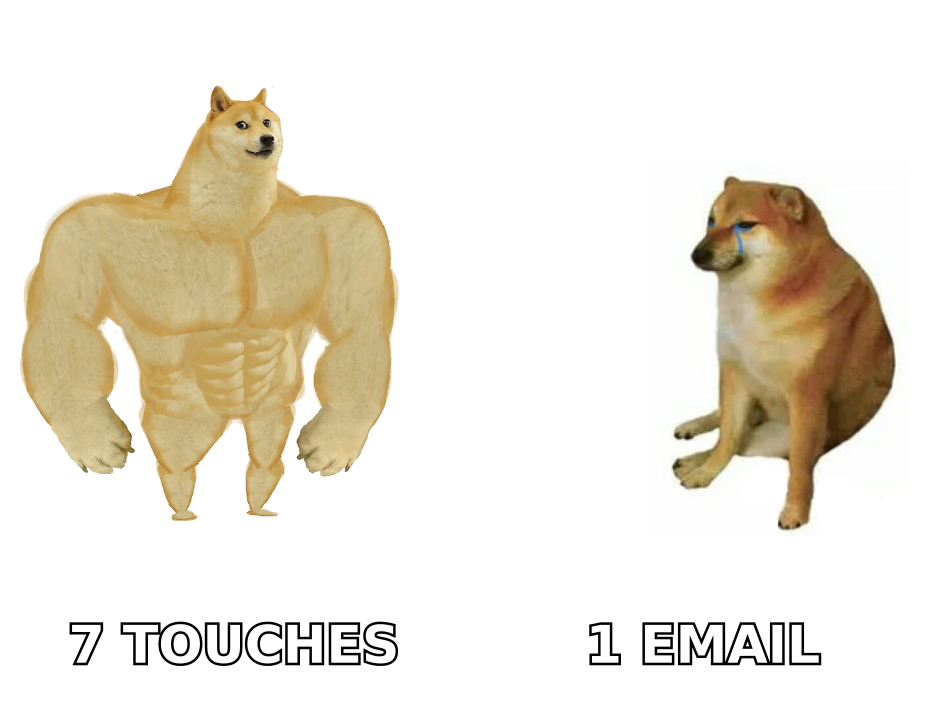
Failure 1: quitting after touch two. The uncomfortable pattern across most outbound teams is that the majority of sequences stop at one or two touches, while a meaningful share of positive replies arrive on touch four or later. Reps quit right before the return curve starts bending upward.
Failure 2: zero new information. "Just following up on my last email" tells the buyer you have nothing to add and they were right to ignore you. Every touch has to carry a payload.
Failure 3: single channel. Email-only cadences fight an inbox that already gets 100+ messages a day. Add a call and a LinkedIn touch and the same message suddenly has three chances to land. LinkedIn outreach works as a follow-up channel precisely because it is a different context, not because the copy is better.
Failure 4: dead data. This is the invisible one. If your list has stale addresses, your sequence is technically running and functionally shouting into a void. Worse, high bounce rates damage sender reputation, which then suppresses delivery to the good addresses too. You end up debugging subject lines when the actual defect is upstream.
What Does a Follow-Up Cadence Look Like in 2026?#
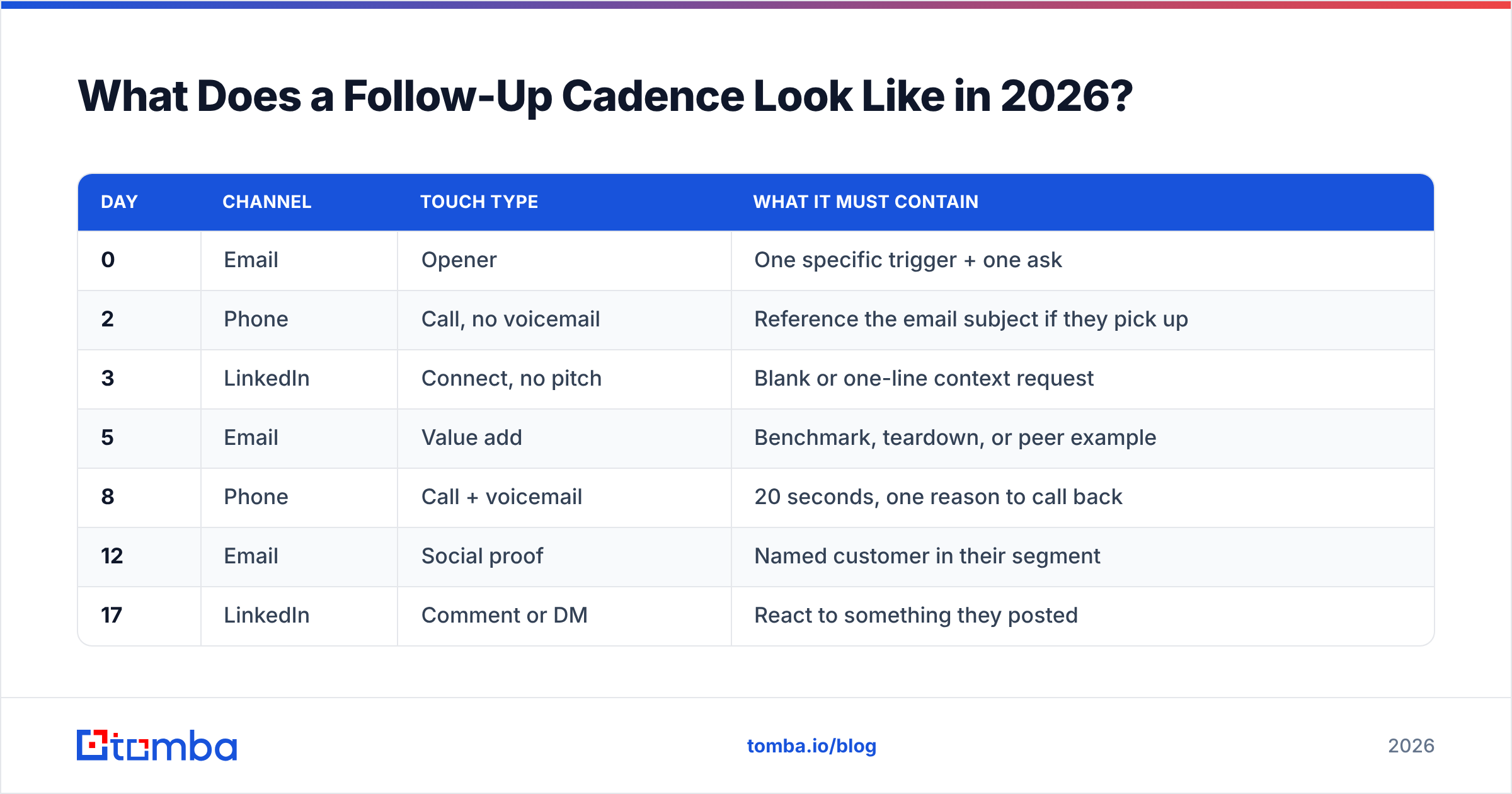
Here is a cadence that holds up across most B2B mid-market motions. Adjust the density for enterprise (slower, more research-heavy) and SMB (faster, more volume).
| Day | Channel | Touch type | What it must contain |
|---|---|---|---|
| 0 | Opener | One specific trigger + one ask | |
| 2 | Phone | Call, no voicemail | Reference the email subject if they pick up |
| 3 | Connect, no pitch | Blank or one-line context request | |
| 5 | Value add | Benchmark, teardown, or peer example | |
| 8 | Phone | Call + voicemail | 20 seconds, one reason to call back |
| 12 | Social proof | Named customer in their segment | |
| 17 | Comment or DM | React to something they posted | |
| 23 | Permission close | "Should I close the file?" | |
| 30+ | Nurture | Quarterly | Move to long-cycle list, not deletion |
Nine touches over 30 days. That is roughly one touch every 3.3 days — persistent without being unhinged. The step most teams skip is day 23, and it is usually the highest-reply message in the whole sequence because it hands control back to the buyer.
Two rules that make this cadence work:
- Never send two touches on the same day. It reads as automated panic.
- Escalate specificity, not volume. Touch 6 should be more tailored than touch 1, not longer.
How Fast Should You Follow Up on an Inbound Lead?#
Within five minutes, and this is the one number worth memorizing.
Lead response research consistently shows that contacting an inbound lead within the first five minutes dramatically outperforms contacting them at 30 minutes, and the curve falls off a cliff after the first hour. HubSpot's research on sales follow-up has covered this pattern for years, as have analyst firms like Gartner tracking buyer-engagement windows.
The mechanism is simple: at minute five the buyer is still on your pricing page with the tab open. At hour two they are in a different meeting and you are a cold call.
Practical implementation:
- Route inbound to a live human, not to a sequence that starts tomorrow morning.
- Call first, email second. Phone gets the five-minute window; email is the receipt.
- Enrich before you dial. A 30-second lookup on company size and role changes the opening line entirely. Tools like data enrichment fill in the firmographics automatically so the rep is not googling while the window closes.
- Have a fallback number. If the form only captured an email, a phone finder lookup can turn a slow email thread into a same-minute conversation.
Outbound follow-up runs on the opposite clock. There, patience wins — spacing touches 2 to 5 days apart consistently outperforms daily bombardment, which mostly generates unsubscribes.
Email, Phone, or LinkedIn — Which Follow-Up Channel Wins?#
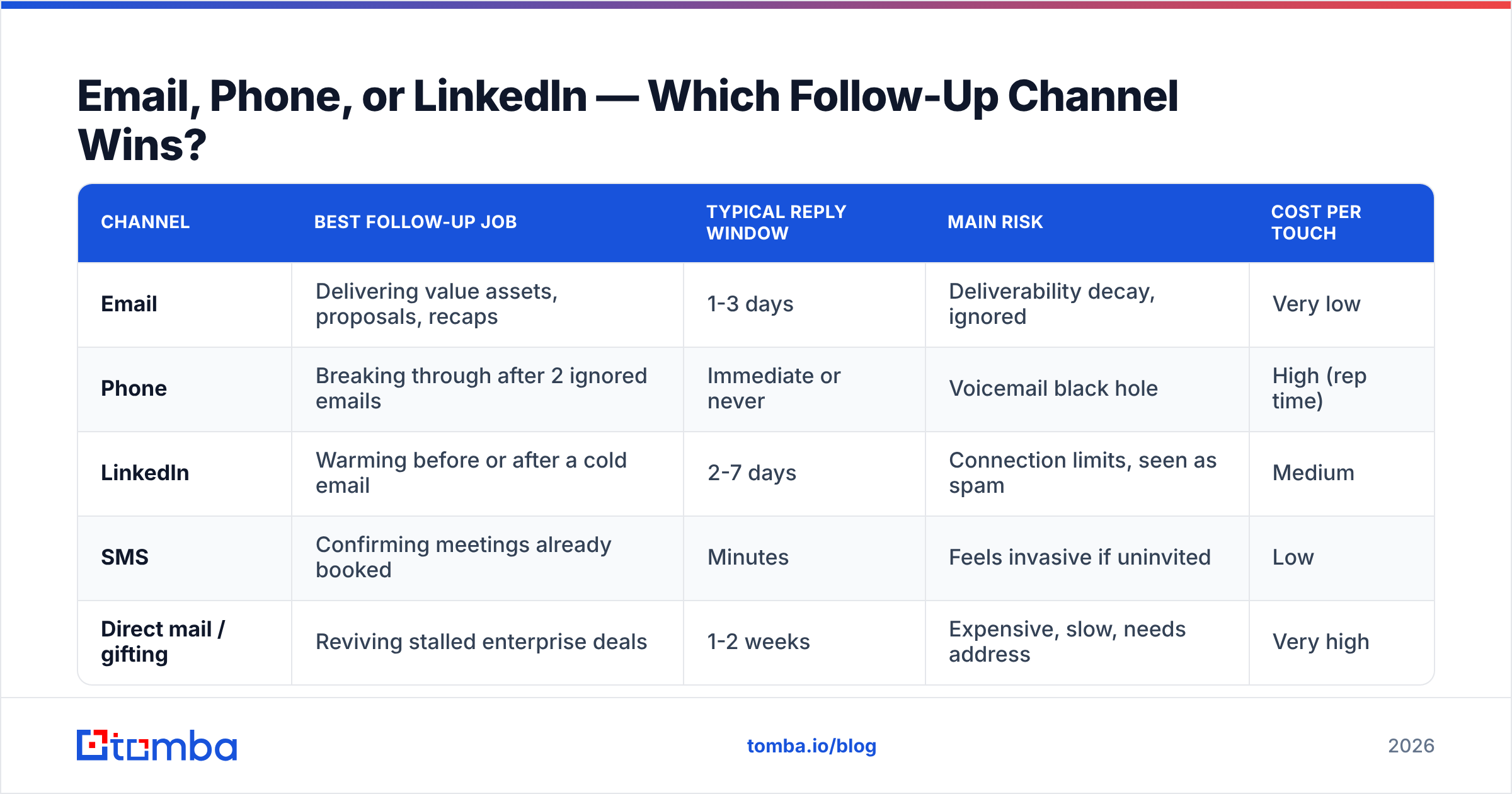
None of them alone. The honest answer is that the mix is the strategy, and each channel has a specific job.
| Channel | Best follow-up job | Typical reply window | Main risk | Cost per touch |
|---|---|---|---|---|
| Delivering value assets, proposals, recaps | 1-3 days | Deliverability decay, ignored | Very low | |
| Phone | Breaking through after 2 ignored emails | Immediate or never | Voicemail black hole | High (rep time) |
| Warming before or after a cold email | 2-7 days | Connection limits, seen as spam | Medium | |
| SMS | Confirming meetings already booked | Minutes | Feels invasive if uninvited | Low |
| Direct mail / gifting | Reviving stalled enterprise deals | 1-2 weeks | Expensive, slow, needs address | Very high |
The pattern that works: email carries the substance, phone creates the urgency, LinkedIn creates the familiarity. A prospect who has seen your name in their inbox, their notifications, and their missed calls treats touch five completely differently than a stranger's first email.
One caveat on SMS — use it only after explicit contact, and only for logistics. Cold SMS in B2B burns goodwill fast and carries real compliance exposure depending on jurisdiction.
What Should Each Follow-Up Message Actually Say?#
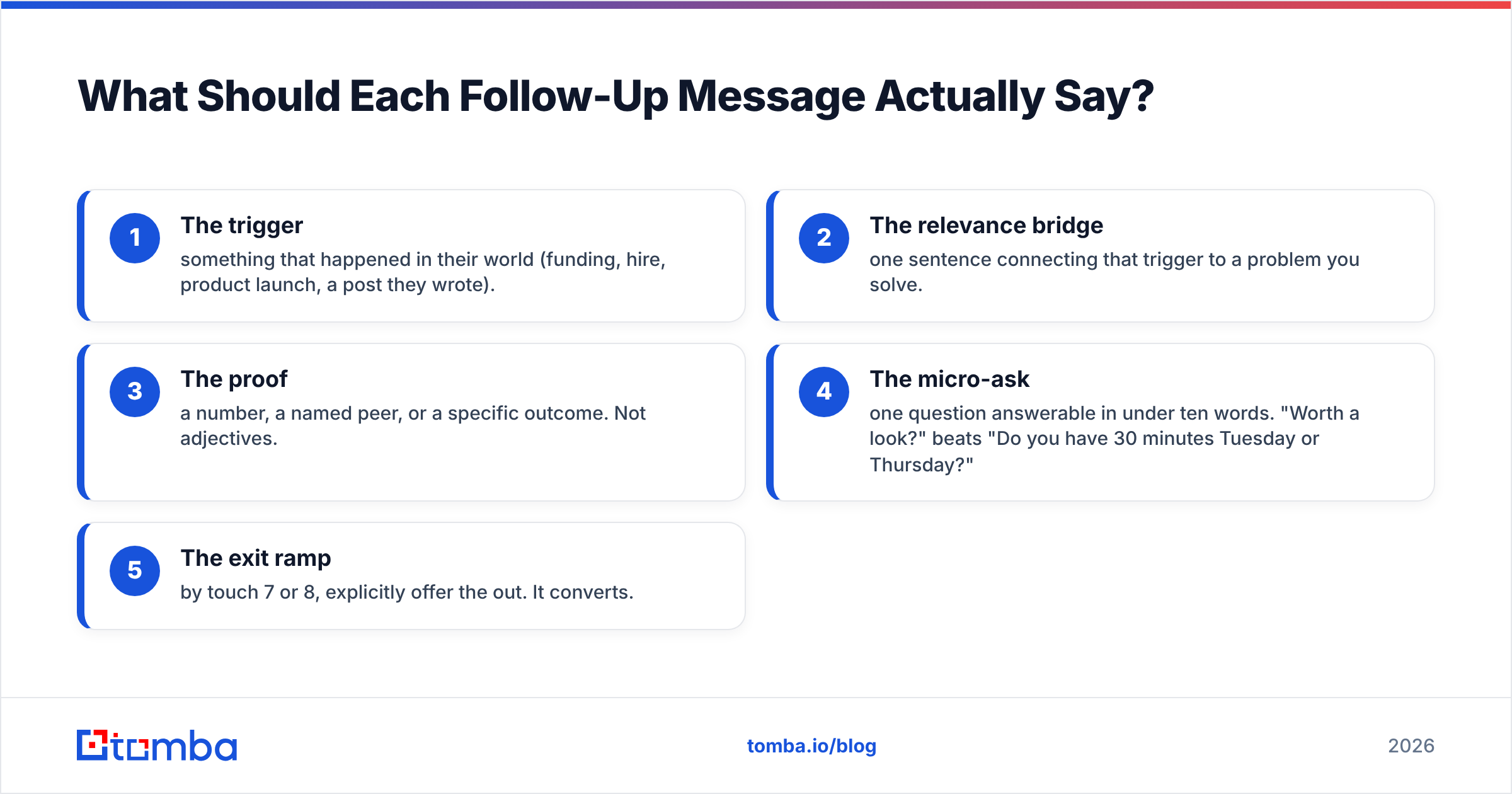
Every follow-up needs a reason to exist that is not "I want something." Use this framework per touch:
- The trigger — something that happened in their world (funding, hire, product launch, a post they wrote).
- The relevance bridge — one sentence connecting that trigger to a problem you solve.
- The proof — a number, a named peer, or a specific outcome. Not adjectives.
- The micro-ask — one question answerable in under ten words. "Worth a look?" beats "Do you have 30 minutes Tuesday or Thursday?"
- The exit ramp — by touch 7 or 8, explicitly offer the out. It converts.
Length target: under 90 words for touches 1-4, under 50 for touches 5+. Nobody has ever replied because an email was longer.
Three follow-up messages that reliably work:
- The teardown. "I looked at your careers page — you are hiring 4 SDRs. Here is what the first 30 days of their list-building usually costs." Specific, useful even if they never buy.
- The peer proof. "[Competitor in their segment] had the same catch-all domain problem. Took 3 weeks to fix." Names beat categories.
- The close-the-file. "I have not heard back, so I am assuming this is not a priority this quarter. Should I close the file or check back in Q3?" Low pressure, high reply.
If you need a starting library, the cold email templates collection covers most of these shapes, and a subject line generator helps when touch 5 needs a fresh thread rather than another reply-all.
How Do You Know Your Follow-Up Is Working?#
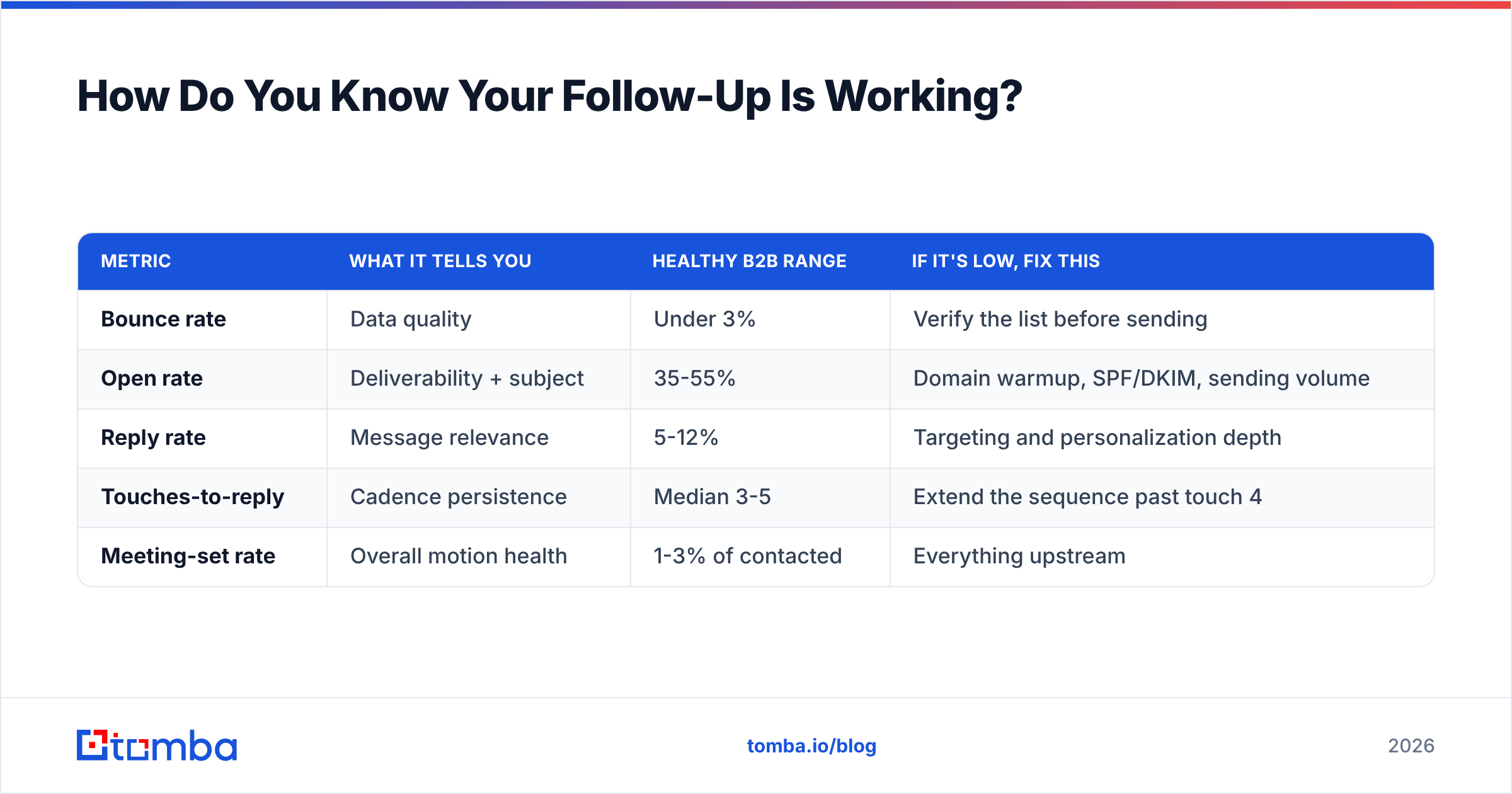
Track four metrics. Ignore the rest until these four are healthy.
| Metric | What it tells you | Healthy B2B range | If it's low, fix this |
|---|---|---|---|
| Bounce rate | Data quality | Under 3% | Verify the list before sending |
| Open rate | Deliverability + subject | 35-55% | Domain warmup, SPF/DKIM, sending volume |
| Reply rate | Message relevance | 5-12% | Targeting and personalization depth |
| Touches-to-reply | Cadence persistence | Median 3-5 | Extend the sequence past touch 4 |
| Meeting-set rate | Overall motion health | 1-3% of contacted | Everything upstream |
The diagnostic order matters. Do not rewrite copy while your bounce rate is 15% — you will be optimizing a message nobody receives. Run the list through an email verifier first, confirm bounce rate is under 3%, then judge the copy.
The touches-to-reply metric is the most underused number in sales ops. Pull it from your CRM for the last 90 days of closed-won deals. If the median is 4 and your sequences stop at 3, you have found free pipeline sitting in your existing process.
Should You Automate Follow-Up or Keep It Manual?#
Automate the scaffolding, keep the substance human. The split looks like this:
- Automate: sending schedule, reminder tasks, CRM logging, list verification, enrichment, meeting-booking links, sequence exit on reply.
- Keep manual: the trigger research, the first line, the proof point, anything after a live conversation.
The failure mode of full automation is obvious to everyone except the person who set it up: buyers can spot a fully templated touch 5, and it converts the relationship from "maybe" to "never." The failure mode of full manual is quieter — reps forget, and 40% of the cadence silently never sends.
A practical middle path: automate touches 1, 3, 6, and 8 (the value-asset and permission-close emails, which can be genuinely useful in templated form), and hand-write touches 2, 4, 5, 7 (the calls and the tailored bridges). Your CRM enforces the schedule; the rep supplies the judgment.
If you are evaluating sequencing platforms, G2's sales engagement category is the least biased place to compare feature sets and pricing across Outreach, Salesloft, Instantly, and the rest. Pick based on CRM sync quality, not on the demo's AI features.
What Breaks Follow-Up at Scale?#
Three things, in this order of frequency.
Contact data decay. B2B contact data goes stale at roughly 25-30% per year — people change jobs, companies get acquired, domains consolidate. A list built in January is measurably worse by August. This is not an argument for buying more data; it is an argument for verifying before every campaign and re-enriching quarterly. A bulk email finder run against your CRM export takes minutes and prevents an entire quarter of shouting at dead addresses.
Catch-all domains. Plenty of enterprise domains accept every address at the SMTP layer, which means standard verification returns "unknown" rather than valid or invalid. Reps then either skip real prospects or blast addresses that silently vanish. A dedicated catch-all verifier resolves a large share of these, which matters most in exactly the enterprise accounts you least want to skip.
No ownership of the stall. When a deal goes quiet, it needs a named owner and a dated next action, or it becomes CRM sediment. Set a rule: any opportunity with no activity in 14 days either gets a permission-close email or moves to nurture. No opportunity sits in "working" indefinitely.
Vendor landscape note, kept honest: if you need verified contacts at volume, several credible options exist — BookYourData is a solid choice for pay-as-you-go verified B2B lists with no subscription commitment, Apollo bundles data with sequencing, and Tomba focuses on finding and verifying addresses through an API-first workflow. They solve overlapping problems from different angles; pick by whether you need a database, a sequencer, or a lookup layer inside your own tooling.
How Do You Build a Follow-Up System This Week?#
Five steps, in order. This is a one-week project, not a quarter-long initiative.
- Audit your current median touches-to-reply. Export 90 days of closed-won and closed-lost. Count touches. If your sequences end before the median, extend them — that alone is usually worth more than any copy rewrite.
- Clean the list. Verify everything currently in an active sequence. Kill anything invalid, quarantine the catch-alls for separate handling.
- Write the nine-touch cadence from the table above, with real trigger research slots for touches 4, 5, and 7.
- Set the inbound SLA at five minutes and instrument it. If you cannot measure response time, you cannot enforce it.
- Add a permission-close to every sequence. It is the cheapest reply-rate improvement available and it keeps your pipeline honest.
Review the numbers at 30 days, not at 7. Cadence changes need a full cycle before the data means anything.
The Bottom Line#
Follow-up is not a personality trait, it is a system. The reps who look relentless are usually just running a documented cadence with clean data behind it, while everyone else improvises and quits at touch two.
Start with the data layer, because it is the one input that silently invalidates everything downstream. If a quarter of your addresses are wrong, no cadence, no template, and no AI writing assistant will save the sequence.
Ready to fix the input side? Tomba Email Finder locates verified professional addresses by domain, name, or company, so your follow-up sequence reaches real inboxes instead of bounce traps. The free tier gives you 25 searches a month to test the accuracy on your own target accounts, and Tomba pricing starts at $49/mo for Starter when you are ready to run it across the full pipeline.
Related guides#
Ready to find emails that actually work?
Join 150,000+ professionals who stopped guessing and started sending. Free credits on signup — no credit card required.
Get the Tomba newsletter
Practical outbound tactics and product updates — once every two weeks.
About the author