Follow Up Letter Guide 2026: Templates, Timing & Examples
Most deals die in the silence after the first contact. Here is how to write a follow up letter that gets replies — timing windows, seven templates, and the mistakes that kill response rates.
TL;DR
- A follow up letter is not a reminder — it is a second pitch with new information. "Just checking in" messages reply at roughly a third the rate of value-added follow-ups.
- Send follow-up #1 between 48 and 72 hours after the original letter, then space subsequent touches at 4, 7, 12, and 21 days. Most positive replies land on touches 2 through 4.
- Structure beats length: one reference to prior contact, one new piece of value, one specific ask under 15 words.
- Sequences of 4–6 touches roughly double total reply rate versus a single send, but touch 7+ mostly generates unsubscribes and spam complaints.
- Bad addresses, not bad copy, cause most "no response" outcomes. Verify before you blame the writing.
What Is a Follow Up Letter?#
A follow up letter is any written message sent after an initial contact — an application, a proposal, a meeting, a cold outreach email, an interview — whose job is to restart a stalled conversation.
The old-school version was literal paper. Today it is almost always email, occasionally LinkedIn, occasionally a physical note when the deal size justifies it. The medium changed; the mechanics did not. You are asking someone who already ignored you once to reconsider.
That framing matters. Most people write follow-ups as if silence were an accident — as if the recipient simply forgot. Sometimes true. More often, your first message did not clear the bar of "worth 90 seconds of my day," and repeating it louder will not change that verdict.
The follow up letter that works treats every touch as a fresh attempt with a different angle, not an echo of the last one.
Why Do Most Follow Up Letters Get Ignored?#
Five failure modes account for the large majority of dead follow-up sequences:
- The no-new-information bump. "Just following up on my last email" adds nothing. The recipient already made a decision — usually "not now" — and you gave them no reason to revisit it.
- Guilt framing. "I haven't heard back from you" makes the reader the villain. Defensiveness is not a reply trigger.
- The re-pitch. Copy-pasting your original value proposition assumes they missed it. They didn't; they rejected it.
- Vague asks. "Let me know your thoughts" requires the reader to invent the next step. A specific yes/no question requires two seconds.
- Broken delivery. The letter never arrived. Bounced address, spam folder, catch-all black hole. No copywriting fixes an undeliverable address.
That last one is the quiet killer. If 18% of your list is stale — a normal figure for B2B data older than six months — you are attributing a data problem to a writing problem and rewriting subject lines that nobody will ever see. Run your list through an email verifier before you diagnose the copy.
When Should You Send a Follow Up Letter?#
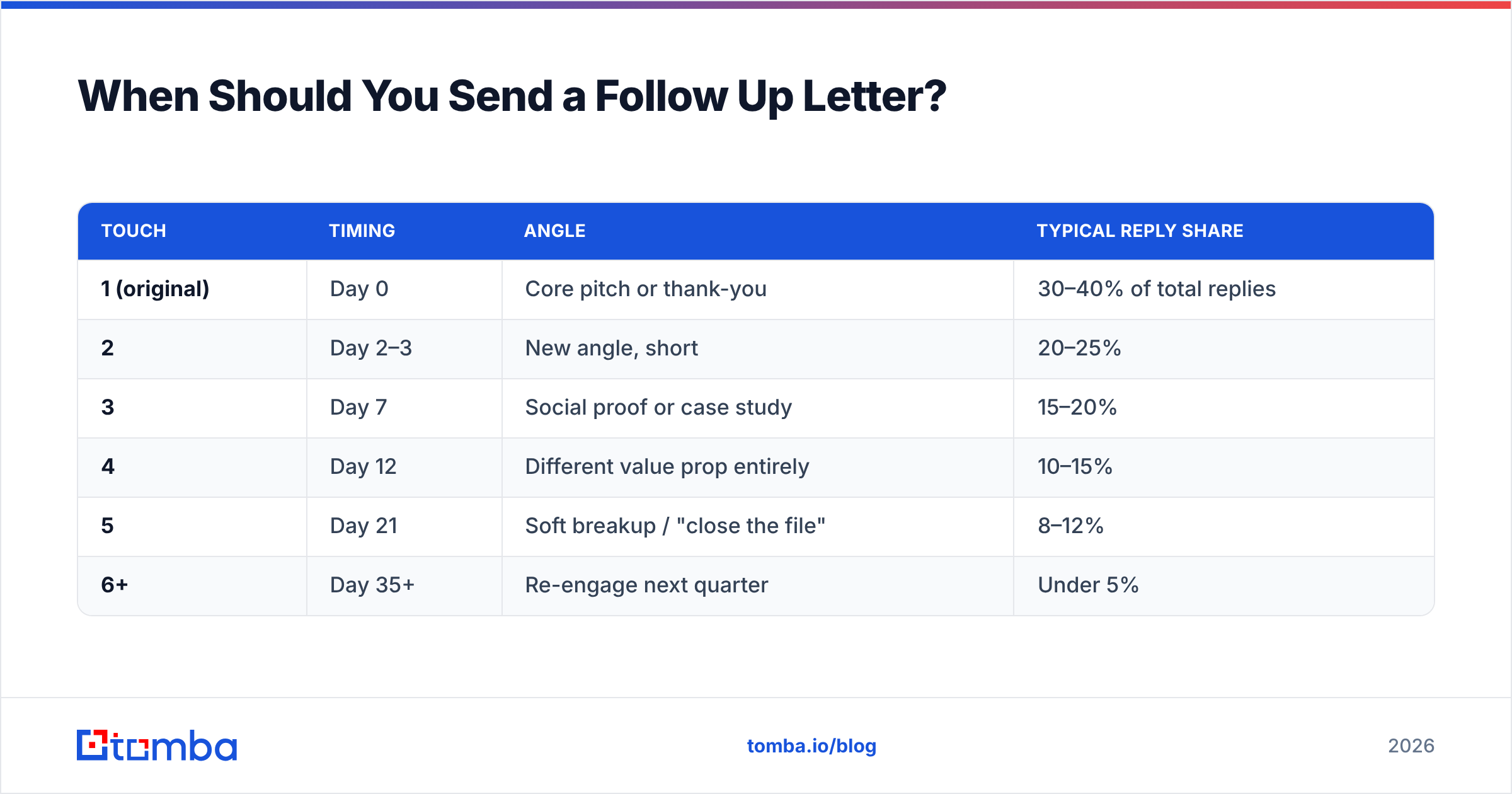
Timing is the highest-leverage variable you control, and most people get it wrong in one direction: too slow, then too aggressive.
Here is a cadence that holds up across cold outreach, post-meeting follow-ups, and proposal chases:
| Touch | Timing | Angle | Typical reply share |
|---|---|---|---|
| 1 (original) | Day 0 | Core pitch or thank-you | 30–40% of total replies |
| 2 | Day 2–3 | New angle, short | 20–25% |
| 3 | Day 7 | Social proof or case study | 15–20% |
| 4 | Day 12 | Different value prop entirely | 10–15% |
| 5 | Day 21 | Soft breakup / "close the file" | 8–12% |
| 6+ | Day 35+ | Re-engage next quarter | Under 5% |
Two things stand out. First, more than half of positive replies arrive after the original message — a single send leaves most of your pipeline on the table. Second, the curve flattens hard after touch five. Reps who push to touch eight or nine are trading a rounding error of replies for real reputation damage.
Context adjusts the schedule:
- Post-interview thank-you letter: within 24 hours, no exceptions. Then one check-in at the timeline they gave you, plus two days.
- Post-meeting recap: same day, ideally within two hours while your notes and their memory are both fresh.
- Proposal follow-up: 3 days, then 7, then a decision-forcing note at 14.
- Cold outreach: the table above.
- Post-conference: within 48 hours or the badge-scan memory is gone.
What Does a Good Follow Up Letter Structure Look Like?#
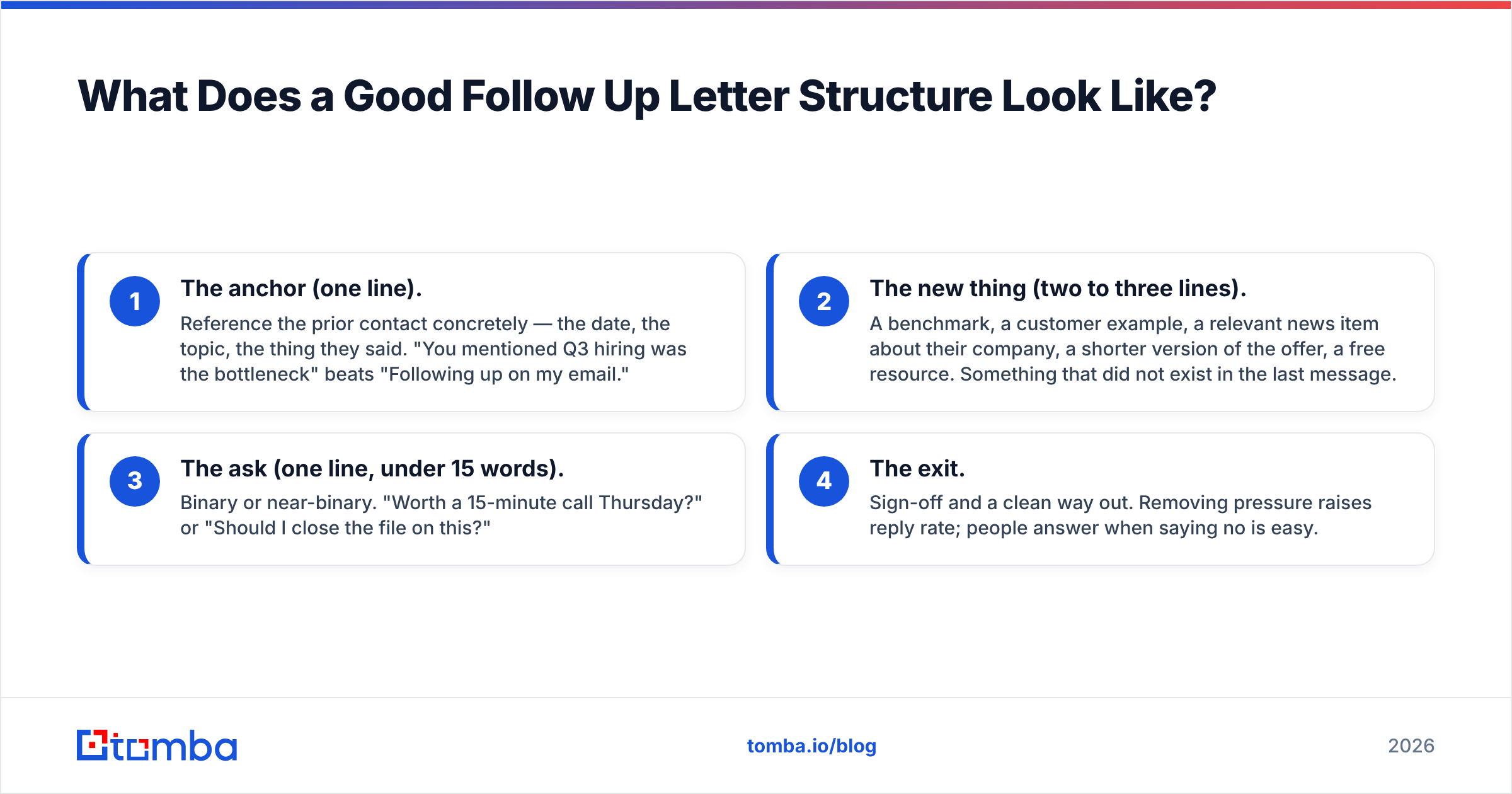
Four blocks. Nothing else.
- The anchor (one line). Reference the prior contact concretely — the date, the topic, the thing they said. "You mentioned Q3 hiring was the bottleneck" beats "Following up on my email."
- The new thing (two to three lines). A benchmark, a customer example, a relevant news item about their company, a shorter version of the offer, a free resource. Something that did not exist in the last message.
- The ask (one line, under 15 words). Binary or near-binary. "Worth a 15-minute call Thursday?" or "Should I close the file on this?"
- The exit. Sign-off and a clean way out. Removing pressure raises reply rate; people answer when saying no is easy.
Total: 50 to 125 words. Anything longer on a follow-up reads as desperation. Your original letter earned the right to be long. The follow-up did not.
A note on subject lines. Replying in the same thread (Re: preserved) generally outperforms a fresh subject for touches 2 and 3, because it carries context. By touch 4, switch to a new thread with a new subject — the old one is now visually associated with "ignored." If you need ideas, a subject line generator will give you variants faster than staring at a blank field.
Which Follow Up Letter Templates Actually Work?#
Seven templates covering the situations that come up most. Adapt the specifics; keep the structure.
1. The cold outreach bump (Day 2–3)
Subject: Re: [original subject]
Hi [Name] — quick addition to my note Tuesday. [Competitor or peer company] cut their [metric] by [number] using the same approach. Two-line summary here: [link].
Worth 15 minutes Thursday or Friday?
[Your name]
2. The post-meeting recap (same day)
Subject: Recap + next steps — [Company] / [Your company]
Hi [Name], good conversation today. What I took away:
- [Their stated problem]
- [Constraint they mentioned]
- [Agreed next step]
I'll send [deliverable] by [day]. Anything I mis-heard?
[Your name]
3. The interview thank-you (within 24 hours)
Subject: Thank you — [Role] conversation
Hi [Name], thanks for the time today. The part about [specific project they described] stuck with me — at [previous company] I ran into the same [problem] and solved it by [one sentence].
Happy to share more detail if useful. Looking forward to hearing about next steps.
[Your name]
4. The proposal chase (Day 7)
Subject: [Project name] — one question
Hi [Name], is the [proposal] still on the table for this quarter, or has the priority shifted? Either answer is genuinely fine — I just want to know whether to hold the [resource/slot/pricing] we discussed.
[Your name]
5. The value-add (Day 12, new thread)
Subject: Thought of you — [relevant topic]
Hi [Name], came across [article/report/tool] and it maps almost exactly to the [challenge] you're working through. No agenda, just useful: [link].
If a conversation makes sense later this quarter, I'm around.
[Your name]
6. The breakup (Day 21)
Subject: Closing the loop
Hi [Name], I've reached out a few times about [topic] and haven't heard back — which usually means the timing is wrong or it isn't a priority. Totally fair.
I'll stop here unless you'd like me to check back in [quarter]. Just reply "later" and I'll do that.
[Your name]
7. The re-engagement (next quarter)
Subject: [Company] just [trigger event] — worth revisiting?
Hi [Name], saw that [Company] [raised a round / opened a new office / launched X]. When we spoke in [month], [reason for no] was the blocker. Has that changed?
[Your name]
Notice that template 6 — the breakup — often outperforms templates 2 through 5 on reply rate. Loss aversion is real. Giving someone permission to close the file is frequently what makes them open it.
How Do Follow Up Channels Compare?#
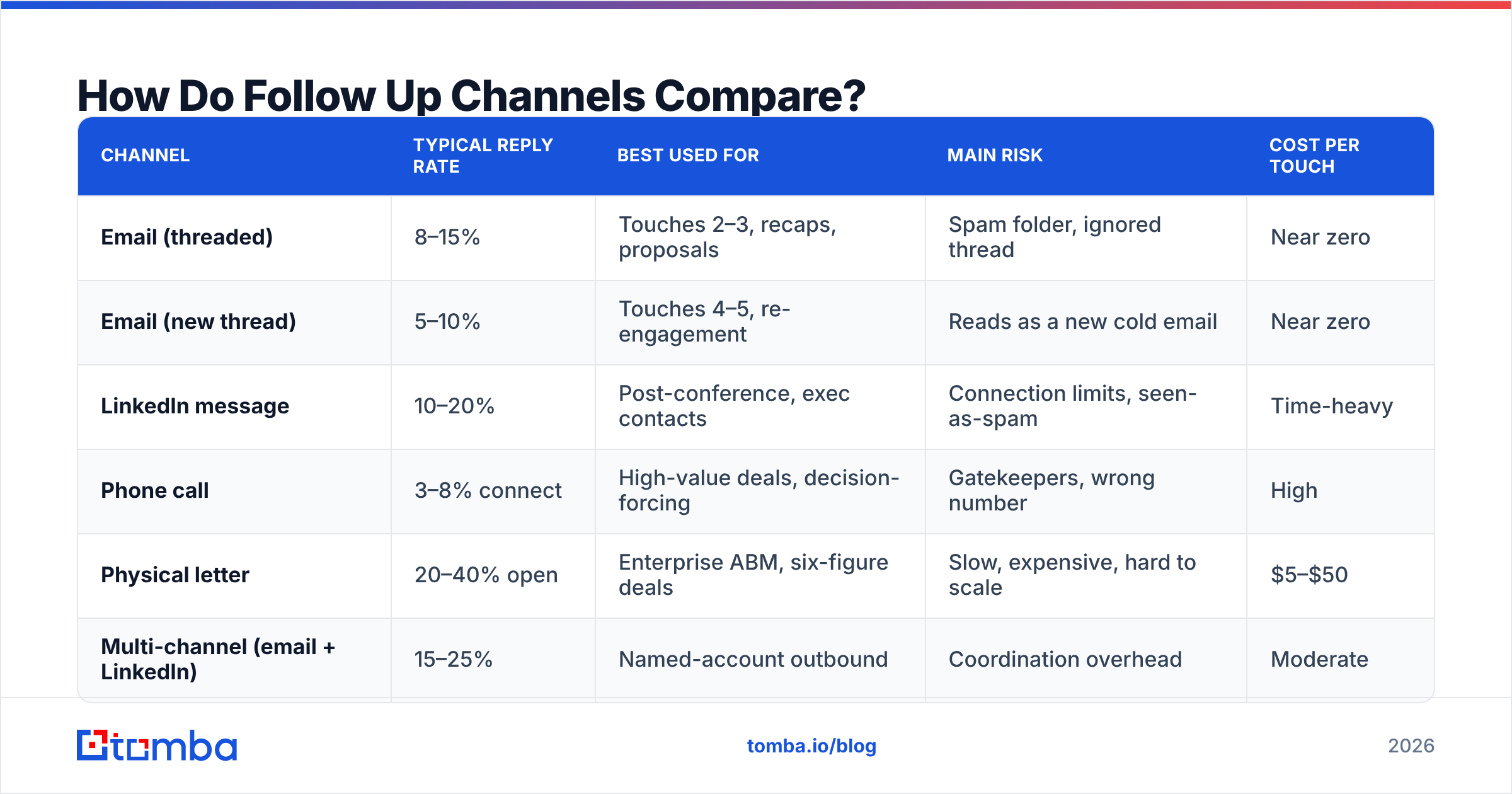
Email is the default, but it is not always the right default. Here is how the main channels stack up for follow-up work:
| Channel | Typical reply rate | Best used for | Main risk | Cost per touch |
|---|---|---|---|---|
| Email (threaded) | 8–15% | Touches 2–3, recaps, proposals | Spam folder, ignored thread | Near zero |
| Email (new thread) | 5–10% | Touches 4–5, re-engagement | Reads as a new cold email | Near zero |
| LinkedIn message | 10–20% | Post-conference, exec contacts | Connection limits, seen-as-spam | Time-heavy |
| Phone call | 3–8% connect | High-value deals, decision-forcing | Gatekeepers, wrong number | High |
| Physical letter | 20–40% open | Enterprise ABM, six-figure deals | Slow, expensive, hard to scale | $5–$50 |
| Multi-channel (email + LinkedIn) | 15–25% | Named-account outbound | Coordination overhead | Moderate |
The multi-channel row is the interesting one. Pairing an email follow-up with a light LinkedIn touch — a comment on their post, not a pitch DM — consistently lifts reply rates over email alone, because the second impression makes the first one feel less anonymous. If you are running this at scale, a LinkedIn finder turns profile URLs into verified work emails so the two channels point at the same real person.
For the physical-letter row, treat those numbers with care. Open rates are high because volume is low. The economics only work when your average contract value clears four figures.
How Many Follow Up Letters Are Too Many?#
Somewhere between five and seven, and the exact number depends on how much value each touch carries.
The honest test: could each message stand alone as a first email? If touch four would embarrass you as a cold open, it does not deserve to be sent as a follow-up either.
Three hard limits worth respecting:
- Reputation. Spam complaints above 0.3% put your sending domain at risk with Gmail and Microsoft. Follow-ups to uninterested recipients are the single biggest complaint source in cold outbound. Google's bulk sender guidelines spell out the thresholds directly.
- Brand. Every prospect you annoy is a future buyer who now associates your company with pestering. That cost never shows up in the sequence dashboard.
- Diminishing returns. If touches 1–5 produced nothing, the base rate on touch 8 converting is low enough that your time is better spent on a new account.
One caveat on the "persistence wins" advice you see everywhere: the studies behind it usually measure contact rate, not conversion rate, and they are usually published by companies selling sequencing software. Persistence works when each touch is differentiated. Persistence with identical bumps just measures how long people take to hit "report spam."
What Tools Support a Follow Up Letter Workflow?#
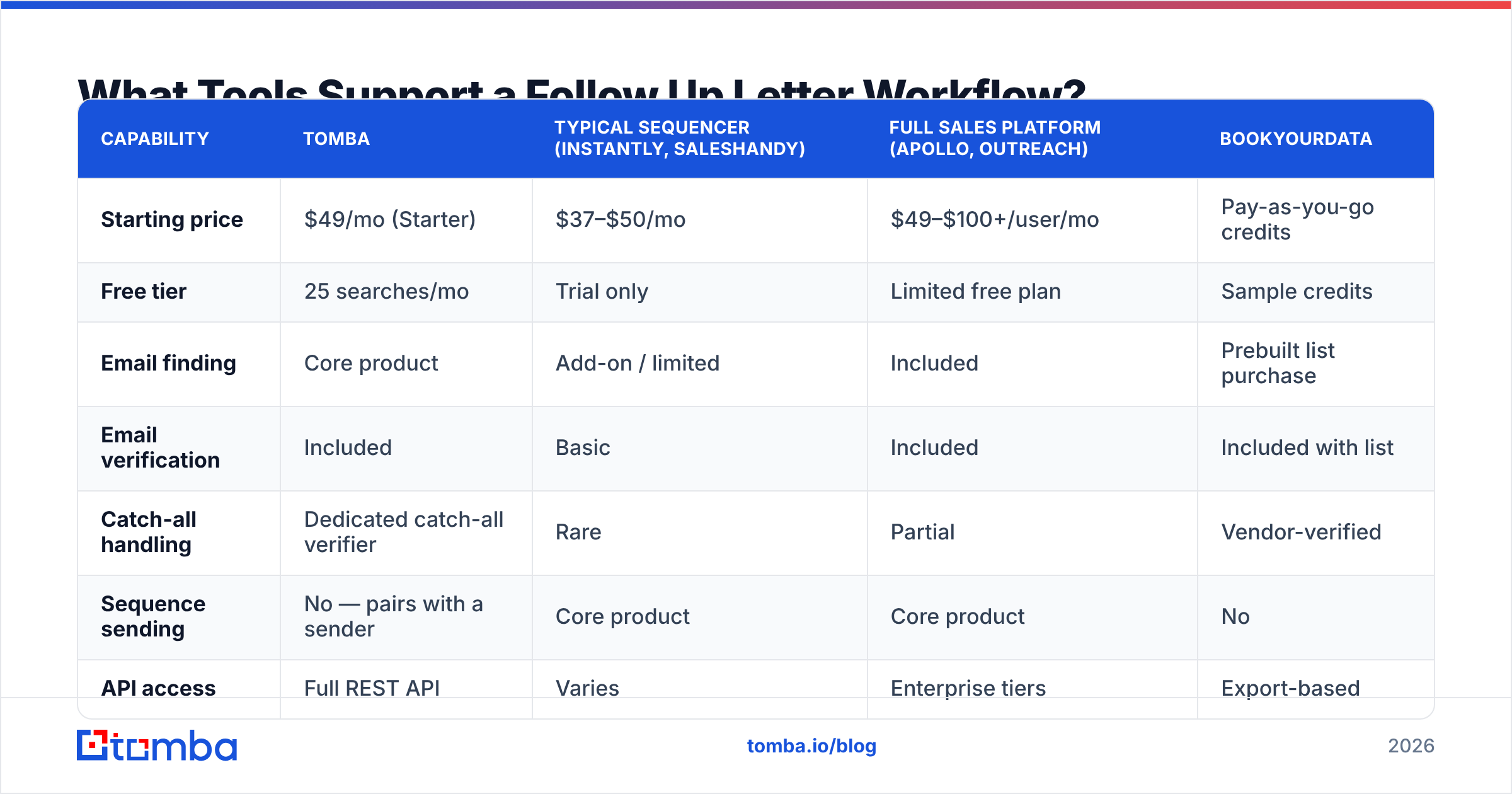
Follow-up sequencing splits into three jobs: finding and verifying the contact, writing the letters, and sequencing the sends. Different tools own different pieces.
| Capability | Tomba | Typical sequencer (Instantly, Saleshandy) | Full sales platform (Apollo, Outreach) | BookYourData |
|---|---|---|---|---|
| Starting price | $49/mo (Starter) | $37–$50/mo | $49–$100+/user/mo | Pay-as-you-go credits |
| Free tier | 25 searches/mo | Trial only | Limited free plan | Sample credits |
| Email finding | Core product | Add-on / limited | Included | Prebuilt list purchase |
| Email verification | Included | Basic | Included | Included with list |
| Catch-all handling | Dedicated catch-all verifier | Rare | Partial | Vendor-verified |
| Sequence sending | No — pairs with a sender | Core product | Core product | No |
| API access | Full REST API | Varies | Enterprise tiers | Export-based |
| Best for | Accurate contact data before the sequence | Running the cadence | End-to-end team workflow | Buying a targeted list outright |
No single row wins outright — these tools solve adjacent problems. A sequencer with bad data sends beautifully-timed letters into the void. A data tool with no sender leaves you copy-pasting. BookYourData is a reasonable choice when you want a curated list handed to you rather than building one; Tomba fits better when you are enriching accounts you already identified.
The practical stack for most teams: source and verify contacts with a data tool, write in whatever you like, sequence in a dedicated sender, and check deliverability separately with a spam checker before the sequence goes live. Review the G2 category listings if you want peer reviews across the field before committing.
How Do You Measure Whether Your Follow Up Letters Work?#
Track four numbers per touch, not per sequence:
- Delivery rate — under 95% means a data problem, not a copy problem. Fix this before anything else.
- Reply rate by touch number — tells you where the sequence dies. If touch 2 outperforms touch 1, your original letter is the weak link.
- Positive reply share — replies that aren't "unsubscribe" or "wrong person." A high reply rate with low positive share means you are annoying people into responding.
- Meetings booked per 100 contacts — the only number your revenue team actually cares about.
Test one variable at a time. Changing timing and copy in the same experiment tells you nothing. Run at least 200 contacts per variant before drawing conclusions; below that, you are reading noise.
And re-verify quarterly. B2B contact data decays at roughly 2–3% per month through job changes alone, so a list that was clean in January is meaningfully stale by summer. Running bulk verification on a schedule keeps your delivery-rate baseline honest.
Getting Your Follow Up Letters in Front of Real People#
Every template in this post assumes the letter lands in a real inbox belonging to a real person who still works there. That assumption fails more often than most teams measure — and when it does, no amount of rewriting will surface a reply.
Start upstream. Tomba's Email Finder returns verified professional email addresses by name, company, or domain, with confidence scoring and source attribution so you can see why an address is trusted. The free tier gives you 25 searches a month to test accuracy against contacts you already know; paid plans start at $49/month on Starter, with Growth at $99/month for teams running larger sequences. Check the full Tomba pricing breakdown to match a tier to your volume.
Fix the delivery layer first. Then your follow up letters get a fair hearing.
Related guides#
Ready to find emails that actually work?
Join 150,000+ professionals who stopped guessing and started sending. Free credits on signup — no credit card required.
Get the Tomba newsletter
Practical outbound tactics and product updates — once every two weeks.
About the author