Follow Up Letter Format: Structure, Examples, and Templates
Most follow-up letters fail because they repeat the first message with a softer apology attached. Here is the 7-part format that actually earns a reply, with five real examples and a cadence that does not annoy people.
TL;DR
- A follow-up letter has seven fixed parts: context anchor, reason for writing, new value, specific ask, deadline or next step, easy exit, and signature block. Miss the "new value" part and you have written a nag, not a letter.
- Formal letters (printed, PDF, or attached) still win in legal, government, procurement, academic, and executive-search contexts. Everywhere else, email is the right channel — the format barely changes, the packaging does.
- Send the first follow-up 2–3 business days after the trigger event, then space subsequent touches out: 3 days, 5 days, 7 days, then stop. Four to five touches captures most of the reply volume.
- The single most common failure is not the wording. It is sending to an address that never delivered in the first place. Verify before you blame your copy.
- Every follow-up should be able to survive being forwarded to someone senior without embarrassing you. If it can't, rewrite it.
What is a follow up letter format?#
A follow-up letter format is the fixed skeleton you drop variable content into after a first contact has gone unanswered or a meeting has ended. It is not a genre of writing. It is a container.
Think of it like a shipping label. The box contents change every time — an interview thank-you, a proposal nudge, an overdue invoice, a post-conference intro — but the label always carries the same fields in the same order, because that is what lets the recipient route it in three seconds without thinking. When you scramble the fields, the reader has to do the work of figuring out who you are and what you want, and most people simply won't.
The format traces back to the standard business letter conventions — sender block, date, recipient block, salutation, body, closing — but modern follow-ups compress the ceremonial parts and expand the body into a specific sequence that does the persuading.
What are the seven parts of a follow-up letter?#
Every follow-up that gets replies contains these seven elements, in this order. Cut any of them and reply rates drop measurably.
- Context anchor — one clause that reminds them exactly when and where you last connected. "We spoke Tuesday about your Q3 onboarding backlog." Not "I hope this finds you well." The anchor does the work that the subject line can't.
- Reason for writing now — why today and not last week or never. A trigger beats a schedule: they said they'd hear back from procurement, the trial expired, the fiscal year turns.
- New value — the non-negotiable part. Something they did not have when you last wrote: a benchmark, a customer example that matches their vertical, a corrected number, a relevant article, an answer to an objection they raised. If you have nothing new, you are not ready to follow up.
- The specific ask — one action, phrased so a yes takes under thirty seconds. "Worth 15 minutes Thursday at 10?" beats "Let me know your thoughts."
- Deadline or forcing function — a real one. Pricing changes, a slot in your implementation calendar, a report going out Friday. Fake urgency is detectable and expensive.
- Easy exit — one line that gives them permission to say no. "If this isn't a priority this quarter, say the word and I'll close the loop." Counterintuitively this raises reply rates, because a cheap no is easier to send than a guilty silence.
- Signature block — full name, title, company, direct phone, and one link. In a formal printed letter this expands to the full sender address block at the top.
That list, applied literally, produces a letter that runs 90–140 words in email and 180–250 words on letterhead. Anything longer is usually the writer negotiating with themselves in public.
Is a follow-up letter different from a follow-up email?#
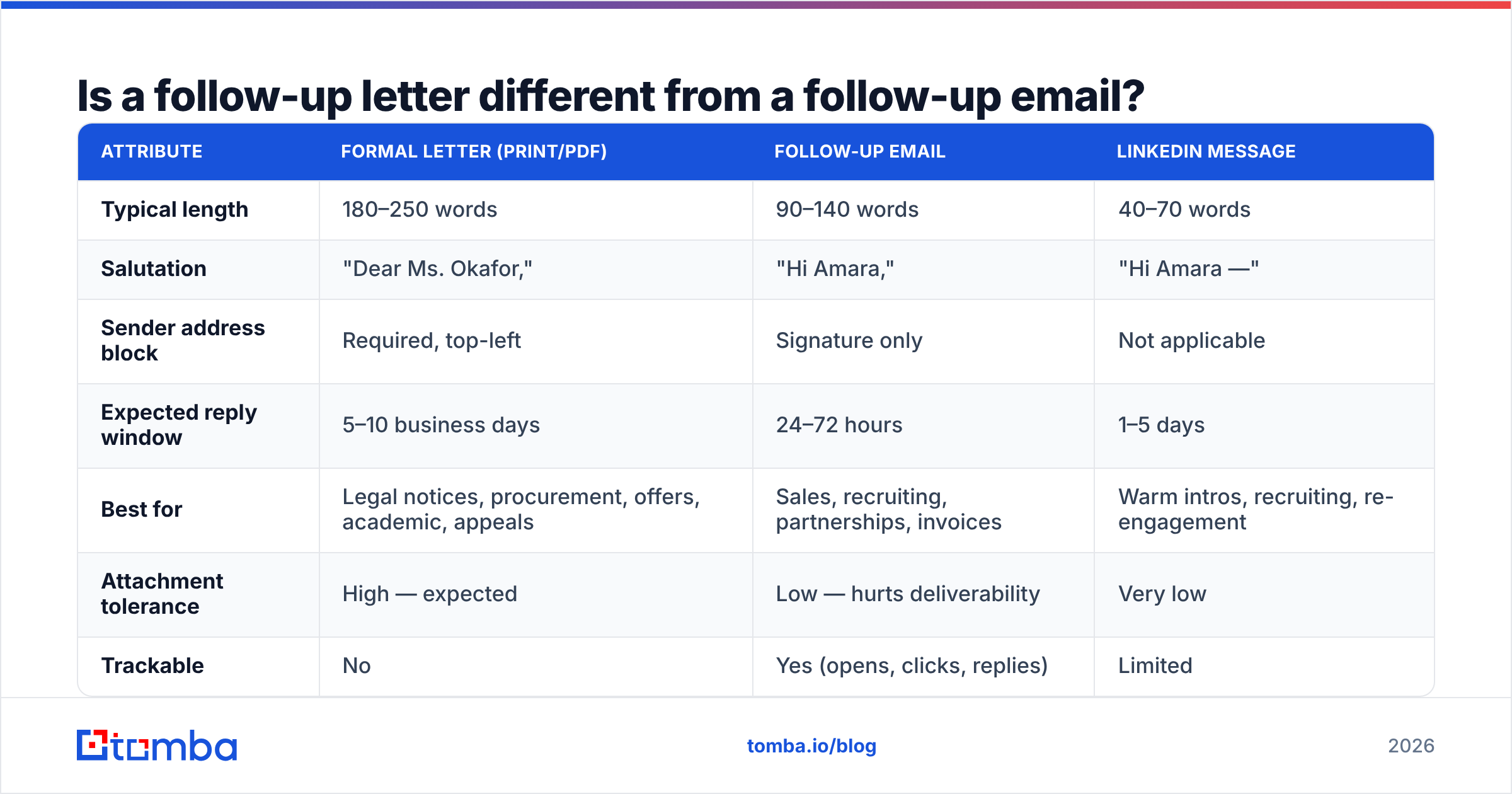
Structurally, no. Operationally, very. The seven parts survive the channel change; the wrapper and the expectations don't.
| Attribute | Formal letter (print/PDF) | Follow-up email | LinkedIn message |
|---|---|---|---|
| Typical length | 180–250 words | 90–140 words | 40–70 words |
| Salutation | "Dear Ms. Okafor," | "Hi Amara," | "Hi Amara —" |
| Sender address block | Required, top-left | Signature only | Not applicable |
| Expected reply window | 5–10 business days | 24–72 hours | 1–5 days |
| Best for | Legal notices, procurement, offers, academic, appeals | Sales, recruiting, partnerships, invoices | Warm intros, recruiting, re-engagement |
| Attachment tolerance | High — expected | Low — hurts deliverability | Very low |
| Trackable | No | Yes (opens, clicks, replies) | Limited |
| Cost per touch | $0.60–$8 (print/courier) | Near zero | Near zero |
The practical read: use the printed or PDF letter when the recipient's organization treats documents as records — a hiring committee, a procurement office, a landlord, a university admissions board. Use email everywhere else, and stop feeling like the informal channel is a downgrade. HubSpot's sales research has consistently found that the majority of closed deals involve multiple follow-up touches, and almost none of those touches arrive by post.
One hybrid pattern works better than either alone: send the email, and attach the formal letter as a PDF when the content genuinely needs a paper trail — a revised quote, a formal acceptance, a notice of intent. Keep the email body short and let the attachment carry the ceremony.
What does a good follow-up letter actually look like?#
Five variants, each with the seven parts intact. Notice how short the useful ones are.
After a job interview (send within 24 hours):
Hi Daniel,
Thanks for the time Tuesday — the detail about migrating the reporting layer before Q4 stuck with me.
I went back through my notes on the Redshift-to-Snowflake project I mentioned. We cut nightly job runtime from 6 hours to 40 minutes, and I wrote up the approach here if it's useful to the team either way: [link].
Happy to answer anything the panel raised after I left. If timelines have shifted, no problem at all — just let me know where things stand.
Best,
Priya Raman
+1 415 555 0148
After a discovery call that went quiet (day 4):
Hi Amara,
You mentioned onboarding was eating two days per new client. I pulled the numbers from a logistics customer with a near-identical setup — they went from 14 hours of manual setup to 3.
Worth 15 minutes Thursday at 10 to walk through how they did it?
If onboarding isn't the fire this quarter, tell me and I'll stop chasing.
After sending a proposal (day 5):
Hi Marcus,
Following up on the proposal from the 12th. Two things changed since: we can now include the SSO module at no extra cost through the end of September, and I've attached the security questionnaire your IT team asked about.
Do you need anything else to get this in front of finance? If the answer is that budget moved to next year, that's genuinely fine — I'd rather know than keep emailing.
After meeting someone at a conference (day 2):
Hi Lena,
Great talking at the DevOps track on Wednesday — the point about on-call rotations breaking down past 12 engineers was the most honest thing I heard all day.
You asked about the incident-review template we use. Copy attached, no strings.
If you ever want to compare notes on scaling the process, I'm around.
Overdue invoice (day 7 past due):
Dear Mr. Ferreira,
Invoice #2291 for $4,800, issued on 14 July, remains unpaid as of today. Payment terms were net 30.
I've re-attached the invoice and the signed statement of work in case either was lost in routing. If the invoice is stuck in your AP queue, let me know the reference number and I'll follow the process on my side.
Please confirm expected payment date by Friday 29 August.
Sincerely,
[Full signature block]
Note the invoice letter is the only one that reads formally. Match the register to the stakes, not to your comfort level.
How long should you wait between follow-ups?#
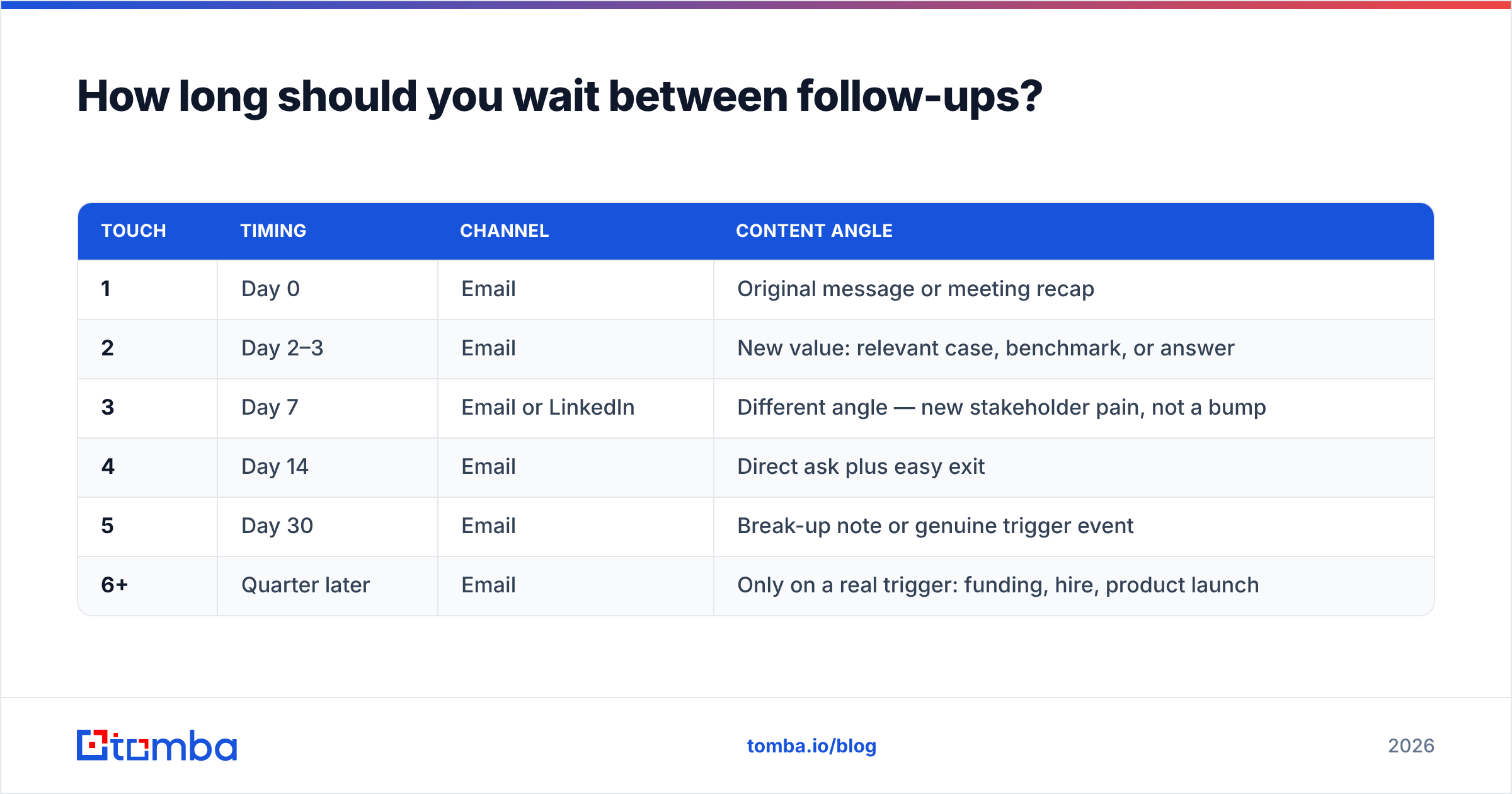
Most people either quit after one touch or send seven in nine days. Both lose. Here is a cadence that holds up across sales, recruiting, and collections.
| Touch | Timing | Channel | Content angle |
|---|---|---|---|
| 1 | Day 0 | Original message or meeting recap | |
| 2 | Day 2–3 | New value: relevant case, benchmark, or answer | |
| 3 | Day 7 | Email or LinkedIn | Different angle — new stakeholder pain, not a bump |
| 4 | Day 14 | Direct ask plus easy exit | |
| 5 | Day 30 | Break-up note or genuine trigger event | |
| 6+ | Quarter later | Only on a real trigger: funding, hire, product launch |
Two rules make this work. First, never send a touch whose only content is that the previous touch was ignored — that is the "just bumping this" email, and it converts close to zero. Second, stop at five unless something in their world actually changes. Persistence past that point is not grit, it is a deliverability problem waiting to happen.
What mistakes kill follow-up replies?#
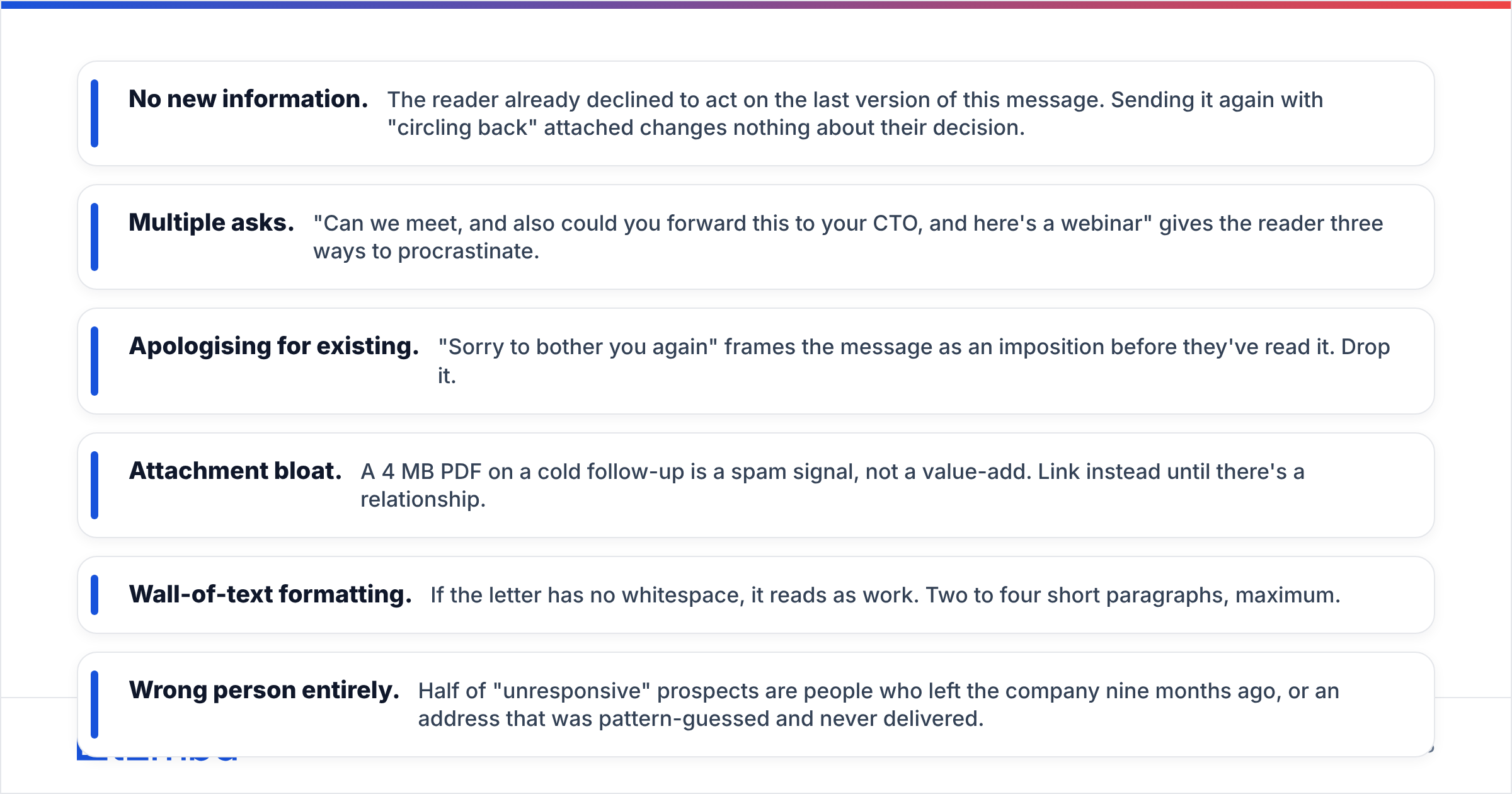
- No new information. The reader already declined to act on the last version of this message. Sending it again with "circling back" attached changes nothing about their decision.
- Multiple asks. "Can we meet, and also could you forward this to your CTO, and here's a webinar" gives the reader three ways to procrastinate.
- Apologising for existing. "Sorry to bother you again" frames the message as an imposition before they've read it. Drop it.
- Attachment bloat. A 4 MB PDF on a cold follow-up is a spam signal, not a value-add. Link instead until there's a relationship.
- Wall-of-text formatting. If the letter has no whitespace, it reads as work. Two to four short paragraphs, maximum.
- Wrong person entirely. Half of "unresponsive" prospects are people who left the company nine months ago, or an address that was pattern-guessed and never delivered.
That last one deserves its own section, because it is the failure people misdiagnose most often.
How do you make sure the follow-up actually reaches someone?#
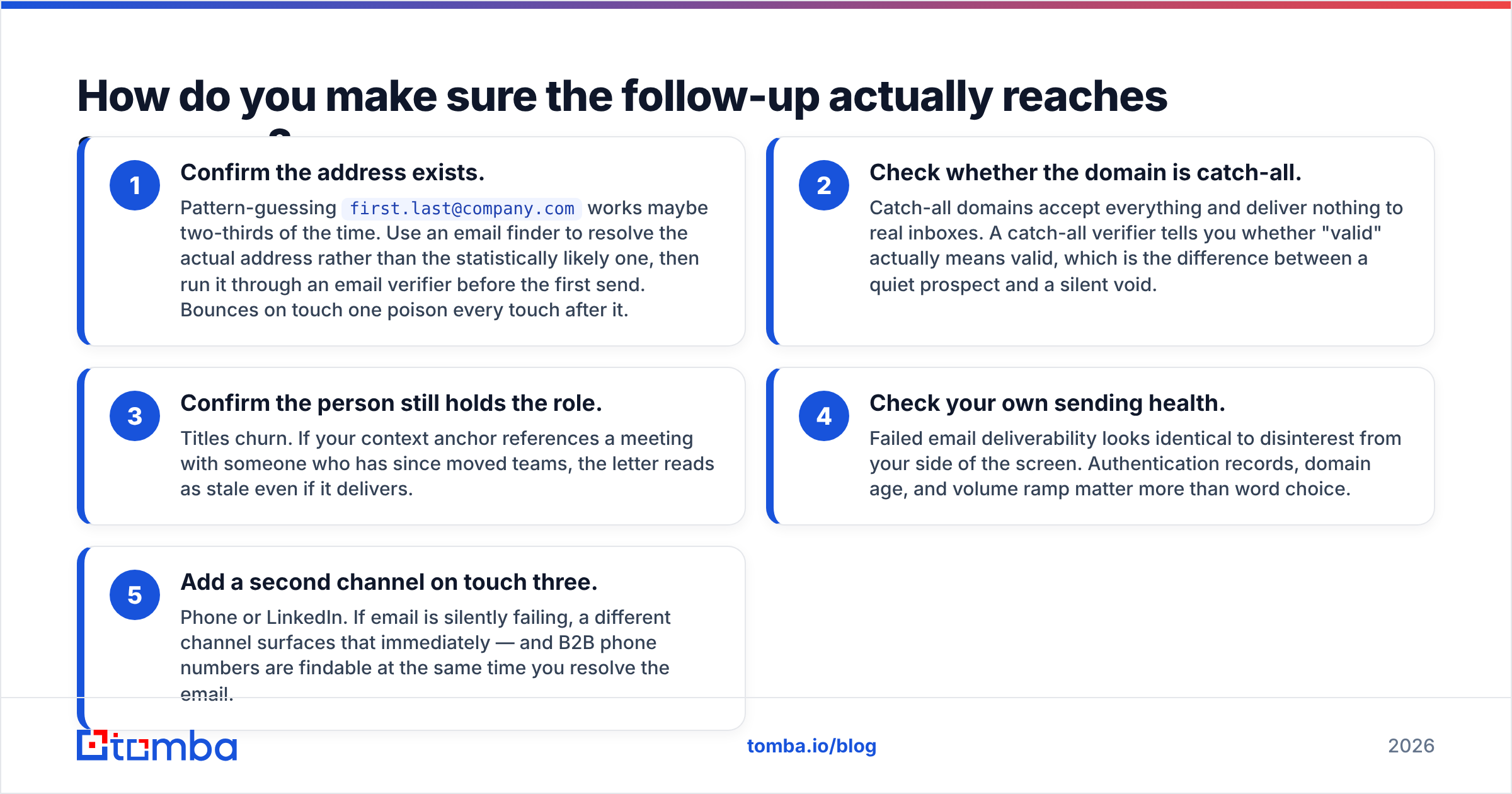
Before you rewrite the letter for the fourth time, prove the message is landing. A perfect follow-up letter format sent to a dead mailbox performs exactly as badly as a terrible one.
Run this check in order:
- Confirm the address exists. Pattern-guessing
first.last@company.comworks maybe two-thirds of the time. Use an email finder to resolve the actual address rather than the statistically likely one, then run it through an email verifier before the first send. Bounces on touch one poison every touch after it. - Check whether the domain is catch-all. Catch-all domains accept everything and deliver nothing to real inboxes. A catch-all verifier tells you whether "valid" actually means valid, which is the difference between a quiet prospect and a silent void.
- Confirm the person still holds the role. Titles churn. If your context anchor references a meeting with someone who has since moved teams, the letter reads as stale even if it delivers.
- Check your own sending health. Failed email deliverability looks identical to disinterest from your side of the screen. Authentication records, domain age, and volume ramp matter more than word choice.
- Add a second channel on touch three. Phone or LinkedIn. If email is silently failing, a different channel surfaces that immediately — and B2B phone numbers are findable at the same time you resolve the email.
Buyers and hiring managers are not ignoring you as often as you think. According to buyer-behaviour data compiled across G2's software reviews and vendor research from firms like Gartner, most B2B purchase groups involve six or more people, which means your letter frequently sits unanswered because the recipient is waiting on someone else — not because your format is wrong. The follow-up that says "who else needs to see this before it moves?" often unlocks more than a fifth rewrite of your value prop.
What should you do next?#
Pick the seven-part skeleton, write one follow-up letter per scenario you actually face — interview, proposal, invoice, conference intro — and save them as reusable email templates with the variable fields marked. Then stop editing them and start measuring reply rates by touch number. That data tells you more in three weeks than another month of wordsmithing.
If your follow-ups are landing in the void rather than getting rejected, the fix is upstream of the copy. Use the Tomba Email Finder to resolve verified addresses by name and domain before your first touch — the free tier covers 25 searches a month, and paid plans start at $49/mo on Tomba pricing if you need volume. A great follow-up letter format only pays off when someone is on the other end to read it.
Related guides#
Ready to find emails that actually work?
Join 150,000+ professionals who stopped guessing and started sending. Free credits on signup — no credit card required.
Get the Tomba newsletter
Practical outbound tactics and product updates — once every two weeks.
About the author