Follow Up Messages That Get Replies: 2026 Playbook
Most deals die in the gap between message one and message four. Here are the follow up messages that actually get replies in 2026 — with cadences, timing data, and copy you can steal.
TL;DR
- Roughly half of all replies to a cold sequence arrive after the first message — the follow-up isn't optional, it's where the pipeline lives.
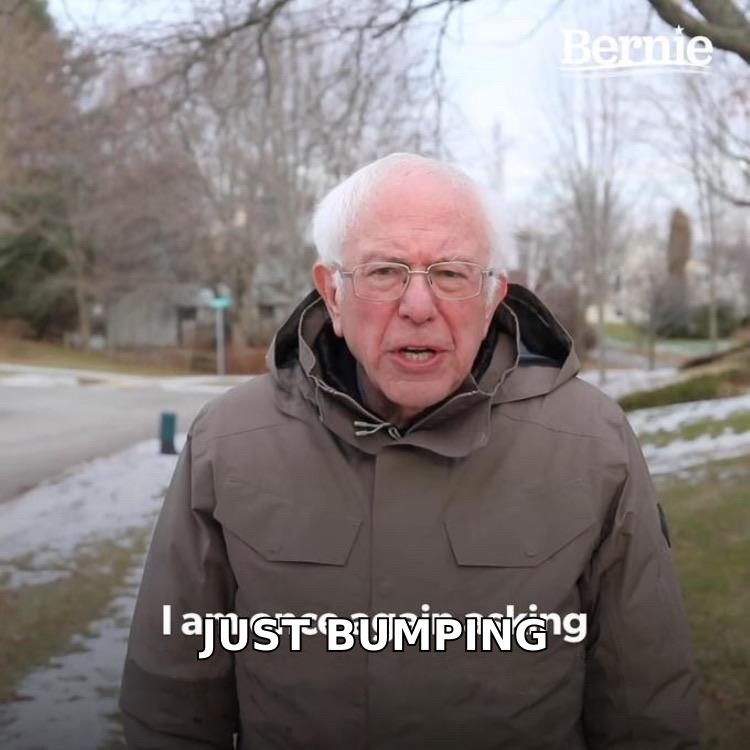
- The single biggest killer of follow up messages is the "just checking in" bump. It adds zero new information and trains the reader to ignore you.
- A 4–6 touch cadence spread over 14–21 business days, each message carrying one new idea, outperforms a 12-touch daily barrage on reply rate and on deliverability.
- Follow-ups to a bad email address don't just fail — they compound bounce damage. Verify before you send, not after.
- Different contexts need different structures: cold outbound, post-demo, post-proposal, and re-engagement all break if you use the same template.
What Are Follow Up Messages, Really?#
A follow-up message is any communication you send after an initial contact that has not yet produced the outcome you need. That covers cold email sequence steps, post-meeting recaps, proposal nudges, LinkedIn touches, and the "we spoke at the conference" email you send eleven days late.
Here's the mental model: a follow-up is not a reminder, it's a second attempt at relevance. Think of it like a doctor's second question. The first question ("what hurts?") gets a vague answer. The second one ("does it hurt more when you sit or when you stand?") is where the diagnosis happens. Your first email guesses at the prospect's problem. Your follow-ups narrow it.
That distinction matters because it dictates the content. If a follow-up is a reminder, the correct body is "just bumping this." If a follow-up is a second attempt at relevance, the correct body is a new angle, a new proof point, or a new question. The second framing wins every time in reply-rate testing.
The four contexts where follow up messages behave differently:
- Cold outbound follow-ups — the recipient has no relationship with you. Every message must earn its own read. Expect 3–7 touches before you archive.
- Warm post-meeting follow-ups — a conversation happened. Your job is to compress what was said into a decision-ready summary and one clear next step.
- Proposal / pricing follow-ups — money is on the table. Silence usually means internal friction, not disinterest. Your messages should remove friction, not ask for status.
- Re-engagement follow-ups — a dead thread from 60+ days ago. The reason to reopen must be external (a product change, a trigger event, a new data point), never "circling back."
Mixing these up is the most common structural mistake. A proposal nudge written like a cold email reads as amnesia; a cold email written like a proposal nudge reads as presumption.
Why Do Most Follow Up Messages Get Ignored?#
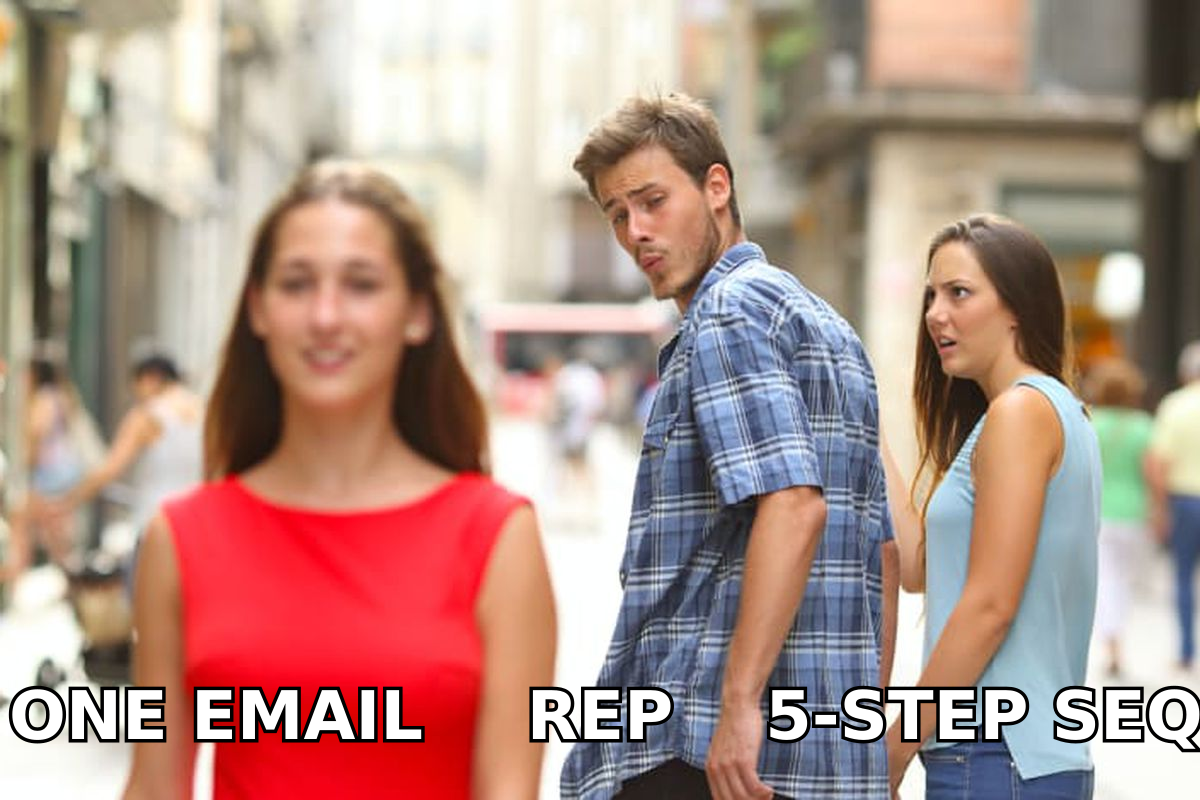
Because they're informationally empty. Open a typical rep's step 3 and you'll find some version of: "Hi {{first_name}}, just following up on my note below. Did you get a chance to look?"
That message asks the reader to do work (recall your first email, evaluate it, formulate a response) while giving them nothing new to work with. It's a withdrawal from the attention account with no deposit.
Five concrete failure modes, ranked by how much damage they do:
- The empty bump. No new information. Cut it entirely — a shorter sequence with substance beats a longer one with filler.
- The guilt trip. "I've reached out three times now." You've told the prospect you're tracking their silence. That reads as pressure, not persistence.
- The false urgency. "Closing this out today" when nothing closes. If you use a breakup email, actually break up — otherwise you've taught them your deadlines are fiction.
- The wall of text. A follow-up longer than the original is a confession that the original didn't work and you've decided to add words instead of clarity.
- The wrong inbox. No amount of copywriting rescues a message sent to
j.smith@when the pattern isjohn.smith@. Bounces on follow-ups hit the same domain repeatedly, which is how sender reputation degrades fastest.
That last one is worth sitting with. Sequences amplify data quality problems. A single bad send is a bounce. The same bad address inside a 6-step sequence is six bounce attempts against one domain, and mailbox providers notice patterns. Running your list through an email verifier before the sequence starts costs less than the deliverability repair afterward.
How Many Follow Up Messages Should You Send?#
Four to six for cold outbound. Two to three for warm post-meeting threads. The tail beyond touch six produces sharply diminishing replies while consuming the same spam-complaint risk as the profitable touches.
The reason isn't a magic number — it's that each additional touch needs a genuinely new angle, and most people run out of angles around message five. If you can articulate six distinct, non-redundant reasons the prospect should care, send six. If you can articulate three, send three and stop.
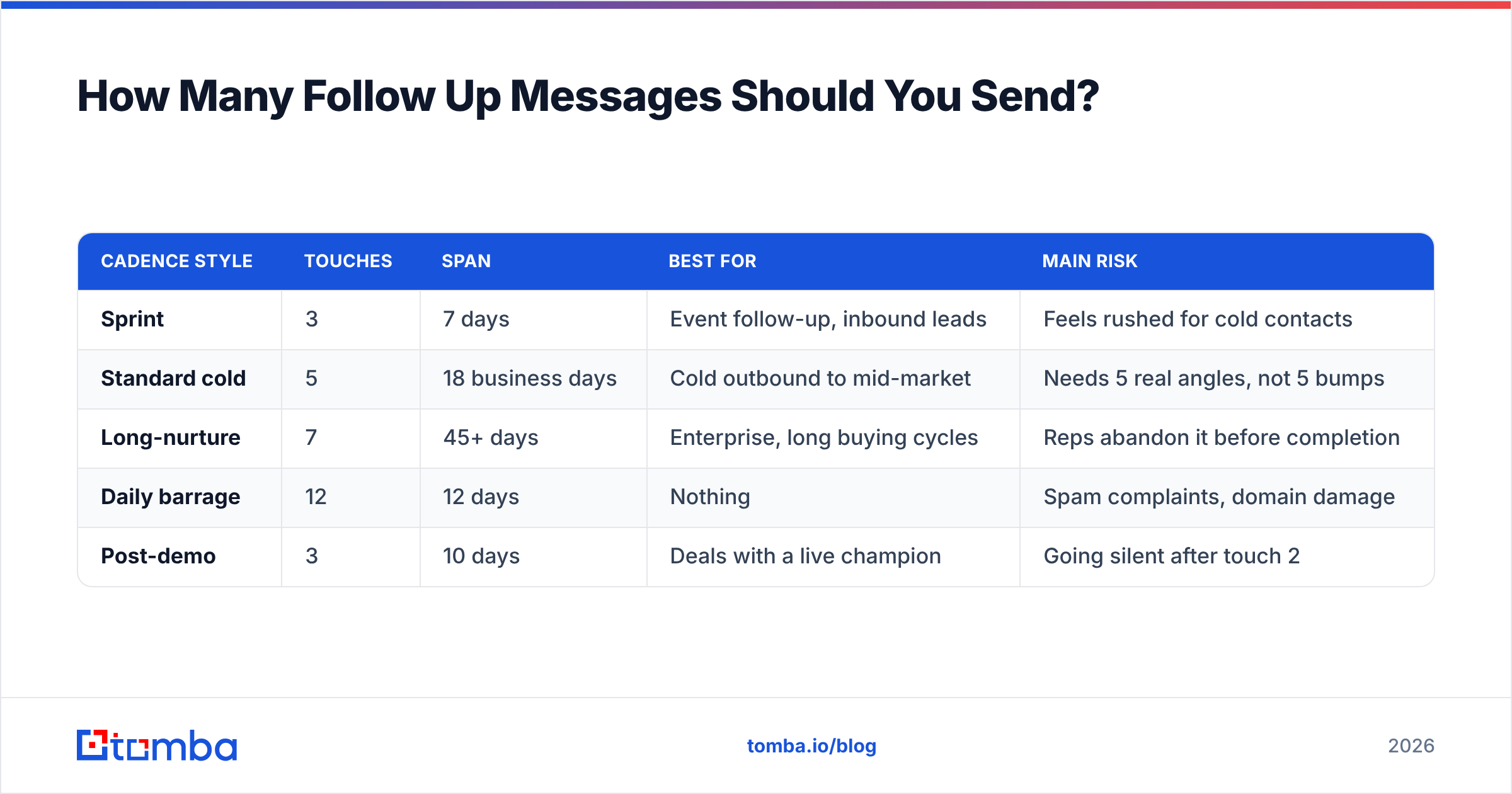
Here's how cadence structures compare in practice:
| Cadence style | Touches | Span | Best for | Main risk |
|---|---|---|---|---|
| Sprint | 3 | 7 days | Event follow-up, inbound leads | Feels rushed for cold contacts |
| Standard cold | 5 | 18 business days | Cold outbound to mid-market | Needs 5 real angles, not 5 bumps |
| Long-nurture | 7 | 45+ days | Enterprise, long buying cycles | Reps abandon it before completion |
| Daily barrage | 12 | 12 days | Nothing | Spam complaints, domain damage |
| Post-demo | 3 | 10 days | Deals with a live champion | Going silent after touch 2 |
Spacing matters as much as count. A workable default: day 0, day 3, day 7, day 13, day 21. The widening gap mirrors how attention decays — early messages catch people who were busy, later ones catch people whose priorities have shifted.
One nuance that gets missed: send-time consistency beats send-time optimization. Endless A/B testing of "Tuesday 10:14am" produces noise at typical B2B volumes. What actually moves reply rate is whether message 4 contains something message 1 didn't.
What Does a Good Follow-Up Structure Look Like?#
Every effective follow-up has four parts, in this order:
- Context anchor (one line). Reference the specific thing, not the fact that you emailed. "On the Q3 onboarding backlog you mentioned" beats "following up on my email."
- New information (two to three lines). A customer result, a relevant article, a product change, a question you didn't ask before. This is the entire justification for the message existing.
- Low-friction ask (one line). Ask for a reply, not a meeting, on early touches. "Worth a look, or is this off-base?" converts better than "do you have 30 minutes Thursday?"
- Exit ramp (optional, final touch only). Give a clean way to say no. Counterintuitively, this produces replies — people find it easier to close a loop than to ignore one.
Length target: under 75 words for touches 2 through 5. If your follow-up needs a scroll, it's a document, not a message — attach it or link it.
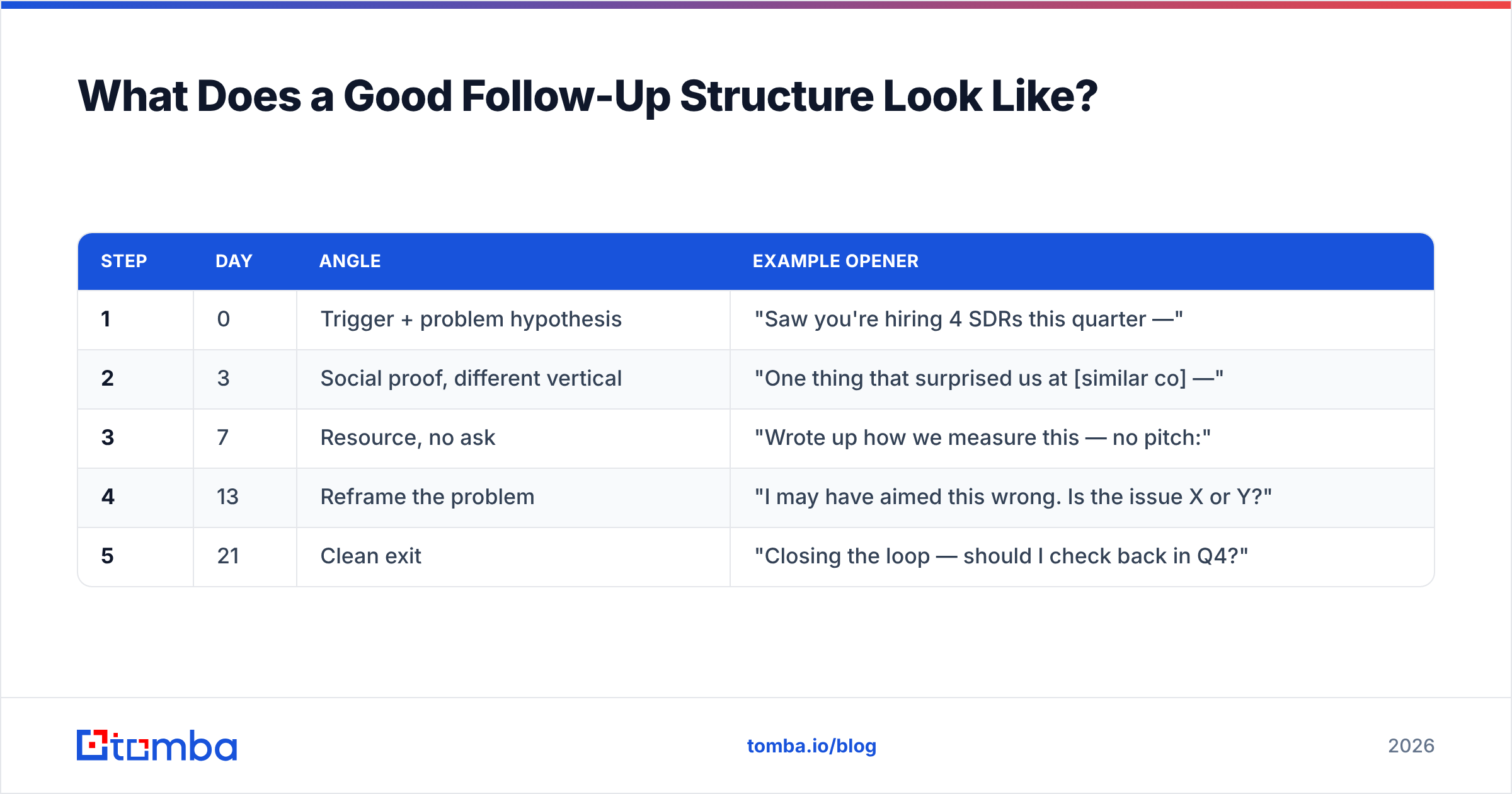
Here's a step-by-step cold sequence that follows the structure:
| Step | Day | Angle | Example opener |
|---|---|---|---|
| 1 | 0 | Trigger + problem hypothesis | "Saw you're hiring 4 SDRs this quarter —" |
| 2 | 3 | Social proof, different vertical | "One thing that surprised us at [similar co] —" |
| 3 | 7 | Resource, no ask | "Wrote up how we measure this — no pitch:" |
| 4 | 13 | Reframe the problem | "I may have aimed this wrong. Is the issue X or Y?" |
| 5 | 21 | Clean exit | "Closing the loop — should I check back in Q4?" |
Notice that step 3 asks for nothing. Giving without asking once inside a sequence measurably lifts step 4 and step 5 reply rates, because it breaks the pattern the reader has learned to filter.
Which Follow-Up Templates Actually Work?#
Four templates worth stealing. Adapt the specifics — the structure is the transferable part.
1. The reframe (cold, touch 4)
Subject: probably aimed this wrong
Hi [Name] — I pitched this as an onboarding problem. Talking to a few other [role]s this month, it's usually a handoff problem between sales and CS instead.
Which one is it on your side? Genuinely curious either way.
Why it works: it admits fallibility and asks a question that's cheap to answer. Reply-optimized, not meeting-optimized.
2. The post-demo recap (warm, touch 1)
Subject: [Company] — 3 things from today
Recapping so you have it in writing:
- You need X live before the Nov renewal.
- Blocker is Y — your security team owns it.
- I'm sending the SOC 2 pack today.
Anything I got wrong?
Why it works: "anything I got wrong?" is the highest-reply-rate closing question in warm follow-ups. Correcting someone is easier than composing.
3. The proposal nudge (money on the table, touch 2)
Subject: re: pricing — what's blocking?
Not chasing a decision, just want to make sure the holdup isn't something I can fix. Usually it's one of: budget timing, a stakeholder who hasn't seen the deck, or a term in the MSA.
Any of those? Happy to send whatever unblocks it.
Why it works: it pre-names the objections, so the prospect can reply with a single word.
4. The re-engagement (dead thread, 90+ days)
Subject: we shipped the thing you asked about
Back in March you said [feature] was the dealbreaker. It shipped last week.
Worth another 15 minutes, or has the priority moved?
Why it works: the reason to reopen is external and specific. "Circling back" has no reason at all.
For more scaffolding, our cold email templates library covers first-touch structures, and the subject line tester is useful for checking whether your follow-up subjects read as spam.
How Do You Follow Up Across Channels?#
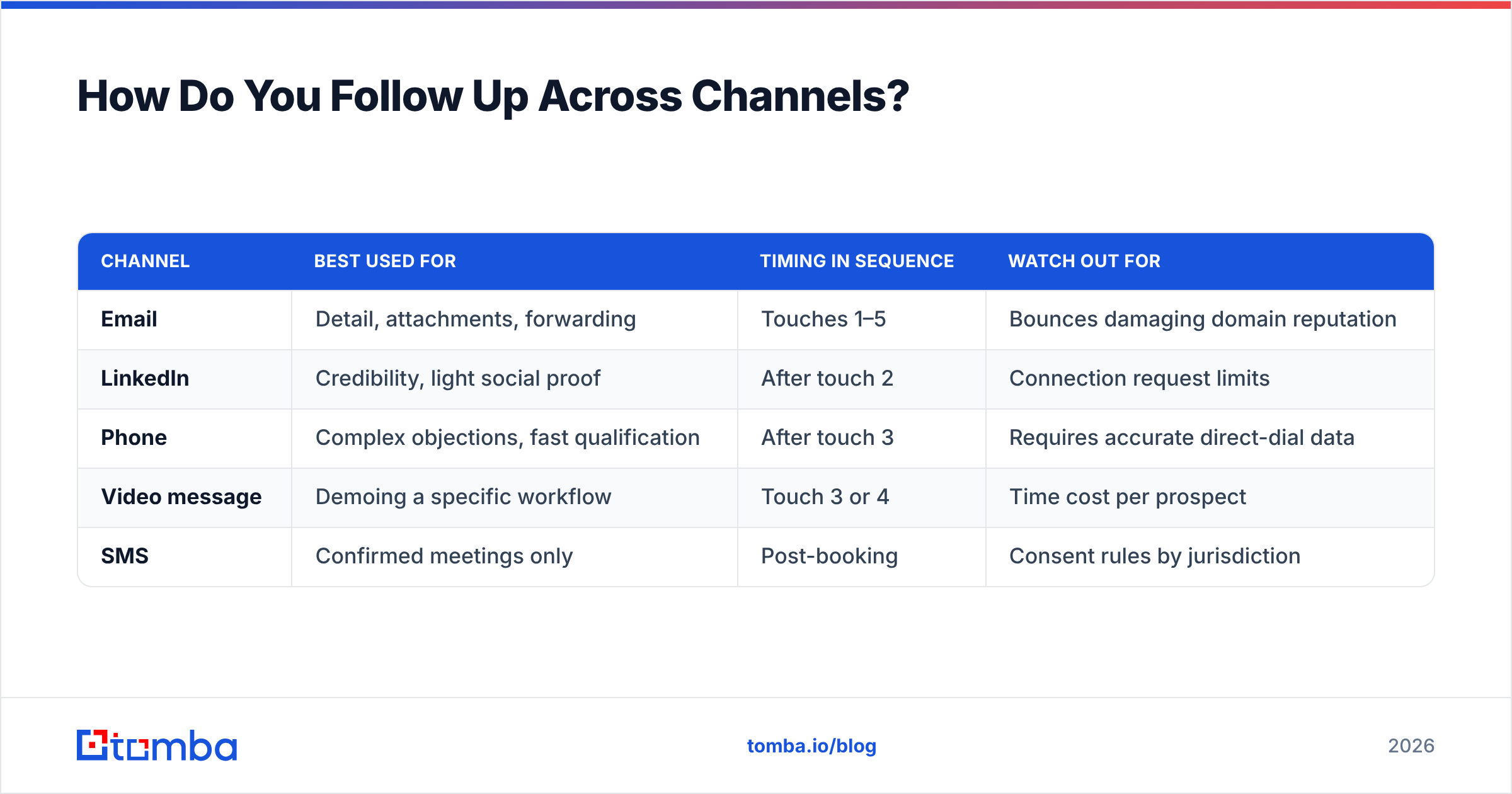
Multi-channel follow-ups outperform email-only sequences, but only when each channel does something the others can't. Copy-pasting your email into a LinkedIn DM is not multi-channel — it's the same message twice.
| Channel | Best used for | Timing in sequence | Watch out for |
|---|---|---|---|
| Detail, attachments, forwarding | Touches 1–5 | Bounces damaging domain reputation | |
| Credibility, light social proof | After touch 2 | Connection request limits | |
| Phone | Complex objections, fast qualification | After touch 3 | Requires accurate direct-dial data |
| Video message | Demoing a specific workflow | Touch 3 or 4 | Time cost per prospect |
| SMS | Confirmed meetings only | Post-booking | Consent rules by jurisdiction |
The channel mix depends on data quality more than strategy. Phone touches need direct dials, not switchboards — a phone finder that returns mobile numbers changes what a "call step" is worth. LinkedIn touches need the right profile matched to the right person, which is where a LinkedIn finder fits into the workflow.
Sequencing guidance from HubSpot's sales research and vendor reviews on G2 consistently points the same direction: the channel that gets the reply is usually not the channel that started the conversation. Email opens the door; the phone or LinkedIn walks through it.
What Should You Measure?#
Reply rate, not open rate. Apple Mail Privacy Protection and similar features have made open tracking directionally useless for B2B — inflated opens from proxy prefetching will tell you a broken sequence is working.
The four metrics that matter for follow up messages:
- Reply rate by step. If step 4 outperforms step 1, your first message is the weak one — fix the top, don't add more steps.
- Positive reply rate. Total replies include "unsubscribe" and "wrong person." Track sentiment separately or you'll optimize for annoyance.
- Bounce rate per domain. Anything above 2–3% means your data hygiene is upstream of your copy problem.
- Sequence completion rate. If reps abandon sequences at step 3, your 7-step cadence is actually a 3-step cadence. Design for what gets executed.
A useful diagnostic: pull your last 200 sent follow-ups and count how many contain a sentence that couldn't have appeared in the previous message. If that number is under half, your reply rate problem is a content problem, and no amount of cadence tuning fixes it.
What Do Follow-Ups Need From Your Data?#
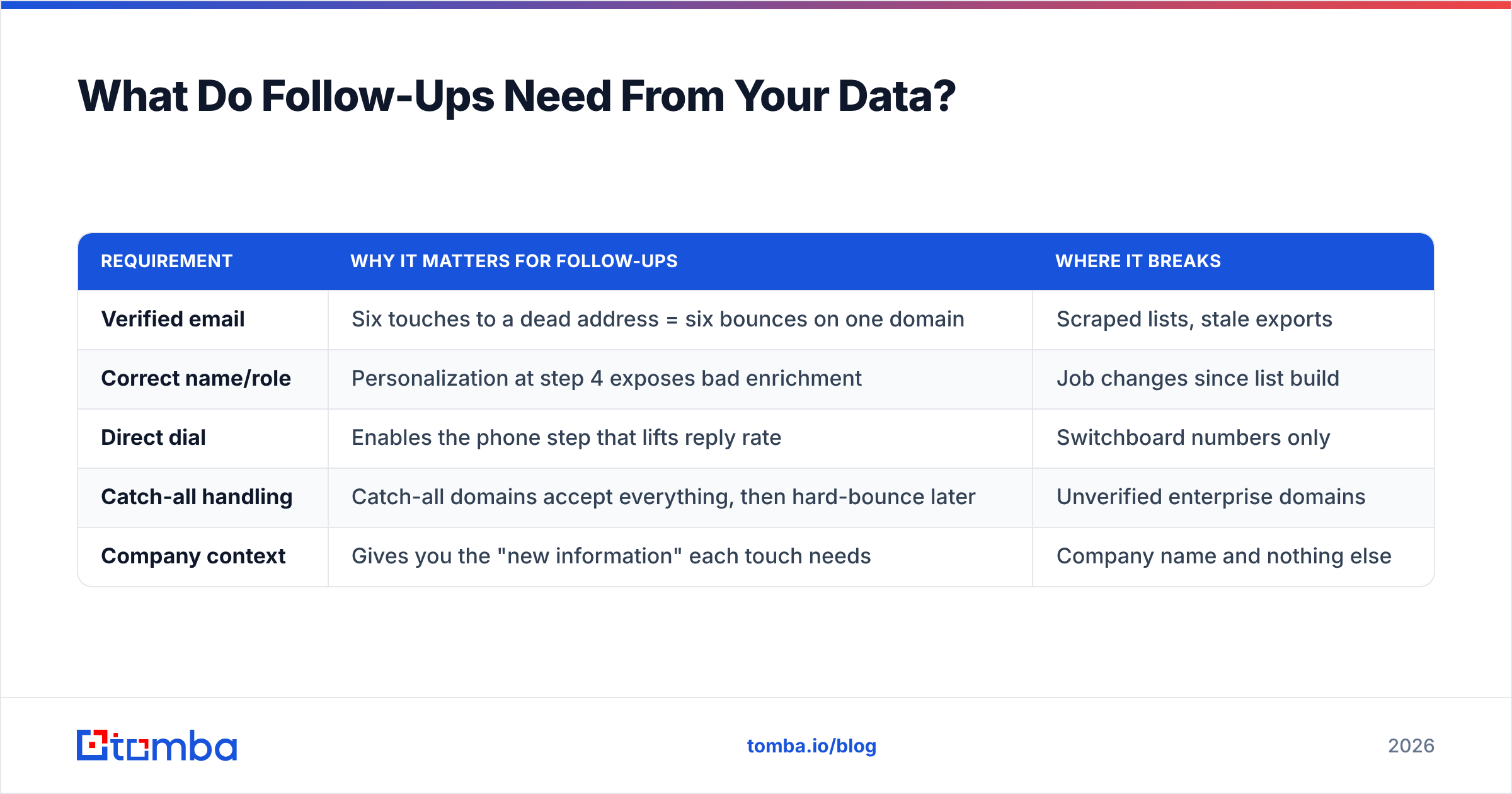
Accurate contact data, delivered before the sequence starts rather than patched mid-flight. A follow-up sequence is a multiplier — it multiplies good targeting and it multiplies bad addresses.
| Requirement | Why it matters for follow-ups | Where it breaks |
|---|---|---|
| Verified email | Six touches to a dead address = six bounces on one domain | Scraped lists, stale exports |
| Correct name/role | Personalization at step 4 exposes bad enrichment | Job changes since list build |
| Direct dial | Enables the phone step that lifts reply rate | Switchboard numbers only |
| Catch-all handling | Catch-all domains accept everything, then hard-bounce later | Unverified enterprise domains |
| Company context | Gives you the "new information" each touch needs | Company name and nothing else |
Catch-all domains deserve specific attention. They accept every address at SMTP time, so a standard verifier marks them "unknown" — then the mail silently disappears or bounces days later. A dedicated catch-all verifier resolves those separately, which matters most in enterprise segments where catch-all configuration is common.
On tooling: there are plenty of credible sources for B2B contact data. Prebuilt list providers like BookYourData work well when you want a filtered list delivered ready to import. Real-time finders work better when you're building targeted lists from named accounts. Both approaches are valid — the deciding factor is whether you're buying volume or precision, and how fresh the records need to be at send time. On Tomba pricing, the Free tier gives 25 searches a month for testing patterns, Starter runs $49/mo, Growth $99/mo, and Pro $249/mo for teams running sequences at volume.
What's the Simplest System You Can Run Tomorrow?#
Strip it to five decisions:
- Pick one cadence — 5 touches over 21 days. Don't run three variants until you've run one properly.
- Write five distinct angles before you write any copy. If you can only find three, run three.
- Verify the list before touch 1. Bounces poison every subsequent step.
- Add one non-email touch at step 3 or 4 — phone or LinkedIn, not both.
- Review reply rate by step after 200 sends. Fix the weakest step; don't add a sixth.
That's it. Most teams underperform not because their follow-up strategy is unsophisticated but because they never execute one consistently for long enough to read the results.
Ready to Build Follow-Ups on Data That Holds Up?#
Every follow-up sequence sits on top of one assumption: that the address is real and belongs to the person you think it does. When that assumption breaks, your carefully written step 4 never gets read — it bounces, and it takes a slice of your domain reputation with it.
Tomba Email Finder resolves professional email addresses by name and domain, with verification built into the same call, so the list you sequence is the list that lands. Start on the free tier — 25 searches a month, no card — and check your next 25 prospects before you write a single follow-up. If the sequence still underperforms after that, at least you'll know it's the copy.
Related guides#
Ready to find emails that actually work?
Join 150,000+ professionals who stopped guessing and started sending. Free credits on signup — no credit card required.
Get the Tomba newsletter
Practical outbound tactics and product updates — once every two weeks.
About the author