Follow Up On Our Conversation: Emails That Actually Get Replies
"Following up on our conversation" is the most-used and least-effective subject line in B2B sales. Here's what to send instead, with timing rules, templates, and a comparison of the follow-up methods that actually book meetings in 2026.
TL;DR
- "Follow up on our conversation" is a status update, not a reason to reply. Reframe every follow-up around a new piece of value: a benchmark, a doc, a named customer, a specific next step.
- Timing beats wording. Send the first follow-up within 24 hours of the call while the context is warm, then space subsequent touches 3, 5, and 8 business days apart.
- Most "no reply" cases are delivery or data problems, not copy problems. Verify the address, check the thread is still on the same domain, and confirm the contact hasn't changed jobs before you rewrite the email a fourth time.
- Reply-to-the-existing-thread beats a fresh email for warm conversations; a new subject line beats a stale thread once you're four touches deep.
- Four to seven follow-ups is the range where most B2B deals actually close. Stopping at two is the single most common reason pipeline evaporates.
What does "follow up on our conversation" actually mean in B2B sales?#
It means you had a real interaction — a discovery call, a booth conversation, a webinar Q&A, a LinkedIn exchange — and now you need to convert that interaction into a next step. The phrase itself has become shorthand for the entire post-conversation email, which is exactly the problem: it describes what you are doing, not what the recipient gets.
Think of it like a restaurant follow-up. If the waiter comes back and says "I'm following up on your order," you learn nothing. If they say "your steak needs four more minutes, here's bread on the house," you know exactly where you stand and you're happy to wait. Technically, the difference is between a status ping and an information-bearing message — and inboxes reward only the second.
The distinction matters because the follow-up is where most B2B revenue is won or lost. A conversation creates intent. Intent decays fast. The follow-up either arrests that decay with something concrete or it accelerates it with a message that reads like an obligation.
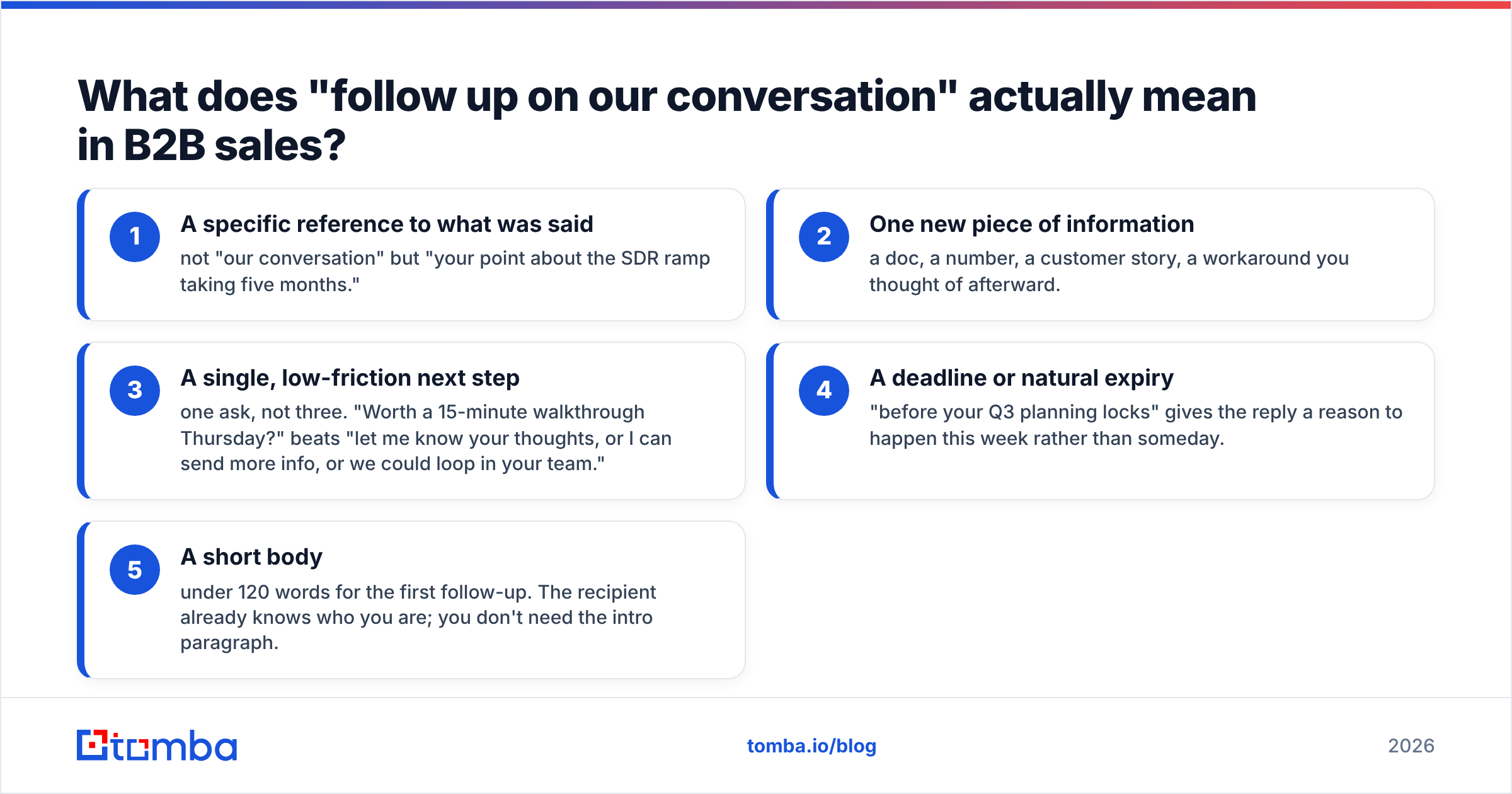
Here's the anatomy of a follow-up that works after a real conversation:
- A specific reference to what was said — not "our conversation" but "your point about the SDR ramp taking five months."
- One new piece of information — a doc, a number, a customer story, a workaround you thought of afterward.
- A single, low-friction next step — one ask, not three. "Worth a 15-minute walkthrough Thursday?" beats "let me know your thoughts, or I can send more info, or we could loop in your team."
- A deadline or natural expiry — "before your Q3 planning locks" gives the reply a reason to happen this week rather than someday.
- A short body — under 120 words for the first follow-up. The recipient already knows who you are; you don't need the intro paragraph.
Why does "just following up" get ignored?#
Because it transfers work to the recipient. "Just following up" asks them to reconstruct the context, decide what you want, and compose a reply — three jobs for zero new value. When an inbox holds 120 unread messages, that email loses every triage pass.
There are three failure modes, and they're worth separating because the fix for each is different.
Failure mode one: no new information. The email restates the call. The recipient already lived through the call. Fix: every follow-up must carry a payload — a case study, a pricing scenario, a competitor teardown, an answer to the objection they raised.
Failure mode two: vague ask. "Let me know your thoughts" has no obvious action. Fix: propose a specific time, attach a specific doc, or ask one binary question they can answer in four words.
Failure mode three: it never arrived. This one gets misdiagnosed constantly. Reps rewrite subject lines for weeks when the actual problem is a bounced address, a spam-foldered domain, or a contact who left the company two months ago. Before you blame the copy, confirm the message landed. Run the address through an email verifier, check your sender reputation, and confirm the domain isn't catch-all-masking a dead mailbox.
That third mode deserves emphasis. In audits of underperforming outbound sequences, a meaningful share of "unresponsive" contacts are simply unreachable — role changes, acquisitions, alias retirements. HubSpot's sales research has long documented how much pipeline is lost to unworked or unreachable follow-ups rather than bad messaging.
When should you send a follow-up after a conversation?#
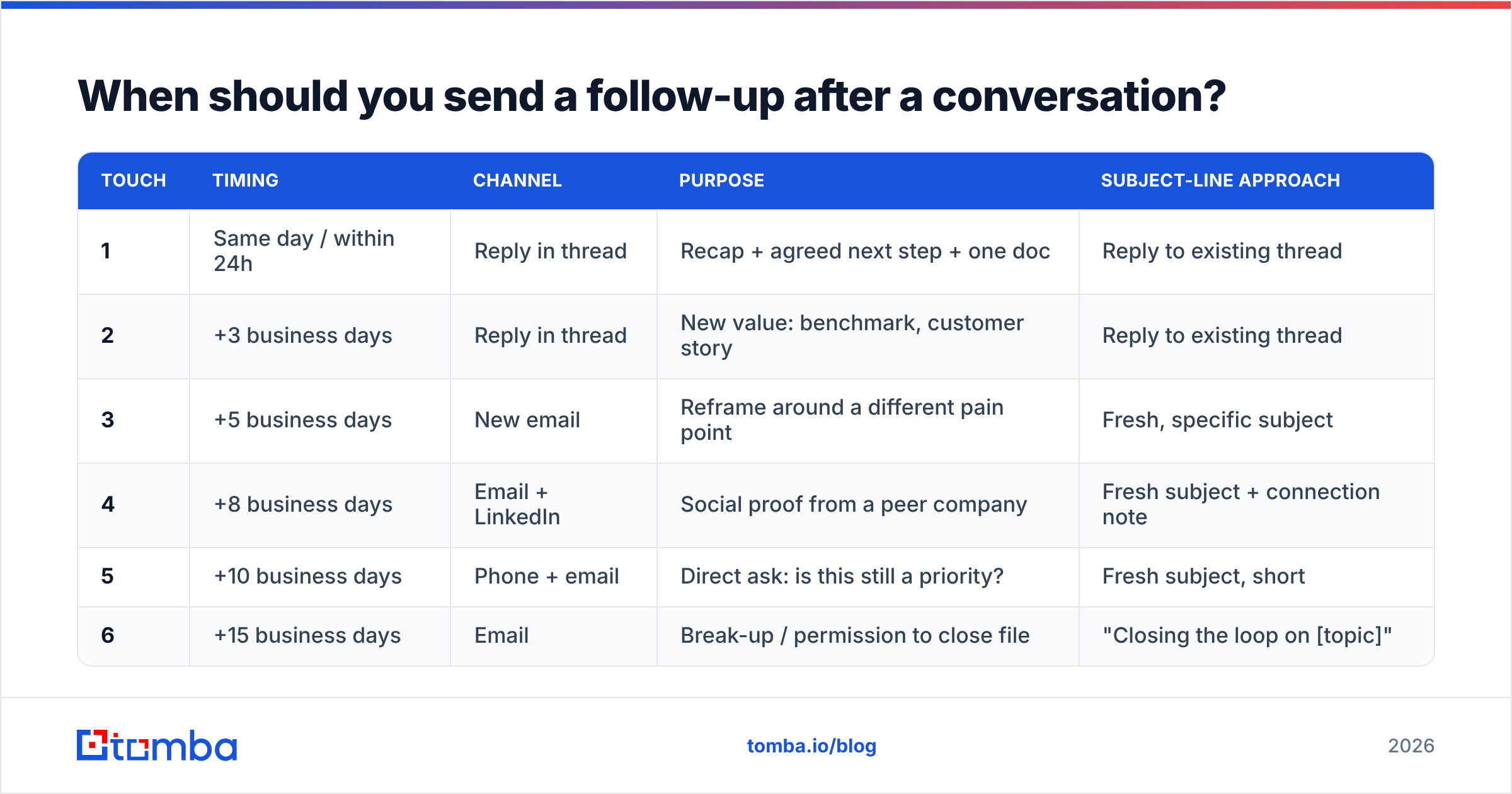
Fast for the first one, patient for the rest. The first follow-up should go out within 24 hours — ideally the same day, while your name is still attached to a face and a topic in their memory. After that, spacing matters more than speed.
Here's a cadence that holds up across most B2B motions:
| Touch | Timing | Channel | Purpose | Subject-line approach |
|---|---|---|---|---|
| 1 | Same day / within 24h | Reply in thread | Recap + agreed next step + one doc | Reply to existing thread |
| 2 | +3 business days | Reply in thread | New value: benchmark, customer story | Reply to existing thread |
| 3 | +5 business days | New email | Reframe around a different pain point | Fresh, specific subject |
| 4 | +8 business days | Email + LinkedIn | Social proof from a peer company | Fresh subject + connection note |
| 5 | +10 business days | Phone + email | Direct ask: is this still a priority? | Fresh subject, short |
| 6 | +15 business days | Break-up / permission to close file | "Closing the loop on [topic]" |
Two rules make this cadence work.
Rule one: reply in-thread for the first two touches, then start fresh. A warm thread carries context and improves the odds of a fast skim-and-reply. Past touch three, that same thread reads as nagging — a new subject line resets the frame.
Rule two: never send two consecutive follow-ups with the same angle. If touch two led with cost savings, touch three leads with implementation speed or risk. Repetition without variation trains the recipient to ignore your name.
Which follow-up method works best: thread reply, new email, or multichannel?#
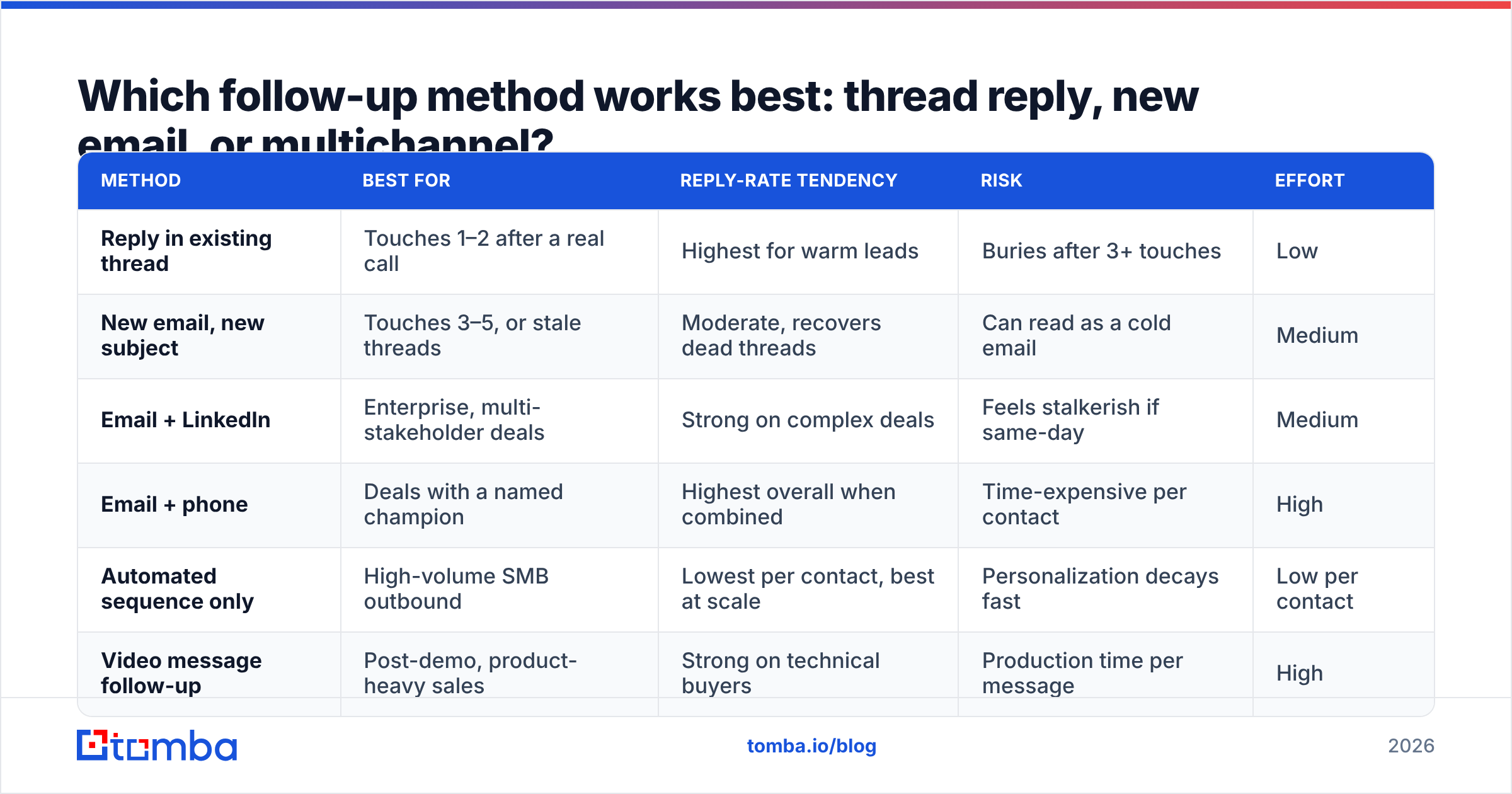
Depends on how warm the conversation was and how many touches deep you are. Here's the honest trade-off table:
| Method | Best for | Reply-rate tendency | Risk | Effort |
|---|---|---|---|---|
| Reply in existing thread | Touches 1–2 after a real call | Highest for warm leads | Buries after 3+ touches | Low |
| New email, new subject | Touches 3–5, or stale threads | Moderate, recovers dead threads | Can read as a cold email | Medium |
| Email + LinkedIn | Enterprise, multi-stakeholder deals | Strong on complex deals | Feels stalkerish if same-day | Medium |
| Email + phone | Deals with a named champion | Highest overall when combined | Time-expensive per contact | High |
| Automated sequence only | High-volume SMB outbound | Lowest per contact, best at scale | Personalization decays fast | Low per contact |
| Video message follow-up | Post-demo, product-heavy sales | Strong on technical buyers | Production time per message | High |
The pattern across all six: effort correlates with reply rate, and volume correlates inversely with it. The strategic decision isn't "which is best" — it's which segment deserves which tier. Reserve phone and video for named accounts. Run sequenced email for the long tail. Don't apply the SMB cadence to your top 20 logos.
For multichannel LinkedIn outreach specifically, spacing between channels matters more than most reps assume. A LinkedIn message the same hour as an email reads as surveillance. The same message two days later reads as persistence.
How many follow-ups are too many?#
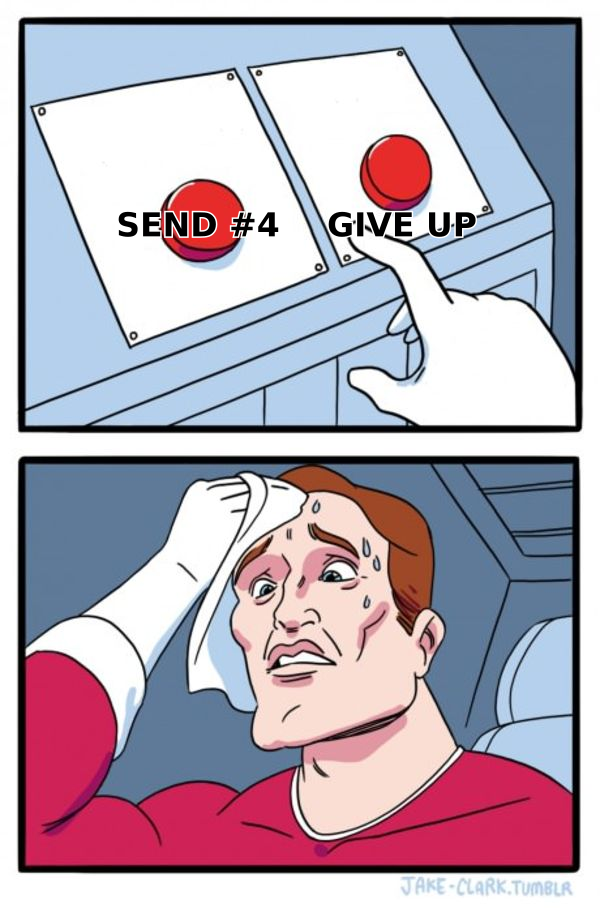
The practical ceiling is six to eight touches over roughly six weeks, and the practical floor — the one almost everyone violates — is four. Most reps stop at one or two, which means they abandon the majority of their pipeline before it had a chance to convert.
Signals to stop early:
- A clear no. "We're not looking at this" ends the sequence. Log it, set a 6-month recycle, move on.
- Hard bounces or repeated soft bounces. That's a data problem. Re-enrich the record rather than continuing to send.
- Zero opens across four touches on a verified address. Either deliverability is broken or the person isn't reading email at all. Switch channels.
- A change in role or company. Your contact moved. Find the replacement instead of emailing a ghost.
Signals to keep going:
- Opens without replies. They're reading. The ask isn't compelling enough yet — change the angle, not the frequency.
- Forwards or new recipients on the thread. Internal circulation is a strong buying signal.
- A stated timeline that hasn't arrived yet. "Ask me in Q4" is a scheduling instruction, not a rejection.
What should you write instead? Templates that carry a payload#
Each of these replaces "following up on our conversation" with something that earns the open.
Template 1 — The same-day recap (touch 1)
Subject: [Reply in thread]
Thanks for the time today. Quick recap so nothing gets lost:
- You're losing ~3 weeks per new rep on manual list building
- Budget sits with [name], review cycle is early September
- Blocker is data accuracy, not tooling cost
I pulled the accuracy benchmark I mentioned — attached. Worth 15 minutes Thursday to walk [name] through the numbers?
Template 2 — The new-information nudge (touch 2)
Subject: [Reply in thread]
One thing I didn't mention on the call: [similar company] had the same catch-all domain problem and solved it by verifying at the point of import rather than pre-send. Cut their bounce rate by about two-thirds.
Want me to send the two-paragraph version of how they set it up?
Template 3 — The reframe (touch 3, new subject)
Subject: The SDR ramp problem, not the data problem
Last time we talked data accuracy. Since then I've been thinking your bigger constraint is ramp time — new reps spend their first month building lists instead of selling.
Different angle, same 15 minutes. Free Tuesday afternoon?
Template 4 — The break-up (final touch)
Subject: Closing the loop on [topic]
I've sent a few notes since we spoke and haven't wanted to clutter your inbox further. I'll assume the timing isn't right and close the file on my end.
If it comes back around before year-end, reply to this and I'll pick it straight back up.
The break-up email consistently outperforms the touches before it, for an uncomfortable reason: it's the first message that doesn't ask for anything. Loss aversion does the work. Use it once, sincerely, and actually stop afterward — a "break-up" you follow with three more emails destroys your credibility.
If you're generating variations at scale, run them through a spam checker before they enter a sequence. Follow-up templates accumulate trigger words ("free", "guarantee", "act now") faster than cold openers because reps keep adding urgency to compensate for silence.
How do you fix follow-ups that never arrive?#
Diagnose in this order, because each step is cheaper than the one after it.
- Verify the address. A follow-up to a dead mailbox looks identical to a follow-up that got ignored. Bulk-verify your entire active sequence list, not just new adds — addresses decay at roughly 2–3% per month in B2B.
- Check catch-all domains. Many enterprise domains accept everything and deliver nothing. A catch-all verifier distinguishes a live mailbox from a black hole that silently absorbs your sequence.
- Audit authentication. Missing or misconfigured SPF, DKIM, and DMARC records send follow-ups straight to spam even when the cold opener landed. Google and Yahoo's bulk-sender requirements made this non-negotiable — Google's sender guidelines spell out the thresholds.
- Check for job changes. If the person moved, re-enrich the account and find the new owner of the problem. Contact enrichment that refreshes on a schedule prevents this from becoming a quarterly cleanup fire drill.
- Only then rewrite the copy. Copy is the last variable to change, not the first — it's the one everyone reaches for because it's the one that feels within their control.
Peer-review sites like G2's sales engagement category show a consistent pattern in reviews: teams that blame reply rates on messaging usually discover a data-hygiene problem underneath. It's worth checking the plumbing before rewriting the brochure.
What tools help you follow up on a conversation at scale?#
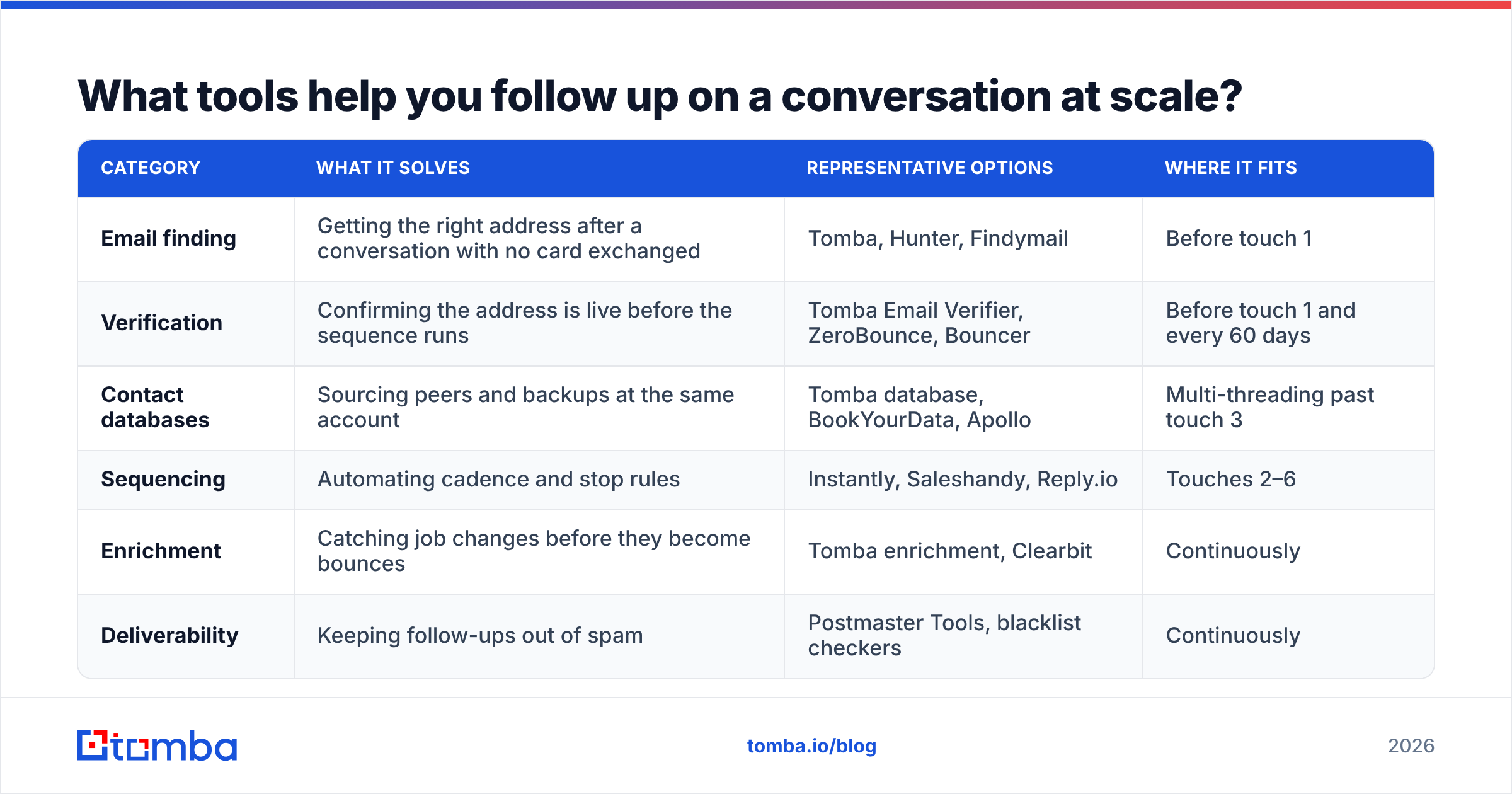
Follow-up quality is mostly a data problem wearing a copywriting costume. Here's how the categories break down:
| Category | What it solves | Representative options | Where it fits |
|---|---|---|---|
| Email finding | Getting the right address after a conversation with no card exchanged | Tomba, Hunter, Findymail | Before touch 1 |
| Verification | Confirming the address is live before the sequence runs | Tomba Email Verifier, ZeroBounce, Bouncer | Before touch 1 and every 60 days |
| Contact databases | Sourcing peers and backups at the same account | Tomba database, BookYourData, Apollo | Multi-threading past touch 3 |
| Sequencing | Automating cadence and stop rules | Instantly, Saleshandy, Reply.io | Touches 2–6 |
| Enrichment | Catching job changes before they become bounces | Tomba enrichment, Clearbit | Continuously |
| Deliverability | Keeping follow-ups out of spam | Postmaster Tools, blacklist checkers | Continuously |
On pricing, the spread is wide. Tomba's plans start with a free tier at 25 searches per month, then Starter at $49/mo, Growth at $99/mo, and Pro at $249/mo, with Enterprise custom — which puts finding and verifying in one bill rather than two vendors. BookYourData takes a different and perfectly valid approach with prepaid credits and a strong verified-database angle, which suits teams that want to buy a list once rather than run continuous discovery. Which fits depends on whether your follow-ups are against a fixed target account list or a continuously expanding one.
Whatever you pick, the sequencing rule holds: find, verify, then send. Reversing that order is how a 6-touch cadence turns into 6 bounces against the same dead address, and how a sending domain earns a reputation problem that takes months to unwind.
The short version#
"Follow up on our conversation" isn't a strategy — it's a placeholder people paste in when they don't have anything new to say. The fix is structural: send the first touch within 24 hours, carry one new piece of information per email, vary the angle between touches, run four to seven touches before you close the file, and verify the address before any of it.
Do those five things and your reply rate moves without you touching a single adjective.
If your follow-ups are stalling because you're guessing at addresses — or emailing contacts who left six months ago — start at the source. The Tomba Email Finder returns verified professional addresses by name and domain, with confidence scoring so you know which contacts are worth a six-touch cadence and which need re-enriching first. The free tier covers 25 searches a month, which is enough to test whether your follow-up problem was ever really a copy problem.
Related guides#
Ready to find emails that actually work?
Join 150,000+ professionals who stopped guessing and started sending. Free credits on signup — no credit card required.
Get the Tomba newsletter
Practical outbound tactics and product updates — once every two weeks.
About the author