Follow Up Proposal Email: Templates and Timing That Close
Most proposals die in silence, not rejection. Here is the follow-up cadence, the exact email templates, and the timing data that turn a quiet proposal into a signed deal.
TL;DR
- Roughly half of proposals that go quiet are still winnable — the buyer stalled internally, not on you. Silence is a process problem, not a rejection.
- Send the first follow up proposal email 48-72 hours after delivery, then space the rest at day 5, day 10, day 17, and a final breakup around day 30.
- Every follow-up must add something: a case study, a revised scope option, a deadline, a new stakeholder angle. "Just checking in" is the single worst-performing opener in B2B.
- The highest-converting follow-ups are addressed to people who never saw the proposal — procurement, finance, the CFO. Find them and loop them in.
- Track proposal opens, not just email opens. If nobody has opened the PDF by day 5, your problem is attention, not price.
You sent the proposal. You felt good about it. The call had gone well, the scope was tight, the pricing was fair. Then: nothing. Day three, nothing. Day seven, nothing. Day twelve, you start rewriting the pricing in your head.
This is the most common failure point in B2B selling, and it is almost never about the proposal itself. Below is what actually happens after you hit send, how to structure a follow-up sequence that respects the buyer's real timeline, and copy you can lift directly.
Why Do Proposals Go Silent After You Send Them?#
Buyers do not ghost you because they hate your pricing. They go quiet because your proposal entered an internal process you cannot see.
Here is what is usually happening on the other side:
- Your champion is not the decision-maker. They liked the demo, forwarded the PDF, and are now waiting on someone who has never spoken to you. Gartner's B2B buying research has consistently found that a typical enterprise purchase involves six to ten stakeholders, most of whom you never meet.
- The budget cycle moved. The project is approved in principle but not funded until next quarter. Nobody wants to email you and say "we ran out of money," so they say nothing.
- A competing priority ate the calendar. A layoff, a reorg, a product launch, an outage. Your proposal is real but no longer urgent.
- They are comparing you against two other vendors and do not want to signal preference by replying quickly.
- The email never arrived. A PDF attachment, a tracking pixel, and a link-heavy signature is a spam-filter cocktail. If your deliverability is weak, your "ghosting" is actually a routing problem.
Only the last of those is your fault, and it is the easiest to fix. The rest require a follow-up sequence that gives the buyer new reasons to re-engage rather than new reasons to feel guilty.
What Is the Right Follow Up Proposal Email Cadence?#
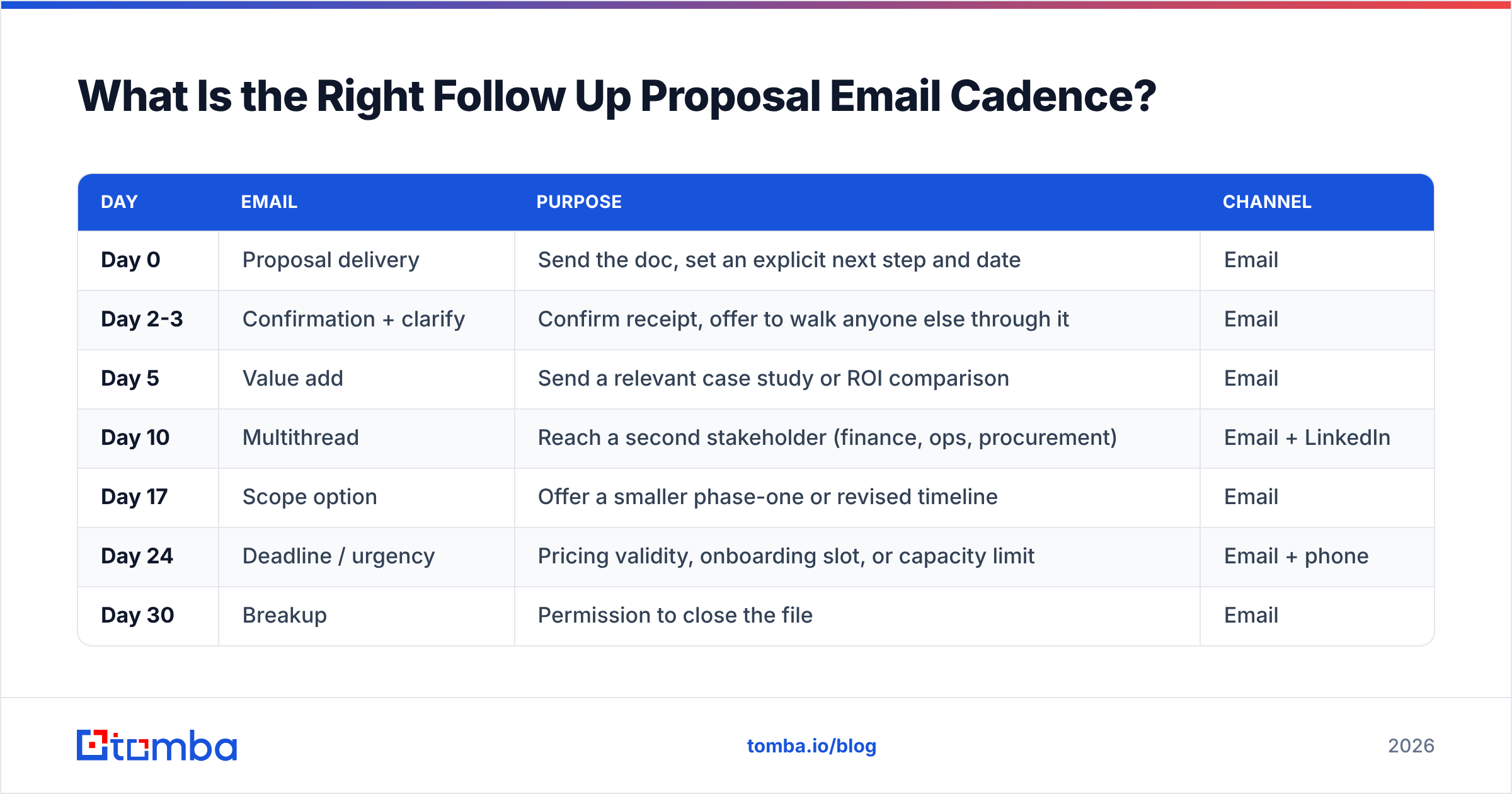
Space your follow-ups so the total sequence spans about 30 days, front-loaded in the first two weeks. The mistake most reps make is either three emails in five days (annoying) or one email every three weeks (forgettable).
Use this schedule as your default:
| Day | Purpose | Channel | |
|---|---|---|---|
| Day 0 | Proposal delivery | Send the doc, set an explicit next step and date | |
| Day 2-3 | Confirmation + clarify | Confirm receipt, offer to walk anyone else through it | |
| Day 5 | Value add | Send a relevant case study or ROI comparison | |
| Day 10 | Multithread | Reach a second stakeholder (finance, ops, procurement) | Email + LinkedIn |
| Day 17 | Scope option | Offer a smaller phase-one or revised timeline | |
| Day 24 | Deadline / urgency | Pricing validity, onboarding slot, or capacity limit | Email + phone |
| Day 30 | Breakup | Permission to close the file |
Two rules make this cadence work:
- Never send two consecutive emails with the same ask. If day 5 asked for a call and day 10 asks for a call, you have sent the same email twice with different words.
- Change channel at least once. A short LinkedIn note or a two-minute voicemail after email three roughly doubles your odds of a reply in most sales teams' own data. Consistent LinkedIn outreach alongside email is the cheapest lift available.
What Should Each Follow-Up Email Actually Say?#
Every follow-up needs a reason to exist that is not "I want an answer." Here are the five that carry the sequence.
The Day 2-3 confirmation#
Short, no pressure, one job: confirm it landed and open the door to other stakeholders.
Subject: Proposal — anything unclear?
Hi Dana,
Sent the proposal Tuesday. Two things before you take it further:
- Page 4 has the phased option we discussed — the Q3-only scope is $18,400 instead of the full $31,000.
- If it's going to anyone on the finance side, I'm happy to jump on a 15-minute call with them directly so you don't have to defend the numbers alone.
Which is easier?
— Marco
Notice the offer: so you don't have to defend the numbers alone. You are removing work from your champion, not adding it.
The Day 5 value add#
Subject: The Northwind rollout you asked about
Hi Dana,
You asked how long onboarding takes with a distributed ops team. Northwind had the same setup — 40 users across three time zones — and was fully live in 11 days. Two-page summary attached.
The relevant bit for you is page 2: they ran the migration without pausing their existing workflows, which was your main concern on the call.
Worth a quick call this week?
— Marco
The Day 10 multithread#
This is the highest-leverage email in the sequence, and most reps never send it because they do not have the second contact's address. That is a solvable problem — a domain search on the company returns the finance, ops, and procurement contacts your champion never introduced you to.
Subject: Q3 ops proposal — quick context for finance
Hi Priya,
Dana's team is reviewing a proposal from us for the Q3 ops rollout. Since it'll likely cross your desk, here's the two-line version:
$18,400 for phase one, 11-day implementation, break-even at month 5 based on the ticket-volume numbers Dana shared.
Happy to answer anything directly — or ignore this entirely if the timing's wrong.
— Marco
Always tell your champion you are doing this. "I'm going to send Priya the summary so she isn't seeing it cold" is collaborative. Going behind their back is not.
The Day 17 scope option#
Subject: Smaller version?
Hi Dana,
Guessing the full scope is the sticking point. If it helps, we can start with just the reporting module — $6,900, live in a week, and it slots into the full build later with no rework.
Not trying to shrink the deal. Just want you to have a version that clears whatever the internal bar is.
— Marco
The Day 30 breakup#
Subject: Closing the file?
Hi Dana,
I'll stop chasing. If the Q3 rollout got pushed or went another direction, no hard feelings — just let me know and I'll close it out on our side.
If it's still live and just slow, say the word and I'll hold the pricing through October.
— Marco
Breakup emails work because they end the ambiguity the buyer has been avoiding. Expect a reply rate somewhere between 15% and 30% on this one — often the highest of the entire sequence.
Which Follow-Up Approach Performs Best?#
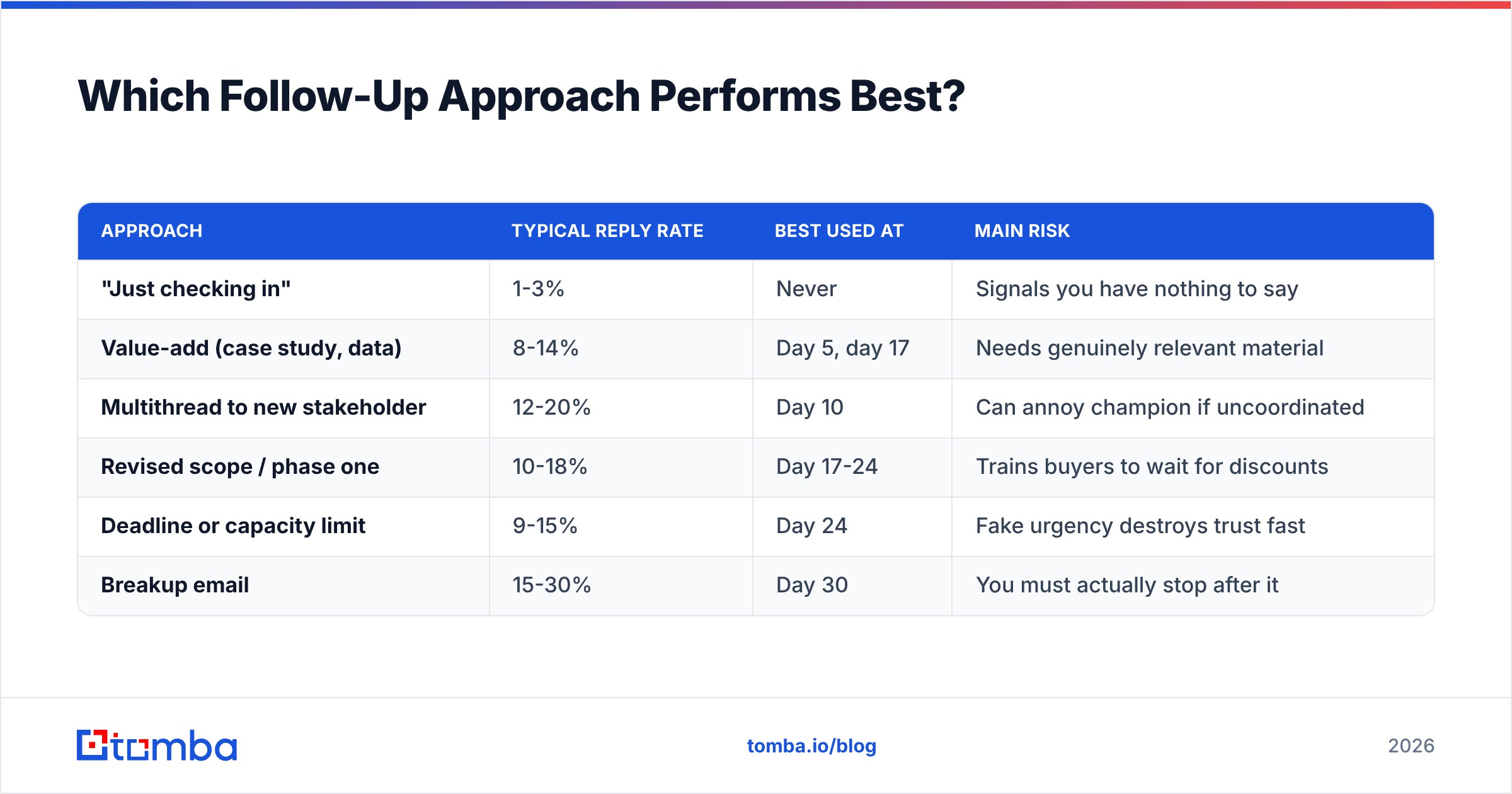
Not all follow-ups are equal. Here is how the common approaches compare in practice:
| Approach | Typical reply rate | Best used at | Main risk |
|---|---|---|---|
| "Just checking in" | 1-3% | Never | Signals you have nothing to say |
| Value-add (case study, data) | 8-14% | Day 5, day 17 | Needs genuinely relevant material |
| Multithread to new stakeholder | 12-20% | Day 10 | Can annoy champion if uncoordinated |
| Revised scope / phase one | 10-18% | Day 17-24 | Trains buyers to wait for discounts |
| Deadline or capacity limit | 9-15% | Day 24 | Fake urgency destroys trust fast |
| Breakup email | 15-30% | Day 30 | You must actually stop after it |
The pattern is obvious: the emails that perform give the buyer something. The ones that fail ask the buyer for something. If you cannot articulate what a follow-up gives, do not send it — wait a day and find something worth sending.
How Do You Make Sure the Follow-Up Actually Arrives?#
You can write the best follow up proposal email in your industry and still lose the deal to a spam folder. Proposal follow-ups are unusually vulnerable because they often carry attachments, tracking links, and long signatures.
Run this checklist before your sequence goes out:
- Verify the address. Contacts churn constantly, and a bounced follow-up to a departed champion looks identical to being ignored. Run the address through an email verifier before you assume silence means disinterest.
- Check your authentication. A missing or malformed SPF record is one of the fastest ways to land in Promotions or worse. Google and Yahoo's bulk-sender requirements made DMARC alignment effectively mandatory, and their documented sender guidelines are worth reading in full.
- Link, don't attach. A hosted proposal link gives you open tracking and avoids attachment filtering. It also tells you whether the problem is your email or your document.
- Strip the tracking pixel on email three and beyond. If the first two are unopened, pixels may be part of why.
- Watch your reply-to domain. Sending from a subdomain the recipient has never seen tanks sender reputation with corporate filters.
If proposal opens are at zero across a whole quarter of deals, deliverability is your bottleneck — not your copy, not your pricing.
How Do You Find the Second and Third Stakeholder?#
Multithreading is the single biggest lever in proposal follow-up, and the blocker is almost always data, not nerve.
Three practical routes:
- Pattern-match the company's email format. If your champion is
dana.reyes@company.com, the CFO is almost certainlyfirst.last@company.comtoo. A company email pattern check confirms the format in seconds so you are not guessing. - Work backwards from LinkedIn. Identify the VP of Finance or Head of Procurement on LinkedIn, then resolve the work address rather than relying on InMail, which frequently sits unread for weeks.
- Enrich the account, not the contact. Pulling the full org map — titles, departments, direct lines — turns a one-contact deal into a three-contact deal. Contact enrichment at the account level is what separates reps who recover stalled proposals from reps who wait.
For phone follow-up on day 24, a verified direct line matters more than a switchboard number. A phone finder lookup on the two or three people who actually sign is usually enough — you do not need the whole org.
One caution on tone: multithreading is not escalation. You are not going over your champion's head to pressure them. You are making sure the people who have to approve the spend have seen the numbers before they are asked to approve them. Frame every message that way and champions rarely object.
What Should You Track to Know If It's Working?#
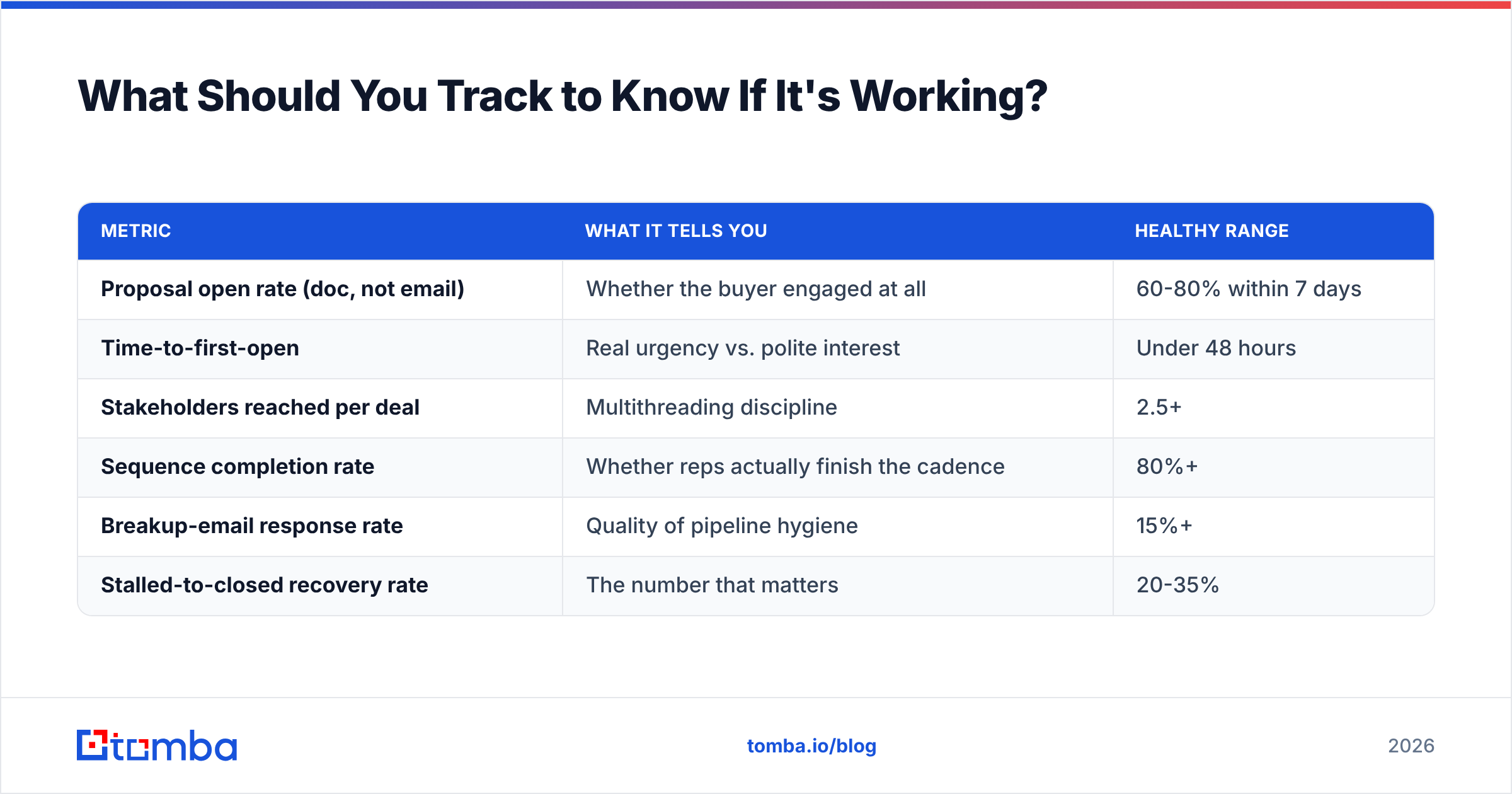
Reply rate alone is a bad metric for proposal follow-up because it lumps "no" in with "no answer." Track these instead:
| Metric | What it tells you | Healthy range |
|---|---|---|
| Proposal open rate (doc, not email) | Whether the buyer engaged at all | 60-80% within 7 days |
| Time-to-first-open | Real urgency vs. polite interest | Under 48 hours |
| Stakeholders reached per deal | Multithreading discipline | 2.5+ |
| Sequence completion rate | Whether reps actually finish the cadence | 80%+ |
| Breakup-email response rate | Quality of pipeline hygiene | 15%+ |
| Stalled-to-closed recovery rate | The number that matters | 20-35% |
The last row is the scoreboard. If fewer than one in five stalled proposals eventually closes, your follow-up is either too short, too generic, or aimed at one person. Reviewing your response rate by email position in the sequence will usually show you exactly where the sequence dies.
Independent buyer-review data on sales tooling — the kind aggregated on G2 — consistently shows that teams with structured, tracked follow-up sequences report materially better close rates than teams running follow-up from memory. The structure is the differentiator, not the cleverness of any individual email.
What Are the Mistakes That Kill Deals at This Stage?#
- Apologizing for following up. "Sorry to bother you again" tells the buyer your email is a bother. It is not. You are doing your job.
- Dropping the price unprompted. Cutting 20% in email four teaches the buyer that waiting is profitable. Change the scope, not the rate.
- Sending nine emails in eleven days. Panic cadence reads as desperation and gets you blocked.
- Stopping after two emails. Most reps quit before the point where replies actually happen. The day 17 and day 30 emails are where recovery lives.
- Following up with the wrong person forever. If your champion left the company, no cadence will save you. Verify first.
- Treating the breakup as a bluff. If you send it and then email again on day 34, every future deadline you set is worthless.
Where Does This Fit in a Broader Outbound Motion?#
Proposal follow-up is the last mile of a much longer process, and it inherits every weakness upstream. If your prospecting data was shaky, your proposal went to a title that cannot buy. If your discovery was thin, your proposal is priced against a problem the buyer does not think they have.
Teams that recover stalled proposals well tend to share three habits:
- They multithread before the proposal, not after. By the time the doc goes out, finance already knows it is coming.
- They set the next step in the proposal email itself. "I'll follow up Thursday if I haven't heard back" is not pushy — it is a calendar entry.
- They keep clean contact data. Every follow-up sequence is only as good as the addresses it runs on, which is why data accuracy is a revenue metric, not an ops metric.
If you want to benchmark your own approach against how other vendors structure buyer follow-up, the published sales-process documentation from HubSpot is a reasonable neutral starting point.
Ready to Stop Losing Deals to Silence?#
The follow-up sequence above only works if it reaches real, current inboxes — and if you can reach the second and third stakeholder who never got introduced. That is a data problem before it is a copywriting problem.
Tomba Email Finder resolves verified work addresses by name and domain, so your day 10 multithread email lands with finance instead of bouncing. Start on the free tier with 25 searches a month to test it against your current stalled deals; paid plans begin at $49/mo on Starter and $99/mo on Growth if you need volume. Full Tomba pricing is public, with no per-seat surprises.
Pull the three stalled proposals sitting in your pipeline right now, find the stakeholder you never emailed, and send the day 10 message. That one email recovers more deals than any rewrite of the proposal ever will.
Related guides#
Ready to find emails that actually work?
Join 150,000+ professionals who stopped guessing and started sending. Free credits on signup — no credit card required.
Get the Tomba newsletter
Practical outbound tactics and product updates — once every two weeks.
About the author