Follow Up Quotation Email Sample: 9 Templates That Close
Most quotes die in silence, not rejection. Here are nine follow-up quotation email samples, the timing sequence behind them, and the reply-rate data that decides which one you send.
TL;DR
- Roughly half of closed quotes need three or more follow-ups, yet most sellers send one and quit. The gap between "sent the quote" and "won the deal" is almost always a timing problem, not a pricing problem.
- The best follow up quotation email sample is short (under 90 words), references a specific line item in the quote, and ends with a binary question the buyer can answer in one tap.
- Use a 5-touch sequence spread over 21 days: +2 days, +5 days, +10 days, +17 days, +30 days. Change the angle every time — never resend the same nudge.
- Send to a verified address. A quote follow-up that bounces looks identical to a buyer ignoring you, and you'll never know which happened.
- Nine copy-paste templates below, each mapped to a scenario: silence, price objection, "checking with the team," expired quote, and the polite breakup.
Why Do Most Quotation Follow-Ups Fail?#
Because they say nothing new.
The typical second email is "Just following up on the quote I sent — any thoughts?" That message adds zero information. The buyer already knows you sent a quote. They already know you want an answer. Restating both facts gives them nothing to react to, so they defer, and deferral compounds into silence.
There's a second failure mode that's quieter and more expensive: the follow-up never arrived. Role addresses get retired, people change companies, and procurement contacts rotate. If you built the quote off a contact you scraped six months ago, your "no response" might be a bounce sitting in a folder nobody reads. Running the address through an email verifier before a high-value quote follow-up takes four seconds and removes an entire category of false negatives.
The third failure is cadence collapse. Sellers send follow-up one on day two, follow-up two on day four, then nothing for a month. The buyer's evaluation cycle usually runs longer than your patience does. HubSpot's sales research has repeatedly found that a meaningful share of deals close after the fifth touch — well past where most reps stop.

What Makes a Follow Up Quotation Email Sample Actually Work?#
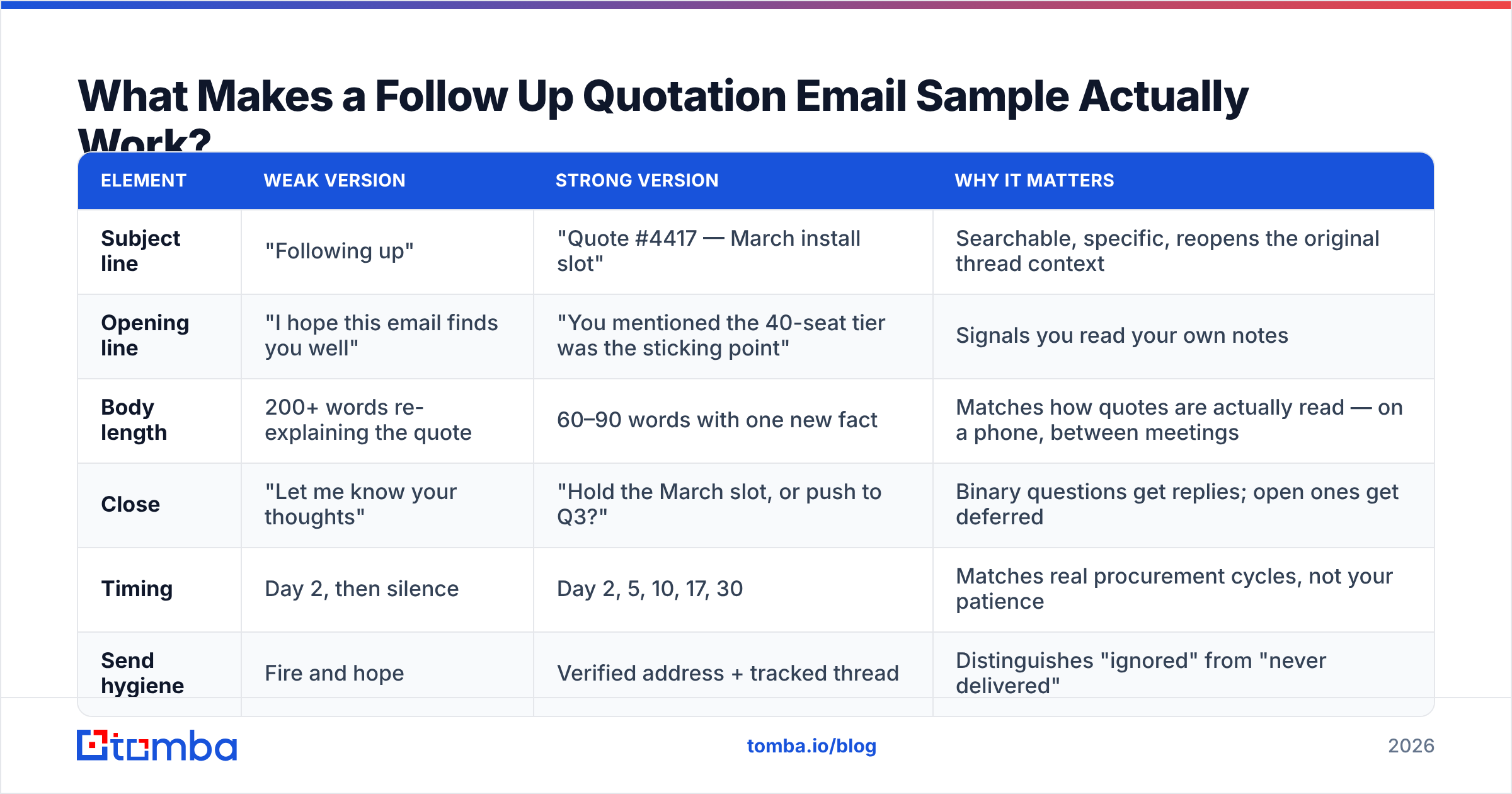
Four elements. Miss any one and the reply rate drops noticeably.
- A subject line that references the quote, not the follow-up. "Quote #4417 — revised timeline" outperforms "Following up." The buyer's inbox search will surface the first one months later; the second is invisible.
- One specific reference to the quote's contents. Name the SKU, the line item, the delivery window, the seat count. Specificity proves a human wrote it and reminds them what they were excited about.
- A new piece of information. A case study from their vertical, a note that the implementation slot is filling, a revised option at a lower tier. Something that wasn't in the original email.
- A binary close. "Should I hold the March slot, or is this a Q3 conversation?" is answerable in five words. "Let me know your thoughts" requires the buyer to compose a paragraph, so they don't.
Keep the body under 90 words. Longer quote follow-ups get skimmed, and skimming is how a "yes, but later" becomes a "no."
| Element | Weak version | Strong version | Why it matters |
|---|---|---|---|
| Subject line | "Following up" | "Quote #4417 — March install slot" | Searchable, specific, reopens the original thread context |
| Opening line | "I hope this email finds you well" | "You mentioned the 40-seat tier was the sticking point" | Signals you read your own notes |
| Body length | 200+ words re-explaining the quote | 60–90 words with one new fact | Matches how quotes are actually read — on a phone, between meetings |
| Close | "Let me know your thoughts" | "Hold the March slot, or push to Q3?" | Binary questions get replies; open ones get deferred |
| Timing | Day 2, then silence | Day 2, 5, 10, 17, 30 | Matches real procurement cycles, not your patience |
| Send hygiene | Fire and hope | Verified address + tracked thread | Distinguishes "ignored" from "never delivered" |
What Is the Right Follow-Up Timing Sequence?#
Five touches across 21 days, then one revival at day 30. Each touch carries a different job.
Touch 1 — Day +2: The confirmation. Not a nudge. You're confirming receipt and offering to walk them through it. Low pressure, high response rate, and it gets your name back at the top of the thread while the quote is still warm.
Touch 2 — Day +5: The clarifier. Assume there's a question they haven't asked. Preempt the most common one for your product — implementation time, contract length, what's excluded. This is where most deals unstick.
Touch 3 — Day +10: The value add. Send something external: a comparable customer's result, a relevant benchmark, a short teardown of how a similar company deployed. No ask beyond "worth 15 minutes?"
Touch 4 — Day +17: The deadline. A real one. Pricing valid through month-end, an install slot, a promotional tier. Never fabricate urgency — buyers detect it and it costs you the relationship, not just the deal.
Touch 5 — Day +30: The breakup. Give them a clean exit. Counterintuitively this is often the highest-reply-rate email in the sequence, because it removes the obligation to negotiate.
If the deal is large enough to justify a call, layer in a phone touch between steps 3 and 4. Pulling a direct dial with a phone finder and leaving a 20-second voicemail referencing the quote number consistently lifts email reply rates on the following touch — the buyer now has two signals from you instead of one.
What Are the Best Follow Up Quotation Email Samples?#
Nine templates. Swap the bracketed fields and keep the length.
1. The 48-hour confirmation#
Subject: Quote #[NUMBER] — anything unclear?
Hi [Name],
Sent over the quote for [specific deliverable] on [day]. Wanted to make sure it landed and that the [line item] section made sense — it's the part most people have questions about.
Happy to walk through it in 10 minutes, or answer here if that's easier.
[Your name]
2. The preempted objection#
Subject: Re: Quote #[NUMBER] — on the [X]-week timeline
Hi [Name],
One thing I should have flagged: the [X]-week implementation on the quote assumes [assumption]. If [their constraint] is a factor, we can compress it to [Y] weeks by [approach].
Does that change the picture, or was timeline not the concern?
[Your name]
3. The internal-champion assist#
Subject: Quote #[NUMBER] — one-pager for [their boss/committee]
Hi [Name],
You mentioned this needs sign-off from [role/team]. I put the quote into a one-page summary with the ROI math already done — attached, no branding, use it however you want.
Anything else that would make the internal case easier?
[Your name]
4. The comparable-customer proof#
Subject: How [Similar Company] handled the same decision
Hi [Name],
[Similar Company] was weighing the same tier question you raised. They started at [option A] and expanded in month four — here's the short version: [one-sentence outcome].
Not saying it's your path, but it might answer the [specific concern] question.
Worth 15 minutes this week?
[Your name]
5. The price-objection reframe#
Subject: Quote #[NUMBER] — a smaller starting point
Hi [Name],
If the [$X] number is the blocker rather than the fit, there's a smaller entry: [reduced scope] at [$Y], with the option to add [component] later at the same unit rate.
Would that version get a yes, or is the timing the real issue?
[Your name]
6. The expired-quote revival#
Subject: Quote #[NUMBER] expired — reissue it?
Hi [Name],
The pricing on quote #[NUMBER] lapsed on [date]. Before I archive it: still live on your side, or has this moved off the roadmap for now?
Happy to reissue at the same rate if it's still active.
[Your name]
7. The genuine deadline#
Subject: [Month] implementation slot — holding until [date]
Hi [Name],
We have two [Month] onboarding slots left and I've been holding one against your quote. I need to release it on [date].
Should I keep it, or plan around a [later month] start?
[Your name]
8. The channel switch#
Subject: Wrong channel?
Hi [Name],
I may be emailing the wrong way about this. If someone else owns the [category] budget now, point me at them and I'll take it off your plate.
Otherwise — quick call Thursday?
[Your name]
9. The breakup#
Subject: Closing the file on quote #[NUMBER]
Hi [Name],
I'll stop chasing this one. If [problem] becomes a priority again, the quote's on file and I'll honor the pricing for 60 days.
Anything I should know for next time — was it price, timing, or fit?
[Your name]
How Do You Know Which Template to Send?#
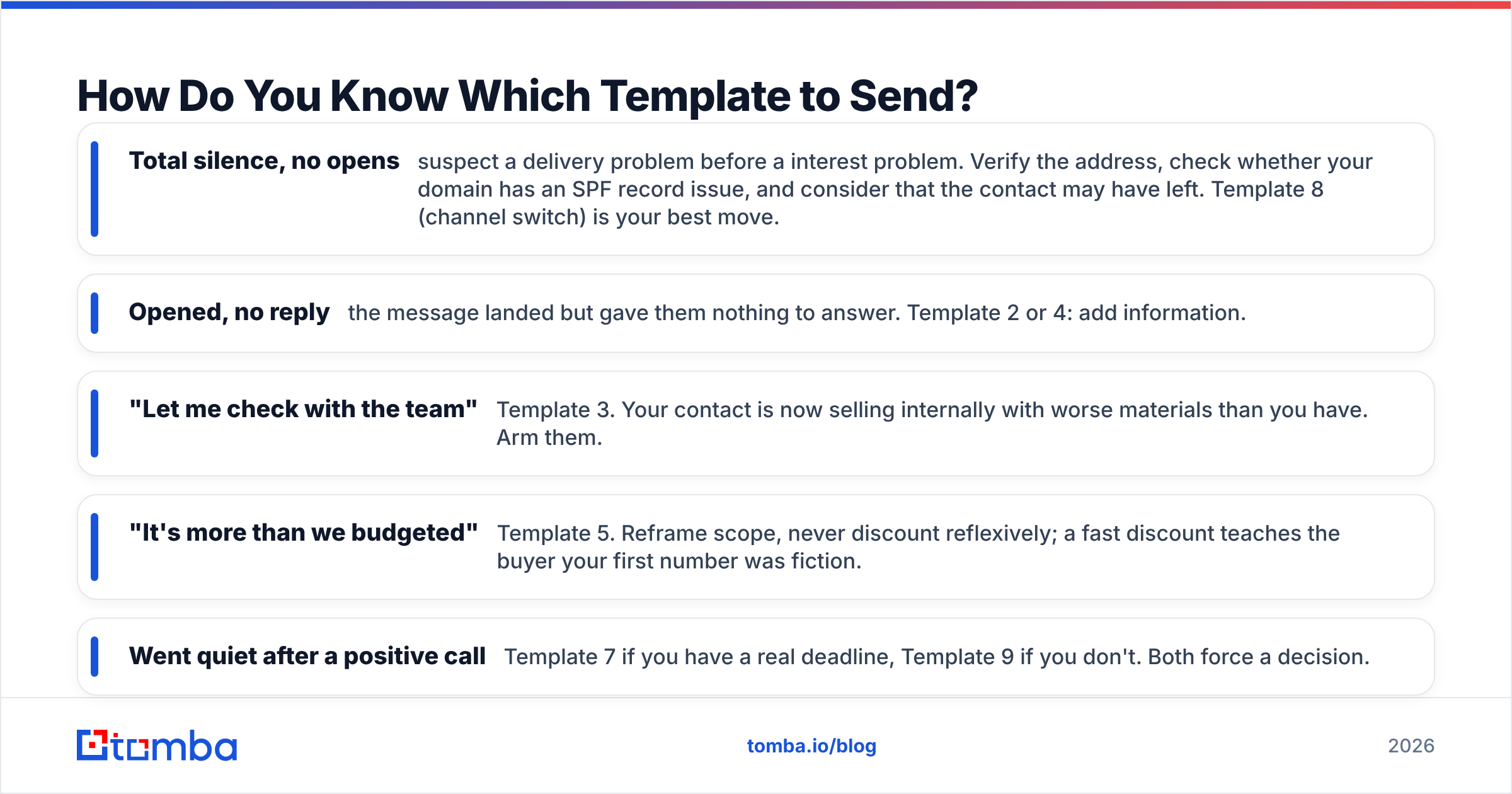
Match the template to the last signal you received, not to the day on the calendar.
- Total silence, no opens — suspect a delivery problem before a interest problem. Verify the address, check whether your domain has an SPF record issue, and consider that the contact may have left. Template 8 (channel switch) is your best move.
- Opened, no reply — the message landed but gave them nothing to answer. Template 2 or 4: add information.
- "Let me check with the team" — Template 3. Your contact is now selling internally with worse materials than you have. Arm them.
- "It's more than we budgeted" — Template 5. Reframe scope, never discount reflexively; a fast discount teaches the buyer your first number was fiction.
- Went quiet after a positive call — Template 7 if you have a real deadline, Template 9 if you don't. Both force a decision.
The signal you can't read from the inbox is whether the person still works there. Contact data decays at roughly 2–3% per month, which means a quote list six months old is meaningfully stale. Before a revival sequence on old quotes, re-run the list through a bulk verify pass and re-find anyone whose address now hard-bounces.
How Should You Track Quote Follow-Ups Without a Full CRM?#
Three fields beat a complicated system: quote number, last touch date, next touch date. That's it. Whether it lives in your CRM, a spreadsheet, or a Kanban board matters far less than whether the "next touch date" field is ever empty. An empty next-touch field is a deal you've silently abandoned.
A few operating rules that hold up across teams:
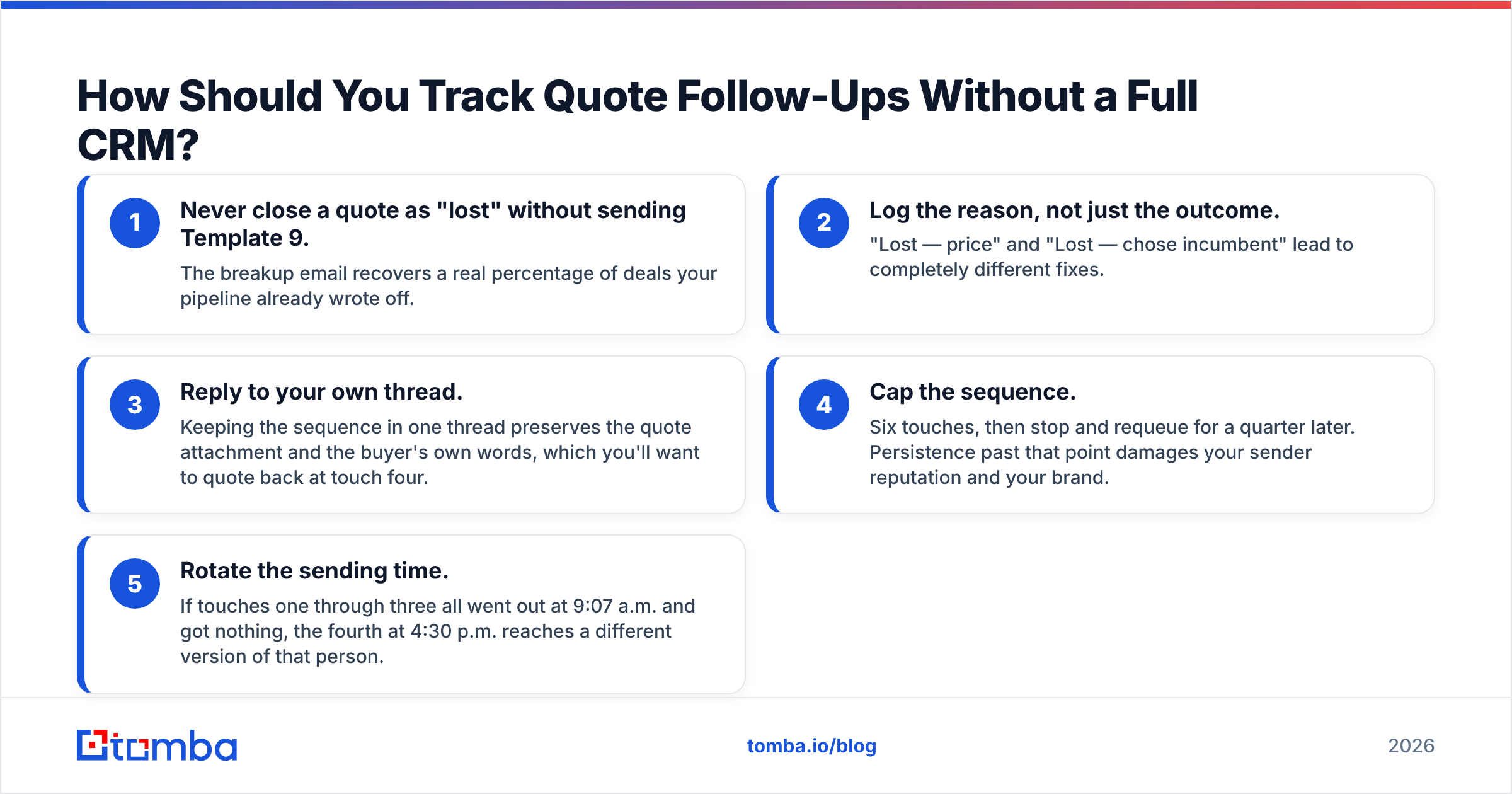
- Never close a quote as "lost" without sending Template 9. The breakup email recovers a real percentage of deals your pipeline already wrote off.
- Log the reason, not just the outcome. "Lost — price" and "Lost — chose incumbent" lead to completely different fixes.
- Reply to your own thread. Keeping the sequence in one thread preserves the quote attachment and the buyer's own words, which you'll want to quote back at touch four.
- Cap the sequence. Six touches, then stop and requeue for a quarter later. Persistence past that point damages your sender reputation and your brand.
- Rotate the sending time. If touches one through three all went out at 9:07 a.m. and got nothing, the fourth at 4:30 p.m. reaches a different version of that person.
For teams running quotes at volume, tools like Pipedrive or a Salesforce opportunity stage with a mandatory next-step field enforce rule one automatically. If you're comparing options, G2's sales-tool category is a reasonable neutral starting point — vendor claims about reply-rate lift rarely survive contact with your own data.
What Should You Never Put in a Quotation Follow-Up?#
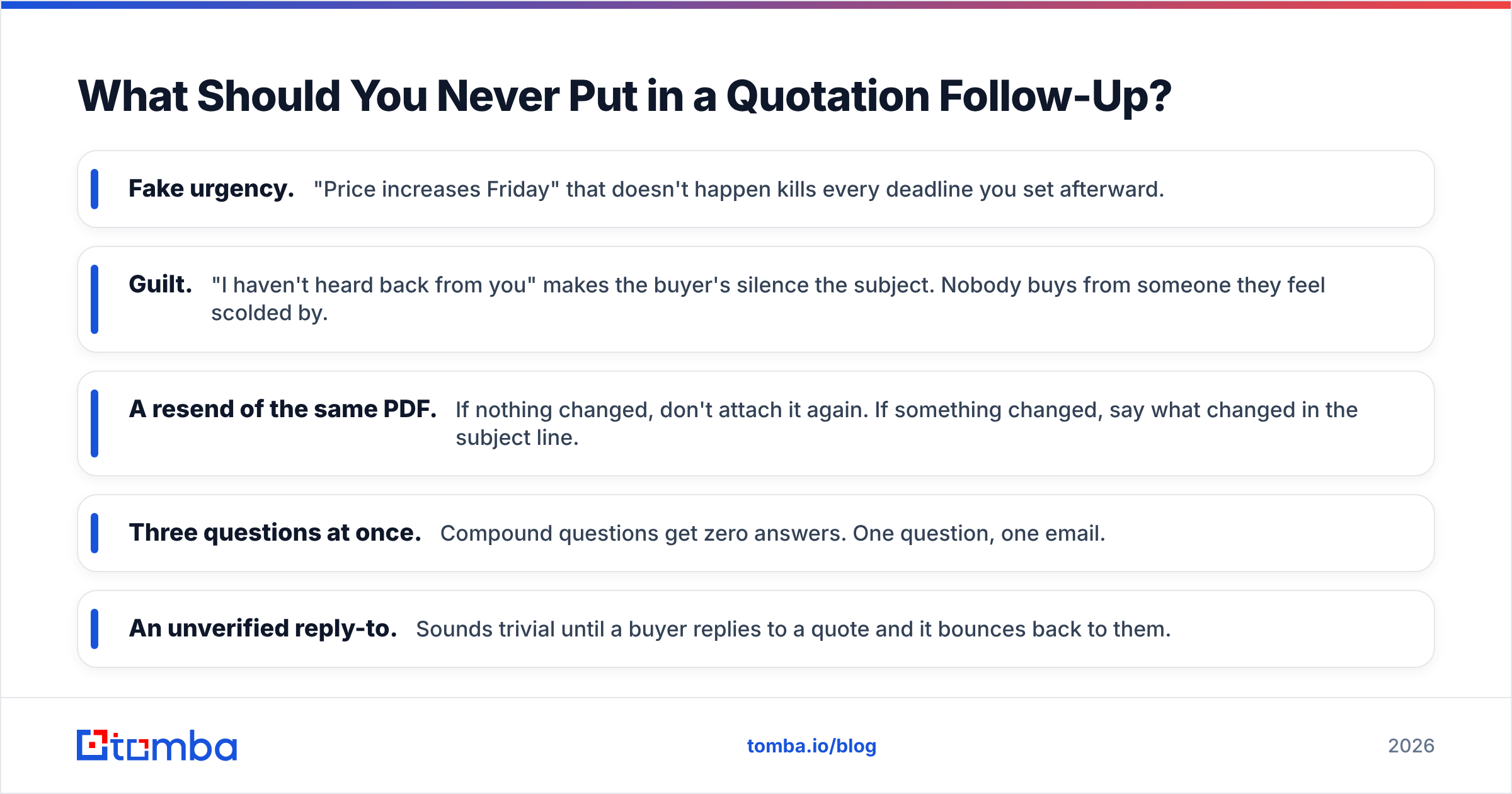
- Fake urgency. "Price increases Friday" that doesn't happen kills every deadline you set afterward.
- Guilt. "I haven't heard back from you" makes the buyer's silence the subject. Nobody buys from someone they feel scolded by.
- A resend of the same PDF. If nothing changed, don't attach it again. If something changed, say what changed in the subject line.
- Three questions at once. Compound questions get zero answers. One question, one email.
- An unverified reply-to. Sounds trivial until a buyer replies to a quote and it bounces back to them.
Send the Follow-Up to an Address That Exists#
Every template above assumes the message reaches a real human. That assumption breaks more often than sellers think — contacts leave, aliases retire, and procurement inboxes get reorganized mid-cycle. When a quote follow-up disappears into nothing, you can't tell a disinterested buyer from a dead mailbox.
Tomba Email Finder closes that gap: find the current address for the decision maker on a stalled quote, confirm it before you send, and re-find the replacement when your champion moves on. The free tier covers 25 searches a month, and paid plans start at $49/mo — see Tomba pricing for the full breakdown. Run your stalled-quote list through it once, then send Template 9 to everyone on it. The replies you get back will tell you which deals were never lost in the first place.
Related guides#
Ready to find emails that actually work?
Join 150,000+ professionals who stopped guessing and started sending. Free credits on signup — no credit card required.
Get the Tomba newsletter
Practical outbound tactics and product updates — once every two weeks.
About the author