Follow Up Sequence: The 2026 Playbook That Gets Replies
Most B2B replies arrive after the first email, yet most reps stop at one. Here is a touch-by-touch follow up sequence with spacing, angles, templates, and the metrics that tell you when to cut it.
TL;DR
- A follow up sequence is a planned series of 4-8 touches after the first message, each carrying a new reason to reply — not a reminder that you exist.
- Most B2B replies land on touch 2 through 5. If you stop after one email, you are throwing away the majority of your pipeline before it forms.
- Spacing beats volume: day 0, +3, +5, +8, +13, +21 outperforms daily nudging on both reply rate and spam complaints.
- "Just bumping this to the top of your inbox" is the single most common sequence killer. Every touch needs its own payload: a proof point, a resource, a different angle, or a clean breakup.
- Bad data destroys good sequences. A 12% bounce rate on touch 1 poisons the domain reputation that touches 2-6 depend on.
What is a follow up sequence?#
A follow up sequence is a pre-planned, scheduled series of outreach touches sent to the same prospect after your initial message, where each touch has a distinct purpose, angle, and call to action.
Think of it like a doctor's office confirming an appointment. The first call is the ask. The text two days later is a different channel with a different framing. The morning-of reminder is short and practical. Nobody thinks the office is spamming — because each contact carries new, useful information at a moment where it is relevant.
The failure mode most sales teams fall into is the opposite: five identical emails that say "circling back," "following up," and "did you see my last note?" That is not a sequence. That is one email sent five times with worse copy each round.
A real follow up sequence has four components:
- A cadence — how many touches, on which days, through which channels.
- An angle map — the specific value or hook each touch delivers (case study, industry trigger, competitor move, teardown, breakup).
- A branching rule — what happens on open-no-reply, on out-of-office, on "not now," on referral-to-colleague.
- An exit condition — the point where the prospect leaves the sequence and enters nurture, or gets closed-lost with a documented reason.
Miss any one of those and you are improvising, which is why reply rates on improvised follow-ups collapse after touch two.
Why do follow-ups outperform the first email?#
Because the first email arrives in the worst possible context and the fifth arrives in a slightly better one.
Your first message lands in an inbox where the recipient has never seen your name, has no reason to trust the sender domain, and is already triaging 100+ messages. Attention is essentially random. By touch three, three things have changed: the name has mild familiarity, the sender domain has passed several engagement filters, and — critically — you have had three chances to hit a week where the problem you solve is actually on their desk.
Timing is the underrated variable. A CFO does not want to hear about spend consolidation in the middle of a quarter close; they want to hear about it two weeks later. You cannot know which week that is. A sequence buys you multiple lottery tickets on the same prospect at a marginal cost of about four minutes of writing.
Vendors and analysts publish wildly varying "average touches to reply" numbers, and you should treat all of them as directional rather than gospel. What holds up across teams that actually measure is the shape of the curve, not the exact figures: touch 1 produces a burst, touches 2-4 produce the largest cumulative block of replies, and touches 6+ produce steeply diminishing returns while raising unsubscribe and complaint rates. Independent sales research from firms like Gartner consistently reinforces the same underlying point — B2B buying groups are large and slow, so single-touch outreach almost never coincides with an active buying window.
How many follow-ups should a sequence have?#
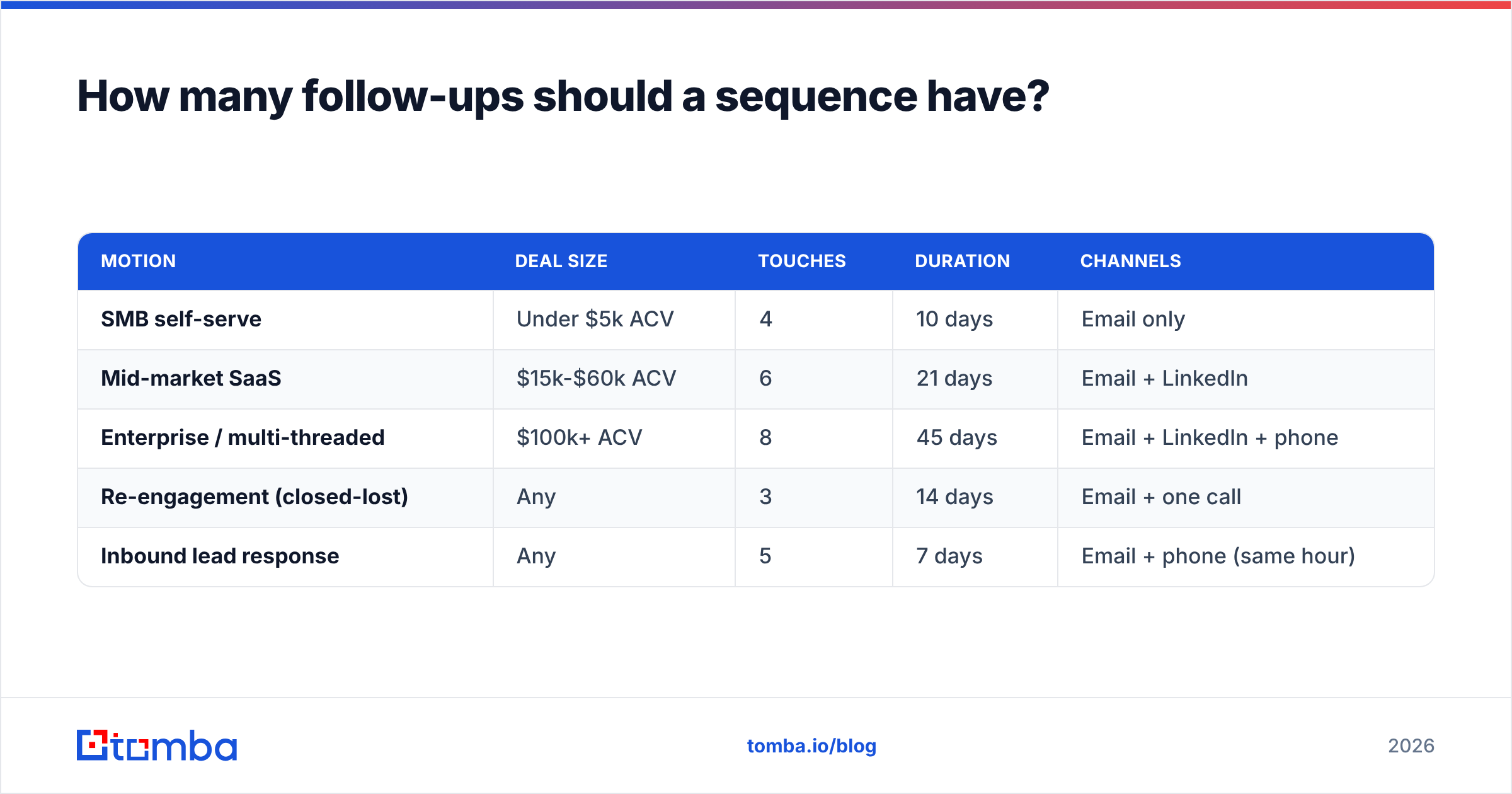
Four to seven touches for most B2B motions. Below four, you are quitting during the highest-yield stretch. Above eight, you are usually harvesting complaints rather than meetings.
The right number depends on deal size and buying-committee complexity:
| Motion | Deal size | Touches | Duration | Channels |
|---|---|---|---|---|
| SMB self-serve | Under $5k ACV | 4 | 10 days | Email only |
| Mid-market SaaS | $15k-$60k ACV | 6 | 21 days | Email + LinkedIn |
| Enterprise / multi-threaded | $100k+ ACV | 8 | 45 days | Email + LinkedIn + phone |
| Re-engagement (closed-lost) | Any | 3 | 14 days | Email + one call |
| Inbound lead response | Any | 5 | 7 days | Email + phone (same hour) |
Two rules make this table work in practice. First, longer sequences require more angle variety, not more frequency — an eight-touch enterprise sequence spread over 45 days is comfortable, the same eight touches over 10 days is harassment. Second, inbound leads invert the logic entirely: speed matters more than spacing, and the first touch should happen within minutes, not days.
What should each touch in the follow up sequence actually say?#
Here is the touch-by-touch angle map that holds up across most B2B categories. Each one answers a different question the prospect has not asked yet.
- Touch 1 — The trigger. Reference something specific and recent: a funding round, a job posting, a product launch, a stat from their site. State one hypothesis about a problem this creates. Ask a low-friction question.
- Touch 2 (+3 days) — The proof. Same thread. One customer result with a number and a name in a comparable segment. No re-pitch. End with "worth a look?" rather than a calendar link.
- Touch 3 (+5 days) — The resource. New thread, new subject line. Give something with standalone value: a teardown of their signup flow, a benchmark for their category, a two-line audit of their email setup. Ask for nothing.
- Touch 4 (+8 days) — The reframe. Pitch a different problem than touch 1. Maybe you led with pipeline volume and they actually care about data hygiene. This is where most "no reply" prospects convert, because you finally guessed the right pain.
- Touch 5 (+13 days) — The lateral. Ask for a referral instead of a meeting: "If this sits with someone else on the RevOps side, happy to go there instead." Prospects who will not book will often forward.
- Touch 6 (+21 days) — The breakup. Short, unambiguous, no guilt. "I'll stop here — if the timing changes in Q3, reply and I'll pick it back up." Breakup emails reliably produce a spike in replies, and roughly half of them are useful.
Keep every touch under 90 words. Keep the ask constant in kind but varied in size: a question, a yes/no, a forward, a close. And write touch 3 and 6 first — they are the two that people skip, and they are the two that carry the sequence.
If you want a starting library rather than a blank page, our cold email templates collection covers the trigger, proof, and breakup structures above, and the subject line generator is worth using for touch 3 where you are opening a fresh thread.
Same thread or new thread?#
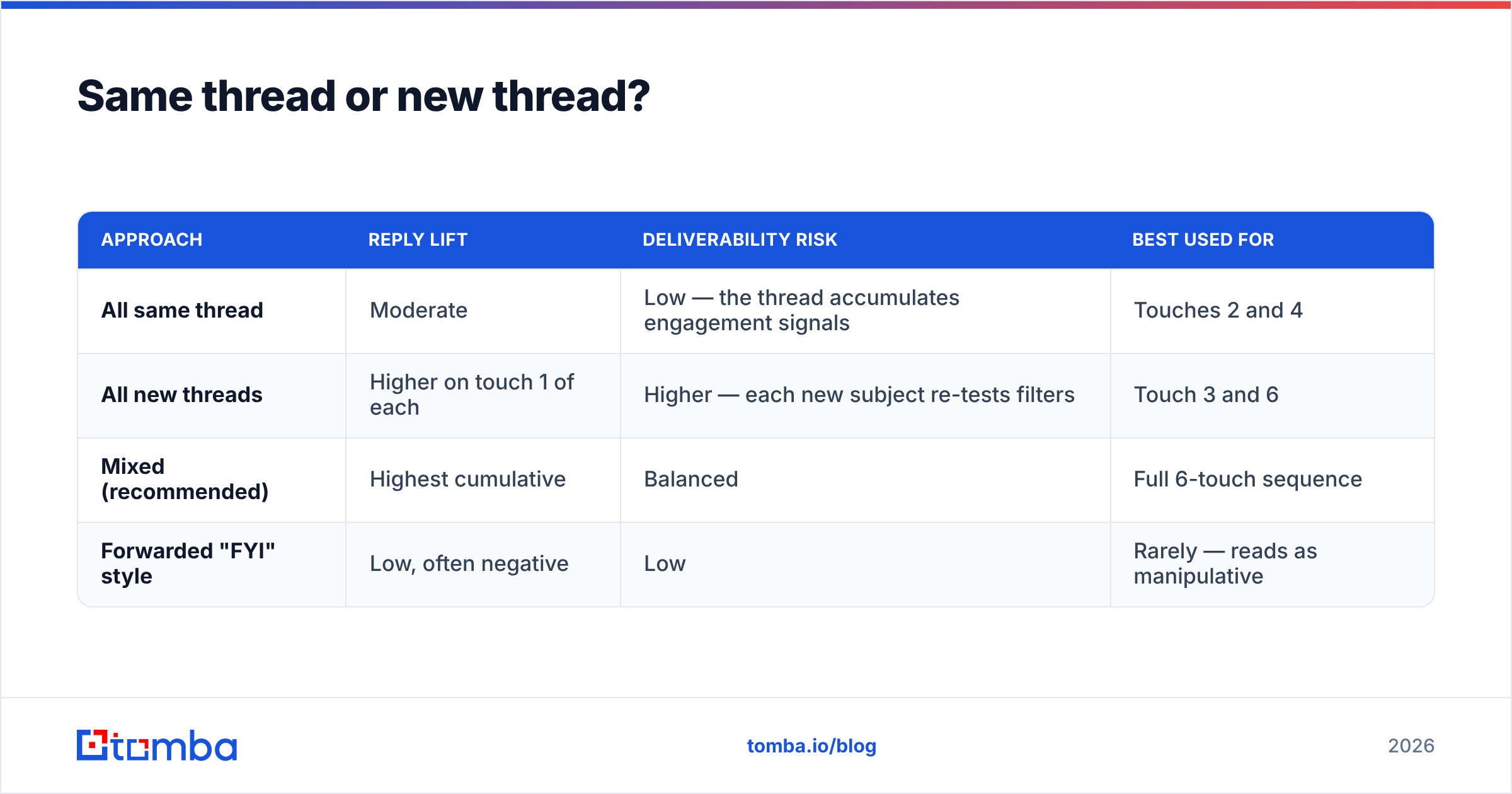
Mixed, and the mix matters more than the choice.
| Approach | Reply lift | Deliverability risk | Best used for |
|---|---|---|---|
| All same thread | Moderate | Low — the thread accumulates engagement signals | Touches 2 and 4 |
| All new threads | Higher on touch 1 of each | Higher — each new subject re-tests filters | Touch 3 and 6 |
| Mixed (recommended) | Highest cumulative | Balanced | Full 6-touch sequence |
| Forwarded "FYI" style | Low, often negative | Low | Rarely — reads as manipulative |
The practical rule: reply-in-thread when you are adding evidence to an argument you already made, and start a fresh thread when you are changing the argument. A prospect who ignored your pipeline pitch will not open thread-message-four about pipeline. They might open a new subject line about data decay.
Avoid the fake-forward trick ("Re: Re: quick question" when no prior conversation exists). It works for a quarter and then torches your domain when recipients mark it as deceptive.
How does channel mix change the sequence?#
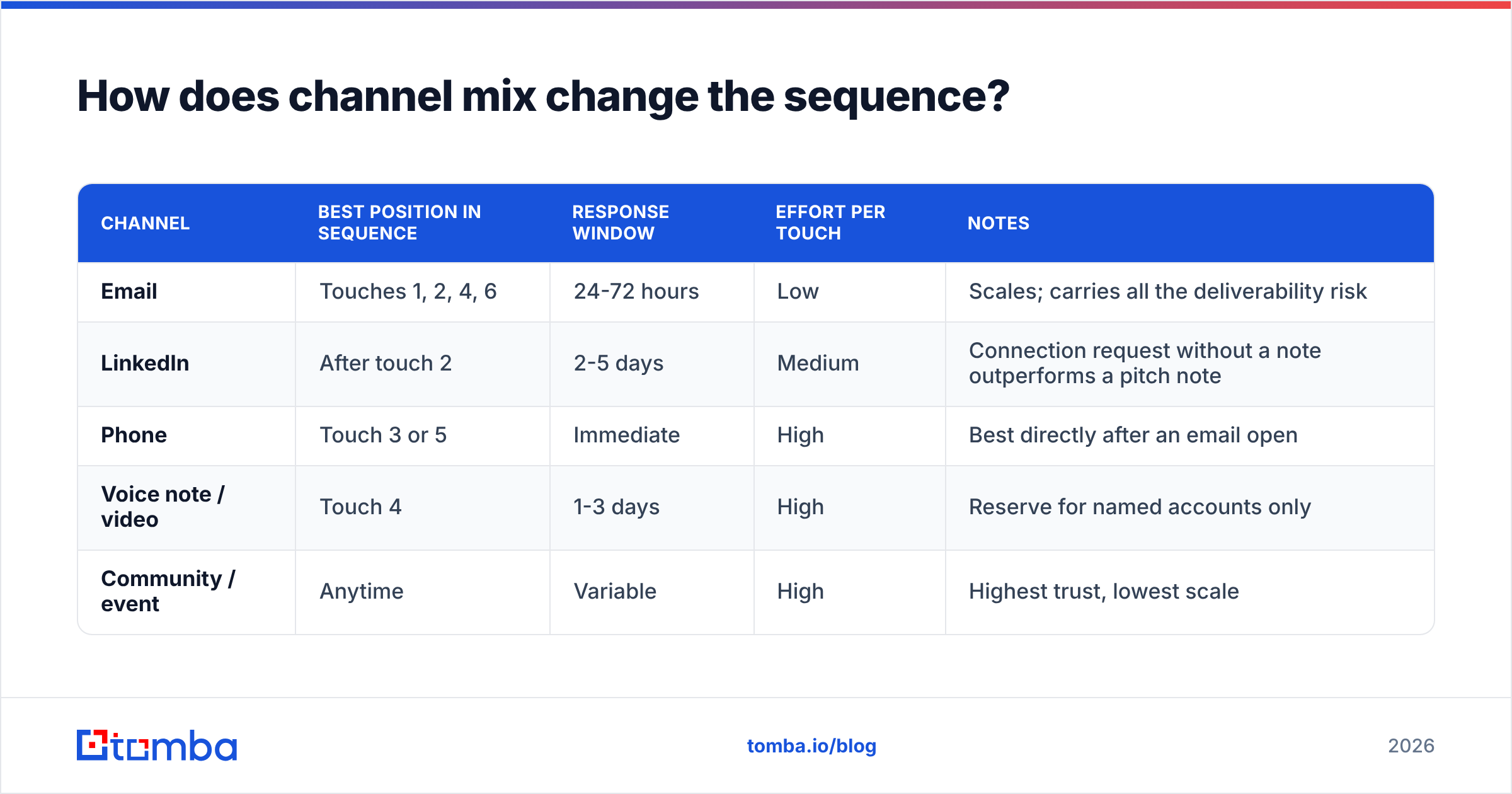
Adding a second channel typically produces a larger lift than adding two more emails, because you are reaching the prospect in a context where email fatigue does not apply.
| Channel | Best position in sequence | Response window | Effort per touch | Notes |
|---|---|---|---|---|
| Touches 1, 2, 4, 6 | 24-72 hours | Low | Scales; carries all the deliverability risk | |
| After touch 2 | 2-5 days | Medium | Connection request without a note outperforms a pitch note | |
| Phone | Touch 3 or 5 | Immediate | High | Best directly after an email open |
| Voice note / video | Touch 4 | 1-3 days | High | Reserve for named accounts only |
| Community / event | Anytime | Variable | High | Highest trust, lowest scale |
For most teams the honest answer is email plus LinkedIn, with phone reserved for the top 20% of the target list. Adding a channel you cannot sustain across the whole list creates uneven sequences and unreadable reporting. If you are building the phone leg, sourcing matters — a phone finder that returns direct dials rather than switchboard numbers is the difference between a 5% and a 0.5% connect rate.
What quietly kills a follow up sequence?#
- Bad addresses on touch 1. A 10-15% bounce rate on the first send damages sender reputation for every subsequent touch. Run the list through an email verifier before the sequence starts, not after the bounces roll in.
- Zero-payload bumps. "Just following up" trains the recipient to ignore your name. Every touch needs one new fact.
- Sending all touches from one mailbox. Volume concentration is the fastest route to the spam folder. Spread across mailboxes and keep daily per-mailbox volume conservative.
- No branching on out-of-office. An auto-reply is a data point, not an obstacle. Pause and resume, and harvest the covering colleague's name from the OOO body.
- Sequences that never exit. If a prospect replies "not now," they must leave the sequence immediately. Nothing burns goodwill faster than a bump 48 hours after someone told you the timing is wrong.
- Copy written once and never tested. Touch 4 is where most sequences leak. Rewrite it monthly.
How do you measure whether the sequence works?#
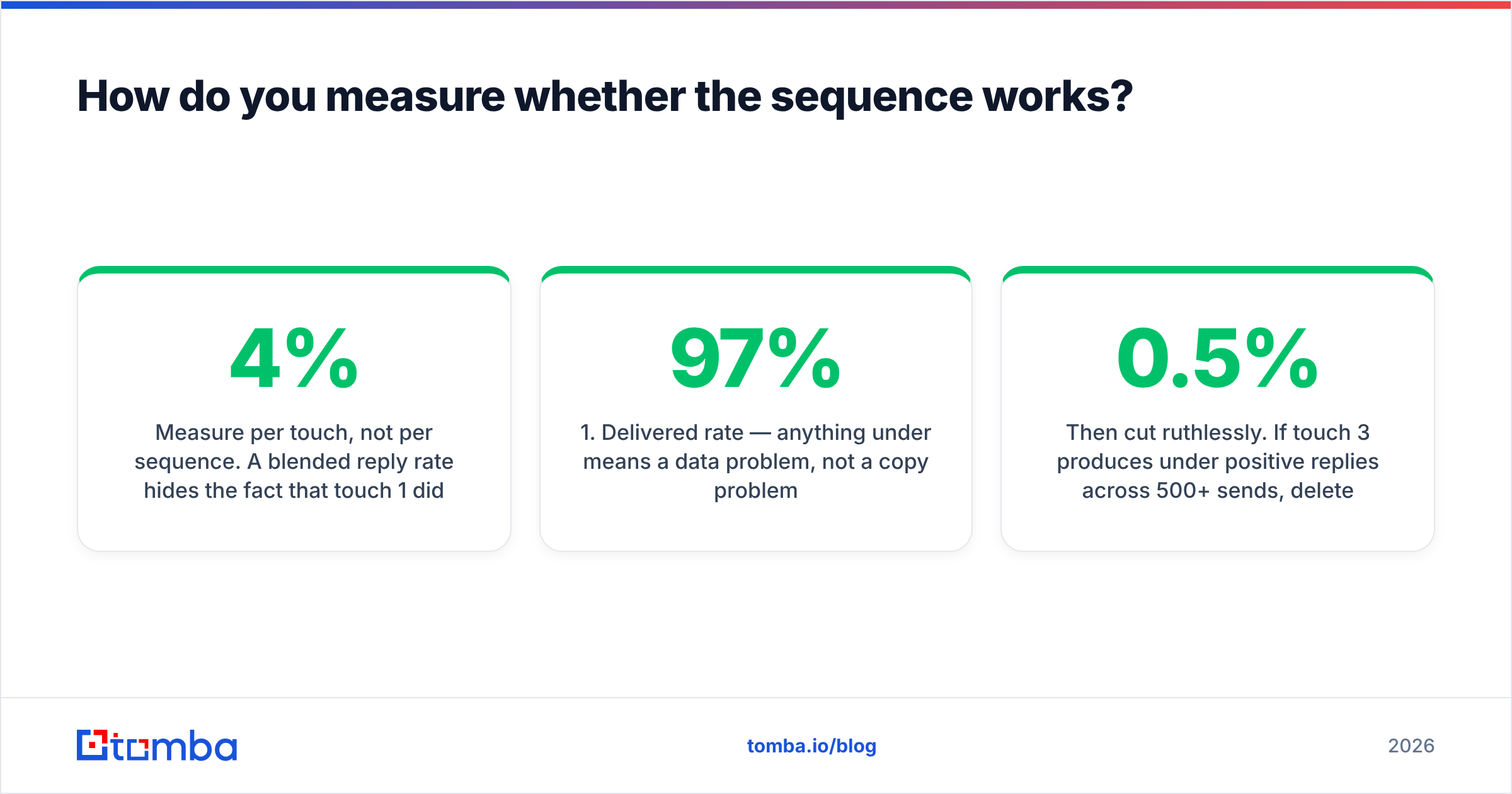
Measure per touch, not per sequence. A blended 4% reply rate hides the fact that touch 1 did 6%, touch 4 did 5%, and touches 2, 3, and 5 did almost nothing while consuming a third of your sending volume.
Track these five, per touch, per segment:
- Delivered rate — anything under 97% means a data problem, not a copy problem.
- Reply rate — all replies, including negatives. Negatives are signal.
- Positive reply rate — replies that advance the deal. This is the number that matters.
- Meeting rate — positive replies that convert to a calendar event.
- Complaint and unsubscribe rate — your early-warning system. Rising complaints on touches 5+ means the sequence is too long for that segment.
Then cut ruthlessly. If touch 3 produces under 0.5% positive replies across 500+ sends, delete it and shorten the sequence. Shorter sequences with better touches beat longer sequences with filler every time. For definitions and benchmarks on the reply side, our glossary entry on response rate sets out how to calculate it consistently, and category reviews on G2 are useful for seeing what sequencing tools actually report natively versus what you have to build yourself.
One caveat on benchmarks generally: reply-rate averages published by vendors are drawn from their own customer bases and skew high. Compare your sequence against your own prior quarter, not against a marketing page. Sales research libraries such as HubSpot's are more useful for structural patterns than for absolute targets.
What does a complete six-touch sequence look like?#
Compressed, for a mid-market SaaS motion:
Day 0 — Trigger. "Saw you opened a second SDR role in Berlin. Usually that means the current list is running dry rather than the team being short. Is sourcing the bottleneck, or is it connect rate?"
Day 3 — Proof, same thread. "One data point in case it's useful: a similar team cut bounce rate from 14% to 2% and got roughly a day a week back on list cleaning. Worth a look at what they changed?"
Day 8 — Resource, new thread. "I pulled the email pattern for your domain and checked 20 public contacts — 3 are stale. Full list attached, no strings. Happy to run the rest if it's useful."
Day 13 — Reframe, new thread. "Different angle: the issue for most teams your size isn't finding contacts, it's the 20-30% that decay every year. That's a maintenance problem, not a sourcing one. Is anyone owning that today?"
Day 18 — Lateral, same thread. "If data ownership sits with RevOps rather than you, point me at them and I'll stop cluttering your inbox."
Day 26 — Breakup. "Closing the loop. If it becomes relevant next quarter, reply here and I'll pick it up. Good luck with the Berlin hire."
Six touches, six distinct reasons to reply, one clean exit. That is the whole discipline.
Where to start#
Fix the data before you fix the copy. A well-written six-touch sequence sent to a list that is 15% invalid will underperform a mediocre sequence sent to a clean one, because bounces suppress the deliverability that touches 2 through 6 depend on. Build the list, verify it, then sequence it.
If you need the sourcing layer, Tomba Email Finder returns verified professional addresses by domain, name, or company, with the verification step built in rather than bolted on. The free tier includes 25 searches a month if you want to test accuracy against a list you already trust before committing; paid plans start at $49/month, and full Tomba pricing is public. Start with 50 known-good contacts, run your six touches, and measure per touch — you will know within three weeks which two touches are carrying the sequence and which two to delete.
Related guides#
Ready to find emails that actually work?
Join 150,000+ professionals who stopped guessing and started sending. Free credits on signup — no credit card required.
Get the Tomba newsletter
Practical outbound tactics and product updates — once every two weeks.
About the author