Follow Up Strategy: The 2026 Playbook That Books Meetings
Most deals die in the gap between the first email and the fifth. Here's a data-backed follow up strategy — cadence, timing, channels, and the exact rules for when to stop.
TL;DR
- Most B2B replies arrive between touch 3 and touch 8, yet the median rep stops at touch 2. The gap is where your pipeline is leaking.
- A working follow up strategy has four moving parts: cadence length, spacing, channel mix, and a new reason to write each time. "Just checking in" is not a reason.
- Spacing beats volume. Day 0 / 3 / 7 / 12 / 18 / 26 outperforms six emails in six days on both reply rate and spam complaints.
- Multichannel sequences (email + phone + LinkedIn) lift connect rates roughly 2x versus email-only, but only if the channels reference each other.
- Bad data kills follow-up before copy ever gets a chance. Bounces on touch 1 poison the domain that has to deliver touches 2 through 8.
Why does follow-up decide more deals than the first email?#
Because the first email is a coin flip and the follow-up is a compounding bet.
Think of it like knocking on a door in an apartment building. One knock proves almost nothing — the person could be in the shower, on a call, or genuinely uninterested. You cannot tell the three apart from a single knock. Follow-up is how you separate "not interested" from "not right now" from "didn't see it."
The numbers back the analogy. Across most published outbound benchmarks, single-touch campaigns land in the 1–3% reply range. Sequences of five to eight touches routinely double or triple that, and a meaningful chunk of positive replies arrive after touch 4 — well past the point where the average rep has already moved on.
There's a second reason follow-up matters more in 2026 than it did in 2022: inbox volume. Buyers now receive more automated outreach than ever, and Gmail and Microsoft both tightened bulk-sender rules in 2024. The result is that any individual email has a lower chance of being seen at all. Persistence is no longer a personality trait — it's a statistical requirement.

What does a follow up strategy actually consist of?#
Four decisions, made before you send anything. Get these wrong and no amount of clever copy saves you.
- Cadence length — how many total touches before you close the loop. For mid-market B2B, 6–9 touches over 3–4 weeks is the workable range. Enterprise runs longer (10–14 over 6–8 weeks) because buying committees are slower. SMB runs shorter.
- Spacing — the interval between touches. Front-load slightly (day 0, 3, 7) then widen (12, 18, 26). Tight early spacing catches people who are simply busy; wide late spacing catches people whose priorities changed.
- Channel mix — email carries the argument, phone forces a decision, LinkedIn provides social proof. The best sequences alternate rather than stack.
- Reason to write — every touch needs a fresh premise: a new data point, a customer story, a relevant trigger event, a different angle on the problem. Reply-all "bumping" your own thread is the cheapest option and it shows.
- Exit criteria — the rule that ends the sequence. Without one you either quit too early out of discomfort or keep going until you get reported.
- Data hygiene — verified addresses at the top of the funnel so touches 2–8 actually reach an inbox.
That last point is the one teams skip. A 12% bounce rate on touch 1 doesn't just cost you those contacts — it drags your domain reputation down for everyone else in the sequence. Run your list through an email verifier before the first send, not after the first disaster.
How many follow-ups is too many?#
The honest answer: fewer than most sequence templates suggest, more than most reps are comfortable with.
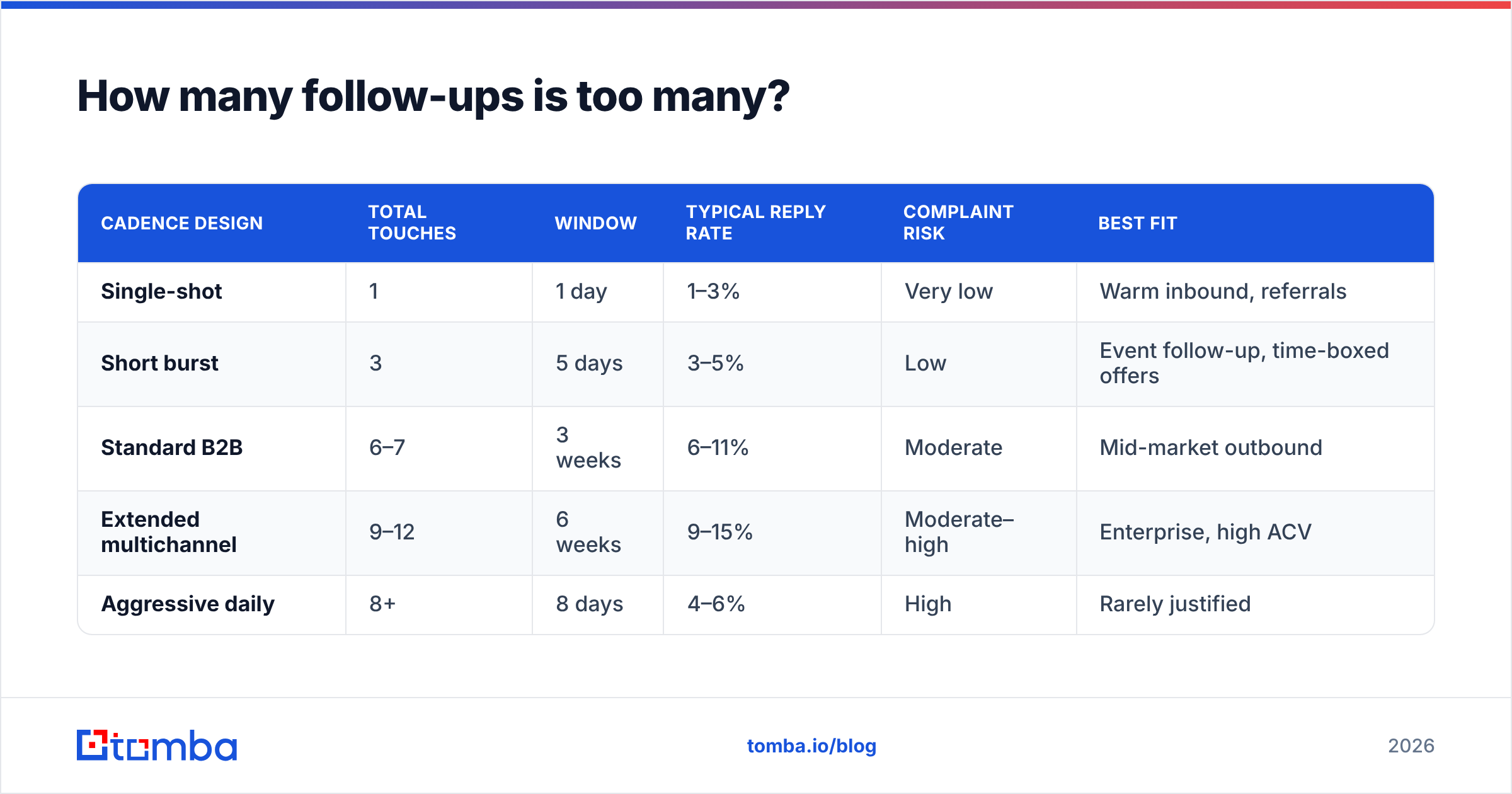
Here's the tension. Reply rate per additional touch declines, but total replies keep accumulating until roughly touch 8. Meanwhile, spam complaints and unsubscribe rates rise roughly linearly with touch count. The optimum is where marginal reply value stops exceeding marginal reputation cost — for most B2B senders that lands between touch 6 and touch 9.
| Cadence design | Total touches | Window | Typical reply rate | Complaint risk | Best fit |
|---|---|---|---|---|---|
| Single-shot | 1 | 1 day | 1–3% | Very low | Warm inbound, referrals |
| Short burst | 3 | 5 days | 3–5% | Low | Event follow-up, time-boxed offers |
| Standard B2B | 6–7 | 3 weeks | 6–11% | Moderate | Mid-market outbound |
| Extended multichannel | 9–12 | 6 weeks | 9–15% | Moderate–high | Enterprise, high ACV |
| Aggressive daily | 8+ | 8 days | 4–6% | High | Rarely justified |
Notice the aggressive daily row. Eight touches compressed into eight days performs worse than seven touches spread over three weeks, despite similar volume. Compression reads as automation. Spacing reads as persistence.
What should each touch in the sequence actually say?#
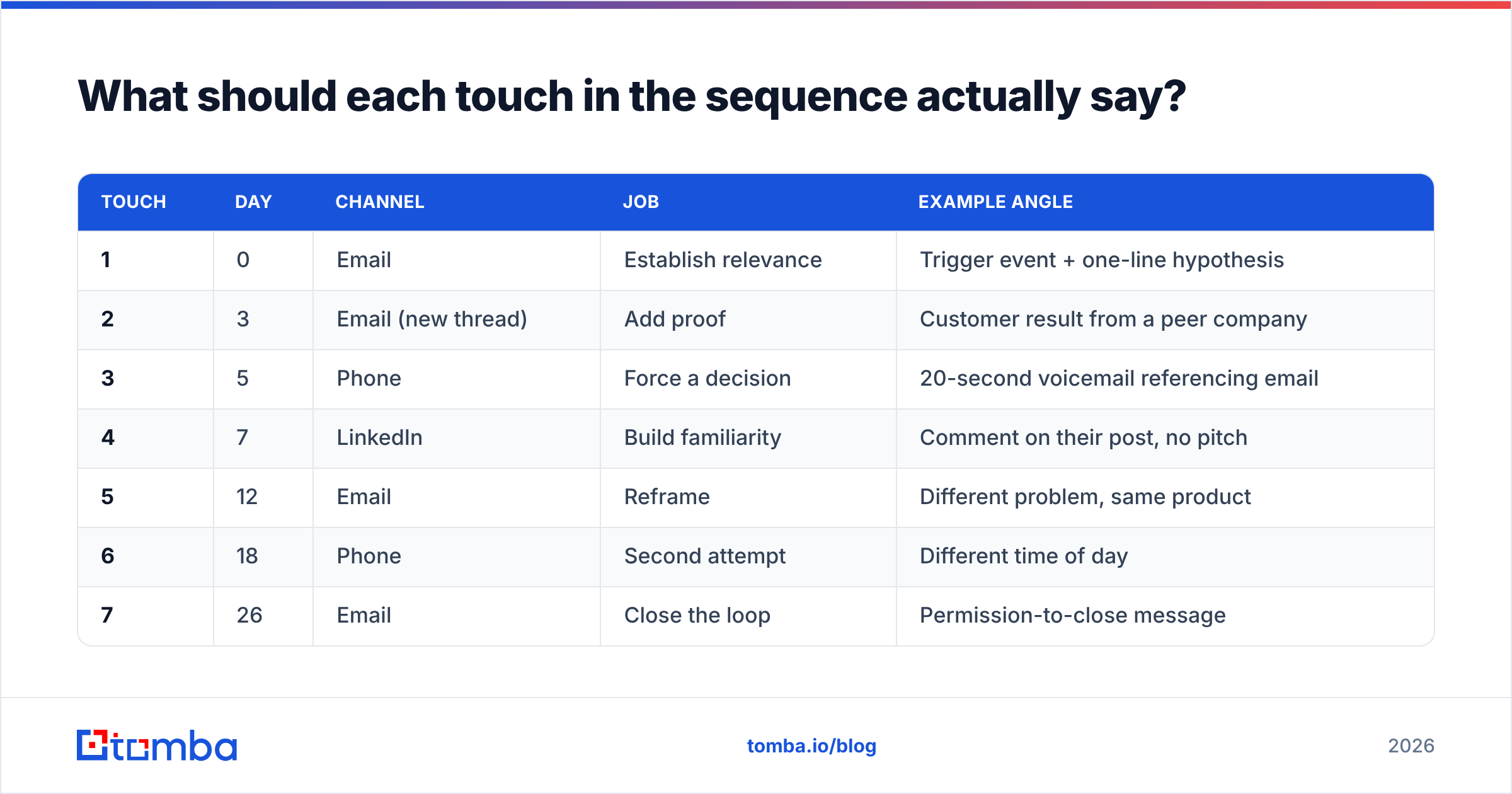
Assign each touch a job. If two touches have the same job, cut one.
| Touch | Day | Channel | Job | Example angle |
|---|---|---|---|---|
| 1 | 0 | Establish relevance | Trigger event + one-line hypothesis | |
| 2 | 3 | Email (new thread) | Add proof | Customer result from a peer company |
| 3 | 5 | Phone | Force a decision | 20-second voicemail referencing email |
| 4 | 7 | Build familiarity | Comment on their post, no pitch | |
| 5 | 12 | Reframe | Different problem, same product | |
| 6 | 18 | Phone | Second attempt | Different time of day |
| 7 | 26 | Close the loop | Permission-to-close message |
The reframe at touch 5 is the highest-leverage message in most sequences. If your first four touches pitched "reduce data costs" and got nothing, touch 5 should pitch "stop reps wasting three hours a week on manual research." Same product, different pain. You're not persuading harder — you're testing a second hypothesis about what this person cares about.
The permission-to-close message at touch 7 consistently outperforms every other single email in a cadence. Something like: "I've reached out a few times about [problem] and haven't heard back, which usually means it's not a priority this quarter. I'll close the file — if that's wrong, just reply 'wrong' and I'll pick it back up." It works because it removes obligation and creates a tiny, low-cost action.
Which channels should you combine, and how?#
Email alone is cheap and scalable but has the worst attention rate. Phone has the best but doesn't scale. LinkedIn sits in between and carries social proof email can't.
The rule that matters: channels must reference each other. A cold call that opens with "I sent you a note Tuesday about your Series B hiring plan" converts at a fundamentally different rate than an unreferenced cold call. The email primed recognition; the call cashes it in.
To run that reference reliably you need both an email and a direct dial for the same contact, which is where most sequences break down operationally. Pulling verified numbers alongside addresses — via a phone finder or your enrichment layer — turns a two-channel plan into something you can actually execute at list scale instead of contact by contact.
Some channel notes worth knowing:
- Voicemail works best at 20–25 seconds with a single ask. Longer messages get deleted at the 15-second mark.
- LinkedIn connection requests without a note accept at a higher rate than requests with a pitch. Connect first, message later.
- Email replies to your own thread are fine once, twice at most. After that, start a fresh thread with a new subject line — buried threads stay buried.
- Text messages convert extremely well and burn goodwill fast. Reserve them for contacts who've already engaged.
When should you stop following up?#
When you hit one of three exits: a clear no, the end of your cadence, or a signal that the contact is wrong.
A clear no ends things immediately — and cleanly. Don't argue. Ask one qualifying question ("Is that a timing thing or a fit thing?") and log the answer. That single data point is worth more than the deal you just lost.
Cadence exhaustion means you sent the permission-to-close message and got silence. Move the contact to a nurture list and re-approach in 90 days with a genuinely new trigger — funding round, new hire in a relevant role, product launch, leadership change. Re-approaching the same person with the same pitch six weeks later is how you get blocked.
The third exit is the one people miss: the contact is simply wrong. If your emails are delivering, being opened, and generating nothing across seven touches, the problem may be that this person doesn't own the problem you're solving. Check whether there's a better-fit title at the same company before you burn more touches. A domain search across the account surfaces who else is there and what the org actually looks like, which is usually faster than another three weeks of guessing.
One caveat worth stating plainly: none of this applies if your emails aren't landing. Before you blame your cadence, confirm delivery. Check your SPF record, watch your bounce rate, and read the actual engagement data rather than assuming silence means rejection. Google's own bulk sender guidelines spell out the thresholds — a complaint rate above 0.3% puts you in trouble regardless of how good your follow-up copy is.
How do you measure whether your follow up strategy is working?#
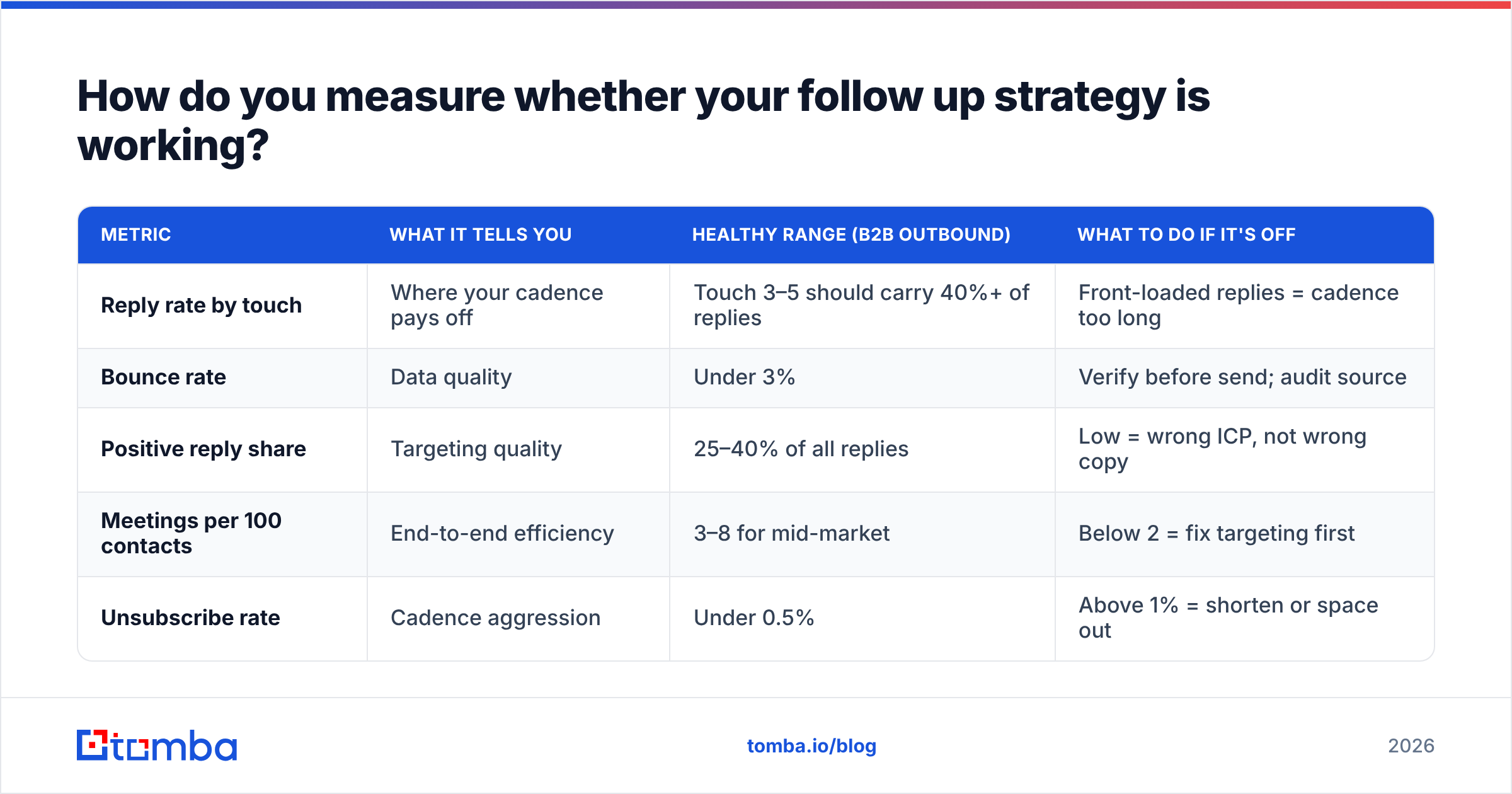
Track reply rate by touch number, not just campaign-level averages. The distribution tells you what the average hides.
| Metric | What it tells you | Healthy range (B2B outbound) | What to do if it's off |
|---|---|---|---|
| Reply rate by touch | Where your cadence pays off | Touch 3–5 should carry 40%+ of replies | Front-loaded replies = cadence too long |
| Bounce rate | Data quality | Under 3% | Verify before send; audit source |
| Positive reply share | Targeting quality | 25–40% of all replies | Low = wrong ICP, not wrong copy |
| Meetings per 100 contacts | End-to-end efficiency | 3–8 for mid-market | Below 2 = fix targeting first |
| Unsubscribe rate | Cadence aggression | Under 0.5% | Above 1% = shorten or space out |
If touch 1 generates 70% of your replies, your cadence is too long for your market — the later touches are adding risk without return. If touches 4–7 generate most replies, you've found a market that needs patience, and shortening the sequence would cost you real pipeline. Both are legitimate findings. What isn't legitimate is running the same seven-touch template across every segment and never checking the distribution.
For benchmarking against peers rather than your own history, G2's sales engagement category reviews and HubSpot's annual sales statistics roundup are both reasonable public reference points. Treat any single published number skeptically — reply-rate benchmarks vary enormously by industry, ACV, and list quality.
What are the most common follow-up mistakes?#
- Bumping the thread with no new content. "Just following up" adds zero information. If you have nothing new to say, wait until you do.
- Apologizing for following up. "Sorry to bother you again" frames your outreach as an imposition and invites the reader to agree.
- Identical spacing. Every-three-days forever reads as a robot. Vary it.
- Ignoring engagement signals. Someone who opened five times and clicked twice deserves a phone call, not email six.
- Sequencing unverified contacts. Every bounce is a small tax on the deliverability of every other email you send that week.
- Never changing the pitch. Seven emails arguing the same point is one email sent seven times.
The engagement-signal mistake is worth expanding on. Most sequencing tools surface open and click data, and most reps ignore it because acting on it breaks the automated flow. But a contact who opened your touch-3 email four times in one afternoon is a materially different prospect than one who never opened anything. Pull the engaged ones out of the automated cadence and handle them manually. That's where your meeting rate actually lives.
What tools support a follow-up cadence?#
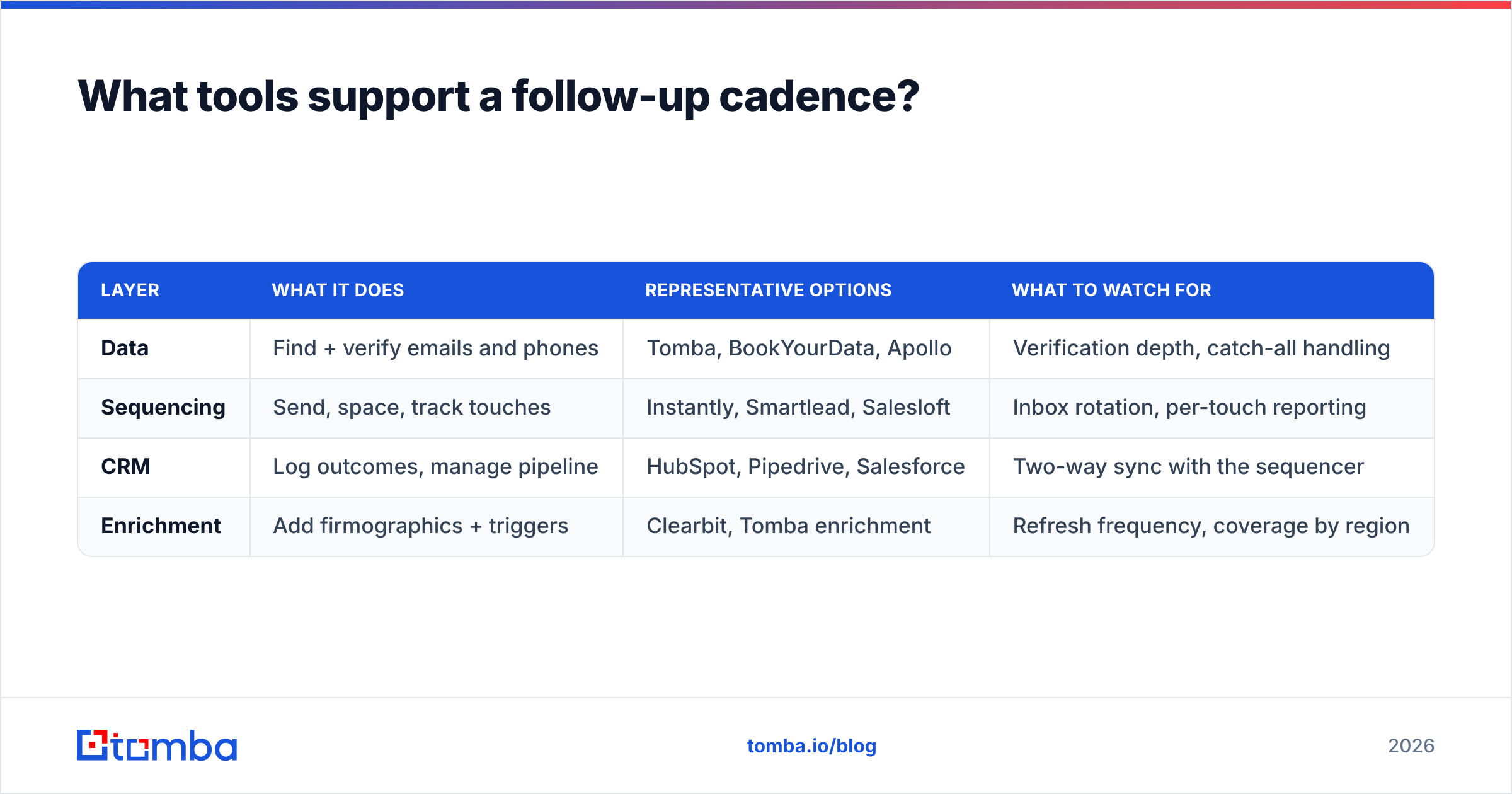
You need three layers, and they're often three different vendors: a data layer (find and verify contacts), a sequencing layer (send and space the touches), and a CRM (record what happened).
| Layer | What it does | Representative options | What to watch for |
|---|---|---|---|
| Data | Find + verify emails and phones | Tomba, BookYourData, Apollo | Verification depth, catch-all handling |
| Sequencing | Send, space, track touches | Instantly, Smartlead, Salesloft | Inbox rotation, per-touch reporting |
| CRM | Log outcomes, manage pipeline | HubSpot, Pipedrive, Salesforce | Two-way sync with the sequencer |
| Enrichment | Add firmographics + triggers | Clearbit, Tomba enrichment | Refresh frequency, coverage by region |
Plenty of platforms claim to do all three. In practice the all-in-one tools tend to be strong at one layer and adequate at the others, which is fine if the adequate layers are the ones you use least. The failure mode to avoid is choosing your data provider based on how good the sequencer is — data quality is the constraint that caps everything downstream.
If you're evaluating options, BookYourData is a solid choice when you want prepaid, pay-as-you-go list purchasing with verification built in, while Tomba fits teams that want search-and-verify as an ongoing API-driven workflow rather than a one-time list buy. Different shapes of the same problem.
Ready to build a follow-up cadence on data that actually delivers?#
Every follow up strategy in this post assumes one thing: the address is real. Seven perfectly written touches sent to a guessed email pattern produce exactly zero meetings and one damaged sending domain.
Start with the Tomba Email Finder to source verified professional addresses by name, domain, or company, then layer your cadence on top. The free tier gives you 25 searches a month to test the workflow; paid plans start at $49/mo on Starter, with Growth at $99/mo for teams running bulk lists — full Tomba pricing is public if you want to compare against your current per-contact cost. Verify first, sequence second, and let the follow-up do what it's supposed to do.
Related guides#
Ready to find emails that actually work?
Join 150,000+ professionals who stopped guessing and started sending. Free credits on signup — no credit card required.
Get the Tomba newsletter
Practical outbound tactics and product updates — once every two weeks.
About the author