Follow Up To Our Conversation: Email Templates That Work
The phrase follow up to our conversation appears in millions of sales emails and gets ignored in most of them. Here is what to send instead: 7 templates, timing benchmarks, and the rules that decide whether your reply lands.
TL;DR
- "Follow up to our conversation" is a filing label, not a subject line. It tells the reader nothing they did not already know and gives them no reason to open.
- The follow-up that wins is sent within 24 hours, references one specific thing the prospect said, and asks for one decision — not "any thoughts?"
- Subject lines that name the topic ("Pricing for the 3-region rollout") consistently outperform generic recap lines because they survive a crowded inbox scan.
- Most follow-ups die from a missing next step, not from bad prose. Every email should end with a dated, single-option ask.
- If the conversation happened at an event or on LinkedIn and you never got a work address, verify before you send — a bounced follow-up damages the domain you need for the next 500 emails.
What does "follow up to our conversation" actually signal?#
It signals that you had a conversation. That is all it does.
The phrase is one of the most common openers in B2B email because it feels safe and polite. It is also one of the least informative things you can put in front of a busy buyer. Think of it like an envelope stamped "correspondence" — technically accurate, completely useless for deciding whether to open it now or in three weeks.
Two problems compound:
It has no recall trigger. Your prospect had six calls that day. "Our conversation" identifies none of them. By the time they parse which conversation you mean, they have already moved to the next email.
It signals low stakes. Recap language reads as administrative. Buyers triage by consequence — what happens if I ignore this? A follow-up labelled as a recap answers "nothing happens," so nothing happens.
The fix is not clever copywriting. It is specificity. Replace the category ("our conversation") with the content (the actual topic, number, or blocker you discussed).
Why do most post-conversation follow-ups get ignored?#
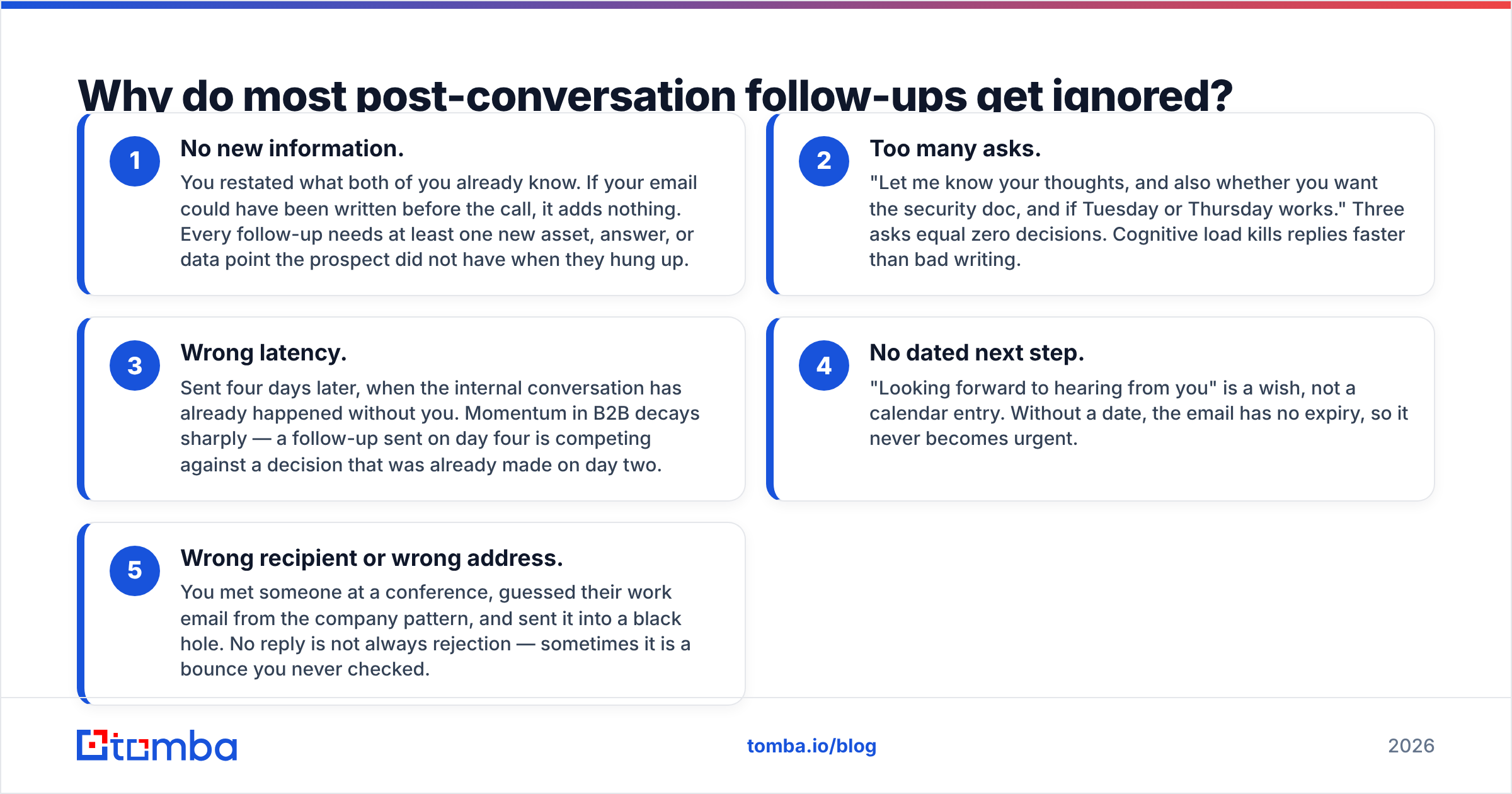
Five failure modes account for the overwhelming majority of dead follow-up threads. Run your last five sent emails against this list:
- No new information. You restated what both of you already know. If your email could have been written before the call, it adds nothing. Every follow-up needs at least one new asset, answer, or data point the prospect did not have when they hung up.
- Too many asks. "Let me know your thoughts, and also whether you want the security doc, and if Tuesday or Thursday works." Three asks equal zero decisions. Cognitive load kills replies faster than bad writing.
- Wrong latency. Sent four days later, when the internal conversation has already happened without you. Momentum in B2B decays sharply — a follow-up sent on day four is competing against a decision that was already made on day two.
- No dated next step. "Looking forward to hearing from you" is a wish, not a calendar entry. Without a date, the email has no expiry, so it never becomes urgent.
- Wrong recipient or wrong address. You met someone at a conference, guessed their work email from the company pattern, and sent it into a black hole. No reply is not always rejection — sometimes it is a bounce you never checked.
Number five is worth dwelling on. In post-event and post-webinar follow-up, address quality is frequently the hidden variable. If you are working from a badge scan, a business card, or a LinkedIn thread, run the address through an email verifier before it goes into a sequence. A single bounce is invisible; a batch of them is a deliverability problem you will spend weeks unwinding.
What should replace "follow up to our conversation" in the subject line?#
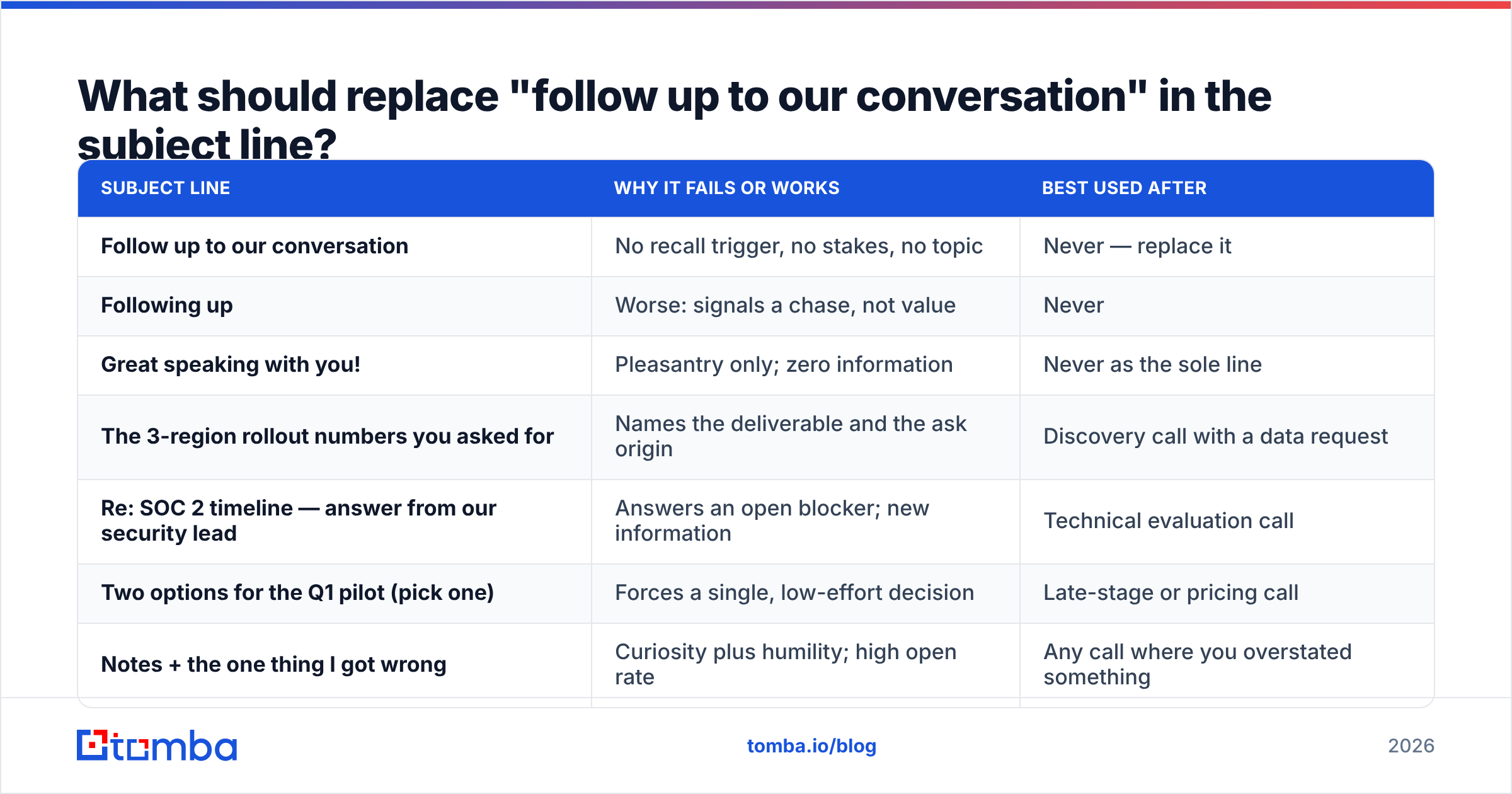
Name the payload. The subject line should read like a file name a busy person would keep.
| Subject line | Why it fails or works | Best used after |
|---|---|---|
| Follow up to our conversation | No recall trigger, no stakes, no topic | Never — replace it |
| Following up | Worse: signals a chase, not value | Never |
| Great speaking with you! | Pleasantry only; zero information | Never as the sole line |
| The 3-region rollout numbers you asked for | Names the deliverable and the ask origin | Discovery call with a data request |
| Re: SOC 2 timeline — answer from our security lead | Answers an open blocker; new information | Technical evaluation call |
| Two options for the Q1 pilot (pick one) | Forces a single, low-effort decision | Late-stage or pricing call |
| Notes + the one thing I got wrong | Curiosity plus humility; high open rate | Any call where you overstated something |
The pattern behind the working lines: each one contains a noun the prospect personally cares about, and each implies a small, finishable action. If you want to pressure-test variants before you send, a subject line tester will flag length, spam-trigger words, and mobile truncation faster than eyeballing it.
One caveat on threading: if the conversation started over email and you are replying in the same thread, keeping the original subject with "Re:" is usually better than starting fresh. Thread continuity is its own recall trigger. Start a new subject only when the topic genuinely changed.
What does a strong follow-up email look like?#
Four templates, each mapped to a different conversation type. Keep them under 120 words. Longer emails do not get read more carefully; they get read less.
1. After a discovery call
Subject: The 3-region rollout numbers you asked for
Hi Dana — you asked how long the EMEA rollout took for a team your size. Two comparable customers: 6 weeks and 9 weeks, both with a two-person internal owner. Full breakdown attached.
You mentioned the finance review is the real gate. Worth a 15-minute call with your controller before you take it forward? I have Thursday 10:00 or Friday 14:00 CET.
— Sam
2. After a demo
Subject: The two things I could not answer on the demo
Hi Marcus — two open items from Tuesday: (1) SSO with Okta is supported, docs here; (2) our data retention default is 24 months, configurable down to 30 days.
Based on what you showed me of your current workflow, the piece that saves you the most time is bulk enrichment, not the dashboards. Happy to build a sandbox with your own list so your team can judge it directly. Want me to set that up?
— Sam
3. After a conference or event conversation
Subject: The pipeline hygiene problem we talked about at SaaStr
Hi Priya — we spoke Wednesday afternoon near the demo hall about your CRM being 40% stale. You said re-verifying quarterly was "on the roadmap and never happens."
I put together a two-page teardown of how three teams automated that step. No pitch in it. Want me to send it over?
— Sam
4. After silence (the third touch)
Subject: Closing the loop on the Q1 pilot
Hi Dana — I have not heard back, which usually means priorities moved. Totally fine.
Should I close this out and check back in Q2, or is the finance review still live? Either answer helps me stop cluttering your inbox.
— Sam
That last one works because it makes "no" easy. Giving the prospect a graceful exit reliably produces more replies than another value-add nudge, and the replies you get are honest.
For more starting points across sequence stages, the cold email templates library covers first-touch, breakup, and re-engagement variants you can adapt to the same structure.
How fast should you follow up after a conversation?#
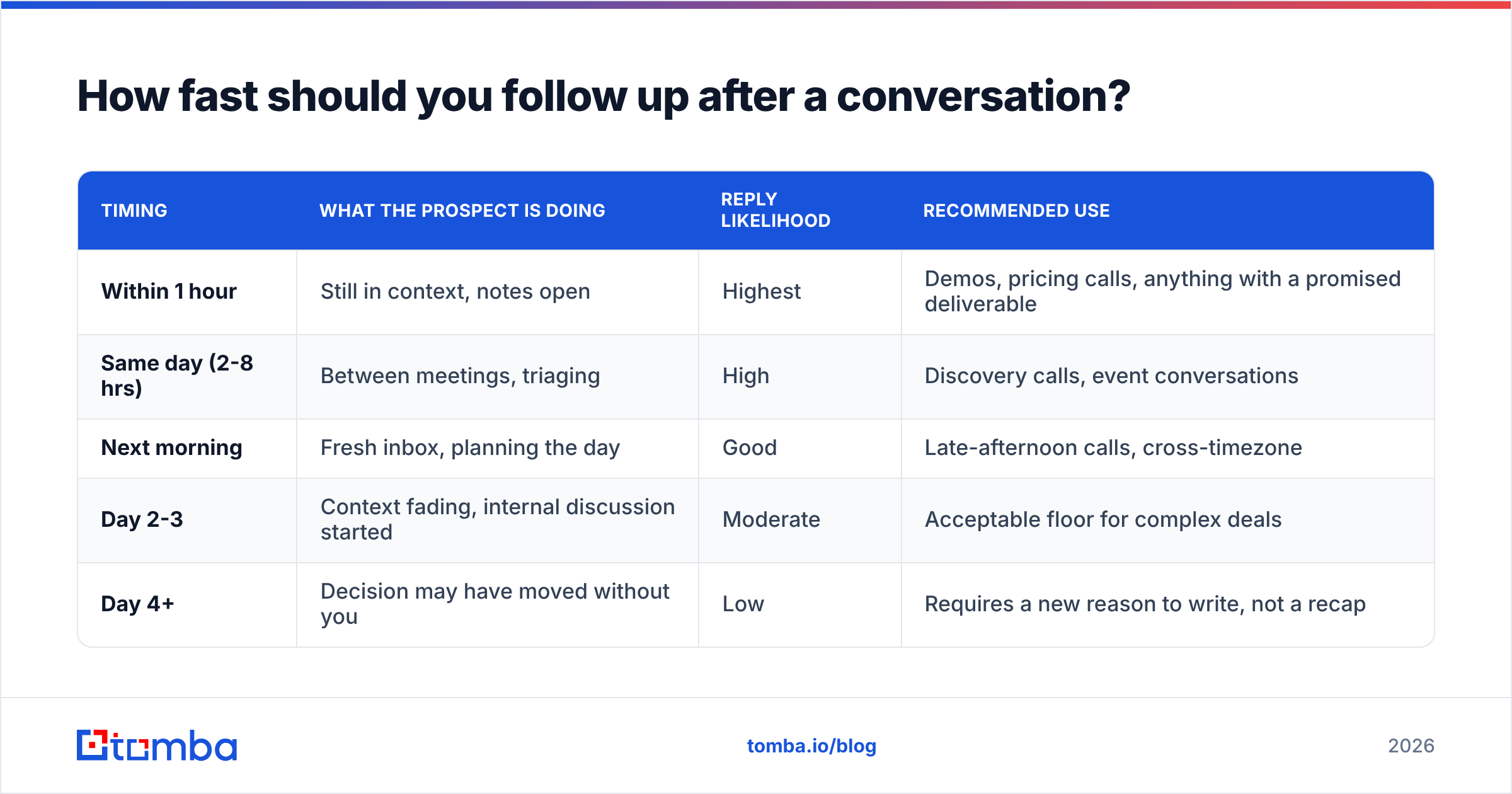
Speed is the single highest-leverage variable you control, and it costs nothing.
| Timing | What the prospect is doing | Reply likelihood | Recommended use |
|---|---|---|---|
| Within 1 hour | Still in context, notes open | Highest | Demos, pricing calls, anything with a promised deliverable |
| Same day (2-8 hrs) | Between meetings, triaging | High | Discovery calls, event conversations |
| Next morning | Fresh inbox, planning the day | Good | Late-afternoon calls, cross-timezone |
| Day 2-3 | Context fading, internal discussion started | Moderate | Acceptable floor for complex deals |
| Day 4+ | Decision may have moved without you | Low | Requires a new reason to write, not a recap |
The pattern that consistently outperforms: send the substantive email within a few hours, then space subsequent touches at widening intervals — day 3, day 7, day 14, day 30. Research summarised across sales-engagement vendors on G2's sales engagement category and buyer-behaviour work from Gartner's sales practice both point the same direction: buyers spend most of their evaluation time independent of any rep, so your job is to be present at the moment they resurface, not to be loud in between.
How many follow-ups should you send before stopping?#
Three to five after a real conversation. More than that and you are training the prospect to ignore you.
The distinction that matters is between a conversation follow-up and a cold sequence. Someone who spoke with you for 30 minutes has earned more persistence than a name on a list — but they have also earned the courtesy of a clean exit. A sensible cadence:
- Touch 1 (same day): deliverable plus a single dated ask.
- Touch 2 (day 3): new information — a case study, benchmark, or answer to a question they did not ask but will.
- Touch 3 (day 7-10): switch channel. LinkedIn, phone, or a note to a second stakeholder you were introduced to.
- Touch 4 (day 21): the breakup. Ask permission to close the thread.
- Touch 5 (quarter later): a genuine re-engagement trigger — funding round, new hire in the role, product launch.
Sequence hygiene matters as much as sequence length. If your CRM record has a stale address, all five touches evaporate. Periodic contact enrichment on active opportunities is cheaper than losing a deal to an inbox that was decommissioned in a reorg.
What if the conversation happened but you never got their email?#
This is the quiet failure case. You had a great conversation at a booth, in a Slack community, on a podcast recording, or in a LinkedIn thread — and you never exchanged addresses.
Three ways to close the gap, ranked by reliability:
Ask directly. Still the best option. A LinkedIn message saying "great chat — what is the best email for you?" costs nothing and converts well.
Derive it from the company pattern. Most organisations use one predictable format. A domain search returns the known addresses for a company plus the dominant pattern, which lets you construct and confirm the right address rather than guessing at first.last@ and hoping.
Verify before sending, always. Whatever route produced the address, confirm it is deliverable first. Catch-all domains are the trap here: they accept everything at the SMTP layer and silently discard invalid mail, so a "successful" send tells you nothing. A dedicated catch-all verifier distinguishes real mailboxes from black holes on those domains.
For a broader view of how follow-up cadence fits into pipeline management, HubSpot's sales blog publishes ongoing benchmark data worth checking against your own numbers.
What should you measure to know if your follow-ups work?#
Reply rate, not open rate. Opens have been unreliable since mail privacy protection became the default on major clients — a large share of "opens" are proxy prefetches, not humans.
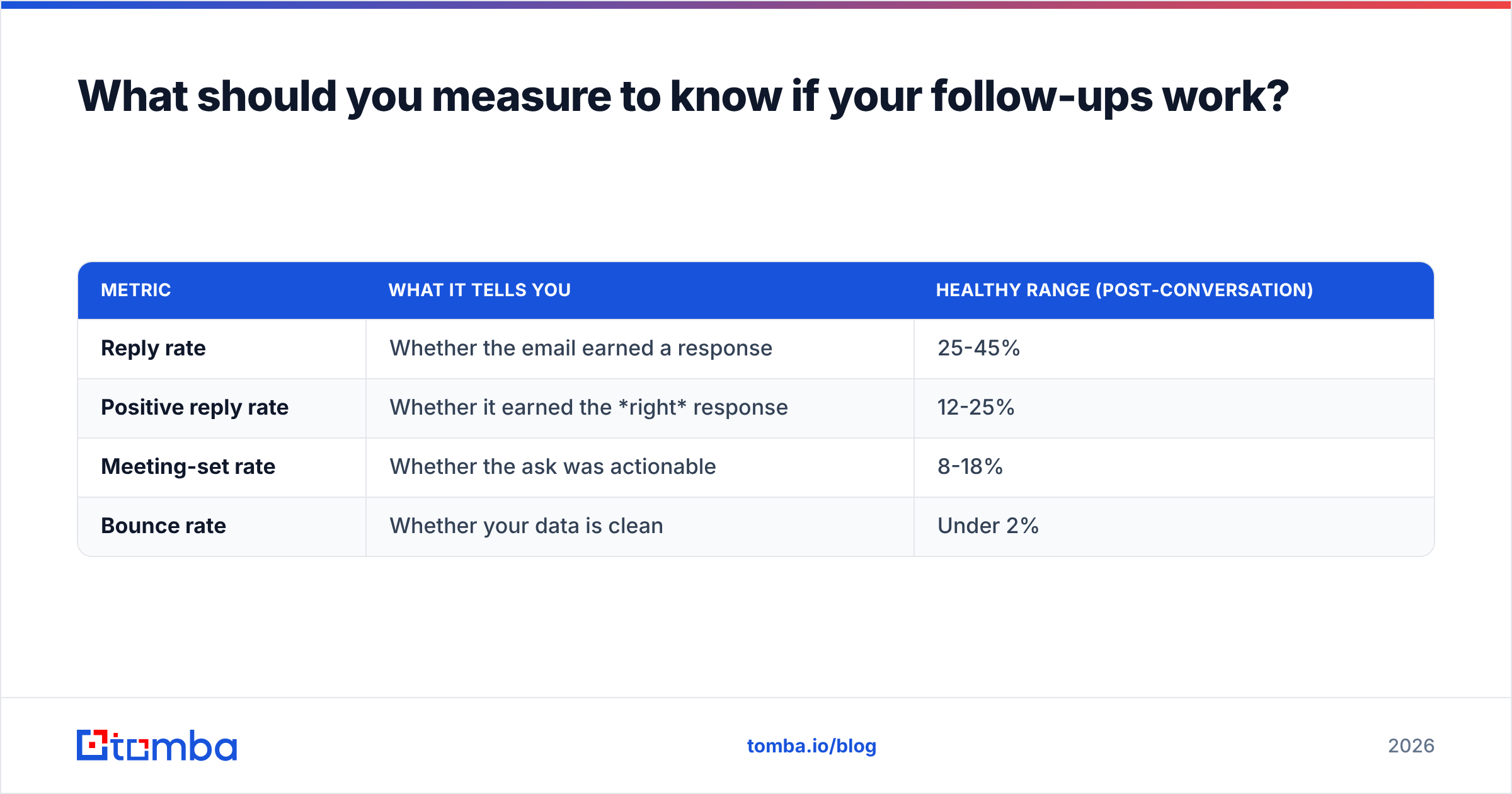
Track four things per follow-up template:
| Metric | What it tells you | Healthy range (post-conversation) |
|---|---|---|
| Reply rate | Whether the email earned a response | 25-45% |
| Positive reply rate | Whether it earned the right response | 12-25% |
| Meeting-set rate | Whether the ask was actionable | 8-18% |
| Bounce rate | Whether your data is clean | Under 2% |
If reply rate is healthy but positive replies are low, your ask is wrong. If bounces exceed 2%, stop optimising copy — your list is the problem, and no subject line rescues a bad address.
The bottom line#
Delete "follow up to our conversation" from your templates. Replace the subject line with the actual topic, the body with one new piece of information, and the close with one dated decision. Send it within 24 hours. Give the prospect an easy no by touch four.
The mechanics are simple; the discipline is not. Most reps lose deals not to a competitor but to a follow-up that arrived late, said nothing new, and asked for everything at once.
And before any of that matters, the email has to arrive. If your post-conversation follow-ups are landing on guessed addresses, start with the Tomba Email Finder — search by name and domain, get a confidence score with the sources behind it, and verify before you send. The free tier covers 25 searches a month, and paid plans start at $49/mo on Tomba pricing if you need volume or API access. Clean addresses first, better copy second — in that order.
Related guides#
Ready to find emails that actually work?
Join 150,000+ professionals who stopped guessing and started sending. Free credits on signup — no credit card required.
Get the Tomba newsletter
Practical outbound tactics and product updates — once every two weeks.
About the author