Following Our Phone Conversation: Email Templates That Work
"Following our phone conversation" is the most-used and least-effective opener in B2B follow-up email. Here are the templates, timing windows, and subject lines that actually get replies after a call.
TL;DR
- "Following our phone conversation" is grammatically fine and strategically weak — it opens with your admin, not the buyer's problem.
- The highest-reply call follow-ups land within 2–4 hours, lead with the buyer's own words, and contain exactly one ask.
- Replace the phrase with a recap line ("You said onboarding takes 6 weeks — here's how we cut that"), or drop it into the second sentence where it does no damage.
- Nine copy-paste templates below cover discovery, demo, pricing pushback, no-shows, cold calls, and the polite close-out.
- If you called a switchboard and never got a direct address, an email finder turns "name + company domain" into a verified inbox before the conversation goes cold.
What does "following our phone conversation" actually mean?#
It's a transitional phrase that signals the email is a continuation of a spoken exchange. In practice it does three jobs: it establishes context ("we've spoken"), it justifies the email ("you're expecting this"), and it stalls for a beat while the writer figures out what to say next.
Job one and two are legitimate. Job three is where the damage happens.
Buyers scan the first six to eight words of an email body in the preview pane before deciding whether to open it fully. "Following our phone conversation," burns all eight on information the recipient already has. They know you spoke. They were there. What they don't know is why this specific email is worth ninety seconds of their afternoon.
The variants — "further to our phone conversation", "as per our discussion", "following up on our call" — all share the same defect. They're throat-clearing dressed as professionalism.
Why does "following our phone conversation" underperform as an opener?#
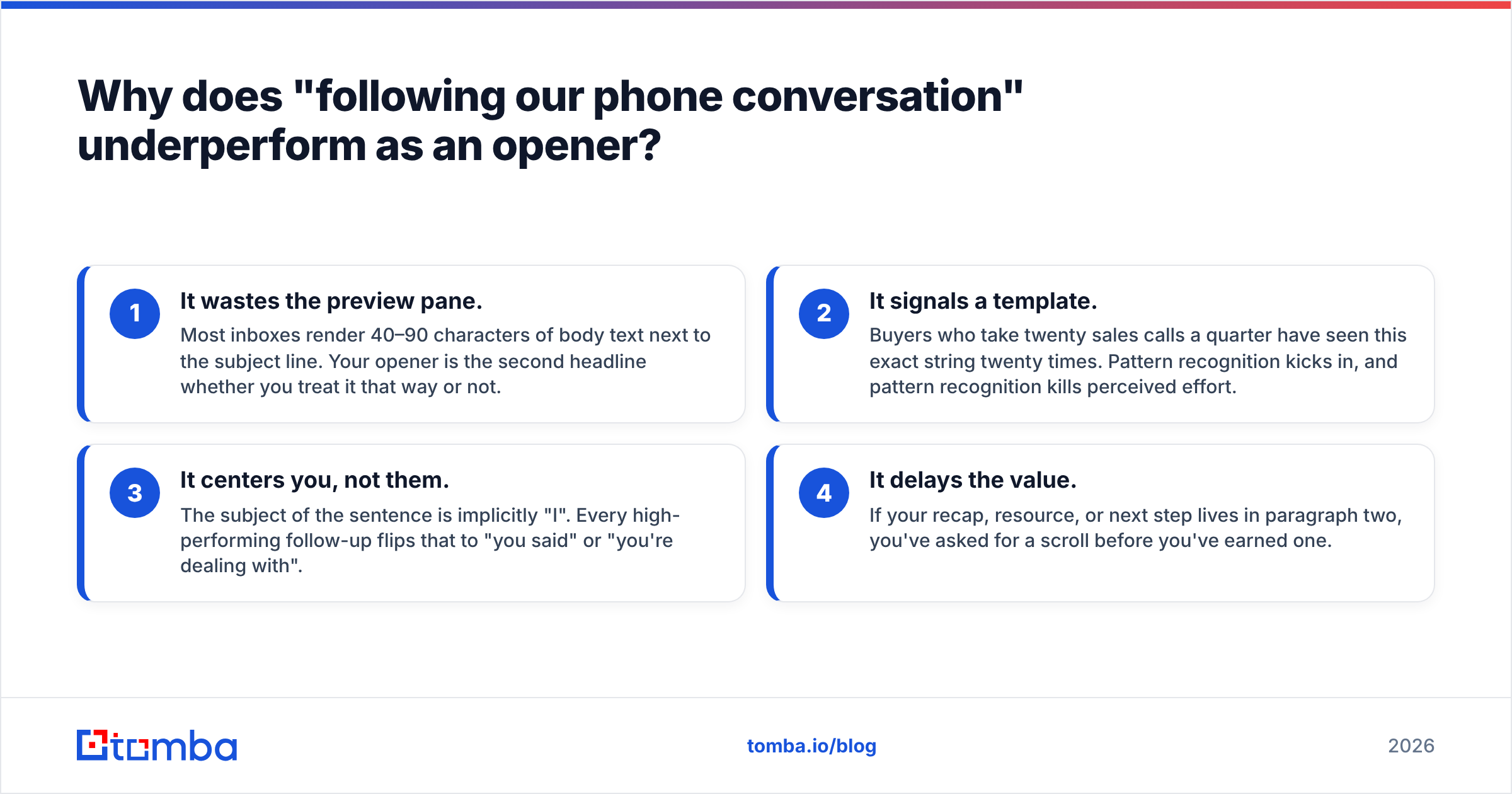
Four reasons, in order of how much they cost you:
- It wastes the preview pane. Most inboxes render 40–90 characters of body text next to the subject line. Your opener is the second headline whether you treat it that way or not.
- It signals a template. Buyers who take twenty sales calls a quarter have seen this exact string twenty times. Pattern recognition kicks in, and pattern recognition kills perceived effort.
- It centers you, not them. The subject of the sentence is implicitly "I". Every high-performing follow-up flips that to "you said" or "you're dealing with".
- It delays the value. If your recap, resource, or next step lives in paragraph two, you've asked for a scroll before you've earned one.
None of this means the phrase is banned. It means it shouldn't be load-bearing. Move it to sentence two — "You mentioned your team loses a day a week to manual list building. Following our call, I pulled the two numbers you asked for." — and it works as connective tissue instead of a speed bump.
What should you write instead of "following our phone conversation"?#
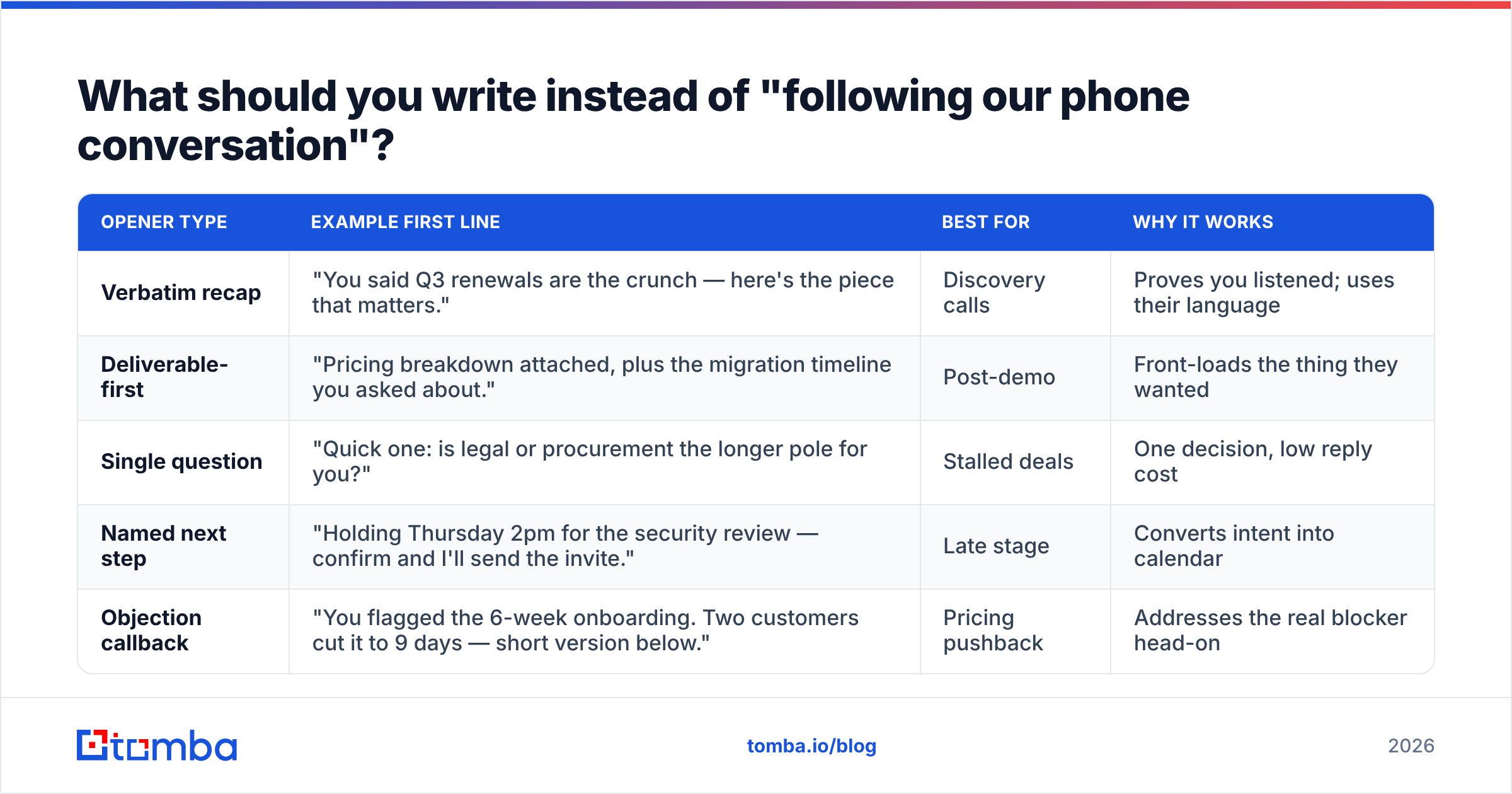
Swap the generic transition for one of five opener types. Each one carries information the buyer doesn't already have.
| Opener type | Example first line | Best for | Why it works |
|---|---|---|---|
| Verbatim recap | "You said Q3 renewals are the crunch — here's the piece that matters." | Discovery calls | Proves you listened; uses their language |
| Deliverable-first | "Pricing breakdown attached, plus the migration timeline you asked about." | Post-demo | Front-loads the thing they wanted |
| Single question | "Quick one: is legal or procurement the longer pole for you?" | Stalled deals | One decision, low reply cost |
| Named next step | "Holding Thursday 2pm for the security review — confirm and I'll send the invite." | Late stage | Converts intent into calendar |
| Objection callback | "You flagged the 6-week onboarding. Two customers cut it to 9 days — short version below." | Pricing pushback | Addresses the real blocker head-on |
The pattern across all five: the first line contains something that could only have come from your call with this person.
When should a call follow-up email land?#
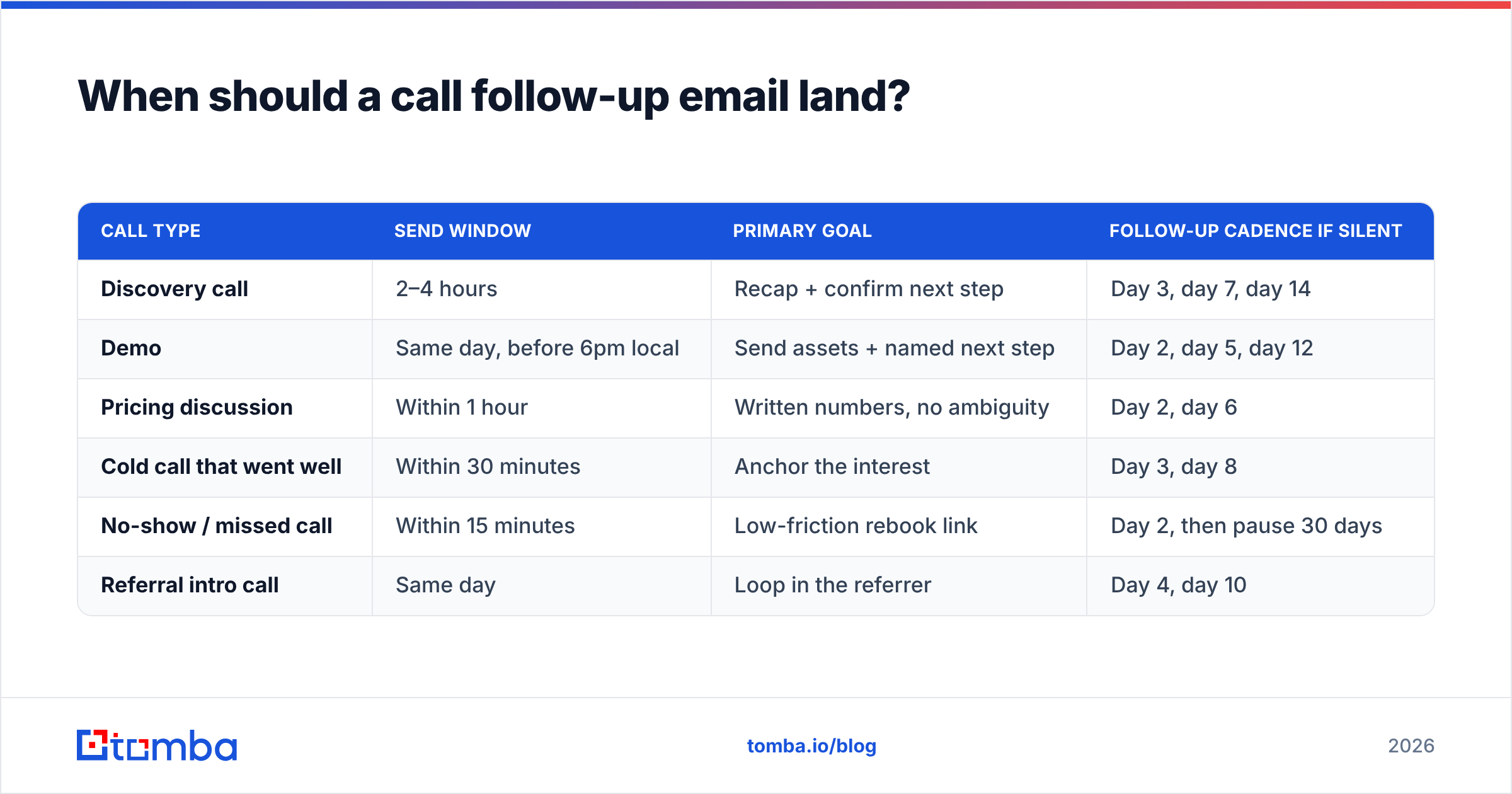
Timing beats copy more often than reps expect. The recap you send at hour two outperforms the beautifully written one you send on day three, because the buyer's short-term memory of the call is still doing half your persuasion for you.
| Call type | Send window | Primary goal | Follow-up cadence if silent |
|---|---|---|---|
| Discovery call | 2–4 hours | Recap + confirm next step | Day 3, day 7, day 14 |
| Demo | Same day, before 6pm local | Send assets + named next step | Day 2, day 5, day 12 |
| Pricing discussion | Within 1 hour | Written numbers, no ambiguity | Day 2, day 6 |
| Cold call that went well | Within 30 minutes | Anchor the interest | Day 3, day 8 |
| No-show / missed call | Within 15 minutes | Low-friction rebook link | Day 2, then pause 30 days |
| Referral intro call | Same day | Loop in the referrer | Day 4, day 10 |
Two rules that survive every industry:
- Never let a call cross midnight without an email. The half-life of a buyer's enthusiasm is measured in hours.
- Never send more than one ask per message. Two asks reads as a to-do list; buyers archive to-do lists.
HubSpot's sales research has consistently shown that follow-up persistence matters more than message polish, and Gartner's B2B buying research makes the same point from the buyer's side: purchase groups spend the majority of their cycle not talking to vendors, so the artifacts you leave behind get read by people who were never on your call. Write for the absent stakeholder as much as the one who picked up.
What are the nine templates worth stealing?#
1. Discovery call recap#
Subject: Your 6-week onboarding problem
Hi Dana,
You said onboarding a new region takes six weeks and two ops hires. That's the number I'd want to move first.
Three things from our call:
- Current state: manual data handoff between CRM and billing
- Target: regional launch in under two weeks
- Constraint: no new headcount before Q1
Next step: I'll send a 20-minute walkthrough of how Redpoint handled the same constraint. Does Thursday 2pm work?
— Sam
2. Demo follow-up with assets#
Subject: Deck + the two numbers you asked for
Hi Marc,
Attached: the deck, and the API rate limits you asked about (500 req/min on Growth, unlimited on Enterprise).
The one thing worth re-watching is the dedupe step at 12:40 — that's the part your ops lead will care about.
Should I set up a technical session with her, or do you want to review internally first?
3. Pricing pushback#
Subject: Re: budget — a smaller starting point
Following our call, the number was the sticking point, not the fit.
Two options that stay inside your range: start on the lower tier for one team and expand at renewal, or run a 30-day paid pilot scoped to the EMEA list only. Both get you the same data quality; only the volume changes.
Which is easier to get signed off?
4. The cold call that went well#
Subject: The 40% bounce rate thing
Hi Priya — you mentioned your last campaign bounced at 40%. That's almost always list hygiene, not sending infrastructure.
Two-minute read on how to diagnose it: [link]
Worth a proper 15 minutes next week?
5. The no-show#
Subject: Missed you — rebook?
Looks like our 10am slipped. No problem, these things happen.
Here's my calendar: [link]. Grab anything that works. If the timing's wrong entirely, tell me and I'll go quiet.
6. Multi-stakeholder loop-in#
Subject: Recap for Tomás + Legal
Hi Dana — adding Tomás so he has the context from our call.
Tomás: short version is we're evaluating whether the current handoff process can be automated. Dana's constraint is no new headcount. The security questionnaire is attached.
7. The nudge (day 7, no reply)#
Subject: Still the right priority?
Dana — checking whether the onboarding project is still on your Q4 list, or whether something bigger landed on it.
Either answer is useful. If it's slipped to next year, I'll follow up in January instead of cluttering your inbox.
8. The referral follow-up#
Subject: Following James's intro
Hi Alex — James suggested we talk after mentioning you're rebuilding the outbound motion.
He said the piece you're missing is verified contact data at the account level, not more volume. Is that a fair read?
9. The close-out#
Subject: Closing the loop
Dana — I've sent three notes and don't want to become noise. I'll assume the timing's off and stop here.
If it changes, the door's open. The onboarding teardown is yours to keep either way.
How do you write the subject line for a call follow-up?#
Reply-to-call emails have a structural advantage: the recipient recognizes your name. That means the subject line doesn't need to sell — it needs to specify.
- Use their noun. "Your 6-week onboarding problem" beats "Great speaking today".
- Keep it under 45 characters. Mobile truncation is unforgiving.
- Never write "Just following up". It reads as "I have nothing new".
- Reply in-thread when a thread exists. Threading preserves context for the stakeholders who join later.
- Skip the emoji. In B2B follow-up after a live call, it reads as a mismatch in register.
If you're stress-testing variants at volume, a subject line generator is faster than staring at a blank field, but the rule stands: the winning line is almost always a phrase the buyer said out loud.
What if you never got their email address on the call?#
This is the failure mode nobody puts in a playbook. You call a main line, you have a good ten-minute conversation with a VP of Ops, and the call ends before anyone spells out an address. Or you get "just send it to info@" — which routes to a shared inbox nobody reads.
The fix is a three-step recovery, done in the same hour as the call:
- Find the pattern. Most companies use one predictable format (
first.last@,flast@,first@). A domain search returns the known addresses on a domain along with the dominant pattern. - Resolve the specific person. Feed the name plus domain into an email finder to get the individual address rather than a guess.
- Verify before you send. Run the result through an email verifier so a hard bounce doesn't damage your sending reputation on the one email that mattered.
Tomba's pricing runs from a free tier at 25 searches per month to Starter at $49/mo, Growth at $99/mo, and Pro at $249/mo, with Enterprise on request — so a rep who needs a few dozen recoveries a month sits comfortably in the lower tiers. If your follow-ups are logged in a CRM, the HubSpot integration pushes the verified address straight onto the contact record instead of leaving it in a spreadsheet.
How do you keep follow-ups from reading like automation?#
Three habits separate reps whose call follow-ups get replies from reps whose don't:
- Write the recap while the call is still running. Type the buyer's exact phrases into a scratchpad during the conversation. Those verbatim quotes are your opener.
- Cap the message at 120 words. If the recap needs more, it belongs in an attachment or a doc, not the body.
- Vary the close. "Let me know your thoughts" is the closing equivalent of "following our phone conversation". Ask a specific, answerable question instead.
- Log the ask, not just the send. Your CRM should record what you asked for, so the next touch escalates rather than repeats.
Templates are scaffolding, not scripts. The nine above work because the variable slots force you to say something only you could say. Fill them lazily and you've just written "following our phone conversation" with extra steps.
Ready to stop losing deals at the address step?#
The best-written call follow-up in your pipeline is worth nothing if it lands in a shared inbox or bounces off a typo. Use the Tomba Email Finder to turn the name and company you got on the phone into a verified, deliverable address in seconds — free for your first 25 searches a month, no card required. Find it, verify it, and send the recap before the call goes cold.
Related guides#
Ready to find emails that actually work?
Join 150,000+ professionals who stopped guessing and started sending. Free credits on signup — no credit card required.
Get the Tomba newsletter
Practical outbound tactics and product updates — once every two weeks.
About the author