Following Up On My Previous Email: Templates That Get Replies
"Following up on my previous email" is the weakest opening line in B2B sales. Here is what to send instead, backed by cadence data, 9 tested templates, and a timing table.
TL;DR
- "Following up on my previous email" adds zero new information, which is exactly why it gets ignored — the reader already decided about email #1.
- Follow-ups still work: most positive replies in a B2B sequence land on messages 2 through 5, not message 1. The problem is the content of the bump, not the act of bumping.
- Replace the phrase with one of four patterns: new value, new angle, new context, or a clean breakup.
- Send 3–5 follow-ups spaced 3–4 business days apart, all on the same thread, and stop cleanly instead of trailing off.
- Before you blame your copy, check whether the address is even deliverable — a chunk of "silent" prospects never received message #1 at all.
What does "following up on my previous email" actually signal?#
It signals that you have nothing new to say.
Think of it like knocking on a neighbor's door twice in a row with the same request. The first knock was a request. The second knock, with the identical words, is just pressure. Nothing about the offer changed — you only changed the volume.
That's the mechanical problem with the phrase. It occupies the highest-value real estate in your email (the first seven words, the ones visible in the preview pane) with a status update about your workflow. The prospect does not care about your workflow. They care about whether this thread is worth 30 seconds.
Three specific costs:
- It re-anchors on a rejection. Pointing at the email they ignored reminds them they already made a decision. You're asking them to reverse it without giving them a reason.
- It burns the preview line. Most inbox clients show 40–90 characters of body text. "Just following up on my previous email below" spends all of it on filler.
- It reads as automated. Every sequence tool ships with this line in its default template. Buyers in software, agency, and finance roles see it a dozen times a week and pattern-match it to "ignore."
The fix is not to be more polite or more apologetic. It's to make each follow-up a standalone email that earns its own open.
Do follow-up emails still work in 2026?#
Yes, and the data is not close. The reply curve in B2B outbound is back-weighted — the first touch introduces you, and later touches convert. Across published outbound benchmarks and vendor studies (see HubSpot's sales statistics roundup), sequences with 4–6 touches consistently outperform single-send campaigns by a wide margin.
What changed is the tolerance for empty touches. A 2026 buyer's inbox has spam filtering, tab sorting, and AI triage layered on top. An email whose only content is "circling back" gets deprioritized by the software before the human sees it.
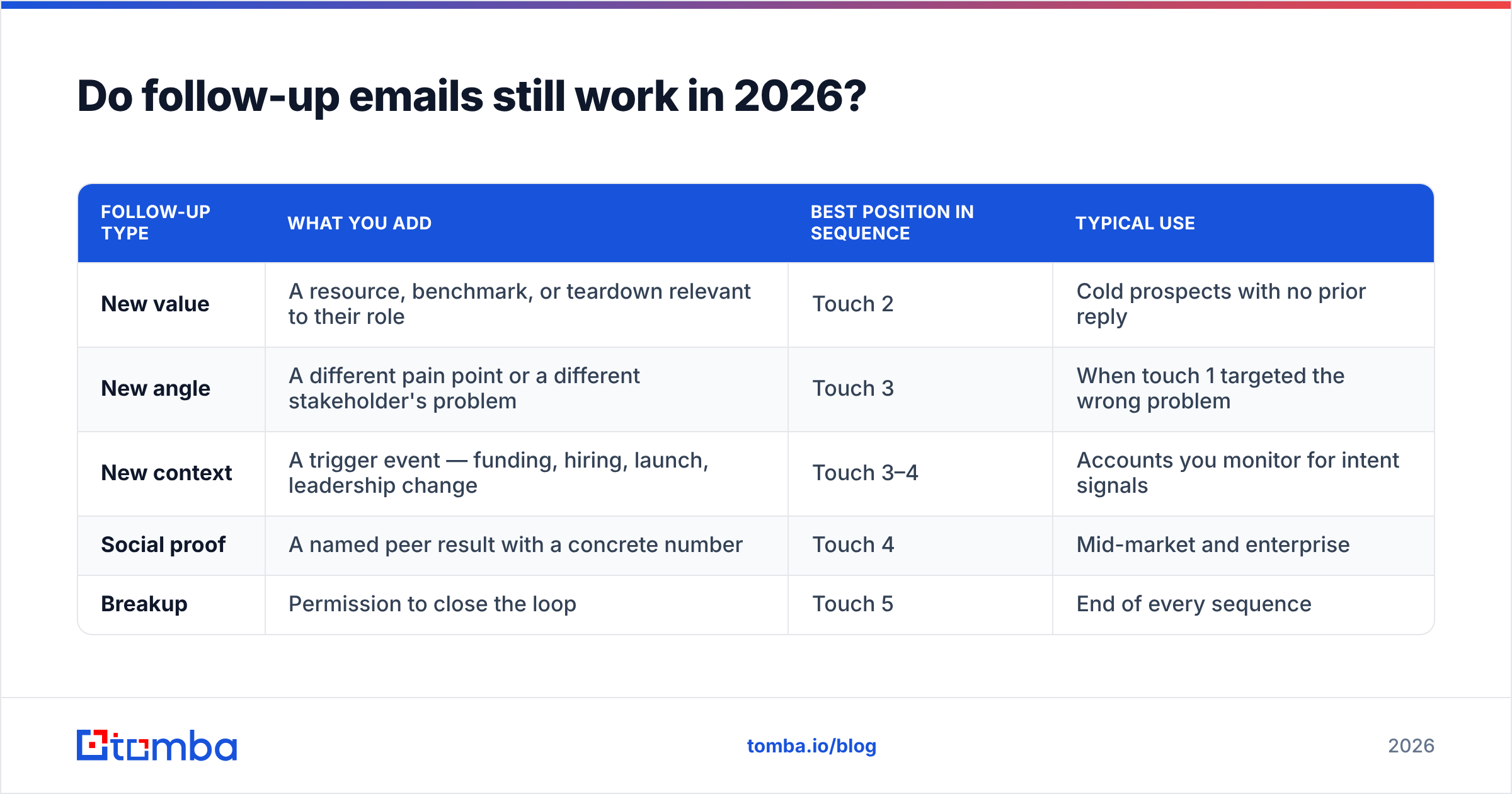
So the rule is simple: every follow-up must contain something the previous one didn't. New information, new framing, new proof, or a clear exit.
| Follow-up type | What you add | Best position in sequence | Typical use |
|---|---|---|---|
| New value | A resource, benchmark, or teardown relevant to their role | Touch 2 | Cold prospects with no prior reply |
| New angle | A different pain point or a different stakeholder's problem | Touch 3 | When touch 1 targeted the wrong problem |
| New context | A trigger event — funding, hiring, launch, leadership change | Touch 3–4 | Accounts you monitor for intent signals |
| Social proof | A named peer result with a concrete number | Touch 4 | Mid-market and enterprise |
| Breakup | Permission to close the loop | Touch 5 | End of every sequence |
Notice that "just bumping this" appears nowhere in that table. There is no touch type where restating your last email is the strongest available move.
What should you write instead of "following up on my previous email"?#
Here are nine openers that replace the phrase, grouped by the job they do. Each is written to survive the preview pane.
New value openers
- "Pulled the numbers on [their category] — median was 2.1%, yours looks like..." — leads with data they don't have.
- "Wrote up the three things [competitor] does differently on [page/process]." — gives before it asks.
- "Short teardown of your [signup flow / careers page / pricing page] — two fixes, no pitch." — specific and inspectable.
New angle openers
- "Different thought: is [X] actually owned by [other team] on your side?" — reframes and hands them an easy one-word reply.
- "I pitched this as a [cost] problem. It's probably a [speed] problem for you." — self-correcting, human, disarming.
- "Guessing the bottleneck is data hygiene, not tooling. Fair?" — a yes/no question is a low-cost reply.
New context openers
- "Saw the [Series B / new VP Sales / new office] news — congrats. Changes the math on this." — a real trigger event, not a LinkedIn scrape.
- "[Peer company] hit [number] after fixing this. Thought of your team." — proof with a name attached.
The breakup
- "Closing the loop on this one — want me to check back in Q1, or leave it?" — gives them the exit, which is why it gets replies.
The through-line: each opener would make sense to a reader who never saw your first email. That is the actual test. If the message collapses without the previous one propping it up, it's a bump, not a follow-up.
How many follow-ups should you send, and how far apart?#
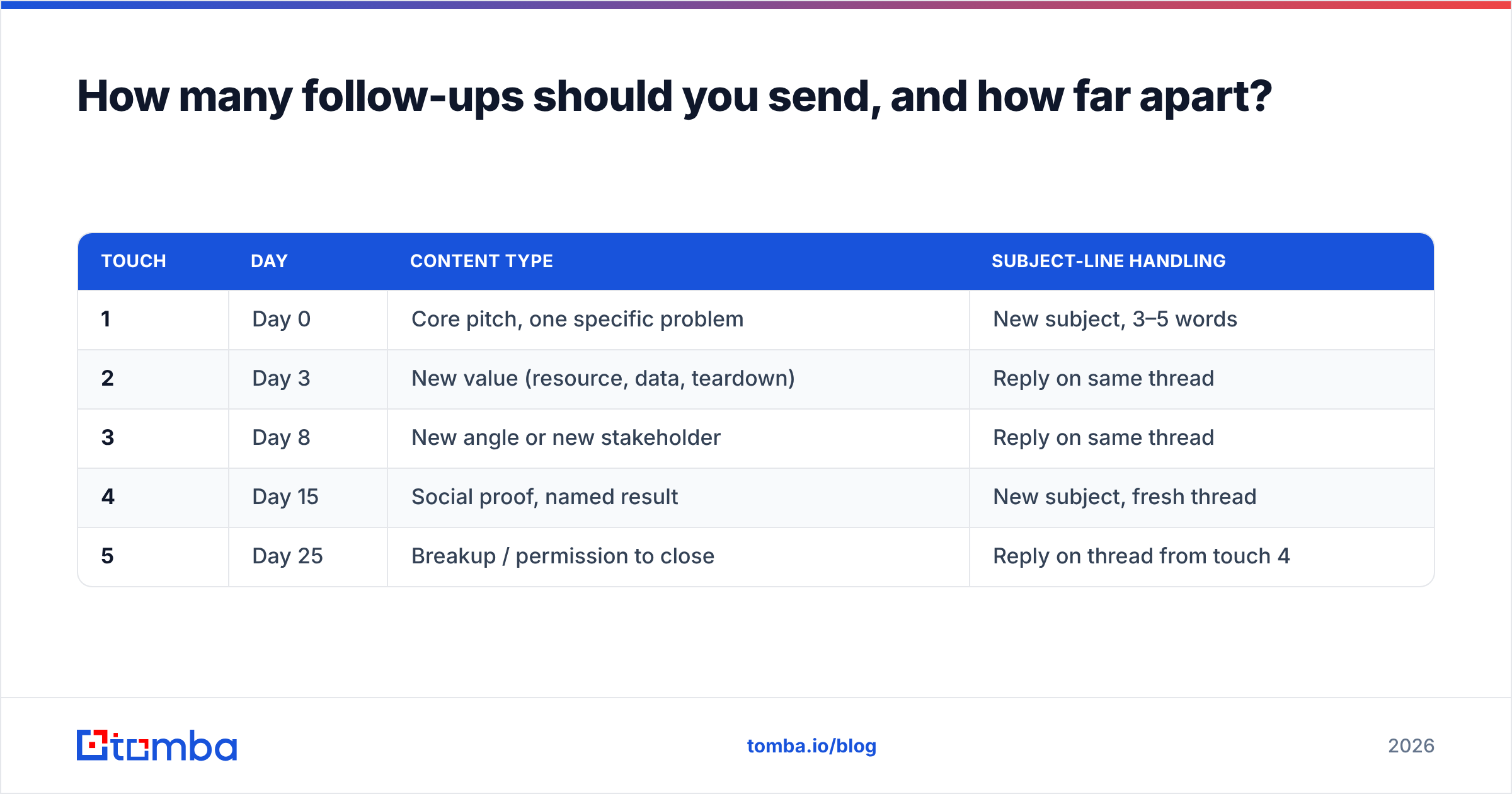
Three to five, spaced 3–4 business days apart, is the range that holds up across most B2B segments. Below three you're leaving the majority of your reply volume on the table. Above six you're generating spam complaints, and complaint rate is the metric that actually ends your domain.
| Touch | Day | Content type | Subject-line handling |
|---|---|---|---|
| 1 | Day 0 | Core pitch, one specific problem | New subject, 3–5 words |
| 2 | Day 3 | New value (resource, data, teardown) | Reply on same thread |
| 3 | Day 8 | New angle or new stakeholder | Reply on same thread |
| 4 | Day 15 | Social proof, named result | New subject, fresh thread |
| 5 | Day 25 | Breakup / permission to close | Reply on thread from touch 4 |
Two mechanics worth getting right:
- Thread vs. new subject. Replying on the same thread keeps context and boosts open rates early. But after three unanswered messages, that thread is a dead zone — start a fresh subject line at touch 4 so it lands as a new conversation rather than a fourth ignored bump.
- Business days, not calendar days. A follow-up landing Saturday morning is a follow-up that gets buried under Monday's backlog. Time-of-send matters less than day-of-send; Tuesday through Thursday is still the reliable window.
If you're sending at any real volume, sequence spacing interacts with email deliverability. Compressed cadences — daily bumps to the same person — raise complaint rates faster than almost anything else you can do, and complaints compound into sender reputation damage that no template rewrite will fix.
Why do prospects ignore follow-ups that look fine on paper?#
Because a meaningful share of them never received the email. This is the diagnostic step most teams skip.
Before you A/B test your fourth rewrite of a follow-up line, split "no reply" into its real causes:
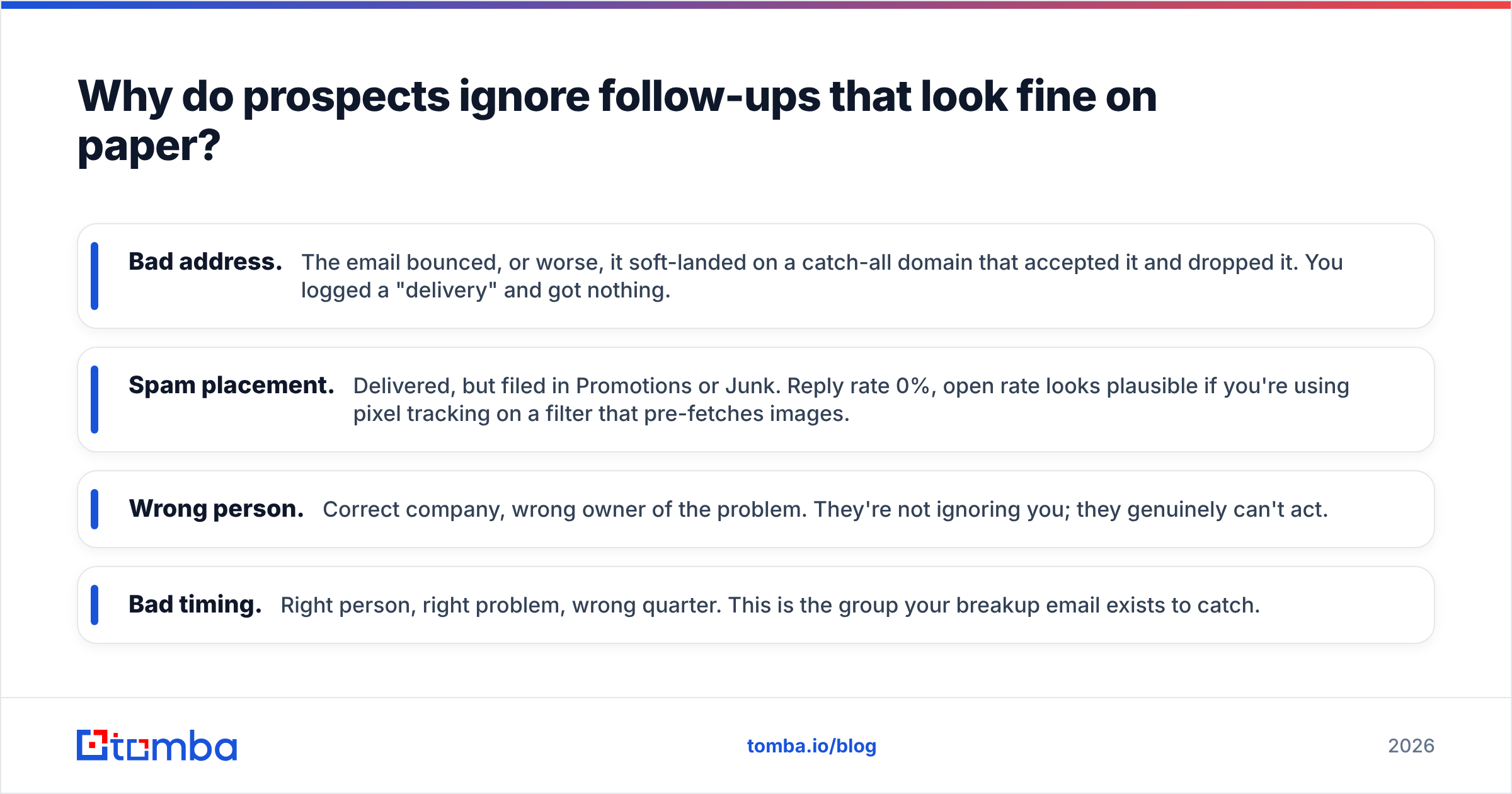
- Bad address. The email bounced, or worse, it soft-landed on a catch-all domain that accepted it and dropped it. You logged a "delivery" and got nothing.
- Spam placement. Delivered, but filed in Promotions or Junk. Reply rate 0%, open rate looks plausible if you're using pixel tracking on a filter that pre-fetches images.
- Wrong person. Correct company, wrong owner of the problem. They're not ignoring you; they genuinely can't act.
- Bad timing. Right person, right problem, wrong quarter. This is the group your breakup email exists to catch.
Only the last two are copy problems. The first two are data and infrastructure problems, and no amount of clever phrasing fixes them.
Run your list through an email verifier before the sequence starts, and use a catch-all verifier for domains that accept everything — those are the addresses that quietly eat your follow-ups. If your bounce rate is above 3%, your follow-up copy is not the variable to test first.
Which tools help you follow up without sounding automated?#
The tooling splits into three jobs: finding the right contact, sending the sequence, and keeping the domain healthy. Most teams over-invest in the middle one.
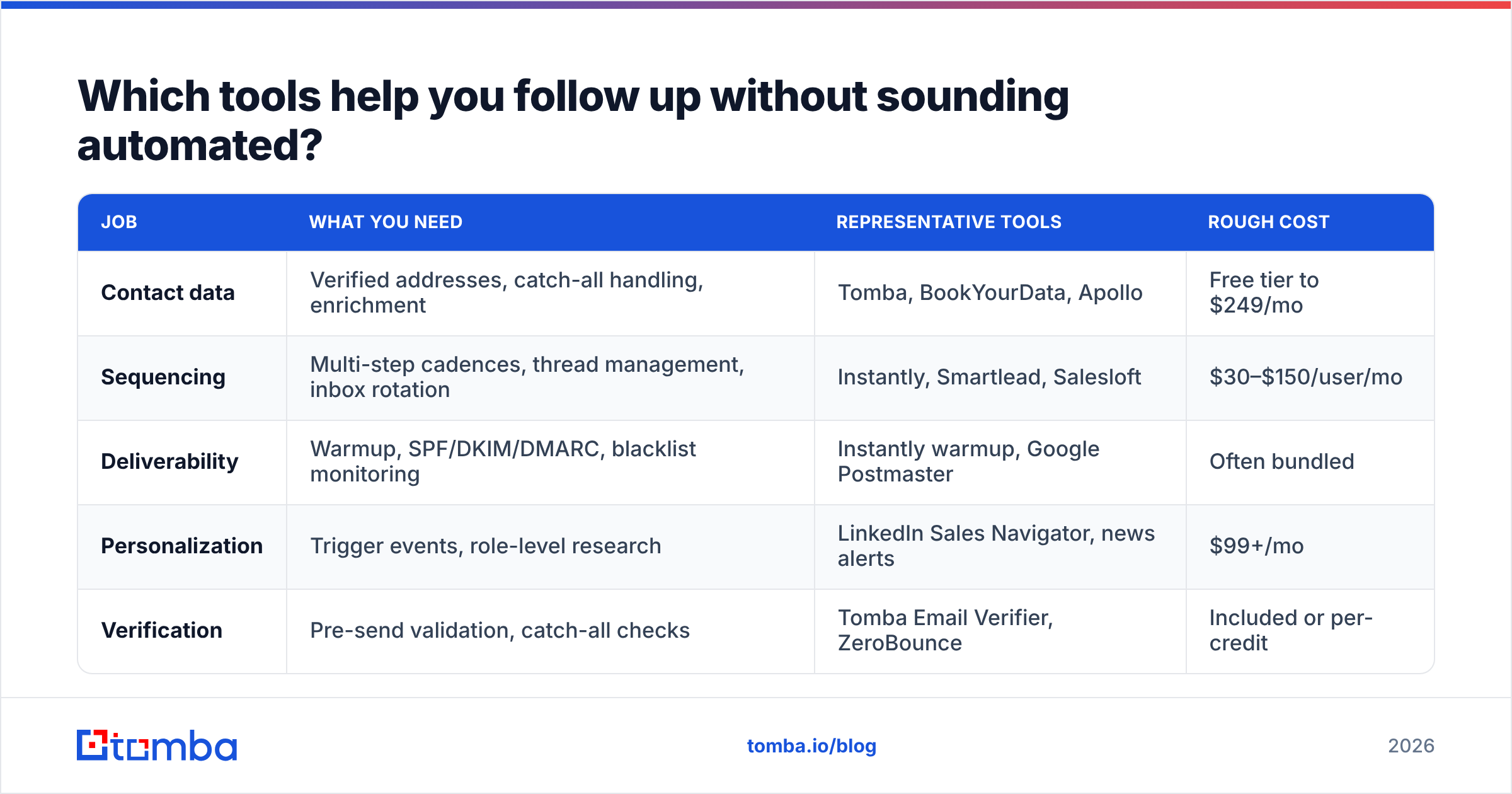
| Job | What you need | Representative tools | Rough cost |
|---|---|---|---|
| Contact data | Verified addresses, catch-all handling, enrichment | Tomba, BookYourData, Apollo | Free tier to $249/mo |
| Sequencing | Multi-step cadences, thread management, inbox rotation | Instantly, Smartlead, Salesloft | $30–$150/user/mo |
| Deliverability | Warmup, SPF/DKIM/DMARC, blacklist monitoring | Instantly warmup, Google Postmaster | Often bundled |
| Personalization | Trigger events, role-level research | LinkedIn Sales Navigator, news alerts | $99+/mo |
| Verification | Pre-send validation, catch-all checks | Tomba Email Verifier, ZeroBounce | Included or per-credit |
On the data side, Tomba pricing runs a free tier at 25 searches/month, Starter at $49/mo, Growth at $99/mo, and Pro at $249/mo, with verification bundled rather than sold as a separate credit pool. BookYourData takes a different route with pay-as-you-go prepaid credits, which suits teams that buy lists in bursts rather than running continuous prospecting — worth a look if your volume is lumpy.
For sequencing, the honest read is that the major platforms are close to parity on cadence features. What differentiates them is inbox rotation and warmup quality, not template libraries. Check current user reviews on G2's sales engagement category before committing to an annual contract.
The one thing no tool solves: whether you actually have something new to say in touch #3. That's a research problem, and it's why the reps with the best follow-up reply rates spend more time reading than writing.
What does a full follow-up sequence look like end to end?#
Here's a five-touch sequence for a hypothetical prospect — a VP of Marketing at a 200-person SaaS company — with the phrase "following up on my previous email" removed everywhere it would normally appear.
Touch 1 — Day 0. Subject: Demo request routing
Noticed your demo form routes to a shared inbox rather than a round-robin. At your traffic level that's usually 6–10 hours of lag on inbound.
We cut that to under 15 minutes for [similar company]. Worth a look?
Touch 2 — Day 3. Reply on thread
Pulled the benchmark I mentioned: median inbound response time in B2B SaaS is 42 hours. Top decile is under 1 hour.
The gap is almost entirely routing, not headcount. Two-page breakdown if useful.
Touch 3 — Day 8. Reply on thread
Different thought — is inbound routing actually owned by your RevOps team rather than marketing? Happy to redirect if so.
Touch 4 — Day 15. New subject: 42 hours → 15 minutes
[Named peer] was at 38-hour average response on inbound demo requests. After restructuring routing, 14 minutes. Same headcount.
Their VP Marketing said the surprise was pipeline quality, not just volume. Want the writeup?
Touch 5 — Day 25. Reply on thread from touch 4
Closing the loop on this. Should I check back after your Q1 planning, or is inbound routing settled for now?
Either answer is genuinely fine.
Five emails, zero bumps. Touch 3 is 22 words and often the highest-replying message in the sequence, because it asks a question that costs nothing to answer.
How do you measure whether your follow-ups are working?#
Track reply rate by touch number, not just campaign-level. This one report changes how teams write.
- Touch 1 reply rate tells you whether your targeting and core value prop are right.
- Touch 2–4 reply rate tells you whether your follow-ups add value. If it collapses to near zero after touch 1, your follow-ups are bumps.
- Touch 5 (breakup) reply rate is often the second-highest in the sequence. If it isn't, your breakup is too passive-aggressive.
- Negative reply rate — "not interested," "wrong person" — is a good metric. It's routing information, and it protects your domain from complaints.
- Complaint rate should stay under 0.1%. Above that, cut your cadence before you touch anything else.
A useful benchmark: healthy sequences see response rate climb or hold steady from touch 1 to touch 3, then decline. A sequence where touches 2 and 3 reply at a tenth of touch 1's rate is a sequence where the follow-ups are dead weight — and dead weight in an inbox costs you reputation, not just time.
What's the one habit that fixes follow-ups permanently?#
Write all your follow-ups before you send touch 1.
When you draft the sequence up front, you're forced to answer "what's my second argument?" while you still have the research open. When you write follow-ups reactively — three days later, with 40 other threads on your plate — you write "just following up," because that's what's available when you have nothing prepared.
The reps who never send that phrase aren't more disciplined. They just did the work earlier.
Follow-ups only pay off if the address is real and the person is the right one. Start with clean data: Tomba's Email Finder locates verified professional addresses by name and domain, with verification built into the same workflow rather than sold as a separate credit pool — so touch #1 actually lands, and touches 2 through 5 have somewhere to go. The free tier covers 25 searches a month if you want to test it against a list you already trust.
Related guides#
Ready to find emails that actually work?
Join 150,000+ professionals who stopped guessing and started sending. Free credits on signup — no credit card required.
Get the Tomba newsletter
Practical outbound tactics and product updates — once every two weeks.
About the author