Following Up On Our Conversation: Emails That Get Replies
"Following up on our conversation" is the most overused opener in B2B email. Here is what it actually signals, when to send it, and six replacements that earn replies instead of silence.
TL;DR
- "Following up on our conversation" is a filing label, not a reason to reply. It tells the recipient what the email is about, not why they should open it.
- The phrase is fine inside the body as a memory anchor. It is weak as a subject line because it carries zero new information.
- The highest-reply follow-ups do three things: reference a specific detail from the conversation, add one new piece of value, and end with a single low-friction ask.
- Timing beats wording. A follow-up sent within 24 hours of a live conversation outperforms a beautifully written one sent nine days later.
- Most "no reply" cases are not rejection. They are inbox routing failures, forwarded threads, or contacts who changed jobs — all fixable with verification and enrichment.
What does "following up on our conversation" actually signal?#
It signals that you are organised and that you are out of ideas.
Think of it like a subject line on an internal memo. "Following up on our conversation" tells the reader which mental folder the email belongs in — the call last Thursday, the booth chat at the conference, the LinkedIn thread. That is genuinely useful context. What it does not do is give the reader a reason to open the message now instead of at some vague later point that never arrives.
Here is the practical split most sellers get wrong:
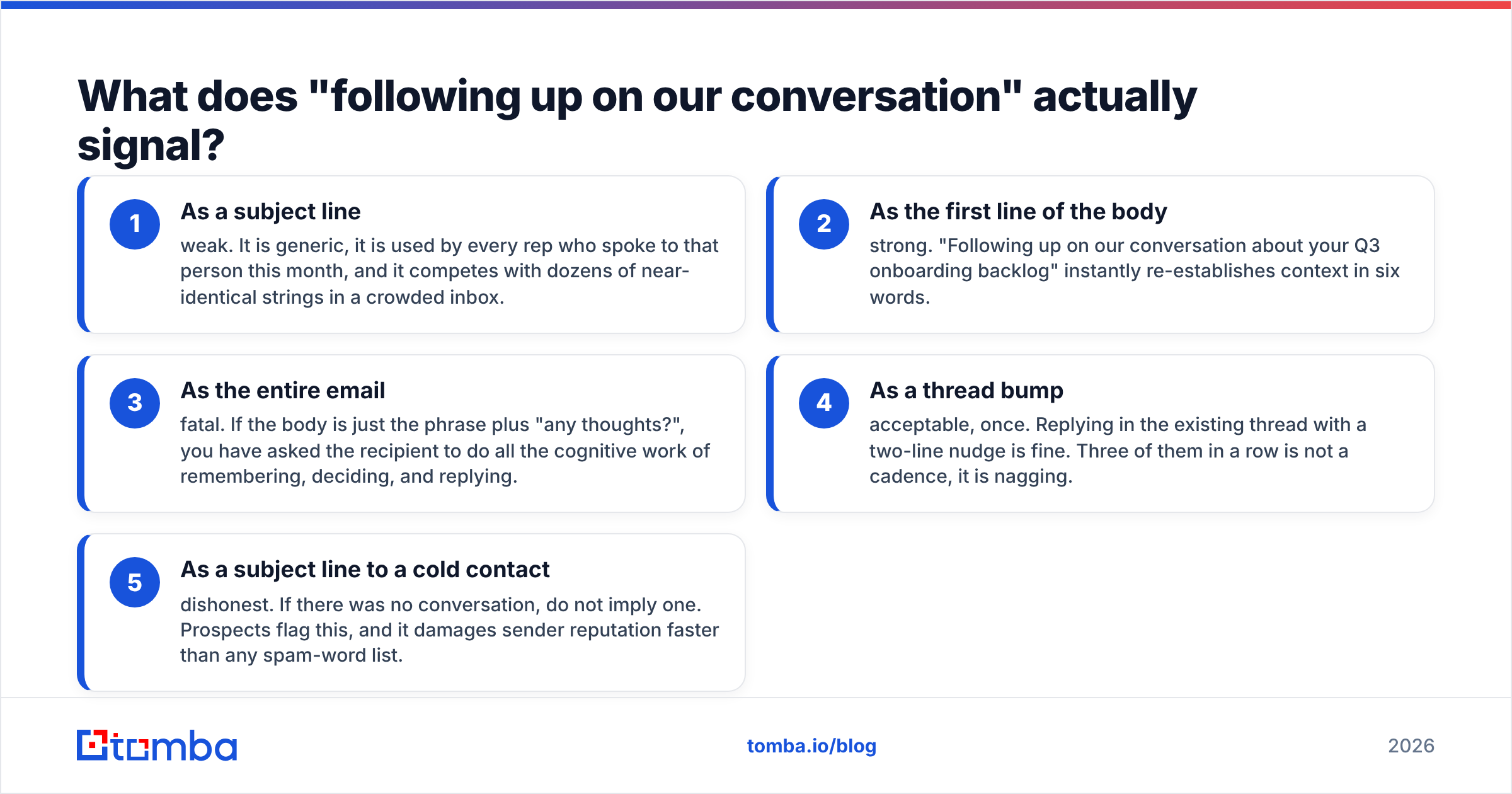
- As a subject line — weak. It is generic, it is used by every rep who spoke to that person this month, and it competes with dozens of near-identical strings in a crowded inbox.
- As the first line of the body — strong. "Following up on our conversation about your Q3 onboarding backlog" instantly re-establishes context in six words.
- As the entire email — fatal. If the body is just the phrase plus "any thoughts?", you have asked the recipient to do all the cognitive work of remembering, deciding, and replying.
- As a thread bump — acceptable, once. Replying in the existing thread with a two-line nudge is fine. Three of them in a row is not a cadence, it is nagging.
- As a subject line to a cold contact — dishonest. If there was no conversation, do not imply one. Prospects flag this, and it damages sender reputation faster than any spam-word list.
The phrase is not banned. It is just doing the wrong job when you put it where the reader's attention is scarcest.

When should you send a follow-up after a conversation?#
Send it the same business day, ideally within four hours.
Memory decay is the single most underrated variable in follow-up performance. The recipient remembers the texture of the conversation — your tone, the specific problem they described, the throwaway comment about their CFO — for a few hours. By day three, they remember a vendor called. By day ten, they remember nothing and your email reads like cold outreach with a false premise.
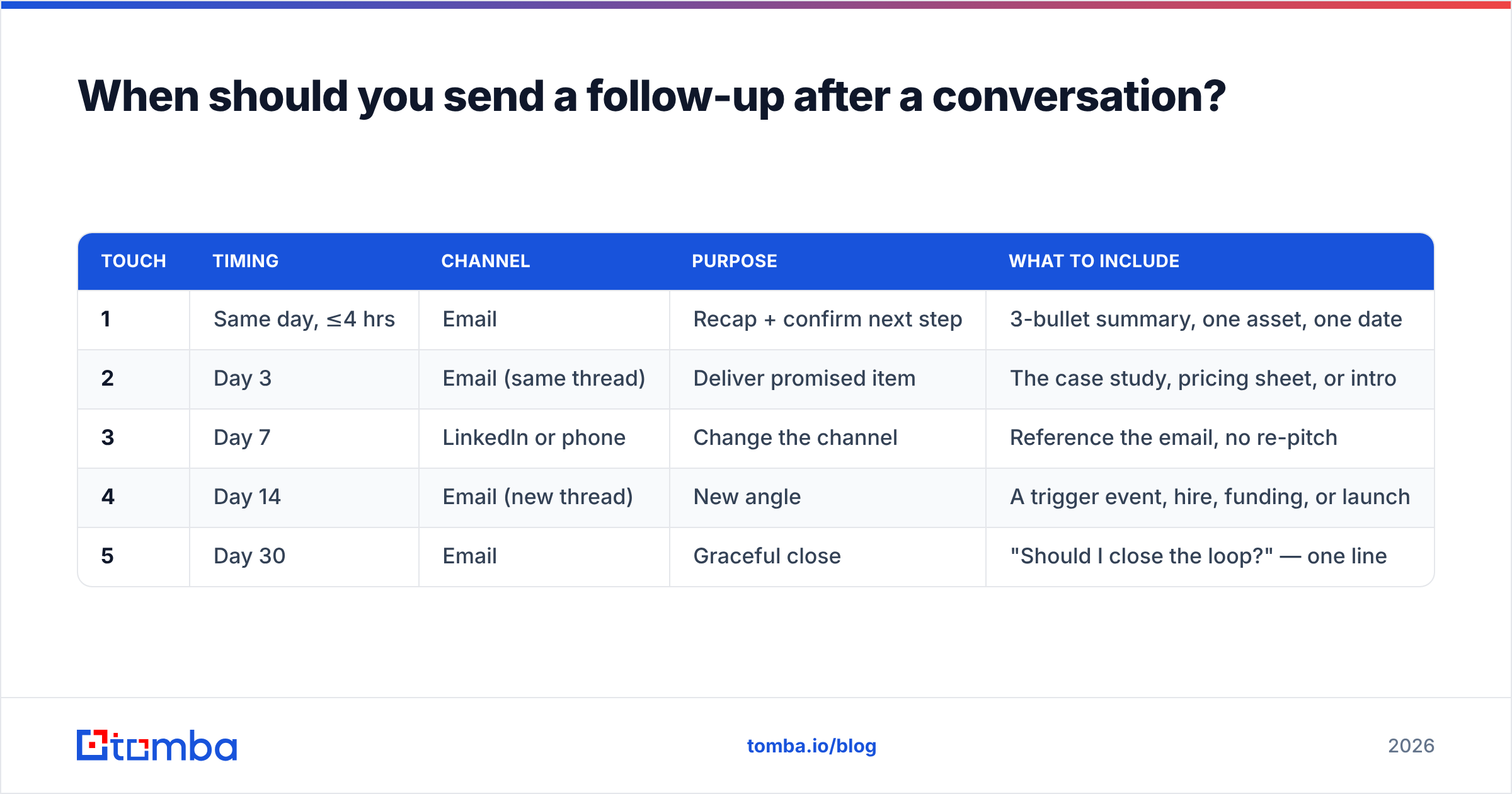
A workable cadence after a real conversation looks like this:
| Touch | Timing | Channel | Purpose | What to include |
|---|---|---|---|---|
| 1 | Same day, ≤4 hrs | Recap + confirm next step | 3-bullet summary, one asset, one date | |
| 2 | Day 3 | Email (same thread) | Deliver promised item | The case study, pricing sheet, or intro |
| 3 | Day 7 | LinkedIn or phone | Change the channel | Reference the email, no re-pitch |
| 4 | Day 14 | Email (new thread) | New angle | A trigger event, hire, funding, or launch |
| 5 | Day 30 | Graceful close | "Should I close the loop?" — one line |
Two notes on that table. First, touch 3 exists because channel-switching lifts reply rates more than rewriting subject lines does — the same message in a different inbox is a genuinely new stimulus. Second, touch 5 is not a bluff. If they do not reply to the breakup, actually stop. Sending a sixth email after announcing you would stop teaches the recipient your words are decorative.
For conference or event conversations, compress everything. Send touch 1 before you leave the venue if you can. The half-life of a booth conversation is roughly one evening.
What should you write instead of "following up on our conversation"?#
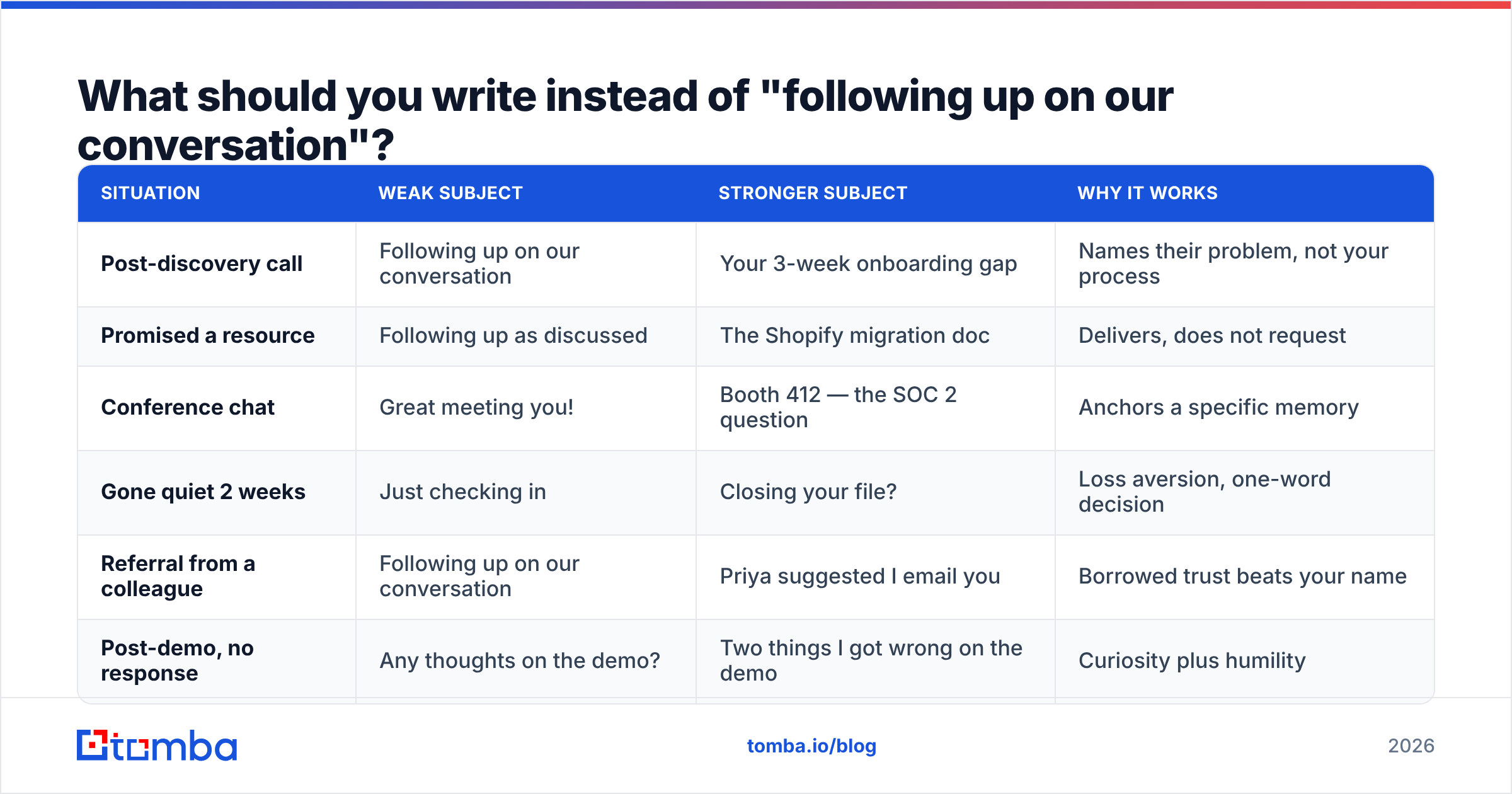
Replace the label with the content of the conversation. Every strong replacement follows the same rule: the subject line contains a noun the recipient personally cares about.
| Situation | Weak subject | Stronger subject | Why it works |
|---|---|---|---|
| Post-discovery call | Following up on our conversation | Your 3-week onboarding gap | Names their problem, not your process |
| Promised a resource | Following up as discussed | The Shopify migration doc | Delivers, does not request |
| Conference chat | Great meeting you! | Booth 412 — the SOC 2 question | Anchors a specific memory |
| Gone quiet 2 weeks | Just checking in | Closing your file? | Loss aversion, one-word decision |
| Referral from a colleague | Following up on our conversation | Priya suggested I email you | Borrowed trust beats your name |
| Post-demo, no response | Any thoughts on the demo? | Two things I got wrong on the demo | Curiosity plus humility |
Notice what none of these do: they do not include the word "quick", they do not open with "I hope this email finds you well", and they do not exceed roughly six words. If you want to pressure-test variants before sending, run them through a subject line tester rather than guessing — small wording changes swing open rates more than most reps expect, and guessing at scale is expensive.
What does a follow-up email that gets replies actually look like?#
It has four parts and it fits on a phone screen without scrolling.
Part 1 — the memory anchor (one line). This is where "following up on our conversation" legitimately belongs, made specific: "Following up on our conversation Tuesday about the duplicate-lead problem in your Salesforce instance."
Part 2 — the recap (three bullets max). Summarise what they said, not what you said. If your recap is a list of your product's features, you were not listening. If it is a list of their constraints, budget window, and stakeholders, you were.
Part 3 — the new value (one item). Something they did not have before this email arrived: a benchmark, a competitor teardown, a customer who solved the same problem, a short Loom. This is the part that earns the open on the next follow-up, because you have trained them that your emails contain things.
Part 4 — the single ask (one sentence, one decision). Not "let me know your thoughts and also whether Thursday works and if you want me to loop in your CTO." One ask. Binary if possible: "Worth a 15-minute call Thursday at 2, or should I send the technical spec first?"
Here is the assembled version:
Subject: Your duplicate-lead problem — two fixes
Hi Marcus,
Following up on our conversation Tuesday about duplicate leads in Salesforce.
What I heard:
- Roughly 18% of inbound records are duplicates
- Your team dedupes manually, ~6 hours a week
- Any fix has to survive the Q4 CRM migration
I pulled the approach a similar team used — they solved it at the enrichment layer instead of the CRM layer, which meant the migration didn't break it. Two-page summary attached.
Worth 15 minutes Thursday at 2pm to walk through it, or should I send the technical spec first?
— Elena
That email respects the reader's time, proves you listened, gives something away, and makes replying a one-word decision. It does not need exclamation marks or a "just circling back."
Why do good follow-ups still get no reply?#
Because a meaningful share of them never reach a human. Before you rewrite the copy for the fourth time, rule out the mechanical failures.
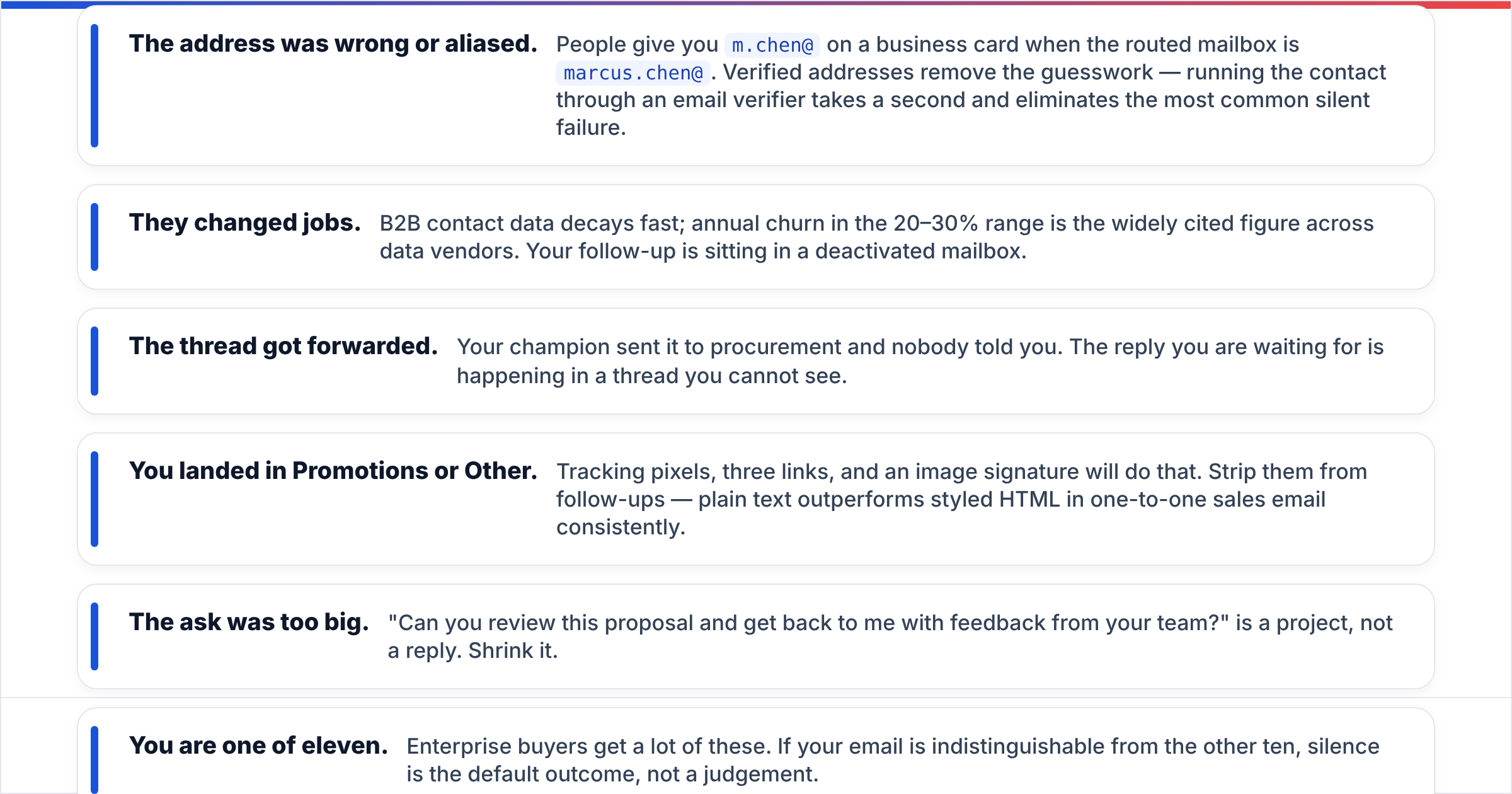
- The address was wrong or aliased. People give you
m.chen@on a business card when the routed mailbox ismarcus.chen@. Verified addresses remove the guesswork — running the contact through an email verifier takes a second and eliminates the most common silent failure. - They changed jobs. B2B contact data decays fast; annual churn in the 20–30% range is the widely cited figure across data vendors. Your follow-up is sitting in a deactivated mailbox.
- The thread got forwarded. Your champion sent it to procurement and nobody told you. The reply you are waiting for is happening in a thread you cannot see.
- You landed in Promotions or Other. Tracking pixels, three links, and an image signature will do that. Strip them from follow-ups — plain text outperforms styled HTML in one-to-one sales email consistently.
- The ask was too big. "Can you review this proposal and get back to me with feedback from your team?" is a project, not a reply. Shrink it.
- You are one of eleven. Enterprise buyers get a lot of these. If your email is indistinguishable from the other ten, silence is the default outcome, not a judgement.
Only after those six are eliminated should you assume the prospect is genuinely uninterested. And when the contact has moved on, the fastest recovery is finding the replacement rather than mourning the thread — a domain search against the company surfaces who now holds the role, and enrichment fills in the rest.
How many follow-ups is too many?#
Between four and six touches over 30 days, then stop and re-enter later with a new reason.
The research consensus across sales-engagement vendors is that reply rates keep climbing through roughly the fourth or fifth touch, then flatten hard. What changes is not the count but the variation. Five emails that say the same thing louder each time are worse than three that each carry a different angle — a resource, a peer benchmark, a trigger event.
A few boundaries that keep you on the right side of both etiquette and deliverability:
- Never send two follow-ups in the same 48 hours after a live conversation.
- Never reference urgency you invented ("this pricing expires Friday" when it does not).
- Never guilt ("I've reached out three times now"). It reads as your problem, not theirs.
- Always make the last email genuinely final, and always make it easy to say no.
For the mechanics of writing each variation, cold email templates give you a starting frame you can adapt — the point is to change the angle each time, not the adjectives. And if your follow-ups keep landing outside the primary inbox, that is a sender reputation problem to solve at the domain level before you touch the copy again.
What do the industry sources say?#
Worth reading beyond this post if you are rebuilding a follow-up cadence from scratch:
- HubSpot's sales blog publishes ongoing benchmark data on follow-up timing and reply rates across segments.
- G2's sales engagement category is the fastest way to see what practitioners actually say about the tools that automate these sequences, versus what the vendors claim.
- The Zeigarnik effect explains why open loops — an unanswered question, an unfinished thought — pull attention harder than closed ones. It is the honest psychological basis for "two things I got wrong on the demo" outperforming "checking in."
The bottom line#
"Following up on our conversation" is not a bad phrase. It is a bad headline. Move it into the first line of the body where it does real work as a memory anchor, and give the subject line the one thing the reader actually cares about: their problem, named specifically.
Then fix the plumbing. A perfectly written follow-up sent to a stale address, a departed employee, or a mistyped alias is worth exactly nothing, and no amount of copy iteration will tell you that is what happened.
Start with the contact, not the copy. If you are following up on conversations from a conference list, a webinar export, or a CRM full of records nobody has touched in a year, run them through Tomba Email Finder first — find the current professional address by name and domain, confirm it is deliverable, and only then spend your energy on the message. The free tier covers 25 searches a month if you want to test it against a handful of contacts you already know the answers for; paid plans start at $49/mo, with full Tomba pricing if you need bulk volume or API access. Good follow-ups reach real inboxes. Everything else is practice.
Related guides#
Ready to find emails that actually work?
Join 150,000+ professionals who stopped guessing and started sending. Free credits on signup — no credit card required.
Get the Tomba newsletter
Practical outbound tactics and product updates — once every two weeks.
About the author