Following Up on Trade Show Leads: The 2026 Playbook
Booth scans decay fast: most event leads are dead within ten days because nobody worked them. Here's the tiering, timing, and data-cleanup system that turns a badge dump into booked meetings.
TL;DR
- Speed beats polish. Leads worked inside 48 hours of the show close at multiples of the ones worked in week two — and by day ten, most badge scans are functionally dead.
- Badge-scan data is dirty by default: personal Gmail addresses, typos from lanyard OCR, job titles that were accurate two employers ago. Clean and enrich before you send anything.
- Tier your list before you write a single email. A three-tier split (hot / warm / cold-scan) lets you spend human time where it converts and automate the rest.
- The winning cadence is multi-channel — email, phone, and LinkedIn — over 21 days, not a single "great to meet you" blast on Monday morning.
- Measure meetings booked per 100 scans, not raw lead count. Booth ROI conversations get a lot simpler when you have that number.
You spent $40,000 on a 20x20 booth, flights, freight, and a coffee cart. Your team scanned 412 badges. Three weeks later, the CRM shows nine meetings and one opportunity. The show didn't fail. The follow-up did.
This guide covers the operational side of following up on trade show leads: how fast to move, how to segment, how to fix the data you actually captured, what to send, and how to prove ROI to the person who signed the booth invoice.
Why do most trade show leads never convert?#
Because the follow-up is treated as an afterthought owned by nobody.
The pattern repeats at every company. Marketing owns the booth. Sales owns the pipeline. The lead list lands in a shared spreadsheet on the Friday after the show, sits through a weekend, gets uploaded to the CRM on Tuesday, gets assigned on Thursday, and reaches a rep the following Monday — nine days after a 90-second conversation the prospect has completely forgotten.
Three specific failure modes do most of the damage:
- No owner named before the show. If follow-up ownership isn't assigned in the pre-event kickoff, it defaults to "whoever has time," which means nobody.
- Every scan treated identically. A person who asked for a technical demo and a person who wanted a tote bag get the same "Great meeting you at Booth 412!" email. One is insulted, the other is spammed.
- Garbage contact data. Badge scanners capture whatever the attendee typed into a registration form six months ago — often a personal email, often a stale title, sometimes a deliberate throwaway.
The result is predictable, and everyone still acts surprised when the pipeline number comes in.
What actually counts as a trade show lead?#
Not every scan is a lead, and pretending otherwise is how you end up reporting "412 leads" to a CFO who will later ask why 412 leads produced one deal.
Split your scans into these categories on the flight home, while the conversations are still fresh:
- Qualified conversations — someone described a problem, asked about pricing, timelines, or integrations, or requested a demo. Usually 5-15% of scans.
- Informed interest — a real conversation happened, they understood what you do, but no explicit buying signal surfaced. Typically 20-30%.
- Content grabbers — they scanned to get a whitepaper, enter a raffle, or claim swag. The biggest bucket, and not worthless — just not urgent.
- Wrong-fit or competitor — students, job seekers, vendors selling to you, competitors doing recon. Remove them from the list entirely rather than letting them pollute your conversion math.
The single highest-leverage habit at any event: have reps add a one-line note to every scan at the booth. "Migrating off legacy CRM in Q1" is worth more than any enrichment tool can give you, and it takes eight seconds.
How fast do you need to follow up on trade show leads?#
Inside 48 hours for tier one, inside five business days for everyone else.
The mechanism is memory, not magic. Your prospect met somewhere between 15 and 60 vendors across three days. Your booth conversation is competing with all of them plus the flight home plus the 300 emails that accumulated while they were out. Every day you wait, the odds of "Oh right, you're the folks with the email verification thing" drop.
HubSpot's research on lead response time has been making the same point for a decade in a different context: contact rates fall off a cliff measured in hours, not days. Event leads decay faster than inbound because there's a hard forgetting curve attached.
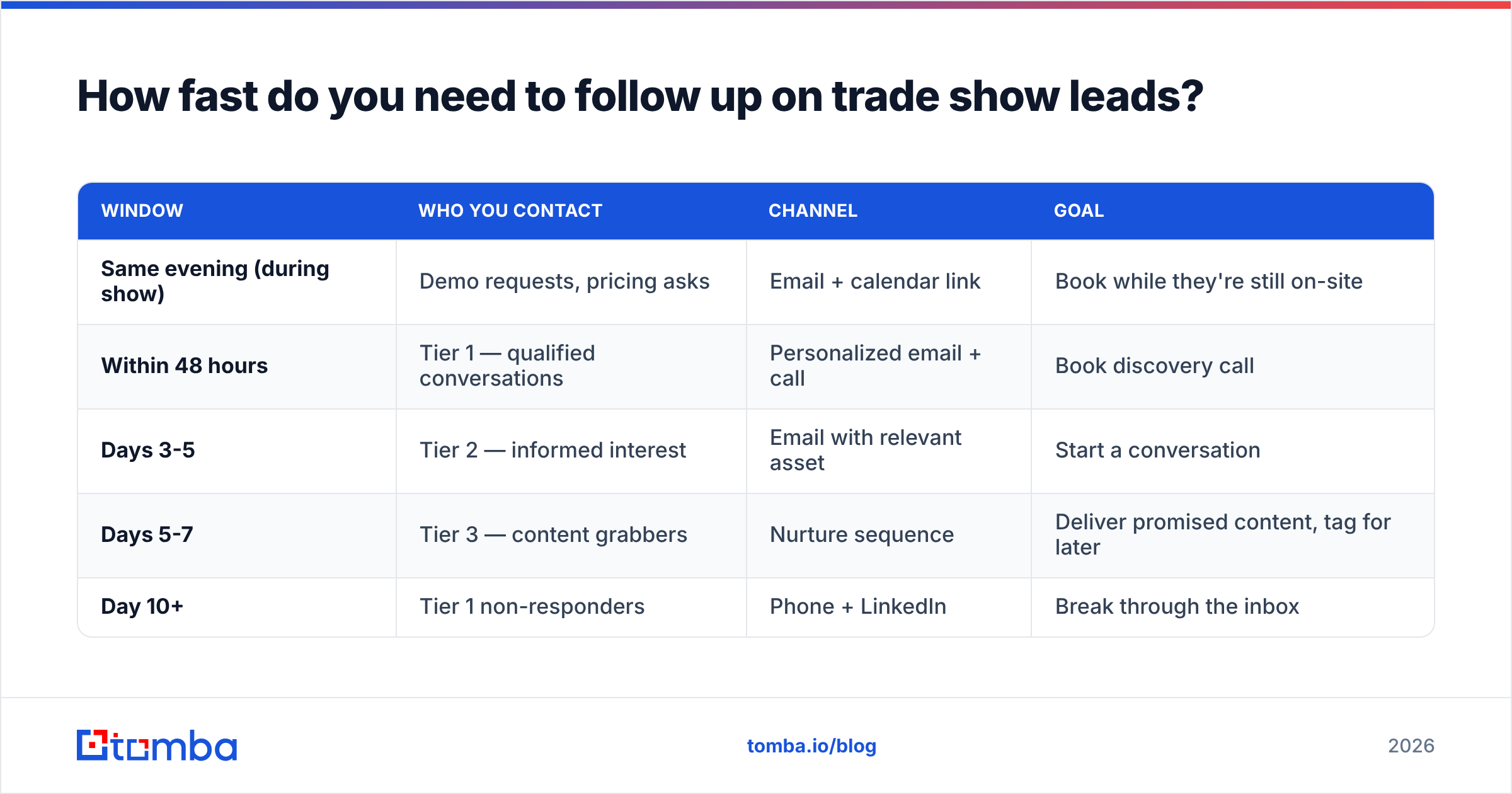
Here's a practical schedule that survives contact with reality:
| Window | Who you contact | Channel | Goal |
|---|---|---|---|
| Same evening (during show) | Demo requests, pricing asks | Email + calendar link | Book while they're still on-site |
| Within 48 hours | Tier 1 — qualified conversations | Personalized email + call | Book discovery call |
| Days 3-5 | Tier 2 — informed interest | Email with relevant asset | Start a conversation |
| Days 5-7 | Tier 3 — content grabbers | Nurture sequence | Deliver promised content, tag for later |
| Day 10+ | Tier 1 non-responders | Phone + LinkedIn | Break through the inbox |
The evening-of email is underrated. If someone asked for a demo at 11am on day two of the show, sending a calendar link at 6pm that same day converts far better than the same message sent the following Tuesday. Half your competitors are waiting until they're back at their desks.
How should you tier and segment badge scans?#
Tiering is the step that separates teams who get ROI from events and teams who don't. Score each scan on four things and let the score pick the treatment.
- Conversation depth — Did a rep actually talk to them, or did they walk past and get scanned? Rep notes are your source of truth here.
- Explicit buying signal — Pricing questions, timeline mentions, "how does this compare to [competitor]," or a demo request. Any one of these forces tier one regardless of other factors.
- Firmographic fit — Company size, industry, tech stack, and geography versus your ICP. This is where enrichment earns its keep.
- Role authority — A VP of Revenue Operations and a marketing intern from the same company are not the same lead, even if both scanned.
- Existing relationship — Check the CRM before you write. An open opportunity, a churned account, or an active support ticket completely changes the right message.
- Competitive context — If they told your rep they're evaluating two other vendors, that's a tier-one lead with a clock on it.
Run this scoring within 24 hours of the show closing. It takes one person about two hours for 400 scans if the rep notes exist. It takes forever if they don't — which is the real argument for enforcing booth-side note-taking.
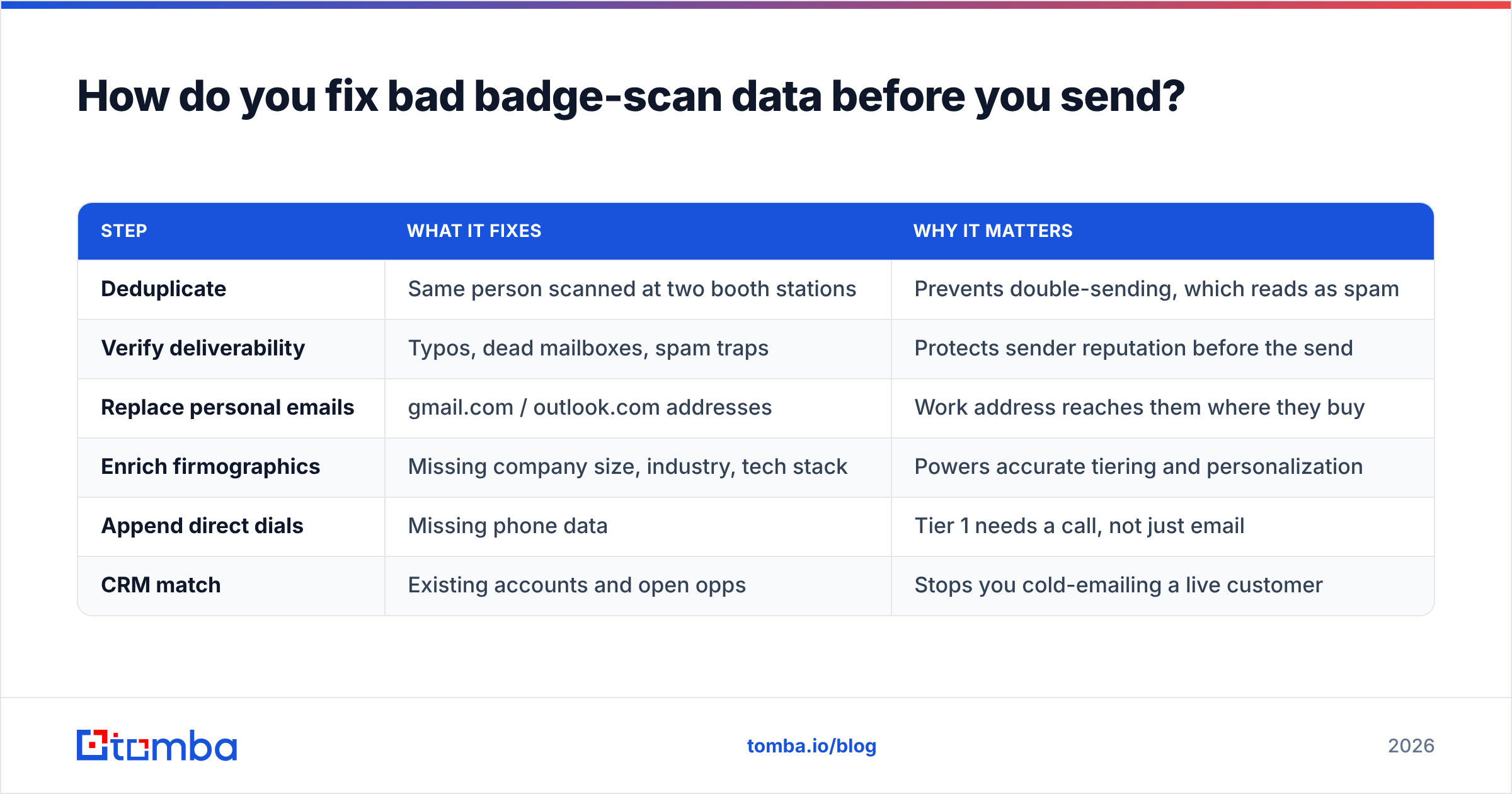
How do you fix bad badge-scan data before you send?#
Assume 20-40% of what the scanner gave you is unusable as-is.
Registration forms are filled out months in advance, often on a phone, often with a personal address to dodge vendor spam. Some scanner apps OCR the badge and introduce character errors. People change jobs between registering and attending. If you upload that list straight into a sequence, your bounce rate spikes, your domain reputation takes damage, and your next campaign — to a completely different list — underperforms because of it.
A clean pipeline looks like this:
| Step | What it fixes | Why it matters |
|---|---|---|
| Deduplicate | Same person scanned at two booth stations | Prevents double-sending, which reads as spam |
| Verify deliverability | Typos, dead mailboxes, spam traps | Protects sender reputation before the send |
| Replace personal emails | gmail.com / outlook.com addresses | Work address reaches them where they buy |
| Enrich firmographics | Missing company size, industry, tech stack | Powers accurate tiering and personalization |
| Append direct dials | Missing phone data | Tier 1 needs a call, not just email |
| CRM match | Existing accounts and open opps | Stops you cold-emailing a live customer |
For the "replace personal emails" step, you know the person's full name and their company from the badge — that's exactly the input an email finder needs to return a business address. Run everything through an email verifier before the first send, and use data enrichment to backfill the firmographic fields your tiering depends on. If your tier-one list needs direct dials for the day-10 phone push, a phone finder closes that gap.
Budget two hours for this. It is the highest-ROI two hours in the entire post-event process, and it is the step teams skip most often.
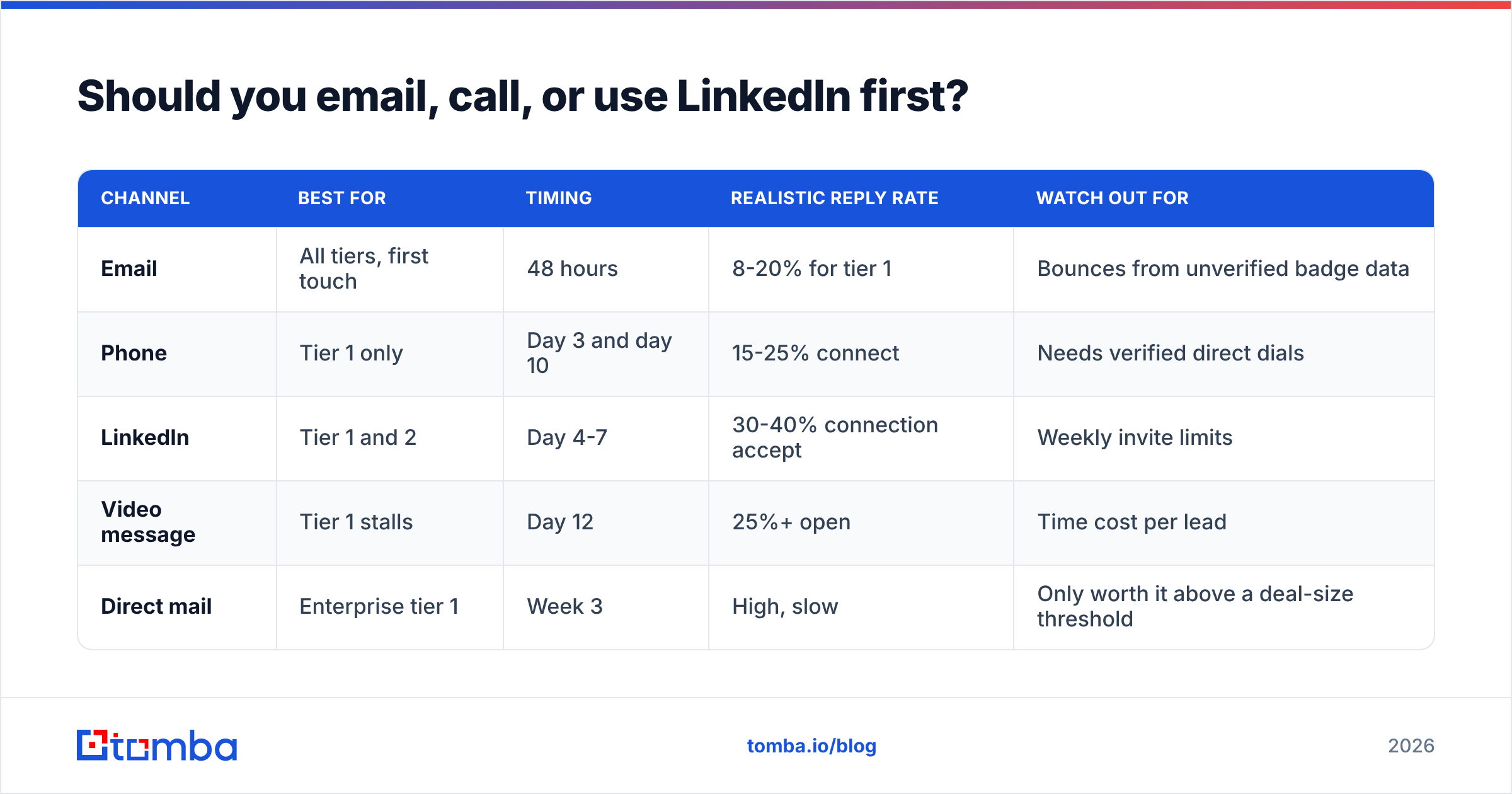
Should you email, call, or use LinkedIn first?#
All three, in a sequence, weighted by tier. Single-channel follow-up is why "we emailed everyone and got nothing" is such a common post-mortem.
| Channel | Best for | Timing | Realistic reply rate | Watch out for |
|---|---|---|---|---|
| All tiers, first touch | 48 hours | 8-20% for tier 1 | Bounces from unverified badge data | |
| Phone | Tier 1 only | Day 3 and day 10 | 15-25% connect | Needs verified direct dials |
| Tier 1 and 2 | Day 4-7 | 30-40% connection accept | Weekly invite limits | |
| Video message | Tier 1 stalls | Day 12 | 25%+ open | Time cost per lead |
| Direct mail | Enterprise tier 1 | Week 3 | High, slow | Only worth it above a deal-size threshold |
The pattern that works: email first (it's the channel they expect after an event), LinkedIn connection second (it puts a face to the name and reopens the memory), phone third (by then you've had two touches, so you're not a cold call). Reversing that order — cold-calling on day one — burns goodwill with people who barely remember the booth.
For teams running structured multi-channel plays, most modern sequencers handle this; the tool matters far less than the tiering discipline that feeds it. Check current user reviews on G2's sales engagement category if you're picking one.
What should the first follow-up email actually say?#
Short, specific, and anchored to the conversation. The failure mode is a template that could have been sent to all 412 people.
Structure that works:
- Subject line: reference the show and the specific topic. "Booth 412 — the Salesforce sync question" beats "Great meeting you at SaaSConnect!"
- First line: prove you were there. Name the thing they said. "You mentioned your team is re-platforming off legacy CRM in Q1."
- Middle: one sentence of relevance, not a pitch. Link the specific asset that answers their specific question.
- Close: one clear ask with a low commitment. A 15-minute call or a direct question, never "let me know if you'd like to learn more."
- Length: under 120 words. They have 300 unread emails from the show.
Do not attach a 40-slide deck. Do not open with "I hope this email finds you well." Do not send the same message to tier one and tier three — if you can't personalize a tier, it belongs in a nurture track instead, where an honest "here's the whitepaper you asked for" performs better than a fake-personal note. If you need starting points, cold email templates are a reasonable base to adapt, but the booth-note detail is what makes them work.
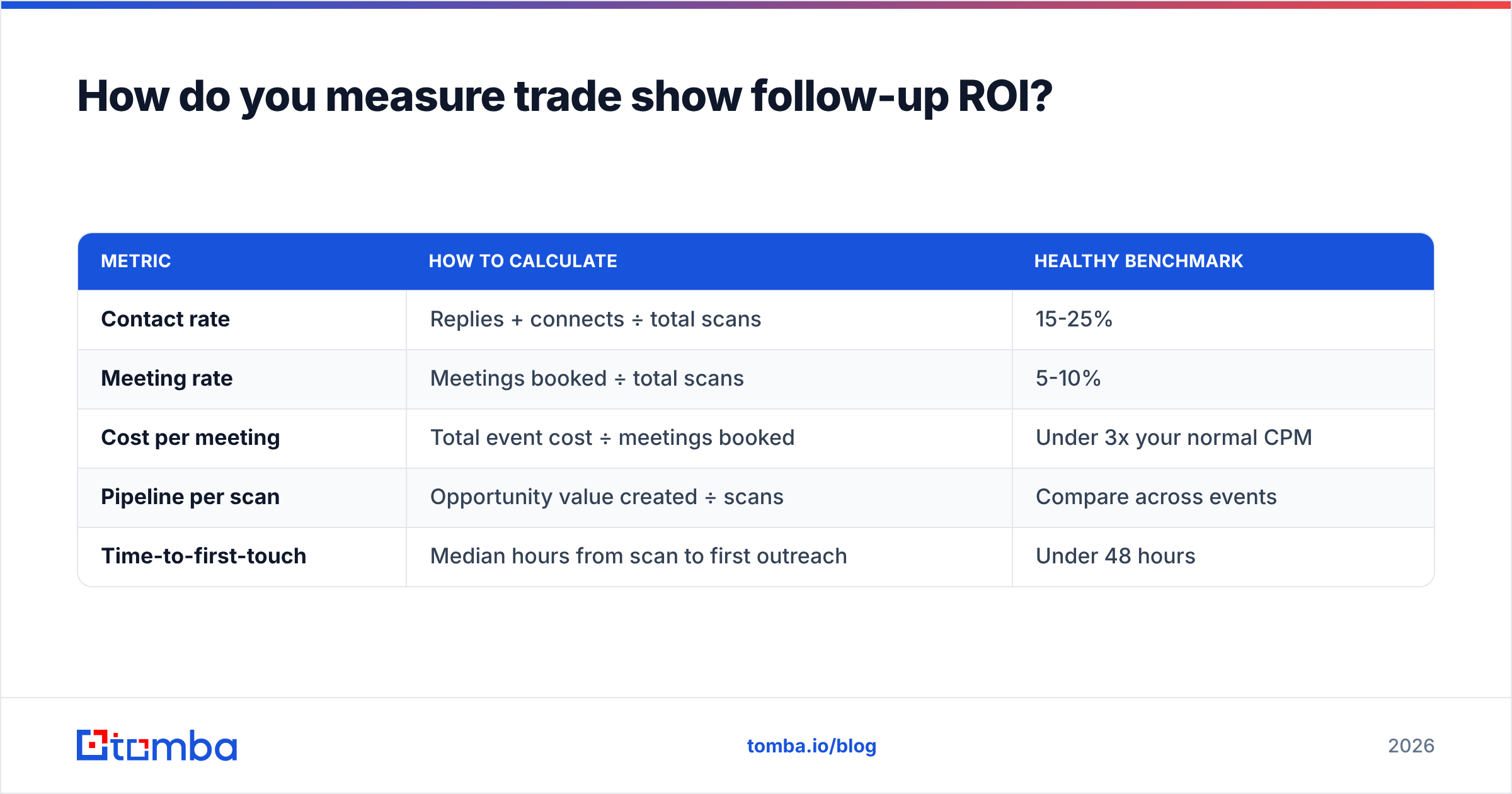
How do you measure trade show follow-up ROI?#
Track four numbers, and track them the same way every event so you can compare shows year over year.
| Metric | How to calculate | Healthy benchmark |
|---|---|---|
| Contact rate | Replies + connects ÷ total scans | 15-25% |
| Meeting rate | Meetings booked ÷ total scans | 5-10% |
| Cost per meeting | Total event cost ÷ meetings booked | Under 3x your normal CPM |
| Pipeline per scan | Opportunity value created ÷ scans | Compare across events |
| Time-to-first-touch | Median hours from scan to first outreach | Under 48 hours |
Time-to-first-touch is the leading indicator. It's the only one of these you can influence in the first week, and it predicts the rest. If your median is nine days, no amount of copywriting will save the number.
Set up the CRM fields before the show, not after. A single "event source" field plus a "scan tier" field lets you slice this in two clicks instead of reconstructing it from memory in Q4 planning. If you already run a CRM with campaign attribution, wire the badge import to it directly.
What are the most common trade show follow-up mistakes?#
- Waiting until everyone's back in the office. The show ends Thursday; tier one gets contacted Thursday night.
- Uploading raw scan data to a sequencer. Bounces from event lists damage the sender reputation you need for every other campaign.
- One message for 400 people. Tiering exists precisely so you don't have to choose between "generic to everyone" and "hand-written to everyone."
- Stopping after two emails. Most booked meetings from event leads come from touch three through six, across multiple channels.
- No handoff protocol. If the rep who had the conversation isn't the one following up, the booth note has to travel with the record — or the personalization dies.
- Discarding non-responders. A tier-two lead who ignored you in March is a warm name in September. Move them to nurture, don't delete them.
Where should you start before your next event?#
Fix the data step first. It's the cheapest change and it unblocks everything downstream — verified addresses mean your sequences actually land, enriched records mean your tiering is real, and direct dials mean your day-10 phone push has something to dial.
Tomba's Email Finder turns the name-plus-company you captured at the badge scanner into a verified business email address, with verification and enrichment in the same workflow so your event list is clean before the first send. The free tier covers 25 searches a month if you want to test it against last event's list; paid plans start at $49/month, and you can compare volumes on Tomba pricing. Run your last show's scans through it, see how many personal addresses you can replace with work addresses, and you'll know exactly how much pipeline the old process was leaving on the expo floor.
Related guides#
Ready to find emails that actually work?
Join 150,000+ professionals who stopped guessing and started sending. Free credits on signup — no credit card required.
Get the Tomba newsletter
Practical outbound tactics and product updates — once every two weeks.
About the author