"Following Up Regarding": 12 Better Follow-Up Templates
"Following up regarding my last email" is the most common opener in B2B outbound — and one of the weakest. Here's why it stalls, what to write instead, and 12 templates you can paste today.
TL;DR
- "Following up regarding my last email" is a status update about you, not a reason for the prospect to reply. That's why it underperforms.
- The phrase itself isn't banned — it works fine when it refers to a real shared event (a call, a demo, a signed doc). It fails when it refers to your own unanswered email.
- Replace the bump with a new unit of value: a fresh angle, a relevant trigger, a shorter ask, or a clean break-up.
- Cadence matters more than wording. Three to five touches over 12–18 business days beats seven touches in seven days.
- None of it matters if the address is wrong. Bad data is the silent killer of follow-up sequences — verify before you sequence.
What does "following up regarding" actually mean?#
It means two very different things depending on what comes after it, and most reps use the weaker version.
Version A — anchored: "Following up regarding the pricing sheet you asked for on Tuesday's call." There's a shared reference point. The recipient knows exactly what thread this belongs to, and there's an implied obligation because they asked.
Version B — unanchored: "Following up regarding my email from last week." The only shared reference is a message they never opened. You're asking them to feel guilty about ignoring you, then rewarding that guilt with... nothing new.
Version A is a legitimate business phrase used every day in account management, recruiting, invoicing, and legal correspondence. Version B is the one that has quietly become a spam signal in crowded inboxes. When 60% of the follow-ups a VP of Marketing receives open with some variant of "just circling back," the phrase stops carrying information and starts carrying noise.
The distinction is worth internalizing before you rewrite a single template: the problem is not the words. The problem is that the words are pointing at an empty room.
Why does "following up regarding" underperform in cold outreach?#
Three structural reasons, none of which are fixed by swapping in a synonym.
- It adds no new information. A reply is a trade — their attention for your value. A bump offers nothing to trade. If email one didn't clear the bar, email two containing strictly less content will not clear it either.
- It shifts the burden onto them. "Did you get a chance to look at this?" makes the prospect responsible for your pipeline. Busy buyers reliably decline that responsibility.
- It compounds thread fatigue. Replying inside a dead thread means scrolling past your own silence. Some prospects find that mildly embarrassing, and mild embarrassment is enough to trigger archive-and-forget.
There's a fourth reason that's easy to miss: reply-rate math punishes low-signal sends disproportionately. Mailbox providers weigh engagement heavily, so a sequence of four ignored bumps trains the filter that your domain produces mail nobody wants. You didn't just lose one prospect. You made the next campaign harder. If you want the mechanics, the glossary entry on email deliverability covers how engagement signals feed reputation.
Note the causality carefully, because it's often stated backwards. Bumping doesn't hurt because it's rude. It hurts because it's low-signal, and low-signal mail at volume is what filters are built to catch.
What should you write instead of "following up regarding"?#
Swap the status update for a reason to exist. Here's the mapping most teams need:
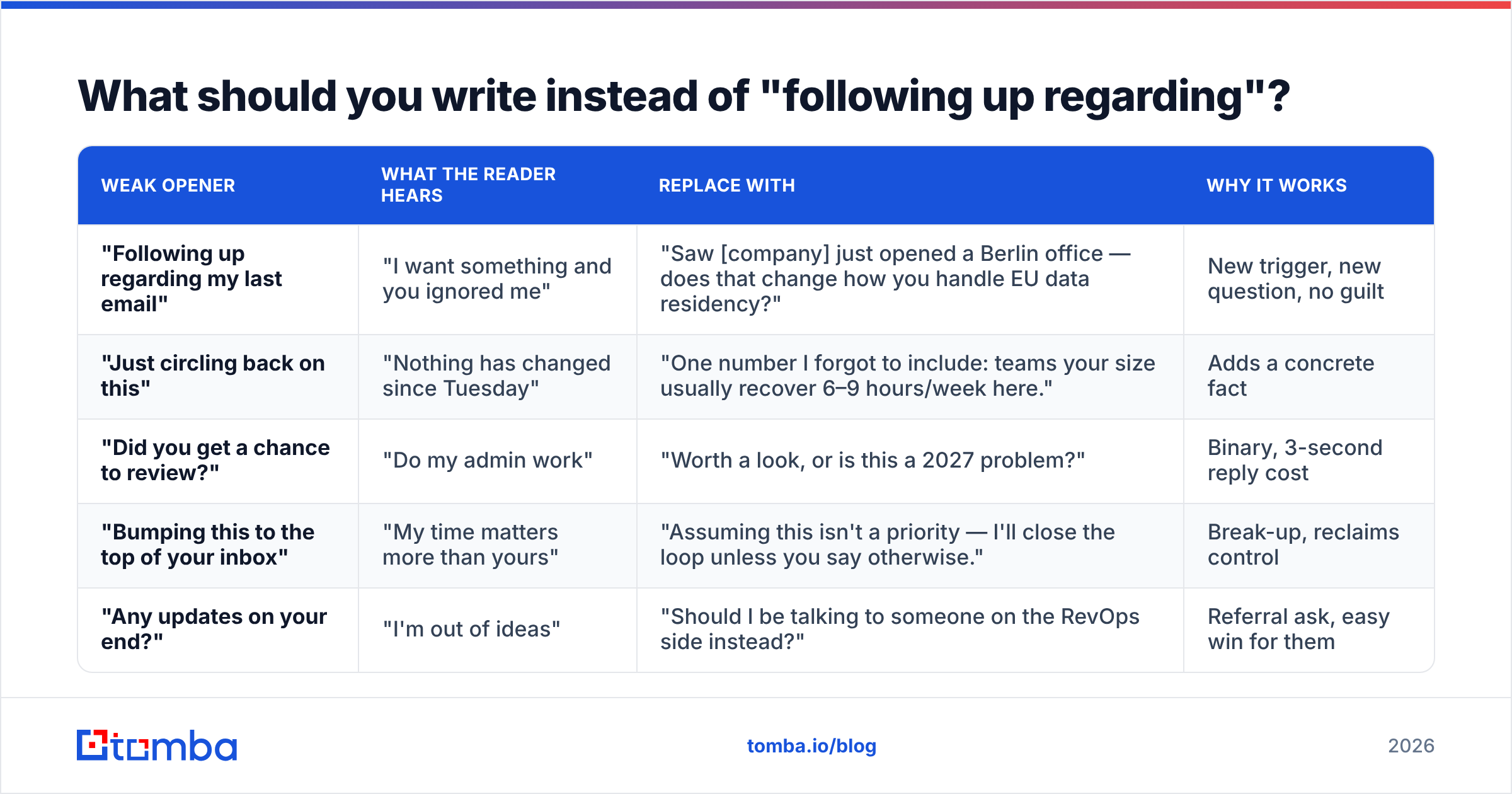
| Weak opener | What the reader hears | Replace with | Why it works |
|---|---|---|---|
| "Following up regarding my last email" | "I want something and you ignored me" | "Saw [company] just opened a Berlin office — does that change how you handle EU data residency?" | New trigger, new question, no guilt |
| "Just circling back on this" | "Nothing has changed since Tuesday" | "One number I forgot to include: teams your size usually recover 6–9 hours/week here." | Adds a concrete fact |
| "Did you get a chance to review?" | "Do my admin work" | "Worth a look, or is this a 2027 problem?" | Binary, 3-second reply cost |
| "Bumping this to the top of your inbox" | "My time matters more than yours" | "Assuming this isn't a priority — I'll close the loop unless you say otherwise." | Break-up, reclaims control |
| "Any updates on your end?" | "I'm out of ideas" | "Should I be talking to someone on the RevOps side instead?" | Referral ask, easy win for them |
The pattern across all five replacements: each one gives the prospect a cheaper action than the original email did. Email one asked for a meeting. Email three asks for a yes/no, a name, or a date. Descending ask cost is the single most reliable structural fix in follow-up writing.
Which follow-up structures actually get replies?#
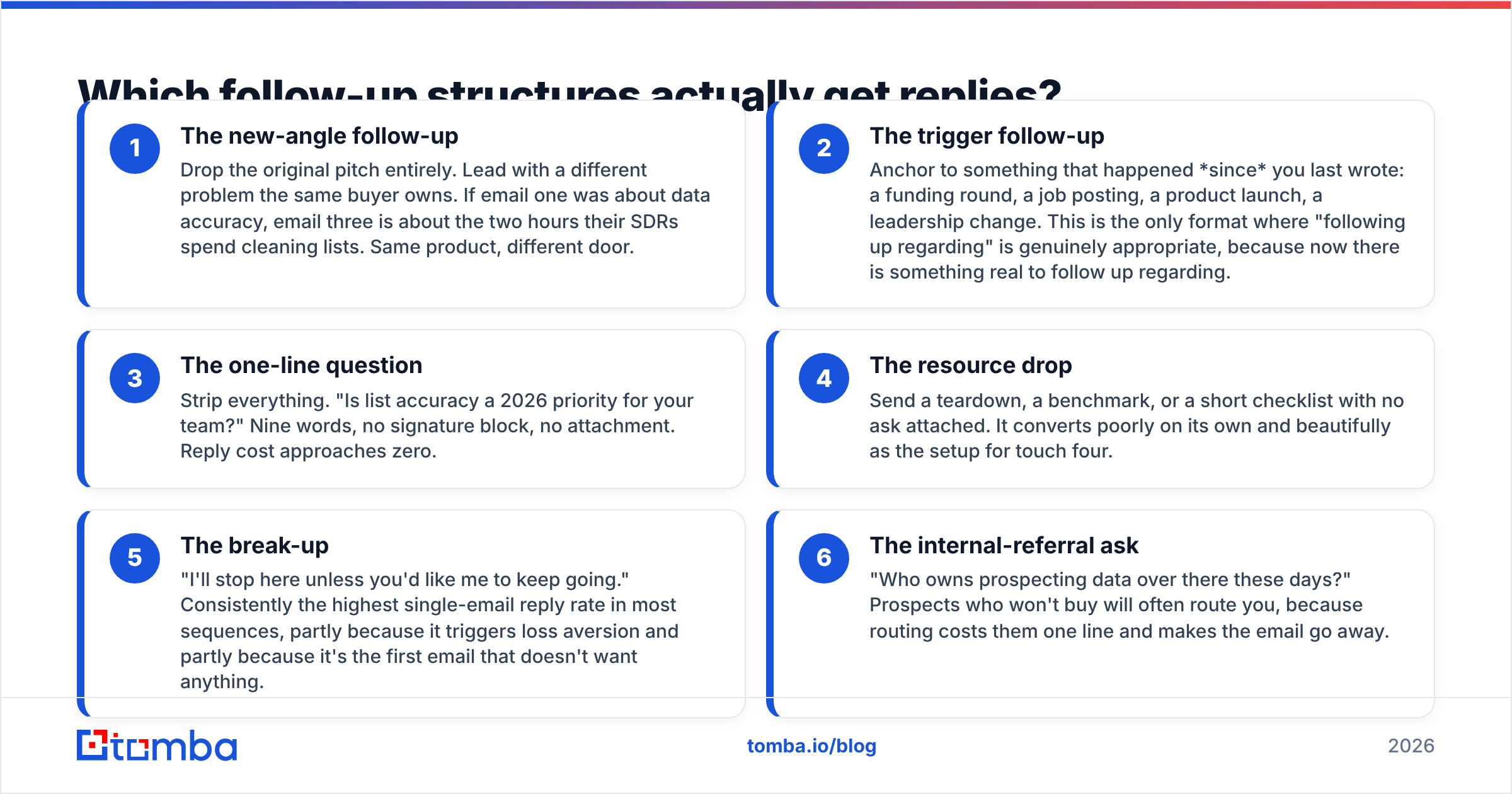
Five formats, ordered by how often they land in real B2B sequences:
- The new-angle follow-up — Drop the original pitch entirely. Lead with a different problem the same buyer owns. If email one was about data accuracy, email three is about the two hours their SDRs spend cleaning lists. Same product, different door.
- The trigger follow-up — Anchor to something that happened since you last wrote: a funding round, a job posting, a product launch, a leadership change. This is the only format where "following up regarding" is genuinely appropriate, because now there is something real to follow up regarding.
- The one-line question — Strip everything. "Is list accuracy a 2026 priority for your team?" Nine words, no signature block, no attachment. Reply cost approaches zero.
- The resource drop — Send a teardown, a benchmark, or a short checklist with no ask attached. It converts poorly on its own and beautifully as the setup for touch four.
- The break-up — "I'll stop here unless you'd like me to keep going." Consistently the highest single-email reply rate in most sequences, partly because it triggers loss aversion and partly because it's the first email that doesn't want anything.
- The internal-referral ask — "Who owns prospecting data over there these days?" Prospects who won't buy will often route you, because routing costs them one line and makes the email go away.
Run your subject lines through a subject line tester before you commit a sequence to production — a follow-up with a strong body and a "RE: quick question" subject still dies at the preview pane.
How many follow-ups should you send, and when?#
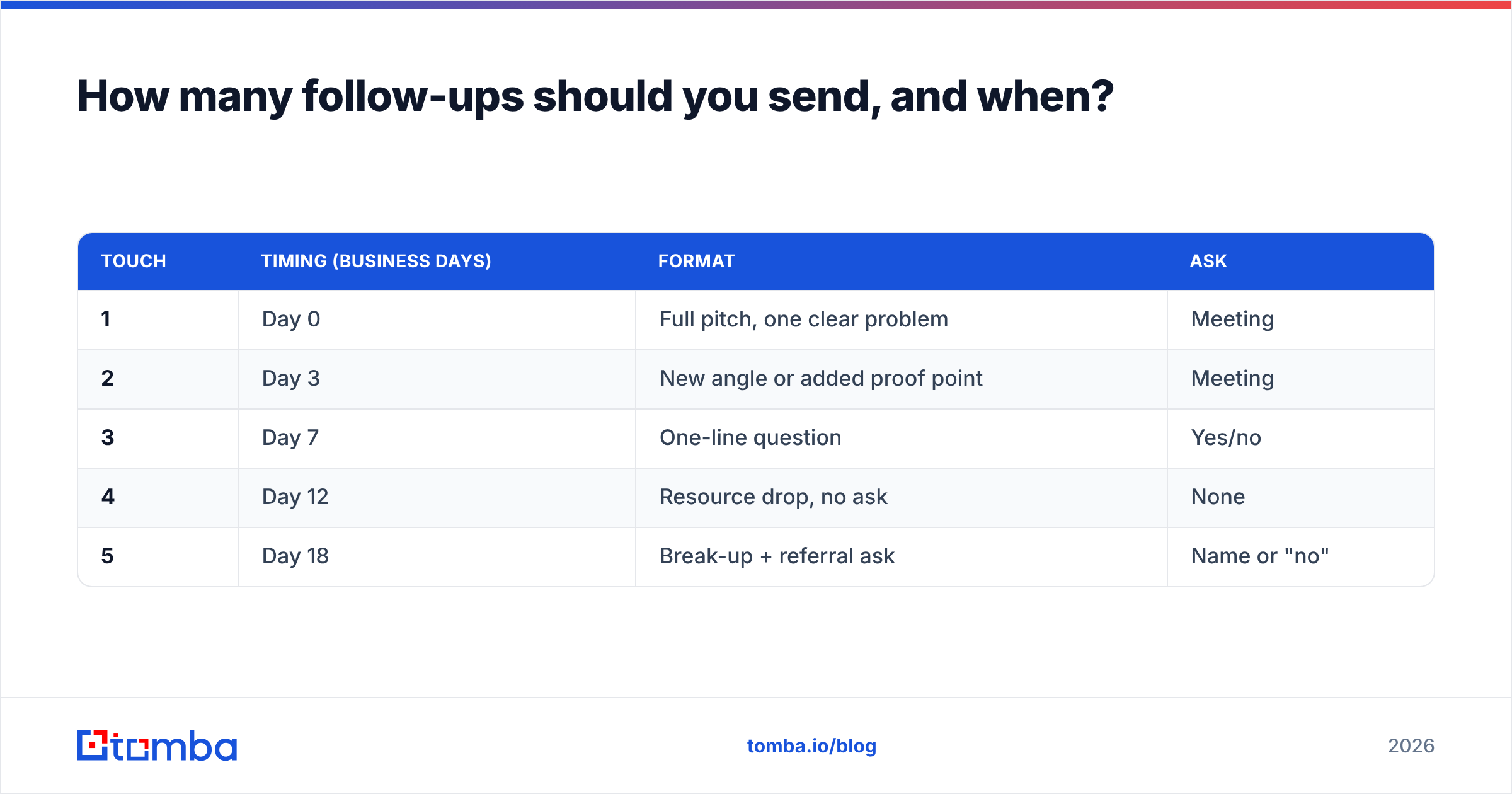
More than most reps send, spaced further apart than most reps space them.
| Touch | Timing (business days) | Format | Ask |
|---|---|---|---|
| 1 | Day 0 | Full pitch, one clear problem | Meeting |
| 2 | Day 3 | New angle or added proof point | Meeting |
| 3 | Day 7 | One-line question | Yes/no |
| 4 | Day 12 | Resource drop, no ask | None |
| 5 | Day 18 | Break-up + referral ask | Name or "no" |
Two rules govern this table. First, never send two touches in the same 48 hours — same-week bumps read as automation and get archived in batch. Second, stop at five for cold, three for warm. A prospect who took a demo and went quiet needs fewer, gentler touches than a stranger; over-sequencing a warm lead damages a relationship you already paid to build.
Sales research from vendors like HubSpot and analyst coverage from Gartner both point the same direction: persistence pays, but only when each touch carries something the last one didn't. Cadence length is not the variable. Content variance is.
Also worth knowing: sequence hygiene has a compliance dimension. Every follow-up in a cold sequence needs a working opt-out path and accurate sender identity — the requirements under the CAN-SPAM Act apply to touch five exactly as they do to touch one.
What do 12 better follow-up emails look like?#
Copy these, swap the brackets, and cut anything that doesn't survive a read-aloud test.
Trigger-based
Subject: Berlin office → EU data residency? "Saw the Berlin announcement. Usually that means somebody suddenly owns a data residency question they didn't have last quarter. Is that landing on your desk or someone else's?"
Subject: [Competitor] just shipped [feature] "Not selling anything with this one — [competitor] shipped [feature] last week and it changes the math on [problem]. Two-line summary below if useful."
Subject: congrats on the [round] raise "Congrats on the raise. Post-round, most teams your size double outbound headcount before they fix data quality, then spend Q3 undoing it. Worth 10 minutes before you hire?"
Value-add
Subject: the number I left out "I sent you a pitch on Tuesday and forgot the only number that matters: [X]% of a typical purchased list is undeliverable within 90 days. That's the whole case, honestly."
Subject: teardown of your signup flow "Spent 15 minutes in your signup flow. Three things I'd change, none of which involve buying anything from me. Want the notes?"
Subject: benchmark for [industry] reply rates "We pulled reply-rate medians for [industry] this quarter. You're probably above the median, but the gap between median and top decile is bigger than most people expect."
Low-cost ask
Subject: quick one "Is [problem] a 2026 priority, or a later thing? Either answer is useful."
Subject: right person? "Should I be talking to you about [topic], or is that RevOps now? Happy to be redirected."
Subject: 30 seconds "Reply '1' if you want the deck, '2' if you want me to check back in Q4, '3' if never. No wrong answers."
Break-up and reactivation
Subject: closing the loop "I'll stop here. If [problem] gets loud later, my inbox stays open. Good luck with [initiative]."
Subject: one last thing before I go "Last email from me. The one asset worth keeping regardless: [resource]. It's free and it doesn't require talking to me."
Subject: six months later "You told me in [month] that this was a next-year problem. It's next year. Still true, or did it change?"
Number twelve outperforms almost everything on this list and almost nobody sends it. Set the reminder when they say "not now," and the follow-up writes itself. If you want more starting points, the cold email templates library covers the first-touch side of the same sequence.
Does list quality matter more than follow-up wording?#
Yes, and it isn't close.
A perfectly written five-touch sequence sent to a stale list produces bounces, spam complaints, and a damaged sending domain. A mediocre sequence sent to verified, correctly-titled contacts produces meetings. Copy is a multiplier on data quality, and multiplying by a bad number gives you a bad number.
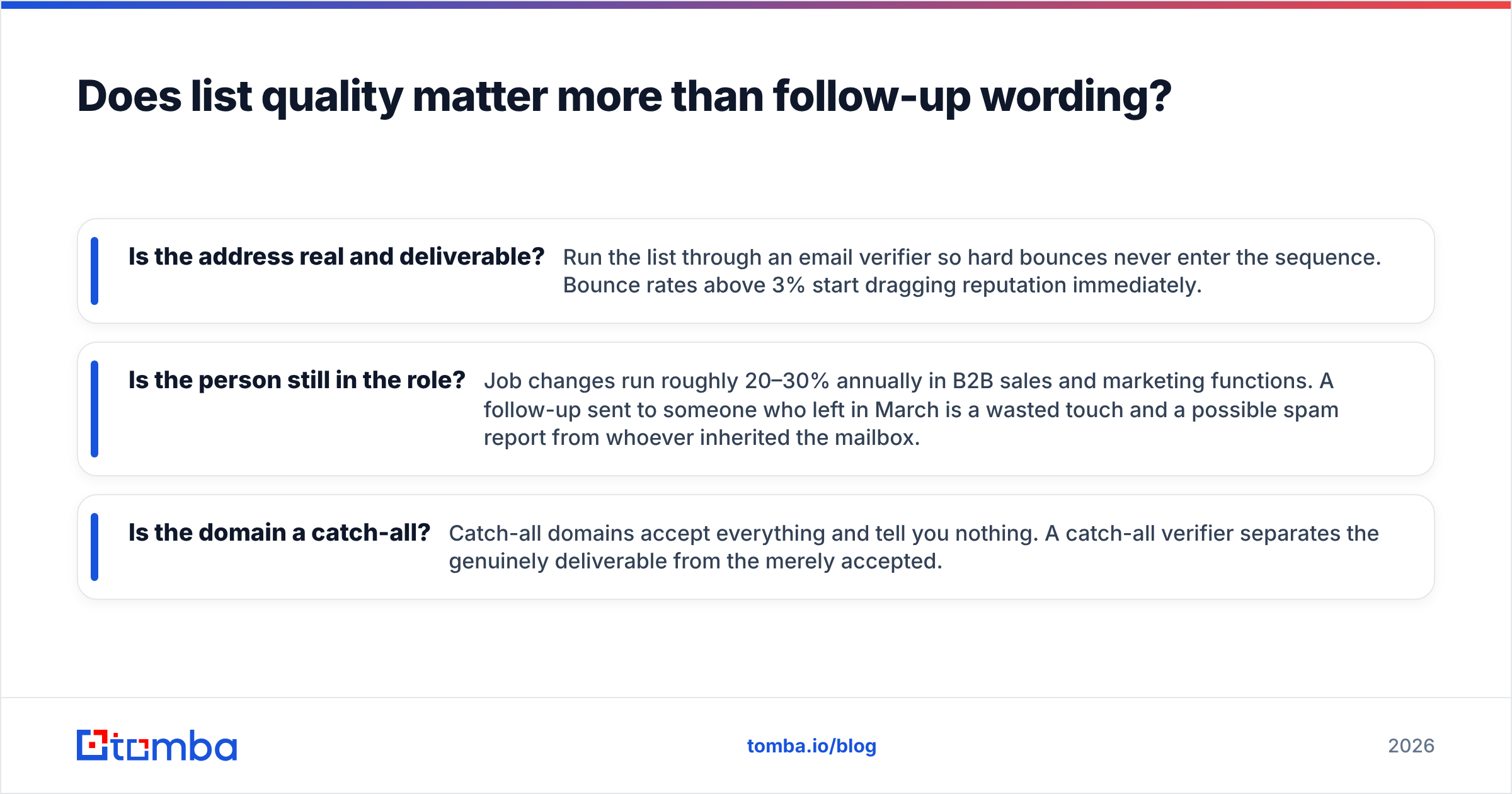
Three checks before any sequence goes live:
- Is the address real and deliverable? Run the list through an email verifier so hard bounces never enter the sequence. Bounce rates above 3% start dragging reputation immediately.
- Is the person still in the role? Job changes run roughly 20–30% annually in B2B sales and marketing functions. A follow-up sent to someone who left in March is a wasted touch and a possible spam report from whoever inherited the mailbox.
- Is the domain a catch-all? Catch-all domains accept everything and tell you nothing. A catch-all verifier separates the genuinely deliverable from the merely accepted.
There's a strategic point buried in the hygiene. Most reps write follow-ups apologetically because deep down they suspect the prospect is a bad fit — wrong company, wrong role, wrong moment. That suspicion leaks into the writing as hedging, over-explaining, and "sorry to bother you." When you trust the list, the tone changes on its own. Confidence in follow-up copy is downstream of confidence in data.
For comparison shopping on data providers, G2's category pages are a reasonable neutral starting point — vendors including Tomba, BookYourData, and the larger enterprise databases all publish verified-rate claims there, and reading three of them side by side calibrates expectations fast.
What are the most common follow-up mistakes?#
- Replying in the same thread five times. Two threads maximum, then start fresh with a new subject. A five-deep quote chain is visually exhausting.
- Apologizing. "Sorry to bother you again" tells the reader you agree you're a bother.
- Attaching the deck at touch two. Attachments hurt deliverability on cold sends and nobody opens a deck from a stranger.
- Sending Monday 8am. Every automated sequence fires then. Mid-morning Tuesday through Thursday clears less competition.
- Ending with "let me know your thoughts." No prospect has thoughts. Ask a question with a one-word answer.
- Never breaking up. The break-up email is the highest-yield message in the sequence. Skipping it to "keep the door open" leaves the highest-converting touch unsent.
FAQ#
Is "following up regarding" ever the right phrase? Yes — when it points at a real shared event. "Following up regarding Thursday's call" is clear and professional. "Following up regarding my previous email" is not.
How long should a follow-up be? Shorter than the email before it. Touch one can run 90 words. Touch three should run under 30.
Should follow-ups use the same subject line? Change it after touch two. Fresh subject lines get fresh preview-pane attention; "RE: RE: quick question" signals a thread the reader already decided to ignore.
What reply rate should I expect? Well-targeted B2B sequences with verified data commonly land in the 5–12% reply band across five touches. Anything under 2% is a targeting or data problem, not a copy problem. See the response rate definition for how to measure it consistently.
Start with contacts worth following up on#
Rewriting your follow-up copy is worth doing — but it's the second lever, not the first. The sequences that work start with a list where every address resolves, every title is current, and every domain is deliverable.
Tomba's Email Finder pulls verified professional addresses by domain, name, or company, with confidence scoring on every result so you know which contacts deserve a five-touch sequence and which should never enter one. The free tier includes 25 searches a month, and paid plans start at $49/mo — full Tomba pricing is public, with no per-seat surprises. Build the list first, then let the follow-ups do what they're actually good at.
Related guides#
Ready to find emails that actually work?
Join 150,000+ professionals who stopped guessing and started sending. Free credits on signup — no credit card required.
Get the Tomba newsletter
Practical outbound tactics and product updates — once every two weeks.
About the author