FollowUp CRM Pricing Reviews Pros and Cons: 2026 Guide
A neutral breakdown of FollowUp CRM pricing, what real reviewers praise and complain about, where the hidden costs sit, and which teams should pick something else.
FollowUp CRM pricing, reviews, pros and cons all point to the same conclusion: this is a sharp tool for a narrow job. It tracks construction bids well. It will not find you new work.
TL;DR
- FollowUp CRM is a per-seat sales CRM built for construction. It is organized around bid tracking and follow-up, not general pipeline work or prospecting.
- Public pricing sits in the $55–$85 per user/month range, depending on term and tier. Add a one-time onboarding fee that buyers often forget to budget.
- Reviewers praise the bid pipeline, win/loss reporting, and fast adoption by estimators. The common complaints: limited customization, thin native integrations, and mobile gaps.
- Seat count drives the cost, not features. A 12-seat estimating team lands near $9,000–$12,000 a year before implementation.
- FollowUp CRM manages the pipeline you already have. It does not create one. You still need a contact data layer to feed it.
What is FollowUp CRM and who is it actually for?#
FollowUp CRM is a vertical sales CRM for commercial construction contractors: general contractors, specialty subs, roofers, electrical and mechanical firms. It skips the generic "deals in stages" model. Instead it is built around the bid — which projects you chase, which estimator owns them, what you bid, who you bid to, and whether you won.
Think of it like the difference between a general toolbox and a plumber's van. A general CRM hands you empty fields and asks you to model construction yourself. FollowUp CRM ships with the plumbing already in place: bid boards, GC contact records, win rate by estimator, and reminders keyed to bid dates.
That focus is the product's biggest strength and its biggest limit. If you sell commercial construction work, the built-in structure saves months of setup. If you sell anything else — SaaS, agency services, manufacturing distribution — you pay vertical-CRM prices for a schema that does not match your business.
Who it fits:
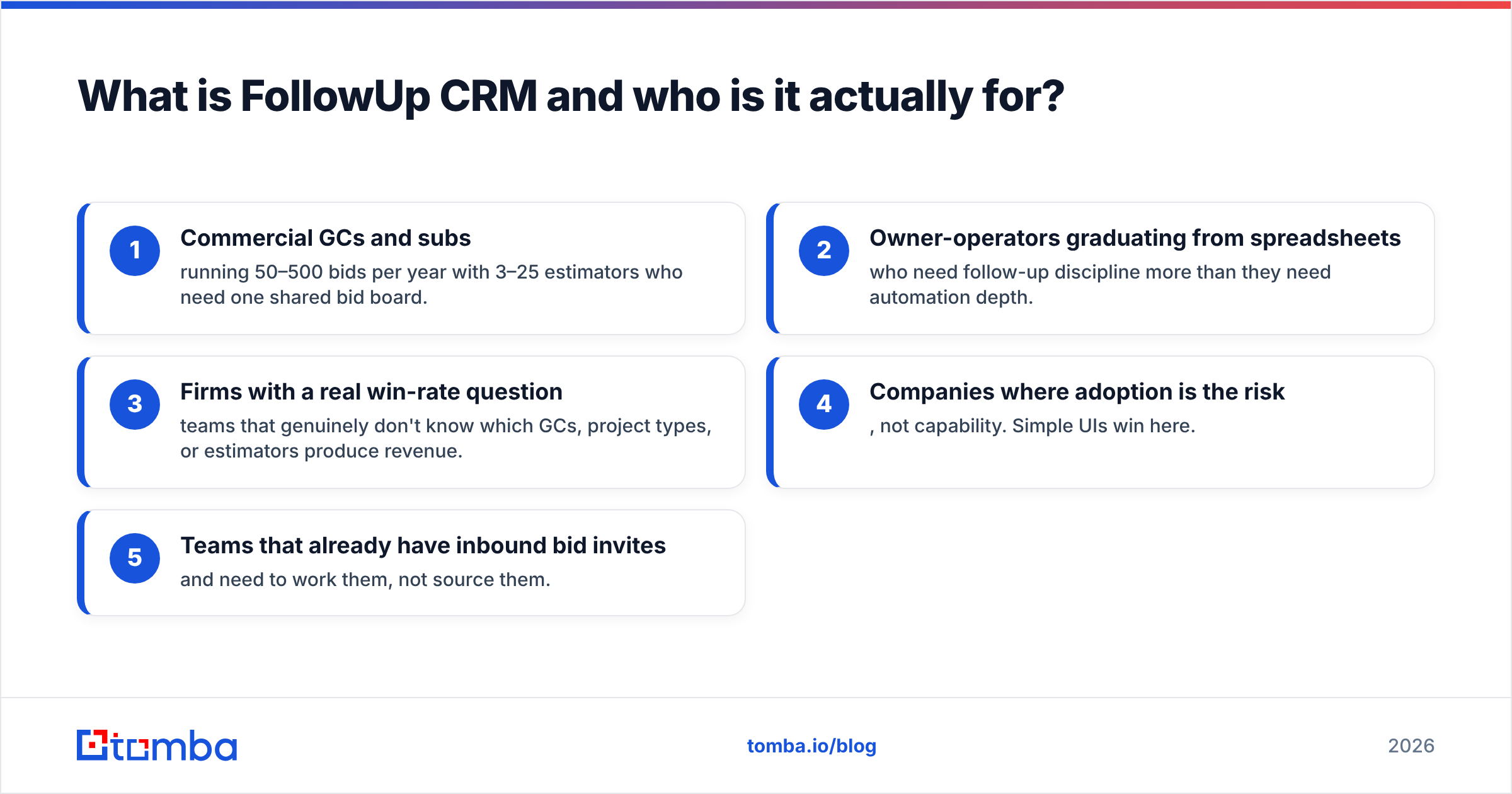
- Commercial GCs and subs running 50–500 bids a year with 3–25 estimators who need one shared bid board.
- Owner-operators graduating from spreadsheets who need follow-up discipline more than automation depth.
- Firms with a real win-rate question — teams that do not know which GCs, project types, or estimators produce revenue.
- Companies where adoption is the risk, not capability. Simple UIs win here.
- Teams that already get inbound bid invites and need to work them, not source them.
Who it does not fit: anyone who needs deep customization, complex multi-product quoting, or a CRM that doubles as an outbound prospecting engine.
How much does FollowUp CRM cost in 2026?#
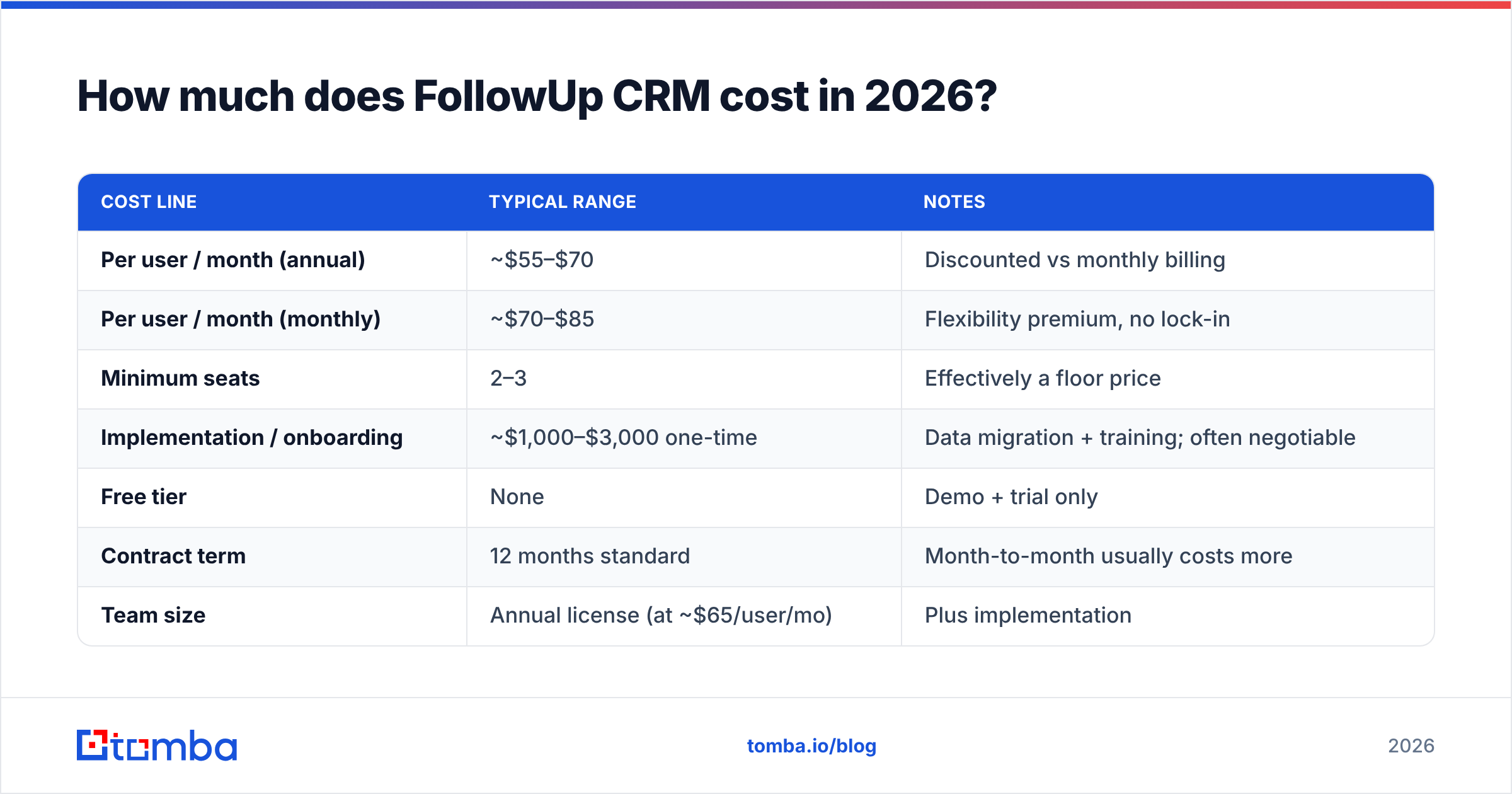
FollowUp CRM does not publish a full self-serve price list the way a PLG SaaS tool does. Like most vertical CRMs, it quotes per user per month, with discounts for annual prepay and volume, plus a one-time implementation charge. Reported figures and buyer reports from directories like G2 and Capterra cluster in a narrow band.
Here is the realistic shape of a 2026 quote. Treat these as planning numbers, not a contract. Always get a written quote.
| Cost line | Typical range | Notes |
|---|---|---|
| Per user / month (annual) | ~$55–$70 | Discounted vs monthly billing |
| Per user / month (monthly) | ~$70–$85 | Flexibility premium, no lock-in |
| Minimum seats | 2–3 | Effectively a floor price |
| Implementation / onboarding | ~$1,000–$3,000 one-time | Data migration + training; often negotiable |
| Free tier | None | Demo + trial only |
| Contract term | 12 months standard | Month-to-month usually costs more |
Run that against real team sizes and the picture sharpens:
| Team size | Annual license (at ~$65/user/mo) | Plus implementation | Effective year-one cost |
|---|---|---|---|
| 3 estimators | $2,340 | $1,000 | ~$3,340 |
| 6 estimators | $4,680 | $1,500 | ~$6,180 |
| 12 estimators | $9,360 | $2,500 | ~$11,860 |
| 25 estimators | $19,500 | $3,000 | ~$22,500 |
The pattern is clear. FollowUp CRM is not expensive per seat next to enterprise CRM, but the cost scales straight up with headcount. There is no cheap "read-only" or "light" seat for PMs, admins, or execs who just want to look at the bid board. That gap is the budget surprise buyers report most.
What do FollowUp CRM reviews actually say?#
Strip out the vendor testimonials and the review pattern is consistent across directories. On FollowUp CRM pricing, reviews, pros and cons, buyers tend to agree on the same short list.
What reviewers praise:
- Adoption speed. Estimators who ignored Salesforce actually use this. The bid-centric layout matches how they already think, so training takes hours, not weeks.
- Win/loss visibility. Reports on win rate by estimator, GC, project type, and bid size are the most-cited value driver. Several reviewers found that 20–30% of their bidding volume produced almost no revenue.
- Follow-up discipline. The namesake feature sends automated reminders after a bid goes out. Reviewers say it recovers deals that would have gone quiet.
- Support responsiveness. Small-vendor advantage: reviewers name their CSM.
What reviewers complain about:
- Customization ceiling. Custom fields, stages, and reports are limited next to a configurable platform. What you get is what you get.
- Integration depth. Native links to accounting (Sage, Foundation, QuickBooks), takeoff, and project management tools are thinner than buyers expect. Some workflows end in CSV exports.
- Mobile experience. Field users say the mobile app lags the desktop version. That is a real problem for superintendents and outside sales.
- No free tier. You cannot evaluate it quietly on your own time. Every path runs through a sales demo.
- Price sensitivity at small scale. For a two-person shop, spreadsheets plus discipline are genuinely competitive.
The fair summary: it is a well-liked product inside its lane, with a hard boundary at the edge of that lane. Reviews rarely say "it broke." They say "it would not bend."
Is FollowUp CRM worth it compared to alternatives?#
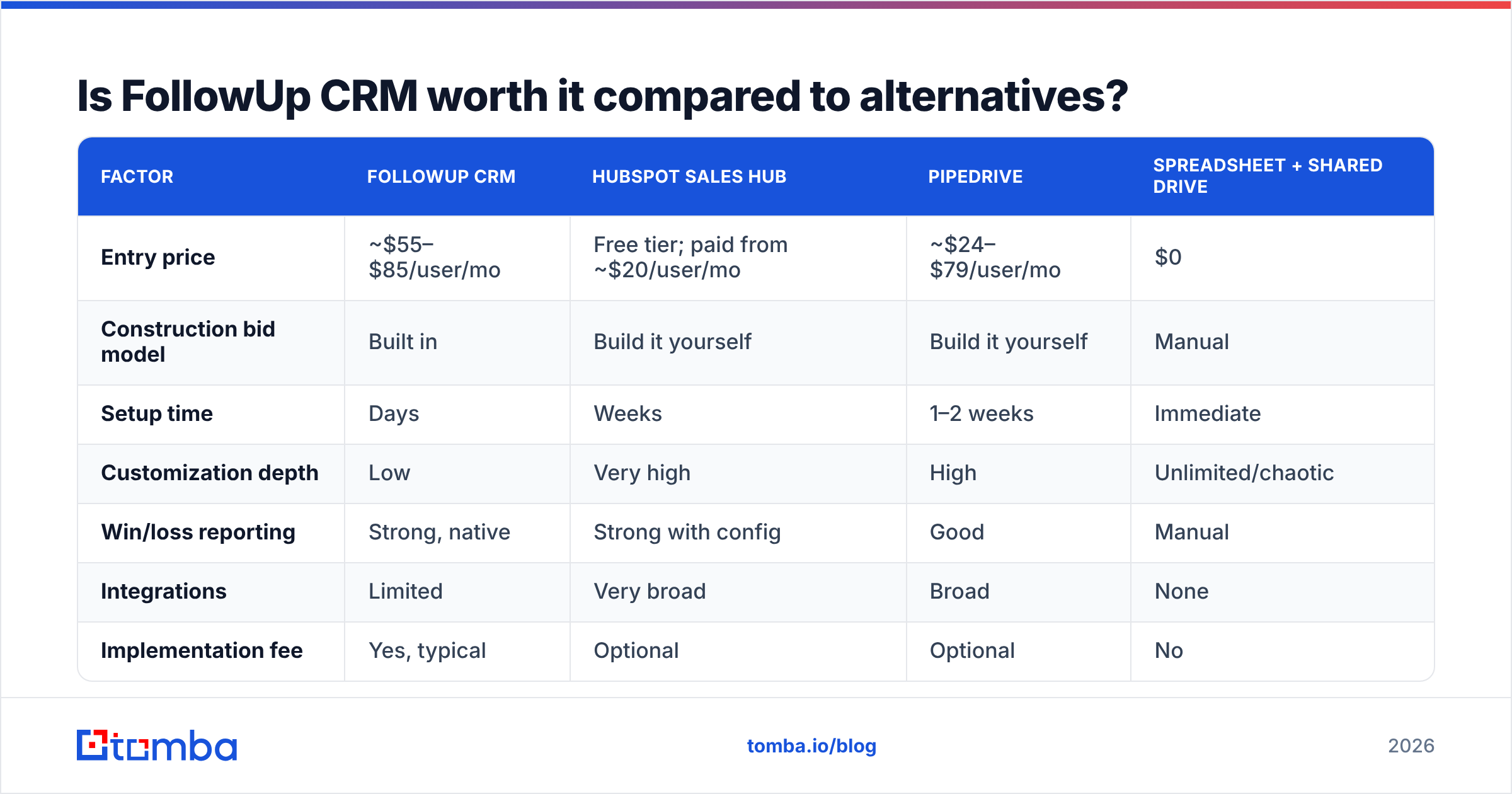
It comes down to one thing: whether construction-specific structure is worth the vertical premium. Here is how it stacks up against the options a contractor really weighs.
| Factor | FollowUp CRM | HubSpot Sales Hub | Pipedrive | Spreadsheet + shared drive |
|---|---|---|---|---|
| Entry price | ~$55–$85/user/mo | Free tier; paid from ~$20/user/mo | ~$24–$79/user/mo | $0 |
| Construction bid model | Built in | Build it yourself | Build it yourself | Manual |
| Setup time | Days | Weeks | 1–2 weeks | Immediate |
| Customization depth | Low | Very high | High | Unlimited/chaotic |
| Win/loss reporting | Strong, native | Strong with config | Good | Manual |
| Integrations | Limited | Very broad | Broad | None |
| Implementation fee | Yes, typical | Optional | Optional | No |
| Best for | 3–25 estimators, commercial construction | Marketing + sales alignment | General B2B pipelines | Under 3 people |
The honest verdict: if you have five or more estimators bidding commercial work, and you cannot answer "what is our win rate with this GC," FollowUp CRM pays for itself fast. If you have two people and a clear pipeline, the premium is hard to justify. The same is true if you need heavy customization. A general CRM configured well — or a lean pipeline built on Pipedrive or HubSpot — will cost less and bend more.
One more angle worth naming. FollowUp CRM is priced like a system of record, and a system of record only earns its keep when the record is complete. Half-entered bids produce reports nobody trusts. That is how teams end up saying "we bought a CRM and nothing changed." Budget for the process change, not just the license.
What are the hidden costs buyers miss?#
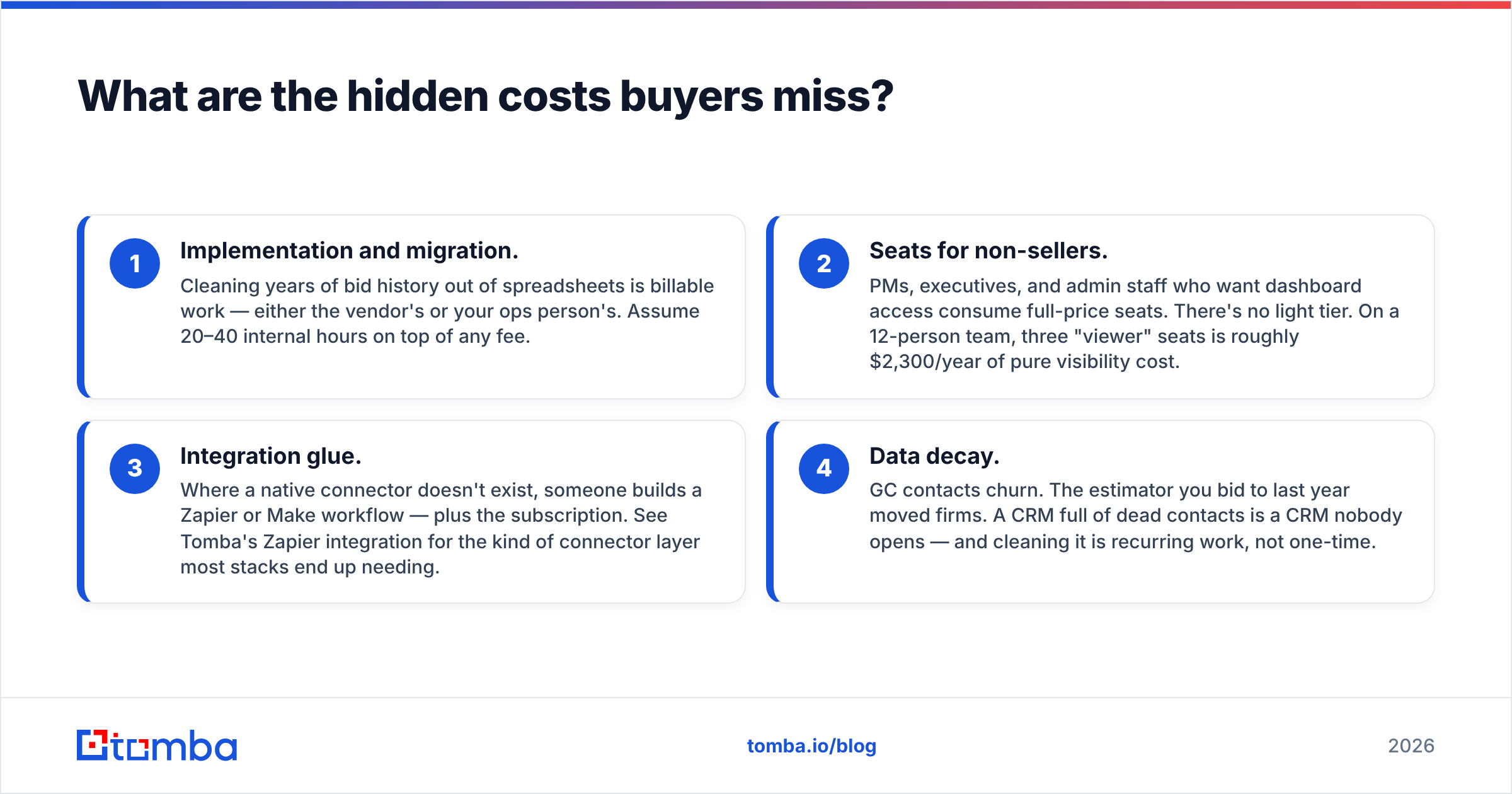
Four line items show up after the contract is signed, not before.
- Implementation and migration. Cleaning years of bid history out of spreadsheets is billable work, either the vendor's or your ops person's. Assume 20–40 internal hours on top of any fee.
- Seats for non-sellers. PMs, executives, and admin staff who want dashboard access use full-price seats. There is no light tier. On a 12-person team, three "viewer" seats cost about $2,300 a year in pure visibility.
- Integration glue. Where no native connector exists, someone builds a Zapier or Make workflow, plus the subscription. See Tomba's Zapier integration for the kind of connector layer most stacks end up needing.
- Data decay. GC contacts churn. The estimator you bid to last year moved firms. A CRM full of dead contacts is a CRM nobody opens, and cleaning it is recurring work, not a one-time job.
That last one is where most contractors quietly lose money. Industry research puts B2B contact decay at 22–30% a year. If your bid list holds 1,200 GC contacts, about 300 go stale annually. Run that list through an email verifier before each campaign. It is cheaper than the alternative: bounced bid notices hurt your sender reputation and can land your domain in spam folders.
Does FollowUp CRM help you find new customers?#
No. This is the most important thing to understand before you buy.
FollowUp CRM is a pipeline management tool. It organizes, tracks, and reports on deals that already exist. It has no contact database, no email finder, and no prospecting engine. If your bid invites dry up, FollowUp CRM will chart the decline and do nothing to reverse it.
That is not a knock on the product. Most CRMs work this way. But it changes the budget math. The real stack looks like this:
- Sourcing layer — find the GCs, developers, and property managers you are not bidding to yet, and get real contact details for their estimating and preconstruction leads.
- Verification layer — confirm those addresses resolve before you send anything.
- CRM layer — FollowUp CRM, where those relationships get worked and measured.
- Reporting layer — win rate, source attribution, and which channel produced revenue.
Skip the first two and you have bought an expensive filing cabinet. A practical workflow: use domain search to pull the contact structure of every GC in your metro, verify the results, then import only confirmed contacts into your CRM. Your bid board stays clean and your follow-up sequences land.
How should you negotiate a FollowUp CRM contract?#
Vertical CRM vendors have more room than their pricing pages suggest. Five things move the number:
- Ask for the implementation fee to be waived on annual prepay. It is the most commonly discounted line item, and vendors will trade it for cash up front.
- Negotiate seat tiers, not per-seat discounts. "We will be at 18 seats by Q3" gets you the 20-seat rate now more often than asking for 10% off.
- Get a pilot with a written exit. A 90-day paid pilot with a clear off-ramp costs a bit more per month. It also removes the biggest risk: buying a system your estimators will not use.
- Pin the renewal uplift in writing. Year-two increases of 7–15% are common in vertical SaaS. Cap it at signature.
- Confirm data export terms. Ask whether you can export contacts, bid history, and notes in a machine-readable format, and at what cost. A vendor that hesitates is telling you something.
Also, run a real trial with real bids, not demo data. The best predictor of CRM ROI is whether your team enters data without being chased. That is a behavior question, not a feature question, and no demo answers it.
FollowUp CRM pricing, reviews, pros and cons: the final verdict#
Weigh FollowUp CRM pricing, reviews, pros and cons against one question: is your bid board messy, or is it empty?
Worth it if: you run commercial construction bids, have 4+ estimators, cannot report win rate by GC or project type, and value fast adoption over deep configuration. At about $65 per user a month, one recovered mid-size bid a year covers the license.
Skip it if: you are a two-person shop, you sell outside construction, you need heavy customization or deep accounting integration, or your real problem is too few bids rather than poor bid management. In that last case, spend the CRM budget on sourcing and outreach. It will produce more revenue than better tracking.
The middle path most contractors should consider: buy fewer seats than you think you need, skip the enterprise onboarding package, and put the difference into a real prospecting motion. A CRM measures your pipeline. It never creates one.
Before you sign anything, be honest about which problem you are solving. If your bid board is full and messy, FollowUp CRM is a good answer. If it is clean because it is empty, you have a different problem, and a CRM subscription will not fix it.
Ready to fill the pipeline your CRM will manage? Start with the contacts. Tomba Email Finder locates verified professional email addresses for the GCs, developers, and preconstruction managers you should be bidding to — by name, company, or domain. The free tier gives you 25 searches a month to test the data quality yourself. Paid plans start at $49/mo on Tomba pricing, with bulk lookups, verification, and API access included. Find the contacts first, then let the CRM do what it is actually good at.
Related guides#
Ready to find emails that actually work?
Join 150,000+ professionals who stopped guessing and started sending. Free credits on signup — no credit card required.
Get the Tomba newsletter
Practical outbound tactics and product updates — once every two weeks.
About the author