Folloze Pricing, Reviews, Pros and Cons: A 2026 Breakdown
Folloze hides its pricing behind a demo form. Here's what buyers actually report paying, what reviewers praise and complain about, and when a cheaper data-first stack beats a full buyer-experience platform.
TL;DR
- Folloze does not publish pricing. Every number you find online — including the ones below — comes from buyer reports, procurement chatter, and review-site notes, not a public rate card. Treat them as ranges, not quotes.
- Reported entry points cluster around $1,000–$2,500/month billed annually, with mid-market ABM deployments landing in the $25K–$60K/year band and enterprise contracts running well past $75K/year once seats, integrations, and onboarding are stacked on.
- Reviewers consistently praise the no-code Boards builder, the personalization depth, and the intent/engagement analytics. The recurring complaints are cost, a steep design learning curve, and the fact that the platform only pays off if you already have content and a target list.
- Folloze is a buyer-experience layer, not a data source. It personalizes what a known account sees. It does not find you the accounts or the contacts.
- If your bottleneck is "we don't have verified contacts to invite into the experience," a $49/mo data tool solves more of your pipeline problem this quarter than a $40K ABM platform does.
What is Folloze, and who actually uses it?#
Think of Folloze as a landing-page builder that has been to business school. Instead of shipping one static page to every visitor, you build a "Board" — a content hub — and the platform swaps the hero copy, the case studies, the pricing framing, and the CTA based on who is looking at it. Same URL, different room, depending on the badge you're wearing when you walk in.
Technically, Folloze is a B2B Buyer Experience Platform (BXP). It sits in the account-based marketing stack alongside intent providers like 6sense and Demandbase, and it targets three jobs:
- Personalized content hubs — one Board per account, industry, persona, or campaign, assembled without a developer.
- Sales-enabled microsites — reps clone a template, drop in the account name and three relevant assets, and send a single link instead of six attachments.
- Engagement analytics — who from the account opened it, what they scrolled, what they downloaded, how long they stayed, and which colleague they forwarded it to.
- Signal routing — engagement scores pushed into Salesforce, Marketo, HubSpot, or your CRM of choice so SDRs act on warm accounts instead of guessing.
The typical customer is a mid-market-to-enterprise B2B company with an existing ABM motion: a marketing ops person, a content library worth personalizing, and a target account list that someone already built. Folloze is the last mile of that motion, not the first.
How much does Folloze pricing actually cost in 2026?#
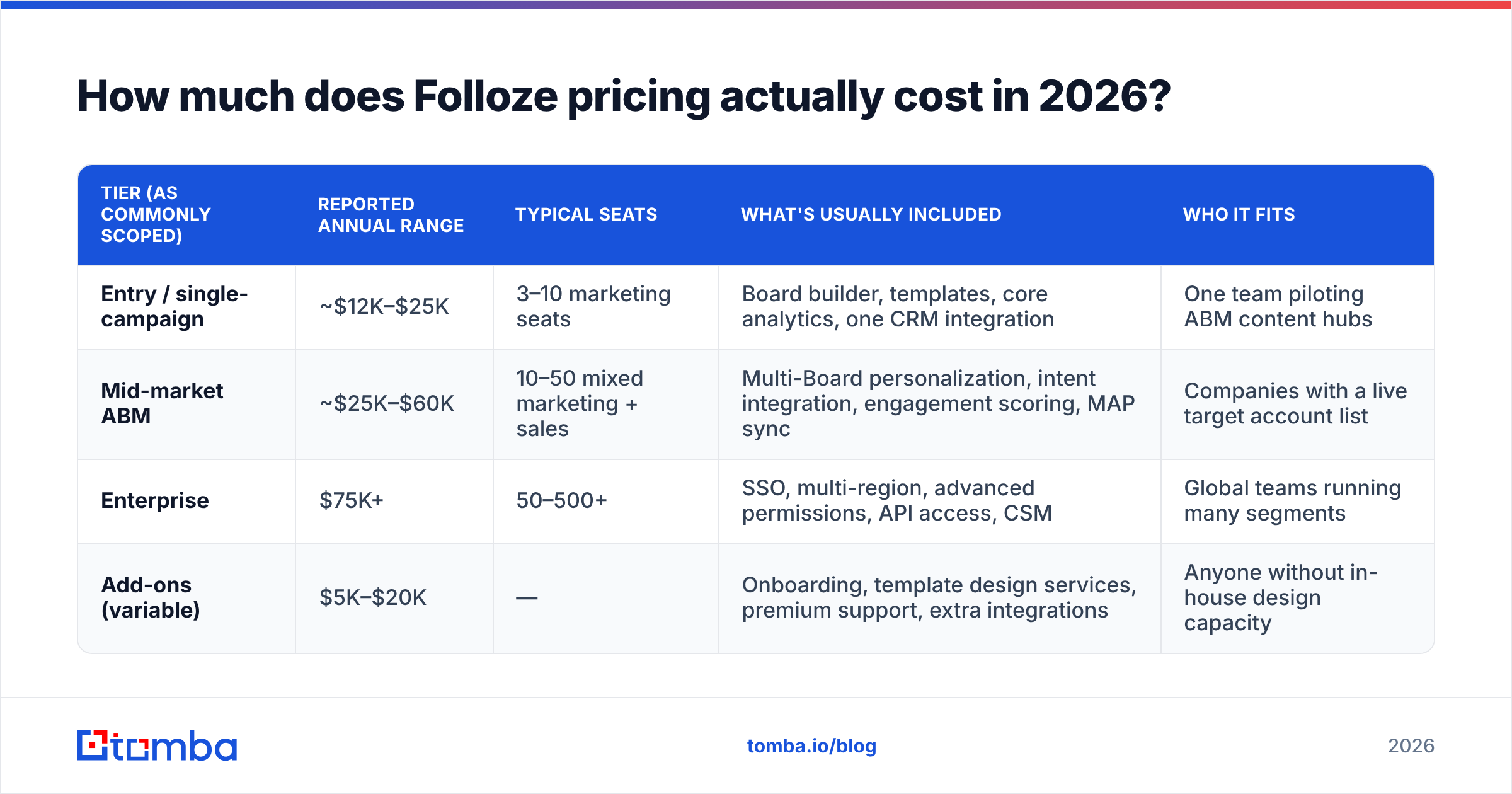
Short answer: expect a five-figure annual contract, and expect to negotiate. Folloze runs a quote-only model — there is no self-serve checkout, no published tier list, and no free plan. You book a demo, scope your use case, and receive a proposal shaped around three variables: number of Boards, number of seats (especially sales seats), and which integrations you need.
Here's the composite picture assembled from buyer reports and review-site commentary. These are estimated ranges for orientation, not quotes.
| Tier (as commonly scoped) | Reported annual range | Typical seats | What's usually included | Who it fits |
|---|---|---|---|---|
| Entry / single-campaign | ~$12K–$25K | 3–10 marketing seats | Board builder, templates, core analytics, one CRM integration | One team piloting ABM content hubs |
| Mid-market ABM | ~$25K–$60K | 10–50 mixed marketing + sales | Multi-Board personalization, intent integration, engagement scoring, MAP sync | Companies with a live target account list |
| Enterprise | $75K+ | 50–500+ | SSO, multi-region, advanced permissions, API access, CSM | Global teams running many segments |
| Add-ons (variable) | $5K–$20K | — | Onboarding, template design services, premium support, extra integrations | Anyone without in-house design capacity |
Three things about that table matter more than the numbers themselves:
- Sales seats are the cost multiplier. Marketing-only deployments stay cheap. The moment you roll Folloze out to 80 AEs so each can personalize their own microsite, the quote changes tier.
- Onboarding is rarely free. Multiple buyers report a one-time implementation or design-services fee in year one. Ask for it in writing before you sign.
- Annual commitment is the default. Month-to-month is uncommon, and multi-year deals are where the discount lives. Standard enterprise SaaS discounting logic applies: 10–25% off list for a two- or three-year term is a reasonable ask.
If you want a sanity check on the category, Gartner Peer Insights tracks ABM platform reviews and gives you a sense of how Folloze's contract shape compares to neighbors in the same market.
What do Folloze reviews actually say?#
The review pattern is unusually consistent for a category this crowded. On G2, Folloze scores well on ease of use and support, and its lowest-scoring dimension is almost always value-for-money — which is exactly what you'd predict for a quote-only platform sold to marketing teams.
Recurring themes from public reviews:
What reviewers praise
- Speed to launch. Marketers with zero HTML build a working, on-brand Board in an afternoon. That's the single most repeated compliment.
- Personalization depth. Dynamic content, account-level logos and copy, persona-based routing — reviewers describe it as noticeably deeper than generic landing-page tools.
- Analytics granularity. Knowing that three people from one account spent 11 minutes on your pricing section is a materially better signal than "the page got 40 views."
- Support and CSM quality. Repeatedly called out as responsive and hands-on.
What reviewers complain about
- Price relative to team size. Small teams say the platform is over-scoped for their volume.
- Design learning curve. "No-code" doesn't mean "no design skill." Boards that look mediocre perform mediocre, and reviewers who lacked a designer said so.
- Reporting rigidity. Some users want more custom report building without exporting to a BI tool.
- Content dependency. The platform amplifies your content library. If the library is thin, the Board is thin. Several reviewers learned this after signing.
That last point is the honest structural critique. Folloze is a distribution and personalization layer. It multiplies whatever you feed it — including zero.
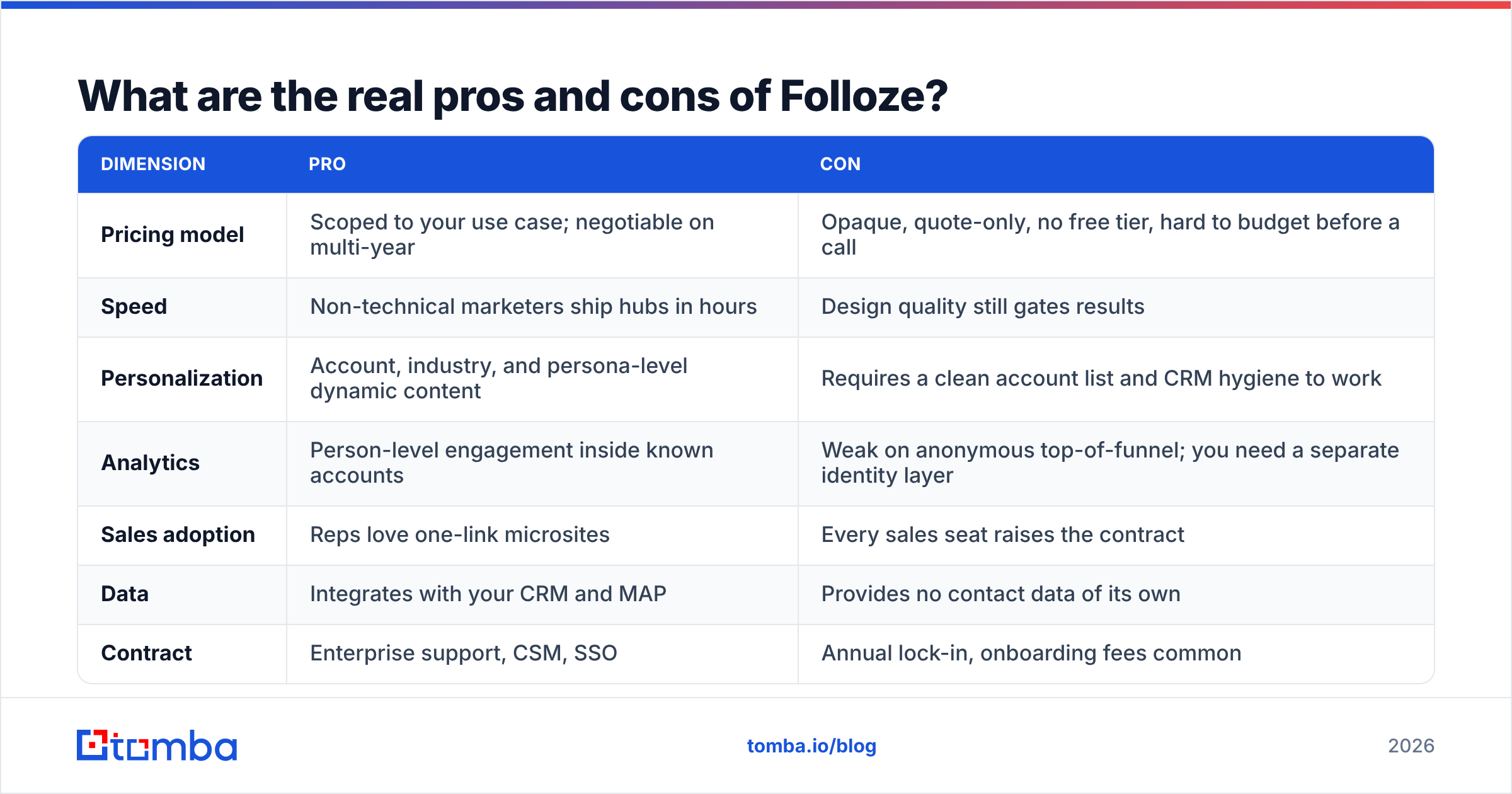
What are the real pros and cons of Folloze?#
| Dimension | Pro | Con |
|---|---|---|
| Pricing model | Scoped to your use case; negotiable on multi-year | Opaque, quote-only, no free tier, hard to budget before a call |
| Speed | Non-technical marketers ship hubs in hours | Design quality still gates results |
| Personalization | Account, industry, and persona-level dynamic content | Requires a clean account list and CRM hygiene to work |
| Analytics | Person-level engagement inside known accounts | Weak on anonymous top-of-funnel; you need a separate identity layer |
| Sales adoption | Reps love one-link microsites | Every sales seat raises the contract |
| Data | Integrates with your CRM and MAP | Provides no contact data of its own |
| Contract | Enterprise support, CSM, SSO | Annual lock-in, onboarding fees common |
Is Folloze worth it, or are you buying the wrong layer?#
Here's the framing that saves the most money: Folloze solves an engagement problem, not an addressability problem. Before you sign a five-figure contract, work out which one you actually have.
Run this diagnostic honestly:
- Do you have a named target account list of 200+ accounts? If no, Folloze has nothing to personalize against. Fix the list first.
- Do you have verified contacts at those accounts — email, title, and ideally phone? If no, you'll be paying for a beautiful room nobody can be invited into.
- Do you have 15+ reusable content assets worth curating? If no, a Board becomes a repackaged PDF.
- Are your existing campaigns getting clicks but stalling after the click? This is the actual Folloze-shaped problem. Traffic arrives, converts poorly, and dies. Personalization fixes that.
- Can you dedicate someone to Board design and maintenance? Unmaintained Boards decay fast, and the renewal conversation gets awkward.
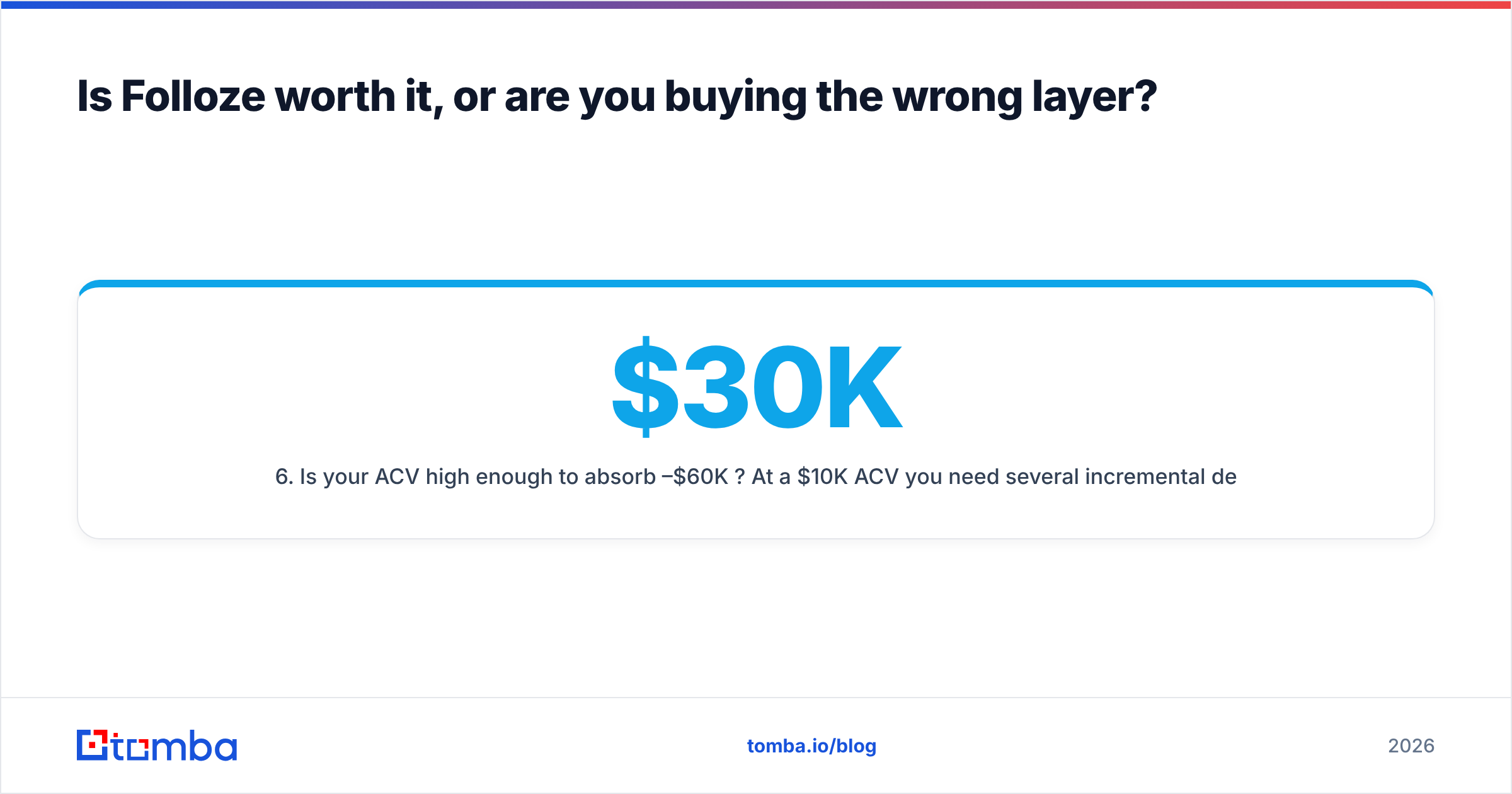
- Is your ACV high enough to absorb $30K–$60K/year? At a $10K ACV you need several incremental deals a year just to break even on the license.
If you answered "no" to items 1 through 3, you have a data and content problem wearing an ABM costume. Buying a buyer-experience platform to solve it is the classic sequencing error — like installing a commercial espresso machine before you've sourced beans.
What's the cheaper stack if you're not ready for Folloze?#
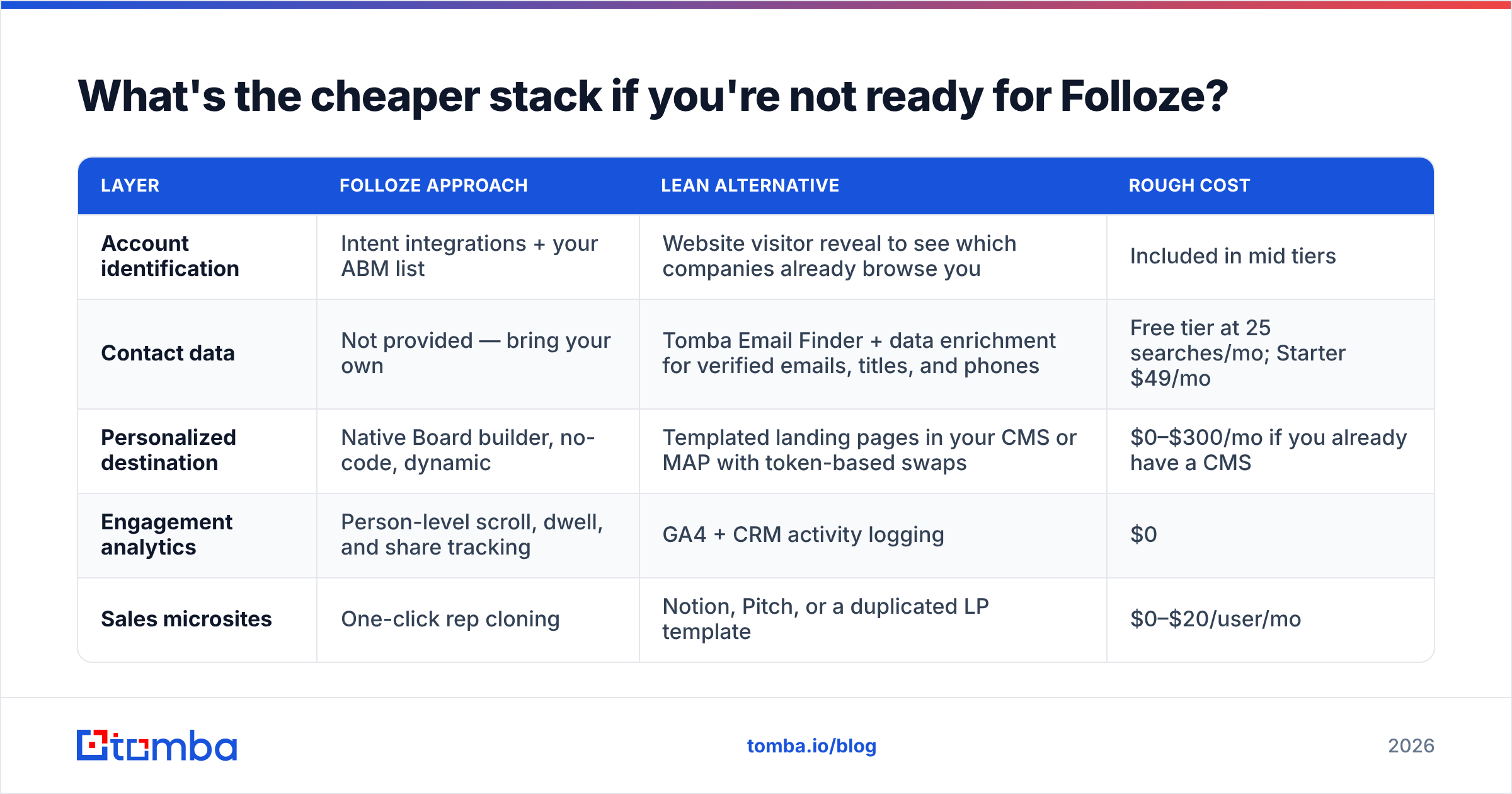
You can approximate a large share of the Folloze outcome with three cheaper components, and you can do it in stages. This isn't a like-for-like replacement — you lose the unified builder and the polish — but it fits a very different budget.
| Layer | Folloze approach | Lean alternative | Rough cost |
|---|---|---|---|
| Account identification | Intent integrations + your ABM list | Website visitor reveal to see which companies already browse you | Included in mid tiers |
| Contact data | Not provided — bring your own | Tomba Email Finder + data enrichment for verified emails, titles, and phones | Free tier at 25 searches/mo; Starter $49/mo |
| Personalized destination | Native Board builder, no-code, dynamic | Templated landing pages in your CMS or MAP with token-based swaps | $0–$300/mo if you already have a CMS |
| Engagement analytics | Person-level scroll, dwell, and share tracking | GA4 + CRM activity logging | $0 |
| Sales microsites | One-click rep cloning | Notion, Pitch, or a duplicated LP template | $0–$20/user/mo |
The honest trade-off: the lean stack costs you assembly time and gives you coarser person-level tracking. What it buys you is the ability to test whether personalized destinations actually move your pipeline before committing to an annual contract. If the templated version lifts meeting rates, you now have an internal business case for Folloze that procurement can't argue with. If it doesn't, you just saved $40,000.
Worth noting for the "we need a list" case: a curated B2B database like BookYourData covers a different need well — pre-built, filterable contact lists you can buy in bulk. That's a legitimate complement to a real-time finder, and plenty of teams run both: bulk list acquisition for breadth, live verification for accuracy at send time. Whichever route you take, run every address through an email verifier before it enters a Board invite sequence — a personalized experience delivered to a bounced address is worse than no experience at all.
How should you negotiate a Folloze contract?#
If you've cleared the diagnostic and Folloze is the right layer, negotiate like it's enterprise software, because it is:
- Ask for the seat breakdown explicitly. Get marketing seats and sales seats priced separately so you can phase the rollout.
- Push onboarding fees into the license. Bundled implementation is a common concession.
- Cap year-two uplift. Write a maximum renewal increase into year one. Without it, you're renegotiating from a weak position.
- Request a pilot scope. A single-campaign deployment for two quarters with an agreed success metric beats a company-wide launch you can't evaluate.
- Time it. End of quarter and end of fiscal year remain the cheapest weeks to sign anything in B2B SaaS.
- Benchmark against two neighbors. Even if you're confident, a competing quote is the only leverage that reliably moves a number.
The verdict on Folloze pricing, reviews, pros and cons#
Folloze is a well-built, well-supported platform that does something genuinely difficult — personalized, no-code buyer experiences with real person-level analytics — and it charges accordingly. The reviews are positive on capability and negative on cost, which is the signature of a good product sold slightly above where most buyers wish it were priced.
It's worth it if you already have the list, the contacts, and the content, and your problem is that engaged accounts stall after the click. It's a costly mistake if you're buying it hoping it will generate demand you don't currently have.
Start with the layer underneath. Before you spend $40,000 personalizing an experience, make sure you can reach the people you want in it. Tomba's Email Finder gets you verified professional emails by domain, name, or company — free for your first 25 searches a month, $49/mo on Starter, with bulk and API access as you scale. Check the full Tomba pricing breakdown, build the target list properly, then decide whether the buyer-experience platform is the next thing you need or the thing you were about to buy too early.
Related guides#
Ready to find emails that actually work?
Join 150,000+ professionals who stopped guessing and started sending. Free credits on signup — no credit card required.
Get the Tomba newsletter
Practical outbound tactics and product updates — once every two weeks.
About the author