Folloze vs Uberflip: Which B2B Content Hub Wins in 2026?
Folloze and Uberflip both promise personalized buyer experiences, but they solve different problems. Here's an honest breakdown of pricing, ABM depth, content scale, and which one actually fits your GTM motion.
Folloze vs Uberflip comes down to one question. Do you need fast custom pages for named accounts, or one home for a large content library? Folloze does the first. Uberflip does the second. Here is the honest breakdown.
TL;DR
- Folloze is an ABM-first buyer experience platform. Sales and marketing build personalized "boards" for one account, one persona, or one deal stage. Its strength is speed at 1:1 and 1:few.
- Uberflip is a content platform built for scale. It pulls in your whole content library. You then build streams, hubs, and pages that feel like part of your own site.
- Neither is cheap. Both cost five figures a year. Both quote custom prices instead of listing tiers.
- Pick Folloze if your GTM motion is account-based and reps need to build pages themselves. Pick Uberflip if you have a large library, an SEO-minded demand gen team, and want one home for content.
- Neither tool finds you buyers. Both assume you already have good contacts. That part is upstream, and it is where most programs break.
What are Folloze and Uberflip, exactly?#
Both tools sit on the same shelf in the martech stack. They fill the gap between "we have content" and "a buyer read it." But they were built on different assumptions.
Folloze began as an ABM sales tool. The core object is a board — a small custom site built for one account, one segment, or one campaign. A rep clones a template, drops in the buyer's logo, swaps three assets, and sends the link. Marketing owns the templates and the brand rules. Sales owns the last mile. Folloze then added a no-code designer, intent data links, and engagement scoring.
Uberflip came from the content side. You connect your blog feed, your resource library, your YouTube channel, and your PDFs. Uberflip pulls them into one library. From there you build streams (picked collections) and hubs (destination pages). The pitch is simple. Your ebook, your webinar replay, and your customer story stop living in five places. They live in one branded hub that you can slice by campaign, industry, or account.
The real difference is scope. Folloze is built for how many custom pages you can ship. Uberflip is built for how much content you can sort and route.

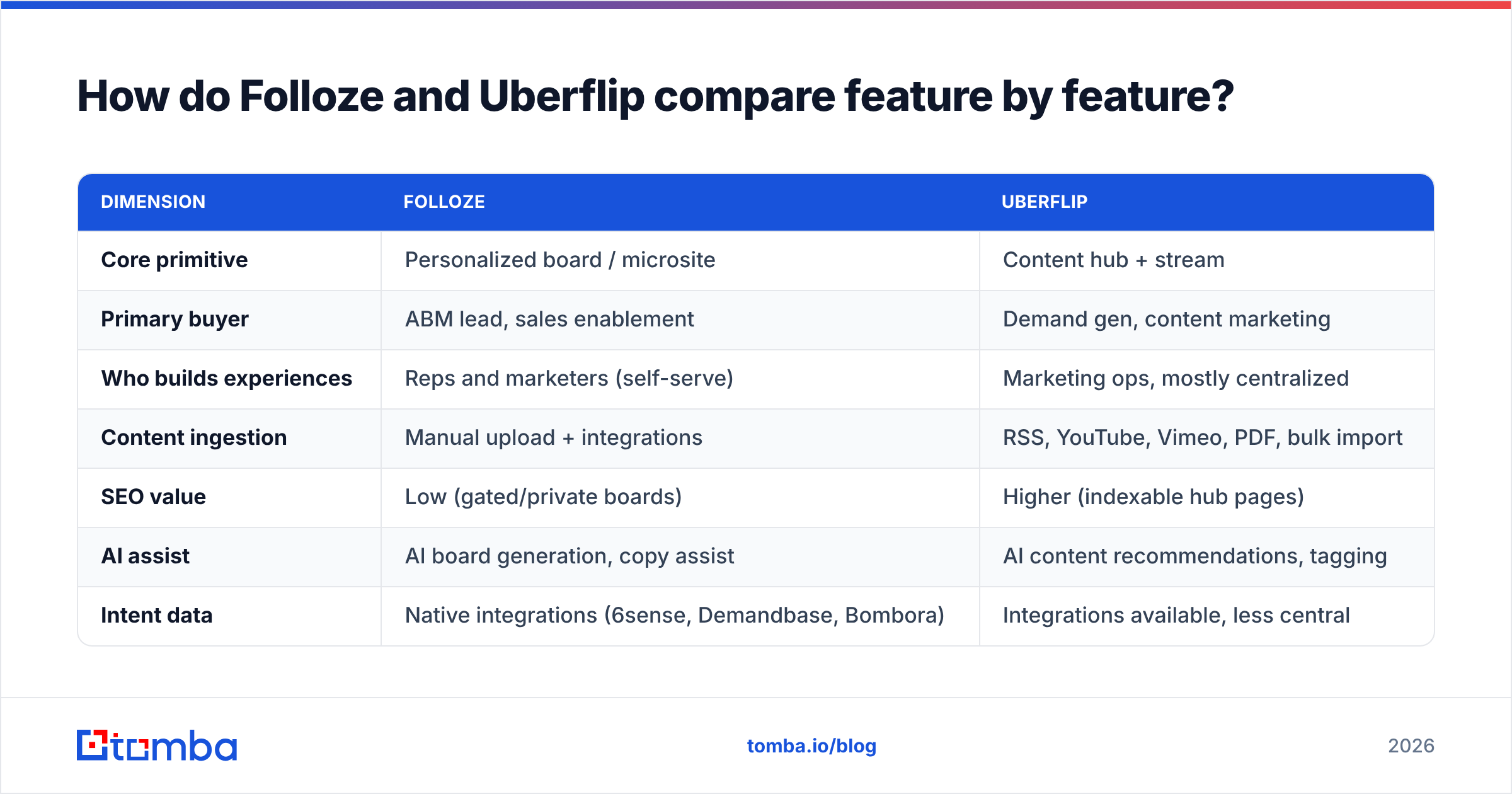
Folloze vs Uberflip: a feature-by-feature comparison#
| Dimension | Folloze | Uberflip |
|---|---|---|
| Core primitive | Personalized board / microsite | Content hub + stream |
| Primary buyer | ABM lead, sales enablement | Demand gen, content marketing |
| Who builds experiences | Reps and marketers (self-serve) | Marketing ops, mostly centralized |
| Content ingestion | Manual upload + integrations | RSS, YouTube, Vimeo, PDF, bulk import |
| SEO value | Low (gated/private boards) | Higher (indexable hub pages) |
| AI assist | AI board generation, copy assist | AI content recommendations, tagging |
| Intent data | Native integrations (6sense, Demandbase, Bombora) | Integrations available, less central |
| Typical entry cost | ~$25k–$60k/yr (custom quote) | ~$20k–$50k/yr (custom quote) |
| Time to first live experience | Days | Weeks (library setup is front-loaded) |
| Best-fit team size | 5+ AEs running named accounts | 3+ content marketers with a real library |
One caveat on the pricing row. Neither vendor lists rates. Deal sizes shared on G2 and Capterra swing widely. They move with seat count, hub count, and add-ons. Treat the ranges as a starting point, not a quote.
Which one is better for account-based marketing?#
Folloze, clearly. And it is not close if your ABM plan includes 1:1 pages per account.
Here is how it works. A marketer builds a template for, say, "Manufacturing — Series C — early buyer." A rep working Acme Corp clones it. Folloze fills in the company facts, the logo, and a custom headline. The rep adds the two case studies that fit Acme. Then they record a 40-second video and send the board link. Every scroll, click, and dwell event flows back to the CRM and into a score.
Uberflip can do account-level work too. The lift is just heavier. You build a stream per segment, then add Sales Assist or a custom CTA layer on top. It works well for 1:many and fine for 1:few. But for a rep building one page for one logo on a Tuesday, Folloze has less friction.
Uberflip wins on content depth. Say a buyer wants to go three levels deep: case study, then whitepaper, then setup guide. Uberflip suggests the next asset well, because it knows your whole library. Folloze boards are hand-picked. They are only as good as the assets a rep remembered to add.
What does each platform cost, and what are the hidden line items?#
Both vendors run a classic enterprise sale. Demo, discovery, custom quote, annual contract. Expect a push for a multi-year deal. Neither has a free tier or a credit card signup.
The line items that surprise buyers:
- Setup and onboarding fees. Both add a one-time service fee. Uberflip's is often larger. Moving a content library is real work: tagging, canonical URLs, redirects.
- Seat growth. Folloze pricing scales with the number of board creators. If ABM works and you go from 5 reps to 40, the renewal is a new deal.
- Analytics and integration tiers. Deeper CRM sync, intent data links, and custom reports often sit in higher tiers.
- Content production. Neither tool creates content. If your library is thin, Uberflip is an expensive way to organize twelve blog posts.
- Contact data. This is the big one, and it is not on the invoice. A custom board with no one to send it to is a costly screensaver.
That last point deserves its own section.
Why do most Folloze and Uberflip rollouts underperform?#
Because the bottleneck is almost never the experience layer.
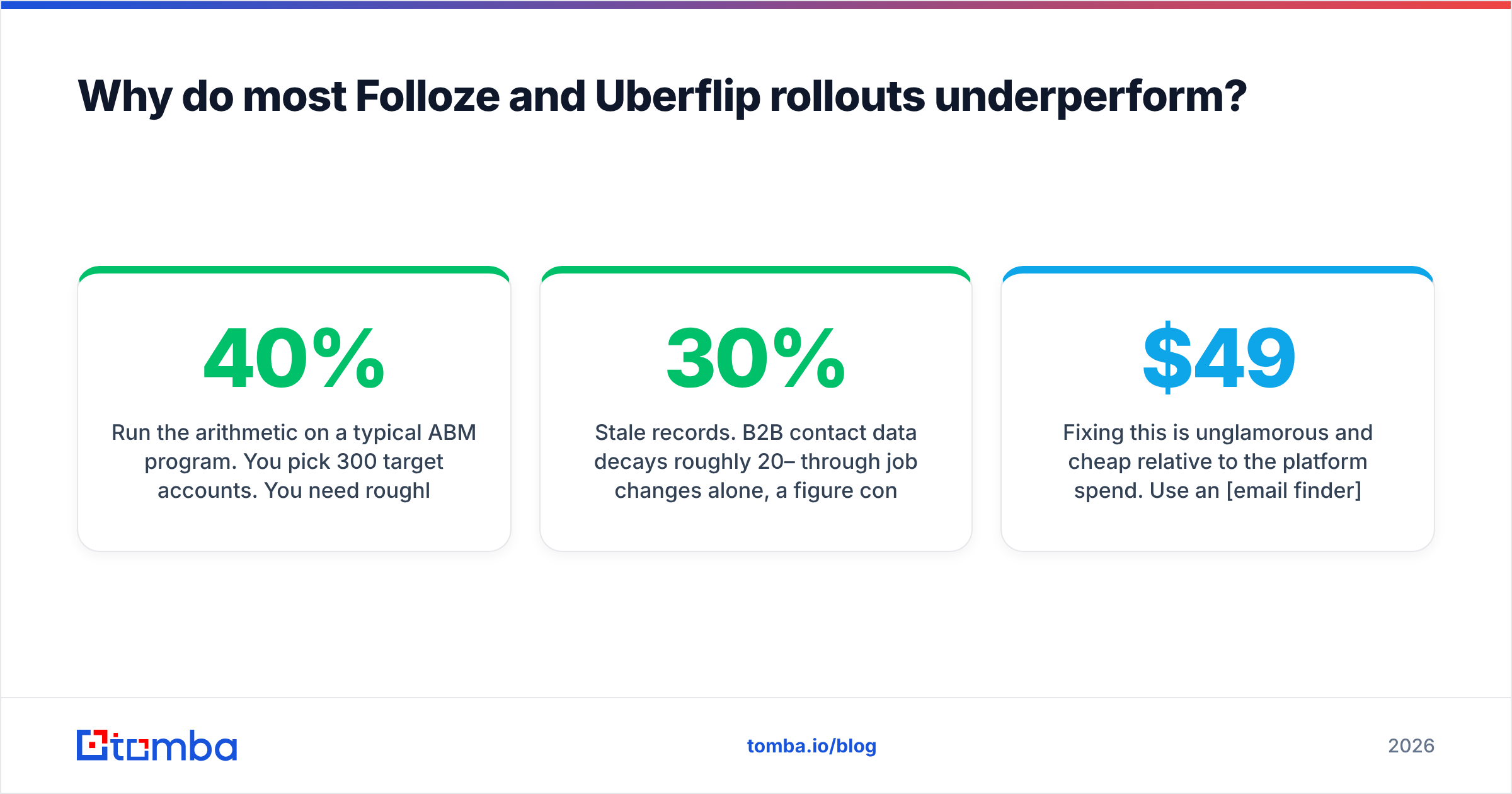
Do the math on a typical ABM program. You pick 300 target accounts. You need 4–6 people per account to reach the buying group. Call it 1,500 contacts. Say your CRM has verified, working emails for 40% of them. Your boards then reach 600 people. The other 900 never see what you paid five figures for.
That gap is a data problem, not a content problem. It shows up in three ways:
- Coverage gaps. You have the company but not the VP of Operations who actually signs.
- Stale records. B2B contact data goes bad by 20–30% a year from job changes alone. Data vendors and analyst firms such as Gartner report the same range.
- Bad delivery. Sending board links to dead inboxes hurts your sender reputation. Then even your valid contacts stop seeing your email.
The fix is dull and cheap next to the platform spend. Use an email finder to close gaps on named accounts. Run the list through an email verifier before any send. Use domain search to map every reachable person at a target company instead of guessing at the org chart. Tomba's Starter plan is $49 a month and Growth is $99 a month. That is a rounding error next to a $40k content contract, and it decides whether the contract creates pipeline.

How do they compare on analytics and attribution?#
Both give you engagement data. The question is what shape it arrives in.
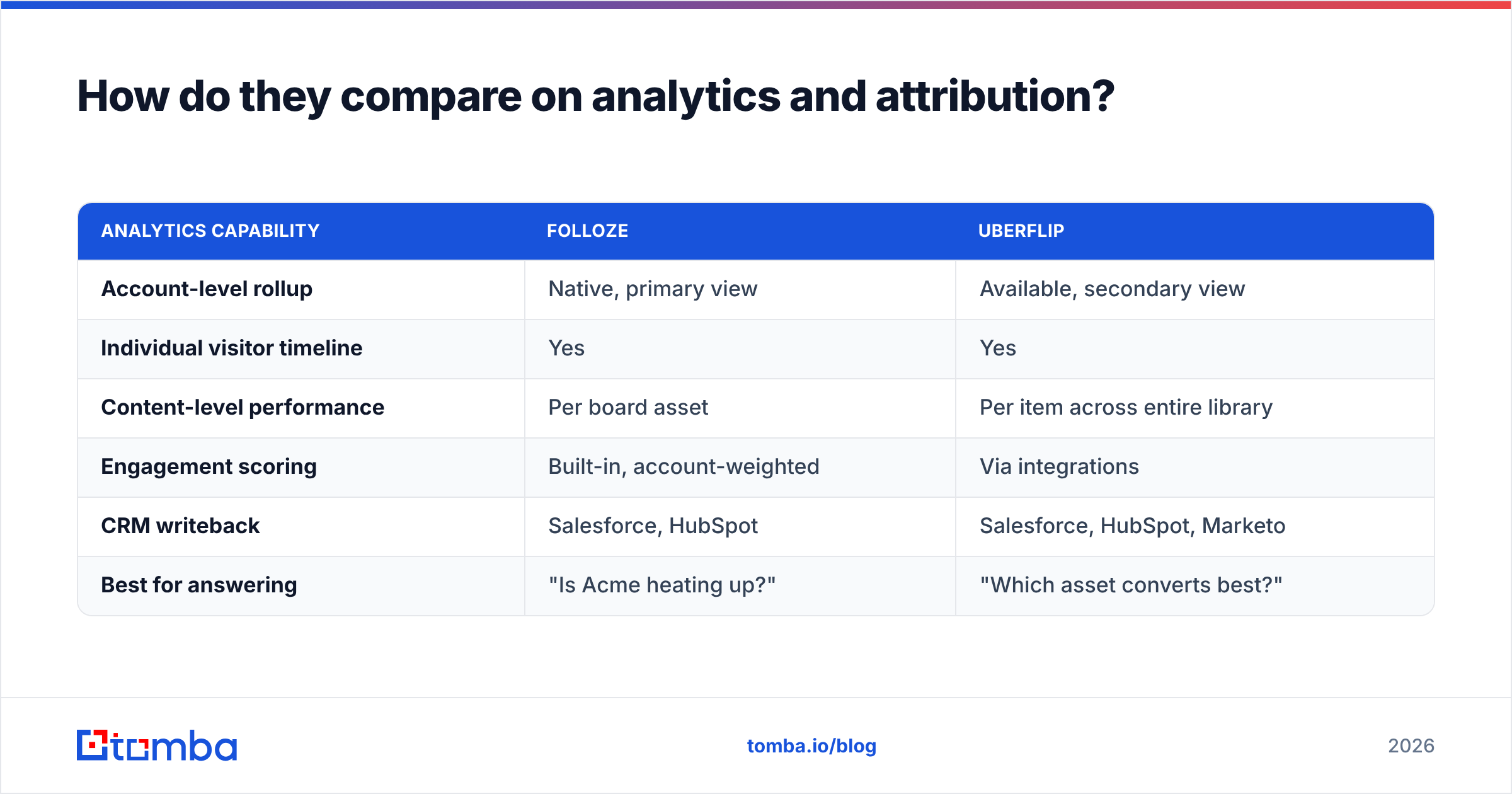
| Analytics capability | Folloze | Uberflip |
|---|---|---|
| Account-level rollup | Native, primary view | Available, secondary view |
| Individual visitor timeline | Yes | Yes |
| Content-level performance | Per board asset | Per item across entire library |
| Engagement scoring | Built-in, account-weighted | Via integrations |
| CRM writeback | Salesforce, HubSpot | Salesforce, HubSpot, Marketo |
| Best for answering | "Is Acme heating up?" | "Which asset converts best?" |
Folloze answers account questions. Uberflip answers content questions. If your CMO's dashboard is sorted by target account, Folloze maps to it cleanly. If it is sorted by content and channel, Uberflip does.
One caveat holds for both. Engagement scores point a direction. They do not predict. Twelve minutes of dwell time from a junior analyst is not the same signal as three minutes from the CFO. Neither tool tells you which one you got unless your records hold accurate job titles. So it comes back to your data. Clean contact enrichment in your CRM is what makes these scores mean something.
Which integrations matter, and who has more of them?#
Uberflip covers more marketing automation tools: Marketo, Eloqua, Pardot, HubSpot, and Salesforce. It also has a documented API and Zapier support. That fits its demand gen roots. It has to hand leads off to nurture systems.
Folloze goes deep but narrow. It focuses on the ABM stack: Salesforce, HubSpot, 6sense, Demandbase, Bombora, LinkedIn, Outreach, and Salesloft. If you already buy intent data, these links feel built for the job rather than generic.
For either tool, the real question is whether contact data flows in clean. Both sit downstream of your CRM. If your records are thin, the merge tags render as blanks. The "personalized" page then reads as an obvious mail merge. Busy teams fix this with a scheduled data job. They call an email finder API or run a batch through bulk lead generation before each campaign wave, so the tags actually fill in.
Is there a cheaper way to get most of the value?#
For some teams, yes. And it is worth saying out loud before you sign an annual contract.
Say you run fewer than 50 target accounts. A good landing page tool and a decent CMS get you 70% of the way. Folloze and Uberflip pay off at volume: 300 boards a quarter, or a 2,000-asset library. Below that, you pay enterprise rates for a job a template can do.
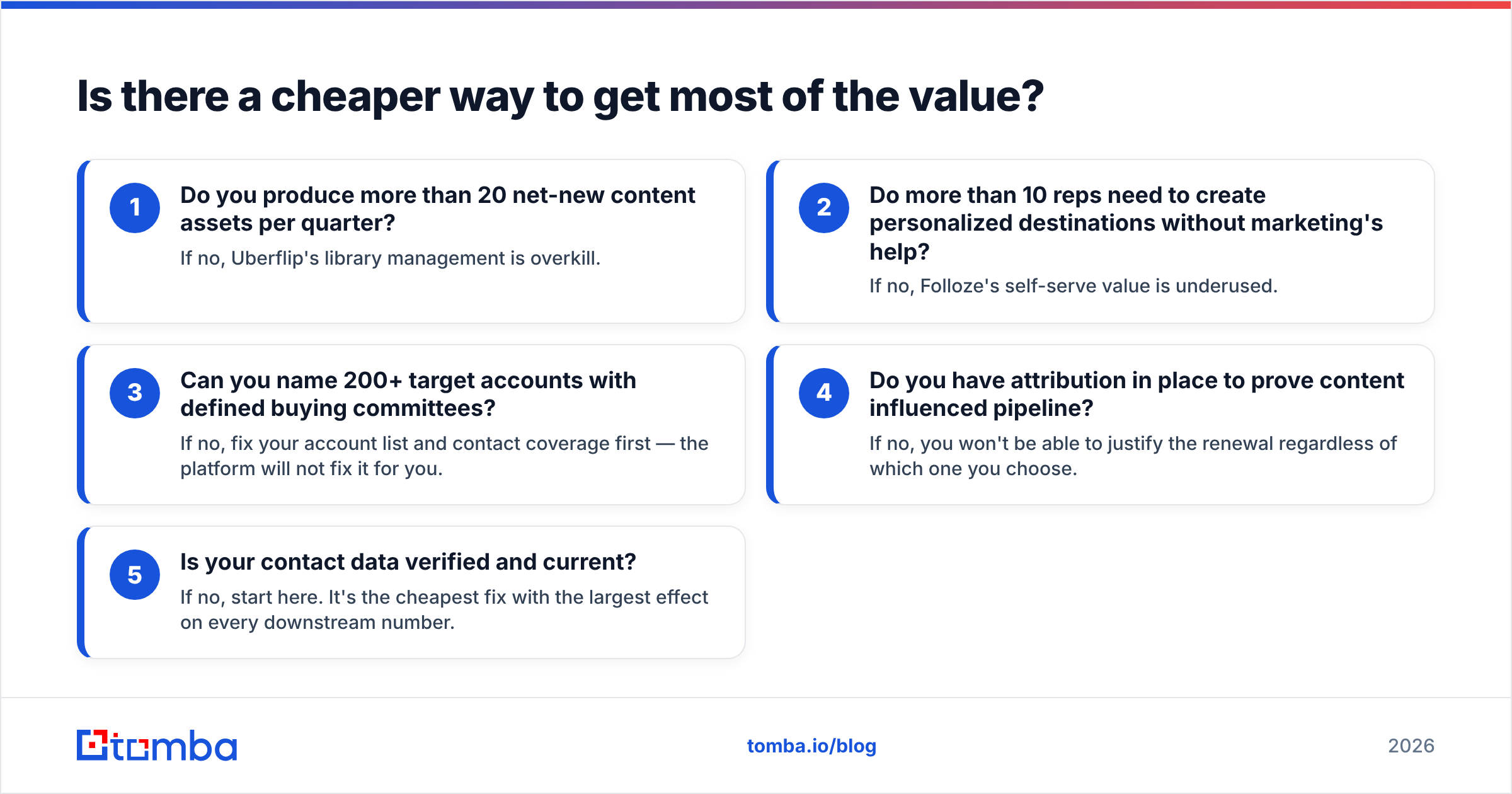
A rough decision test:
- Do you produce more than 20 net-new content assets per quarter? If no, Uberflip's library management is overkill.
- Do more than 10 reps need to build custom pages without marketing's help? If no, Folloze's self-serve value is underused.
- Can you name 200+ target accounts with defined buying groups? If no, fix your account list and contact data first. The platform will not do it for you.
- Can you prove content moved pipeline? If no, you will struggle to justify the renewal, whichever tool you buy.
- Is your contact data verified and current? If no, start here. It is the cheapest fix, and it lifts every number after it.
Folloze vs Uberflip: the verdict for 2026#
Choose Folloze if: you run a named-account motion and your reps are willing to build. You need custom pages in hours, not sprints. It fits ABM-led teams where sales and marketing share one account list.
Choose Uberflip if: you have a real content library and your demand gen team owns the buyer journey. You want one branded hub that serves paid, organic, email, and sales at once. It fits content-led teams.
Choose neither yet if: your account list has gaps, your CRM records are more than 18 months old, or you cannot name the five people at each account who must see the content. Every dollar you spend on the experience layer multiplies what your data layer gives it. That includes zero.
Teams that get real ROI do the boring work first. A tight account list. Verified contacts at each one. Clean CRM records. The platform then amplifies a motion that already works. It does not create one.
Before you spend five figures on a content experience platform, make sure the experience reaches someone. Use the Tomba Email Finder to fill gaps across your target account list. Find verified work emails by domain, name, or company. Map the full buying group at each account. Push clean records into your CRM before your first board goes live. Start free with 25 searches a month, or see Tomba pricing. Starter is $49 a month and Growth is $99 a month — about what one day of an ABM platform contract costs.
Related guides#
Ready to find emails that actually work?
Join 150,000+ professionals who stopped guessing and started sending. Free credits on signup — no credit card required.
Get the Tomba newsletter
Practical outbound tactics and product updates — once every two weeks.
About the author