FOMO in Sales: How to Use Urgency Without Losing Trust
Fake deadlines are the fastest way to lose a B2B deal in 2026. Here is how FOMO actually works on buying committees, which urgency tactics still lift reply rates, and the exact point where scarcity turns into a credibility problem.
TL;DR
- FOMO in sales is the deliberate use of scarcity, deadlines, and social proof to make inaction feel expensive. It works because loss aversion is real — people work harder to avoid losing something than to gain it.
- Manufactured urgency ("this price expires Friday" for the fourth Friday in a row) now reads as a tell. B2B buyers pattern-match on it within one line.
- Real FOMO comes from four honest sources: contract timing, capacity limits, competitive movement, and internal cost of delay. Everything else is theater.
- The highest-converting FOMO in 2026 is peer-based, not deadline-based: "three of your competitors shipped this last quarter" outperforms "offer ends soon" in B2B.
- Urgency only converts when your targeting is right. Sending a deadline to the wrong contact at the wrong company just accelerates a no.
What is FOMO in sales?#
FOMO — fear of missing out — is the buyer's anxiety that a window is closing and they will be worse off for having waited. In sales, it's the deliberate framing of a decision so that not deciding carries a visible cost.
Think of it like a flight you've been watching for three weeks. Nothing about the plane changed. But when the seat map goes from "42 seats left" to "3 seats left," you book. The product is identical; the cost of hesitation became legible.
That's the whole mechanism. FOMO doesn't create desire — it converts existing, latent desire into action by putting a price on delay. Which is also why it fails so spectacularly when the desire isn't there yet. A deadline attached to a product the buyer doesn't want is just noise with a countdown timer.
In B2B, FOMO operates differently than in consumer sales. There is no impulse buy on a $60k annual contract signed by a five-person committee. Instead, FOMO in B2B works by giving your internal champion ammunition — a reason to push the deal forward this quarter instead of letting it drift into next quarter's "revisit" pile. According to Gartner's B2B buying research, the largest competitor in most enterprise deals isn't a rival vendor — it's the status quo. FOMO is the tool that makes the status quo look risky.
Why does FOMO work on B2B buyers?#
Three overlapping psychological effects do the work.
Loss aversion. Kahneman and Tversky's loss aversion research found people weigh losses roughly twice as heavily as equivalent gains. "You'll save 12 hours a week" is a gain frame. "You're currently burning 12 hours a week" is a loss frame. Same number, materially different urgency.
Scarcity signaling. When supply is constrained, perceived value rises. In B2B this shows up as limited onboarding slots, a fixed number of pilot seats, or a specialist implementation team with a real calendar.
Social proof under uncertainty. When a buyer can't fully evaluate a technical product, they substitute a proxy: what are comparable companies doing? Peer movement is the strongest FOMO trigger in B2B precisely because it reduces perceived risk while raising perceived cost of inaction.
The catch: all three effects collapse the moment the buyer detects manipulation. A fabricated deadline doesn't just fail to convert — it retroactively discounts everything else you said, including the honest parts.

What's the difference between real and manufactured urgency?#
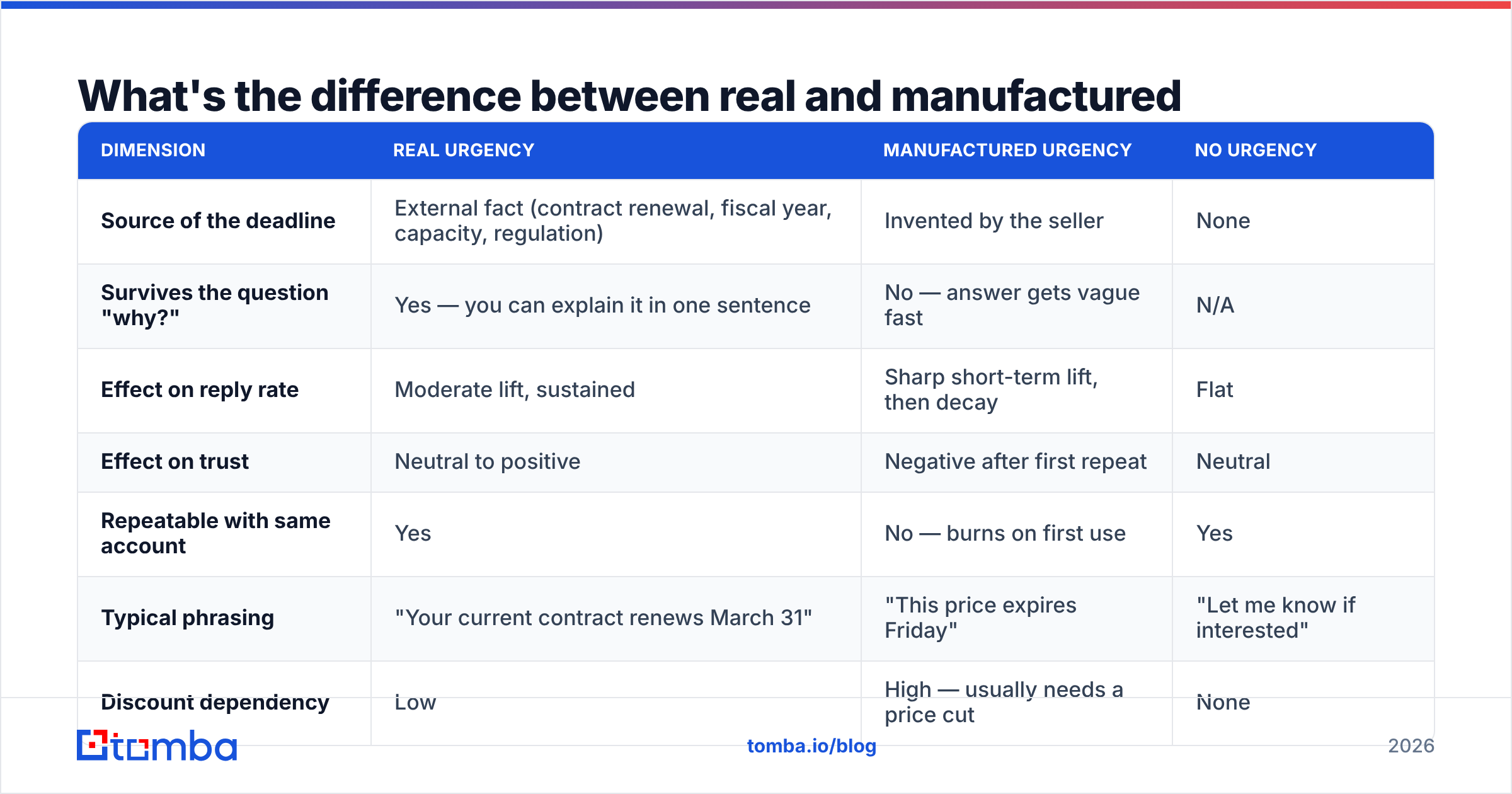
This is the whole game. Here's how the two compare on the dimensions that actually matter:
| Dimension | Real urgency | Manufactured urgency | No urgency |
|---|---|---|---|
| Source of the deadline | External fact (contract renewal, fiscal year, capacity, regulation) | Invented by the seller | None |
| Survives the question "why?" | Yes — you can explain it in one sentence | No — answer gets vague fast | N/A |
| Effect on reply rate | Moderate lift, sustained | Sharp short-term lift, then decay | Flat |
| Effect on trust | Neutral to positive | Negative after first repeat | Neutral |
| Repeatable with same account | Yes | No — burns on first use | Yes |
| Typical phrasing | "Your current contract renews March 31" | "This price expires Friday" | "Let me know if interested" |
| Discount dependency | Low | High — usually needs a price cut | None |
| Best channel | Email, call, proposal | Nowhere, honestly | — |
The practical test: if the prospect asks "what happens if I decide in three weeks instead?" and you have a specific, factual answer, your urgency is real. If your answer is "well, I'd have to check with my manager," you invented it — and the buyer already knows.
Which FOMO tactics actually work in B2B?#
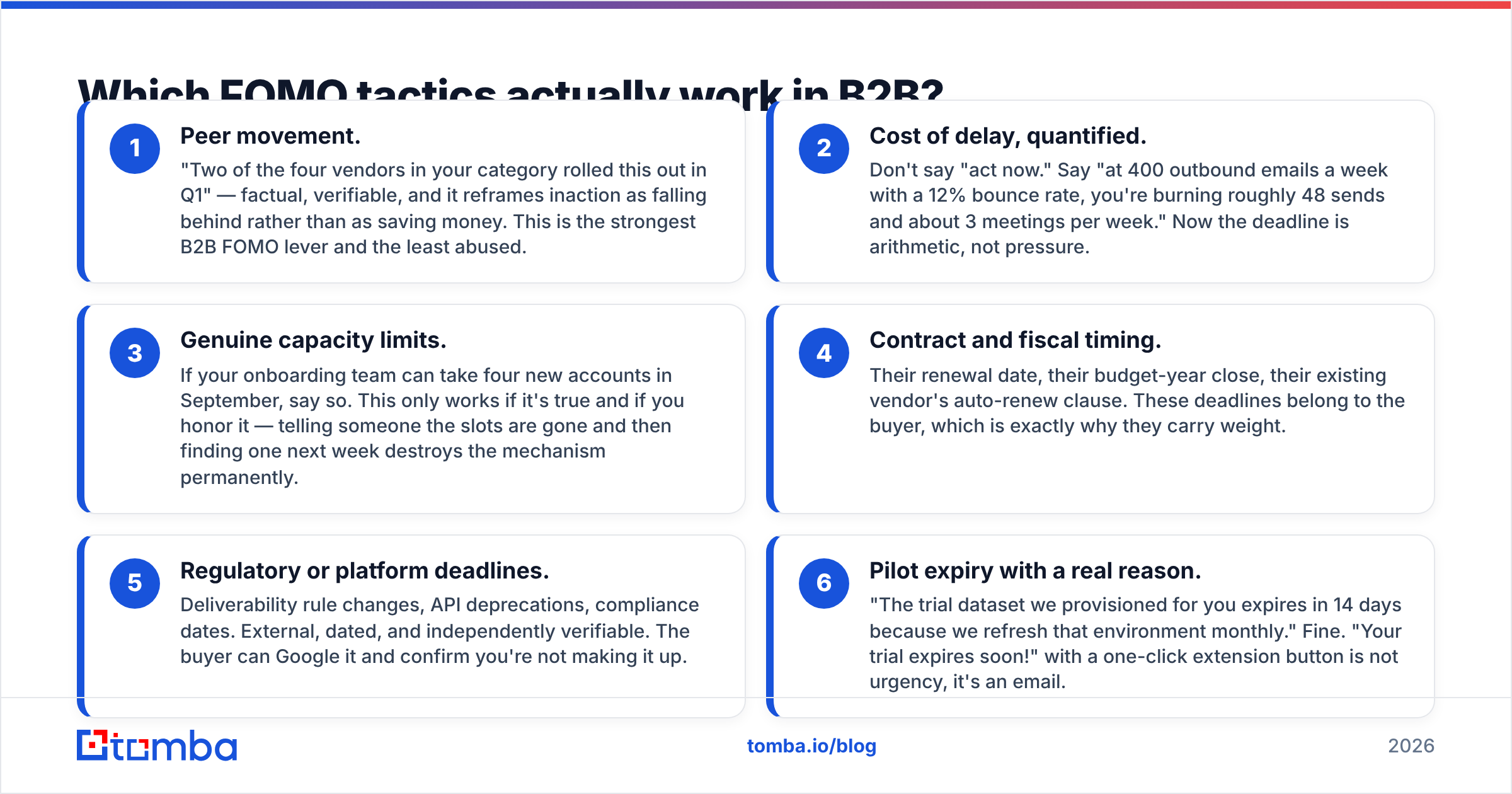
Six that hold up, ordered roughly by how well they survive a skeptical buyer:
Peer movement. "Two of the four vendors in your category rolled this out in Q1" — factual, verifiable, and it reframes inaction as falling behind rather than as saving money. This is the strongest B2B FOMO lever and the least abused.
Cost of delay, quantified. Don't say "act now." Say "at 400 outbound emails a week with a 12% bounce rate, you're burning roughly 48 sends and about 3 meetings per week." Now the deadline is arithmetic, not pressure.
Genuine capacity limits. If your onboarding team can take four new accounts in September, say so. This only works if it's true and if you honor it — telling someone the slots are gone and then finding one next week destroys the mechanism permanently.
Contract and fiscal timing. Their renewal date, their budget-year close, their existing vendor's auto-renew clause. These deadlines belong to the buyer, which is exactly why they carry weight.
Regulatory or platform deadlines. Deliverability rule changes, API deprecations, compliance dates. External, dated, and independently verifiable. The buyer can Google it and confirm you're not making it up.
Pilot expiry with a real reason. "The trial dataset we provisioned for you expires in 14 days because we refresh that environment monthly." Fine. "Your trial expires soon!" with a one-click extension button is not urgency, it's an email.
Notice what's missing: discount deadlines. Price-based FOMO trains buyers to wait for the next discount and signals your list price was fiction. Use it as a last resort in a specific deal, never as a systematic motion.
How does FOMO change by channel?#
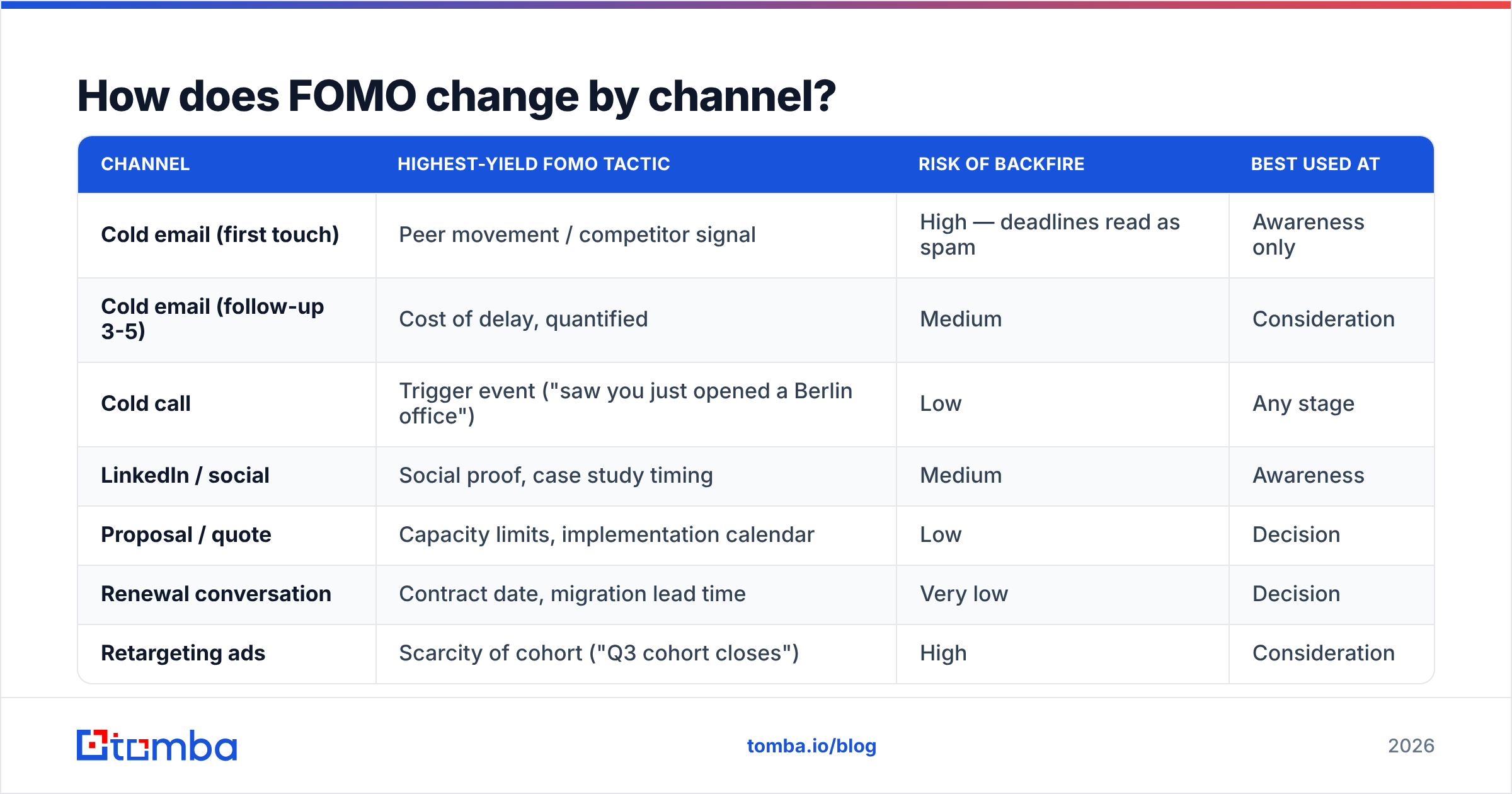
Urgency has very different tolerances depending on where it lands. A line that works in a proposal will get you blocked in a first-touch cold email.
| Channel | Highest-yield FOMO tactic | Risk of backfire | Best used at |
|---|---|---|---|
| Cold email (first touch) | Peer movement / competitor signal | High — deadlines read as spam | Awareness only |
| Cold email (follow-up 3-5) | Cost of delay, quantified | Medium | Consideration |
| Cold call | Trigger event ("saw you just opened a Berlin office") | Low | Any stage |
| LinkedIn / social | Social proof, case study timing | Medium | Awareness |
| Proposal / quote | Capacity limits, implementation calendar | Low | Decision |
| Renewal conversation | Contract date, migration lead time | Very low | Decision |
| Retargeting ads | Scarcity of cohort ("Q3 cohort closes") | High | Consideration |
The pattern is consistent: the earlier the stage, the softer the FOMO. At first touch you have no permission to impose a deadline, because you haven't established that your product matters. Urgency before relevance is just rudeness with a timer on it.
What does honest FOMO look like in a cold email sequence?#
Here's a four-touch structure where urgency escalates in step with earned relevance, not in step with your quota calendar.
Touch 1 — relevance, zero urgency.
Noticed you're hiring three SDRs in Q3. Most teams that scale outbound that fast hit a data quality wall around month two — bounce rates climb, domain reputation slips. Is that on your radar?
Touch 2 — peer movement.
Two other Series B teams in your space moved their list-building in-house this year after their bounce rate crossed 8%. Happy to share what their setup looks like.
Touch 3 — quantified cost of delay.
Rough math on 3 new reps at 300 sends/week each: at an 8% bounce rate that's ~72 wasted sends weekly and real damage to your sender reputation. Fixing verification first usually pays for itself in week one.
Touch 4 — real, dated constraint (only if one exists).
Our implementation team's September slots close on the 5th. If the new reps start in October, that timing lines up — otherwise the next window is late October.
If touch 4 has no true constraint behind it, delete it and send a breakup email instead. A breakup message is itself a legitimate FOMO device: it's the one deadline you fully control and can honestly enforce. And it works — teams consistently report breakup emails outperforming the middle of the sequence on response rate.
One practical note: urgency lives or dies in the subject line, which is where most reps overcorrect into spam territory. Run yours through a subject line tester before you send 2,000 of them — "LAST CHANCE" and "expires today" are among the most reliably filtered phrases in B2B inboxes.
When does FOMO backfire?#
Five failure modes, in rough order of how often they show up in real pipelines:
- Repeat deadlines. The same "ends Friday" offer, four Fridays running. Buyers keep receipts. This is the single fastest way to convert a warm lead into a permanent ignore.
- Urgency without fit. Pressuring a prospect who has no problem you solve. You don't lose a deal here — you lose the account for a year, because now you're the vendor who wasted their time.
- Urgency aimed at the wrong person. A deadline delivered to someone with no budget authority creates anxiety they can't act on, so they disengage. This is a targeting failure dressed as a messaging failure.
- Discount dependency. Every deal closes on a price deadline, so your list price becomes a fiction and your margin becomes a negotiation. G2's buyer behavior research consistently shows software buyers are more price-anchored than vendors assume — don't hand them the anchor.
- Manufactured scarcity that's checkable. Claiming limited seats on a product with self-serve signup. Thirty seconds of clicking exposes it.
The through-line: FOMO amplifies whatever's already true about your deal. Strong fit plus real urgency accelerates. Weak fit plus urgency accelerates the loss.
How do you measure whether FOMO is working?#
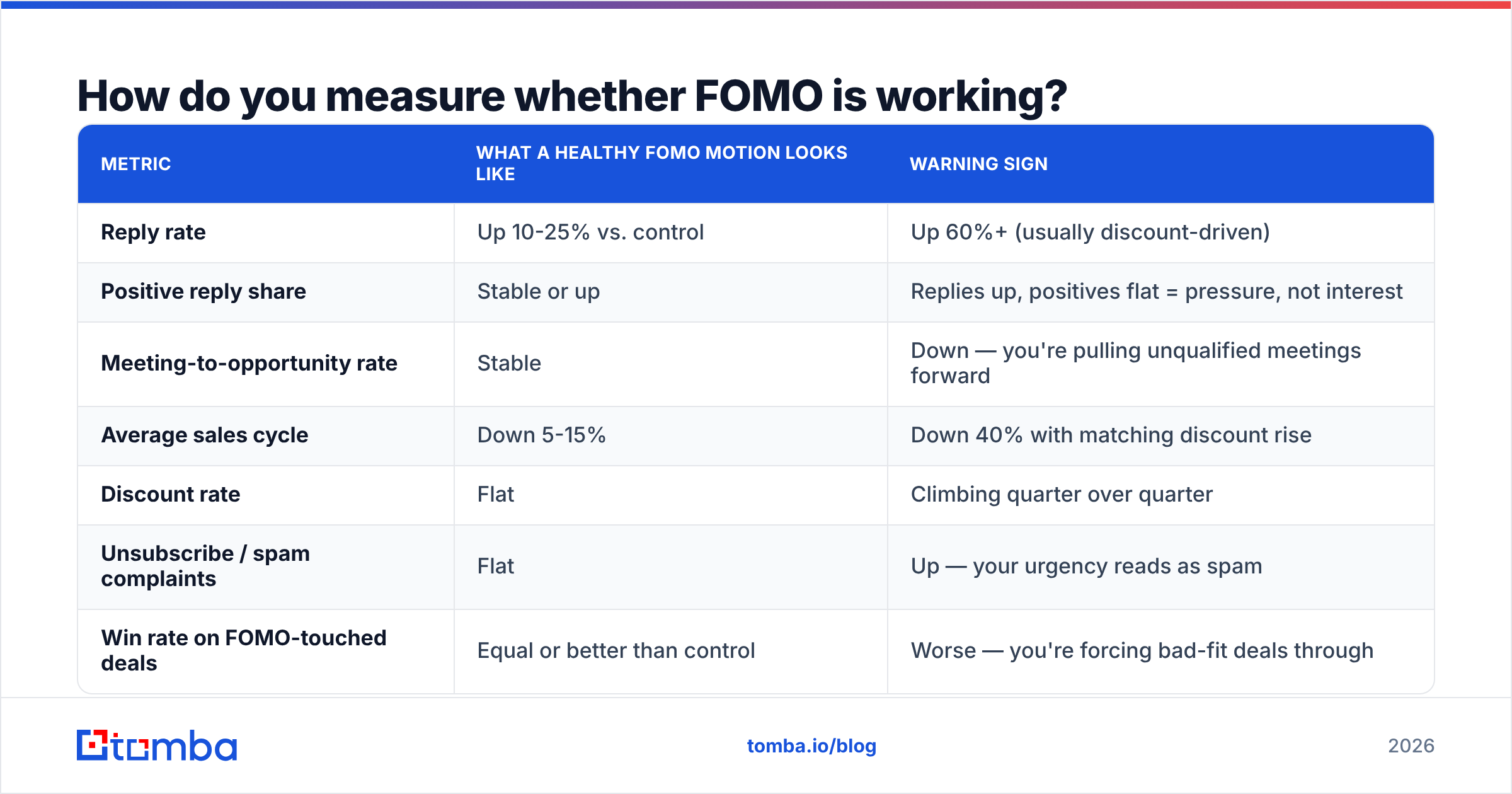
Don't measure it on reply rate alone — manufactured urgency spikes replies while quietly poisoning everything downstream. Track the pair.
| Metric | What a healthy FOMO motion looks like | Warning sign |
|---|---|---|
| Reply rate | Up 10-25% vs. control | Up 60%+ (usually discount-driven) |
| Positive reply share | Stable or up | Replies up, positives flat = pressure, not interest |
| Meeting-to-opportunity rate | Stable | Down — you're pulling unqualified meetings forward |
| Average sales cycle | Down 5-15% | Down 40% with matching discount rise |
| Discount rate | Flat | Climbing quarter over quarter |
| Unsubscribe / spam complaints | Flat | Up — your urgency reads as spam |
| Win rate on FOMO-touched deals | Equal or better than control | Worse — you're forcing bad-fit deals through |
Run FOMO as an A/B test on a real segment, not as a blanket rewrite of your sequences. And hold the test for at least a full sales cycle, because the damage from fake urgency shows up in quarter two, not in the reply column of week one.
Does FOMO work without accurate contact data?#
No — and this is the part most urgency advice skips.
Urgency is a precision instrument. A deadline sent to a stale email address doesn't just fail to convert; it hits an inactive mailbox, drives up your bounce rate, and drags down the domain reputation that determines whether your next message lands at all. High-pressure copy plus bad data is the worst combination in outbound: maximum spam signal, minimum reach.
The sequencing that works is unglamorous. First, get the right accounts and the right person inside each account. Second, verify the address so your message actually arrives. Third — and only third — layer urgency onto a message that a real, relevant human will read. Teams that reverse this order end up blaming the copy for what was always a data problem. Running contacts through an email verifier before a high-intent send is the cheapest insurance in the stack, and enriching accounts with firmographic and trigger data through data enrichment is what lets you write "I saw you opened a Berlin office" instead of "act now."
Build the targeting before you build the pressure. FOMO converts when it reaches the exact person who feels the problem you're describing — and nothing else. Use the Tomba Email Finder to get verified, role-accurate contacts by domain, name, or company, so your urgency lands in a live inbox belonging to someone who can actually act on it. Start on the free tier with 25 searches a month, or scale up from $49/mo on Starter — full Tomba pricing is public, no fake countdown attached.
Related guides#
Ready to find emails that actually work?
Join 150,000+ professionals who stopped guessing and started sending. Free credits on signup — no credit card required.
Get the Tomba newsletter
Practical outbound tactics and product updates — once every two weeks.
About the author