Forager Alternatives: 9 Better Email Finders for 2026
Forager.ai works, but quote-based pricing and API-first onboarding push a lot of teams to shop around. Here are nine Forager alternatives compared on accuracy, coverage, credits and real cost.
TL;DR
- Forager.ai is a solid API-first B2B contact data provider, but it sells on quote-based pricing and assumes you have engineering time — that's the single biggest reason teams shop for Forager alternatives.
- If you want published, self-serve pricing plus a real UI, look at Tomba, Hunter, Findymail or Prospeo. If you want an all-in-one prospecting suite, look at Apollo. If you want pay-as-you-go credits with no subscription, look at BookYourData.
- Accuracy claims from every vendor in this category are marketing numbers. The only figure that matters is your bounce rate on your own ICP — test 500 contacts before you sign anything annual.
- Coverage beats "hit rate" as a metric. A tool that returns 60% of your list at 97% deliverability beats one that returns 90% at 82%.
- Budget rule of thumb: under 5,000 lookups/month, self-serve tools in the $39–$99 range win on total cost. Above ~50,000/month, API-first vendors like Forager start to compete again.
What is Forager.ai, and who actually uses it?#
Forager.ai is a B2B contact and company data provider built around a real-time enrichment API. Instead of selling you a static CSV export, it positions itself as a live data layer: you send an identifier (a name plus a domain, a LinkedIn URL, a company), it returns work emails, phone numbers, job titles and firmographics — refreshed on a rolling basis rather than snapshotted once a quarter.
The typical Forager customer is not a solo SDR. It's a data or RevOps team piping contacts into a warehouse, a recruiting platform embedding contact lookup in its own product, or a growth engineering team building an internal enrichment waterfall. Forager's own positioning leans hard into API access, refresh cadence and volume — which tells you a lot about who it's built for.
That's also the source of the friction. Forager publishes limited self-serve pricing and routes serious volume through sales conversations. If you're a five-person outbound team that needs 3,000 verified emails a month and wants to start this afternoon, a demo call and a custom quote is the wrong shape of product. That mismatch — not data quality — drives most searches for Forager alternatives.
Why do teams look for Forager alternatives?#
From the migration conversations we see and public review threads on G2, the reasons cluster into five buckets:
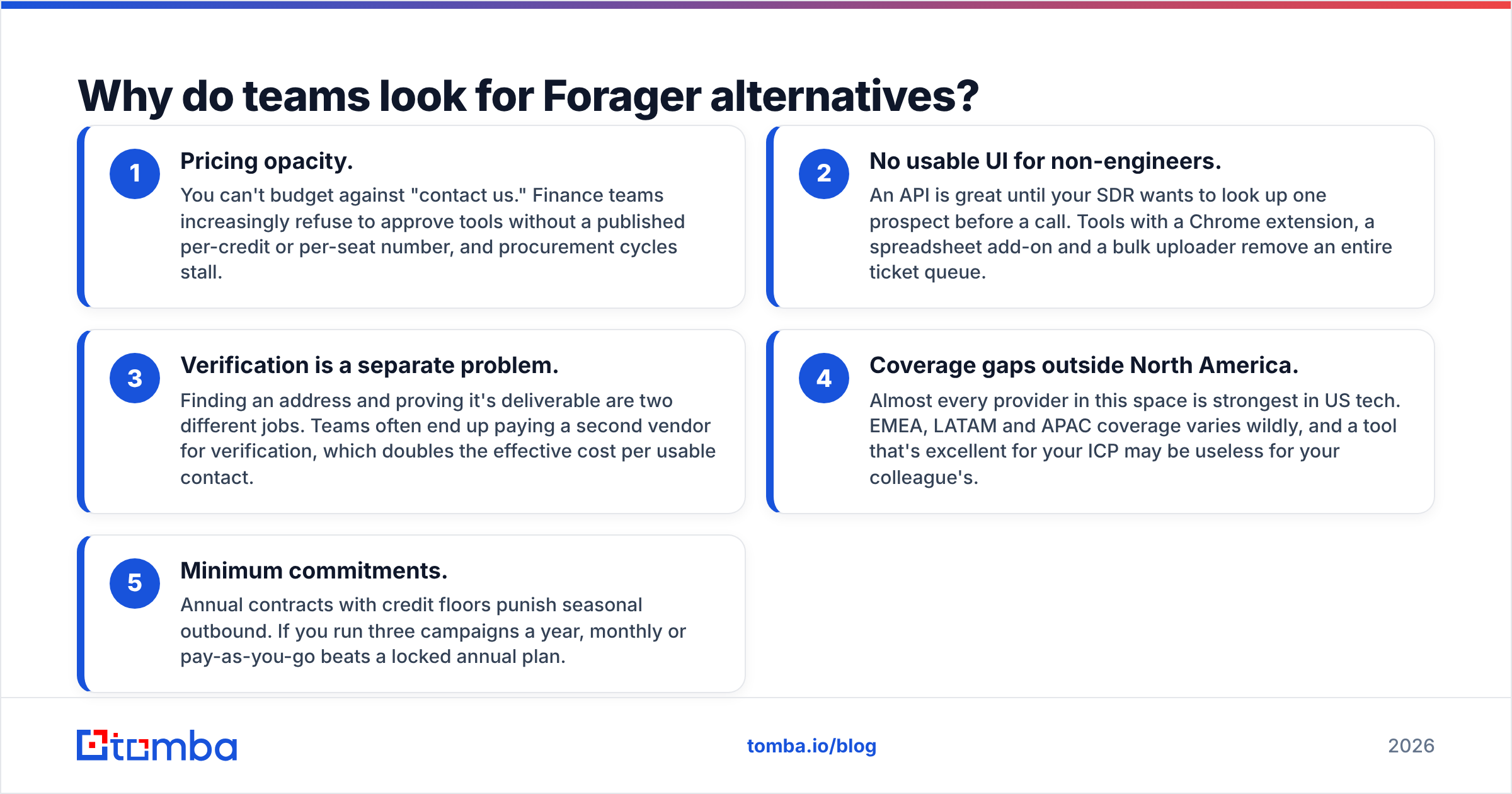
- Pricing opacity. You can't budget against "contact us." Finance teams increasingly refuse to approve tools without a published per-credit or per-seat number, and procurement cycles stall.
- No usable UI for non-engineers. An API is great until your SDR wants to look up one prospect before a call. Tools with a Chrome extension, a spreadsheet add-on and a bulk uploader remove an entire ticket queue.
- Verification is a separate problem. Finding an address and proving it's deliverable are two different jobs. Teams often end up paying a second vendor for verification, which doubles the effective cost per usable contact.
- Coverage gaps outside North America. Almost every provider in this space is strongest in US tech. EMEA, LATAM and APAC coverage varies wildly, and a tool that's excellent for your ICP may be useless for your colleague's.
- Minimum commitments. Annual contracts with credit floors punish seasonal outbound. If you run three campaigns a year, monthly or pay-as-you-go beats a locked annual plan.
If none of those apply to you, Forager is a perfectly reasonable choice and you can stop reading. If two or more apply, keep going.
How should you evaluate a Forager alternative?#
Run the same five checks on every vendor on your shortlist. This is the part most teams skip, and it's the reason so many "we switched and it's the same" stories exist.
- Coverage on your list, not their list. Upload 500 real prospects from your actual ICP — same industries, same geographies, same seniority. Record how many rows come back with an email at all. That's your coverage rate, and it's the number that determines pipeline volume.
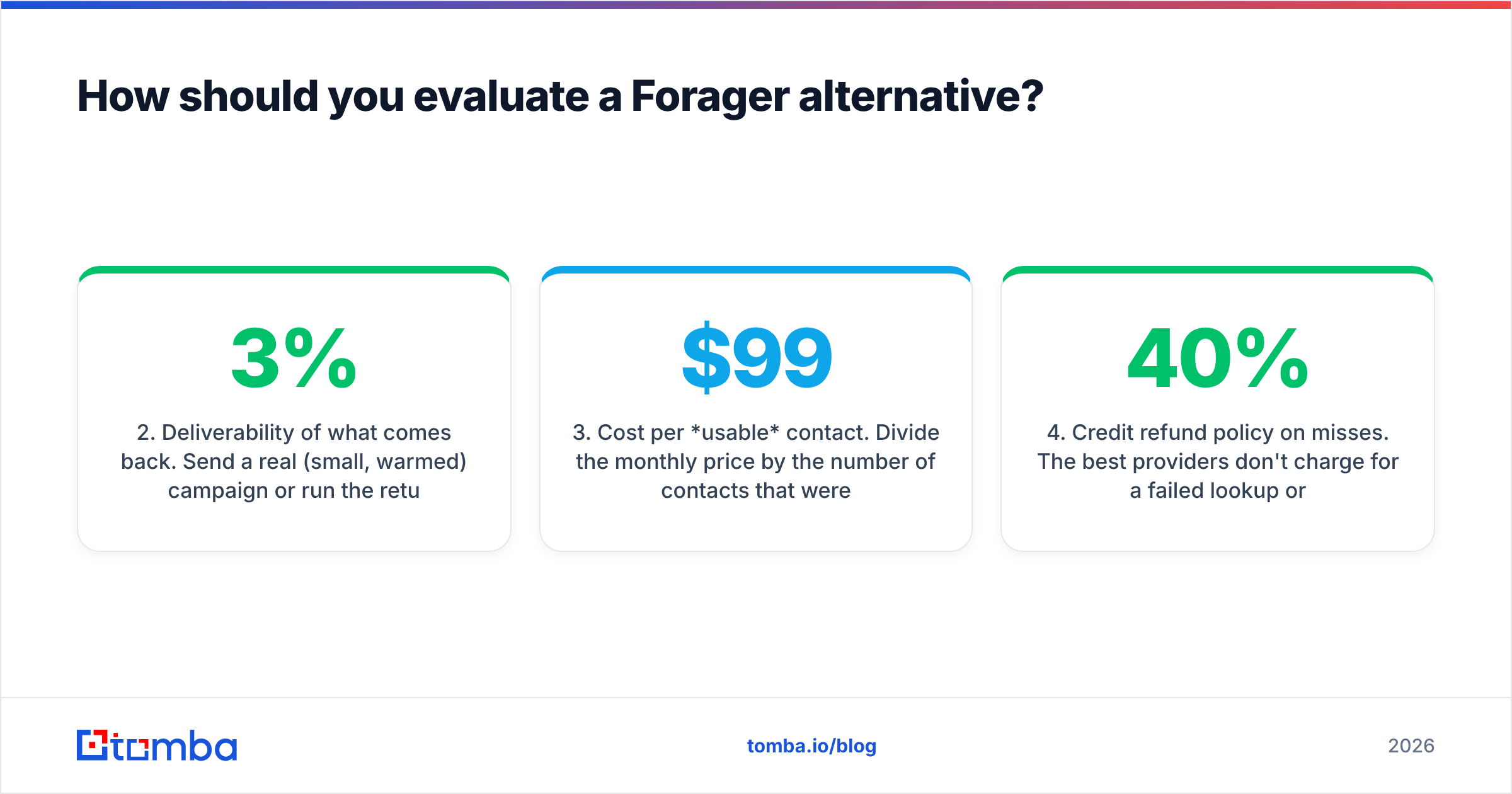
- Deliverability of what comes back. Send a real (small, warmed) campaign or run the returned addresses through an independent email verifier. Bounce rate above 3% will start hurting your sender reputation regardless of what the vendor promised.
- Cost per usable contact. Divide the monthly price by the number of contacts that were both found and verified — not by the credit allowance. A $99 plan with 5,000 credits and a 45% usable rate costs $0.044 per contact. A $49 plan with 1,000 credits and an 80% usable rate costs $0.061. Now you can compare honestly.
- Credit refund policy on misses. The best providers don't charge for a failed lookup or for a result they can't verify. Ask this explicitly; it can swing effective cost by 30–40%.
- Integration surface. API, Chrome extension, Google Sheets, Excel, Zapier, HubSpot, Salesforce, CSV. You need at least two of these to avoid manual copy-paste becoming someone's job.
Which Forager alternatives are worth testing in 2026?#
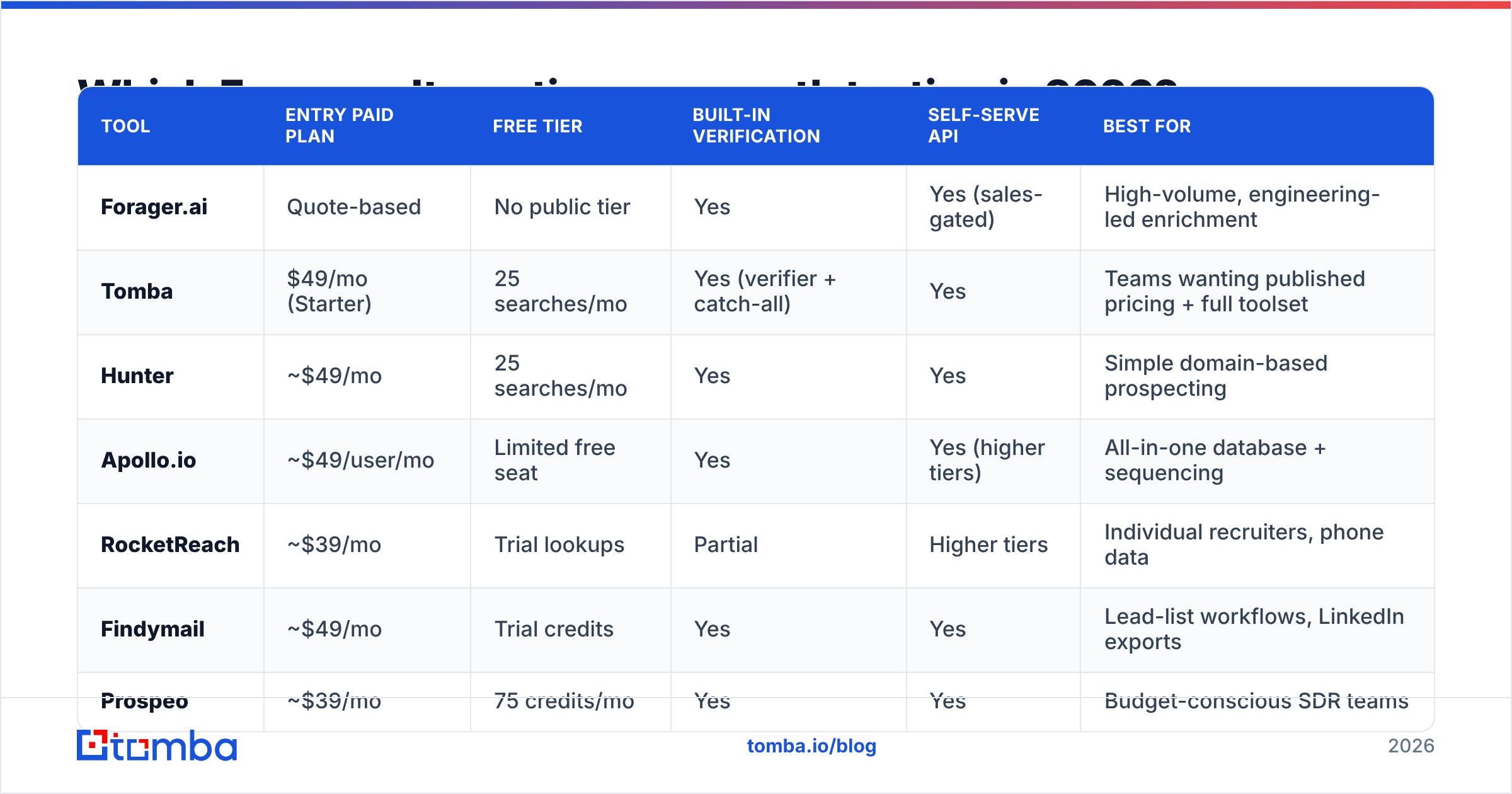
Here's the shortlist, compared on the attributes that actually change your decision. Prices are entry-level list prices at the time of writing and change often — always confirm on the vendor's own pricing page before you budget.
| Tool | Entry paid plan | Free tier | Built-in verification | Self-serve API | Best for |
|---|---|---|---|---|---|
| Forager.ai | Quote-based | No public tier | Yes | Yes (sales-gated) | High-volume, engineering-led enrichment |
| Tomba | $49/mo (Starter) | 25 searches/mo | Yes (verifier + catch-all) | Yes | Teams wanting published pricing + full toolset |
| Hunter | ~$49/mo | 25 searches/mo | Yes | Yes | Simple domain-based prospecting |
| Apollo.io | ~$49/user/mo | Limited free seat | Yes | Yes (higher tiers) | All-in-one database + sequencing |
| RocketReach | ~$39/mo | Trial lookups | Partial | Higher tiers | Individual recruiters, phone data |
| Findymail | ~$49/mo | Trial credits | Yes | Yes | Lead-list workflows, LinkedIn exports |
| Prospeo | ~$39/mo | 75 credits/mo | Yes | Yes | Budget-conscious SDR teams |
| BookYourData | Pay-as-you-go credits | Sample records | Yes (accuracy guarantee) | Yes | One-off list purchases, no subscription |
| Wiza | ~$83/mo | Limited free credits | Yes | Yes | LinkedIn Sales Navigator exports |
| Clearbit (HubSpot Breeze) | Bundled with HubSpot | No standalone free | Firmographic focus | Yes | HubSpot-native enrichment |

Tomba — the self-serve replacement for an API-first vendor#
Tomba is the closest structural match to Forager for teams that want the same capability without the sales call. You get an email finder, an email verifier, domain search, a catch-all verifier, phone finder and enrichment under one account, with published Tomba pricing: free tier at 25 searches/month, Starter at $49/mo, Growth at $99/mo, Pro at $249/mo, and custom enterprise terms above that.
The practical difference is that the same credit balance covers finding and verifying, so you're not paying two vendors for one usable contact. There's a Tomba API with the same endpoints the dashboard uses, plus a CLI, Chrome extension, Sheets and Excel add-ons, and a bulk email finder for CSV work. That combination — API for engineers, UI for SDRs — is what most Forager refugees are actually shopping for.
Trade-off: Tomba's database is optimized for work-email discovery and verification. If your core requirement is deep intent data or technographics, you'll still want a second source.
Hunter — the simplest domain-first option#
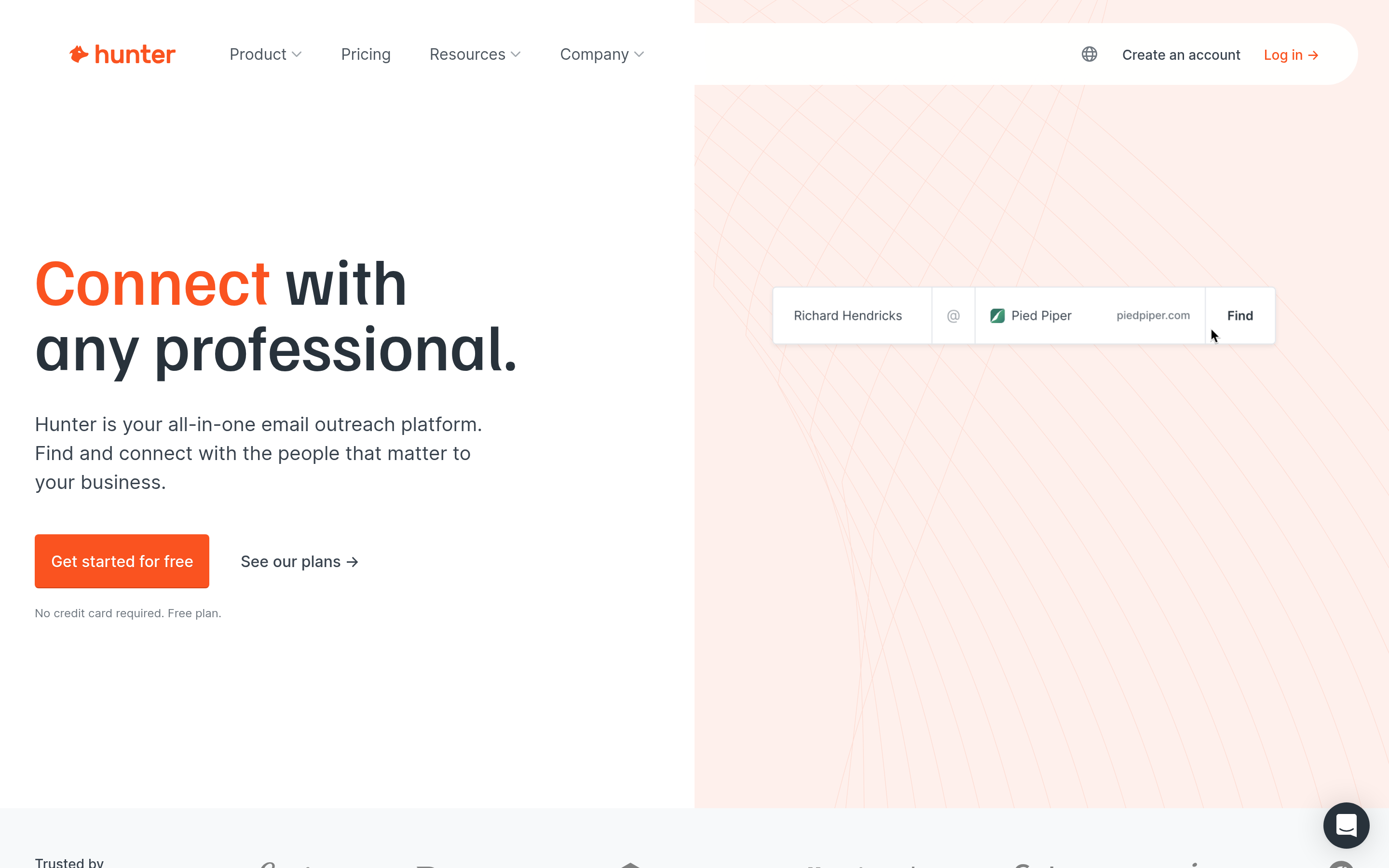
Hunter has been the default entry point in this category for a decade. Its domain search returns every known address at a company plus the pattern, which is genuinely fast for account-based prospecting. Confidence scores are conservative, which many teams prefer to inflated ones.
Trade-off: person-level coverage outside common patterns is thinner than database-backed tools, and credits burn quickly on bulk work.
Apollo.io — when you want the whole stack#
Apollo bundles a large contact database with sequencing, dialer and basic CRM functions. If you're replacing Forager and an outreach tool, the math changes in Apollo's favor. Data quality is average-to-good on US tech and noticeably weaker on smaller EMEA companies.
Trade-off: seat-based pricing scales badly, and export limits on lower tiers surprise people. If you only need data, you're paying for a lot of unused surface area. Teams that hit that wall usually end up comparing an Apollo alternative on cost per record alone.
RocketReach and Wiza — people-first, LinkedIn-adjacent#
Both are strongest when your workflow starts from a person rather than a company. RocketReach has good personal-email and phone coverage for recruiting use cases. Wiza is purpose-built for exporting LinkedIn Sales Navigator searches into enriched lists.
Trade-off: neither is a great fit for domain-level sweeps, and both get expensive fast at volume.
Findymail and Prospeo — the lean SDR picks#
Findymail markets on low bounce rates and doesn't charge for unverified results, which makes its effective cost lower than the sticker price suggests. Prospeo undercuts most of the market on entry price with a usable free tier.
Trade-off: smaller companies, smaller data footprints, and support that's fast but not enterprise-grade.
BookYourData — buy the list, skip the subscription#
BookYourData takes a different shape entirely: you filter a B2B database, see the count, and buy those records as credits with no monthly commitment. It publishes an accuracy guarantee and refunds bad records, which is unusually concrete for this category. For a team that needs 10,000 contacts once for a specific campaign — not 1,000 a month forever — that model is genuinely cheaper than any subscription here.
Trade-off: it's a list purchase model, so it's less suited to continuous, real-time enrichment inside a product.
How accurate are these tools in practice?#
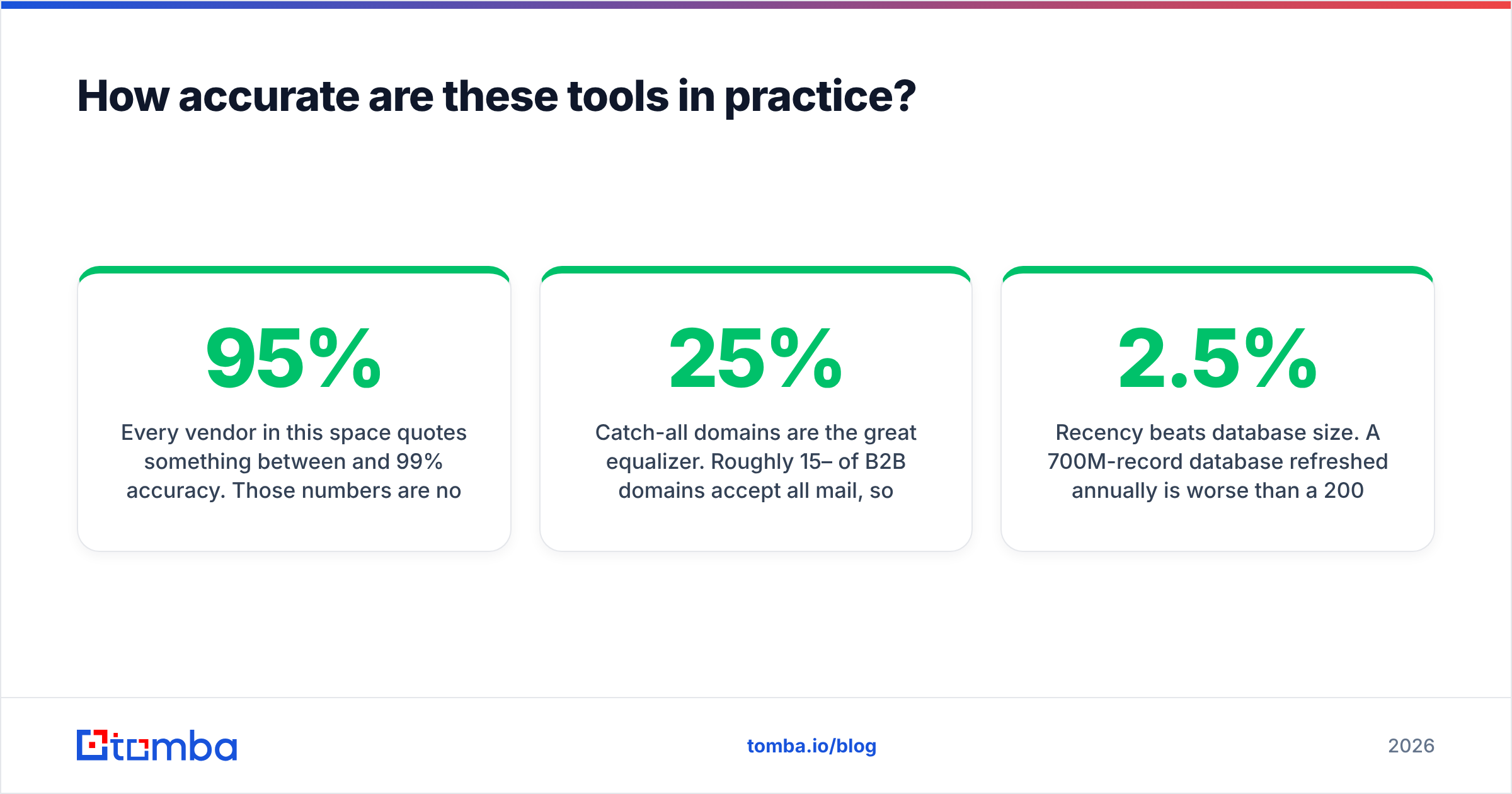
Every vendor in this space quotes something between 95% and 99% accuracy. Those numbers are not comparable, because each one is measured differently — some count "syntactically valid," some count "SMTP accepted," some count "did not bounce in our sample."

What holds up across independent testing:
- Catch-all domains are the great equalizer. Roughly 15–25% of B2B domains accept all mail, so no SMTP check can confirm an individual mailbox. Tools that mark these honestly (rather than passing them as "valid") save you the bounce. This is exactly what a dedicated catch-all verifier is for.
- Recency beats database size. A 700M-record database refreshed annually is worse than a 200M-record one refreshed monthly, because B2B contacts decay at roughly 2–2.5% per month through job changes alone.
- Pattern inference is not verification. Guessing
first.last@domain.comis trivial. Proving that mailbox exists is the hard part, and it's where cheap tools quietly fail.
What does switching actually cost you?#
Three costs get overlooked when teams leave a quote-based vendor:
- Re-integration time. If Forager sits inside a warehouse pipeline, budget 4–8 engineering hours to swap endpoints and re-map fields. Most alternatives here have similar REST shapes, so it's rarely worse than a day.
- Historical enrichment. Records enriched under the old contract don't disappear, but your refresh cadence does. Plan a one-time bulk re-enrichment of your active CRM segment.
- Verification double-spend. If you were paying separately for verification, folding it into one vendor is where the real savings show up — often 30–50% off the combined bill.
Which Forager alternative should you pick?#
Match the tool to the constraint that's actually binding you:
- You need published pricing and both an API and a UI: Tomba. Start on the free tier, upgrade to Starter at $49/mo when the 25 searches run out.
- You need account-level sweeps and nothing else: Hunter.
- You're replacing a data tool and a sequencer: Apollo.
- You need one big list, once, with no subscription: BookYourData.
- You live in LinkedIn Sales Navigator: Wiza.
- You're optimizing purely for cost per verified email at small volume: Prospeo or Findymail.
- You're doing millions of lookups with a dedicated data team: honestly, stay on Forager or negotiate against a similar API-first vendor. At that scale, per-credit pricing beats seat pricing and the sales call is worth it.
The decision framework matters more than the ranking. Run the 500-contact test on your top two, measure coverage and bounce rate separately, and compute cost per usable contact. That exercise takes an afternoon and routinely changes the answer teams walked in with.
Ready to test one without a sales call?#
If the thing pushing you off Forager is opacity — unclear pricing, gated API access, a demo you don't have time for — start with the Tomba Email Finder. The free tier gives you 25 searches a month with no card, finding and verification share the same credit pool, and every plan above it is published on the page. Run your 500-row test list through it, compare the bounce rate against whatever you're paying for now, and let the numbers decide.
Related guides#
Ready to find emails that actually work?
Join 150,000+ professionals who stopped guessing and started sending. Free credits on signup — no credit card required.
Get the Tomba newsletter
Practical outbound tactics and product updates — once every two weeks.
About the author