Forager Pricing in 2026: Real Costs, Limits, and Alternatives
Forager sells B2B contact data on a credit model with quote-heavy tiers. Here is what it actually costs, where the hidden charges hide, and which cheaper email finders match it on accuracy.
TL;DR
- Forager sells B2B contact data on a credit model, and most of its real pricing lives behind a sales conversation rather than a public checkout page. Expect quoted annual deals, not a transparent monthly card charge.
- Reported entry points cluster in the $49–$99/month range for individual seats, with team and data-licensing agreements running into four and five figures per year.
- The number that matters is not the sticker price. It is your cost per verified, deliverable contact after failed lookups, catch-all domains, and unused credits.
- If you mainly need work emails at a known domain, a straightforward tool like Tomba pricing at $49/mo Starter or $99/mo Growth will usually beat a quote-based data platform on cost per usable record.
- Buy Forager when you need a large, refreshed dataset and API delivery. Skip it when you need a few thousand accurate emails a month.
What is Forager and who is it actually for?#
Forager (forager.ai) is a B2B contact and company data provider. It sits closer to the "data platform" end of the market than the "single-seat email finder" end: refreshed people and company records, employment change signals, and API or data-feed delivery for teams that want to pipe contacts into their own systems.
That positioning explains the pricing model. Tools built for one SDR publish a price list and let you swipe a card. Platforms built for data teams quote you, because the deal depends on record volume, refresh frequency, delivery method, and contract length. Neither approach is wrong. They just serve different buyers.
You are probably a good fit for Forager if you are building an internal lead database, enriching a CRM at scale, or shipping a product feature that needs contact data underneath it. You are probably a poor fit if you are a founder or a three-person sales team who needs 2,000 verified emails this quarter — you will pay platform overhead for a workflow that a standard email finder covers.
How does Forager pricing actually work?#
Credit-based data pricing follows the same skeleton almost everywhere. Understanding the five moving parts is how you avoid overpaying by 3x.
- Credits, not contacts. A credit is consumed per lookup or per enrichment call, and in most credit systems a failed lookup can still cost you something depending on the vendor's policy. Ask directly: "Do I get charged for a null result?" The answer changes your effective cost per contact more than any headline discount.
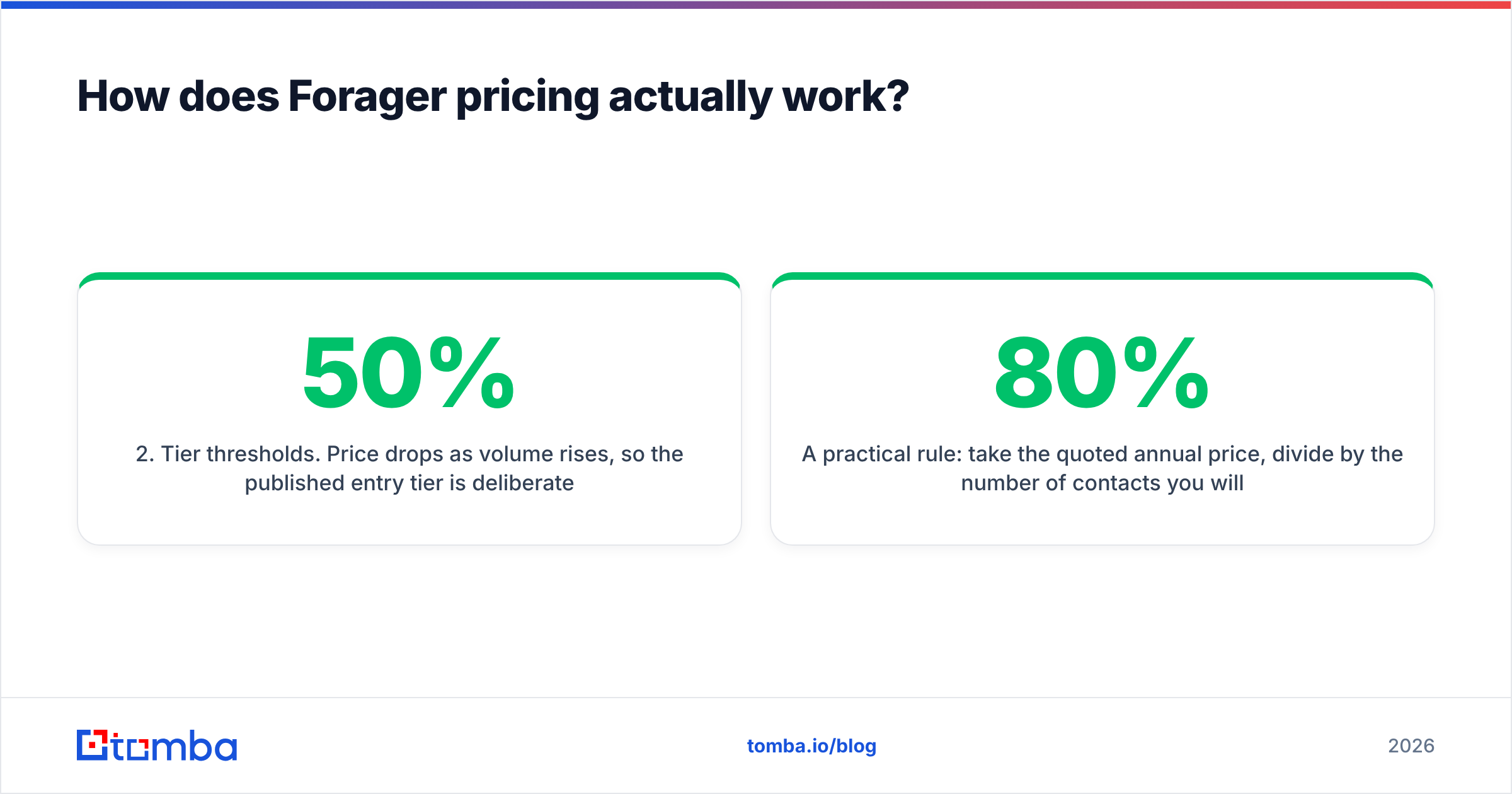
- Tier thresholds. Price per credit drops as volume rises, so the published entry tier is deliberately the worst per-unit deal. The jump from a starter tier to a mid tier often cuts per-credit cost by 30–50%, which is why sales teams push you up a tier rather than discount the one you asked for.
- Annual commitment. Quote-based platforms price annual contracts meaningfully below month-to-month. The discount is real, but it converts a flexible expense into a fixed one — and unused credits at year end are usually gone.
- Seats versus credits. Some vendors charge per user and per credit. Confirm whether adding a second SDR doubles your bill or simply shares the same credit pool. This single question has swung deals by thousands of dollars.
- Delivery surcharges. API access, bulk exports, webhook feeds, and CRM integrations are sometimes gated to higher tiers. If you need the email finder API style of programmatic access, verify it is included before you sign, not after.
A practical rule: take the quoted annual price, divide by the number of contacts you will realistically use (not the credits you are allocated), then subtract the ones that bounce. That final figure is your true unit cost. Most buyers discover it is 40–80% higher than the number on the proposal.
Is Forager's data accuracy worth the price?#
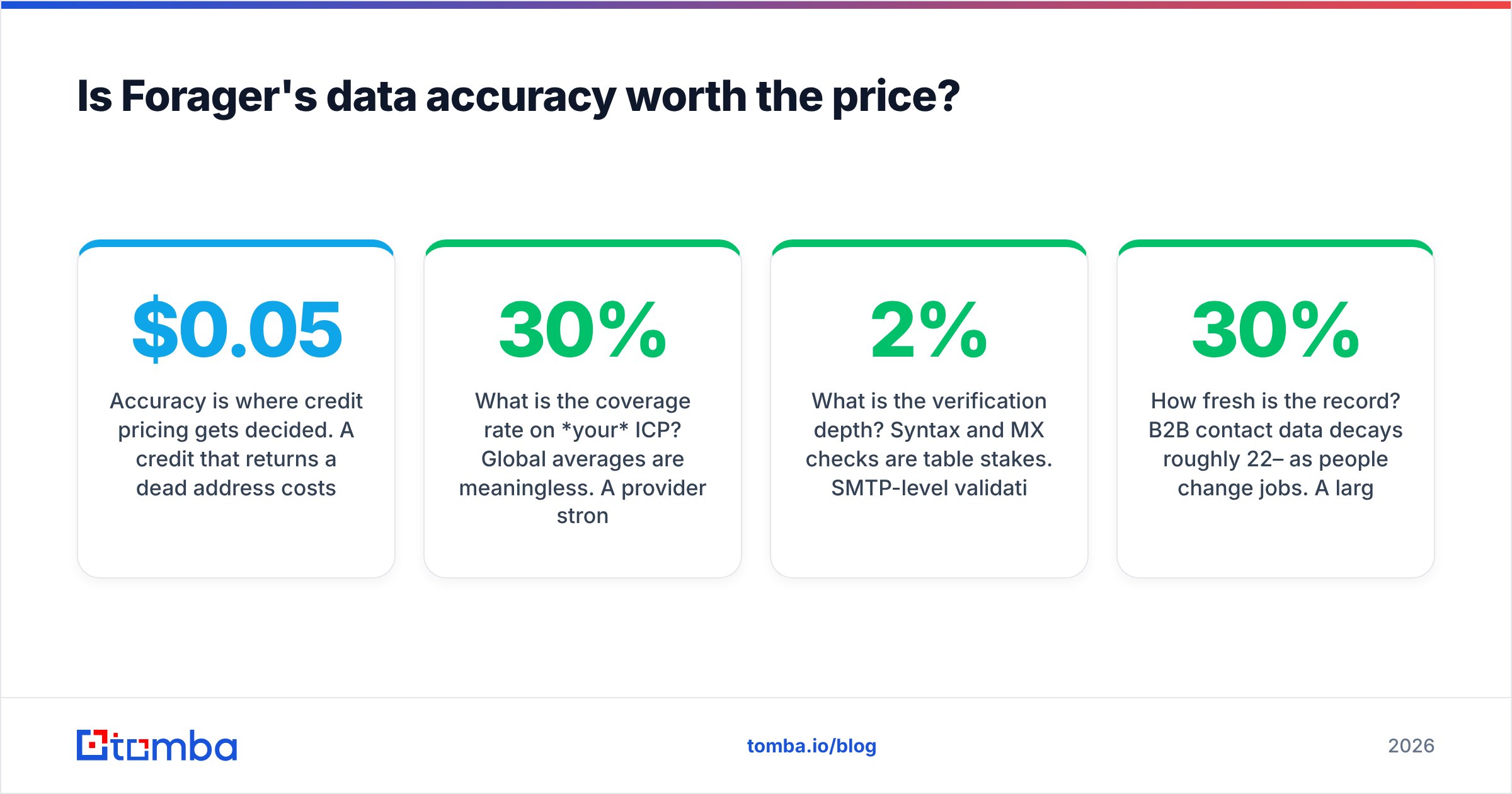
Accuracy is where credit pricing gets decided. A $0.05 credit that returns a dead address costs more than a $0.15 credit that lands in an inbox, because the bounce also damages your sending domain and burns a prospect you cannot re-approach cleanly.

Three questions cut through vendor accuracy marketing:
- What is the coverage rate on your ICP? Global averages are meaningless. A provider strong in US SaaS may return 30% coverage on German manufacturing. Run 200 of your own target accounts through a trial before you commit.
- What is the verification depth? Syntax and MX checks are table stakes. SMTP-level validation and a real catch-all policy are what separate a 2% bounce rate from a 9% one. If catch-all domains are a large share of your list, a dedicated catch-all verifier matters more than raw database size.
- How fresh is the record? B2B contact data decays roughly 22–30% per year as people change jobs. A large dataset refreshed annually is worse than a smaller one refreshed monthly.
Whatever provider you pick, treat verification as a separate step. Running exports through an email verifier before they touch your sequencer is the cheapest insurance in outbound, and it makes vendor comparisons honest — you find out which credits were actually deliverable.
How does Forager pricing compare to other B2B data tools?#
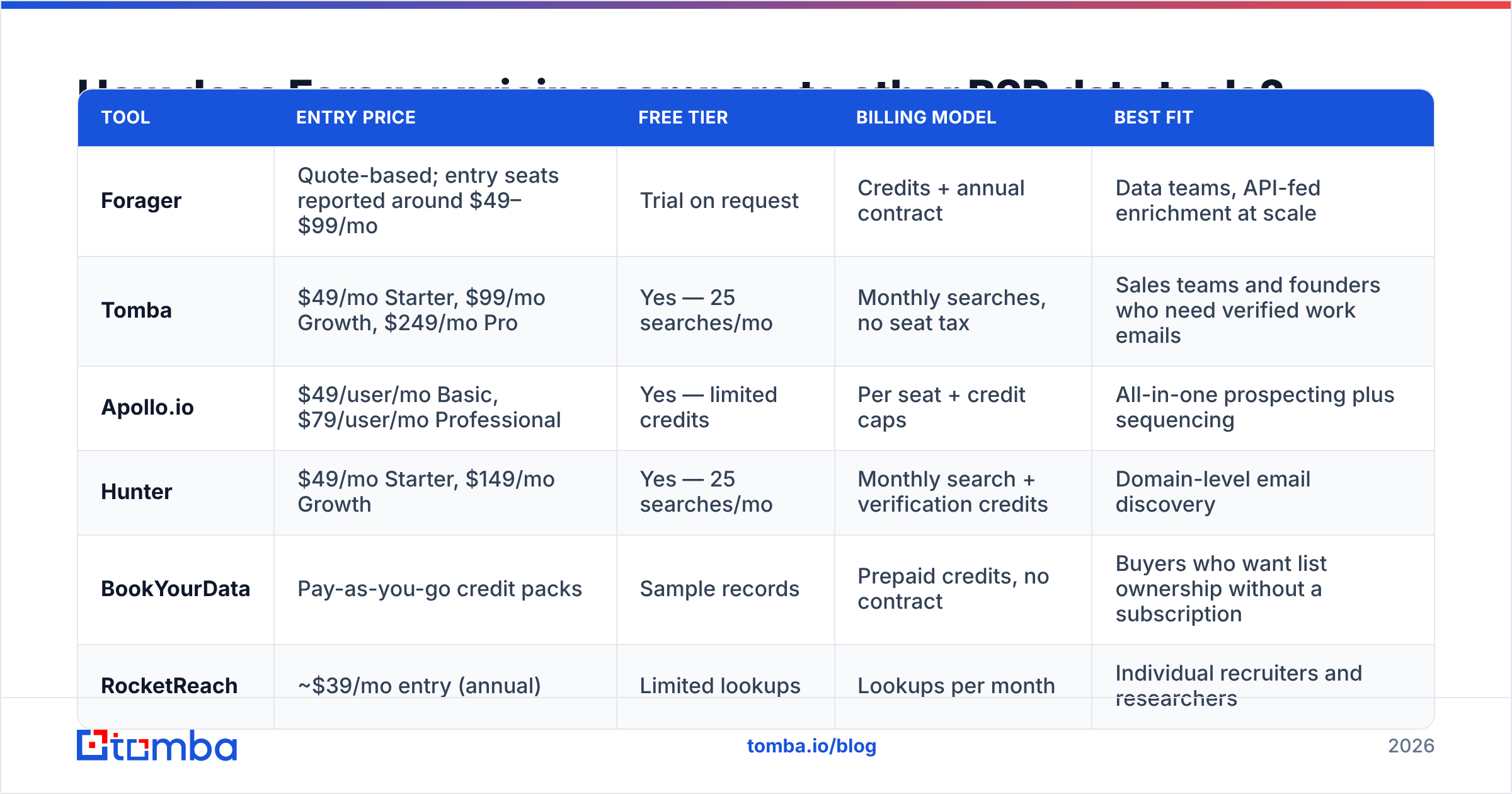
Here is the landscape as of 2026. Figures are published list prices where vendors publish them, and reported ranges where they do not. Always confirm on the vendor's own page before budgeting.

| Tool | Entry price | Free tier | Billing model | Best fit |
|---|---|---|---|---|
| Forager | Quote-based; entry seats reported around $49–$99/mo | Trial on request | Credits + annual contract | Data teams, API-fed enrichment at scale |
| Tomba | $49/mo Starter, $99/mo Growth, $249/mo Pro | Yes — 25 searches/mo | Monthly searches, no seat tax | Sales teams and founders who need verified work emails |
| Apollo.io | $49/user/mo Basic, $79/user/mo Professional | Yes — limited credits | Per seat + credit caps | All-in-one prospecting plus sequencing |
| Hunter | $49/mo Starter, $149/mo Growth | Yes — 25 searches/mo | Monthly search + verification credits | Domain-level email discovery |
| BookYourData | Pay-as-you-go credit packs | Sample records | Prepaid credits, no contract | Buyers who want list ownership without a subscription |
| RocketReach | ~$39/mo entry (annual) | Limited lookups | Lookups per month | Individual recruiters and researchers |
Two patterns stand out. First, the transparent-pricing tools cluster tightly around $49/month for an entry plan — that is the market's anchor, and any quote materially above it needs to justify itself with coverage or delivery you cannot get elsewhere. Second, per-seat pricing (Apollo's model) and per-credit pricing (Forager's, BookYourData's) scale in opposite directions. Per-seat punishes team growth; per-credit punishes volume growth. Match the model to whichever of the two you expect to increase.
BookYourData deserves a specific mention here because it solves a real problem quote-based platforms create: you can buy a defined number of records, own them outright, and skip the annual commitment entirely. For teams that run campaigns in bursts rather than continuously, prepaid credits are often the more rational structure.
Where do the hidden costs in Forager pricing show up?#
The proposal is rarely the whole bill. Budget for these:
- Wasted credits on failed lookups. If null results are billable, a 65% coverage rate on your ICP means you are paying roughly 1.5 credits for every contact you can actually use.
- Rollover restrictions. Monthly credits that do not roll over convert seasonal usage into permanent waste. If your outbound is quarterly, you may pay twelve months for four months of work.
- Verification you still have to run. Most data platforms hand you a confidence score, not a guarantee. A separate verification pass is a real line item — factor $0.001–$0.004 per address.
- Integration engineering. API-first delivery means someone builds and maintains the pipeline. That is developer hours, and on a small team it is the largest hidden cost of the whole purchase.
- Overage rates. Ask what a credit costs above your allotment. Overage pricing is often 2–3x the in-plan rate, and it is where mid-year budget surprises come from.
- The annual lock. A twelve-month contract signed on 60 days of testing is a bet. If coverage on your segment disappoints in month three, you pay for nine more.
Independent review sites are useful here because buyers complain about billing in public. Scan the recent reviews on G2 and filter for company size similar to yours — enterprise reviewers and solo reviewers describe completely different products.
Is there a cheaper alternative to Forager?#
Yes, for most buyers — and the reason is structural, not competitive point-scoring.
Forager's cost is justified by breadth and delivery infrastructure. If you are not consuming that breadth, you are subsidizing it. A team sourcing 3,000–20,000 contacts a month at known companies is buying a much simpler thing: accurate work emails at specified domains, verified, exportable, ideally scriptable.

That workload maps cleanly onto transparent-priced tools:
- Domain-first sourcing. If you already know the accounts, domain search returns the people and patterns at each company without you buying a global database.
- List enrichment. Have names and companies but no emails? Bulk email finder workflows handle CSV in, verified emails out, at a fixed monthly cost.
- Programmatic use. Need it in your own stack? A documented REST API on a $99/mo plan removes the enterprise contract from the equation entirely.
- Prepaid, no subscription. If you want to own records outright with zero recurring commitment, credit-pack vendors like BookYourData are the cleaner structure.
The honest counter-argument: none of these replace a genuine data platform if your requirement is a continuously refreshed dataset of millions of records with change signals. If that is the brief, Forager and its peers are the right category, and the quote is the price of admission. Just be sure that is actually the brief and not an aspiration.
Which plan should you actually buy?#
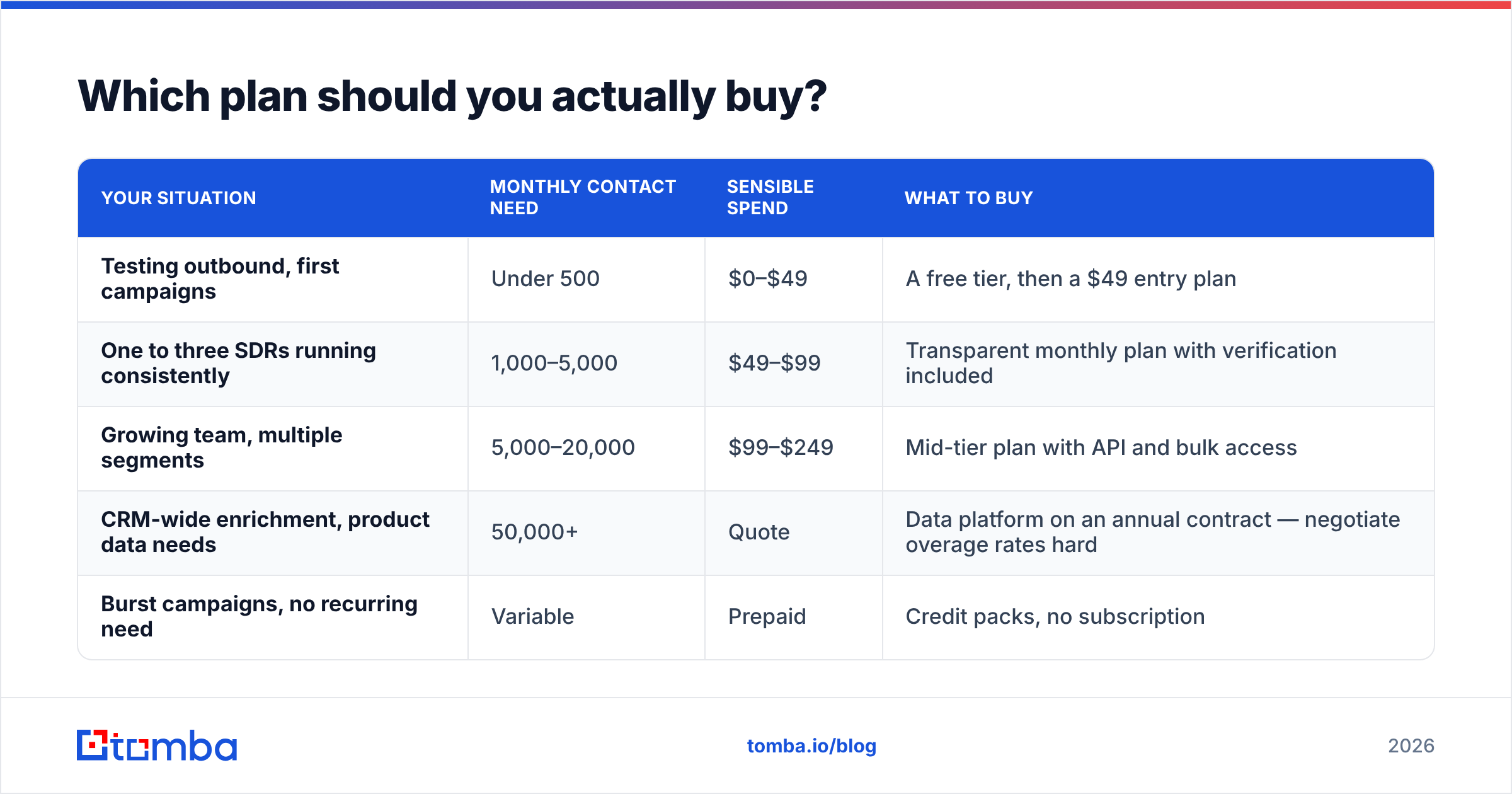
Match the tier to your monthly volume and your delivery need, not to the feature list.
| Your situation | Monthly contact need | Sensible spend | What to buy |
|---|---|---|---|
| Testing outbound, first campaigns | Under 500 | $0–$49 | A free tier, then a $49 entry plan |
| One to three SDRs running consistently | 1,000–5,000 | $49–$99 | Transparent monthly plan with verification included |
| Growing team, multiple segments | 5,000–20,000 | $99–$249 | Mid-tier plan with API and bulk access |
| CRM-wide enrichment, product data needs | 50,000+ | Quote | Data platform on an annual contract — negotiate overage rates hard |
| Burst campaigns, no recurring need | Variable | Prepaid | Credit packs, no subscription |
Before you sign anything quote-based, do three things. Run a 200-account trial on your real ICP. Verify the returned addresses independently. Then compute cost per deliverable contact and compare it against a $49 or $99 published plan doing the same job. If the platform is not at least 2x better on that number, the simpler tool wins on total cost of ownership once you count the engineering time.
The bottom line on Forager pricing#
Forager pricing is opaque by design because it serves buyers whose needs are genuinely custom. That is a legitimate model — but it also means the burden is on you to prove the premium is earned on your specific accounts, not on a global coverage stat.
For the large majority of B2B teams, the requirement is narrower than the platform being sold: verified work emails at target companies, delivered on time, without a bounce problem. If that describes you, start with the Tomba Email Finder — the free tier gives you 25 searches a month to test coverage on your own account list, Starter is $49/mo, Growth is $99/mo, and every result runs through verification before it reaches your export. Run the same 200 accounts through both, compare cost per deliverable contact, and let the number decide.
Sources: forager.ai, g2.com, apollo.io
Related guides#
Ready to find emails that actually work?
Join 150,000+ professionals who stopped guessing and started sending. Free credits on signup — no credit card required.
Get the Tomba newsletter
Practical outbound tactics and product updates — once every two weeks.
About the author