Forager.ai Pros and Cons: Honest 2026 Review for B2B Teams
Forager.ai sells freshness: B2B contact data re-crawled on a fast cycle and delivered by API or flat file. Here is where that pays off, where it does not, and which teams should pick a cheaper per-lookup tool instead.
The Forager pros and cons come down to one trade. You buy fresh data at scale, and you give up cheap, simple, per-lookup buying. Here is how that trade plays out.
TL;DR
- Forager.ai is a B2B contact and company data provider. Its whole pitch is freshness — profiles get re-crawled on a fast cycle, not left to sit for months.
- The pros are real: broad profile coverage, API and bulk-file delivery, and job-move signals that most static databases miss.
- The cons are real too. Pricing hides behind a sales call. Minimums are built for big teams. You still have to check emails yourself. The workflow suits data teams, not single reps.
- Need a few thousand verified emails a month? A per-lookup email finder at $49/mo does the same job for far less.
- Piping millions of fresh records into a warehouse or a scoring model? Then Forager's delivery model is worth a call.
What is Forager.ai, and who is it built for?#
Forager.ai is a B2B data vendor. It keeps a large index of work profiles and company records. It re-crawls them often. It sells access through an API, bulk files, and a browser tool. Its public pitch on forager.ai leans on one thing: recency. Many databases refresh once a quarter. Forager markets a much shorter cycle.
That one choice explains almost everything else about the product. The Forager pros and cons both trace back to it.
Think of the B2B data market like food shopping. Most vendors run a supermarket. The shelves are huge, but some of the stock was picked three months ago. Forager runs a farm box. The list is smaller in any one niche, but the box came this week. Both are fine businesses. Which one you want depends on whether you feed two people or cater a wedding.
Forager fits a data or RevOps team best. That team has somewhere to put raw records: a warehouse, a CRM job, a lead score, a territory plan. It fits a single rep worst. That rep wants twelve emails before a Tuesday call block. That is not a flaw. It is a segment.
The pros half of the Forager pros and cons ledger#
Five things Forager does well, in rough order of how often they matter.
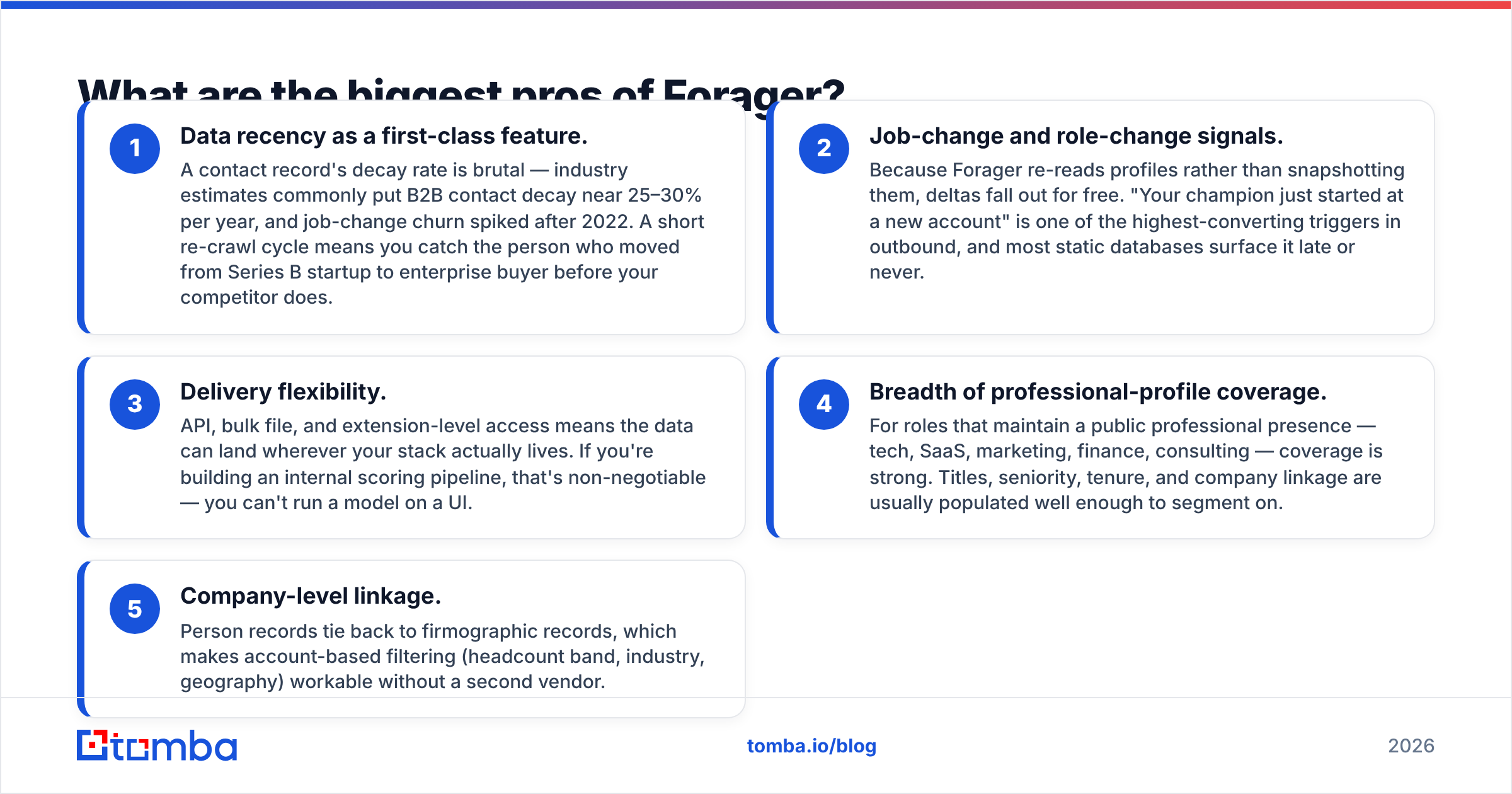
- Fresh data as a core feature. Contact records rot fast. Industry estimates put B2B contact decay near 25–30% a year, and job hopping spiked after 2022. A short re-crawl cycle means you catch the buyer who moved before your rival does.
- Job-change signals. Forager re-reads profiles instead of freezing them, so the deltas fall out for free. "Your champion just started at a new account" is one of the best triggers in outbound. Static databases flag it late, or never.
- Flexible delivery. API, bulk file, and extension access mean the data lands where your stack lives. Building a scoring pipeline? Then this matters a lot. You cannot run a model on a UI.
Coverage is the other half of the pros case.
- Broad profile coverage. Coverage is strong for roles with a public work profile: tech, SaaS, marketing, finance, consulting. Titles, seniority, tenure, and company links are filled in well enough to segment on.
- Company links. Person records tie back to company records. That makes account-based filters — headcount band, industry, region — work without a second vendor.
Is your problem "our CRM data is 18 months stale and we do not know who still works where"? Then Forager aims right at you.
The cons half of the Forager pros and cons ledger#
Now the other side. None of these kill the deal on their own. Together, they add up.
Pricing hides behind a sales call. As of early 2026, Forager does not publish a price list. You book a call, you describe volume, and you get a quote. That is normal for data vendors who sell to big firms. But it costs you three things: weeks of eval time, no way to compare line items before you are in talks, and pressure to sign for a year. If you buy tools on a company card, you will feel that friction on day one.
Minimums do not match small teams. Data vendors price on records, not seats. A five-person team that burns 2,000 lookups a month is an odd fit for a model built around millions of rows. You end up paying for a pipe you cannot fill.
Fresh is not the same as verified. This is the most missed point in the whole market. A fresh profile tells you a person's current job title. It does not tell you whether their email will accept mail. Those are two checks against two systems. Any real sending workflow still needs an SMTP pass through an email verifier before the first send. It does not matter how fresh the source profile is.
Catch-all domains stay murky. Roughly a fifth of business domains accept mail at any address, which defeats a simple check. Does a big slice of your ICP sit behind catch-all setups? Then you need a catch-all verifier on top of what the vendor returns. No data vendor solves this for you at the record level.
Coverage skews to public profiles. Local SMBs, trades, plants, and non-English markets are thin in every profile-based database. Forager is no exception. If your ICP is a 40-person metal shop in the Midwest, plan to fill gaps by hand.
It is a data product, not a workflow product. There is no sequencer, no dialer, no pipeline view. That is arguably a virtue — best-of-breed beats bundled and bland. But it means Forager is a line item in a stack, not a stack.
How accurate is Forager's data in practice?#
Accuracy sits at the center of any Forager pros and cons call. Read vendor accuracy claims as marketing, not as fact. That goes for the whole market. Each vendor defines "accurate" its own way. Some count a valid-looking address. Some count an address the mail server accepts. Some count a delivered send. Those numbers do not compare.

Run your own test. It takes an afternoon, and it is the only number that counts.
- Pull 200 contacts whose emails you know are good — people who replied to you in the last 90 days.
- Strip the emails. Feed the name and domain to each vendor you test.
- Score three things on their own: hit rate (did it return anything?), match rate (did it match the address you know is right?), and cost per correct match (spend ÷ correct matches).
- Re-run the same list 60 days later to measure decay.
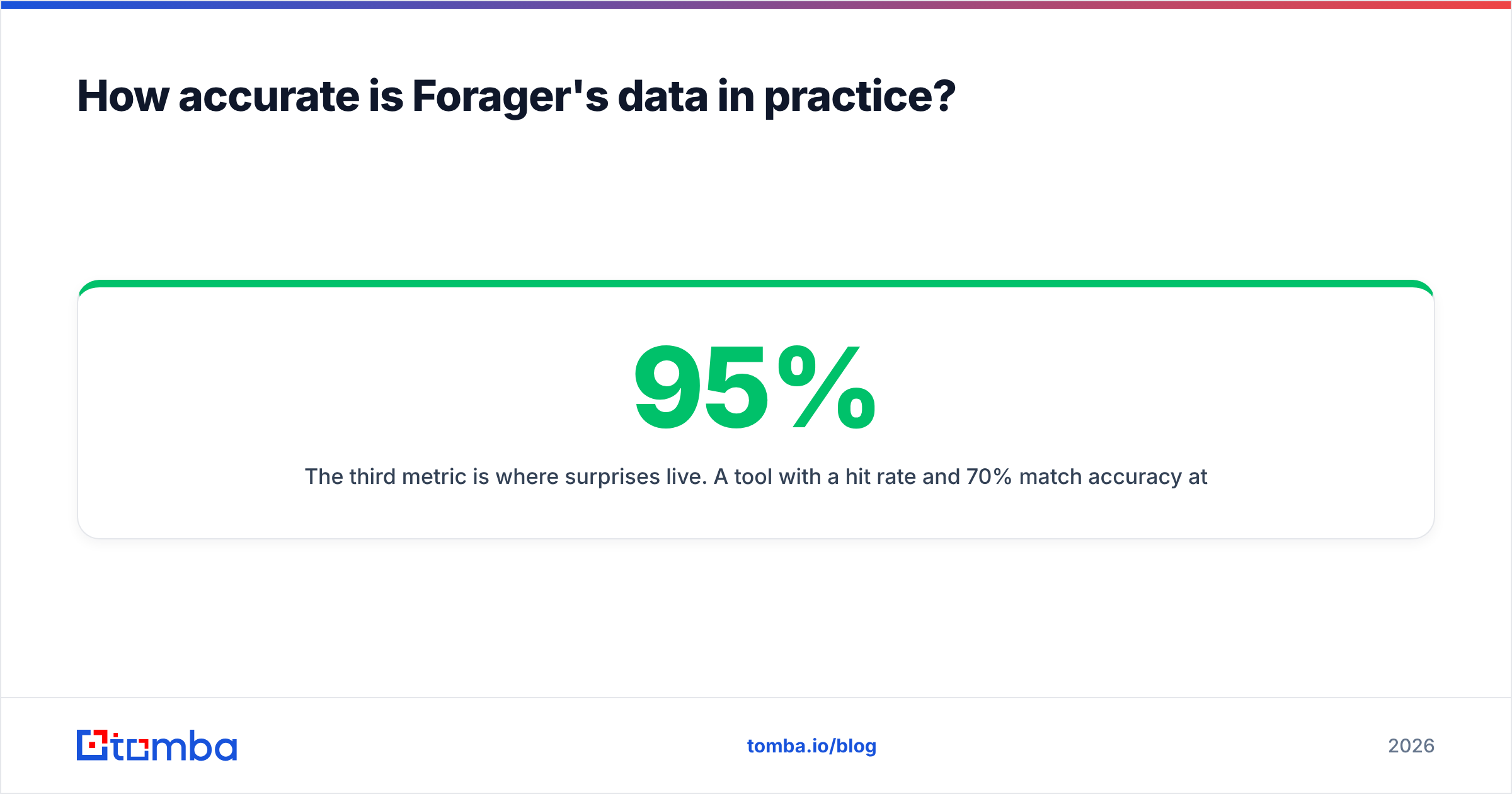
The third metric holds the surprises. Say one tool hits 95% of the time, but only 70% of those match, at $0.30 a record. It loses to a tool that hits 75% of the time with 92% matching at $0.05. You pay for the misses either way. Tomba publishes where its data comes from so this kind of audit is possible. Ask any vendor to do the same, and treat a dodge as a data point.
One honest note in Forager's favor. On freshness, a fast re-crawl is a real edge, and it shows up in job-change alerts. A rival on a quarterly cycle cannot fake it. On email deliverability, it is close to a wash. Everyone guesses patterns and then checks them, and that check sets your bounce rate.
How does Forager compare to other B2B data tools?#
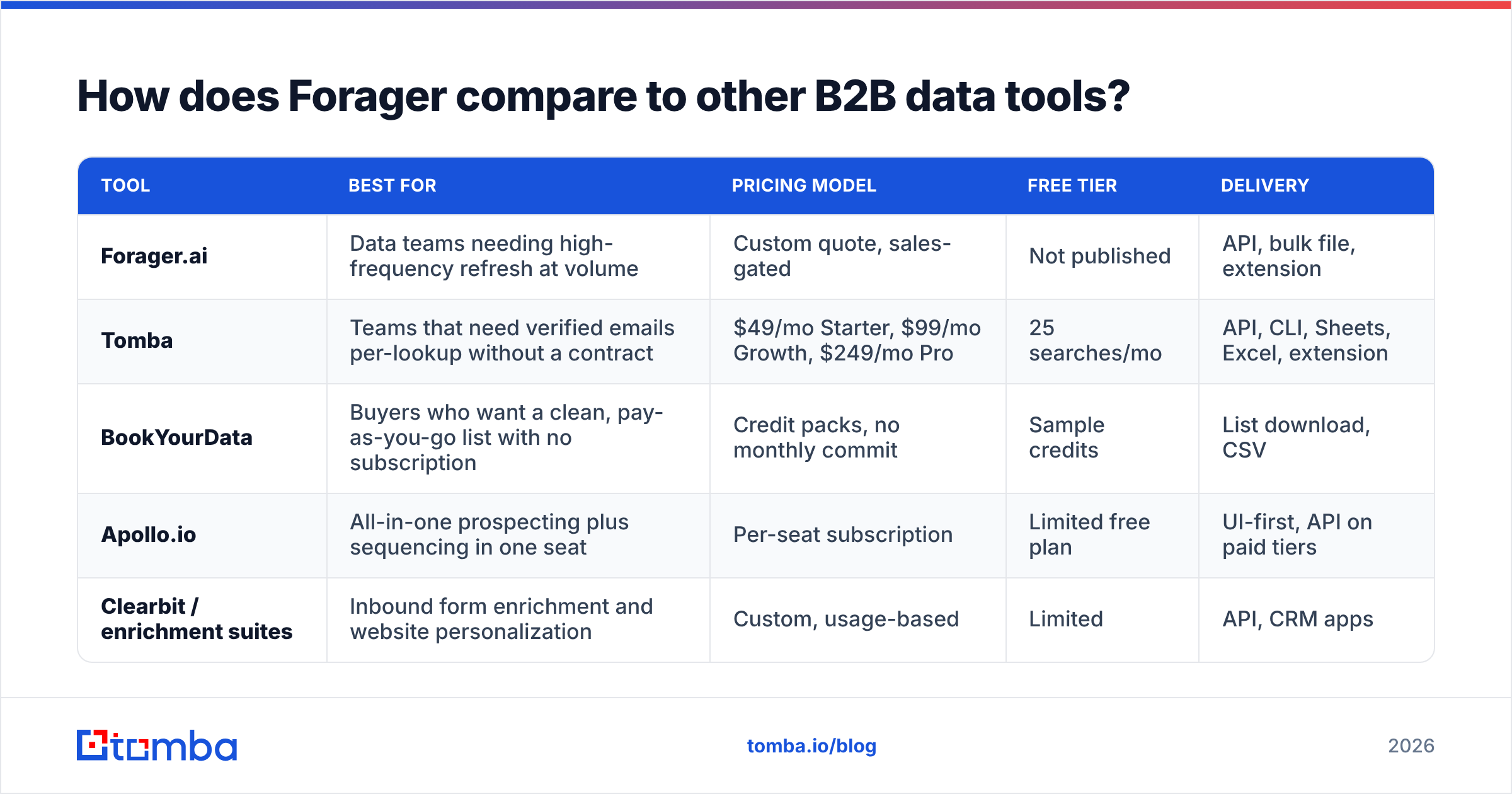
The Forager pros and cons only mean something next to the alternatives. Here is the honest landscape. Prices reflect public rates in early 2026. Confirm them with each vendor.

| Tool | Best for | Pricing model | Free tier | Delivery |
|---|---|---|---|---|
| Forager.ai | Data teams needing high-frequency refresh at volume | Custom quote, sales-gated | Not published | API, bulk file, extension |
| Tomba | Teams that need verified emails per-lookup without a contract | $49/mo Starter, $99/mo Growth, $249/mo Pro | 25 searches/mo | API, CLI, Sheets, Excel, extension |
| BookYourData | Buyers who want a clean, pay-as-you-go list with no subscription | Credit packs, no monthly commit | Sample credits | List download, CSV |
| Apollo.io | All-in-one prospecting plus sequencing in one seat | Per-seat subscription | Limited free plan | UI-first, API on paid tiers |
| Clearbit / enrichment suites | Inbound form enrichment and website personalization | Custom, usage-based | Limited | API, CRM apps |
A few reads on that table:
- Forager vs Tomba is not a head-to-head. Forager sells fresh records at scale. Tomba sells verified emails per lookup, with public pricing and a free tier you can test today. Different unit of value, different buyer.
- BookYourData earns a mention for one job Forager handles poorly. You need 5,000 contacts in one niche, once, and you never want to think about a plan again. Credit packs with no monthly commit fit that job better, and the list builder is made for it.
- Apollo wins on seat cost if you want data and sequencing in one tool. It loses on data portability if you later want to move.
- Enrichment suites solve a different problem. You already have the email. You want the firmographics.
Forager pros and cons: is it worth it for your team?#
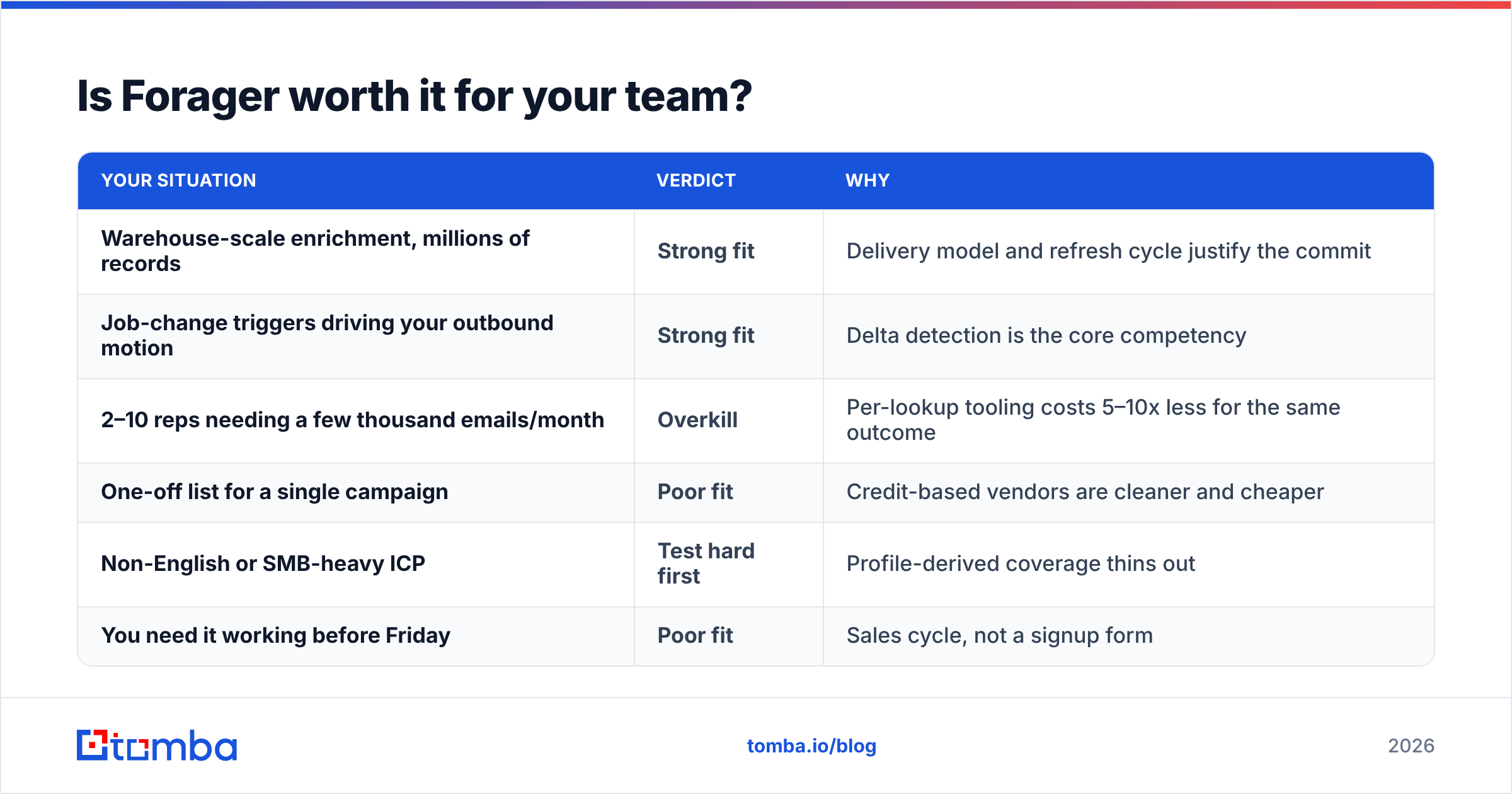
Match yourself to a row.
| Your situation | Verdict | Why |
|---|---|---|
| Warehouse-scale enrichment, millions of records | Strong fit | Delivery model and refresh cycle justify the commit |
| Job-change triggers driving your outbound motion | Strong fit | Delta detection is the core competency |
| 2–10 reps needing a few thousand emails/month | Overkill | Per-lookup tooling costs 5–10x less for the same outcome |
| One-off list for a single campaign | Poor fit | Credit-based vendors are cleaner and cheaper |
| Non-English or SMB-heavy ICP | Test hard first | Profile-derived coverage thins out |
| You need it working before Friday | Poor fit | Sales cycle, not a signup form |
Here is the rule I would give a friend. If you cannot say what happens to the data after it lands, you do not need a data-delivery vendor yet. Buy lookups. Prove the motion works. Move up to bulk refresh when your pipeline is starving for it.
What should you ask before signing anything?#
Take this Forager pros and cons checklist to the call — with Forager or anyone else.
- What does your accuracy number measure? Syntax, mail-server acceptance, or delivered mail? Get it in writing.
- How do you count catch-all domains? If you score them as valid, my bounce rate will not match your number.
- How often does each field refresh? Job titles and emails may not run on the same clock.
- Can I run a paid pilot on my own list first? A vendor sure of its match rate will say yes.
- What happens to the data if I leave? Rights to keep delivered records vary a lot by contract.
- Which rules do you support? GDPR and CCPA duties do not move to the vendor just because you bought from one. Data quality and provenance stay your problem in an audit.
What is the practical alternative stack?#
Did the Forager pros and cons math land badly for your team? For most teams under 50 reps, this pattern works.
- Find emails per lookup, rather than buying a database you will use 3% of.
- Verify every address before it enters a sequence. This is the biggest lever on deliverability — bigger than copy, timing, or volume.
- Enrich only the records that convert. Contact enrichment on 200 warm leads beats enrichment on 200,000 cold ones.
- Automate the dull part with an email finder API so your CRM stays current without manual exports.
That stack costs a few hundred dollars a month. It needs no sales call. It gets the same outcome at the volumes most teams really run. For a lot of teams, that is where the Forager pros and cons debate ends. Move up to a data contract when your volume breaks the stack — not before.
Forager pros and cons: the final verdict#
Forager.ai is a solid data vendor with a real edge on freshness. It is a good buy for one kind of buyer: a technical team with a warehouse, real volume, and a use case that lives or dies on how fresh a record is.
The cons do not kill the deal on their own. Still, hidden pricing, high minimums, checks you own, and thin coverage outside public profiles add up. For most small and mid-market sales teams, the math lands better somewhere else.
Weigh the Forager pros and cons against your real monthly lookup volume, not against next year's ambitions.
Want to test the cheaper path first? Start with Tomba Email Finder — 25 free searches a month, no sales call, and results you can score against your own list today. Does it clear your bar at $49/mo? Then you just saved a procurement cycle. If not, you walk into the Forager call with a real benchmark instead of a brochure number.
Related guides#
Ready to find emails that actually work?
Join 150,000+ professionals who stopped guessing and started sending. Free credits on signup — no credit card required.
Get the Tomba newsletter
Practical outbound tactics and product updates — once every two weeks.
About the author