Forager vs Lead411 in 2026: Contact Data, Pricing, Accuracy
Forager sells fresh, frequently-recrawled contact data. Lead411 sells a full sales-intelligence suite with intent and triggers. Here is which one actually fits your outbound motion — and when neither is the right buy.
TL;DR
- Forager is a data-freshness play: a large B2B contact graph that is re-crawled and re-verified on a fast cycle, sold mainly through API, bulk exports, and enrichment workflows.
- Lead411 is a sales-intelligence suite: contacts plus direct dials, Bombora-powered intent, and hiring/funding growth triggers, sold per seat with unlimited-style export allowances on its main plan.
- Pick Forager if you are an ops or growth engineer piping data into your own stack. Pick Lead411 if you are an SDR team that wants a searchable UI, triggers, and dials in one login.
- Neither is cheap for small teams. Lead411's headline plan sits around $99/user/month on annual billing; Forager quotes by volume and seat count rather than publishing a full self-serve ladder.
- If all you actually need is accurate work emails at a predictable price, a focused finder like Tomba Email Finder covers the same job from $49/mo without buying a platform.
What are Forager and Lead411?#
They solve overlapping problems from opposite ends.
Forager.ai positions itself around data recency. The pitch is that most B2B databases decay — people change jobs, titles shift, companies rebrand — and the value is in how often the graph gets refreshed rather than how many rows it claims. Forager leans on continuous crawling and re-verification, and it sells that output primarily as feeds, bulk files, and API access. That makes it a supplier to your systems more than a destination app for reps.
Lead411 is the older, broader product. It is a sales-intelligence platform: search a contact database, filter by title/industry/tech/geography, layer on Bombora intent topics, subscribe to growth triggers (funding rounds, hiring surges, exec changes), and push results into your CRM or its own light cadence tool. Reps live in the UI. RevOps uses the exports.
The short version: Forager is a data pipe. Lead411 is a workspace. That distinction drives almost every trade-off below.

How do Forager and Lead411 compare head-to-head?#
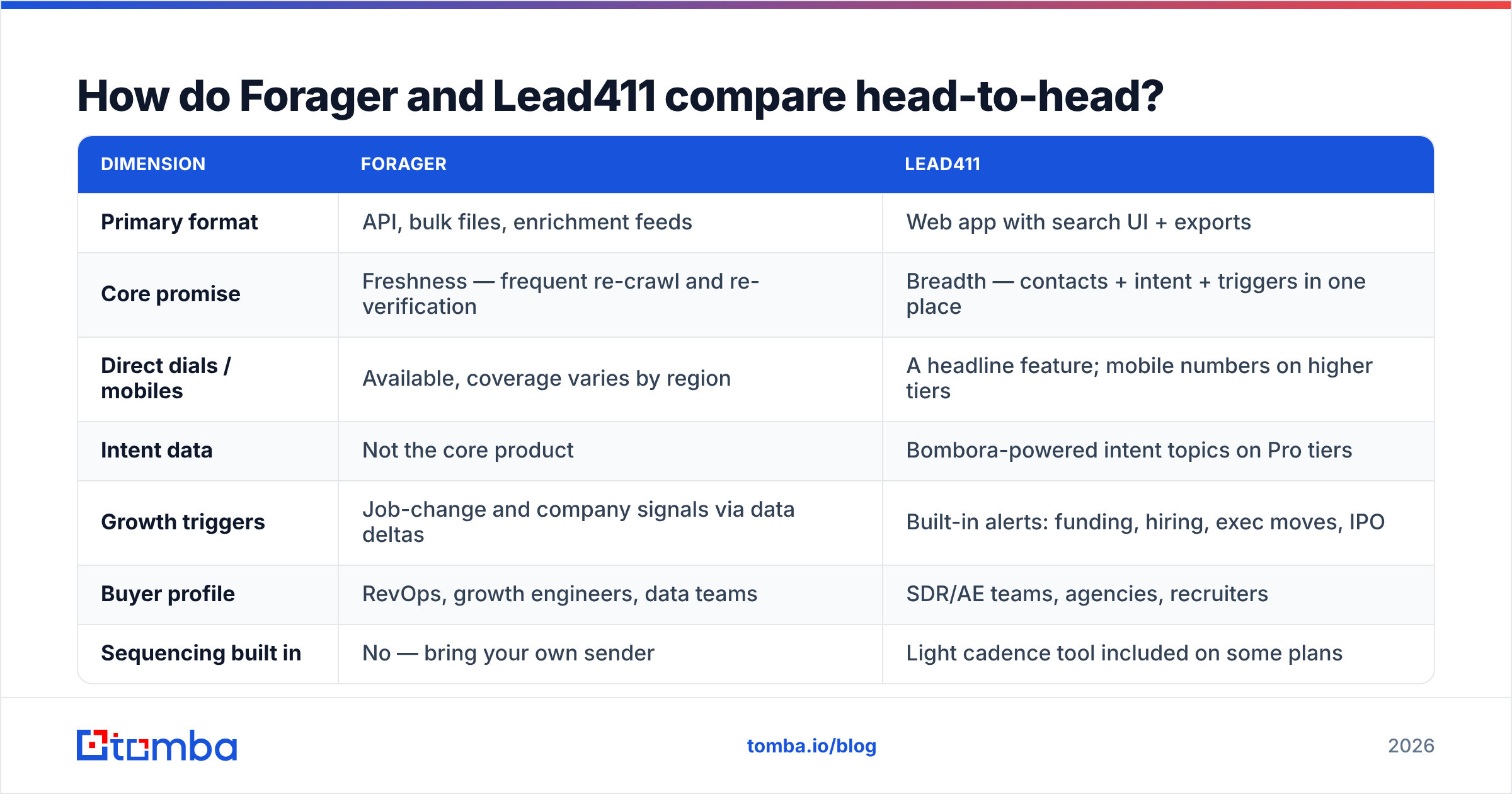
| Dimension | Forager | Lead411 |
|---|---|---|
| Primary format | API, bulk files, enrichment feeds | Web app with search UI + exports |
| Core promise | Freshness — frequent re-crawl and re-verification | Breadth — contacts + intent + triggers in one place |
| Direct dials / mobiles | Available, coverage varies by region | A headline feature; mobile numbers on higher tiers |
| Intent data | Not the core product | Bombora-powered intent topics on Pro tiers |
| Growth triggers | Job-change and company signals via data deltas | Built-in alerts: funding, hiring, exec moves, IPO |
| Buyer profile | RevOps, growth engineers, data teams | SDR/AE teams, agencies, recruiters |
| Sequencing built in | No — bring your own sender | Light cadence tool included on some plans |
| CRM sync | Via API / your own pipeline | Native HubSpot, Salesforce, Pipedrive-style connectors |
| Pricing model | Quote-based, scales with volume and seats | Per seat, published entry tier, annual discount |
| Learning curve | Higher — assumes engineering | Lower — trained SDR can use it day one |
Read that table as two different purchases. If you already run your own enrichment layer, Lead411's UI, cadences, and connectors are surface area you will never touch — you would be paying per seat for a browser you do not open. If you have no data engineer, Forager's API-first shape means the value stays locked behind work you cannot schedule.
Which one has better email accuracy?#
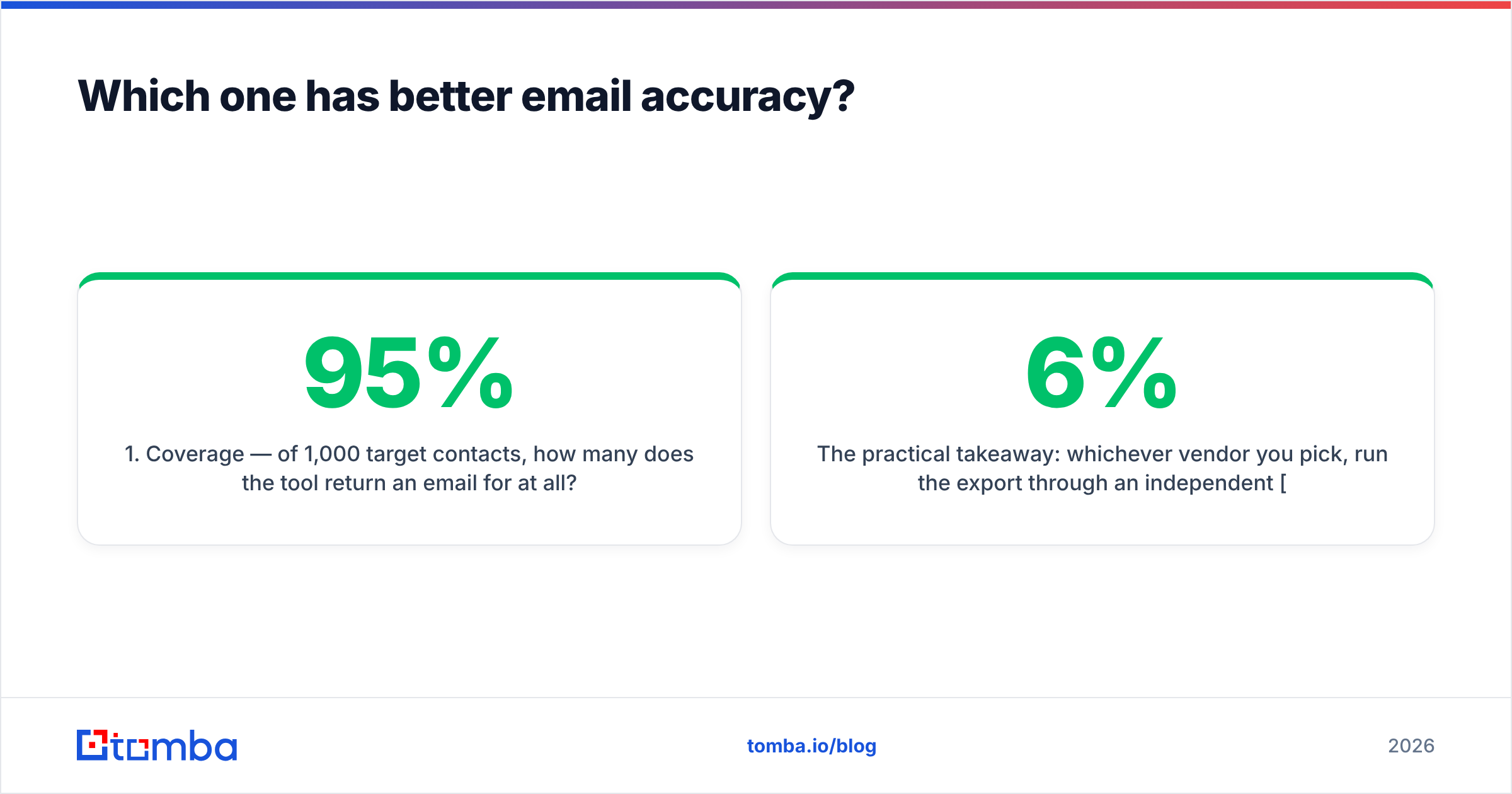
Neither vendor will hand you an independent number, and you should be sceptical of any that does. Accuracy in this category is not a single figure — it is three separate things that get collapsed into one marketing claim:
- Coverage — of 1,000 target contacts, how many does the tool return an email for at all? A tool with 95% "accuracy" on the 30% it can find is worse than one with 88% on 70%.
- Validity — of the emails returned, how many survive SMTP verification without a bounce? This is what most "accuracy %" claims actually measure.
- Freshness — how many are still attached to a human who works there? A perfectly valid address at a company someone left nine months ago still burns your reply rate.
Forager's whole argument is #3. Lead411's strength is #1 within North American mid-market, where its database has been accumulating for years. In practice both land in a similar band once you verify, which is why the comparison below is worth running yourself rather than trusting a landing page.

The practical takeaway: whichever vendor you pick, run the export through an independent email verifier before it touches a sending domain. Vendor-side validation is a marketing asset; a second-opinion verification pass is a deliverability control. They are not the same job, and treating them as one is how teams end up explaining a 6% bounce rate to their CTO.
What does each one cost?#
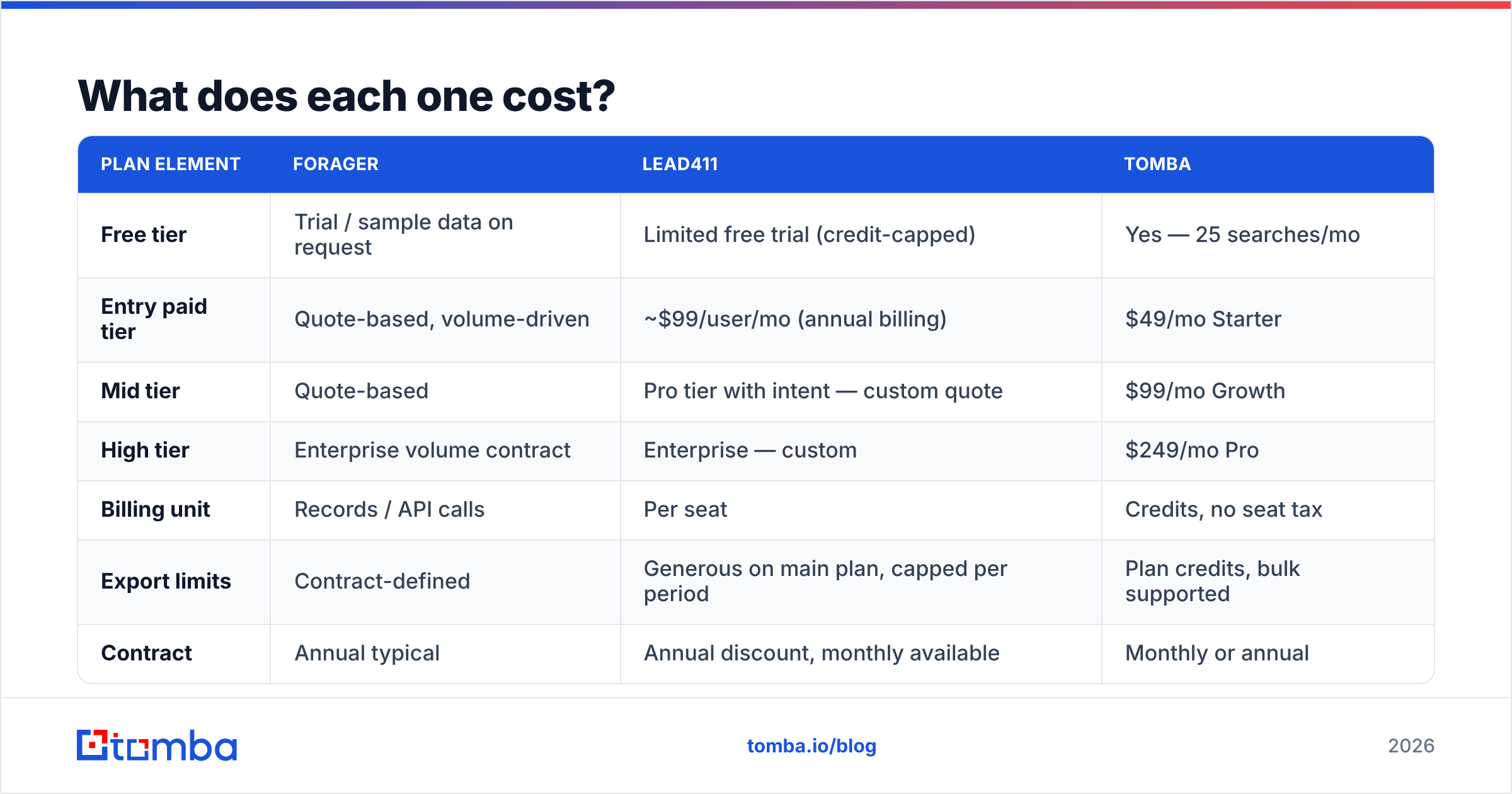
Published pricing moves, so treat these as directional and confirm on each vendor's site before you sign.
| Plan element | Forager | Lead411 | Tomba |
|---|---|---|---|
| Free tier | Trial / sample data on request | Limited free trial (credit-capped) | Yes — 25 searches/mo |
| Entry paid tier | Quote-based, volume-driven | ~$99/user/mo (annual billing) | $49/mo Starter |
| Mid tier | Quote-based | Pro tier with intent — custom quote | $99/mo Growth |
| High tier | Enterprise volume contract | Enterprise — custom | $249/mo Pro |
| Billing unit | Records / API calls | Per seat | Credits, no seat tax |
| Export limits | Contract-defined | Generous on main plan, capped per period | Plan credits, bulk supported |
| Contract | Annual typical | Annual discount, monthly available | Monthly or annual |
Three cost patterns worth naming.
Per-seat pricing punishes small teams unevenly. Lead411's model is fine when six SDRs each search daily. It is poor value when one ops person pulls a list twice a month — you are paying for concurrency you do not use.
Quote-based pricing hides the floor. Forager's volume model can be excellent at scale and awkward below it, because you cannot self-serve your way to a $200 test. Budget time for a sales conversation before you learn whether it fits.
Credit pricing is the honest middle for list-building. If the job is "get verified emails for these 4,000 companies," a credit model prices exactly that. You can compare it against Tomba pricing in about ninety seconds, which is the point.
Who should choose Forager?#
Choose Forager when the data is going into a machine, not a human's screen.
- You run enrichment on a schedule. Nightly job-change detection, CRM hygiene sweeps, lifecycle re-scoring. Forager's re-crawl cadence is the actual product here.
- You have engineering capacity. Someone who will write and own the integration, handle rate limits, and reconcile records.
- Your ICP shifts fast. Startups, AI companies, anywhere headcount and titles churn quarterly. Stale databases fail hardest on exactly these accounts.
- You want to own the workflow. No opinionated UI, no cadence tool you did not ask for, no seat licences for people who only need the output.
Where it disappoints: a five-person SDR team with no technical owner. Without a pipeline to feed, an API-first vendor is an invoice attached to a Postman collection.
Who should choose Lead411?#
Choose Lead411 when the workflow lives inside a rep's day.
- You want intent plus contacts in one login. Bombora topics next to the contact record removes a stitching problem most teams never get around to solving.
- You call as much as you email. Direct dial coverage is a genuine differentiator; email-only tools are not competing here. Pair it with a phone validator before a dialler campaign so your connect rate is not sabotaged by dead numbers.
- Triggers drive your motion. Funding rounds and hiring spikes as alerts, not as a report you manually pull.
- Your ICP is US mid-market. That is where Lead411's density has historically been strongest. International coverage thins noticeably outside North America and Western Europe — verify against your own territory list before signing.
Where it disappoints: EMEA and APAC-heavy target lists, and any team that wants raw data volume without paying for seats.

What are the alternatives to both?#
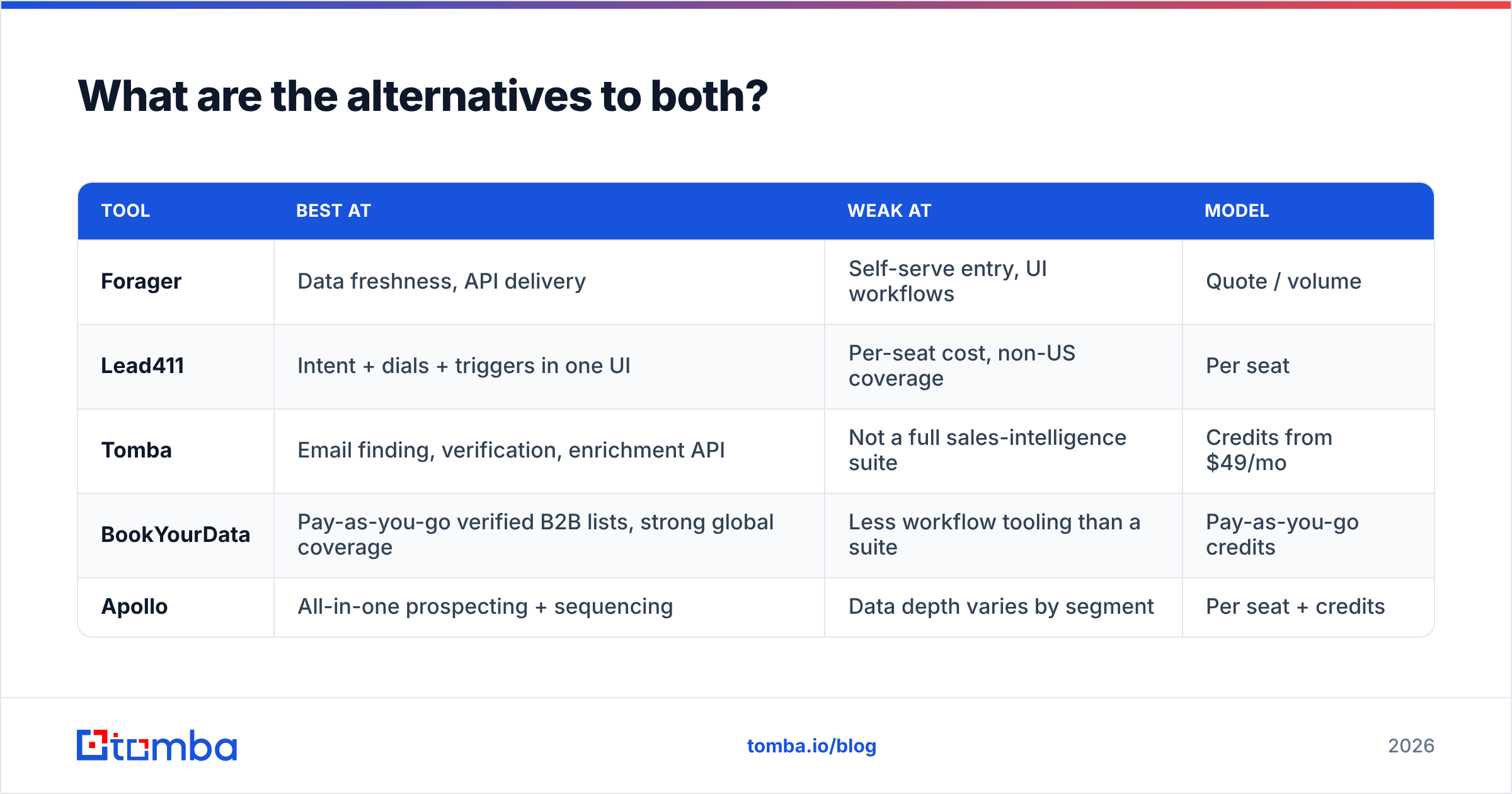
Most teams comparing Forager vs Lead411 are really asking a budget question: do I need a platform, or do I need accurate emails? The market splits accordingly.
| Tool | Best at | Weak at | Model |
|---|---|---|---|
| Forager | Data freshness, API delivery | Self-serve entry, UI workflows | Quote / volume |
| Lead411 | Intent + dials + triggers in one UI | Per-seat cost, non-US coverage | Per seat |
| Tomba | Email finding, verification, enrichment API | Not a full sales-intelligence suite | Credits from $49/mo |
| BookYourData | Pay-as-you-go verified B2B lists, strong global coverage | Less workflow tooling than a suite | Pay-as-you-go credits |
| Apollo | All-in-one prospecting + sequencing | Data depth varies by segment | Per seat + credits |

Two of these deserve a specific note. BookYourData is a reasonable fit if you want to buy a defined list without a subscription commitment — the pay-as-you-go structure means a one-off campaign does not turn into an annual contract, and its international coverage holds up better than most US-centric databases. Apollo wins on breadth and loses on the fact that breadth is expensive; teams that only need the finder frequently end up looking for an Apollo alternative within two renewal cycles.
If you land on the "I just need emails" side, the surrounding pieces matter more than the headline database: a bulk email finder for list runs, a verification pass before send, and an email finder API so the whole thing can be automated later without a migration.
How should you test them before you buy?#
Run the same evaluation against every vendor on your shortlist. Vendors hate this because it is the only test that cannot be gamed by a demo.
- Build a 200-row golden list. Real target accounts and real named people from your actual ICP — not a clean sample the vendor supplies. Include at least 40 rows from your weakest geography.
- Measure coverage first. Count how many rows come back with an email at all. This number, not the accuracy percentage, decides whether the tool is usable.
- Verify with a neutral third party. Push every returned address through a verifier that is not the vendor you are testing. Record valid, invalid, catch-all, and unknown separately.
- Handle catch-alls explicitly. A large share of B2B domains accept everything at the gateway. Use a catch-all verifier rather than counting those rows as wins or discarding them wholesale.
- Spot-check freshness. Take 25 returned contacts and check their current employer on LinkedIn. If more than three have moved on, the database is older than the pitch suggested.
- Price the real job. Divide total monthly cost by usable verified contacts. Not by credits, not by seats — by contacts you would actually send to. That single number usually reorders the shortlist.
Most teams that run this discover the gap between vendors is smaller than the gap between "raw export" and "verified export." Cleaning the data you already have is often the highest-ROI move available.
So which one wins?#
There is no single winner, and any post that declares one is selling something.
Lead411 wins for an SDR team that calls and emails US mid-market accounts, wants intent signals attached to contacts, and will genuinely use a UI every day. The per-seat cost is defensible when seats are active.
Forager wins for a data-mature team that treats contact records as infrastructure. If you have someone who will own an integration and you care more about job-change detection than about a search screen, its freshness model is the stronger asset.
Neither wins if your real requirement is "find verified work emails for a defined list, without a procurement cycle." That is a narrower job, and paying platform prices for it is the most common overspend in this category.
If that last description sounds like your team, start with the narrow tool. Tomba Email Finder finds professional email addresses by name, domain, or company, verifies them before they reach your sequence, and runs from a free tier at 25 searches a month up to $249/mo — with an API, bulk processing, and CRM integrations included rather than gated behind a seat count. Test it against the same 200-row golden list you throw at Forager and Lead411, and let the cost-per-verified-contact number make the decision for you.
Related guides#
Ready to find emails that actually work?
Join 150,000+ professionals who stopped guessing and started sending. Free credits on signup — no credit card required.
Get the Tomba newsletter
Practical outbound tactics and product updates — once every two weeks.
About the author