Forager vs Leadzenai 2026: Which B2B Contact Data Tool Wins?
Forager vs Leadzenai: both promise fresh B2B contact data, but they solve different problems. Here's how coverage, accuracy, pricing and workflow fit actually compare in 2026.
Forager vs Leadzenai is a comparison of two different products, not two versions of the same one. Forager sells fresh B2B contact data through an API. Leadzenai sells a self-serve app for finding leads. The right pick depends on how your team works.
TL;DR
- Forager is built around freshness. A machine-learning pipeline re-crawls and re-verifies profiles all day. It sells mostly as an API or data feed, for teams that pipe contact data into their own systems.
- Leadzenai is built around discovery. A self-serve prospecting UI and a LinkedIn extension let SDRs and small teams search, filter, and export leads without writing code.
- Neither tool replaces the other. Forager fits a stack. Leadzenai fits a person clicking "find leads" in a browser.
Both sit in the mid-to-high end of the cost curve, and neither raw export is send-safe on its own.
- Verify every list before you send it. That rule holds for both vendors.
- If your real bottleneck is one valid work email for a known person or domain, a dedicated finder-plus-verifier like Tomba usually costs less and bounces less than either.
Forager vs Leadzenai: what is each tool, actually?#
Start with the honest framing: these two tools get compared because they both show up in "B2B contact data" searches, not because they compete head-to-head on a feature grid.
Forager.ai positions itself as a real-time B2B data provider. The pitch is refresh rate. A static database decays 25–30% a year, so Forager keeps re-processing public professional profiles and company records instead. Job changes, title updates, and departures surface fast. Delivery skews technical: API access, bulk data feeds, and enrichment endpoints. Buyers are data teams, GTM engineers, and companies building their own products on top of contact data.
Leadzen.ai comes at it from the opposite end. It's a prospecting app: search by name, company, industry, or role; filter down; reveal contact details; export. A browser extension pulls contacts while you browse LinkedIn. It sells to individual SDRs, recruiters, and small sales teams in a self-serve motion. The company is India-based, and its coverage reflects that. APAC and Indian company data is a genuine differentiator.
So the real question in "forager vs leadzenai" is not "which has better data." It's "which shape of product matches how your team works?"
Forager vs Leadzenai: how the tools compare on what matters#
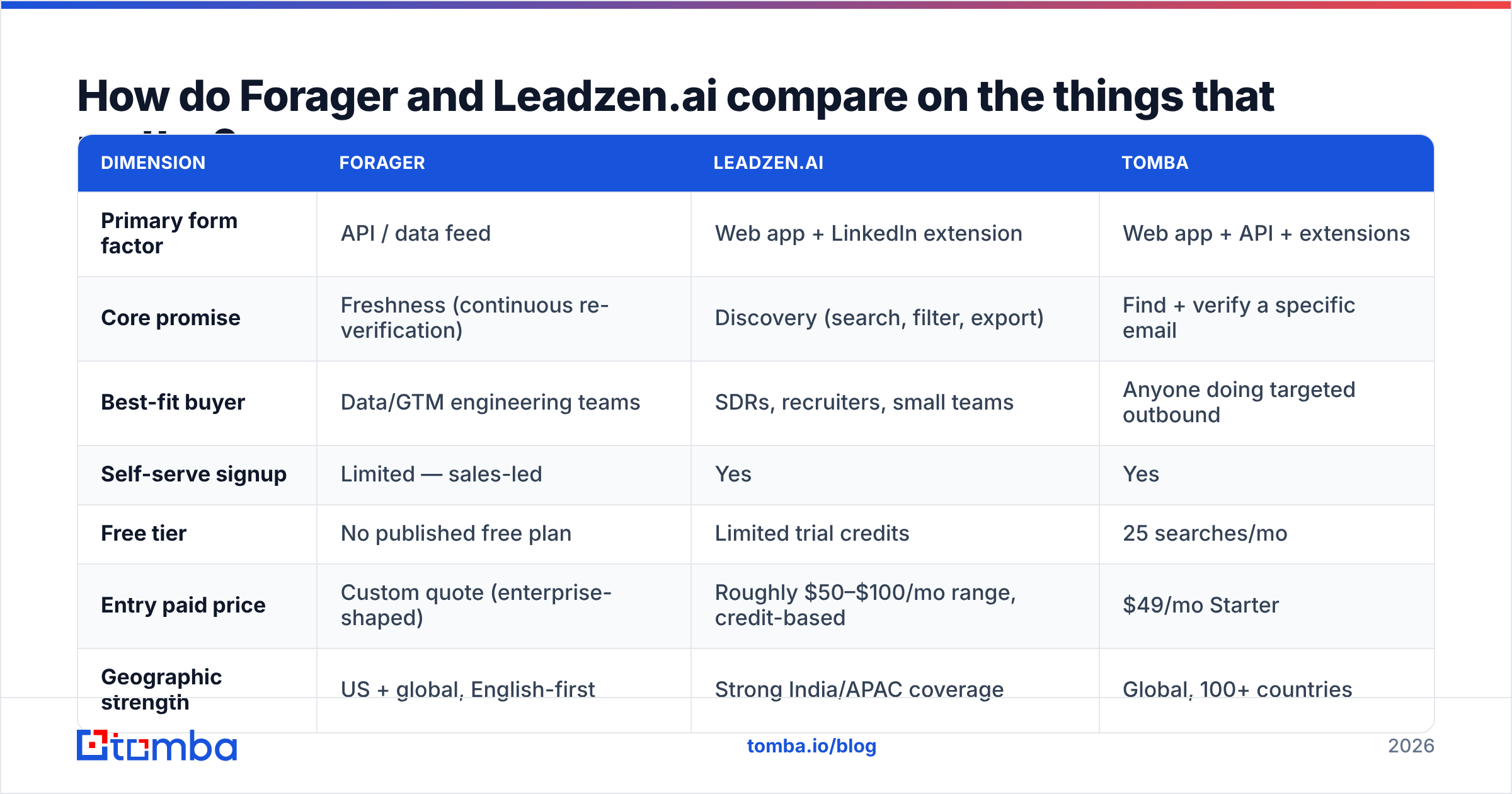
Here's the side-by-side. Treat all pricing as directional. Both vendors quote per-seat and per-credit deals that move, and Forager in particular runs custom contracts rather than published tiers.
| Dimension | Forager | Leadzen.ai | Tomba |
|---|---|---|---|
| Primary form factor | API / data feed | Web app + LinkedIn extension | Web app + API + extensions |
| Core promise | Freshness (continuous re-verification) | Discovery (search, filter, export) | Find + verify a specific email |
| Best-fit buyer | Data/GTM engineering teams | SDRs, recruiters, small teams | Anyone doing targeted outbound |
| Self-serve signup | Limited — sales-led | Yes | Yes |
| Free tier | No published free plan | Limited trial credits | 25 searches/mo |
| Entry paid price | Custom quote (enterprise-shaped) | Roughly $50–$100/mo range, credit-based | $49/mo Starter |
| Geographic strength | US + global, English-first | Strong India/APAC coverage | Global, 100+ countries |
| Built-in email verification | Yes, part of the pipeline | Basic validation | Dedicated verifier + catch-all handling |
| Phone numbers | Available in enrichment | Available on higher tiers | Yes, separate phone finder |
| Bulk processing | API-native | CSV export | Bulk finder + bulk verifier |
| Learning curve | High (developer required) | Low | Low |
The pattern jumps out immediately: Forager asks you to bring engineering, Leadzenai asks you to bring a human clicking through a UI, and a focused finder asks you to bring a name and a domain.

Which one has better data accuracy?#
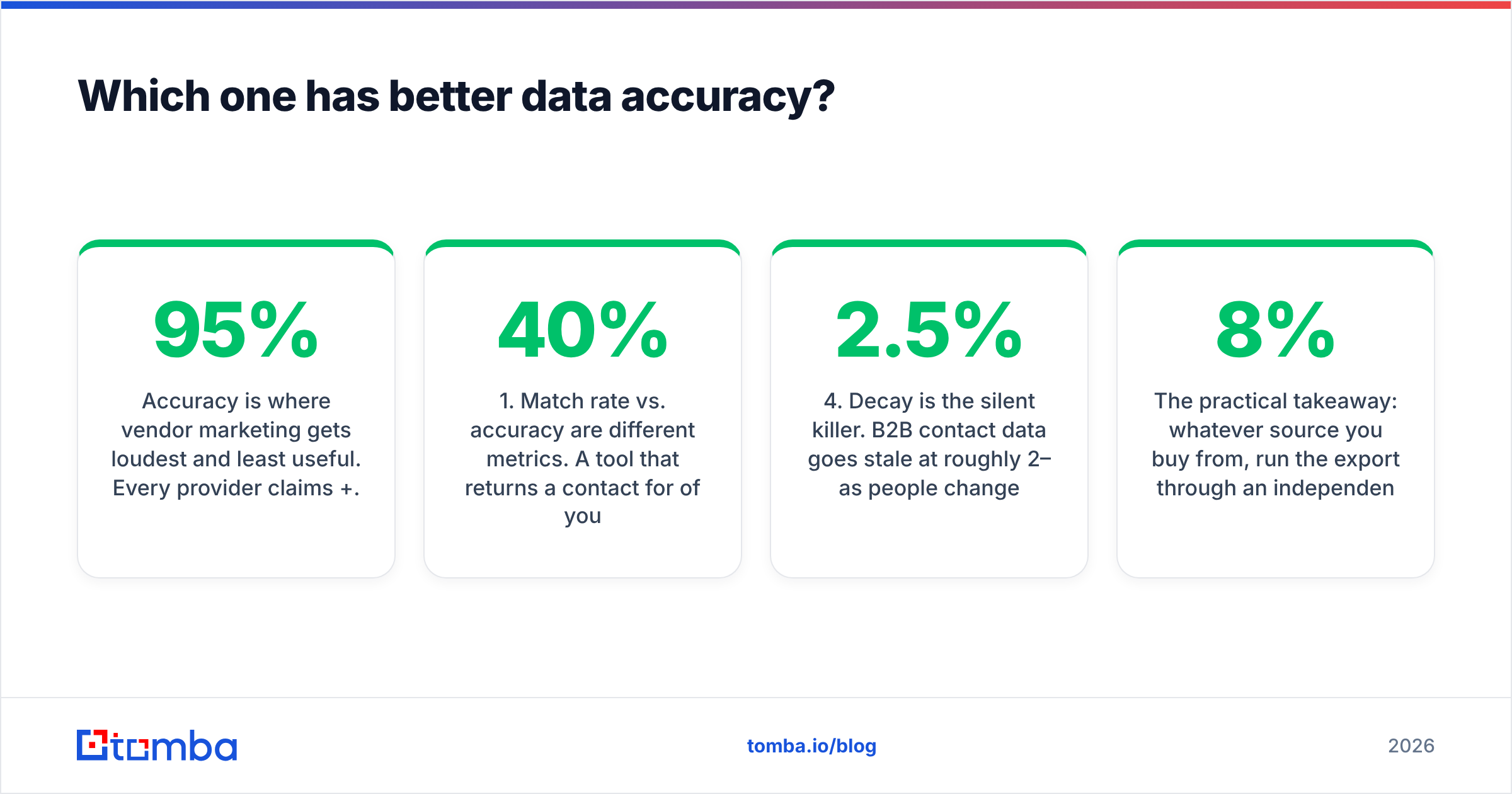
Accuracy is where vendor marketing gets loudest and least useful. Every provider claims 95%+. Almost none define what they're measuring.
Here's what the numbers usually hide:
- Match rate vs. accuracy are different metrics. A tool that returns a contact for 40% of your list but is right 97% of the time is a very different product from one that returns 85% coverage at 80% accuracy. Vendors quote whichever number looks better.
- "Verified" often means syntax + MX record. That check tells you the domain can receive mail. It tells you nothing about whether
first.last@exists on that server. - Catch-all domains break everything. Roughly a fifth of business domains accept all mail at the SMTP layer, so a naive verifier marks every guess as valid. This is where bounce rates come from. A dedicated catch-all verifier uses pattern confidence and extra signals instead.
Two more factors decide whether a list still works next quarter:
- Decay is the silent killer. B2B contact data goes stale at roughly 2–2.5% per month as people change jobs. A database refreshed quarterly is much worse than one refreshed weekly, whatever either claims on day one.
- Regional coverage varies wildly. A provider with excellent US SaaS coverage can be near-useless for German mittelstand manufacturers or Indian services firms — and vice versa.
Forager's whole architecture is a response to point 4. Continuous re-crawling is the right answer to decay. If you're enriching a CRM of 200,000 records where a third of the contacts have moved on, that matters more than raw coverage.
Leadzen's advantage is on point 5 for its home region. If your ICP includes Indian mid-market companies, its coverage there beats most Western-built databases that treat APAC as an afterthought.
Neither of those advantages helps much with point 3. In the forager vs leadzenai matchup, neither vendor solves catch-all domains for you. Catch-all handling is a specialised problem, and it's the single biggest driver of bounce rate on a real send.

The practical takeaway: whatever source you buy from, run the export through an independent email verifier before it touches a sequencer. Treating your data vendor as its own quality control is how teams end up at 8% bounce and a burned sending domain.
Is Forager worth it for your team?#
Forager makes sense when three conditions hold at once.
You have engineering capacity. The product ships as an API and a data feed. If nobody on your team will write the integration, maintain the sync job, and handle rate limits, you're buying a capability you can't use. There is no meaningful "log in and browse leads" experience.
Your volume justifies a contract. Custom-quoted enterprise data deals only pencil out above a certain scale. If you need 2,000 contacts a month, you're paying enterprise overhead for boutique volume.
Freshness is your actual pain. This is the key qualifier. If your complaint is "our CRM is full of people who left two years ago," Forager's continuous refresh fixes that. If your complaint is "I can't find the VP of Engineering's email at this company," you're solving a different problem and paying a lot for the privilege.
Where Forager struggles: no free tier to evaluate with, a sales-led motion that adds weeks before you see data, and a form factor that's simply wrong for a five-person sales team. Check G2's B2B data category for user reviews across the segment. The recurring theme with API-first vendors is evaluation friction, not data quality.
Is Leadzen.ai worth it for your team?#
Leadzen inverts every one of those conditions.
Zero engineering required. Sign up, search, export. An SDR can be productive in an afternoon. The LinkedIn extension lets you prospect inside the workflow you're already in, which beats tab-switching to a separate database.
Credit-based pricing scales down. You can start small. For a team of two or three doing a few hundred contacts a month, this fits far better than a custom enterprise contract.
Regional edge. If you're selling into India or broader APAC, Leadzen's coverage is a legitimate reason to choose it over a US-centric tool.
Where Leadzen struggles: credits get burned on searches that return nothing useful, verification is lighter than a dedicated tool, and the API story is thinner than Forager's. If you want to automate enrichment across a 50,000-row database on a schedule, you'll feel the ceiling. There's also less transparency around data sourcing than enterprise buyers demand. Ask about it directly if you operate under GDPR.
What if neither shape fits your problem?#
Many teams who search for forager vs leadzenai don't need either tool. They need a reliable answer to one question: what is the work email for this person at this company?
That's a narrower job than "give me a B2B database," and it's solved differently. A dedicated finder takes a name and a domain, applies known company email patterns, checks the result against live mail infrastructure, and returns a confidence score. It doesn't try to be your CRM, your database, or your sequencer.
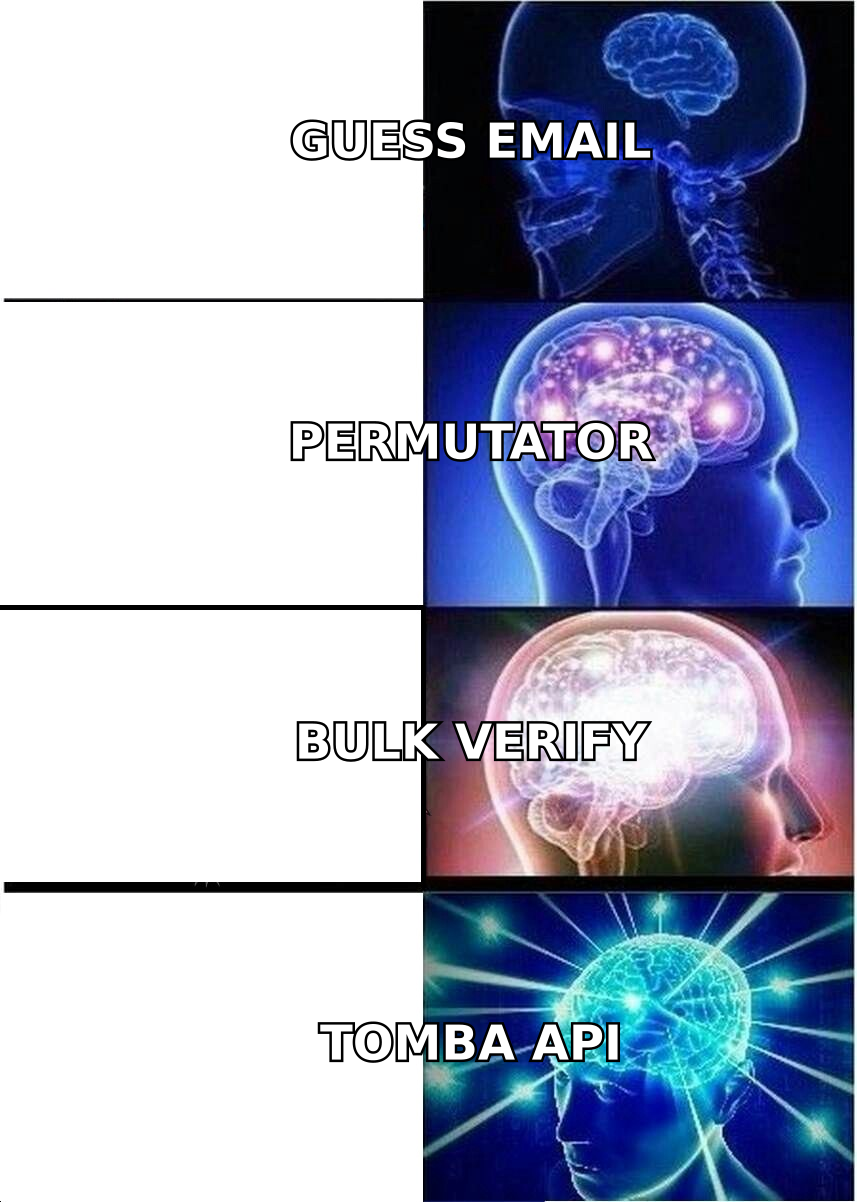
This is the category Tomba sits in. The email finder handles the name-plus-domain case, domain search pulls every discoverable address at a company with roles and sources attached, and the verifier — including proper catch-all logic — runs before anything leaves your account.
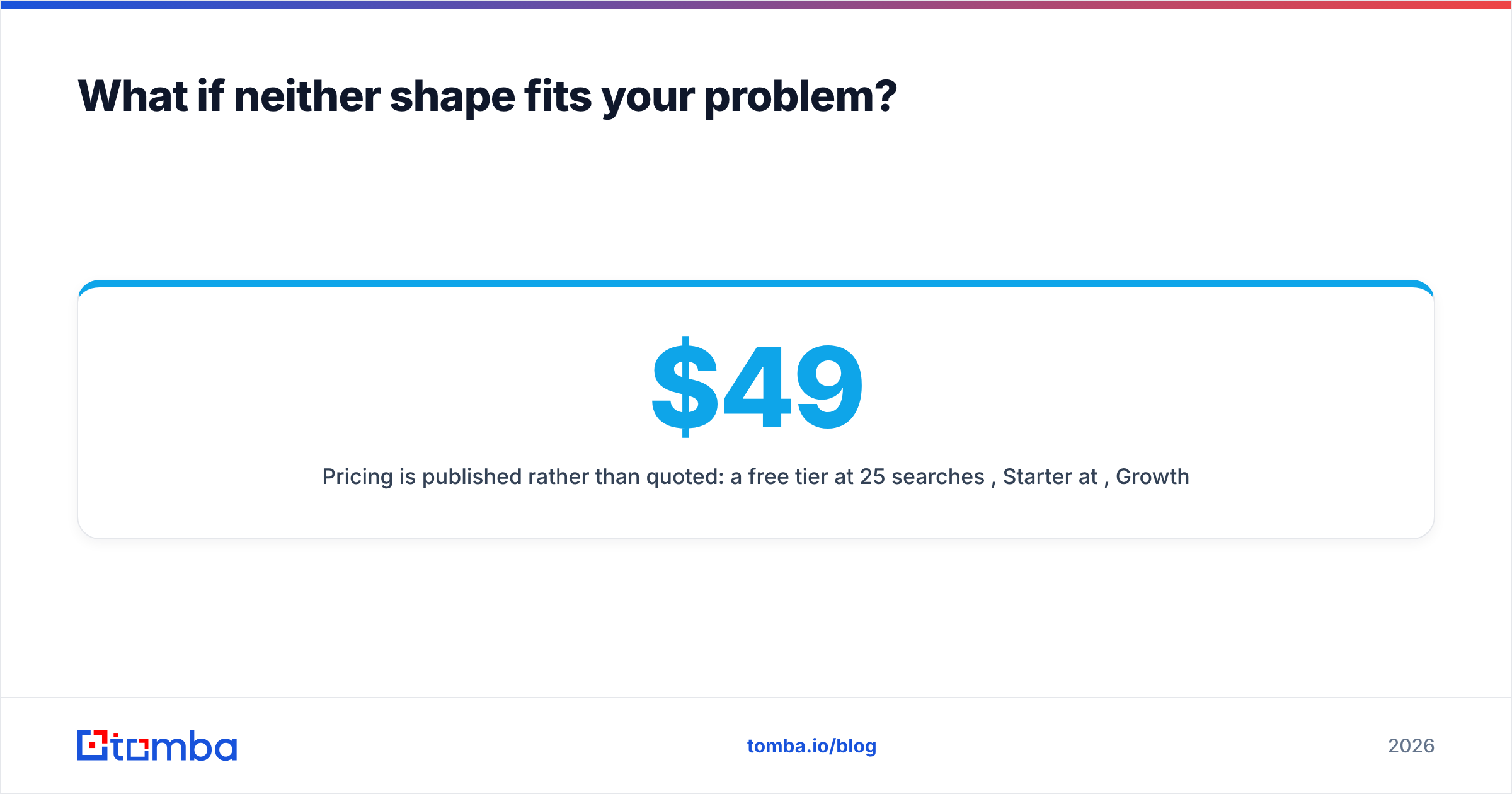
Pricing is published rather than quoted: a free tier at 25 searches per month, Starter at $49/mo, Growth at $99/mo, Pro at $249/mo, and custom enterprise. You can see the full Tomba pricing breakdown without booking a call. That matters when you're comparing three vendors and two of them won't quote until you've sat through a demo.

For teams that want programmatic access without an enterprise contract, the Tomba API exposes the same finder and verifier endpoints on every paid tier. That closes most of the gap that pushes people toward API-first data vendors in the first place.
How should you actually run the evaluation?#
Don't compare feature lists. Compare outputs on your own data. Here's the test that separates real accuracy from marketing accuracy.
Step 1 — Build a 100-row golden list. Pull 100 contacts you already have confirmed, deliverable emails for. Real people, real companies, spread across the geographies and company sizes in your ICP. Strip the emails out; keep name and domain.
Step 2 — Run the same list through every candidate. Forager via API, Leadzenai via UI export, Tomba via bulk email finder or CSV. Same input, same day.
Step 3 — Score three numbers separately. Match rate (how many rows returned anything), precision (of those, how many matched your known-good email), and false-confidence rate (how many wrong answers were labelled high-confidence). That third number costs you a domain reputation, and nobody reports it.
Step 4 — Test the hard subset. Take 20 rows from catch-all domains specifically. This is where tools diverge most and where averages hide the failure.
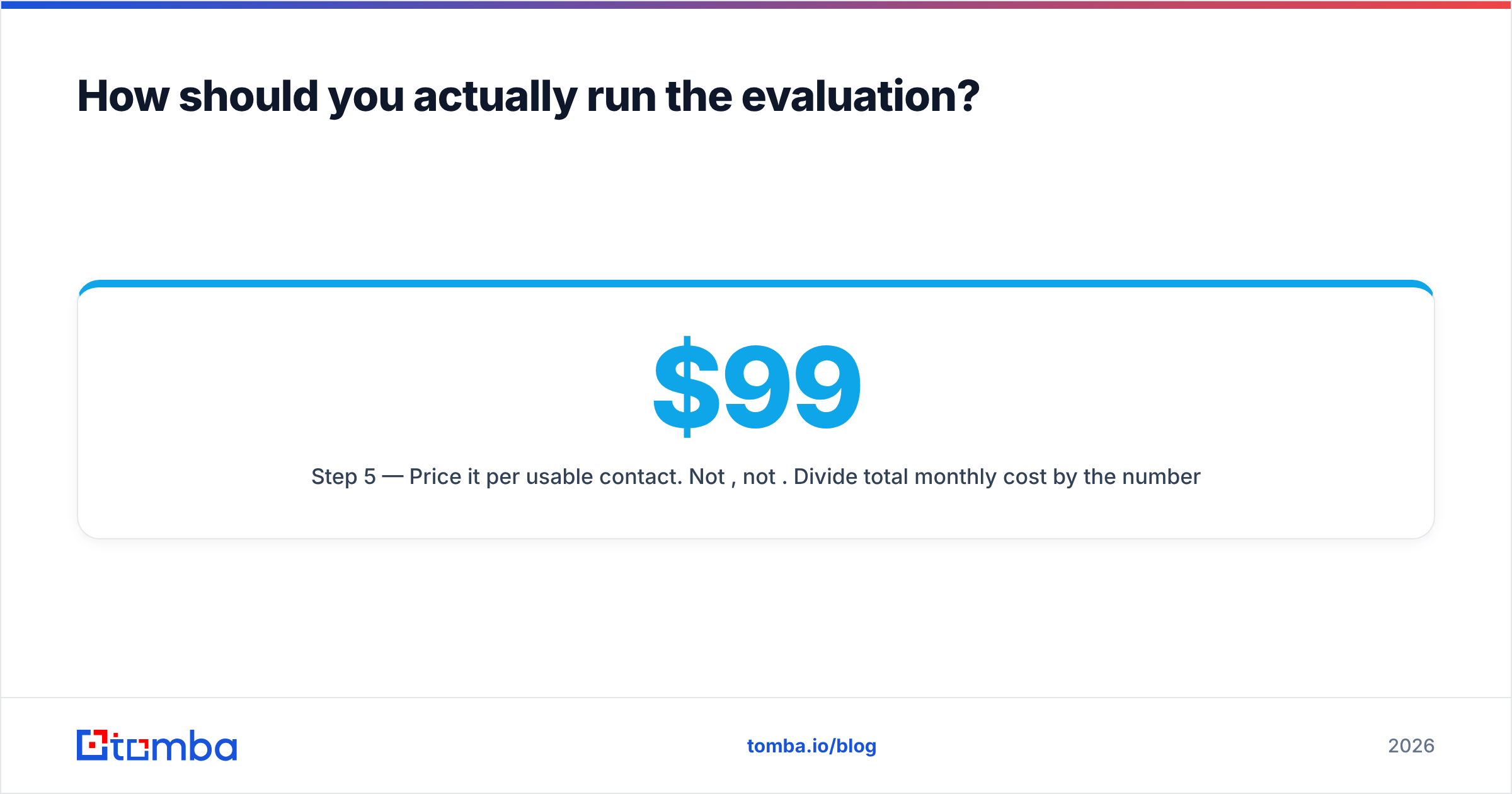
Step 5 — Price it per usable contact. Not per credit, not per seat. Divide total monthly cost by the number of contacts that came back both returned and correct. A $99 tool at 70% precision beats a $59 tool at 35% precision, and the sticker price tells you neither.
Most teams skip steps 3 and 4, buy on match rate, then discover the problem six weeks later when reply rates crater and sender reputation tanks. The two hours this test takes are the cheapest insurance in your GTM stack.
Forager vs Leadzenai: which should you pick?#
Short version:
- Pick Forager if you have engineers, enterprise volume, and a decay problem. You're enriching a large existing database and freshness is the constraint.
- Pick Leadzenai if you're a small self-serve team, you prospect inside LinkedIn, and India/APAC coverage is central to your ICP.
- Pick a dedicated finder-and-verifier if your job is targeted: you know who you want to reach, you need the right address, and you need it to not bounce.
Most outbound teams under 30 people fall into the third bucket and don't realise it. They shop for a database because that's what the category pages sell, then use 4% of what they bought.
Ready to test it against your own list? The Tomba Email Finder gives you 25 free searches a month — enough to run the golden-list test above on a real sample before you spend anything. Feed it names and domains, check the confidence scores and sources against emails you already know are good, and let the precision number decide. That's a better basis for a purchase than any forager vs leadzenai comparison post, including this one.
Related guides#
Ready to find emails that actually work?
Join 150,000+ professionals who stopped guessing and started sending. Free credits on signup — no credit card required.
Get the Tomba newsletter
Practical outbound tactics and product updates — once every two weeks.
About the author