Forager vs LimeLeads: Which B2B Lead Database Wins in 2026?
Forager.ai sells real-time verified contact data; LimeLeads sells pay-as-you-go US company lists. They solve different problems. Here's the honest breakdown of pricing, coverage, accuracy and which one actually fits your outbound motion.
Forager vs LimeLeads comes down to one question: do you want a live data feed, or a cheap list today? Here is the short answer first, then the detail.
TL;DR
- Forager.ai is a real-time contact and company data platform. It refreshes profiles on a rolling basis, tracks job changes, and ships data by API. It is priced for teams, not for individuals.
- LimeLeads is a self-serve, US-heavy B2B list builder. You buy credits, filter, and export. It is cheap and fast. But the data is a static snapshot, not a live feed.
- Need 500 verified contacts at named accounts this week? LimeLeads is the faster, cheaper answer.
- Need enrichment on a schedule because your CRM decays 30% a year? Forager is the right shape of tool.
- Neither one is a great email finder on its own. Add a verification layer before you send. Bounce rates on database exports are worse than on freshly found, freshly verified addresses.
- The common winning setup in 2026 is a hybrid. Use one source to find accounts. Use a dedicated finder and verifier for the actual sending addresses.
Forager vs LimeLeads: what is each tool?#
Both sell B2B contact data. That is where the likeness ends.
Forager.ai sells real-time data. Its profile graph is re-crawled and re-verified on a rolling basis instead of once a quarter. So job changes, new titles, and departures show up fast. Delivery leans on API calls, bulk enrichment files, and CRM sync rather than a point-and-click list builder. It is a data pipeline product with a UI attached.
LimeLeads is the opposite shape. You open a browser and filter by industry, location, company size, revenue, and title. You preview the matching companies and contacts, then export what you want against a credit balance. There is no long onboarding and no annual contract gate. The catalogue skews to US small and mid-market firms, and the interface stays simple on purpose.
The short version: Forager sells you a pipe. LimeLeads sells you a bucket.
That gap drives everything downstream. It sets the price model, the refresh speed, the setup effort, and who on your team actually opens the tool.

Forager vs LimeLeads: the head-to-head comparison#
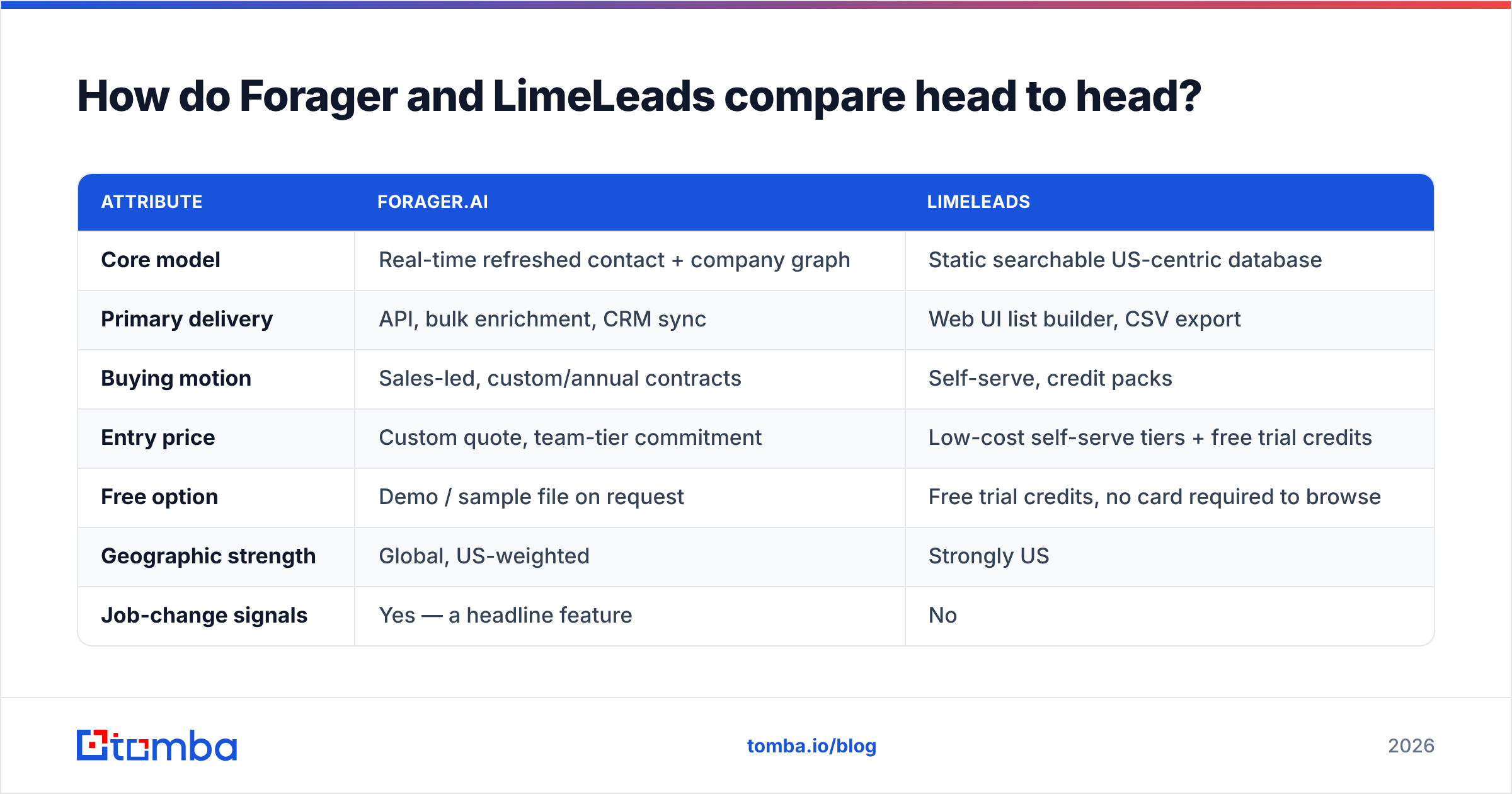
Here is the side by side on the attributes that change your buying decision. Pricing on both platforms depends on your quote or plan. Treat the tiers as the shape of the model, not a locked price. Check current numbers on each vendor's own page before you sign.
| Attribute | Forager.ai | LimeLeads |
|---|---|---|
| Core model | Real-time refreshed contact + company graph | Static searchable US-centric database |
| Primary delivery | API, bulk enrichment, CRM sync | Web UI list builder, CSV export |
| Buying motion | Sales-led, custom/annual contracts | Self-serve, credit packs |
| Entry price | Custom quote, team-tier commitment | Low-cost self-serve tiers + free trial credits |
| Free option | Demo / sample file on request | Free trial credits, no card required to browse |
| Geographic strength | Global, US-weighted | Strongly US |
| Job-change signals | Yes — a headline feature | No |
| Email verification depth | Verified at refresh time | Basic validation on export |
| Phone numbers | Available, tier-dependent | Limited |
| Best for | RevOps, enrichment pipelines, data teams | SDRs and founders building lists fast |
| Weak spot | Overkill and overpriced for small teams | Snapshot data decays between refreshes |
Read that table as two different budget lines. Forager competes with enrichment vendors and data warehouses. LimeLeads competes with cheap list-building tools, and with doing the work by hand.
Which one has more accurate data?#
Accuracy is the wrong single question. Ask instead: accurate as of when?
Every B2B database is a photo of a moving crowd. B2B contact data decays by 20–30% a year in normal conditions. In high-churn segments like tech sales, marketing, and startups, it decays faster. A record that was perfect in March can be three people out of date by November.
This is where the two products split:
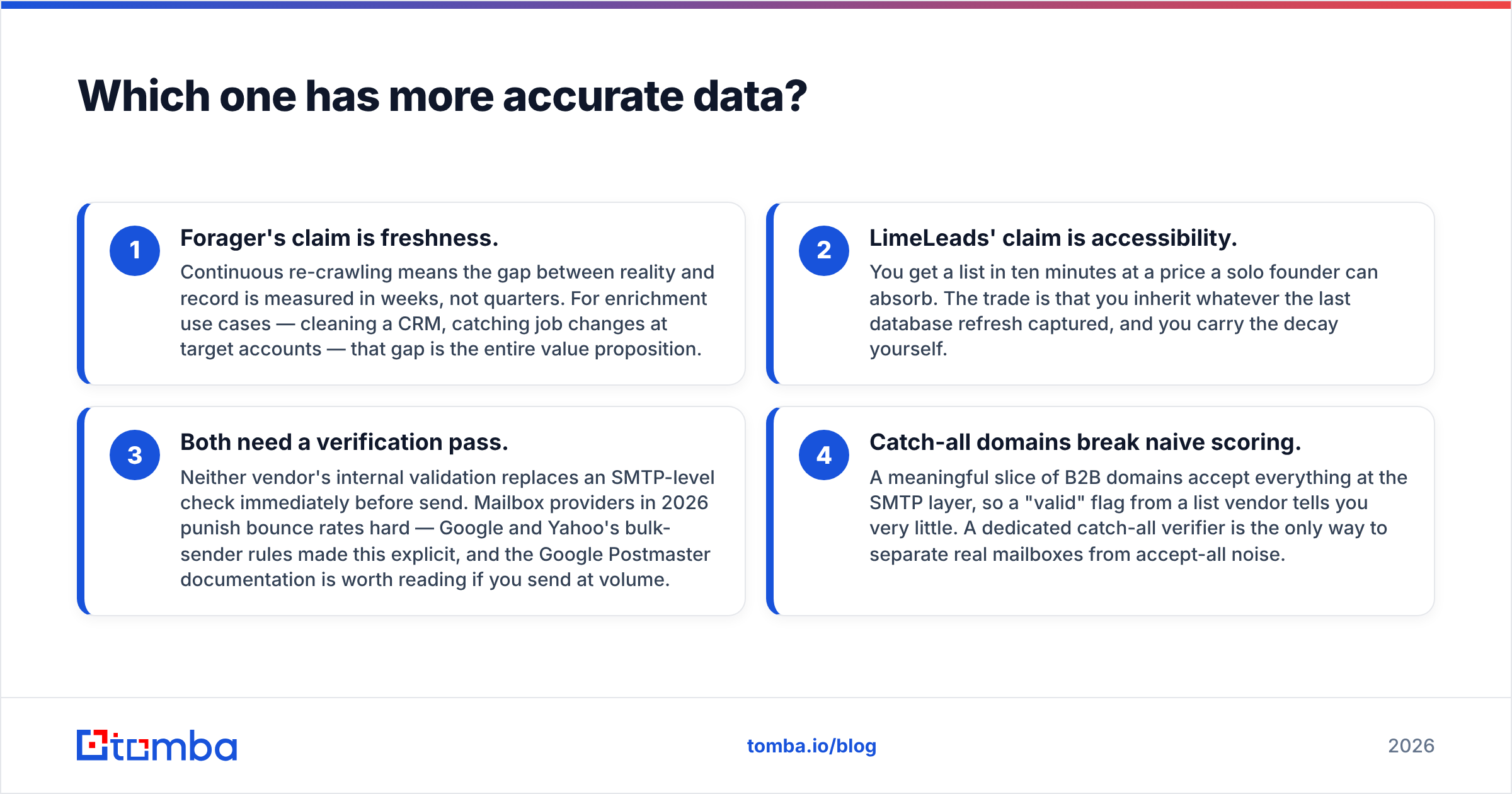
- Forager's claim is freshness. Non-stop re-crawling keeps the gap between record and reality down to weeks, not quarters. For enrichment work — cleaning a CRM, catching job changes at target accounts — that gap is the whole value.
- LimeLeads' claim is access. You get a list in ten minutes, at a price a solo founder can absorb. The trade is simple. You inherit whatever the last refresh captured, and you carry the decay yourself.
- Both need a verification pass. Vendor validation does not replace an SMTP check right before you send. Mailbox providers punish bounce rates hard in 2026. Google and Yahoo's bulk sender rules made that explicit, and the Google Postmaster documentation is worth reading if you send at volume.
- Catch-all domains break naive scoring. Many B2B domains accept every address at the SMTP layer. So a "valid" flag from a list vendor tells you very little. A dedicated catch-all verifier is the only way to tell real mailboxes from accept-all noise.
The honest summary: Forager is more likely to be right today. LimeLeads is more likely to be affordable today. Neither one removes your duty to verify emails before the first send.
What does each one actually cost?#
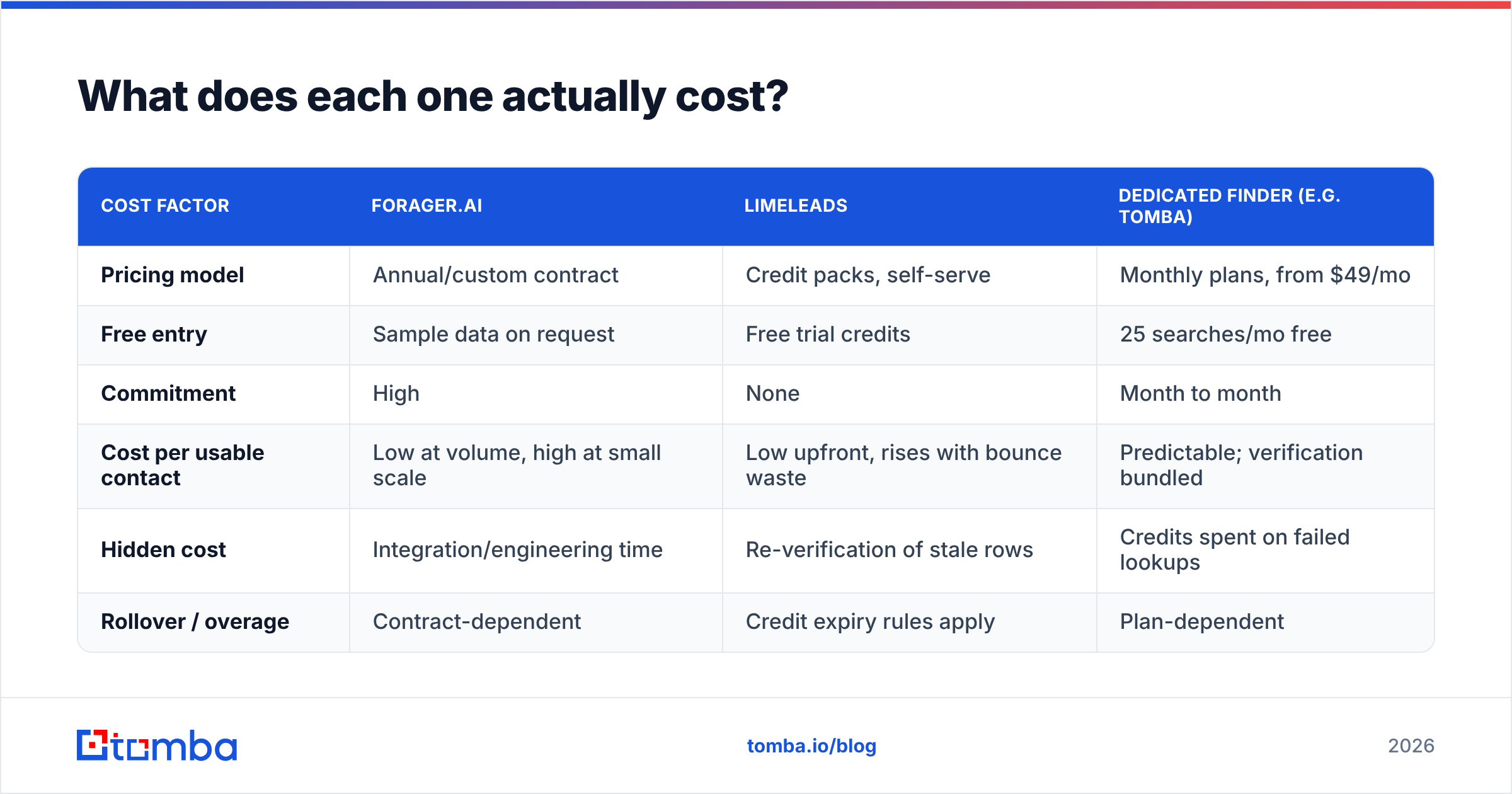
Compare total cost per usable contact, not headline price per record. A $0.02 record that bounces 18% of the time costs more than a $0.10 record that bounces 2%. The difference is the damage done to your sending domain.
| Cost factor | Forager.ai | LimeLeads | Dedicated finder (e.g. Tomba) |
|---|---|---|---|
| Pricing model | Annual/custom contract | Credit packs, self-serve | Monthly plans, from $49/mo |
| Free entry | Sample data on request | Free trial credits | 25 searches/mo free |
| Commitment | High | None | Month to month |
| Cost per usable contact | Low at volume, high at small scale | Low upfront, rises with bounce waste | Predictable; verification bundled |
| Hidden cost | Integration/engineering time | Re-verification of stale rows | Credits spent on failed lookups |
| Rollover / overage | Contract-dependent | Credit expiry rules apply | Plan-dependent |
Most teams learn the pattern the hard way. A cheap list is only cheap if you never have to clean it. Set aside 10–20% of your data spend for verification. That is how you avoid the reputation spiral that follows a 15% bounce campaign.
Want a neutral read on the wider market? G2's lead intelligence category is a fair starting point. Keep the usual caveat in mind: review-site rank tracks marketing budget as much as product quality.
Is Forager better than LimeLeads for outbound prospecting?#
For pure outbound, LimeLeads usually wins on speed to first list. Forager wins on everything that happens after month three.
Choose LimeLeads if:
- You are targeting US SMBs and mid-market companies.
- You want to build and export a list today, with no sales call.
- Your volume is in the hundreds or low thousands per month.
- You already have a verification step in your stack.
Choose Forager if:
- You are enriching an existing CRM rather than building lists from scratch.
- Job-change and role-move triggers are part of your play.
- You need API delivery into a warehouse or an automated workflow.
- You have budget approval for an annual data line item.
Choose neither if: your real bottleneck is finding valid addresses for accounts you have already picked. That is a finder-and-verifier problem, not a database problem. A domain search against your target account list often produces better addresses at lower cost. It also beats paying for a full database you open twice a quarter.
There is an honest third option worth naming. Providers like BookYourData sit between the two models. They offer self-serve pay-as-you-go pricing with per-record verification guarantees. For teams that want simple list building without stale rows, that middle ground is a real fit. There is no single correct vendor here, only a correct match to your motion.

How do you actually stack these tools together?#
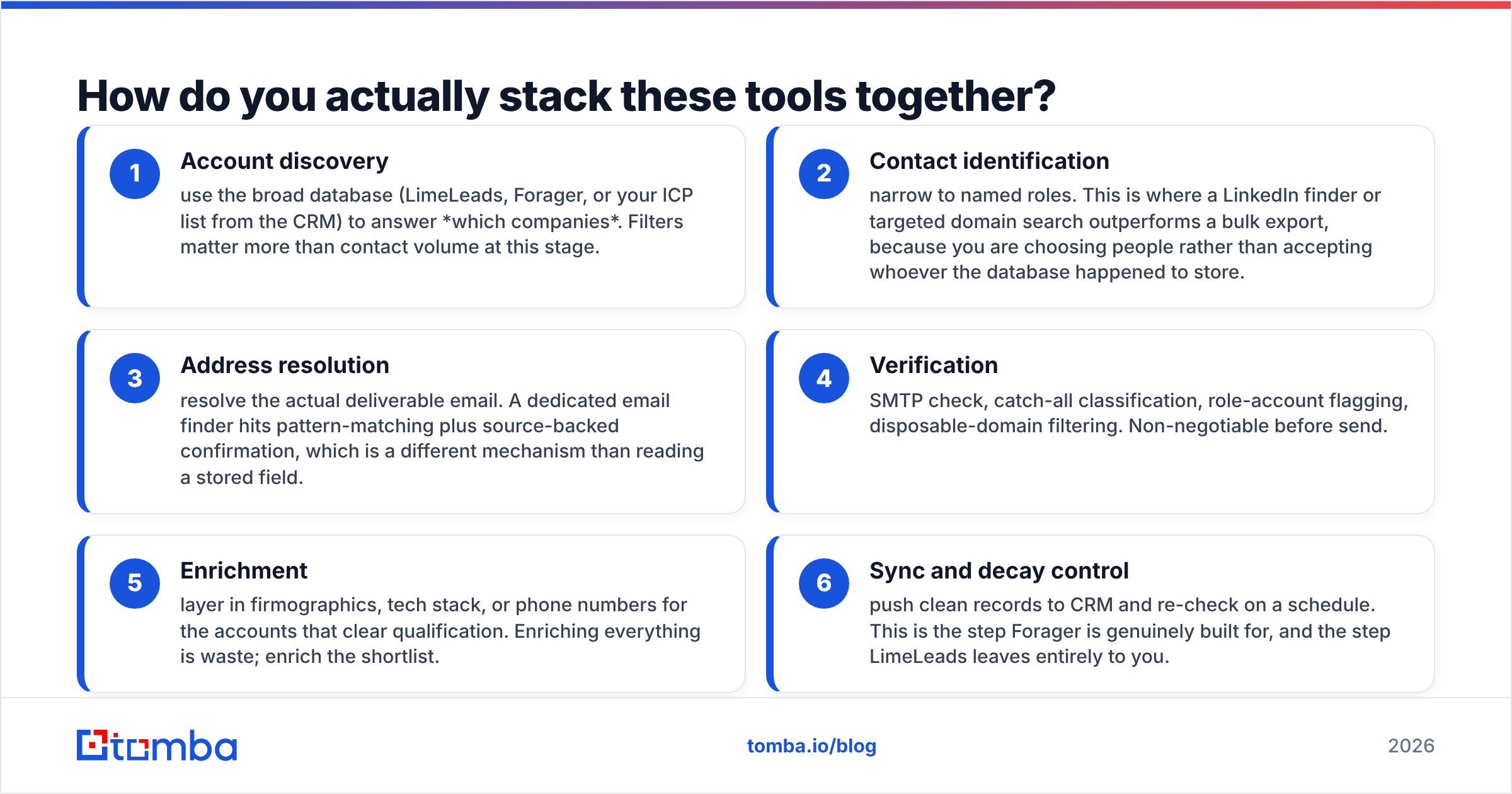
The teams with the best cost-per-meeting numbers rarely buy one platform and stop. They build a short chain instead, and each step has one job.
- Account discovery — use the broad database to answer which companies. Filters matter more than contact volume at this stage.
- Contact identification — narrow to named roles. A LinkedIn finder or a targeted domain search beats a bulk export here. You pick the people instead of taking whoever the database stored.
- Address resolution — resolve the real deliverable email. A dedicated email finder uses pattern matching plus source-backed proof. That is a different mechanism from reading a stored field.
- Verification — SMTP check, catch-all check, role-account flag, disposable-domain filter. Do not skip this before you send.
- Enrichment — add firmographics, tech stack, or phone numbers for accounts that clear qualification. Enriching everything is waste. Enrich the shortlist.
- Sync and decay control — push clean records to the CRM and re-check on a schedule. Forager is built for this step. LimeLeads leaves it entirely to you.
Steps 1 and 2 are where Forager and LimeLeads compete. Steps 3 and 4 are where both are weakest. There, failure shows up as a bounce rate, not as a line item.
What should you watch out for before you buy either?#
Four things show up again and again in post-purchase regret:
- Credit expiry. Self-serve credit models often wipe unused balances at period end. If your prospecting is bursty, you will pay for credits you never spend. Read the terms, not the pricing page.
- Export caps. Some plans limit rows per export or per day, whatever your credit balance says. That turns a "10,000 record" plan into a logistics problem.
- Geographic mismatch. If your ICP is EMEA or APAC, US-weighted databases show high total counts and low usable counts. Total database size is a vanity metric. Run a filtered preview on your exact ICP first.
- Contract lock-in versus real usage. Annual data contracts are priced on projected volume. Teams often commit at a volume they hit once in Q1 and never again. Ask for a quarterly out or a ramped commitment.
So run a preview query on your precise ICP in both tools before you spend anything. Filter to your exact industry, headcount band, geography, and titles. If the count collapses from 400,000 to 900, that is your real number. It may be cheaper to source those 900 with a bulk email finder than to license a database.
Forager vs LimeLeads: which one wins in 2026?#
Verdict: LimeLeads for fast, cheap, US-focused list building. Forager for ongoing enrichment and job-change intelligence at team scale. They are not really substitutes. Any comparison that crowns one overall winner is flattening two different jobs into one scoreboard.
The more useful frame is this. Both are discovery tools, and neither is a delivery tool. Your open rate depends on whether the address exists, and on whether your domain is trusted. A database subscription moves neither of those directly.
Want to stop paying for stale rows and start sending to addresses that resolve? Start at the resolution layer. Tomba Email Finder finds professional addresses by domain, name, or company. Source attribution and verification come built into the same lookup. The free tier covers 25 searches a month, Starter is $49/mo, and there is an API if you would rather wire it into the pipeline than click through a UI. Run your next 100 target accounts through it alongside whichever database you are evaluating. Then compare bounce rates after one send. That single test will tell you more than any vendor comparison page, including this one.
Related guides#
Ready to find emails that actually work?
Join 150,000+ professionals who stopped guessing and started sending. Free credits on signup — no credit card required.
Get the Tomba newsletter
Practical outbound tactics and product updates — once every two weeks.
About the author