Forager vs Prosperfleet Valgen: Which B2B Data Wins?
Forager and Prosperfleet Valgen both promise verified B2B contact data, but they solve different problems. Here's an honest breakdown of coverage, accuracy, pricing transparency and API access — plus a test protocol you can run before you sign anything.
Forager vs Prosperfleet Valgen is a real decision if you buy B2B contact data. One vendor publishes its API limits. The other gates pricing behind a demo call. Below we compare coverage, accuracy, pricing and API access — and give you a test you can run yourself.
TL;DR
- Forager is the more documented, more API-friendly of the two: a contact-data platform built around programmatic access, bulk pulls and refresh cycles. If you want to pipe data into a warehouse, it's the safer bet.
- Prosperfleet Valgen sits in the quote-only, sales-led corner of the market. Expect a demo call before you see a number, and expect coverage to be strongest in whatever verticals it was originally built for.
- Neither vendor publishes an independently audited accuracy figure, so treat every "98% verified" claim — including the ones on this page — as a hypothesis you test, not a fact you buy.
What actually decides it:
- The deciding factor is almost never raw database size. It's match rate on your ICP list, bounce rate after verification, and whether pricing survives contact with your actual volume.
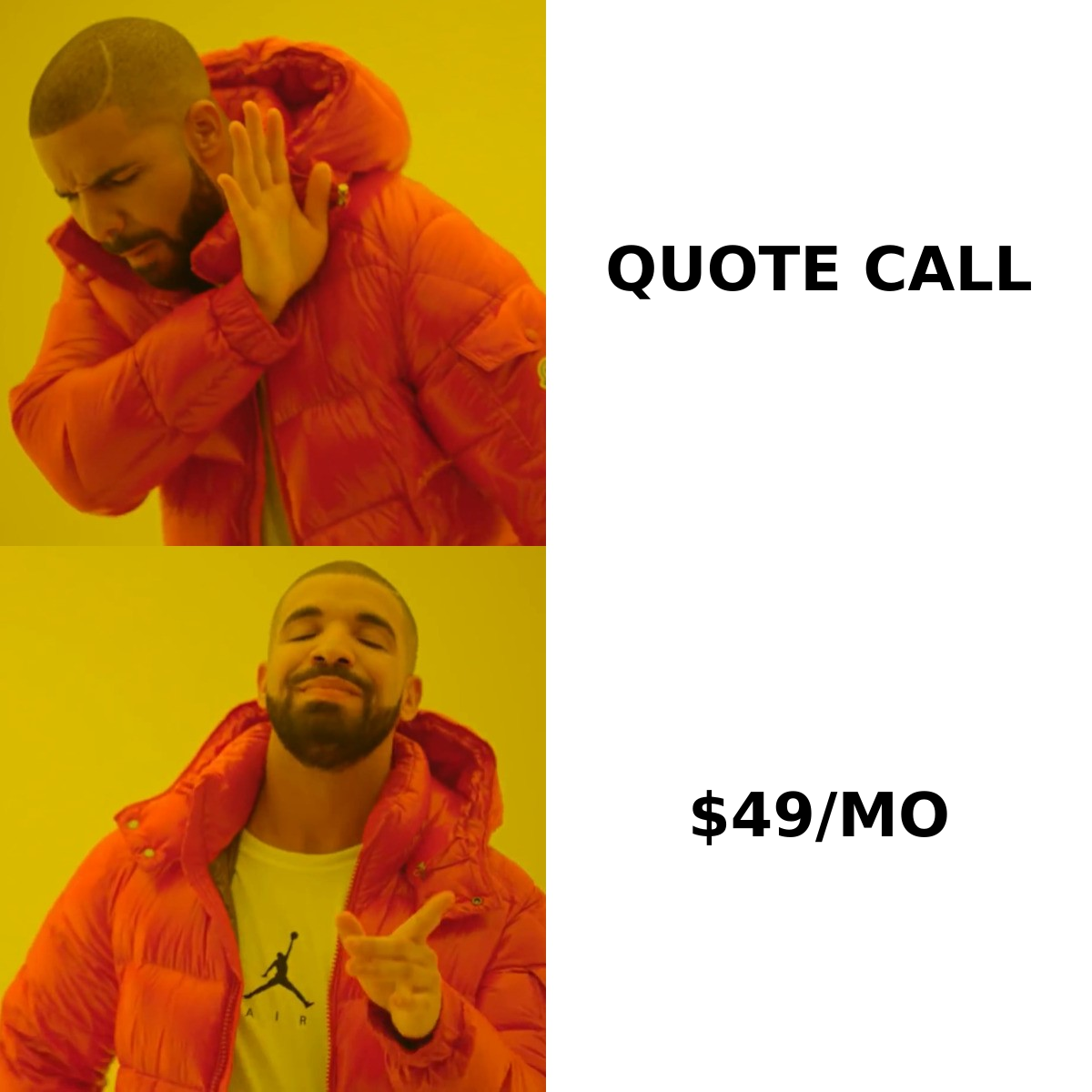
- If your bottleneck is finding and verifying work emails at a predictable per-credit cost, a focused tool like Tomba's email finder at $49/mo will usually beat a broad platform you only use 10% of.
What are Forager and Prosperfleet Valgen?#
Short version: both sell B2B contact data, but they're aimed at different buyers.
Forager positions itself as a contact-data and enrichment layer — people, companies, and the work emails that connect them. Its centre of gravity is the API and bulk delivery. Teams use it to enrich CRM records at scale, refresh stale contacts on a schedule, and back internal prospecting tools. You can see its current positioning on the Forager site. The pitch is "data as infrastructure," not "a nicer prospecting UI."
Prosperfleet Valgen is the smaller and less publicly documented of the pair. It shows up in the sales-intelligence category alongside dozens of similar mid-market platforms. The mix is familiar: contact records, account signals and some workflow tooling in one seat-based subscription. Its pricing and coverage claims sit behind a sales process, so most of what buyers repeat about it comes from demos rather than published docs.
That asymmetry matters, and I'm going to be direct about it: there is far more verifiable public information about Forager than about Prosperfleet Valgen. That's not a knock on the product. It's a procurement reality. When one vendor publishes limits and the other doesn't, you carry more risk on the second one. Price that risk into your decision.
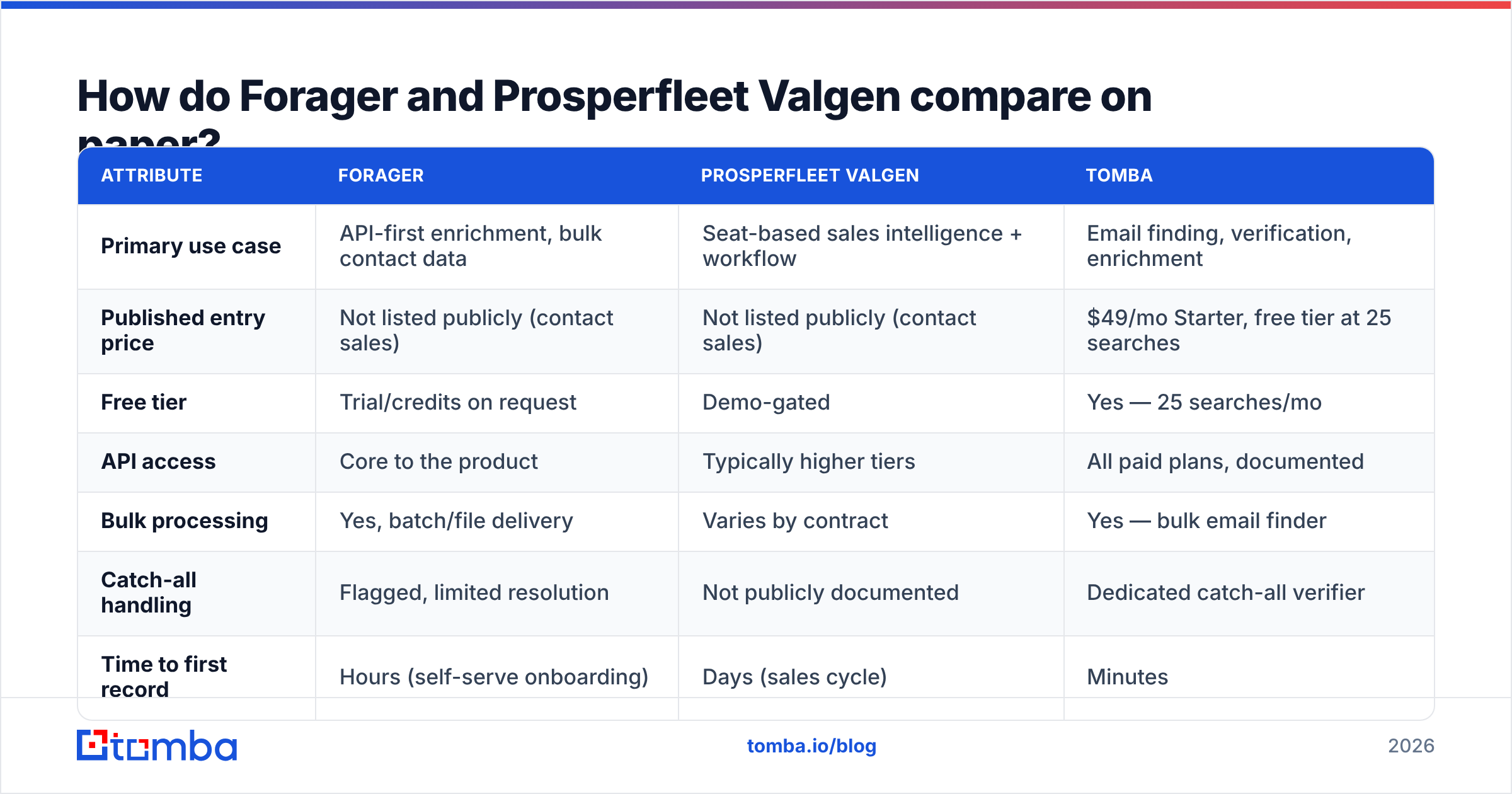
Forager vs Prosperfleet Valgen: how do they compare on paper?#
Here's the practical comparison, with Tomba included as a transparent-pricing reference point rather than as the assumed winner.
| Attribute | Forager | Prosperfleet Valgen | Tomba |
|---|---|---|---|
| Primary use case | API-first enrichment, bulk contact data | Seat-based sales intelligence + workflow | Email finding, verification, enrichment |
| Published entry price | Not listed publicly (contact sales) | Not listed publicly (contact sales) | $49/mo Starter, free tier at 25 searches |
| Free tier | Trial/credits on request | Demo-gated | Yes — 25 searches/mo |
| API access | Core to the product | Typically higher tiers | All paid plans, documented |
| Bulk processing | Yes, batch/file delivery | Varies by contract | Yes — bulk email finder |
| Catch-all handling | Flagged, limited resolution | Not publicly documented | Dedicated catch-all verifier |
| Time to first record | Hours (self-serve onboarding) | Days (sales cycle) | Minutes |
| Best for | Data/RevOps engineering teams | Mid-market sales teams wanting one seat-based platform | Lean teams that need accurate emails now |
Two honest caveats about that table. First, any row marked "not publicly documented" is exactly that — absence of published information, not evidence of a weakness. Second, entry pricing on quote-only vendors moves with negotiation. The number your peer got is not the number you'll get.
Which one finds more valid emails?#
Nobody outside the vendors can answer that with authority. Be suspicious of any blog post that claims otherwise. What you can do is measure it yourself in about ninety minutes.

The two metrics that decide the outcome:
Match rate — of 200 real prospects in your ICP, how many come back with any email at all? This is where database composition shows up. A vendor with 500M records that skews US enterprise will crater on a list of German mid-market ops managers. A smaller database tuned to your segment will beat it outright.
Precision — of the emails returned, how many actually deliver? A tool that returns 90% of your list at 70% precision is worse than one that returns 60% at 96% precision. The first one quietly burns your sender reputation. The second doesn't.
The trap is that vendors report these separately and let you assume they multiply cleanly. They don't. Ask for match rate and bounce rate on the same sample, and if a rep can't produce that, run your own test.
Catch-all domains are where the numbers usually break down. Roughly a fifth of B2B domains accept mail to any address, so SMTP checks return "accept" whether or not the mailbox exists. Some vendors count those as verified. That single accounting choice can swing a published accuracy figure by ten points. It's why a proper catch-all verifier matters more than a headline percentage.
How should you actually test a B2B data vendor?#
Run this before you sign anything. It works for Forager, for Prosperfleet Valgen, and for every alternative you shortlist.
- Build a 200-row truth set from your own CRM. Pull closed-won and closed-lost contacts where you already know the email is real. Strip the emails, keep name + company domain. This is your answer key, and the only benchmark that reflects your ICP rather than the vendor's.
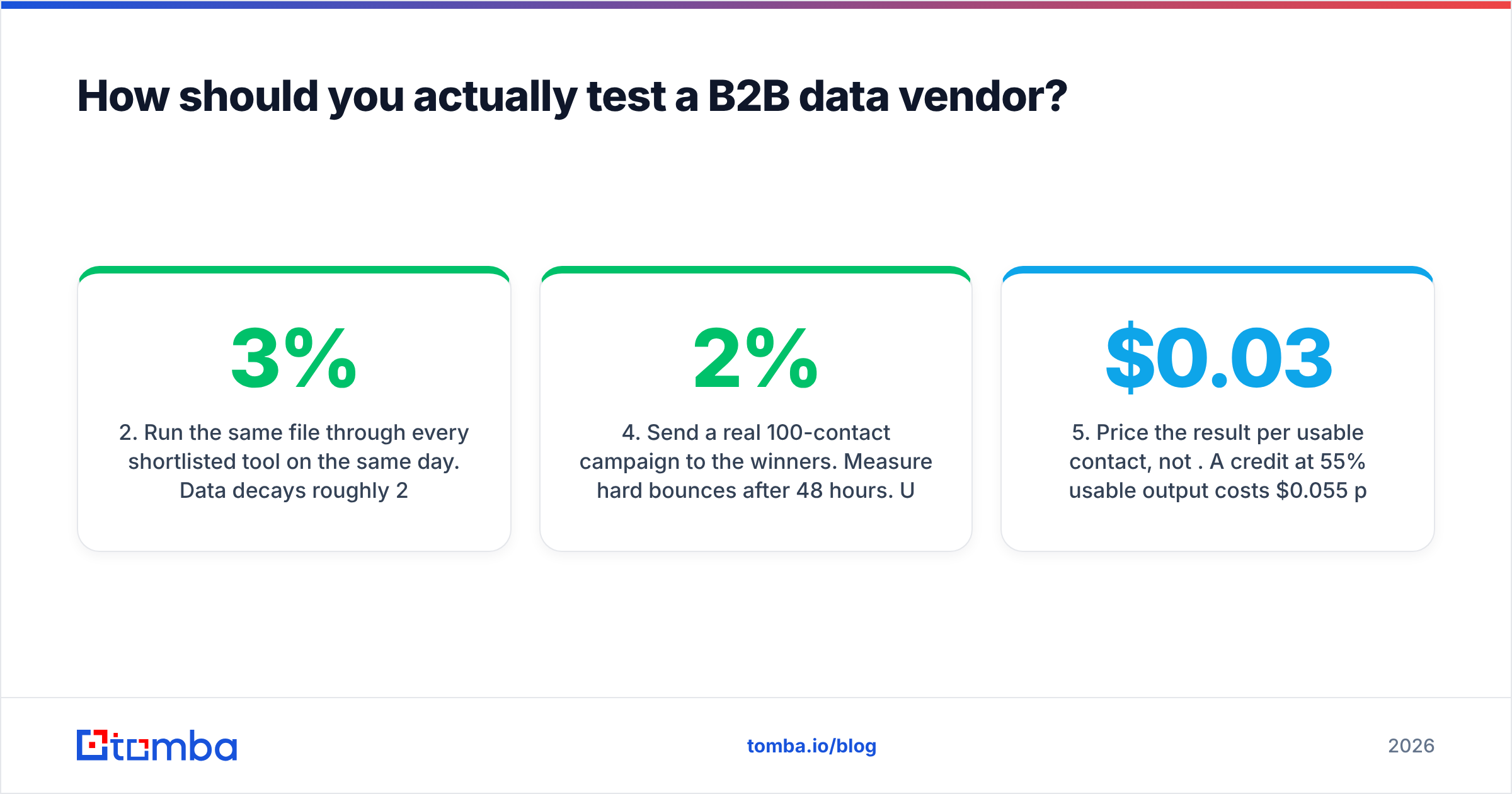
- Run the same file through every shortlisted tool on the same day. Data decays roughly 2–3% per month. A test run in March against a competitor's run from January is not a comparison. It's noise.
- Score match rate and precision separately. Match rate = rows returned ÷ 200. Precision = correct emails ÷ rows returned. Write both down. A single blended "accuracy" number hides the trade-off you actually care about.
Then prove it with real sends and real math:
- Send a real 100-contact campaign to the winners. Measure hard bounces after 48 hours. Under 2% is healthy. Over 5% means the verification layer isn't doing its job, whatever the dashboard claimed.
- Price the result per usable contact, not per credit. A $0.03 credit at 55% usable output costs $0.055 per real contact. A $0.05 credit at 92% costs $0.054. The "expensive" tool was cheaper.
- Test the failure path. Feed in 20 deliberately bad rows — misspelled domains, dead companies, personal Gmail addresses. A good vendor returns nothing. A bad one returns confident garbage, and confident garbage is the most expensive kind.
Step six eliminates more vendors than the other five combined.
What does each one cost in practice?#
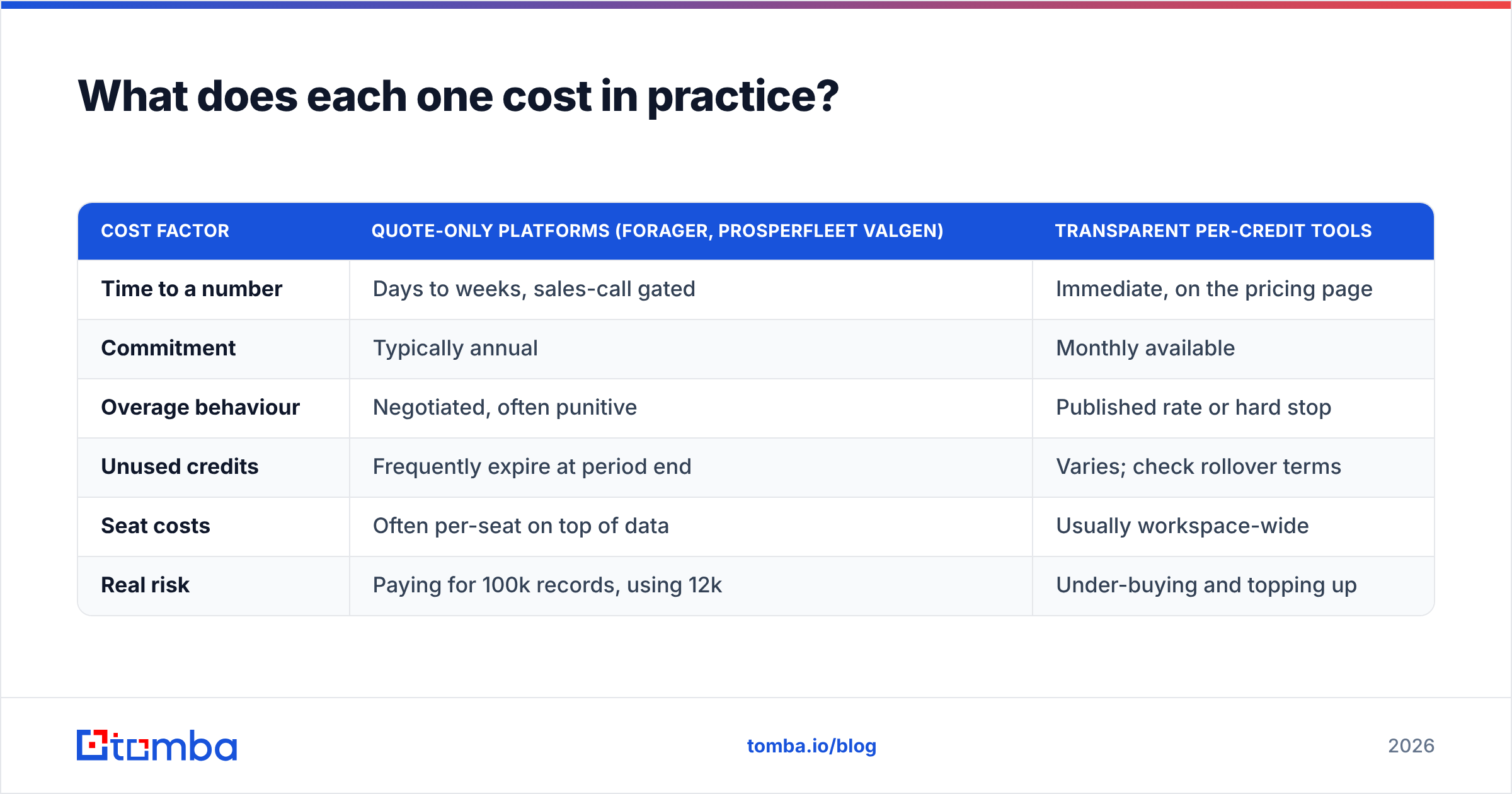
Neither Forager nor Prosperfleet Valgen publishes a public price list. That puts both in the "book a call to find out" category. It's a legitimate model for enterprise data contracts, but it has real costs for a buyer: a slower evaluation, no way to benchmark against peers, and annual commitments that assume volume you haven't validated yet.
| Cost factor | Quote-only platforms (Forager, Prosperfleet Valgen) | Transparent per-credit tools |
|---|---|---|
| Time to a number | Days to weeks, sales-call gated | Immediate, on the pricing page |
| Commitment | Typically annual | Monthly available |
| Overage behaviour | Negotiated, often punitive | Published rate or hard stop |
| Unused credits | Frequently expire at period end | Varies; check rollover terms |
| Seat costs | Often per-seat on top of data | Usually workspace-wide |
| Real risk | Paying for 100k records, using 12k | Under-buying and topping up |
For reference, Tomba's pricing runs Free (25 searches/mo), Starter $49/mo, Growth $99/mo, Pro $249/mo, and Enterprise on request. It's published, monthly-cancellable, and the same for everyone. That transparency isn't automatically better than a negotiated enterprise contract. It's better when you don't yet know your volume, which describes most teams evaluating their first or second data vendor.
The failure mode I see repeatedly: a team signs a $24k annual platform contract because the per-record price looked great at 100k records. Then they run 9k records in year one. They paid roughly ten times the unit price they negotiated. Buy for the volume you can prove from last quarter, not the volume in next year's plan.

Which is better for API-first teams?#
Forager, fairly clearly. The caveat: "API access exists" and "API is usable at scale" are different claims. Before you commit either way, get written answers on six things:
- Rate limits in requests per second, and what happens on breach — queue, 429, or account suspension.
- Latency at p95, not average. Average latency hides the timeouts that break a real-time enrichment form.
- Webhook or callback support for bulk jobs, so you're not polling a status endpoint for twenty minutes.
- Credit accounting on misses. Are you charged for a lookup that returns nothing? Over a 50k-row enrichment this is a material line item.
- Sandbox environment with non-billable calls, so your integration tests don't cost money every CI run.
- Deprecation policy — how much notice before a breaking change lands.
If a vendor can't answer all six in writing, the API is a feature checkbox, not a product. For comparison, the Tomba API publishes its limits and endpoints openly. At minimum that lets you scope the integration before you pay.
Prosperfleet Valgen's API story is harder to assess from outside. If you're evaluating it seriously, treat the API as an unknown to validate in a trial, not a capability you can assume from the sales deck.
Where does Tomba fit in this comparison?#
Honestly? In a different weight class, and that's the point.
Forager and Prosperfleet Valgen are platforms. They want to be your contact database, your enrichment layer, and in Prosperfleet Valgen's case part of your workflow too. That's the right architecture if you have a RevOps function to own it and enough volume to justify the contract.
Tomba is deliberately narrower: find the email, verify the email, enrich around it. Domain search for mapping a company's contacts, an email verifier for cleaning lists before send, catch-all resolution, phone finding, and a documented API — without a database subscription or a seat-based platform commitment.
Where that wins: agencies running campaigns across many client domains, founders doing their own outbound, engineering teams that want one clean endpoint rather than a platform. Where it doesn't: if you need intent signals, account scoring, and a full sales-engagement suite in one contract, buy a platform. Tomba isn't trying to be that, and pretending otherwise would waste your time.
Which should you choose?#
The Forager vs Prosperfleet Valgen answer comes down to who owns the data inside your team.
Choose Forager if your team is technical, your primary consumer of the data is a warehouse or an internal tool, and you need scheduled refreshes rather than ad-hoc lookups. Its API-first design is the clearest differentiator in this matchup, and self-serve onboarding gets you to a real test faster.
Choose Prosperfleet Valgen if the demo shows genuinely strong coverage in your specific vertical and geography, and your team wants one seat-based platform rather than assembled parts. Insist on a paid pilot with your own truth-set file before any annual commitment. The lack of public documentation means the trial is your due diligence.
Choose a focused email finder if your actual bottleneck is "I need accurate work emails, verified, at a price I can predict." That's a narrower problem than either platform is built for, and narrower tools solve it for less.
The meta-advice: run the six-step protocol above on all three. It costs you an afternoon. It's the only comparison that uses your data, your ICP, and your inbox. Every published benchmark — including the charts on this page — is someone else's sample.
Cross-check what you learn against real user reviews on G2 and Capterra. If the category itself is new to you, the sales intelligence overview is a decent 10-minute primer on what these platforms are built from.
Want to run the test today instead of booking a demo? Start with the Tomba Email Finder — 25 free searches, no card, no sales call. Upload your 200-row truth set, check the match rate and precision yourself, and use the result as the baseline you hold Forager and Prosperfleet Valgen against. If Tomba wins on your data, Starter is $49/mo. If it doesn't, you've still got a hard number to negotiate with. Either way you leave the afternoon with evidence instead of a slide deck.
Related guides#
Ready to find emails that actually work?
Join 150,000+ professionals who stopped guessing and started sending. Free credits on signup — no credit card required.
Get the Tomba newsletter
Practical outbound tactics and product updates — once every two weeks.
About the author