Forecast Commit: How to Call Your Number and Actually Hit It
A commit number is a promise, not a guess. Here's how commit, best case, and pipeline categories actually work, what accuracy targets to hold reps to, and how to build a commit process that survives a board meeting.
TL;DR
- A forecast commit is the revenue a rep or manager promises will close in the current period — a number they will be held to, not a hopeful estimate.
- Commit is one category in a ladder: Closed Won → Commit → Best Case → Pipeline → Omitted. Each has its own entry criteria and its own expected close rate.
- Healthy teams land within ±5% of the committed number at the company level. Individual rep variance of ±15% is normal early; anything wider means your criteria are vague.
- Sandbagging and happy ears are both forecast failures. The fix is evidence-based entry criteria, not more pressure in the pipeline review.
- Commit accuracy collapses when the pipeline feeding it is dirty. Bad contact data, stale champions, and single-threaded deals distort every category upstream.
What is a forecast commit?#
A forecast commit is the portion of your pipeline that a seller states, on the record, will close before the period ends. It is a commitment in the contractual sense — if you commit $180K for Q3, leadership plans hiring, spend, and board messaging around $180K arriving.
Think of it like a restaurant kitchen calling out tickets. "Fire table 12" is not "table 12 might want food eventually." It's a declaration that the dish is going out, and everyone downstream — expo, servers, the guest — plans around it. A forecast commit works the same way: finance, the board, and your own hiring plan are all downstream of the number you call.
The technical definition: commit is a forecast category applied at the opportunity level, rolled up by rep, then by manager, then by segment, into a single company number submitted each week. Most CRMs — Salesforce, HubSpot, Pipedrive — ship forecast categories natively and map them to deal stages by default. That default mapping is almost always wrong for your business, which is where most forecast problems begin.
The distinction that matters: stage describes where a deal is in your process. Forecast category describes your confidence that it closes this period. A deal can sit in "Negotiation" and still belong in Pipeline if the buyer's fiscal year doesn't open until next quarter. Teams that let stage auto-drive category are not forecasting — they're reporting stage distribution and calling it a forecast.
What are the forecast categories and how do they differ?#
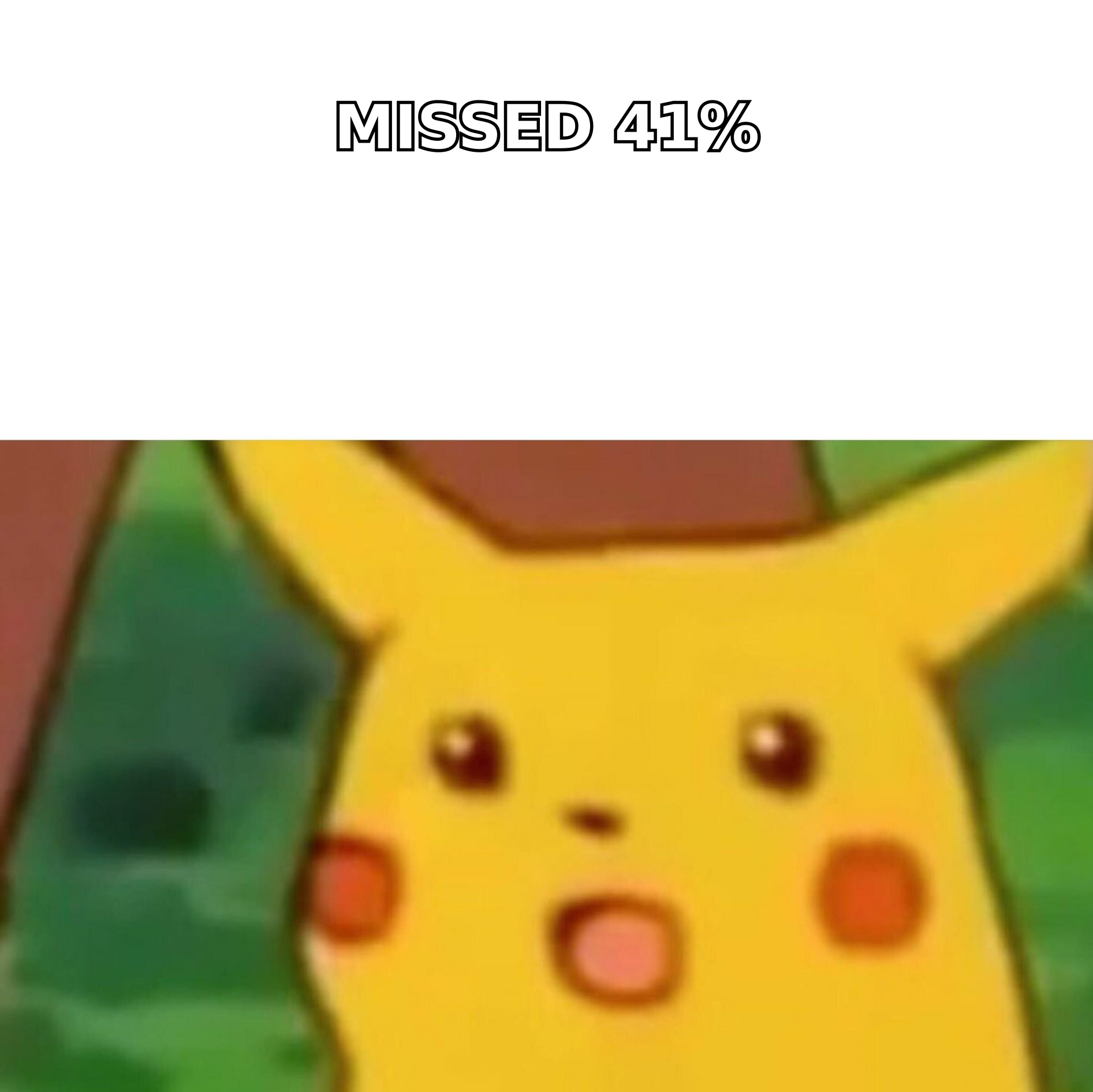
Five categories cover nearly every B2B revenue org. The names vary; the logic doesn't.
| Category | Definition | Typical close rate | Who can change it | Common failure |
|---|---|---|---|---|
| Closed Won | Signed, countersigned, booked | 100% | Nobody (locked) | Booking before signature lands |
| Commit | Rep promises it closes this period | 85–95% | Rep, with manager review | Committing on verbal agreement only |
| Best Case | Closes if things break right | 40–60% | Rep | Used as a dumping ground for hope |
| Pipeline | Real deal, wrong timing or unproven | 10–25% | Rep | Stale deals never get cleaned out |
| Omitted | Dead, disqualified, or pushed indefinitely | 0% | Rep, manager audit | Deals left open to pad pipeline coverage |
The gap between Commit and Best Case is where forecast discipline lives or dies. Best Case should mean "I can name the specific thing that has to happen." If a rep can't name it, the deal is Pipeline.
Entry criteria for Commit — use these as a hard checklist, not a vibe:
- Economic buyer confirmed and engaged. You've spoken to the person who signs, not just the person who cares.
- Written mutual action plan with dates for legal, security review, and signature.
- Pricing agreed in writing — email, quote acceptance, or a redlined order form. Verbal pricing is Best Case.
- Procurement and legal timeline mapped against your period end, with buffer. A 14-day security review starting on day 25 of the month is not a commit.
- No unresolved blocking objection — not "they're thinking about the integration concern."
- Multi-threaded — at least two contacts responsive in the last ten days.
Miss any one of them and the deal is Best Case. That rule is boring and it is the single highest-leverage change most sales orgs can make to forecast accuracy.
Why do commit numbers miss?#
Four causes, in rough order of frequency.
Happy ears. The rep heard "this looks great, let's get it done" and translated it into a commit. Buyers are polite. Enthusiasm is not a signal — a countersigned order form is a signal. This is the dominant failure mode in teams with quarterly quotas and monthly commits.
Sandbagging. The inverse: reps under-commit to guarantee an over-delivery narrative. It feels harmless and it destroys planning. If your team consistently lands 115–130% of commit, you don't have a great team — you have a broken forecast, and finance is under-hiring because of it.
Timing blindness. The deal was real and the buyer was ready, but nobody mapped the buyer's procurement calendar. Enterprise legal reviews, security questionnaires, and vendor onboarding routinely add 15–30 days that were never in the plan.
Bad upstream data. This one is quieter and more corrosive. When your pipeline is built on unverified contacts, wrong titles, and champions who left the company, every category above it inherits the error. A "committed" deal where your main contact bounced two weeks ago isn't a commit — it's a ghost. Running your account list through an email verifier before the quarter opens catches a surprising share of these, and data enrichment on your open opportunities will flag the job changes that quietly killed a deal you're still forecasting.
Research on forecast performance is consistently unflattering. Gartner has repeatedly found that most B2B sales organizations report forecast accuracy below what leadership believes it to be, and the gap widens with deal complexity. The pattern is stable across vendors and segments: the more stakeholders in a deal, the worse a single rep's confidence estimate performs.
How do you measure forecast commit accuracy?#
Track three numbers, weekly, and never let them be reported by the person who submitted the forecast.
Commit accuracy = Closed Won from committed deals ÷ Total committed. Target: 90–95%. Below 85% means your entry criteria are decorative.
Forecast variance = (Actual − Forecast) ÷ Forecast. Target: within ±5% at company level. Positive variance above 10% is sandbagging; negative variance below −10% is happy ears.
Slippage rate = Deals committed in period N that closed in period N+1 ÷ Deals committed in period N. Target: under 15%. High slippage with high eventual close rate is a timing problem, not a qualification problem — fix the mutual action plans, not the criteria.
Benchmark reference points, drawn from public vendor benchmarks and community data on G2:
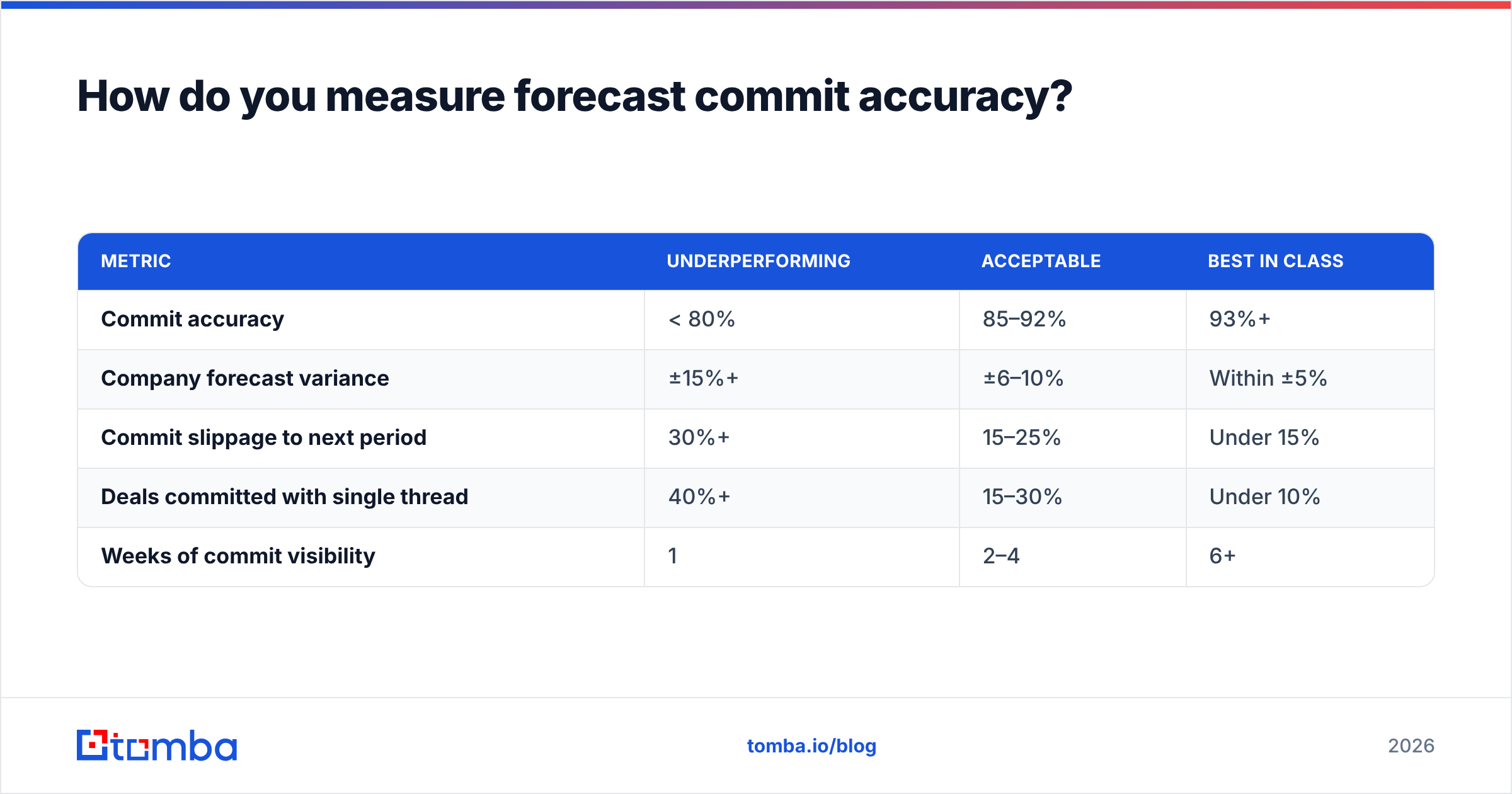
| Metric | Underperforming | Acceptable | Best in class |
|---|---|---|---|
| Commit accuracy | < 80% | 85–92% | 93%+ |
| Company forecast variance | ±15%+ | ±6–10% | Within ±5% |
| Commit slippage to next period | 30%+ | 15–25% | Under 15% |
| Deals committed with single thread | 40%+ | 15–30% | Under 10% |
| Weeks of commit visibility | 1 | 2–4 | 6+ |
Score reps on accuracy, not just attainment. A rep who commits $200K and delivers $198K is more valuable to the business than one who commits $120K and delivers $210K, even though the second one looks like a hero on the leaderboard. Make that explicit in your comp and QBR conversations or the sandbagging never stops.
What does a good commit review actually look like?#
Thirty minutes, weekly, per rep. Deal-by-deal on commit only — Best Case gets five minutes at the end and Pipeline doesn't get reviewed here at all.
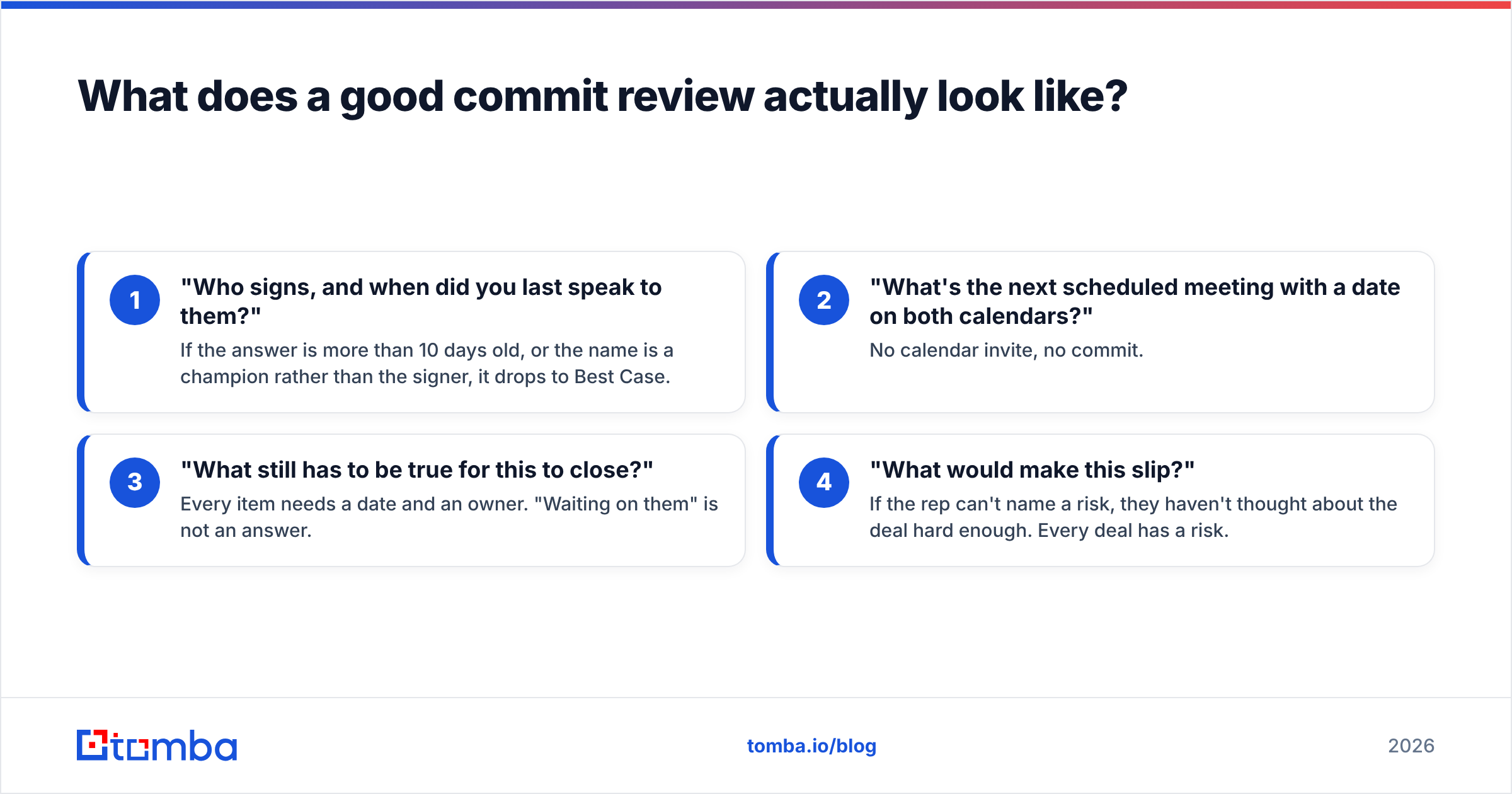
The four questions per committed deal:
- "Who signs, and when did you last speak to them?" If the answer is more than 10 days old, or the name is a champion rather than the signer, it drops to Best Case.
- "What's the next scheduled meeting with a date on both calendars?" No calendar invite, no commit.
- "What still has to be true for this to close?" Every item needs a date and an owner. "Waiting on them" is not an answer.
- "What would make this slip?" If the rep can't name a risk, they haven't thought about the deal hard enough. Every deal has a risk.
Manager rule: you may move a deal down a category on the spot. You may never move one up without the rep agreeing on the record — that's how managers end up owning the miss and reps stop taking the forecast seriously.
Run the review against the CRM live, not a spreadsheet. If the CRM doesn't reflect reality, that's the finding. A forecast built on a system nobody updates is theater, and every downstream revenue operations process inherits the fiction.
How does pipeline quality determine commit reliability?#
Your commit number can only be as good as the pipeline it was drawn from. Three upstream levers matter more than any forecasting tool you'll buy.
Coverage ratio. You need roughly 3–4x your quota in qualified pipeline entering a period, higher for transactional velocity motions. Below 3x, reps commit deals that aren't ready because there's nothing else to commit. This is the mechanical origin of most happy-ears forecasting — it's a supply problem masquerading as a discipline problem.
Contact accuracy. Every stalled deal has a story, and a large share of those stories are "the champion left and we found out six weeks later." Job changes hit B2B contact databases hard — a meaningful percentage of business email addresses decay every year. Running open opportunities through a reverse email lookup or a scheduled enrichment pass catches departures before they show up as an unexplained slip.
Multi-threading depth. Single-threaded deals slip at roughly double the rate of multi-threaded ones. If your commit list is single-threaded, you're not forecasting revenue — you're forecasting one person's continued employment and enthusiasm. Building a second and third thread requires finding the right people, which is where a domain search across the account earns its keep: pull the finance, security, and operations contacts before you need them, not during the fire drill.
Peer providers cover different corners of this problem. Contact databases like BookYourData sell curated B2B lists that are useful for building coverage at the top of the funnel; Tomba's strength is verified discovery and enrichment against accounts you already have. Both approaches feed the same goal — a pipeline where the contacts in your committed deals are real, current, and reachable.
Should you use an AI forecasting tool?#
Sometimes. AI forecast tools — Clari, Gong Forecast, BoostUp, and the native predictive features in most CRMs — fit deal attributes against historical outcomes and produce a probability that often beats rep intuition on volume-heavy motions.
Where they help:
- High deal volume (100+ opportunities per period). The model has enough training signal.
- Consistent sales process. If your stages mean the same thing across the team, patterns are learnable.
- Detecting sandbagging. The model doesn't care about your leaderboard narrative.
Where they don't:
- Under ~50 deals per quarter. Not enough data; you get confident noise.
- New products or new segments. No history to learn from.
- Dirty CRM hygiene. Garbage in, confidently-scored garbage out.
The honest position: AI forecasting is a check on your commit process, not a replacement for it. If the model says 62% and your rep says commit, that's a conversation worth having. If you've outsourced the judgment entirely, you've just moved the accountability somewhere nobody can be held to it.
How do you roll out a commit process without a revolt?#
Four weeks, in order.
Week 1 — Define and publish. Write the entry criteria for each category on one page. Circulate it. Make it non-negotiable and specific enough that two managers reading the same deal reach the same category.
Week 2 — Recategorize everything. Every open opportunity gets re-graded against the new criteria. Expect commit to shrink by 20–40%. That drop is not a problem being created — it's a problem being revealed, and it's better revealed in week 2 than in the last week of the quarter.
Week 3 — Run the first reviews. Managers coach against the criteria, not against the number. The point of the first cycle is calibration, not pressure.
Week 4 — Start scoring accuracy. Publish commit accuracy per rep alongside attainment. Once accuracy is visible, sandbagging and happy ears both self-correct faster than any lecture will produce.
Then hold it. The most common failure is a beautifully designed commit process that quietly reverts to stage-driven auto-categorization within two quarters because nobody kept scoring it.
Get the data your forecast depends on#
A commit number is only as trustworthy as the contacts inside the deals that make it up. If your committed opportunities are built on stale emails, departed champions, and a single thread into a company, no forecasting methodology will save the quarter.
Start upstream. Use the Tomba Email Finder to build multi-threaded coverage across the accounts already in your pipeline — finance, security, and procurement contacts found before you need them, verified before you send. The free tier gives you 25 searches a month to test it against your current commit list; paid plans start at $49/mo on Starter, with Growth at $99/mo and Pro at $249/mo. Full Tomba pricing is public.
Run your open commit deals through it this week. The contacts that come back wrong are the deals that were about to slip.
Related guides#
Ready to find emails that actually work?
Join 150,000+ professionals who stopped guessing and started sending. Free credits on signup — no credit card required.
Get the Tomba newsletter
Practical outbound tactics and product updates — once every two weeks.
About the author