Forecastio Alternatives: 9 Sales Forecasting Tools for 2026
Forecastio is clean, HubSpot-native, and cheap for small teams. It is also the wrong tool the moment your forecast lives in Salesforce or your reps stop updating deals. Here are nine alternatives, with honest pricing and fit notes.
TL;DR
- Forecastio is a HubSpot-native forecasting and sales-performance layer aimed at SMB and lower-mid-market teams. It is genuinely good at what it does and priced far below enterprise revenue-intelligence platforms.
- You outgrow it in three predictable ways: you migrate to Salesforce, you need conversation data inside the forecast, or you need multi-product and multi-currency roll-ups that a lightweight tool cannot model.
- The realistic shortlist in 2026: Clari, BoostUp, Aviso, Weflow, Mediafly Intelligence360, Gong Forecast, Salesforce Revenue Intelligence, HubSpot's native forecasting, and plain spreadsheets plus a data hygiene process.
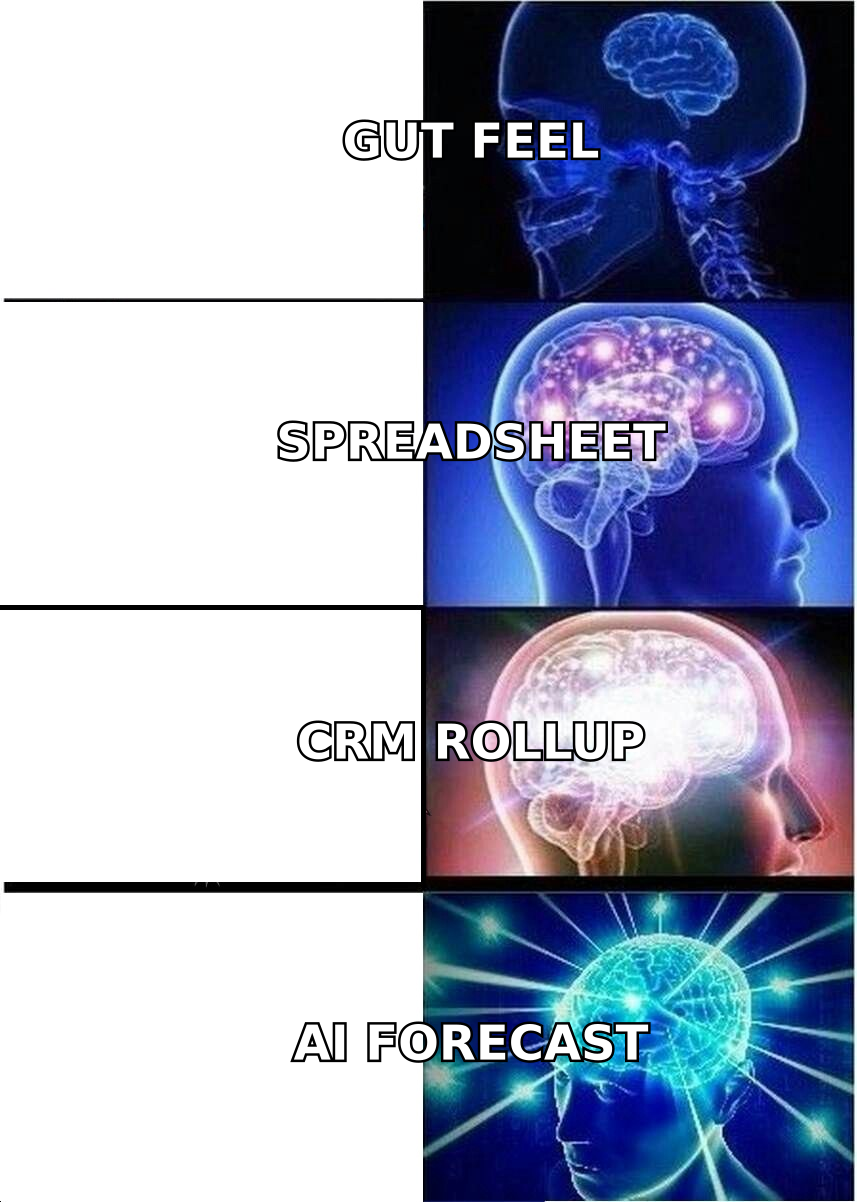
- Almost every "our forecast is wrong" problem is a data problem, not a modelling problem. If 30% of your contacts bounce and half your deals have no next step, no algorithm saves you.
- Fix the input layer first: verified contact data, complete account records, and a rule that a deal without a stakeholder email does not exist.
What is Forecastio, and who actually uses it?#
Forecastio is a sales performance and forecasting tool built specifically around HubSpot. It pulls deal, activity, and quota data out of your CRM and turns it into forecast scenarios, pipeline coverage math, rep-level attainment tracking, and "what has to happen for you to hit the number" planning views.
The buyer profile is consistent: a 5-to-60-rep B2B team on HubSpot, usually with a fractional or first-hire RevOps person, who has outgrown a Google Sheet but cannot justify a six-figure revenue-intelligence contract. Forecastio sits in that gap deliberately. It does not try to be a conversation-intelligence platform or a CRM of record.
That focus is the strength and the ceiling. If your motion is one product, one currency, one CRM, and a sales cycle measured in weeks, Forecastio covers most of what you need. Change any one of those variables and you start hunting for Forecastio alternatives.
Why do teams look for Forecastio alternatives?#
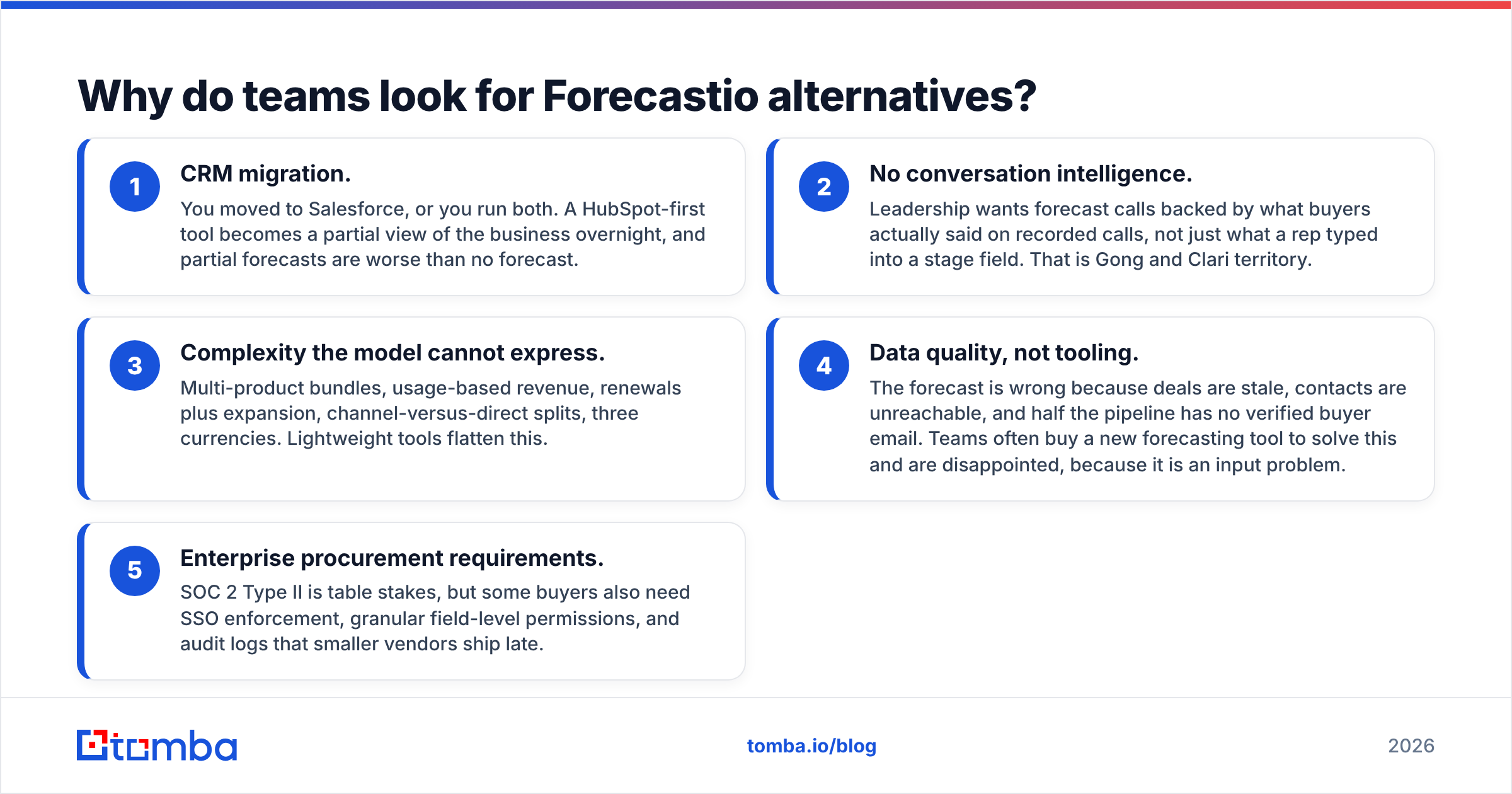
Five reasons come up repeatedly, roughly in order of frequency:
- CRM migration. You moved to Salesforce, or you run both. A HubSpot-first tool becomes a partial view of the business overnight, and partial forecasts are worse than no forecast.
- No conversation intelligence. Leadership wants forecast calls backed by what buyers actually said on recorded calls, not just what a rep typed into a stage field. That is Gong and Clari territory.
- Complexity the model cannot express. Multi-product bundles, usage-based revenue, renewals plus expansion, channel-versus-direct splits, three currencies. Lightweight tools flatten this.
- Data quality, not tooling. The forecast is wrong because deals are stale, contacts are unreachable, and half the pipeline has no verified buyer email. Teams often buy a new forecasting tool to solve this and are disappointed, because it is an input problem.
- Enterprise procurement requirements. SOC 2 Type II is table stakes, but some buyers also need SSO enforcement, granular field-level permissions, and audit logs that smaller vendors ship late.
Reason four is worth pausing on. Forecast accuracy is downstream of pipeline accuracy, and pipeline accuracy is downstream of whether you can reach the people in the deal. Teams doing serious revenue operations work treat contact hygiene as part of the forecasting stack, not a separate chore.
What should you compare before switching?#
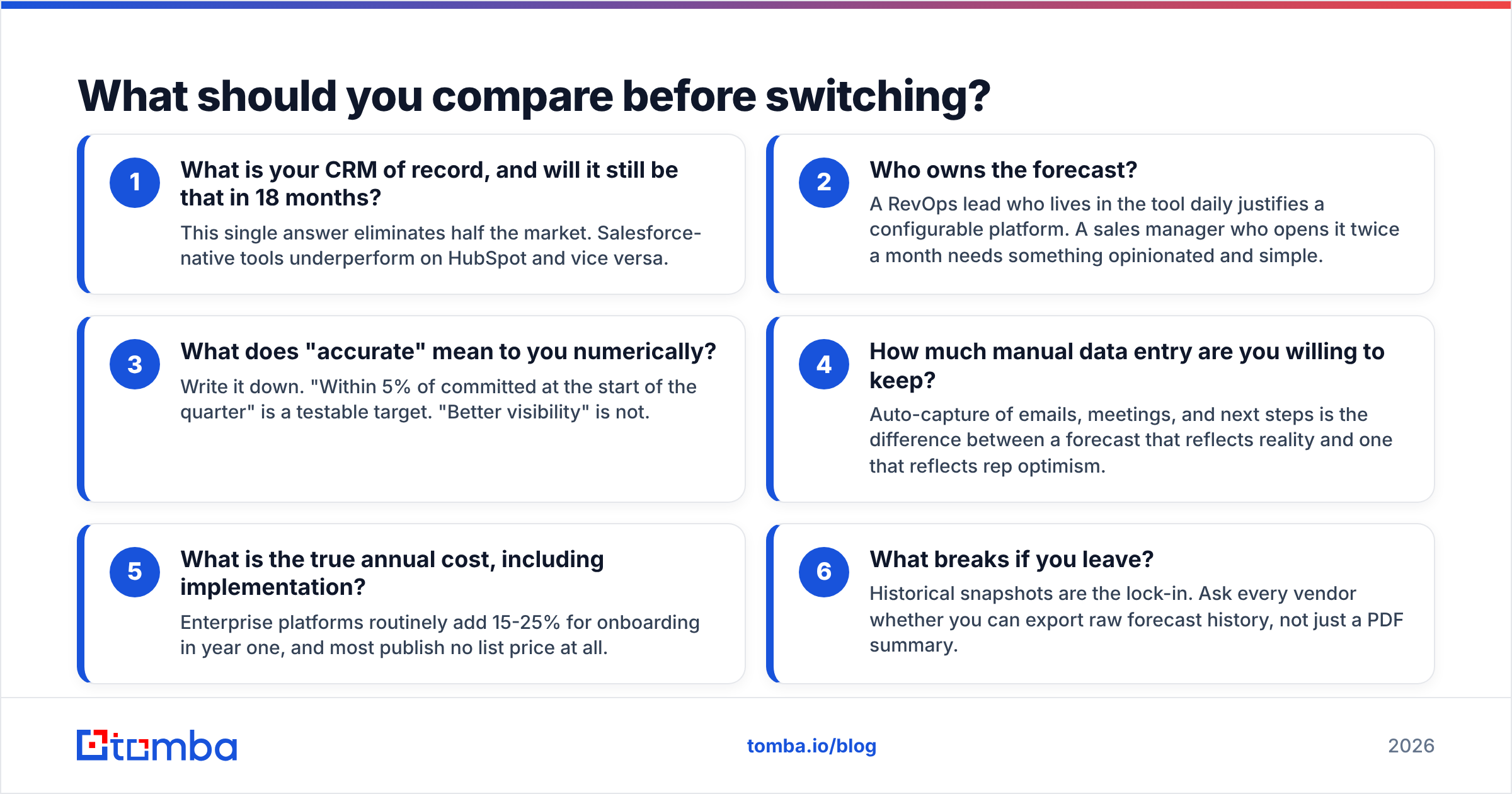
Do not start with feature grids. Start with these six questions, in this order:
- What is your CRM of record, and will it still be that in 18 months? This single answer eliminates half the market. Salesforce-native tools underperform on HubSpot and vice versa.
- Who owns the forecast? A RevOps lead who lives in the tool daily justifies a configurable platform. A sales manager who opens it twice a month needs something opinionated and simple.
- What does "accurate" mean to you numerically? Write it down. "Within 5% of committed at the start of the quarter" is a testable target. "Better visibility" is not.
- How much manual data entry are you willing to keep? Auto-capture of emails, meetings, and next steps is the difference between a forecast that reflects reality and one that reflects rep optimism.
- What is the true annual cost, including implementation? Enterprise platforms routinely add 15-25% for onboarding in year one, and most publish no list price at all.
- What breaks if you leave? Historical snapshots are the lock-in. Ask every vendor whether you can export raw forecast history, not just a PDF summary.
Which Forecastio alternatives are worth shortlisting in 2026?#
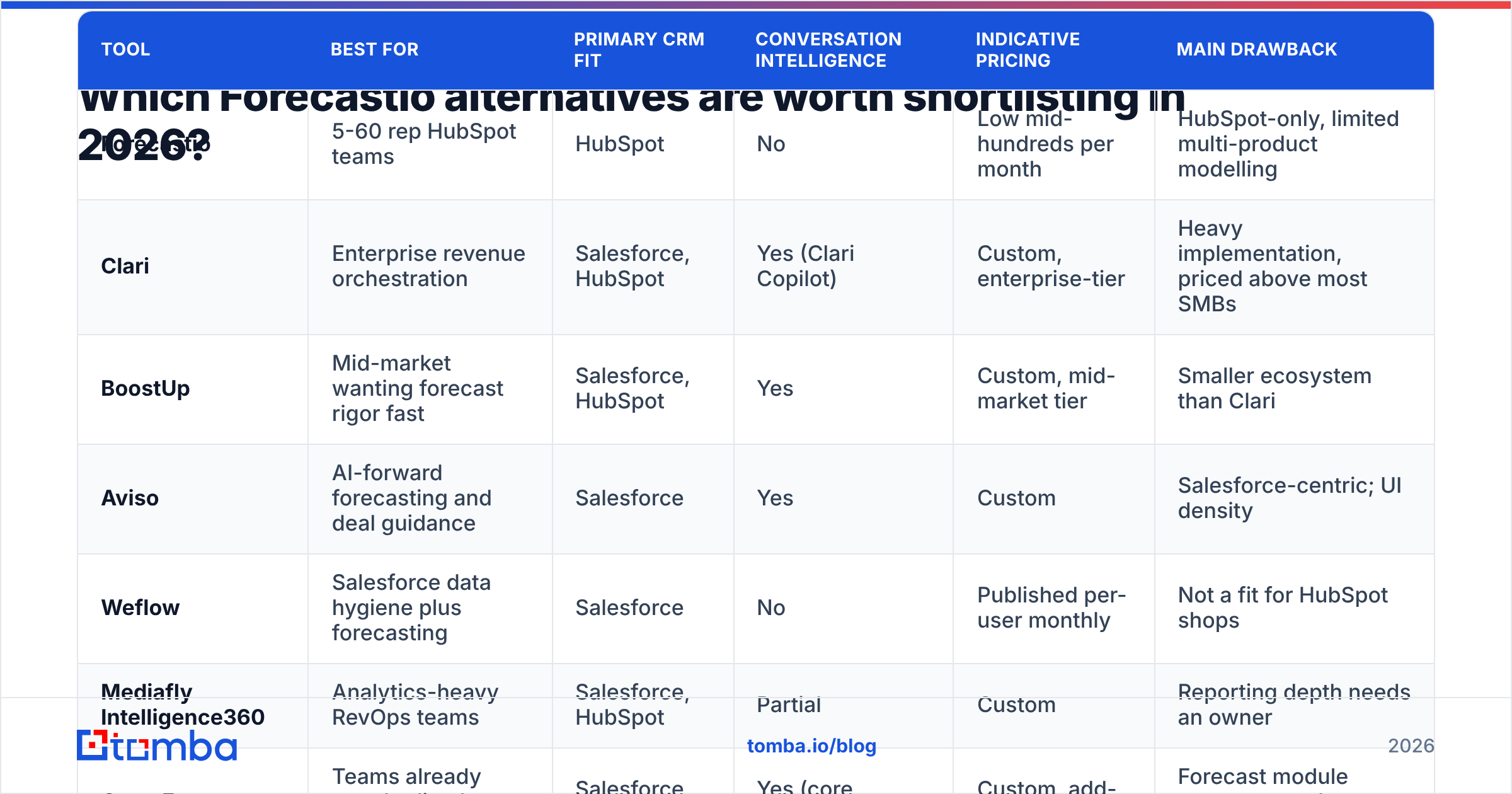
Here is the comparison in one place. Pricing marked "custom" means the vendor does not publish list pricing and quotes per seat and per module. Treat any number below as a starting point for negotiation, not a fixed rate card, and always confirm on the vendor's own pricing page before you budget.
| Tool | Best for | Primary CRM fit | Conversation intelligence | Indicative pricing | Main drawback |
|---|---|---|---|---|---|
| Forecastio | 5-60 rep HubSpot teams | HubSpot | No | Low mid-hundreds per month | HubSpot-only, limited multi-product modelling |
| Clari | Enterprise revenue orchestration | Salesforce, HubSpot | Yes (Clari Copilot) | Custom, enterprise-tier | Heavy implementation, priced above most SMBs |
| BoostUp | Mid-market wanting forecast rigor fast | Salesforce, HubSpot | Yes | Custom, mid-market tier | Smaller ecosystem than Clari |
| Aviso | AI-forward forecasting and deal guidance | Salesforce | Yes | Custom | Salesforce-centric; UI density |
| Weflow | Salesforce data hygiene plus forecasting | Salesforce | No | Published per-user monthly | Not a fit for HubSpot shops |
| Mediafly Intelligence360 | Analytics-heavy RevOps teams | Salesforce, HubSpot | Partial | Custom | Reporting depth needs an owner |
| Gong Forecast | Teams already standardised on Gong | Salesforce, HubSpot | Yes (core strength) | Custom, add-on to Gong | Forecast module assumes you buy Gong |
| Salesforce Revenue Intelligence | Salesforce-only shops | Salesforce | No | Add-on per user | Locks you deeper into one vendor |
| HubSpot native forecasting | Teams under ~10 reps | HubSpot | No | Included in Sales Hub Pro+ | Basic scenarios, no AI commit logic |
Clari#
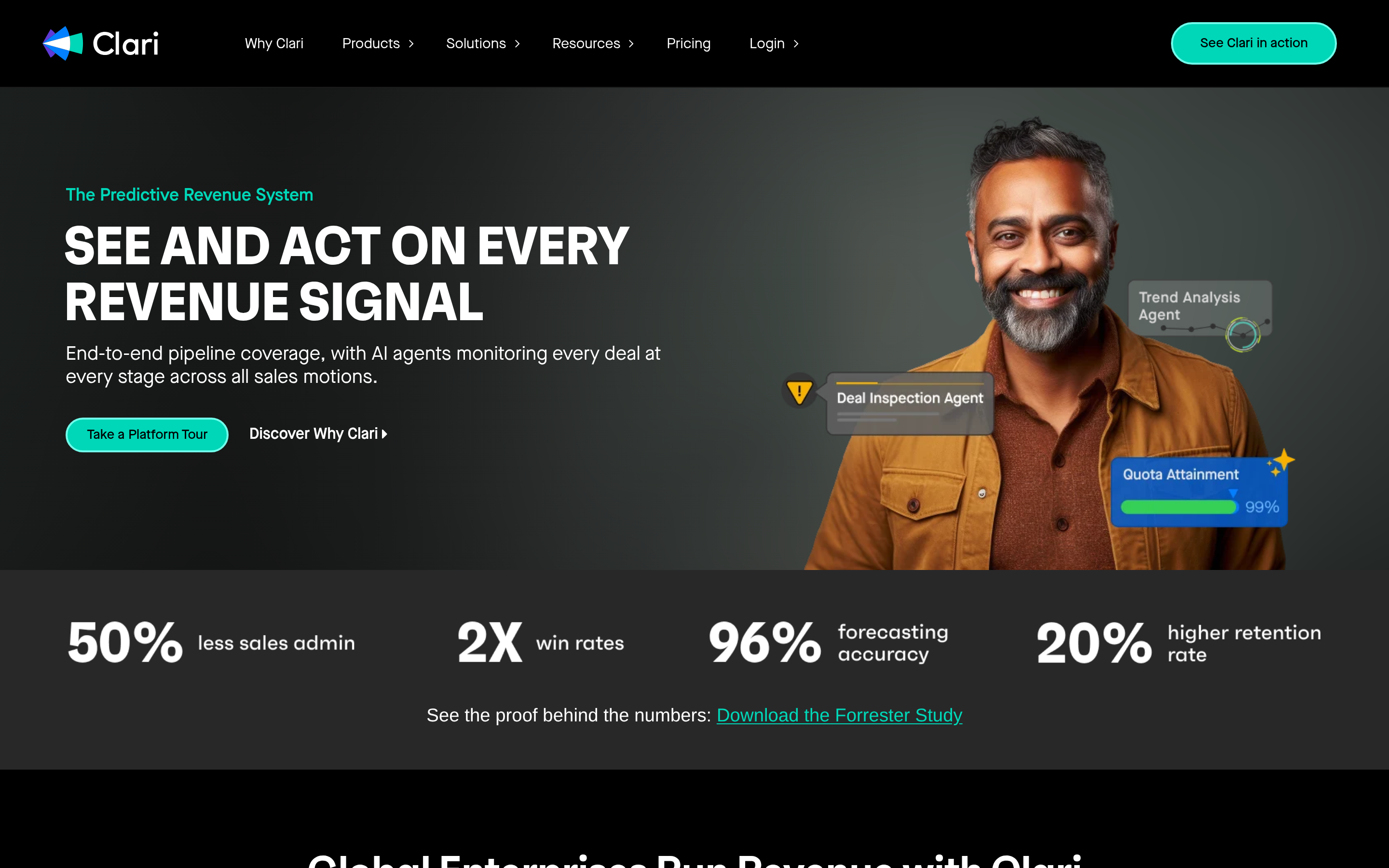
The category definer. Clari treats forecasting as one module in a broader "revenue orchestration" platform covering pipeline inspection, deal rooms, conversation capture, and revenue cadences. If you have a formal weekly forecast call across multiple segments and geographies, it is the most complete option.
The honest caveat: implementation is a project, not a signup. Budget for a RevOps owner and a quarter of tuning. Below roughly 50 reps, you will use maybe a third of what you pay for.
BoostUp#
The most common Clari-替代 shortlist entry for mid-market teams. BoostUp emphasises forecast submission workflows, deal risk scoring, and manager-level pipeline inspection without the enterprise implementation weight. Buyers on G2 consistently rate time-to-value higher than the larger platforms.
Pick it when you want enterprise-grade forecast discipline in one quarter rather than three, and you can live with a smaller integration marketplace.
Aviso#
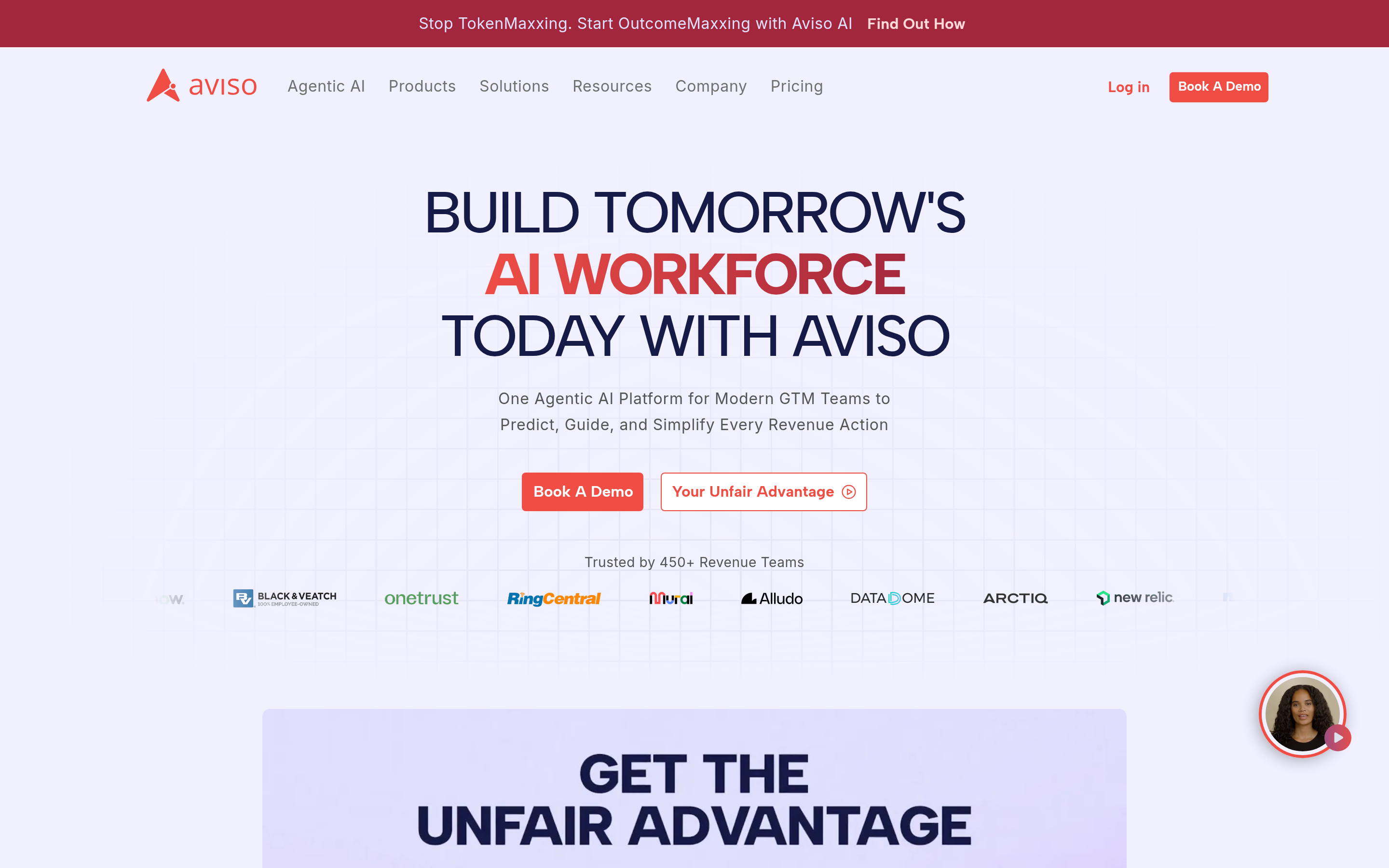
Aviso leans hardest into AI-generated forecast calls and deal guidance. Its pitch is that the model, not the rep, produces the number, and the rep argues with it. That works well for teams with long sales cycles and enough closed-won history for the model to learn from.
If your company closed 40 deals last year, there is not enough signal. Aviso rewards volume.
Weflow#
Weflow is the pragmatic pick for Salesforce teams whose actual problem is that nobody updates Salesforce. It layers a fast pipeline-review interface and activity capture on top of the CRM, then builds forecasting on the cleaner data. It publishes per-user pricing, which is refreshing in this category.
If you are on HubSpot, skip it.
Mediafly Intelligence360#
Formerly InsightSquared, now part of Mediafly. Deep historical analytics, cohort-based conversion math, and forecast modelling that a strong RevOps analyst can push very far. The flip side is that it expects an analyst. Without one, you buy a lot of dashboards nobody opens.
Gong Forecast#
If Gong is already your system of record for what happened in deals, adding its forecast module is the lowest-friction upgrade you can make. Forecast rolls up against actual conversation signals, so "the champion went dark three weeks ago" surfaces before the quarter ends rather than after.
The obvious condition: this only makes economic sense if you were buying Gong anyway.
Salesforce Revenue Intelligence and HubSpot native forecasting#
Both CRMs ship forecasting that is better than it was three years ago and still thinner than a dedicated tool. Native forecasting is the right answer for teams under about ten reps, or for teams that have never enforced a forecast process and need to learn the discipline before buying software to scale it.
Start native. Upgrade when you can articulate exactly which question the native tool cannot answer.
Is an enterprise platform overkill for a 12-rep team?#
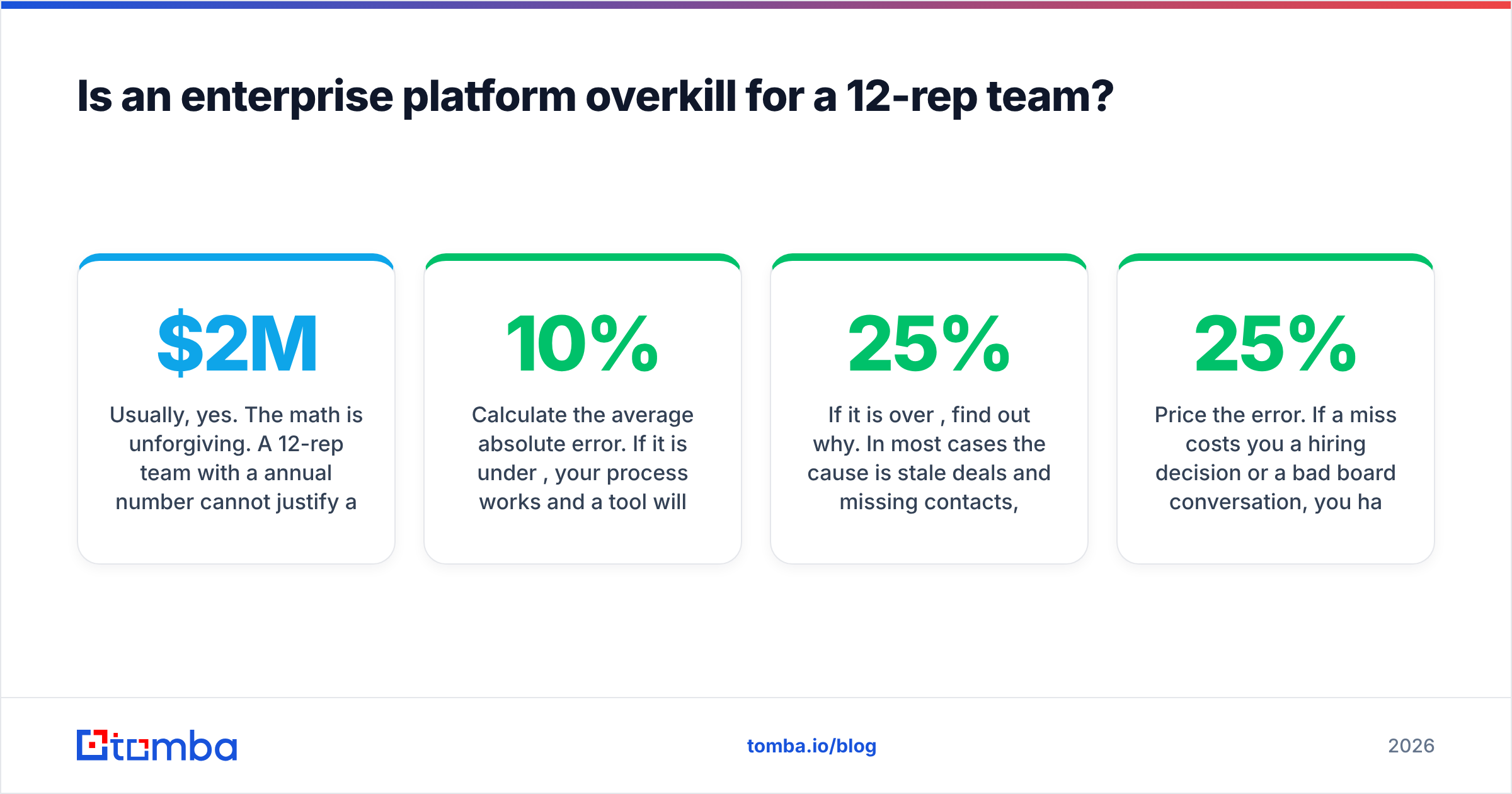
Usually, yes. The math is unforgiving. A 12-rep team with a $2M annual number cannot justify a platform whose all-in year-one cost lands in the mid five figures unless the forecast miss it prevents is larger than the spend.
Run this test before you buy anything:
- Take your last four quarters. Compare the forecast you submitted in week two against the actual close.
- Calculate the average absolute error. If it is under 10%, your process works and a tool will produce marginal gains.
- If it is over 25%, find out why. In most cases the cause is stale deals and missing contacts, not a weak model.
- Price the error. If a 25% miss costs you a hiring decision or a bad board conversation, you have a real budget case. If it does not, fix hygiene first.
That last point is where most teams should start, and it is the least glamorous work in the stack.
Do you need a forecasting tool at all if your pipeline data is thin?#
No. A forecasting platform is a magnifying glass. Point it at bad data and you get a very expensive, very confident wrong answer.
Three symptoms tell you the input layer is the problem:
- Deals with no identified economic buyer. If your opportunity record has one contact and that contact is a champion two levels down, the deal is not forecastable at any confidence level.
- Bounce rates above 5% on outbound. That is a direct signal your contact data is decaying, which means the accounts in your pipeline are also stale. People change jobs; nobody updates the CRM.
- Next steps older than 14 days. A deal with no scheduled next action is a deal in the forecast that should not be.
The fix is boring and cheap compared to a platform contract. Before each quarterly pipeline review, run every open-opportunity contact through an email verifier and flag anything that fails. Then use data enrichment to fill in missing titles, company size, and seniority so your scoring logic has something to work with. Where a deal is missing a stakeholder entirely, an email finder closes the gap in seconds rather than waiting for a rep to remember.
Teams that do this consistently often discover their forecast error drops enough that the platform purchase gets deferred a year. That is a legitimate outcome.
How do you migrate without losing forecast history?#
Switching forecasting tools mid-year is where most rollouts fail. Four rules keep it survivable:
- Export historical snapshots before you cancel. Weekly forecast-versus-actual history is the asset. Most vendors will export it on request during the contract term, and none will after.
- Run parallel for one full quarter. Both tools, same inputs, same submission cadence. If the new tool's number diverges wildly, you learn why while you still have a fallback.
- Freeze your stage definitions during the transition. Changing stage exit criteria and tooling at the same time makes it impossible to attribute any change in accuracy.
- Migrate the process, not just the data. If forecast calls were undisciplined before, new software will not fix that. Write the cadence down first.
If you connect the new tool through your CRM, verify what syncs both ways. A read-only connection is safer during parallel running; check your HubSpot integration settings and any other data sources feeding the same objects so you do not end up with two systems overwriting each other's fields.
Which alternative should you actually pick?#
Short answers, by situation:
- HubSpot, under 10 reps, no RevOps hire: stay on HubSpot native forecasting and fix data hygiene. Revisit in two quarters.
- HubSpot, 10-50 reps, want more than native: Forecastio remains a strong default. Compare against BoostUp if you need forecast submission workflows and risk scoring.
- Salesforce, reps do not update the CRM: Weflow, because the hygiene layer is the actual product.
- Salesforce, 50+ reps, formal forecast process: Clari or BoostUp. Clari if you want the full revenue platform; BoostUp if you want speed to value.
- Already running Gong: add Gong Forecast before evaluating anything else. Lowest marginal cost, highest data continuity.
- Analyst-led RevOps team that wants to model everything: Mediafly Intelligence360 or Aviso.
Nobody gets fired for starting simple. The teams with the most accurate forecasts are rarely the ones with the most expensive tooling; they are the ones with clean pipeline data and a manager who asks hard questions on Thursday mornings.
Fix the data your forecast is built on#
Every tool on this list models what your CRM tells it. If your CRM is full of dead contacts and half-built account records, you are paying to formalise guesswork.
Start at the input layer. Use the Tomba Email Finder to identify the missing decision-makers on every open opportunity, verify what you already have, and enrich records so your pipeline reflects real, reachable buyers. The free tier covers 25 searches a month so you can test it against a slice of your pipeline before committing; paid plans start at $49/mo, with full Tomba pricing published up front. Get the inputs right, and the forecasting decision gets a lot easier — and often a lot cheaper.
Related guides#
Ready to find emails that actually work?
Join 150,000+ professionals who stopped guessing and started sending. Free credits on signup — no credit card required.
Get the Tomba newsletter
Practical outbound tactics and product updates — once every two weeks.
About the author