Forecastio Pricing, Reviews, Pros and Cons: An Honest 2026 Look
Forecastio promises HubSpot-native forecasting and sales analytics without a full RevOps stack. Here's what the seat-based pricing really costs, where reviewers agree, and the three cases where you should skip it.
TL;DR
- Forecastio is a HubSpot-native sales forecasting and analytics layer — it does not replace your CRM, it reads from it and models on top of it.
- Pricing is seat-based and skewed toward annual commitments. The real cost driver is not the sticker price; it's how many seats you're forced to license and the minimum term.
- Reviewers consistently praise setup speed (hours, not a RevOps quarter) and dashboard depth. The recurring complaints are HubSpot-only lock-in, thin non-HubSpot integrations, and forecasts that are only as good as the pipeline data underneath.
- It's a strong fit for 10–75 seat HubSpot sales teams with no dedicated analyst. It's a poor fit for Salesforce shops, multi-CRM orgs, and teams under ~8 reps.
- Before you buy any forecasting tool, fix the input layer. Garbage contacts and stale accounts produce confident, wrong forecasts.
What is Forecastio, actually?#
Forecastio is a sales performance and forecasting platform built specifically on top of HubSpot. It pulls deal, activity, and pipeline history out of your CRM and turns it into forecast models, capacity planning, quota attainment tracking, and pipeline hygiene alerts.
The analogy: HubSpot is the kitchen — it stores the ingredients and records every order. Forecastio is the head chef who looks at last month's tickets and tells you whether you'll actually serve 300 covers on Friday, and which station is going to blow up. It doesn't cook. It predicts and diagnoses.
That distinction matters for your budget. You are paying for an analytics and modelling layer on data you already own. If the underlying data is bad, you're paying to render bad data more beautifully.
Here's what the product actually covers:
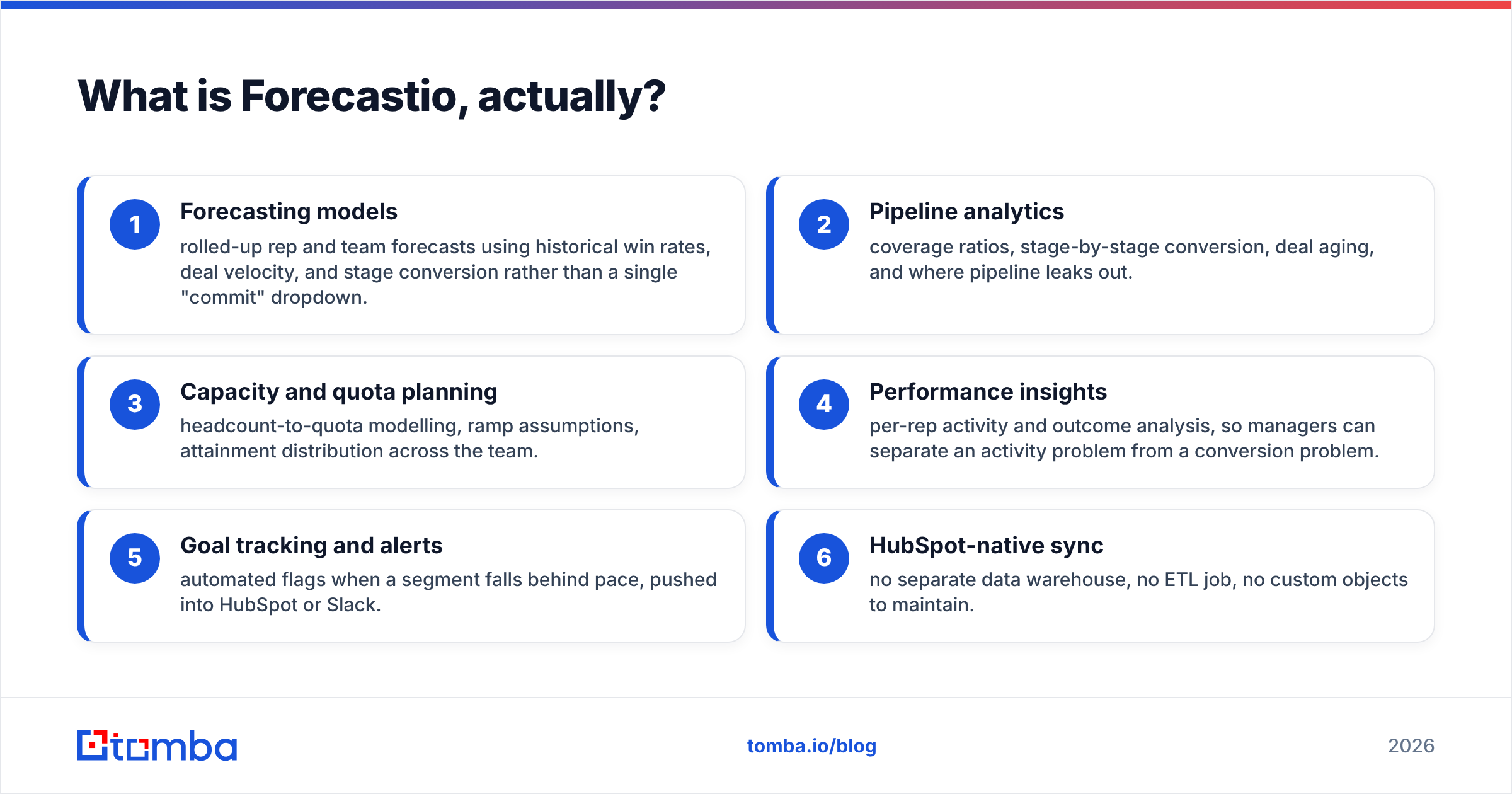
- Forecasting models — rolled-up rep and team forecasts using historical win rates, deal velocity, and stage conversion rather than a single "commit" dropdown.
- Pipeline analytics — coverage ratios, stage-by-stage conversion, deal aging, and where pipeline leaks out.
- Capacity and quota planning — headcount-to-quota modelling, ramp assumptions, attainment distribution across the team.
- Performance insights — per-rep activity and outcome analysis, so managers can separate an activity problem from a conversion problem.
- Goal tracking and alerts — automated flags when a segment falls behind pace, pushed into HubSpot or Slack.
- HubSpot-native sync — no separate data warehouse, no ETL job, no custom objects to maintain.

How does Forecastio pricing work in 2026?#
Forecastio prices per seat, with tiered plans and a meaningful discount for annual commitment. The structure is standard for the category: a core analytics plan, a higher tier that unlocks the forecasting and planning modules, and a custom enterprise tier for larger orgs with SSO, security review, and onboarding requirements.
Two things matter more than the headline number:
Minimum seat counts. Seat-based tools in this category typically enforce a floor. If the floor is 10 seats and you have 6 reps, your effective per-seat cost inflates by 60% overnight. Ask for the minimum in writing before you evaluate.
Who needs a seat. Some teams license only managers and RevOps — the people who actually open dashboards. Others discover mid-contract that rep-level views require rep-level seats. This single answer can double or halve your invoice. Get it clarified during the trial, not during renewal.
Because vendor list prices move, treat every figure below as a modelling input rather than a quote. Check forecastio.ai for current numbers before you commit budget.
What does it cost in practice?#
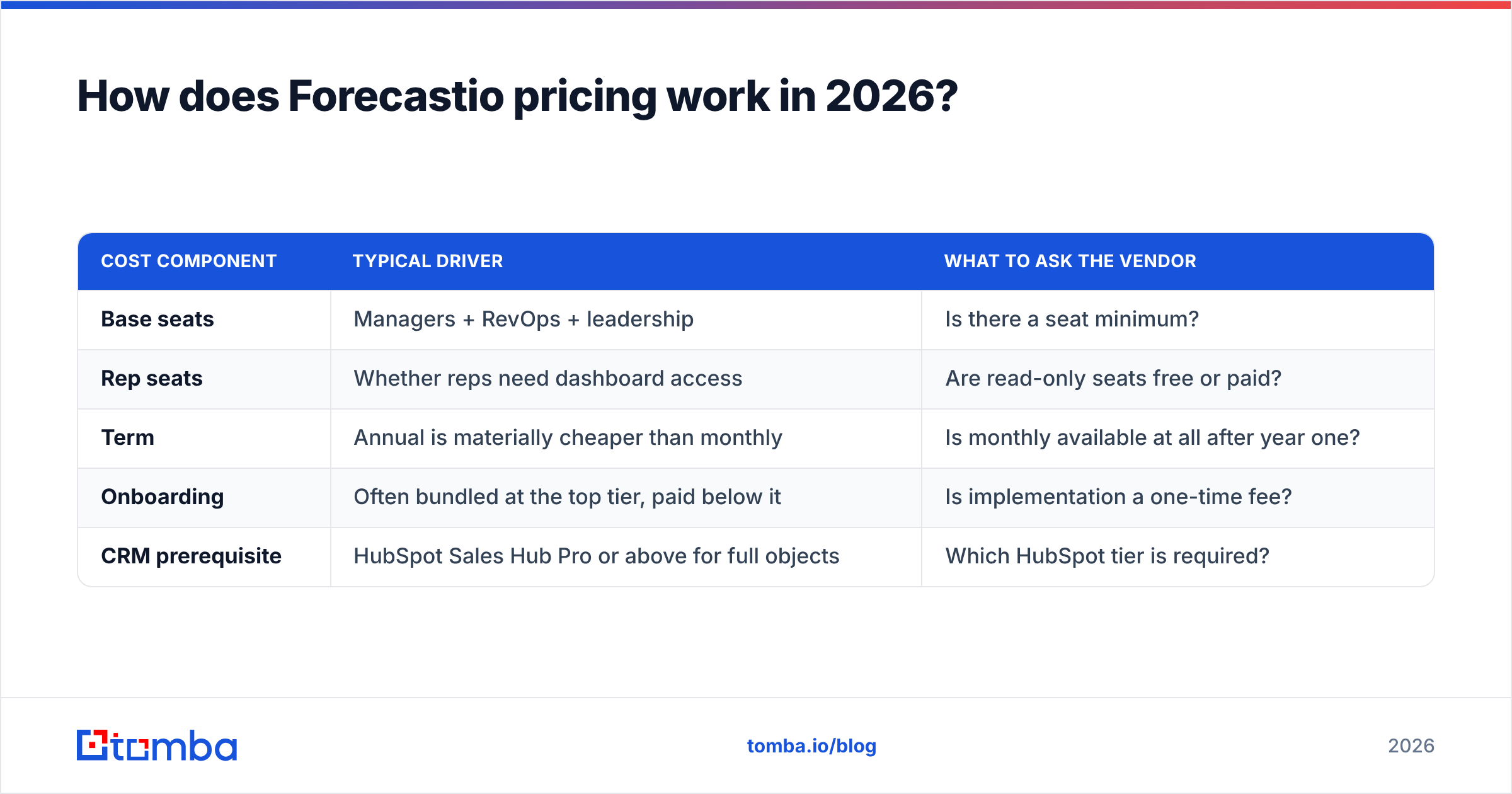
Model your total annual spend like this, not off a per-seat sticker:
| Cost component | Typical driver | What to ask the vendor |
|---|---|---|
| Base seats | Managers + RevOps + leadership | Is there a seat minimum? |
| Rep seats | Whether reps need dashboard access | Are read-only seats free or paid? |
| Term | Annual is materially cheaper than monthly | Is monthly available at all after year one? |
| Onboarding | Often bundled at the top tier, paid below it | Is implementation a one-time fee? |
| CRM prerequisite | HubSpot Sales Hub Pro or above for full objects | Which HubSpot tier is required? |
That last row is the one budgets miss. A forecasting layer on HubSpot assumes HubSpot properties and pipeline structures that generally require Sales Hub Professional or higher. If you're on Starter, your "Forecastio cost" is really Forecastio plus a HubSpot upgrade — and the HubSpot line item is usually the bigger one.
How does Forecastio compare to the alternatives?#
The competitive set splits three ways: enterprise revenue-intelligence suites, your CRM's built-in forecasting, and the spreadsheet you're currently maintaining.
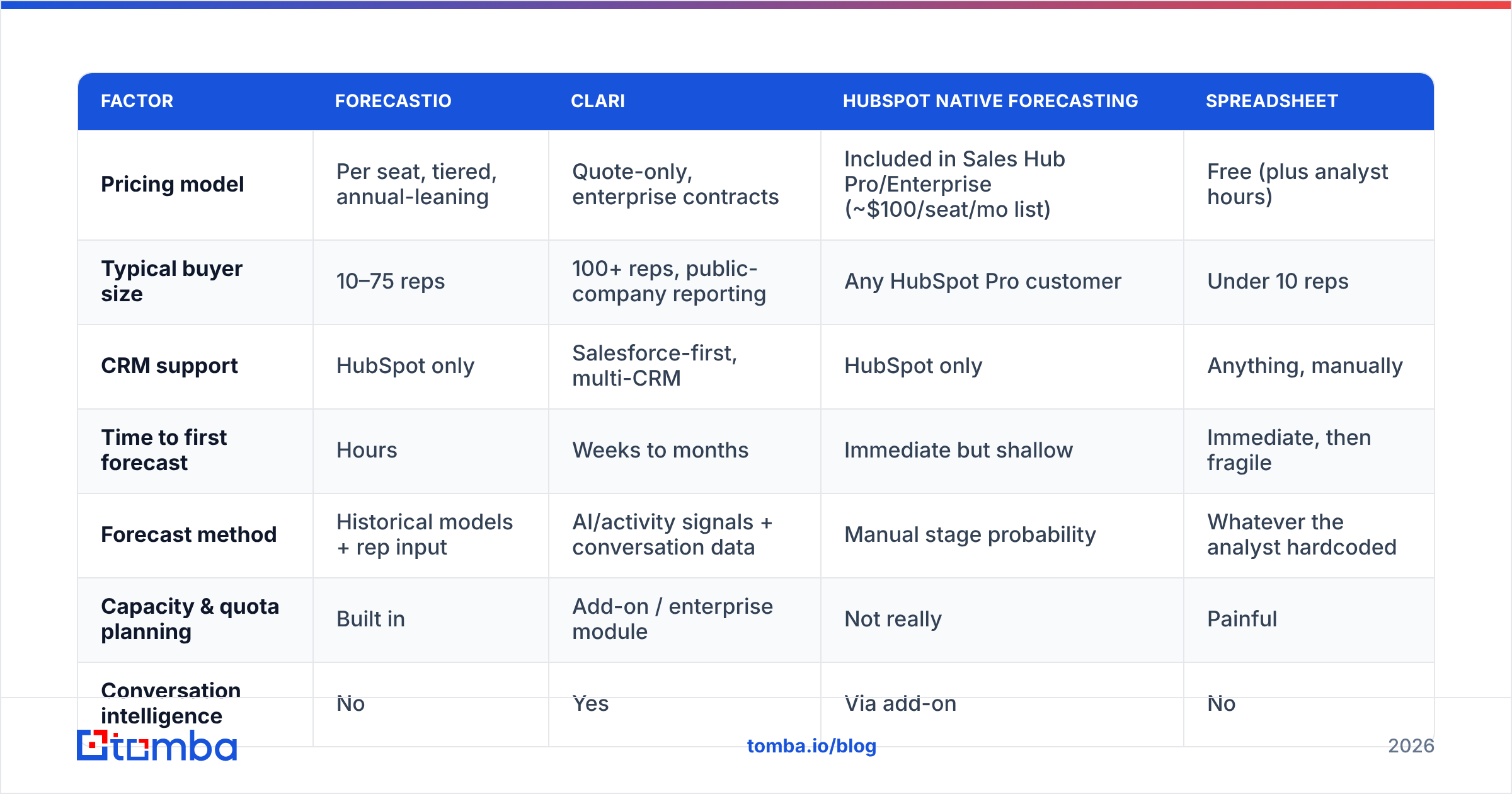
| Factor | Forecastio | Clari | HubSpot native forecasting | Spreadsheet |
|---|---|---|---|---|
| Pricing model | Per seat, tiered, annual-leaning | Quote-only, enterprise contracts | Included in Sales Hub Pro/Enterprise (~$100/seat/mo list) | Free (plus analyst hours) |
| Typical buyer size | 10–75 reps | 100+ reps, public-company reporting | Any HubSpot Pro customer | Under 10 reps |
| CRM support | HubSpot only | Salesforce-first, multi-CRM | HubSpot only | Anything, manually |
| Time to first forecast | Hours | Weeks to months | Immediate but shallow | Immediate, then fragile |
| Forecast method | Historical models + rep input | AI/activity signals + conversation data | Manual stage probability | Whatever the analyst hardcoded |
| Capacity & quota planning | Built in | Add-on / enterprise module | Not really | Painful |
| Conversation intelligence | No | Yes | Via add-on | No |
| Realistic annual cost, 20 reps | Low five figures | High five to six figures | Bundled in CRM spend | ~0.4 FTE of analyst time |
Read that table honestly and the positioning is clear: Forecastio is priced and scoped for the gap between "HubSpot's built-in probability field isn't good enough" and "we're not ready to sign a Clari contract."
If you're a Salesforce shop, this comparison is academic — Forecastio isn't a candidate. If you're a HubSpot shop with 25 reps and a VP Sales who rebuilds the forecast in Sheets every Monday morning, it's exactly the gap it was built for.
What do Forecastio reviews say — the pros?#
Across public review sites and practitioner write-ups, the same four strengths keep appearing.
Setup is genuinely fast. This is the most consistent praise. Because it reads native HubSpot objects instead of demanding custom fields, most teams get a working forecast in a day. Compare that to enterprise revenue platforms where "go live" is a quarter-long project with a solutions architect.
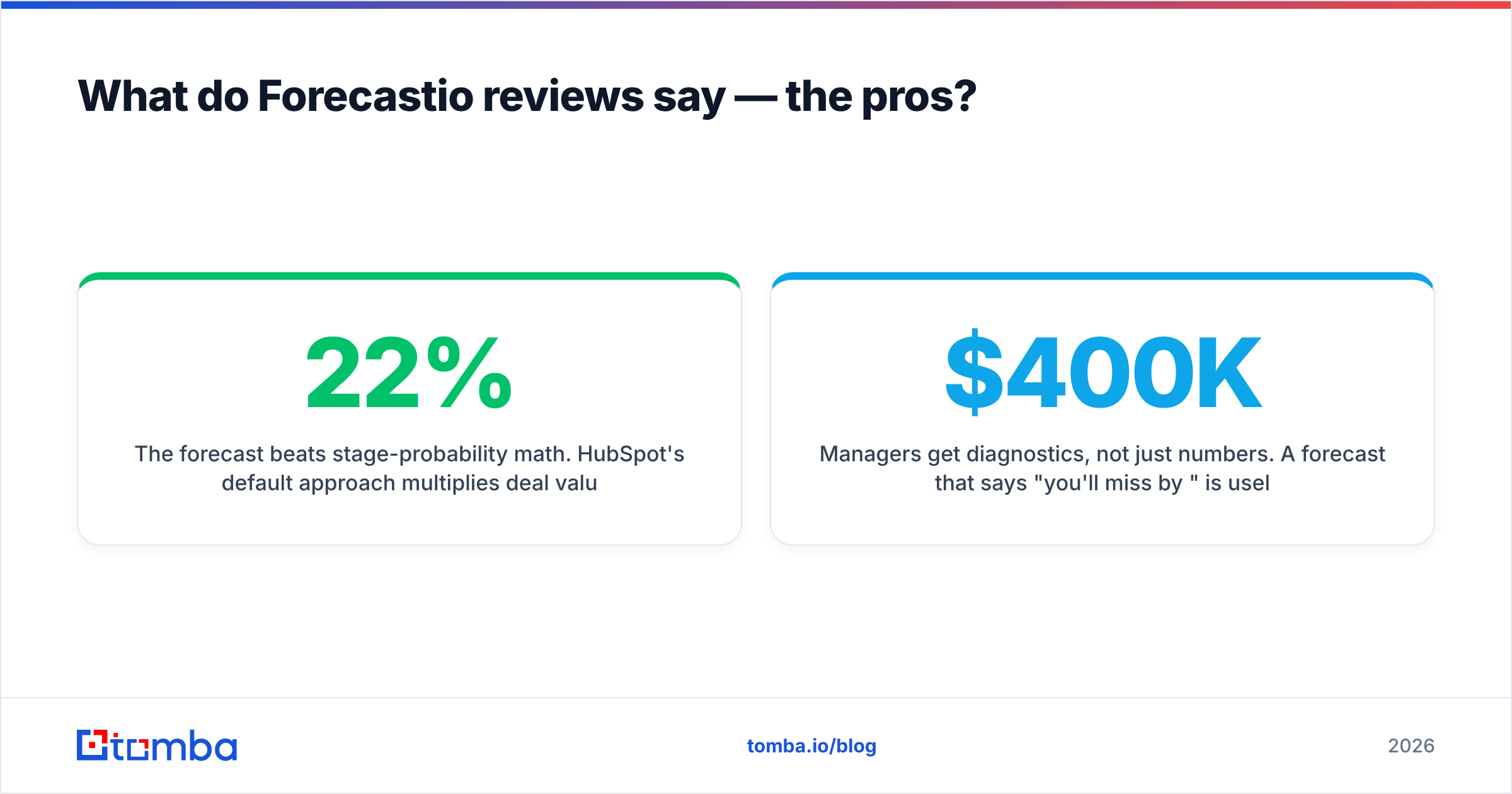
The forecast beats stage-probability math. HubSpot's default approach multiplies deal value by a static stage percentage. Forecastio models actual historical conversion by stage, segment, and rep. If your Stage 3 deals convert at 22% but your CRM says 60%, the difference between those two numbers is your entire credibility problem with the board. Fixing it is the core value.
Managers get diagnostics, not just numbers. A forecast that says "you'll miss by $400K" is useless. A view that says "you'll miss by $400K because enterprise segment stage-2-to-3 conversion halved and three reps have zero new pipeline this month" is a Monday agenda. Reviewers repeatedly cite this diagnostic layer as the thing that made the tool stick.
It's priced below the enterprise tier. For a mid-market team, avoiding a six-figure revenue-intelligence contract while still getting credible forecasts is the whole business case.
What are the cons and hidden costs?#
HubSpot lock-in is total. If your company migrates CRMs — or acquires a company on Salesforce — Forecastio doesn't come with you. That's a strategic risk for anyone in an active M&A posture. Weigh it against the fact that the same lock-in is why setup is so fast.
The forecast inherits your data quality. This is the con that quietly costs the most. Forecastio models what's in HubSpot. If half your deals are attached to contacts who left the company, if account records are duplicated, if 30% of your outbound never reached a real inbox, the model is being trained on fiction. It will produce a confident number that is wrong in the same direction every quarter.
This is why serious teams fix the input layer first. Run your CRM contacts through an email verifier to strip dead addresses, and use data enrichment to fill in missing company size, role, and industry fields — the exact dimensions Forecastio needs to segment forecasts. A forecasting tool sitting on unenriched, unverified records is an expensive way to formalize a guess.
Non-HubSpot integrations are thin. If your revenue picture spans a billing system, a product-usage database, and a support platform, expect to do that joining elsewhere. Forecastio's depth is inside the CRM boundary.
No conversation intelligence. There's no call recording or transcript analysis. If your buying committee wants "why did we lose" from actual call data, you need a second tool.
Small teams won't clear the bar. Under roughly 8–10 reps, you don't have enough closed-won history for statistical models to outperform an experienced manager's gut. You'd be paying for math that needs more data than you have.
Is Forecastio worth it for your team?#
Here's the decision framework, stripped of vendor language.
Buy it if: you run HubSpot Sales Hub Pro or Enterprise, you have 10–75 quota-carrying reps, at least four quarters of clean closed-deal history, no dedicated data analyst, and a leadership team that has stopped trusting the CRM's forecast number.
Skip it if: you're on Salesforce or a multi-CRM setup, you have fewer than 8 reps, your HubSpot pipeline stages were last audited two years ago, or you already pay for an enterprise revenue-intelligence platform.
Wait if: your data hygiene is bad. Spend one quarter cleaning contacts, deduplicating accounts, and standardizing stage definitions. Then buy. Doing it in the other order means you'll spend your trial arguing about why the numbers look wrong — and you'll blame the tool.
One more budgeting note: negotiate the seat minimum before you negotiate the price. A 15% discount on 25 forced seats is worse than list price on the 12 seats you actually need. Vendors in this category have far more flexibility on seat floors during a competitive evaluation than at renewal.
What should you fix before buying a forecasting tool?#
Forecasting is downstream of pipeline, and pipeline is downstream of contact data. Fix that order:
- Verify every contact attached to an open deal. Bounced-out champions distort velocity metrics because deals sit "active" while nobody is actually being emailed.
- Standardize your stage exit criteria. If two reps define "Discovery complete" differently, no model can correct for it.
- Enrich accounts with firmographics. Segment-level forecasts require segment fields. Empty industry and headcount columns mean one undifferentiated forecast.
- Deduplicate accounts and contacts. Duplicates inflate pipeline coverage and make win rates look worse than they are.
- Re-source contacts on stalled deals. A deal isn't dead because the buyer went quiet; often the buyer changed jobs. Finding the replacement contact is cheaper than writing off the pipeline.
That last point is where most teams recover the most revenue. If your HubSpot integration can push verified, current contact data back into the deal record automatically, your forecast stops decaying between quarters.
The bottom line#
Forecastio is fairly priced for what it does: a fast-to-deploy, HubSpot-native forecasting and analytics layer that gives mid-market sales leaders a defensible number without an enterprise contract or a full-time analyst. The pros — speed, diagnostic depth, cost relative to Clari-tier platforms — are real and consistently reported. The cons are equally real: total HubSpot dependency, no conversation intelligence, and a model that is only ever as honest as the CRM feeding it.
If you're in the fit profile, run the trial. If you're not, the money is better spent upstream on pipeline quality.
And that's the practical starting point either way. Before you license any forecasting model, make sure the pipeline it reads is built on real, reachable, current contacts. Use the Tomba Email Finder to source verified professional emails for the accounts already sitting in your CRM, and to replace the contacts who've moved on. The free tier covers 25 searches a month, and paid plans start at $49/mo — see Tomba pricing for the full breakdown. Clean inputs first, better forecasts second.
Related guides#
Ready to find emails that actually work?
Join 150,000+ professionals who stopped guessing and started sending. Free credits on signup — no credit card required.
Get the Tomba newsletter
Practical outbound tactics and product updates — once every two weeks.
About the author