Formal Greetings in Email: What to Use in 2026
"Dear Sir or Madam" is quietly killing your reply rate. Here's the data-backed ranking of formal email greetings, when each one fits, and the openers to retire in 2026.
TL;DR
- The safest formal greeting in 2026 is
Dear [First Name] [Last Name],for first contact with someone you have never met, andDear Mr./Ms. [Last Name],in legal, academic, government, and most APAC or DACH contexts. Dear Sir or Madam,andTo Whom It May Concern,signal you did not do the research. They correlate with lower reply rates because they tell the reader the message is a blast.- Comma vs. colon matters more than people admit: colon reads as formal US business correspondence, comma reads as standard professional email everywhere else.
- A perfect greeting on an unverified address is worthless — bounces and wrong-name errors do more damage to your reputation than any salutation choice.
- Match formality to three variables: the recipient's seniority, the industry's norms, and whether the email is cold or a continuation of a thread.
Why do formal greetings in email still matter in 2026?#
Because the greeting is the first line the recipient reads after the subject, and it's the fastest signal of whether the message was written for them or for a list of 4,000 people.
Think of it like a handshake at a conference. Nobody has ever won a deal because of a handshake, but a clammy, over-long, or aggressively bro-ish one plants a doubt that the next ten minutes have to undo. Formal greetings in email work the same way: they can't carry a weak pitch, but a wrong one adds friction before your value prop gets a chance.
There's a practical reason too. Mailbox providers have gotten aggressive about bulk-pattern detection. Generic openers like "To Whom It May Concern" appear in millions of templated messages, so they cluster with content patterns that spam filters have already learned. That doesn't mean the phrase alone triggers a spam folder — but it does mean it belongs to the same statistical neighborhood as messages that do.

The last reason is boring and important: personalization now costs almost nothing. Finding a first name, last name, and role takes seconds with a decent email finder, so a nameless greeting reads as laziness rather than caution.
What are the most common formal email greetings, ranked?#
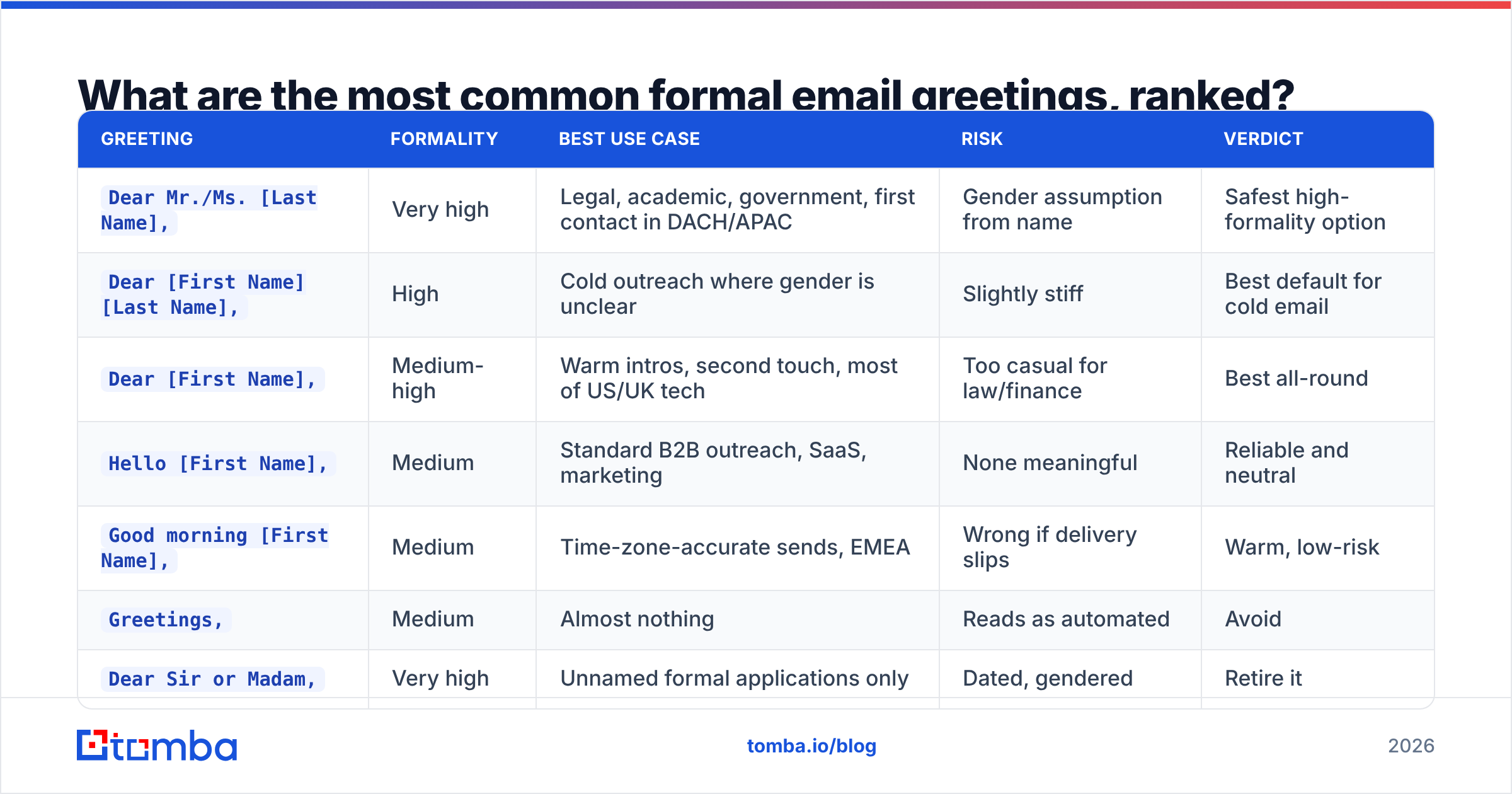
Here's how the standard options stack up. "Risk" means the chance the greeting actively hurts you with a typical B2B recipient.
| Greeting | Formality | Best use case | Risk | Verdict |
|---|---|---|---|---|
Dear Mr./Ms. [Last Name], |
Very high | Legal, academic, government, first contact in DACH/APAC | Gender assumption from name | Safest high-formality option |
Dear [First Name] [Last Name], |
High | Cold outreach where gender is unclear | Slightly stiff | Best default for cold email |
Dear [First Name], |
Medium-high | Warm intros, second touch, most of US/UK tech | Too casual for law/finance | Best all-round |
Hello [First Name], |
Medium | Standard B2B outreach, SaaS, marketing | None meaningful | Reliable and neutral |
Good morning [First Name], |
Medium | Time-zone-accurate sends, EMEA | Wrong if delivery slips | Warm, low-risk |
Greetings, |
Medium | Almost nothing | Reads as automated | Avoid |
Dear Sir or Madam, |
Very high | Unnamed formal applications only | Dated, gendered | Retire it |
To Whom It May Concern, |
Very high | Reference letters, legal notices | Signals zero research | Retire it |
Dear Hiring Manager, |
High | Job applications with no listed name | Acceptable fallback | Situational |
Hi [First Name], |
Low-medium | Follow-ups, existing threads | Too casual for cold C-suite | Fine after first reply |
If you want a single rule: use Dear [First Name] [Last Name], for cold first contact and Hi [First Name], once they've replied. That covers roughly 80% of B2B sending.
When should you use "Dear," "Hello," or "Hi"?#
Pick by three variables, in this order:
- Seniority of the recipient. A VP of Engineering at a 60-person startup expects
Hi Sarah,. A General Counsel at a bank expectsDear Ms. Okafor,. When you're guessing, formality up — over-formal reads as respectful, over-casual reads as presumptuous. - Industry convention. Law, accounting, healthcare, government, higher education, and insurance skew formal. SaaS, agencies, media, ecommerce, and startups skew casual. Manufacturing and logistics sit in the middle and reward
Hello [First Name],. - Region and language. Germany, Austria, Switzerland, Japan, Korea, and much of the Middle East treat titles as non-negotiable in first contact. The US, UK, Australia, Netherlands, and Nordics run flatter — first names from message one are normal.
- Cold vs. warm. First cold touch → higher formality. Reply-in-thread → drop one level. By touch three in an active conversation,
Hi Sarah,or no greeting at all is fine. - Channel context. If your email is following a LinkedIn conversation, mirror the tone you used there. Whiplash between a casual DM and a
Dear Sir,email reads as two different people.
That's the whole decision tree. There is no fourth consideration worth the cognitive load.
What formal greetings should you stop using?#
Four openers are past their expiry date, and one is a landmine.
To Whom It May Concern, — This survived because it works for legal notices and reference letters, where the recipient genuinely is unknown. In sales email it says: I could not be bothered to find your name. Recipient-facing cost is real. In a world where a domain search returns named contacts for a company in under a minute, there's no defense for it.
Dear Sir or Madam, — Same problem, plus a gender binary that lands badly with a chunk of your audience. British formal correspondence held onto it longest; even there it's fading.
Dear Valued Customer, — Reads as a mail-merge that failed. If you know they're a customer, you know their name.
Greetings, — Nobody has said this out loud since about 1994. It reads as bot output, which is exactly the perception you're fighting in an AI-heavy inbox era.
Dear Mrs. [Last Name], — The landmine. Marital-status titles are guesses. Ms. is the neutral default and has been the recommended business standard for decades. Never infer Mrs. from a photo, a name, or anything else.
One more that trips people: Dear [First Name], followed by an exclamation mark. Dear Sarah! mixes formal salutation with casual punctuation and reads as unstable. Pick a register and stay in it.
Comma or colon: what punctuation follows a formal greeting?#
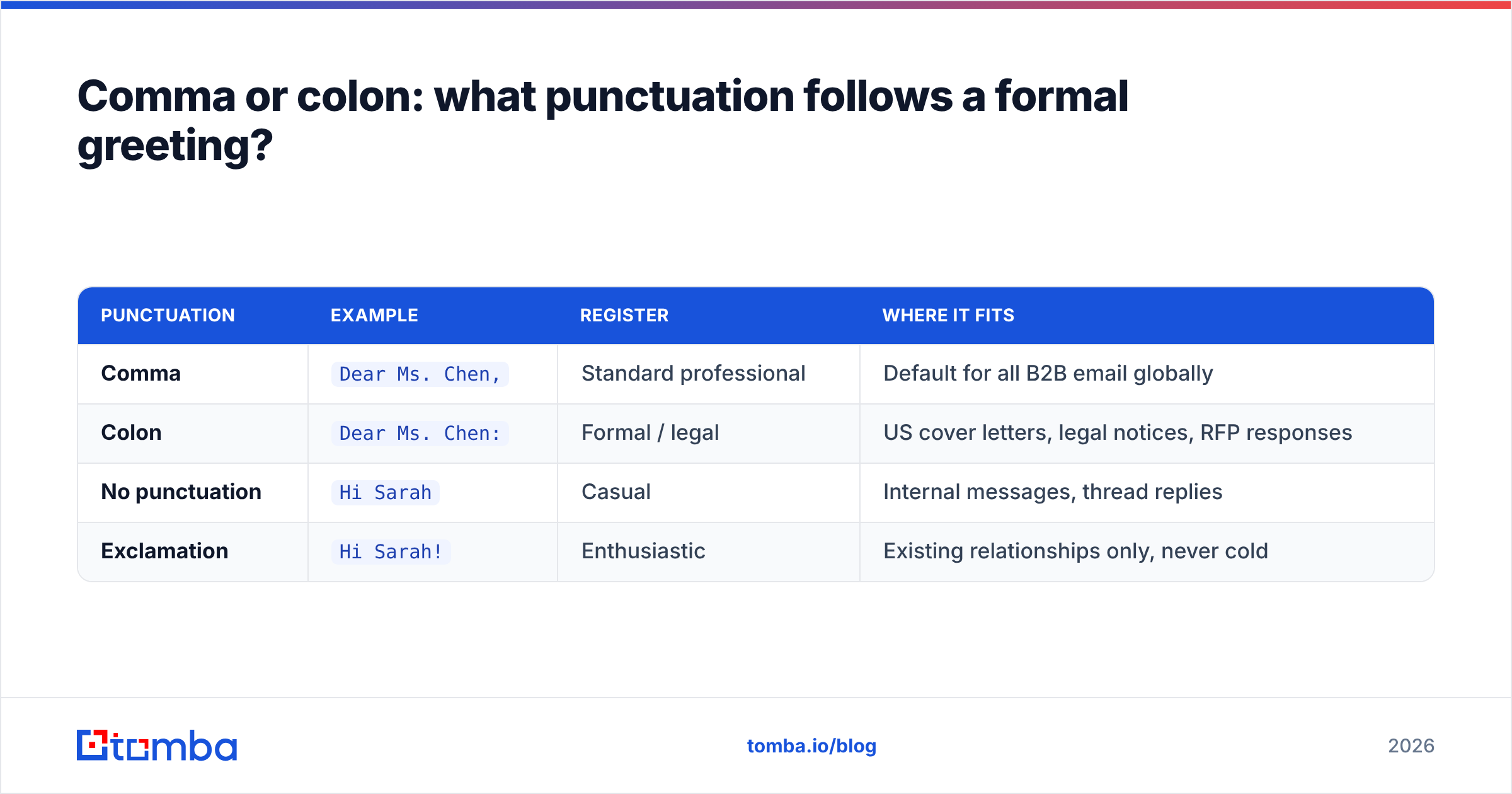
Short answer: comma for email, colon for formal letters and US business correspondence that happens to be sent by email.
| Punctuation | Example | Register | Where it fits |
|---|---|---|---|
| Comma | Dear Ms. Chen, |
Standard professional | Default for all B2B email globally |
| Colon | Dear Ms. Chen: |
Formal / legal | US cover letters, legal notices, RFP responses |
| No punctuation | Hi Sarah |
Casual | Internal messages, thread replies |
| Exclamation | Hi Sarah! |
Enthusiastic | Existing relationships only, never cold |
Capitalization rule that catches people: in Dear Ms. Chen, only the first word and proper nouns are capitalized. Dear Ms. chen, is obviously wrong, but so is Hi There, — it should be Hi there,. Small, but the kind of thing a detail-oriented buyer notices.
Skip a line after the greeting. No indentation. That's the standard business email format most style guides converge on.
How do formal greetings change by country?#
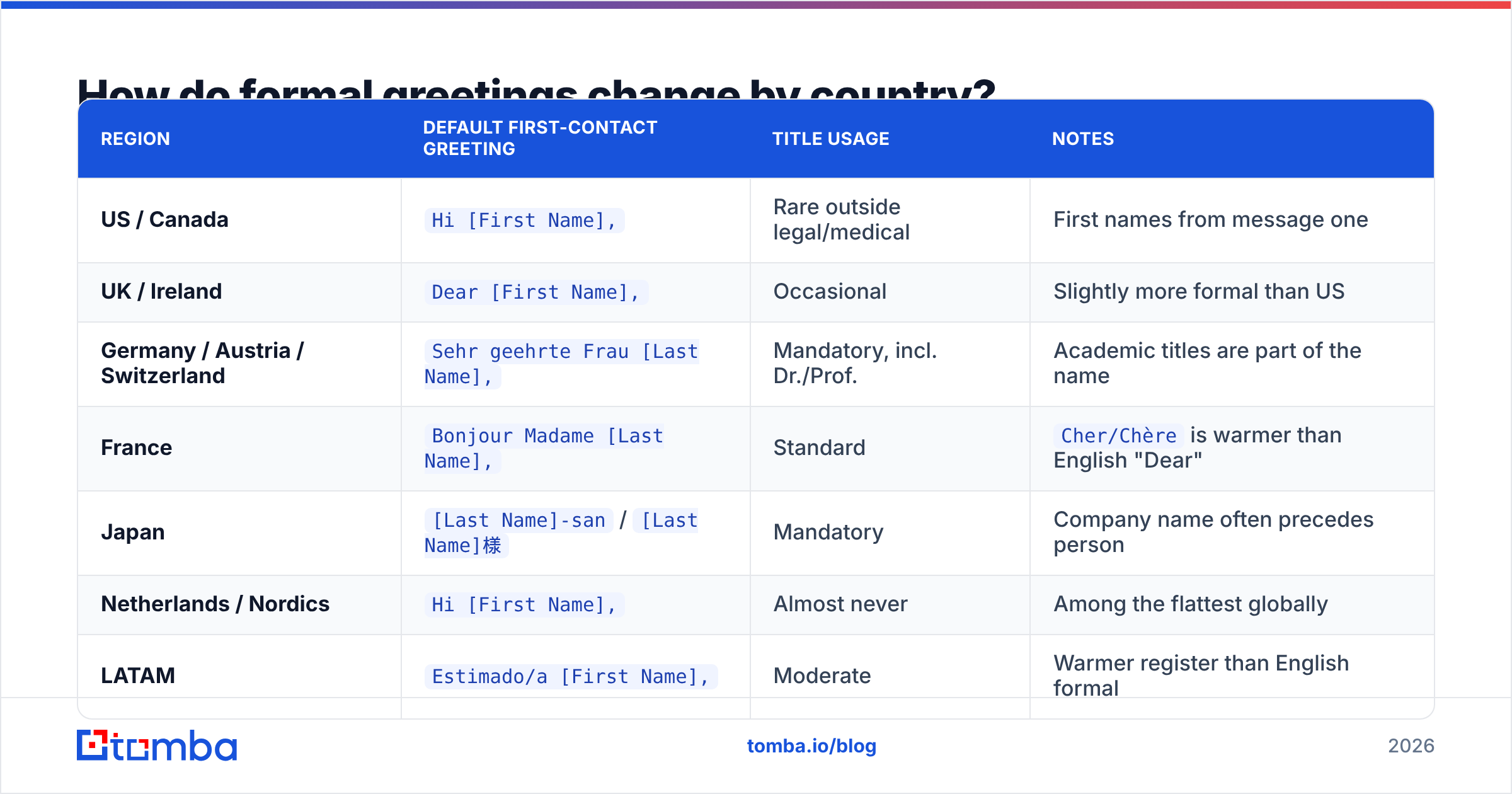
Meaningfully, and this is where most outbound teams lose deals without knowing it.
| Region | Default first-contact greeting | Title usage | Notes |
|---|---|---|---|
| US / Canada | Hi [First Name], |
Rare outside legal/medical | First names from message one |
| UK / Ireland | Dear [First Name], |
Occasional | Slightly more formal than US |
| Germany / Austria / Switzerland | Sehr geehrte Frau [Last Name], |
Mandatory, incl. Dr./Prof. | Academic titles are part of the name |
| France | Bonjour Madame [Last Name], |
Standard | Cher/Chère is warmer than English "Dear" |
| Japan | [Last Name]-san / [Last Name]様 |
Mandatory | Company name often precedes person |
| Netherlands / Nordics | Hi [First Name], |
Almost never | Among the flattest globally |
| LATAM | Estimado/a [First Name], |
Moderate | Warmer register than English formal |
| Middle East | Dear Mr./Ms. [Last Name], |
Mandatory | Titles carry real weight |
The German case is the one that burns people most often. Dropping the Dr. from Sehr geehrter Herr Dr. Weber isn't a stylistic choice — it reads as a slight. If you sell into DACH, store title as a separate CRM field, not glued to the first-name column.
Does the greeting actually affect reply rates?#
It affects reply rates less than personalization depth, but the two are entangled — and the greeting is where personalization visibly fails.
Here's the honest breakdown of what moves the needle on cold email response, in rough order of impact:
- List quality and targeting. Right person, right company, right timing. Nothing else comes close.
- Deliverability. If it lands in spam, the greeting is irrelevant. Authentication, warmup, and list hygiene dominate here. Check your setup with an SPF checker before you blame copy.
- Subject line and first sentence. These determine open and continue-reading decisions.
- Relevance of the offer. Does this solve something they have?
- The greeting. Real, but secondary — it's a friction remover, not a conversion driver.
The greeting's biggest measurable effect is negative: a wrong name or a wrong title creates an instant delete. Getting Dear Mr. Andrea Rossi, wrong when Andrea is a woman, or emailing Dear Mr. Smith, when Smith left the company eight months ago, ends the conversation before sentence two.

That's why name and title accuracy is a data problem, not a copywriting problem. Your greeting is only as good as the record behind it. Run contacts through email verification so you're not sending a beautifully-worded Dear Ms. Okafor, to an address that bounced six months ago, and use data enrichment to keep role and title current.
What should the line after the greeting say?#
This is where the formality investment either pays off or evaporates.
Bad, in every register:
Dear Ms. Chen,
I hope this email finds you well. My name is Marcus and I'm the Account Executive at Acme, where we help companies like yours streamline their workflows.
That opener has told her nothing. "I hope this email finds you well" is the greeting's evil twin — filler that signals template.
Better:
Dear Ms. Chen,
Your team posted three SDR roles in Q1 — usually a sign the pipeline coverage math isn't working yet.
Same greeting, completely different message. The formal salutation now reads as respect rather than distance, because what follows proves you looked.
Structural rules for the sentence after any formal greeting:
- Never start with "My name is." Your signature and the From line handle that.
- Never start with "I hope this finds you well." It's the most-skipped sentence in B2B email.
- Lead with an observation about them, not a claim about you.
- Keep it under 20 words. The greeting already used a line; don't spend the second one on throat-clearing.
If you're building templates at scale, our cold email templates library pairs each greeting register with an opening line that fits it.
How do you scale formal greetings without sounding templated?#
Three mechanics, all boring, all effective.
Store name parts separately. First name, last name, title, prefix, and preferred name should each be their own field. Merging Sarah Chen-Okafor into a single "name" column and then rendering Hi Sarah Chen-Okafor, is a classic self-own. Same for the person who goes by "Mike" but is "Michael J. Torres" in your CRM.
Build a fallback ladder, not a fallback string. Most teams set one fallback — usually Hi there, — which fires whenever first name is empty. Better: if first name is missing, try preferred name; if that's missing, try last name with a title; if that's missing, don't send. A record with no name is a record you haven't researched.
Segment templates by formality tier, not by persona. Two or three tiers — formal, standard, casual — cover more variance than a dozen persona-specific templates, and they're far easier to keep consistent. Assign the tier at list-build time based on industry and region, then let the rest of the copy stay the same.
For teams comparing data providers on exactly this — whether names, titles, and prefixes come back clean enough to merge — the honest field is broader than it looks. Tools like BookYourData do well on pre-built list depth and verified title data, while Tomba pricing starts at a free tier with 25 searches per month and $49/mo on Starter, which suits teams doing targeted, name-by-name research rather than buying lists in bulk. Both approaches produce a usable Dear Ms. Chen, — they just get there differently.
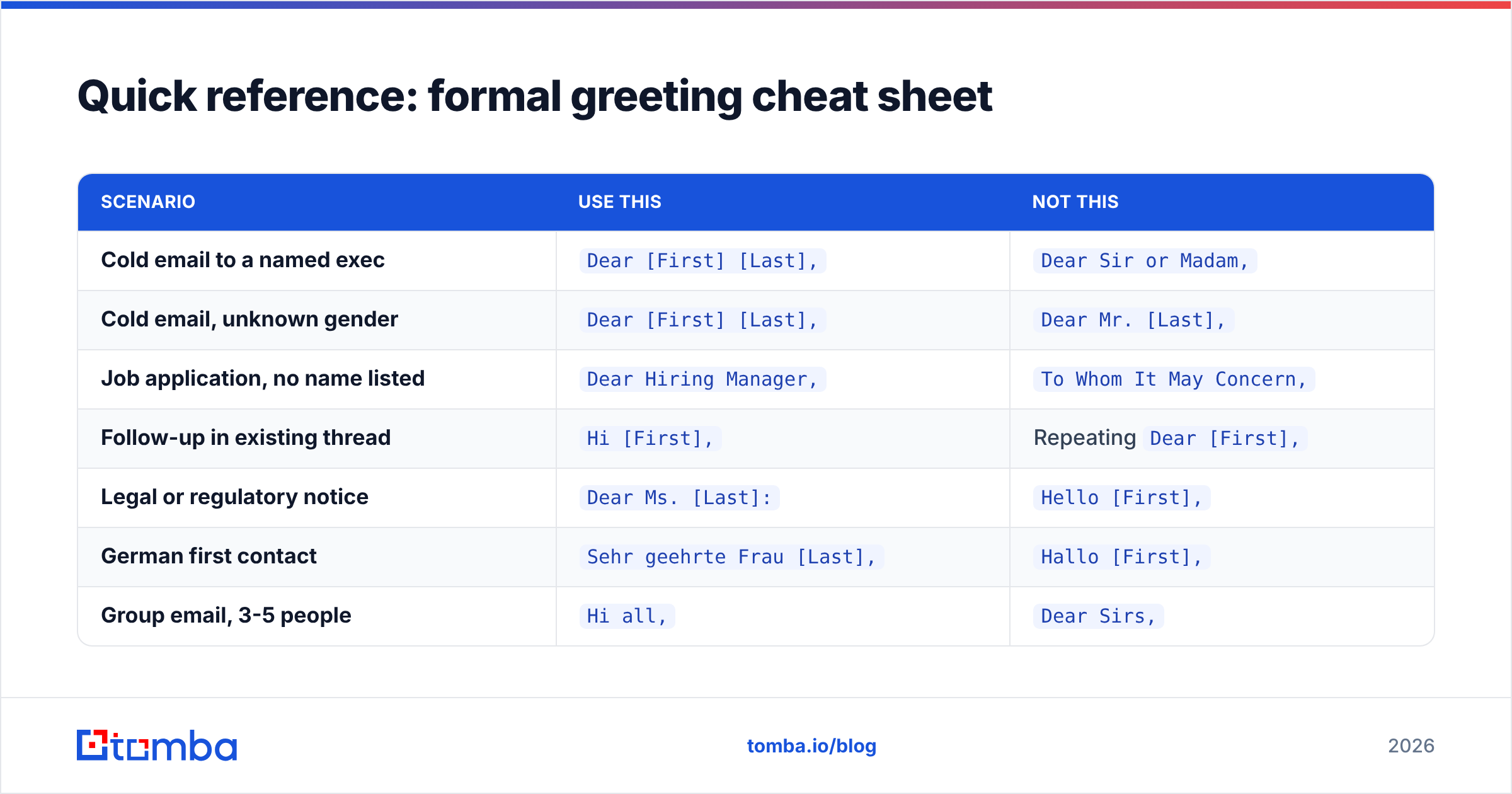
Quick reference: formal greeting cheat sheet#
| Scenario | Use this | Not this |
|---|---|---|
| Cold email to a named exec | Dear [First] [Last], |
Dear Sir or Madam, |
| Cold email, unknown gender | Dear [First] [Last], |
Dear Mr. [Last], |
| Job application, no name listed | Dear Hiring Manager, |
To Whom It May Concern, |
| Follow-up in existing thread | Hi [First], |
Repeating Dear [First], |
| Legal or regulatory notice | Dear Ms. [Last]: |
Hello [First], |
| German first contact | Sehr geehrte Frau [Last], |
Hallo [First], |
| Group email, 3-5 people | Hi all, |
Dear Sirs, |
| Support or vendor request | Hello [First], |
Greetings, |
Print it, pin it, stop debating it in Slack. For a deeper definition of related terms, the B2B glossary covers the outreach vocabulary around this.
Get the name right before you get the greeting right#
A Dear Ms. Okafor, sent to an address that doesn't exist is a wasted send. A Hi Mike, sent to Michael who left the company is worse — it lands with his replacement, who now knows your data is stale.
Start with the record. Tomba's Email Finder returns the verified work address along with the first name, last name, and role you need to write the right greeting — by domain, by full name, or by company. Free tier gives you 25 searches a month to test the accuracy against contacts you already know, and Starter runs $49/mo when you're ready to scale. Fix the data layer, and the greeting takes care of itself.
Sources and further reading: Grammarly's salutation guide, HubSpot's email greeting research, and G2's cold email software category for tooling comparisons.
Related guides#
Ready to find emails that actually work?
Join 150,000+ professionals who stopped guessing and started sending. Free credits on signup — no credit card required.
Get the Tomba newsletter
Practical outbound tactics and product updates — once every two weeks.
About the author