How to Write a Formal Sales Proposal That Wins B2B Deals
A formal sales proposal is a decision document, not a brochure. Here is the nine-section structure, the pricing table format buyers forward internally, and the mistakes that stall deals in legal review.
TL;DR
- A formal sales proposal is a decision document for a buying committee, not a marketing brochure for your champion. Write it so someone who never met you can approve it.
- Nine sections cover almost every B2B deal: cover, executive summary, problem statement, proposed solution, scope, timeline, pricing, terms, and next step.
- Put pricing where buyers can find it in under 30 seconds. Hiding price on page 14 does not delay the objection — it delays the deal.
- Proposals fail on distribution more than on content. If it never reaches the CFO, the finance lead, and the security reviewer, it never gets signed.
- Gartner research puts the typical B2B buying group at six to ten people. Build your proposal — and your contact data — for all of them.
What is a formal sales proposal?#
A formal sales proposal is a written offer that states what you will deliver, on what timeline, for what price, under what terms — in a format a buyer can circulate, annotate, and approve internally without you in the room.
Think of it like a mortgage application packet versus a text message asking for money. The text might work with a friend. The packet is what a committee signs.
That distinction matters because the proposal is usually the first artifact in your deal that travels without you. Your champion forwards the PDF to procurement. Procurement forwards the pricing page to finance. Legal pulls the terms section. Each reader spends 90 seconds in a different part of the document and forms a verdict.
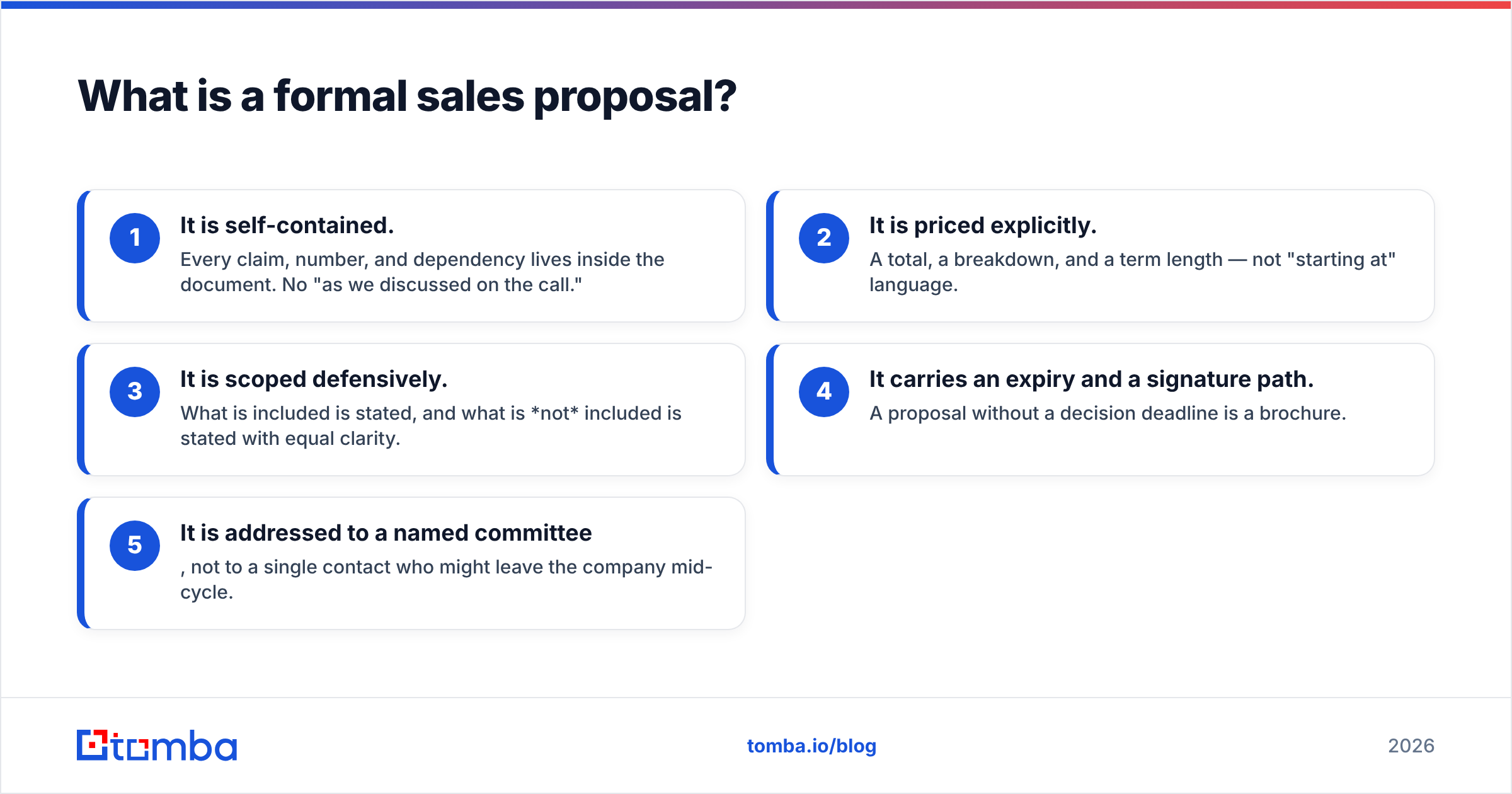
Four properties separate a formal proposal from an informal one:
- It is self-contained. Every claim, number, and dependency lives inside the document. No "as we discussed on the call."
- It is priced explicitly. A total, a breakdown, and a term length — not "starting at" language.
- It is scoped defensively. What is included is stated, and what is not included is stated with equal clarity.
- It carries an expiry and a signature path. A proposal without a decision deadline is a brochure.
- It is addressed to a named committee, not to a single contact who might leave the company mid-cycle.
Formal proposal vs quote vs SOW vs pitch deck — which do you send?#
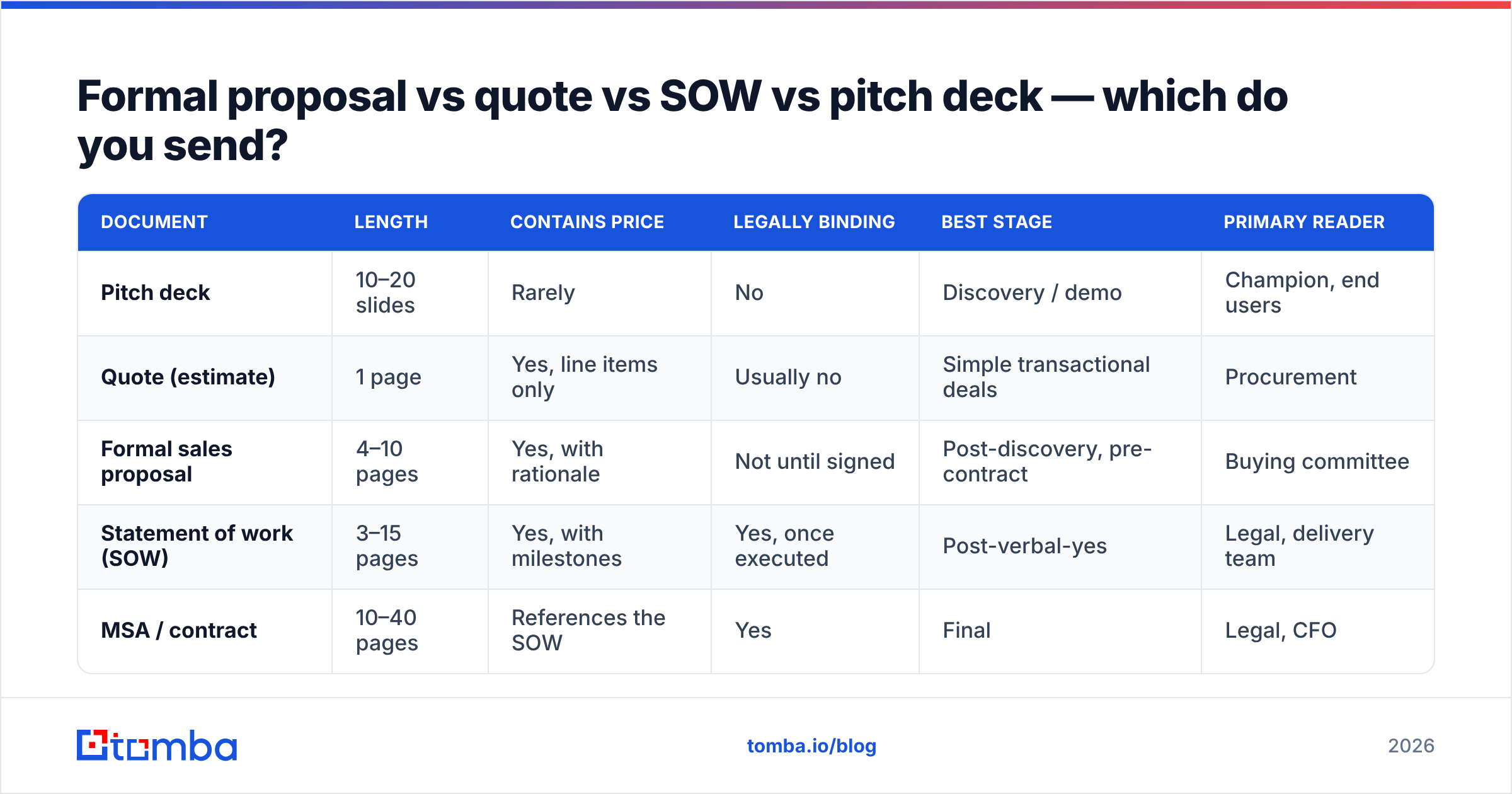
Reps burn cycles sending the wrong artifact at the wrong stage. Here is the practical mapping.
| Document | Length | Contains price | Legally binding | Best stage | Primary reader |
|---|---|---|---|---|---|
| Pitch deck | 10–20 slides | Rarely | No | Discovery / demo | Champion, end users |
| Quote (estimate) | 1 page | Yes, line items only | Usually no | Simple transactional deals | Procurement |
| Formal sales proposal | 4–10 pages | Yes, with rationale | Not until signed | Post-discovery, pre-contract | Buying committee |
| Statement of work (SOW) | 3–15 pages | Yes, with milestones | Yes, once executed | Post-verbal-yes | Legal, delivery team |
| MSA / contract | 10–40 pages | References the SOW | Yes | Final | Legal, CFO |
The rule of thumb: send a quote when the buyer already knows what they want and only needs a number. Send a formal sales proposal when the buyer still needs to justify the purchase to someone else.
What sections does a formal sales proposal need?#
Nine sections, in this order. Deviating costs you clarity, and clarity is the only thing that survives a forwarded PDF.
1. Cover page. Buyer's legal entity name, your legal entity name, proposal date, expiry date, and a reference number. Procurement teams file by reference number. Give them one.
2. Executive summary. Half a page, maximum. State the buyer's stated goal, your proposed approach in two sentences, the investment, and the expected outcome window. Write this last, and write it for a CFO who will read nothing else.
3. Problem statement. Mirror the buyer's own language from discovery calls. If they said "our SDRs waste four hours a week on list building," write that — not "operational inefficiency in top-of-funnel workflows." Quoting the buyer back to themselves is the single highest-trust move in the document.
4. Proposed solution. Map each stated problem to a specific capability. Use a two-column table: Your challenge / How we address it. Avoid feature dumps — a feature with no attached problem reads as padding and invites scope questions.
5. Scope and deliverables. List what is included as concrete nouns: number of seats, number of integrations, hours of onboarding, support tier. Then add an explicit Not included subsection. Reps avoid this section because it feels negative. Procurement loves it because it prevents change orders, and legal moves faster when exclusions are pre-stated.
6. Timeline. Week-by-week or phase-by-phase, with named dependencies on the buyer's side. "Week 2: customer provides CRM admin access" prevents the most common go-live slip.
7. Investment (pricing). See the next section.
8. Terms and assumptions. Payment schedule, contract length, renewal mechanics, cancellation window, data handling. Two paragraphs here can shave a week off legal review.
9. Next step. One sentence, one action, one date. "Sign electronically by March 14 to hold the Q2 onboarding slot" beats "let us know your thoughts."
Where should pricing go in a formal sales proposal?#
Page one or page two — visible without scrolling past three sections.
Buyers who cannot find the price assume you are hiding something. And the people who most need the number — finance, the budget owner — are the least likely to read your solution narrative. Make the price scannable and give it structure so it can be defended internally.
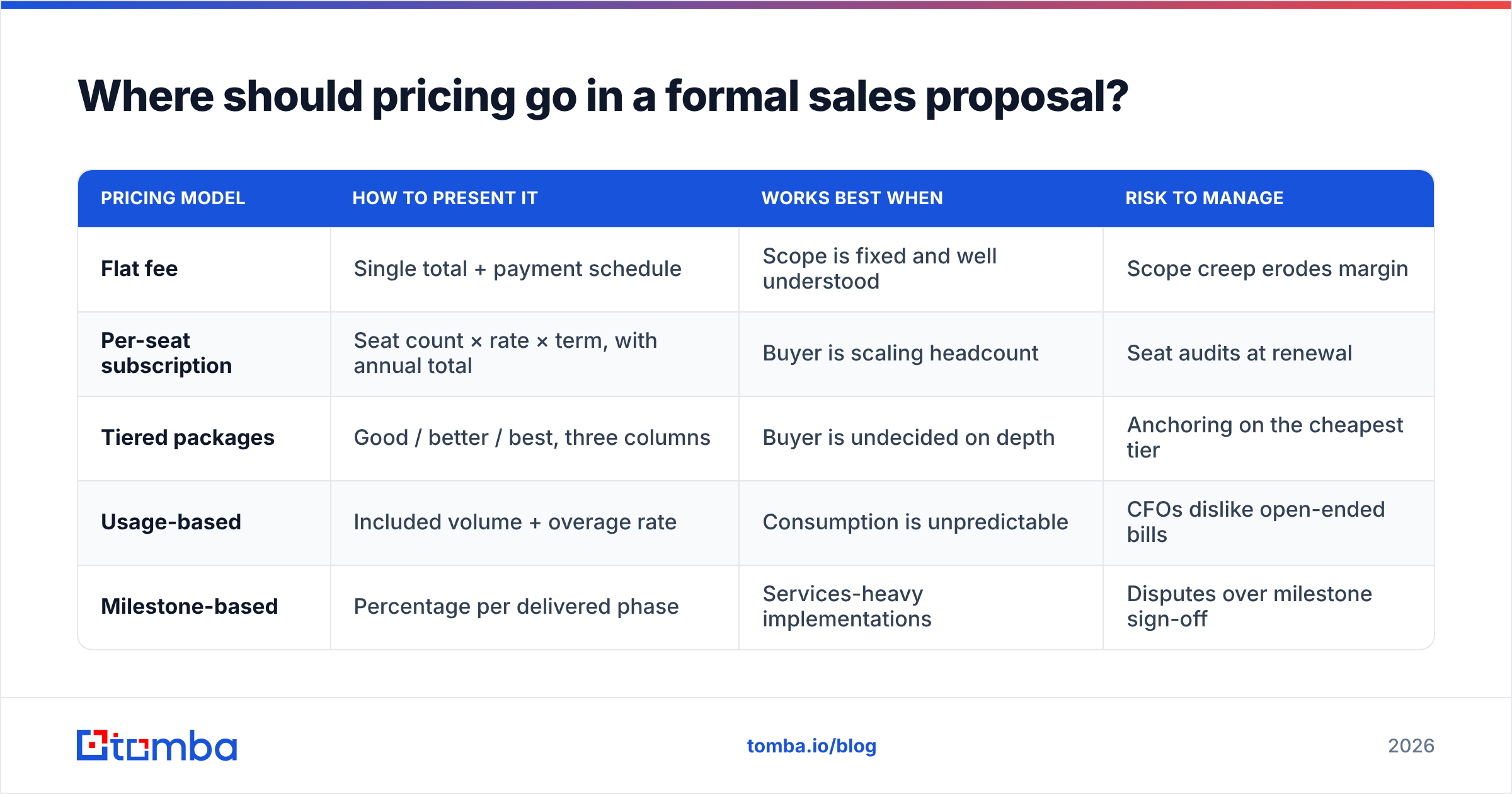
| Pricing model | How to present it | Works best when | Risk to manage |
|---|---|---|---|
| Flat fee | Single total + payment schedule | Scope is fixed and well understood | Scope creep erodes margin |
| Per-seat subscription | Seat count × rate × term, with annual total | Buyer is scaling headcount | Seat audits at renewal |
| Tiered packages | Good / better / best, three columns | Buyer is undecided on depth | Anchoring on the cheapest tier |
| Usage-based | Included volume + overage rate | Consumption is unpredictable | CFOs dislike open-ended bills |
| Milestone-based | Percentage per delivered phase | Services-heavy implementations | Disputes over milestone sign-off |
Two formatting details that measurably reduce back-and-forth: show the annual total, not just the monthly rate (finance budgets annually), and show one optional line item clearly marked as optional. A single optional add-on gives the buyer something to cut, which protects the core scope from being cut instead.
If you are benchmarking your own pricing presentation, look at how transparent SaaS vendors publish tiers. Tomba pricing, for example, lists a free tier at 25 searches per month, Starter at $49/mo, Growth at $99/mo, and Pro at $249/mo — visible totals, no "contact us" wall until the enterprise tier. That structure is easy to paste into a proposal because every number is already defensible.
How long should a formal sales proposal be?#
Four to ten pages for most B2B deals under $100k. Enterprise and public-sector RFP responses run longer because the buyer dictates the format.
Length is not the real variable — density is. A ten-page proposal where every page answers a question the buyer actually asked beats a four-page proposal that skips the timeline. Conversely, a twenty-page deck padded with team bios and logo walls signals that you could not summarize the value.
Test it this way: hand the document to someone in your company who was not on the deal. Give them 90 seconds. Then ask them what you are selling, what it costs, and what happens next. If they cannot answer all three, the proposal is not ready to send.
Who should actually receive the proposal?#
This is where most well-written proposals die. Gartner's research on the B2B buying journey has consistently found that a typical complex purchase involves six to ten decision makers, each arriving with their own independently gathered information. Sending a beautifully structured document to one champion and hoping it propagates is a coin flip.
Build a distribution list before you send:
- The champion — your internal advocate, usually the person who ran discovery with you.
- The economic buyer — signs or approves the budget. Often a VP or CFO you have never spoken to.
- The technical evaluator — IT, security, or ops. Cares about integrations and data handling.
- The procurement contact — cares about terms, payment schedule, and vendor comparison.
- The end-user lead — cares about onboarding time and whether their team will actually adopt it.
You will rarely be handed all five email addresses. This is a data problem, and it is solvable: use a domain search to pull the verified email pattern and named contacts at the buyer's company, then run data enrichment to attach titles and seniority so you can tell the CFO apart from a namesake in another department. For deals where the economic buyer never replies to email, a phone finder lookup gives you a second channel before the proposal expires.
One practical habit: address the proposal's cover page to the committee by role, not by a single name. "Prepared for the Revenue Operations and Finance teams at Acme Corp" survives a champion's departure. "Prepared for Dana" does not.
What tools should you use to build and send it?#
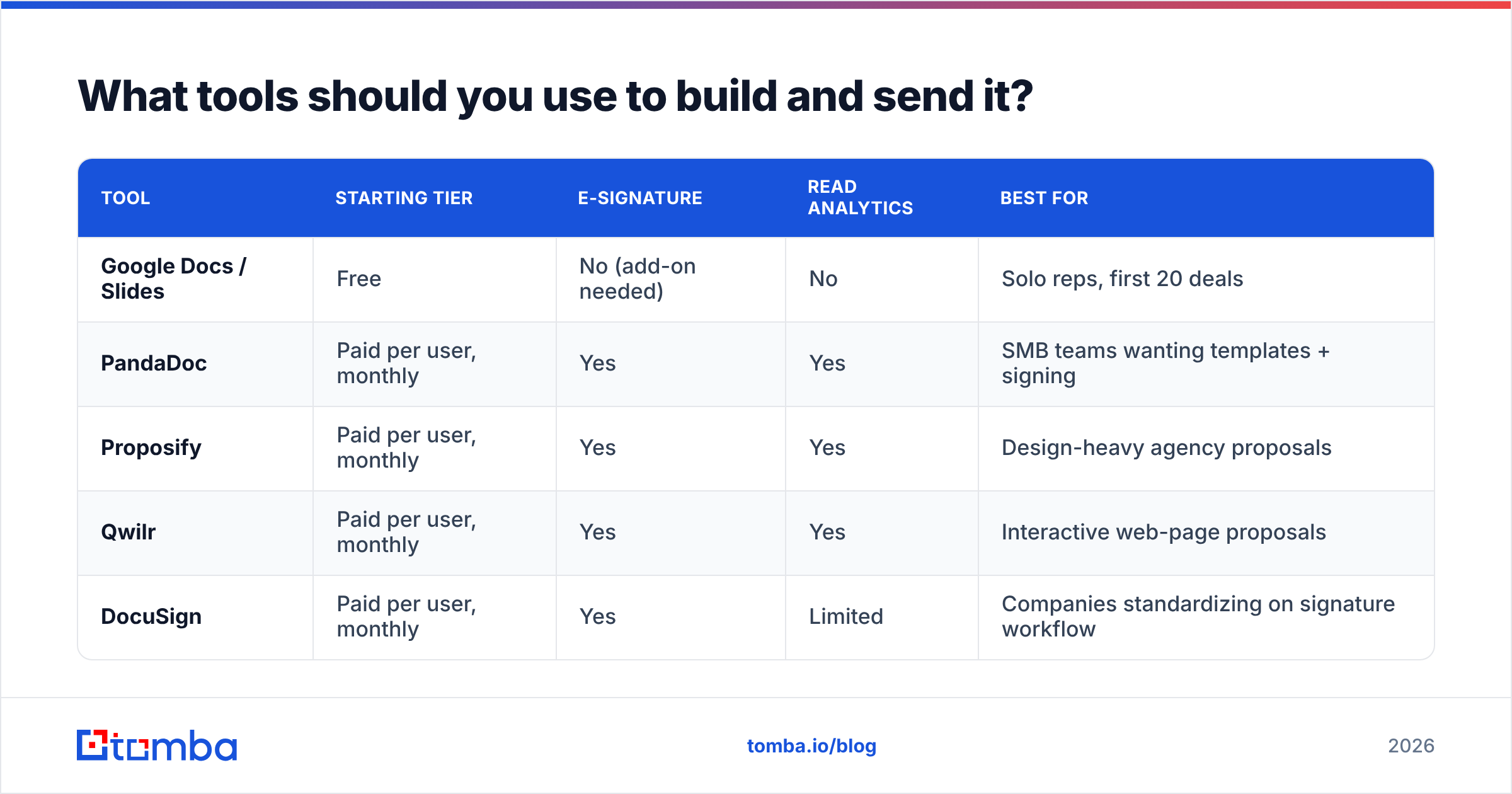
You can win deals with a well-structured Google Doc exported to PDF. Dedicated proposal software earns its keep when you need analytics, e-signature, and template governance across a team.
| Tool | Starting tier | E-signature | Read analytics | Best for |
|---|---|---|---|---|
| Google Docs / Slides | Free | No (add-on needed) | No | Solo reps, first 20 deals |
| PandaDoc | Paid per user, monthly | Yes | Yes | SMB teams wanting templates + signing |
| Proposify | Paid per user, monthly | Yes | Yes | Design-heavy agency proposals |
| Qwilr | Paid per user, monthly | Yes | Yes | Interactive web-page proposals |
| DocuSign | Paid per user, monthly | Yes | Limited | Companies standardizing on signature workflow |
Check current tiers on each vendor's own pricing page before quoting them internally — proposal software pricing changes often, and per-seat minimums vary. Verified user reviews on G2 are useful for gauging how each tool handles approval workflows, which is the feature most teams under-evaluate.
Whatever you use, the proposal should write back to your CRM automatically. A proposal sent from a tool that does not log the send date, the open events, and the expiry is a forecasting blind spot.
What mistakes kill formal sales proposals?#
- Sending it before the buyer agreed on the problem. A proposal is a summary of an agreement you already reached verbally. If discovery is incomplete, the proposal becomes a guess with a price attached.
- Boilerplate that mentions the wrong company. It happens constantly with template reuse, and it is unrecoverable. Search the document for the previous client's name before every send.
- No expiry date. Without one, the proposal sits in an inbox indefinitely and your quarter closes without it.
- Legal terms buried in an appendix. If your terms include auto-renewal or a long cancellation notice, surface them. Buyers who discover them in redlines lose trust in everything above them.
- A vague next step. "Let me know if you have questions" transfers all momentum to the buyer. Name the action and the date.
- Skipping the follow-up plan. HubSpot's sales proposal guidance makes the point well: the send is the midpoint of the process, not the end. Schedule a review call at the same time you send the document, so the calendar invite arrives with the PDF.
How do you follow up after sending?#
Book the review call before you hit send. That single change removes the awkward "just checking in" email from your process entirely.
If the call is already on the calendar, your follow-up sequence is short and functional:
- Send day: the proposal plus a two-line summary in the email body — total investment and the decision date. Many people will never open the attachment.
- Day 2: a one-line message to the economic buyer you did not speak with, offering to answer pricing questions directly.
- Review call: walk the scope and terms sections live, page by page. Do not present the whole document — presenting invites passivity.
- 48 hours before expiry: confirm whether the date needs extending. Extending on request is fine. Letting it lapse silently is not.
Track your response rate at each of these touchpoints. If proposals routinely go dark after step one, the problem is usually distribution — the document reached one person instead of five.
Build the proposal on contacts that actually exist#
A formal sales proposal only converts if it lands in the right inboxes. The structure above handles the reading; the contact data handles the reaching.
Use the Tomba Email Finder to build a verified list of every stakeholder at the account before you send — the economic buyer, the technical evaluator, and the procurement contact included. Start on the free tier at 25 searches per month, and move to Starter at $49/mo when you are running enough deals that a bounced proposal costs you more than the subscription. Getting the document right is half the work. Getting it in front of the whole committee is the other half.
Related guides#
Ready to find emails that actually work?
Join 150,000+ professionals who stopped guessing and started sending. Free credits on signup — no credit card required.
Get the Tomba newsletter
Practical outbound tactics and product updates — once every two weeks.
About the author