Forrester Wave Intent Data Providers: 2026 Buyer's Guide
The Forrester Wave tells you which intent data providers scored well. It does not tell you what they cost, what breaks in month three, or whether you need one at all. Here is the honest buyer's read.
The Forrester Wave intent data providers report ranks the vendors. It does not price them. This guide fills that gap.
TL;DR
- The Forrester Wave intent data providers report is a vendor scorecard, not a shopping list. It scores current offering, strategy, and market presence. None of those is "fits your budget."
- Leaders here are enterprise platforms. Entry pricing runs $25,000–$80,000+ per year. Data volume and seat count drive the number.
- Intent data tells you which account is looking. It rarely tells you which person to email. Most intent programs die on that last step.
- Under ~50 target accounts a quarter, or under $5M ARR? A co-op feed plus good contact discovery usually beats a full ABM platform.
- Budget for action, not just signal. A $60K feed with no verified contacts makes dashboards, not pipeline.
What is the Forrester Wave intent data providers report?#
The Forrester Wave is Forrester Research's vendor comparison format. Analysts pick a market and set the criteria. They invite vendors that qualify, run briefings, and call reference customers. Then they plot each vendor on two axes: current offering across, strategy up. Bubble size shows market presence. Vendors land in one of four bands — Leaders, Strong Performers, Contenders, and Challengers.
In B2B intent, the Wave covers vendors that sell signals about buying research. Those signals show which companies are reading up on a topic, a category, or a rival. Sources include publisher networks, review-site behavior, ad bidstream data, tech-stack change alerts, and your own website traffic.
Two things matter more than the chart itself.
The criteria weightings sit inside the report. Forrester decides how much data sourcing counts against roadmap or partners. A vendor can lead on strategy and size while its raw signal quality sits mid-pack. Read the sub-scores, not the picture.
The inclusion cutoff is based on revenue and customer count. Smaller, sharper, cheaper vendors often miss it. They are not weak. They are just small. Absence from the Wave proves nothing.
How do Forrester Wave intent data providers get scored?#
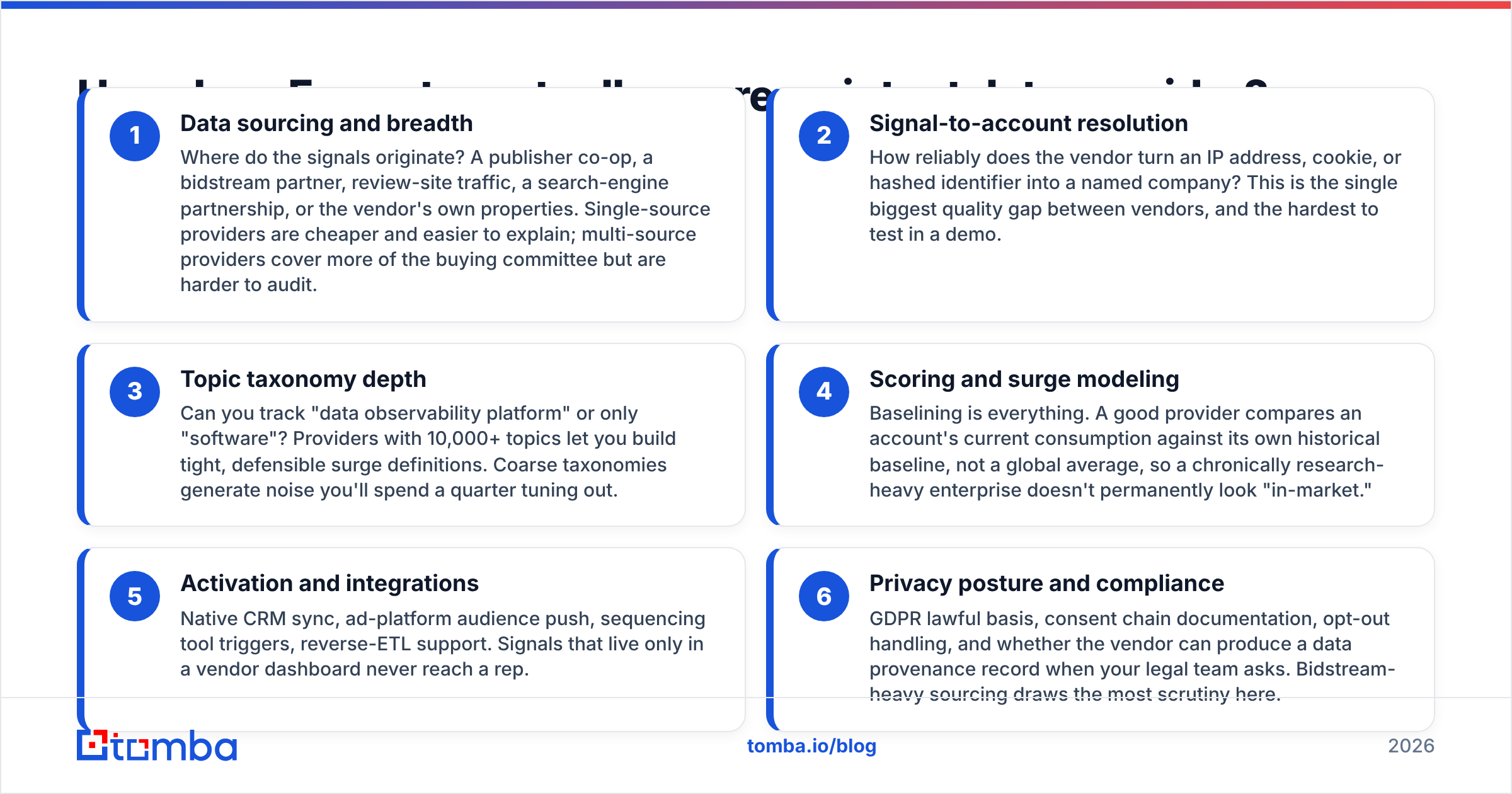
Wave criteria shift each cycle. But the scoring keeps circling the same six things. Learn them and you can run your own mini-Wave on vendors Forrester skipped.
- Data sourcing — Where do signals come from? Publisher co-ops, ad bidstream, review sites, or the vendor's own pages. Single-source feeds are cheaper and easier to audit.
- Account resolution — How well does an IP or cookie become a named company? This is the biggest quality gap, and the hardest to test in a demo.
- Topic depth — Can you track "data observability platform" or only "software"? Coarse topic lists create noise you spend a quarter tuning out.
- Surge scoring — Good vendors compare an account against its own history, not a global average. That keeps research-heavy firms from always looking "in-market."
- Activation — CRM sync, ad audience push, sequence triggers. A signal stuck in a dashboard never reaches a rep.
- Privacy — GDPR basis, consent records, opt-outs, and a paper trail your lawyers can read. Bidstream-heavy vendors draw the most heat.
Score each vendor 1–5 on the six. Weight them for your own case. Now you have a fair comparison, and it cost you nothing.
Which intent data providers typically compete in this category?#
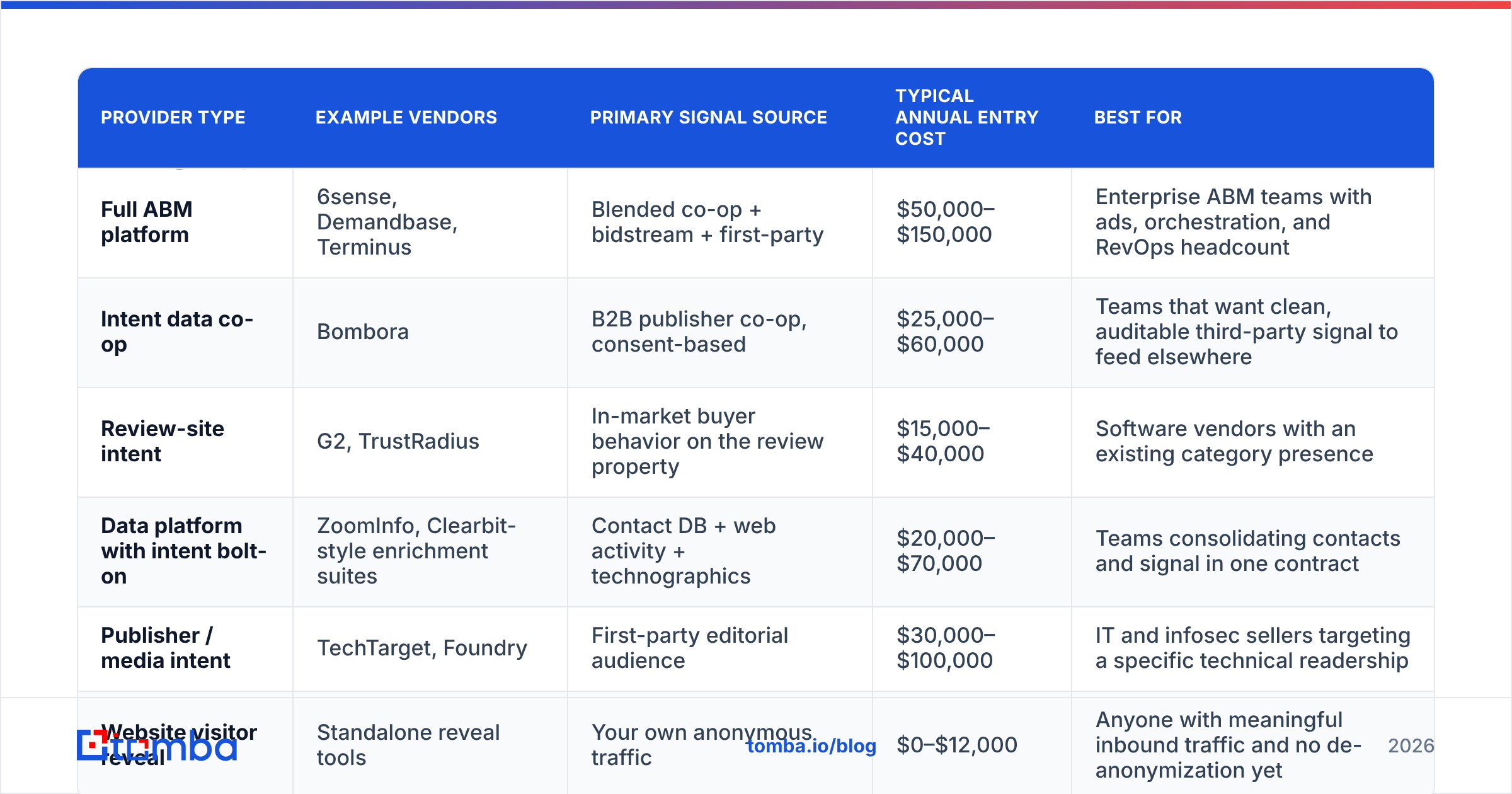
These names show up often in intent evaluations and buyer shortlists. Placement changes every cycle. Treat this as a map of types, not a ranking. Check the current Wave for live scoring.
| Provider type | Example vendors | Primary signal source | Typical annual entry cost | Best for |
|---|---|---|---|---|
| Full ABM platform | 6sense, Demandbase, Terminus | Blended co-op + bidstream + first-party | $50,000–$150,000 | Enterprise ABM teams with ads, orchestration, and RevOps headcount |
| Intent data co-op | Bombora | B2B publisher co-op, consent-based | $25,000–$60,000 | Teams that want clean, auditable third-party signal to feed elsewhere |
| Review-site intent | G2, TrustRadius | In-market buyer behavior on the review property | $15,000–$40,000 | Software vendors with an existing category presence |
| Data platform with intent bolt-on | ZoomInfo, Clearbit-style enrichment suites | Contact DB + web activity + technographics | $20,000–$70,000 | Teams consolidating contacts and signal in one contract |
| Publisher / media intent | TechTarget, Foundry | First-party editorial audience | $30,000–$100,000 | IT and infosec sellers targeting a specific technical readership |
| Website visitor reveal | Standalone reveal tools | Your own anonymous traffic | $0–$12,000 | Anyone with meaningful inbound traffic and no de-anonymization yet |
Buyers skip the last row and regret it later. Your own website traffic is the strongest signal you will ever get. It costs a fraction of a co-op feed, and you already own the data. Tools like website visitor reveal name the companies behind anonymous visits before you spend a cent on third-party signal.

Is a Wave Leader the right choice for your team?#
Usually not. The reason is structural, not technical.
Leaders rank partly on breadth. Ads, orchestration, measurement, sales data, and predictive scoring all ship in one platform. That breadth is what makes them costly and slow. Most enterprise ABM rollouts take 60–120 days before the first campaign ships. They also assume you have a RevOps owner, an ops admin, and clean CRM data.
Ask three questions before you shortlist a Leader.
Do you have enough accounts? Intent scoring pays off when your list is too big to sort by hand. With 200 named accounts, a rep can read the news and check the careers page. With 20,000, you need a machine.
Do you act on the signals you have? If demo requests sit for 48 hours, a surge feed only adds to the queue. Fix throughput first.
Can you name a person within a day? This is the failure nobody demos. The platform says Acme surged on "data warehouse migration" for three days. Fine. Who at Acme? Which of the 40 people in engineering? What is their email? If the answer is a manual LinkedIn hunt, your intent tool is making homework, not pipeline.
Peer reviews on G2 help in one specific way. Skip the star ratings. Read the "what do you dislike" notes from companies your size. The gripes cluster around resolution accuracy and time to value. They are far more honest than the analyst story.
What does intent data actually cost in 2026?#
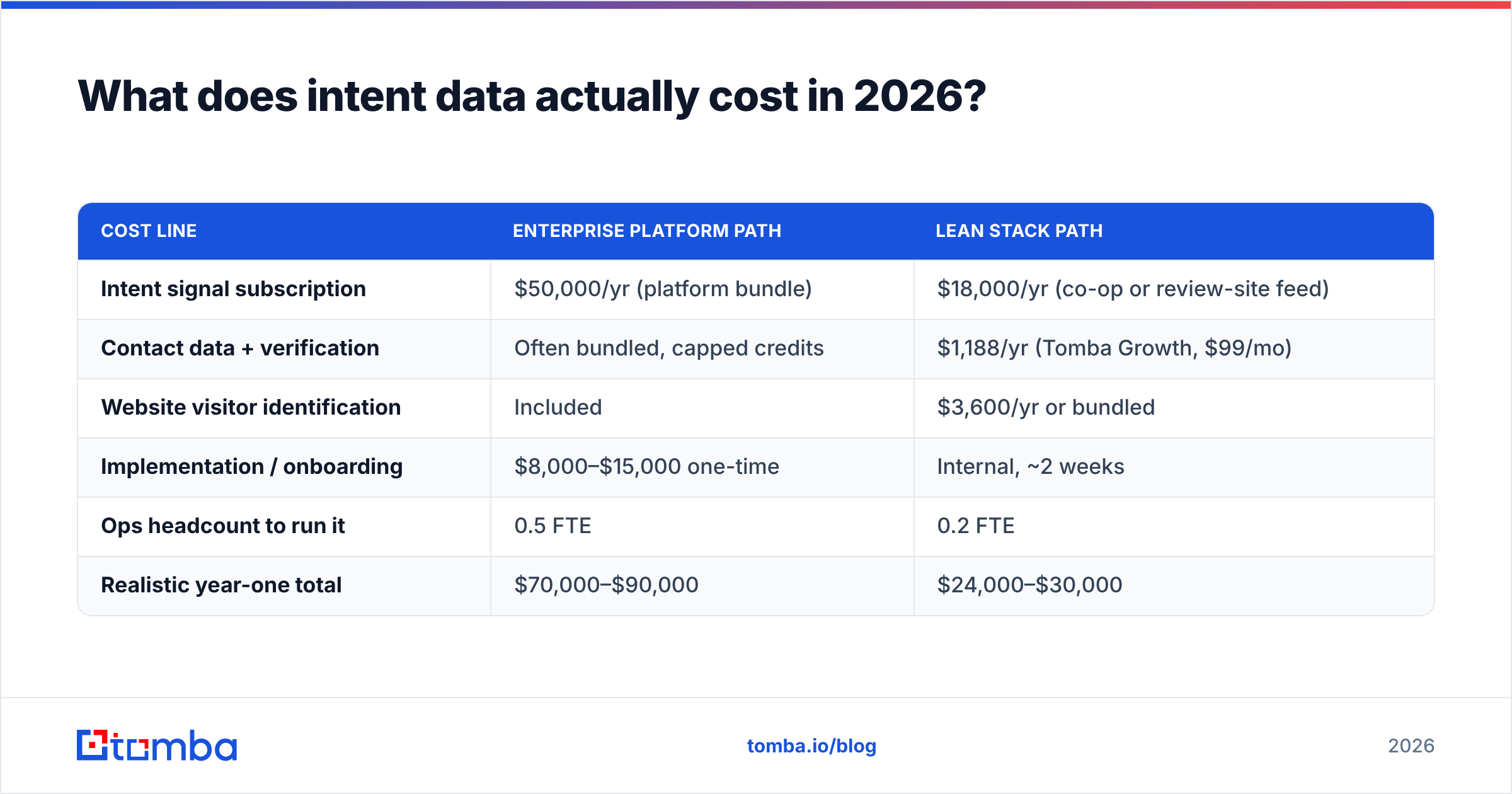
Sticker price is about half the real number. Here is a truer count for a mid-market team running intent-driven outbound.
| Cost line | Enterprise platform path | Lean stack path |
|---|---|---|
| Intent signal subscription | $50,000/yr (platform bundle) | $18,000/yr (co-op or review-site feed) |
| Contact data + verification | Often bundled, capped credits | $1,188/yr (Tomba Growth, $99/mo) |
| Website visitor identification | Included | $3,600/yr or bundled |
| Implementation / onboarding | $8,000–$15,000 one-time | Internal, ~2 weeks |
| Ops headcount to run it | 0.5 FTE | 0.2 FTE |
| Realistic year-one total | $70,000–$90,000 | $24,000–$30,000 |
The lean path gives up predictive scoring, ad audience sync, and unified reporting. Those are real features. Pay for them once your program makes enough pipeline to justify the reporting layer. Not before.
Check one detail in every contract: credit rollover and overage rates on contact exports. Platforms often pair big signal volume with a small export cap. Then they charge premium rates for the exports you actually need. Model your export volume against your surge count before you sign.
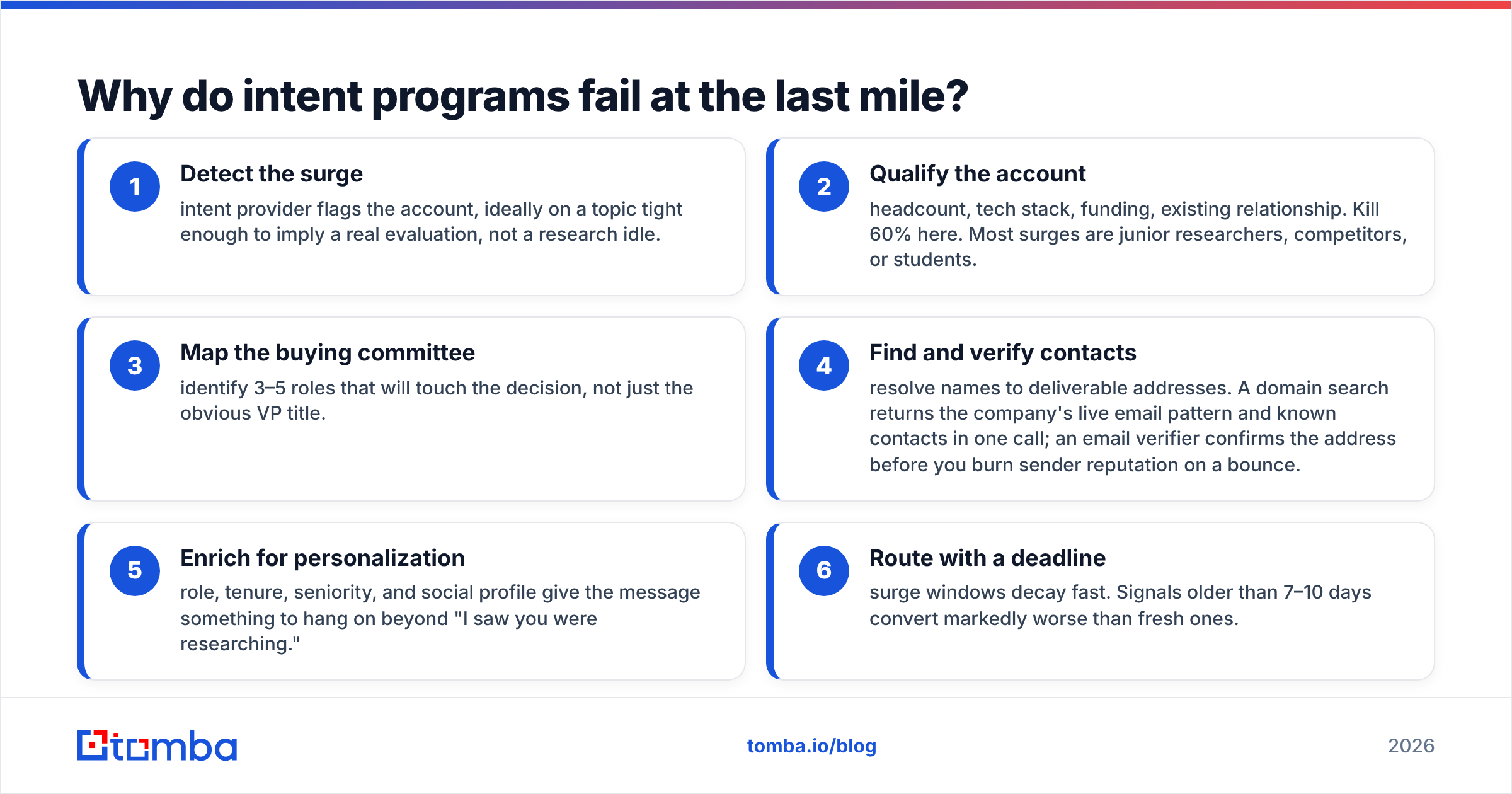
Why do intent programs fail at the last mile?#
Because a signal is an account, and outreach needs a person.
Every vendor resolves activity to a company. Almost none name the director who read three comparison pages last Tuesday. Privacy law and plain technical limits both block it. So the workflow that converts looks like this.
- Catch the surge — the vendor flags an account on a topic tight enough to imply a real evaluation.
- Qualify it — headcount, tech stack, funding, past contact. Kill 60% here. Many surges are junior researchers, rivals, or students.
- Map the buyers — pick 3–5 roles that will touch the decision, not just the obvious VP.
- Find and verify contacts — a domain search returns the live email pattern and known contacts. An email verifier checks the address before a bounce hurts your sender score.
- Add context — role, tenure, and a social profile give the email something real to open with.
- Send fast — surge windows fade. Signals older than 7–10 days convert much worse.
Steps 3 to 5 are where money leaks. Teams that paid $60K for signal try to run contact discovery on bundled export credits. They hit the cap in week six and stall. Keep your signal vendor and your contact vendor separate. Both prices stay honest, and you can swap either one.

How do you evaluate providers without the report?#
No Forrester subscription? Most teams under 200 people do not have one. Run a structured pilot instead. It tests your accounts, not a reference customer's.
Pick 100 accounts you already know. Include 20 that became deals, 20 that went dark, and 60 random targets. Ask each vendor to score all 100 after the fact. Good resolution shows up as surge flags clustered on your closed-won accounts. A vendor that lights up all 100 evenly is selling noise.
Test topic depth by hand. Search the vendor taxonomy for the three phrases your best customers use. If the closest match is two levels too broad, your alerts start diluted.
Ask for the sourcing document. How much signal comes from consented co-op publishers, and how much from bidstream? Get the split in writing. Vendors that dodge this are the ones your legal team will reject later.
Run a two-week test. Take the top 25 surging accounts, map the buyers, and send. Compare reply rate to your normal outbound. If intent-sourced sequences do not beat baseline by 1.5x, either the signal or your last mile is broken. Find out before you sign a multi-year deal.
Check the exit. Can you export past signal data if you leave? Many platforms treat scored intent as their own work. That clause turns a switch into a rebuild.
Does intent data still work in 2026?#
Yes, with two caveats that have hardened over the last two years.
Cookie deprecation and stricter mobile IDs shrank the bidstream part of most datasets. Vendors with publisher co-ops and their own editorial audiences held up better. Ask any vendor how coverage changed year over year. Watch how comfortable they look answering.
Outbound also got noisier. When five rivals buy the same co-op feed, the same accounts get five emails in one week. The value is no longer in knowing an account is in market. It is in how fast and how well you act. Speed and message quality now decide the winner.
So move the marginal budget. An extra $30K on a platform tier buys slightly better scoring. The same $30K on contact accuracy, deliverability, and a rep who acts within a day buys conversions. If you must choose, pick the B2B data and enrichment layer. It touches every signal you already have.
Where should you start?#
Start with the signals you own. Find the companies already on your site. Add a co-op or review-site feed once that pipeline gets worked properly. Only then look at a full ABM platform. Use the Forrester Wave intent data providers sub-scores as one input, weighted for your budget and team size.
Whatever signal you buy, the account-to-contact gap is yours to close. Tomba's Email Finder turns a surging domain into named, verified contacts in seconds. It handles pattern detection and catch-all domains, and it has an API for your intent workflow. The free tier gives 25 searches a month. Starter is $49/mo and Growth is $99/mo — about one two-hundredth of an enterprise intent contract, covering the step that contract leaves undone.
Related guides#
Ready to find emails that actually work?
Join 150,000+ professionals who stopped guessing and started sending. Free credits on signup — no credit card required.
Get the Tomba newsletter
Practical outbound tactics and product updates — once every two weeks.
About the author