Freckle Alternatives in 2026: 9 Visitor ID Tools Compared
Freckle promises to turn anonymous website traffic into named leads. Here are nine alternatives compared on match rate, contact data quality, compliance risk and real cost — plus which one fits your motion.
TL;DR
- Freckle sits in the visitor-identification category: it tries to attach an identity to anonymous website traffic so you can follow up before a form gets filled.
- Most teams shopping for Freckle alternatives are chasing one of three things — a lower floor price, higher match rates on their actual traffic, or a cleaner compliance story in the EU and UK.
- Visitor ID is only half the job. An identified visitor with no verified email is a name, not a lead, which is why pairing identification with an email finder and verifier usually beats buying a single all-in-one.
- The nine alternatives below split into three groups: person-level identifiers, company-level identifiers, and contact-data platforms that feed both.
- Cheapest reliable stack for most SMB and mid-market teams: a free or low-cost identification layer plus Tomba at $49/mo for verified contact data — well under a single enterprise visitor-ID contract.
What is Freckle, and what does it actually do?#
Freckle belongs to the website visitor identification category — software that takes anonymous traffic hitting your site and resolves it to a company, and in some configurations a person, using a mix of reverse-IP lookups, cookie and device graphs, and third-party identity data partnerships.
The pitch is simple and genuinely appealing: roughly 95–98% of B2B site visitors never fill in a form. If you can name even a slice of them, you can run outbound against people who already showed intent, which converts far better than a cold list.
The catch is equally simple. Identification is probabilistic. Vendors in this space quote match rates ranging from single digits to 60%+, and those numbers are not measured the same way. Some count "we matched the company." Some count "we matched a person." Some count "we matched a person and had a deliverable email for them." Those are three wildly different products sold under one label.
That definitional mush is the number one reason people go shopping for Freckle alternatives after a quarter — the dashboard fills up, but the sequence-ready contact count doesn't.
Why do teams look for Freckle alternatives?#
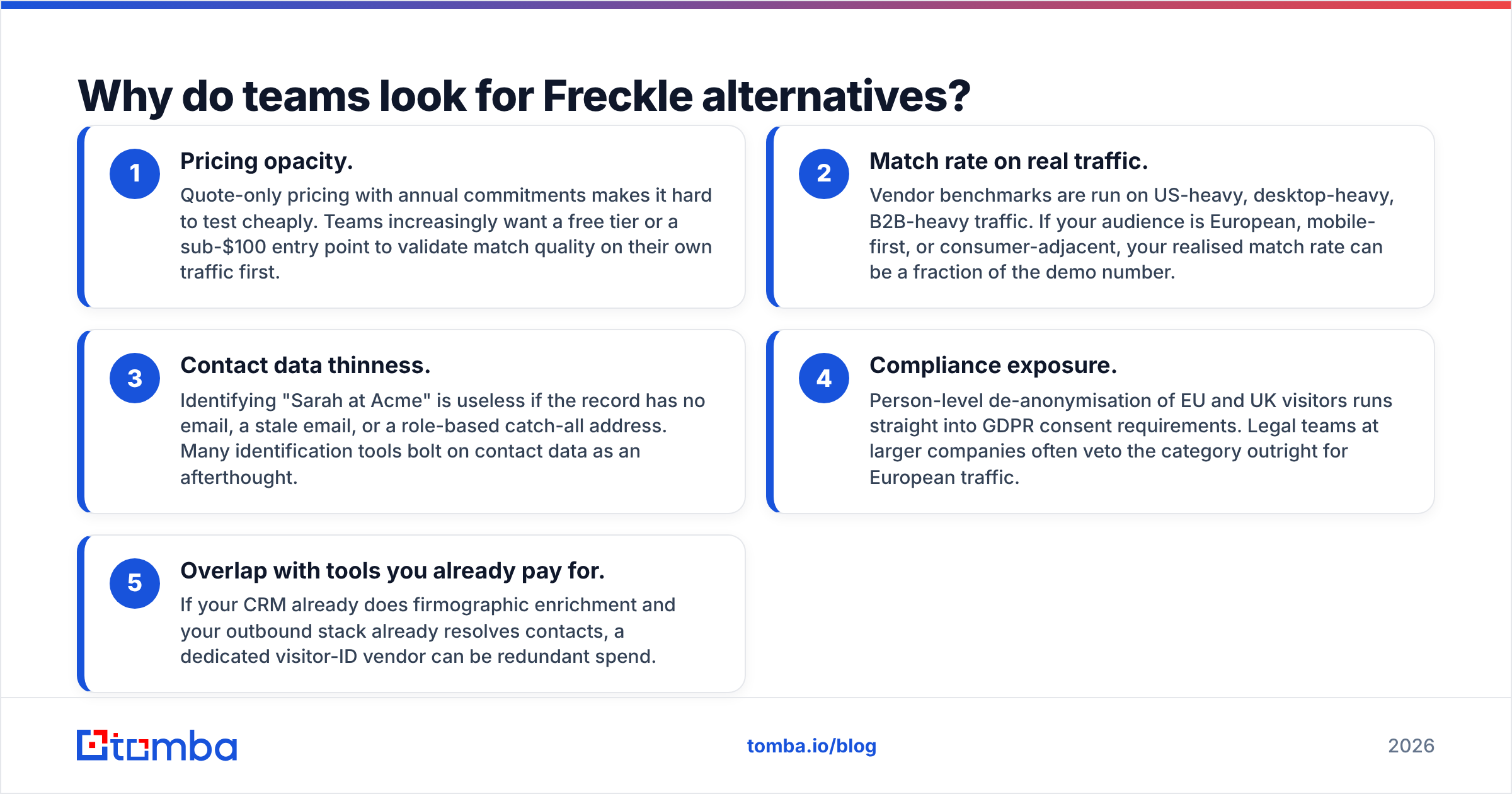
Five patterns show up repeatedly when teams evaluate a switch:
- Pricing opacity. Quote-only pricing with annual commitments makes it hard to test cheaply. Teams increasingly want a free tier or a sub-$100 entry point to validate match quality on their own traffic first.
- Match rate on real traffic. Vendor benchmarks are run on US-heavy, desktop-heavy, B2B-heavy traffic. If your audience is European, mobile-first, or consumer-adjacent, your realised match rate can be a fraction of the demo number.
- Contact data thinness. Identifying "Sarah at Acme" is useless if the record has no email, a stale email, or a role-based catch-all address. Many identification tools bolt on contact data as an afterthought.
- Compliance exposure. Person-level de-anonymisation of EU and UK visitors runs straight into GDPR consent requirements. Legal teams at larger companies often veto the category outright for European traffic.
- Overlap with tools you already pay for. If your CRM already does firmographic enrichment and your outbound stack already resolves contacts, a dedicated visitor-ID vendor can be redundant spend.
How should you evaluate a Freckle alternative?#
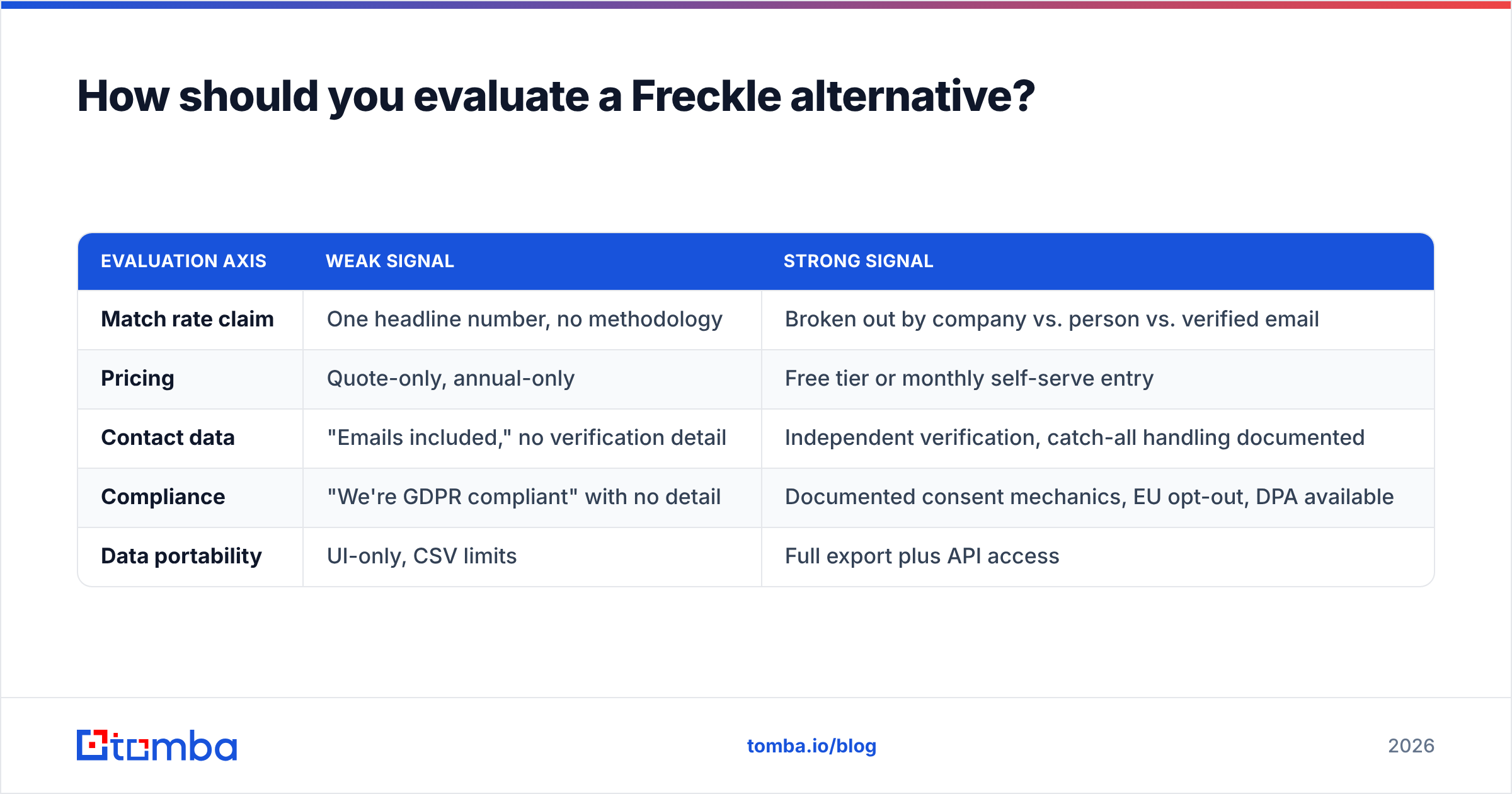
Judge every candidate on the same five axes, and insist on testing against your traffic, not a canned demo dataset:
- Resolution level — company-only, person-level, or both? Company-level is lower risk and higher volume. Person-level is higher value and higher risk. Know which one you're buying.
- Deliverable-contact yield — of the identities returned in a 30-day trial, what percentage came with an email that passes independent verification? This is the only match-rate number that maps to pipeline. Run the export through an email verifier you control, not the vendor's own scoring.
- Geographic coverage — ask for match rate broken out by region. US-only strength is common; EU coverage is where most tools thin out fast.
- Cost per usable contact — divide the annual contract by the number of verified, sequence-ready contacts you actually produced in the trial. A $12,000 tool that yields 400 usable contacts costs $30 each. A $588/year tool that yields 300 costs $2.
- Exit cost — can you export identified accounts and contacts in bulk, or does the data live inside the vendor's UI? Pixel-based tools that hoard the resulting data create real switching friction.
| Evaluation axis | Weak signal | Strong signal |
|---|---|---|
| Match rate claim | One headline number, no methodology | Broken out by company vs. person vs. verified email |
| Pricing | Quote-only, annual-only | Free tier or monthly self-serve entry |
| Contact data | "Emails included," no verification detail | Independent verification, catch-all handling documented |
| Compliance | "We're GDPR compliant" with no detail | Documented consent mechanics, EU opt-out, DPA available |
| Data portability | UI-only, CSV limits | Full export plus API access |
What are the best Freckle alternatives in 2026?#
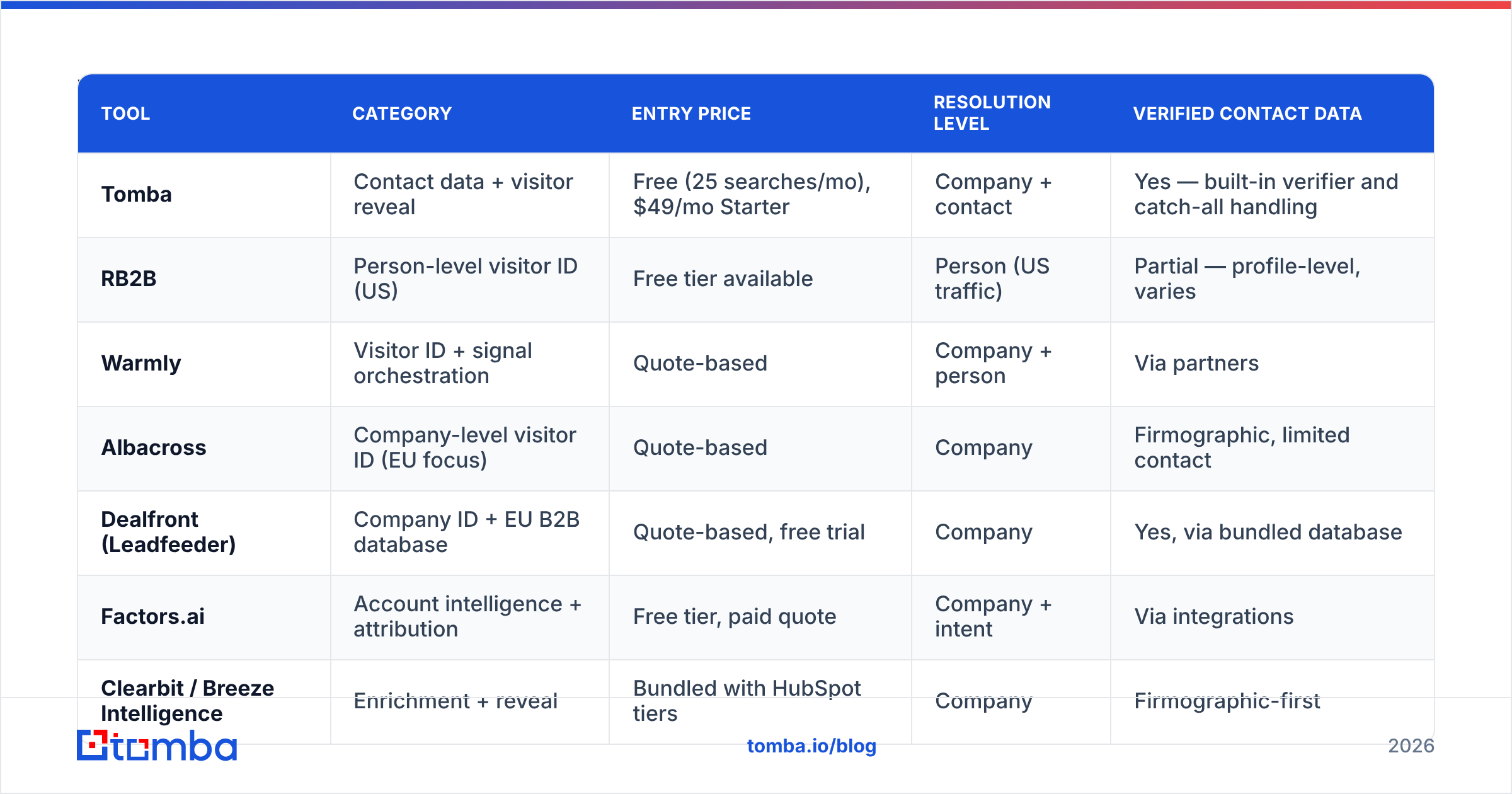
The honest framing: no single tool wins on every axis. Pick based on whether your bottleneck is identification volume or contact quality.
| Tool | Category | Entry price | Resolution level | Verified contact data |
|---|---|---|---|---|
| Tomba | Contact data + visitor reveal | Free (25 searches/mo), $49/mo Starter | Company + contact | Yes — built-in verifier and catch-all handling |
| RB2B | Person-level visitor ID (US) | Free tier available | Person (US traffic) | Partial — profile-level, varies |
| Warmly | Visitor ID + signal orchestration | Quote-based | Company + person | Via partners |
| Albacross | Company-level visitor ID (EU focus) | Quote-based | Company | Firmographic, limited contact |
| Dealfront (Leadfeeder) | Company ID + EU B2B database | Quote-based, free trial | Company | Yes, via bundled database |
| Factors.ai | Account intelligence + attribution | Free tier, paid quote | Company + intent | Via integrations |
| Clearbit / Breeze Intelligence | Enrichment + reveal | Bundled with HubSpot tiers | Company | Firmographic-first |
| Vector | Person-level intent + contacts | Quote-based | Person | Yes |
| BookYourData | Verified B2B contact database | Pay-as-you-go credits | Contact-level | Yes — accuracy-guaranteed lists |
Pricing in this category moves constantly and most vendors negotiate. Confirm current numbers on each vendor's own site — and on G2 for user-reported detail — before you commit to an annual term.
Tomba#
Best fit when your bottleneck is contact data rather than traffic identification. Tomba's core is the email finder, with domain search, catch-all verification, phone lookup and enrichment alongside it, plus a website visitor reveal layer. The practical pattern: identify accounts however you like, then use domain search to pull the right personas at those accounts and verify before sending.
Pricing is public and low-friction — Free (25 searches/mo), Starter $49/mo, Growth $99/mo, Pro $249/mo, Enterprise custom. See Tomba pricing for current limits. That matters when you're testing a hypothesis rather than committing a year of budget.
Trade-off: it is not a person-level de-anonymisation specialist. If your entire strategy depends on naming individual anonymous visitors, pair it with a dedicated identification layer.
RB2B#
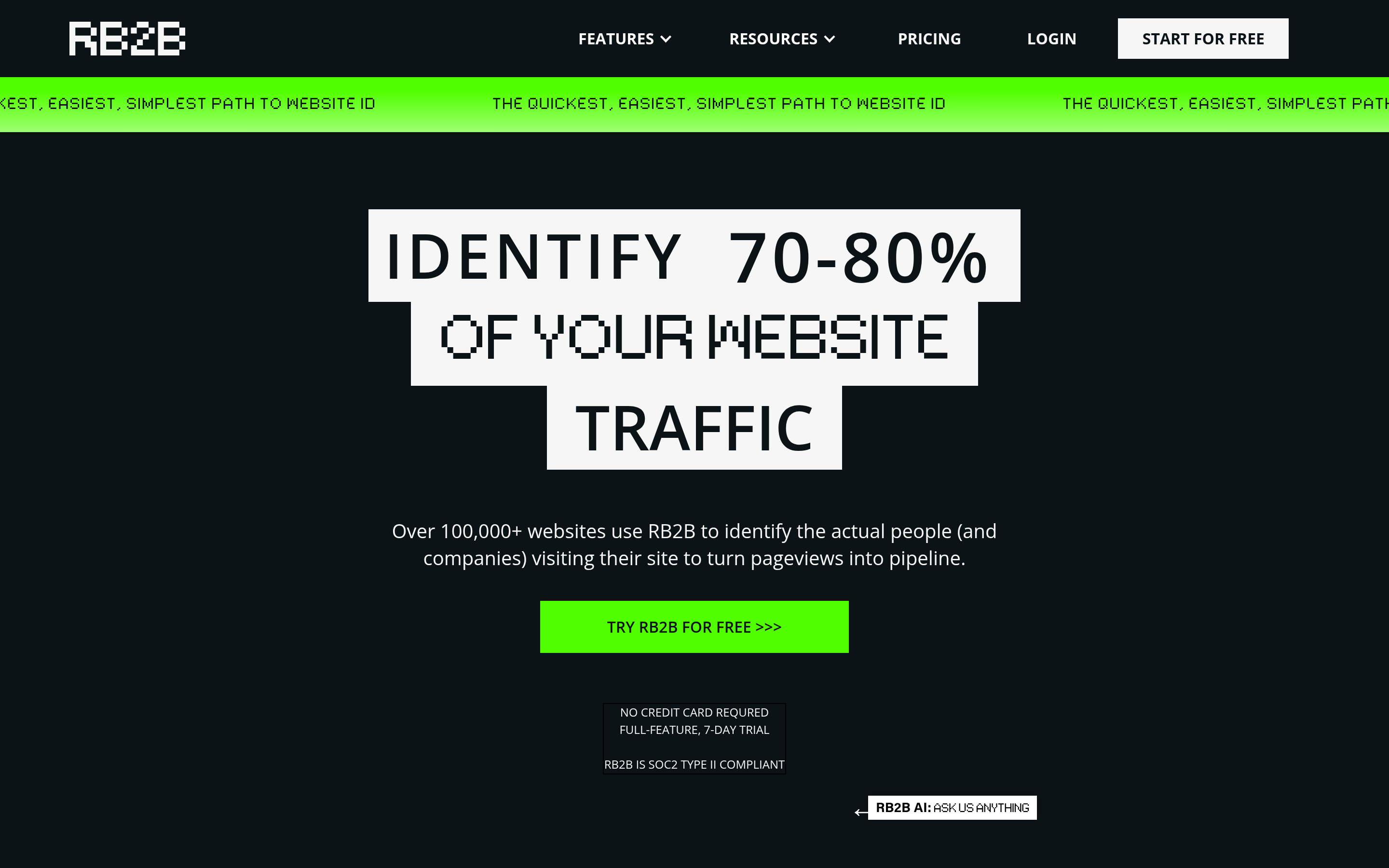
The best-known person-level identifier for US traffic, with a free tier that made the category accessible. Strong Slack-native workflow — identified visitors land in a channel in near real time.
Trade-off: US-only coverage by design, and profile completeness varies. Many teams run RB2B for identification and a separate finder/verifier for deliverable addresses.
Warmly#
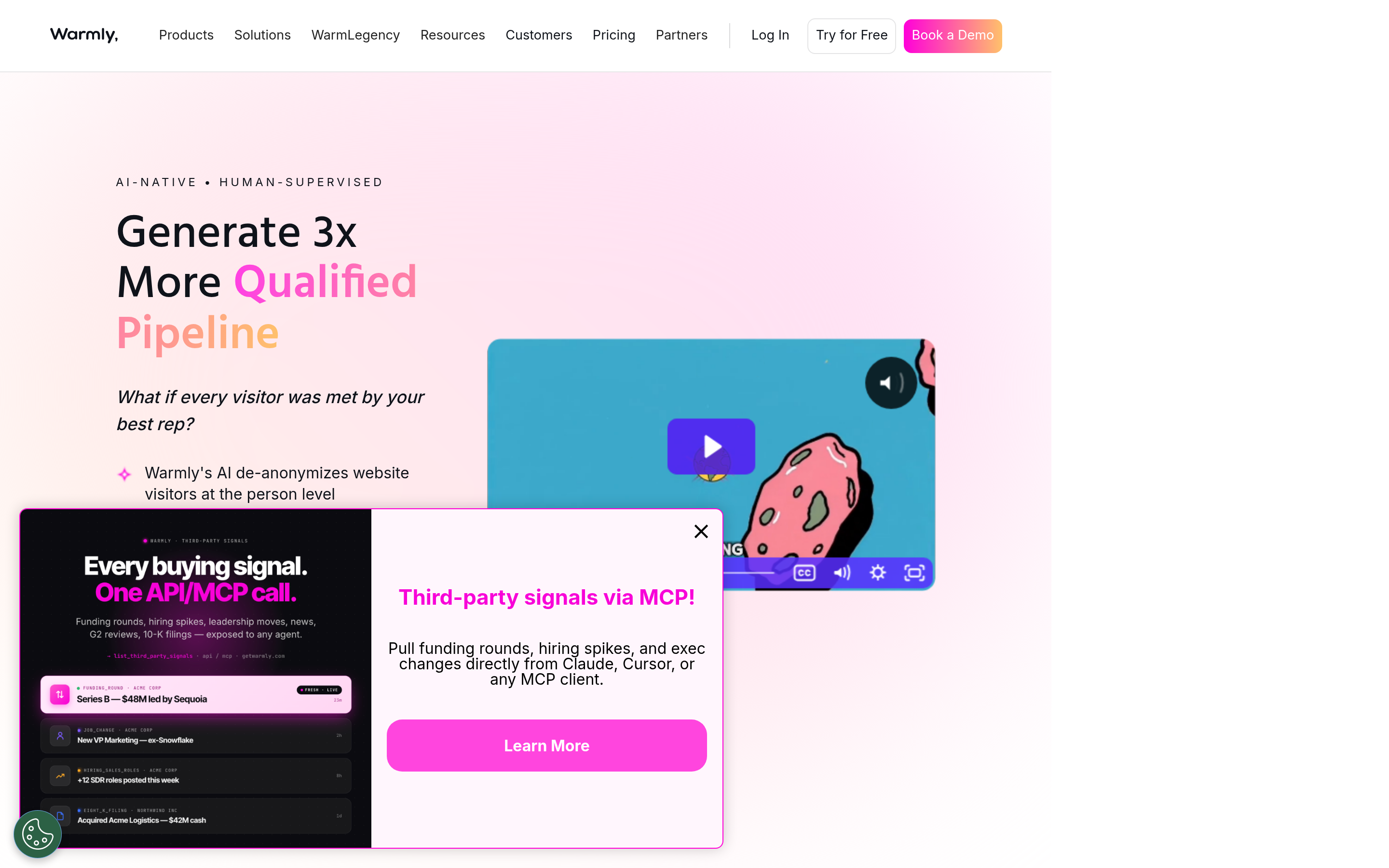
Combines visitor identification with orchestration — auto-enrolment into sequences, chat pop-ups for warm visitors, and Slack alerts. Good for teams that want the signal to trigger action automatically instead of landing in a CSV.
Trade-off: quote-based pricing that generally lands well above SMB budgets, and value depends on having enough traffic to justify the orchestration layer.
Albacross#
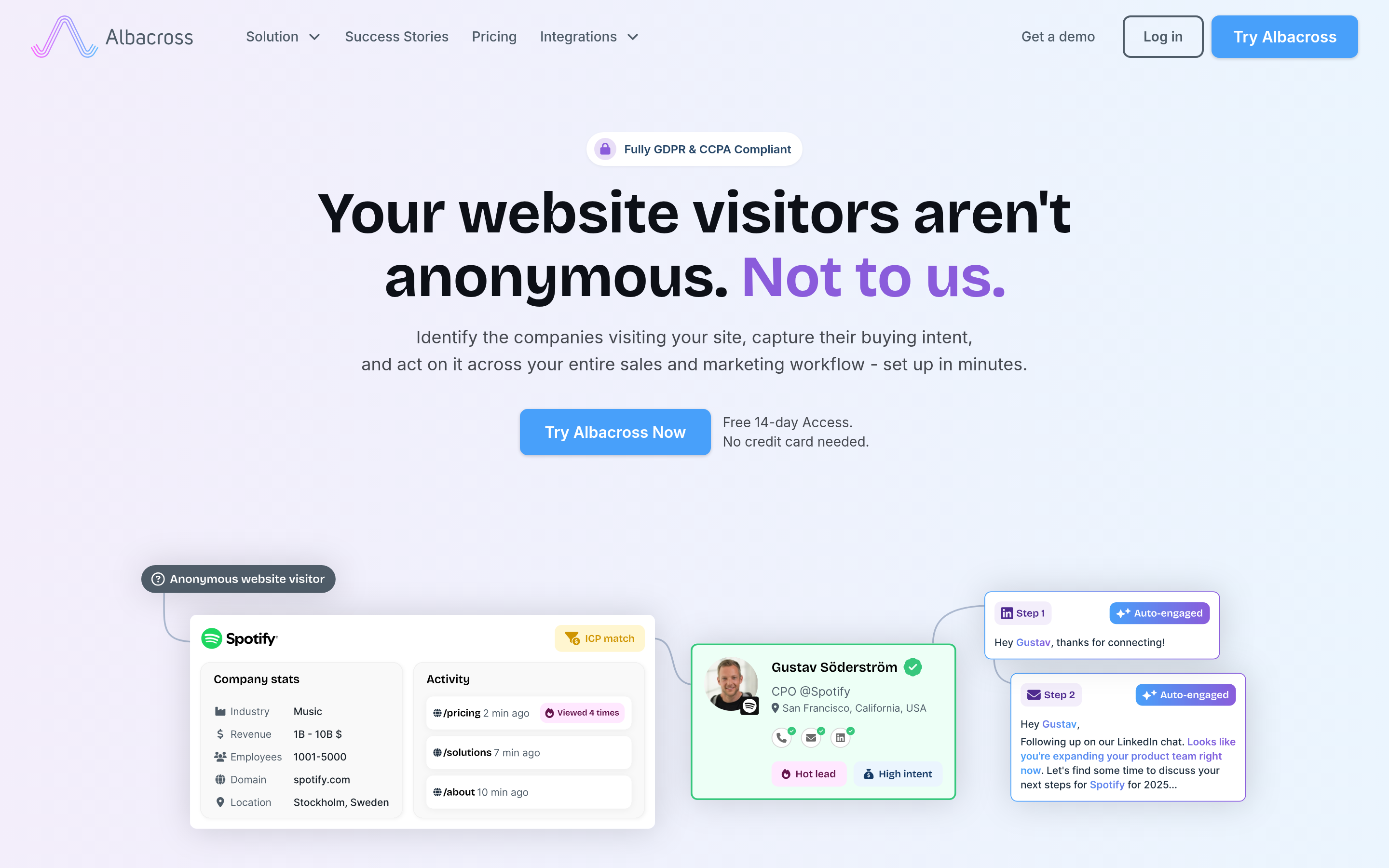
Long-established company-level identification with stronger European coverage than most US-first tools, and a company-level model that sidesteps the sharpest person-level consent questions.
Trade-off: company-level only. You still need to find the right person and their verified email — which is exactly the gap an email finder API fills.
Dealfront (Leadfeeder + Echobot)#
The merged Leadfeeder/Echobot product pairs company-level identification with a large European B2B database, making it one of the more coherent EU-first options. Useful if your ICP is DACH or Nordic.
Trade-off: the bundle is priced as a platform, so it's expensive if you only need one half of it.
Factors.ai#
Sits closer to account intelligence and marketing attribution than pure identification — it stitches website behaviour, ad data and intent signals into account-level scoring. Strong for demand-gen teams that need to prove which channels produce pipeline.
Trade-off: reporting-heavy. If you want a list of people to email tomorrow, this is more machinery than you need.
Clearbit / HubSpot Breeze Intelligence#
Now folded into HubSpot's data layer, this is the default if you already live in HubSpot. Reveal and enrichment sit natively next to your CRM records, which removes an integration headache.
Trade-off: firmographic-first, and value is tied to your HubSpot tier. Standalone buyers have fewer options than they did pre-acquisition. If you're evaluating the standalone route, the Clearbit alternative comparison covers the gaps.
Vector#

Person-level intent plus contact data, aimed at outbound teams that want the signal and the contact in one payload rather than joining two systems.
Trade-off: quote-based, newer, and coverage is strongest in US tech.
BookYourData#
A different answer to the same problem: instead of identifying who visited, buy a verified, targeted contact list for the segment you already know converts. Their accuracy-guaranteed model and pay-as-you-go credits make it a genuinely low-risk way to fill a segment fast, and it pairs well with a company-level identification layer — identify the accounts, then pull verified contacts for the matching personas.
Trade-off: list-based buying doesn't capture the timing signal that visitor ID gives you. Best used alongside identification, not instead of it.

Is person-level visitor identification legal in 2026?#
Short answer: it depends entirely on where your visitors are, and "the vendor says it's compliant" is not a defence.
Person-level identification of EU and UK visitors generally requires a lawful basis and, in practice, consent for the tracking technologies involved. Most vendors handle this by geo-fencing — running person-level resolution only for US traffic and falling back to company-level elsewhere. Ask directly how the tool behaves for an EU visitor, and get the answer in writing along with a DPA.
Analyst coverage from firms like Gartner has consistently flagged identity-resolution vendors as a governance risk area for exactly this reason. If you're in a regulated vertical or sell into enterprise, loop legal in before the pilot, not after procurement asks.
The lower-risk pattern that most compliance teams accept: company-level identification (no personal data resolved from the visit) plus separately sourced business contact data for the personas you target at that company. That is also, conveniently, the cheaper stack.
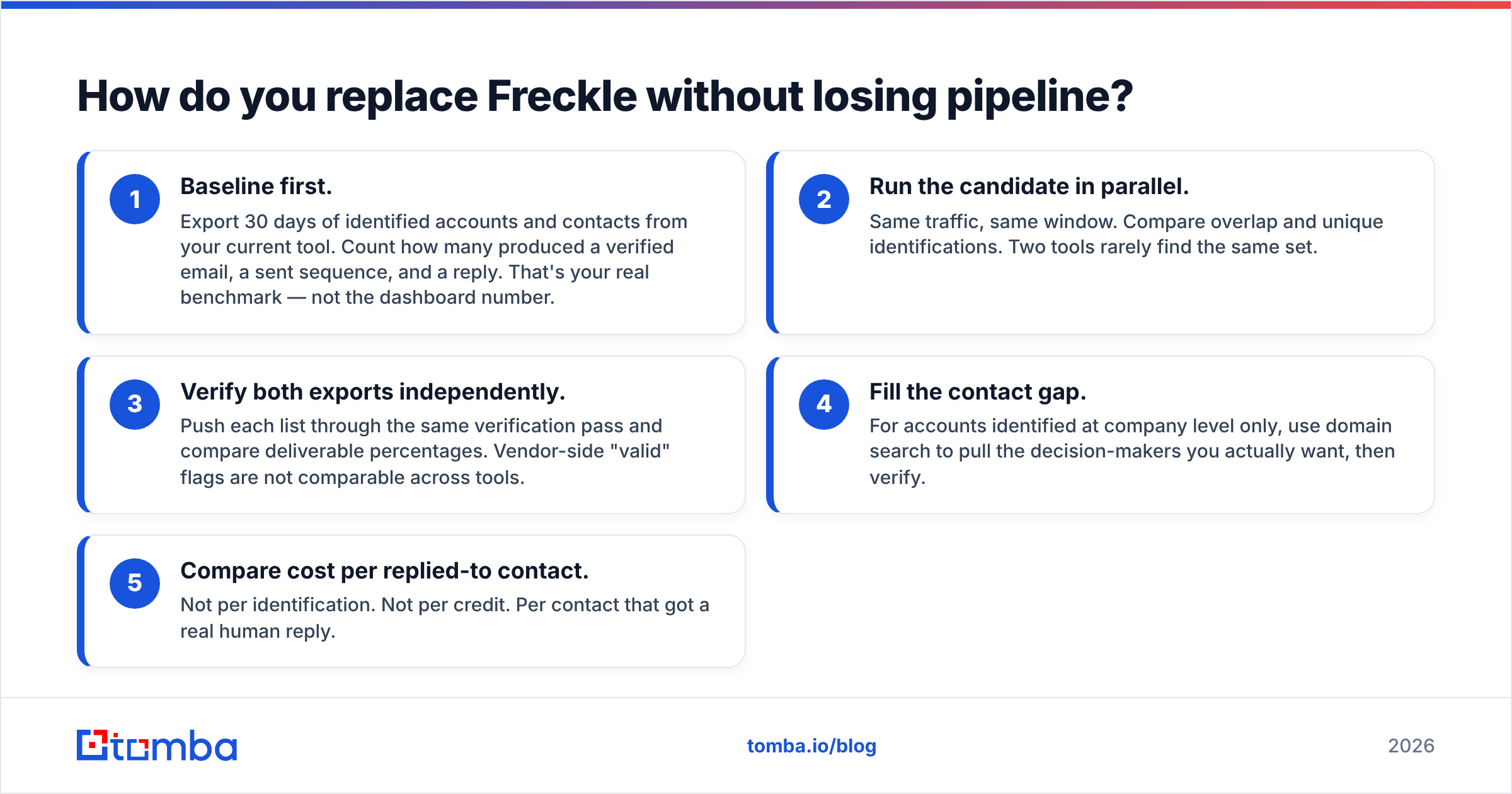
How do you replace Freckle without losing pipeline?#
Run the swap as a 30-day overlap, not a cutover:
- Baseline first. Export 30 days of identified accounts and contacts from your current tool. Count how many produced a verified email, a sent sequence, and a reply. That's your real benchmark — not the dashboard number.
- Run the candidate in parallel. Same traffic, same window. Compare overlap and unique identifications. Two tools rarely find the same set.
- Verify both exports independently. Push each list through the same verification pass and compare deliverable percentages. Vendor-side "valid" flags are not comparable across tools.
- Fill the contact gap. For accounts identified at company level only, use domain search to pull the decision-makers you actually want, then verify.
- Compare cost per replied-to contact. Not per identification. Not per credit. Per contact that got a real human reply.
Teams that run this properly are often surprised: the expensive identification layer produces fewer usable contacts than a cheap one paired with a strong finder and verifier. Sometimes it produces more, and then the spend is justified. Either way you'll know, which is more than most buyers in this category can say.
Which Freckle alternative should you actually pick?#
- US-heavy traffic, person-level signal is the whole point: RB2B or Vector, paired with independent verification.
- European traffic or a nervous legal team: Albacross or Dealfront at company level, contacts sourced separately.
- Already on HubSpot: Breeze Intelligence, unless you need person-level resolution.
- Contact data is the real bottleneck: Tomba, with a free or cheap identification layer in front of it.
- You need volume in a known segment this week: BookYourData for verified list coverage, with identification layered on for timing.
Start where the constraint actually is. Most teams discover their problem was never identifying visitors — it was turning identified accounts into people they could reliably reach.
Ready to fix the contact-data half of the problem? Tomba Email Finder turns a company domain and a name into a verified, deliverable business email — with catch-all handling, bulk processing, and an API that drops into whatever identification layer you choose. Start free with 25 searches a month, or run a full 30-day parallel test on the $49/mo Starter plan and see what your identified accounts are really worth.
Related guides#
Ready to find emails that actually work?
Join 150,000+ professionals who stopped guessing and started sending. Free credits on signup — no credit card required.
Get the Tomba newsletter
Practical outbound tactics and product updates — once every two weeks.
About the author