Freckle Pricing 2026: Reviews, Pros and Cons, Real Costs
Freckle sells itself as Clay without the learning curve. We break down the credit model, the free plan limits, what reviewers actually complain about, and when a cheaper stack does the same job.
TL;DR
- Freckle pricing runs on output credits: a free tier with 500 credits/month and unlimited seats, then paid plans that start around $99/month for roughly 2,500 credits and climb toward $999/month for 40,000 credits.
- One credit = one delivered data point. Phone numbers cost 5 credits each, so a phone-heavy workflow burns budget 5x faster than an email-only one.
- The genuine strength is the CRM-native model: Freckle sits on top of HubSpot or Salesforce and auto-enriches records as they arrive, with no table-building or formula syntax.
- The genuine weakness is scope. If you are not on HubSpot or Salesforce, or you mostly need verified work emails at volume, you are paying platform pricing for a feature.
- For pure contact discovery and verification, a dedicated finder at $49/month covers most of the same ground for a fraction of the spend.
What is Freckle and who is it actually for?#
Freckle is a CRM data enrichment platform. Founded in 2023, it plugs into HubSpot or Salesforce, watches records as they land, and fills in missing attributes using AI research agents that pull from 50+ sources.
The positioning is blunt and, to be fair, accurate: Clay without the learning curve. Clay is enormously powerful and enormously fiddly — most teams that buy it either hire a Clay specialist or watch the seat go unused after month two. Freckle's bet is that a large slice of the market wants the outcome (enriched records, on autopilot) without the table-building, waterfall configuration, and formula debugging.
You describe what you want in plain English — "find the company's funding stage, current ATS, and the VP of Engineering's LinkedIn" — and the agents go get it. That is the product in one sentence.
Who it fits: a 10–60 person go-to-market team on HubSpot or Salesforce with no dedicated RevOps engineer, where inbound and outbound records arrive dirty and nobody has time to clean them.
Who it does not fit: teams whose real problem is "we need 5,000 verified work emails this month." That is a different product category, and paying enrichment-platform rates for it is how software budgets quietly double.
How does Freckle pricing work in 2026?#
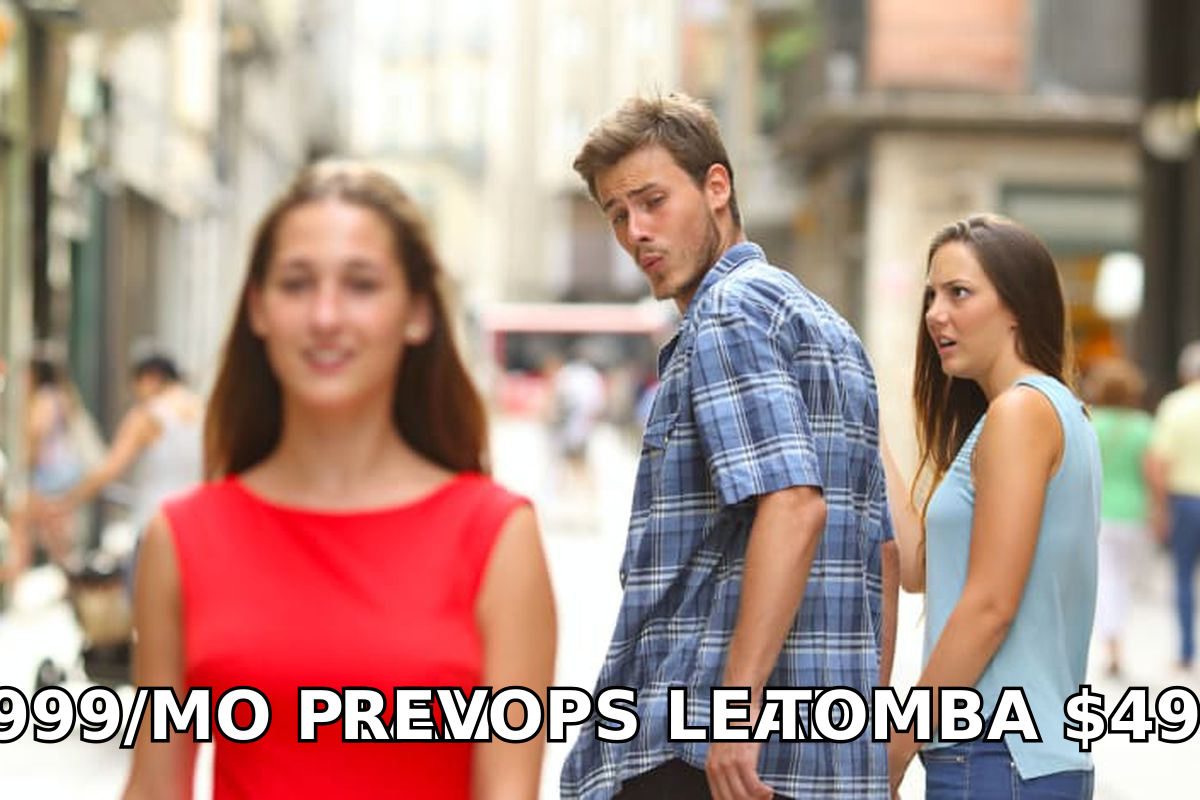
Freckle pricing is credit-based, and the company is loud about a specific distinction: you pay for outputs, not actions. If an agent runs three searches and finds nothing, you are not charged. If it returns a verified data point, that is one credit.
Here is the published shape at the time of writing. Always re-check Freckle's pricing page before you sign anything — credit-based vendors reprice more often than seat-based ones.
| Plan | Monthly cost | Credits/month | Best for |
|---|---|---|---|
| Free | $0 | 500 | Evaluation, tiny inbound volume |
| Entry paid ("Build") | ~$99/mo | ~2,500 | One-team pilot, inbound enrichment |
| Mid tier | ~$299–$499/mo | ~10,000–20,000 | Full GTM team, outbound + inbound |
| Top published tier | ~$999/mo | ~40,000 | Multi-team, high-volume CRM |
| Enterprise | Custom | Custom | Security review, SSO, custom sources |
Three mechanics matter more than the headline numbers:
- Annual commitment cuts about 15%. Standard SaaS discount, standard trade-off — you lose the ability to walk after a bad month.
- Unused credits roll over up to 2x your monthly limit. Better than the burn-it-or-lose-it model most enrichment vendors use, but the cap means a slow quarter still wastes budget.
- Top-ups cost 1.25x your plan's per-credit rate. Overage is deliberately priced as a nudge to upgrade. Size your plan for your busy month, not your average one.
What does one Freckle credit actually buy?#
This is where most pricing comparisons go wrong. "2,500 credits for $99" sounds like 2,500 enriched contacts. It is not.
- One credit = one delivered attribute, not one record. A contact where you want email, title, LinkedIn URL, and company headcount is four credits, not one.
- Phone numbers cost 5 credits each. A single mobile number costs the same as five company attributes. Phone-first teams should model this carefully before committing.
- Failed lookups are free. Genuinely good policy — you are not billed for the agent trying and missing, which is the single most common complaint about competitor credit models.
- Waterfall enrichment counts once. If Freckle checks four providers and the fourth one returns the email, you pay one credit, not four.
- Unlimited users on every tier, including free. No per-seat tax. For a 20-person sales floor this is a material saving versus seat-priced enrichment tools.
Run the math on your own record shape. A team enriching 500 new CRM records a month with 5 attributes each burns 2,500 credits — exactly the entry plan, with zero headroom for outbound list building. That is the number to stress-test in a demo.
Is the free plan enough to evaluate Freckle?#
Mostly, yes — and that is unusual enough to call out.
The free tier includes 500 credits, natural-language data requests, AI research agents, email and phone enrichment, waterfall enrichment, webhooks, native CRM integrations, and basic export. Compare that to enrichment vendors who gate the CRM sync behind the $500/month tier, and Freckle's free plan is a real trial rather than a lead magnet.
Use those 500 credits deliberately:
- Pick 40 records from your CRM you already know cold — ones where you can eyeball the answer.
- Request the same 5 attributes you would ask for in production, including at least a few phone numbers.
- Score the fill rate and the accuracy separately. High fill with 70% accuracy is worse than lower fill with 95%, because bad data reaches your reps as truth.
- Time the round trip. Agent-based research is slower than static-database lookups; if your speed-to-lead SLA is 60 seconds, verify Freckle clears it.
What do Freckle reviews say are the real strengths?#
Across G2, Capterra, and independent 30-day teardowns, the praise clusters tightly:
It actually removes work. The most repeated line in Freckle reviews is that setup took under an hour and nobody needed training. For teams who bounced off Clay, this is the whole value proposition and it appears to land.
The plain-English requests work better than expected. Asking for "companies hiring SDRs right now" or "current CRM in the tech stack" returns usable answers. These are long-tail attributes that static B2B databases simply do not carry, because they go stale in weeks.
Output-based billing builds trust. Not being charged for misses is a small policy with a large psychological effect. Buyers who have been burned by action-credit models notice immediately.
No seat tax. Unlimited users on every plan means you can give the whole revenue team access without a procurement conversation.
Auto-enrichment on arrival. Records get enriched when they land, not when someone remembers to run a batch. That is the difference between clean data and a quarterly cleanup project.
What are the cons buyers actually report?#
CRM support is narrow. HubSpot and Salesforce, and that is it. If you run Pipedrive, Close, Attio, or anything homegrown, the core differentiator — CRM-native auto-enrichment — evaporates. You are left with an API and a UI, which plenty of cheaper tools also offer.
Credit math is opaque until you use it. The multi-attribute-per-record structure means real consumption routinely runs 3–6x what buyers estimate. Several reviewers describe blowing through a monthly allocation in the first ten days of a list-building sprint.
Phone credits are expensive. At 5 credits each, mobile numbers on the entry plan cap out around 500/month if you spend the entire allocation on phones. Cold-calling teams should price a dedicated phone finder alongside it rather than absorbing that into enrichment credits.
Young company, thin track record. Founded in 2023 with modest disclosed funding. That is not disqualifying — plenty of good tools are young — but it belongs in your risk assessment if Freckle would become load-bearing for CRM hygiene.
No verification layer worth the name. Enrichment finds data. It does not tell you whether the mailbox will accept mail six weeks from now. You still need an email verifier in the chain before anything hits a sending tool.
Agent latency. Research agents are slower than index lookups. For batch overnight work this is irrelevant. For real-time form enrichment it can be a problem.

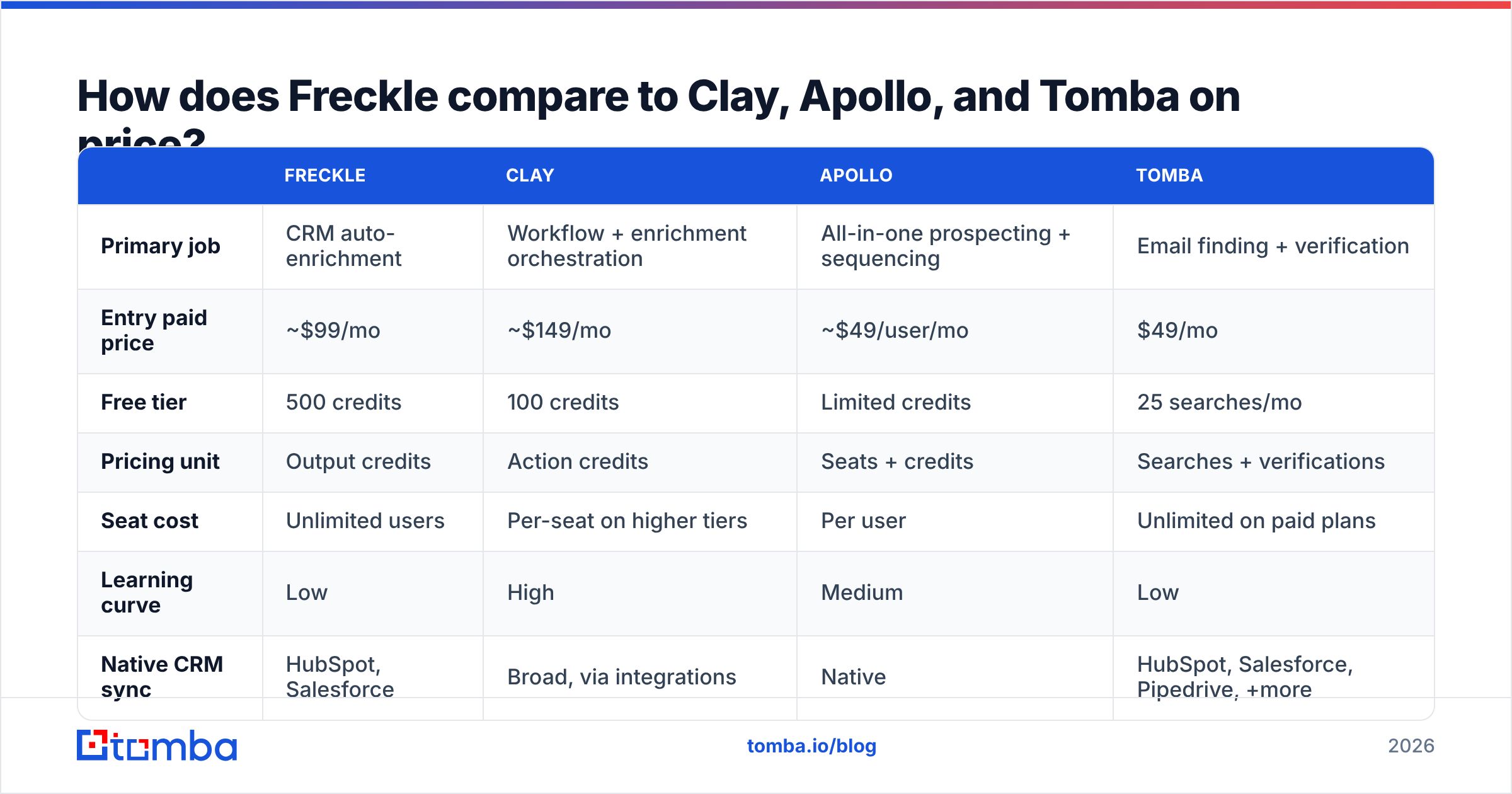
How does Freckle compare to Clay, Apollo, and Tomba on price?#
Different categories, overlapping jobs. The honest framing is that Freckle competes with Clay on workflow and competes with contact-data tools only at the edges.
| Freckle | Clay | Apollo | Tomba | |
|---|---|---|---|---|
| Primary job | CRM auto-enrichment | Workflow + enrichment orchestration | All-in-one prospecting + sequencing | Email finding + verification |
| Entry paid price | ~$99/mo | ~$149/mo | ~$49/user/mo | $49/mo |
| Free tier | 500 credits | 100 credits | Limited credits | 25 searches/mo |
| Pricing unit | Output credits | Action credits | Seats + credits | Searches + verifications |
| Seat cost | Unlimited users | Per-seat on higher tiers | Per user | Unlimited on paid plans |
| Learning curve | Low | High | Medium | Low |
| Native CRM sync | HubSpot, Salesforce | Broad, via integrations | Native | HubSpot, Salesforce, Pipedrive, +more |
| Verification included | Limited | Via providers | Basic | Full verifier + catch-all handling |
| API access | Yes | Yes | Yes | Yes, on all paid plans |
Read the table by job, not by price. If your bottleneck is "our CRM records are 40% empty and nobody owns fixing it," Freckle at $99/month is cheap. If your bottleneck is "we need 3,000 verified work emails a month for outbound," Freckle at $99/month is expensive, because you will spend most credits on attributes you did not need to buy from a research agent.
Is Freckle pricing worth it for your team?#
Worth it when:
- You are on HubSpot or Salesforce and record hygiene is a named, unowned problem.
- You need long-tail attributes — hiring signals, tech stack, funding stage — that static databases miss.
- You evaluated Clay and abandoned it because nobody had time to learn it.
- You have 15+ people who would benefit from access and seat pricing elsewhere is killing you.
Not worth it when:
- Your CRM is not HubSpot or Salesforce.
- Your dominant need is verified email at volume — that is a finder-and-verifier problem, priced accordingly.
- You are cold-calling heavy and would spend most credits on 5-credit phone lookups.
- You need sub-second real-time enrichment on inbound forms.
A pattern worth stealing: run Freckle on the enrichment half and a dedicated finder on the discovery half. Use domain search to build and verify the contact layer at flat, predictable cost, then let Freckle's agents fill the exotic attributes on records that actually reached your pipeline. You stop spending research-agent credits on work an index can do for a tenth of the price, and both tools do what they are genuinely best at.
Wire the whole thing together through your existing stack — most teams run this via a HubSpot integration on one side and the Tomba API on the other, so records get discovered, verified, and enriched without anyone touching a CSV.
What should you check before you buy?#
- Model your worst month, not your average. Overage at 1.25x is the most common source of budget surprise on credit plans.
- Count attributes per record, then multiply. Five attributes on 500 records is 2,500 credits — the entire entry plan.
- Test phone fill rate separately. At 5 credits each, phone accuracy determines whether that line item is viable at all.
- Confirm your CRM is supported today, not on the roadmap.
- Ask about data provenance and compliance. 50+ sources is a strength for coverage and a question mark for GDPR posture. Get the answer in writing.
- Benchmark against a flat-rate baseline. Price the same monthly volume through a dedicated finder's pricing and compare total cost of the outcome, not the sticker price of the tool.
The bottom line on Freckle pricing#
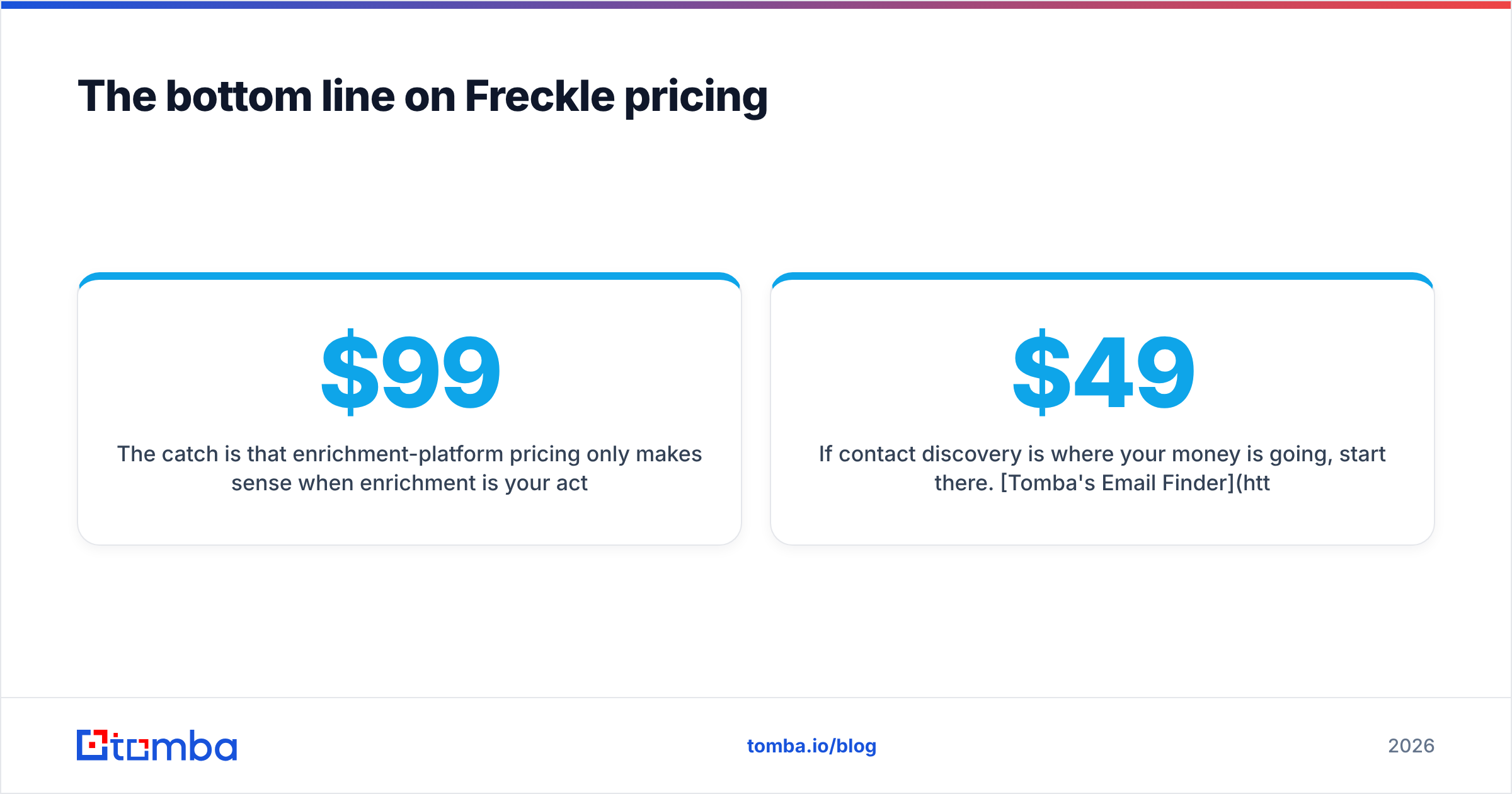
Freckle is a well-built, honestly-priced tool solving a real problem for a specific buyer: HubSpot and Salesforce teams drowning in incomplete records with nobody to own the cleanup. The output-based credit model is more buyer-friendly than most, the free tier is a genuine trial, and unlimited seats is a real cost advantage.
The catch is that enrichment-platform pricing only makes sense when enrichment is your actual bottleneck. For most outbound teams it is not — the bottleneck is finding and verifying the contact in the first place, and that is a job a $99–$999/month research-agent platform is architecturally overqualified and financially overpriced to do.
If contact discovery is where your money is going, start there. Tomba's Email Finder covers domain search, pattern detection, catch-all handling, and verification on one flat plan starting at $49/month, with 25 free searches to test accuracy against your own known-good list before you spend anything. Run it against the same 40 records you would test Freckle on, compare fill rate and bounce rate side by side, and let the numbers pick your stack.
Related guides#
Ready to find emails that actually work?
Join 150,000+ professionals who stopped guessing and started sending. Free credits on signup — no credit card required.
Get the Tomba newsletter
Practical outbound tactics and product updates — once every two weeks.
About the author