Free Business Contacts Database: What You Actually Get in 2026
Free B2B contact databases promise millions of records — but the usable share is smaller than the marketing says. Here's what free tiers really deliver, where they break, and when paying beats scraping.
TL;DR
- A "free business contacts database" almost always means one of three things: a limited free tier on a paid platform (25–100 credits/month), a scraped public dataset, or a directory you can browse but not export.
- Free datasets skew stale. B2B contact data decays roughly 25–30% per year as people change jobs, so a 2023 dump is mostly noise by 2026.
- The realistic free ceiling is 25–150 verified contacts per month across stacked free tiers — enough to test a message, not to run a pipeline.
- Verification matters more than volume. An unverified free list with a 22% bounce rate will damage your sending domain faster than it generates meetings.
- Best free-to-paid path: use free tiers for discovery and pattern-finding, then pay only for verified, deliverable records at the moment you actually send.
What Is a Free Business Contacts Database?#
A free business contacts database is any source that gives you B2B contact records — name, company, role, email, sometimes phone — without a credit card. The category is broad and mostly mislabeled, so it helps to split it into four honest buckets.
- Freemium platform tiers. Commercial vendors give you a small monthly credit allowance so you can test data quality. Tomba's free tier gives 25 searches per month; other vendors run 10–100. The data is the same data paying customers get — you just get less of it.
- Open and public datasets. Company registries (SEC EDGAR, UK Companies House, OpenCorporates), government supplier lists, and open-data portals. Excellent for firmographics — legal name, address, registration number, SIC code. Almost never contains a working personal email.
- Scraped or leaked dumps. The "50 million B2B contacts, free download" torrents and Google Drive links. Legally radioactive under GDPR and CCPA, almost always years old, and frequently seeded with spam traps.
- Directories and communities. Chamber of commerce listings, industry association member pages, conference attendee lists, Crunchbase free view. Browsable, rarely exportable, but genuinely useful for building a named-account list by hand.
The confusion happens because all four get marketed with the same phrase. When someone says they found a free B2B database with two million records, they usually mean bucket three — and bucket three is the one that will get your domain blocklisted.
Why Do Free Contact Databases Decay So Fast?#
Think of a contact list like milk in the fridge. It looks fine on day one, and nothing visually changes for a while, but the expiry date is real and it does not care whether you opened the carton.
B2B contact data has a measurable decay rate. Industry consensus puts email address decay somewhere between 22% and 30% annually, driven by job changes, company rebrands, domain migrations, mergers, and layoffs. Compound that: a dataset assembled in early 2024 is, by mid-2026, roughly half wrong. Phone data decays faster still because direct dials get reassigned.
Free datasets suffer disproportionately for three reasons:
- No refresh budget. Maintaining data costs money. Whoever gave it away for free has no incentive to re-crawl it next quarter.
- No verification layer. Commercial vendors run SMTP checks, catch-all detection, and MX validation before serving a record. A CSV on a forum has none of that.
- Selection bias. Data that gets given away is usually data someone else already monetized and discarded.

The practical consequence: a 10,000-row free list is not 10,000 prospects. After removing role accounts, dead domains, job-changers, and hard bounces, you are typically left with 3,000–5,000 reachable humans, of whom maybe half are still in the right role. That is why running any list through an email verifier before the first send is not optional — it is the difference between a campaign and an incident.
How Do Free Tiers Compare Against Each Other?#
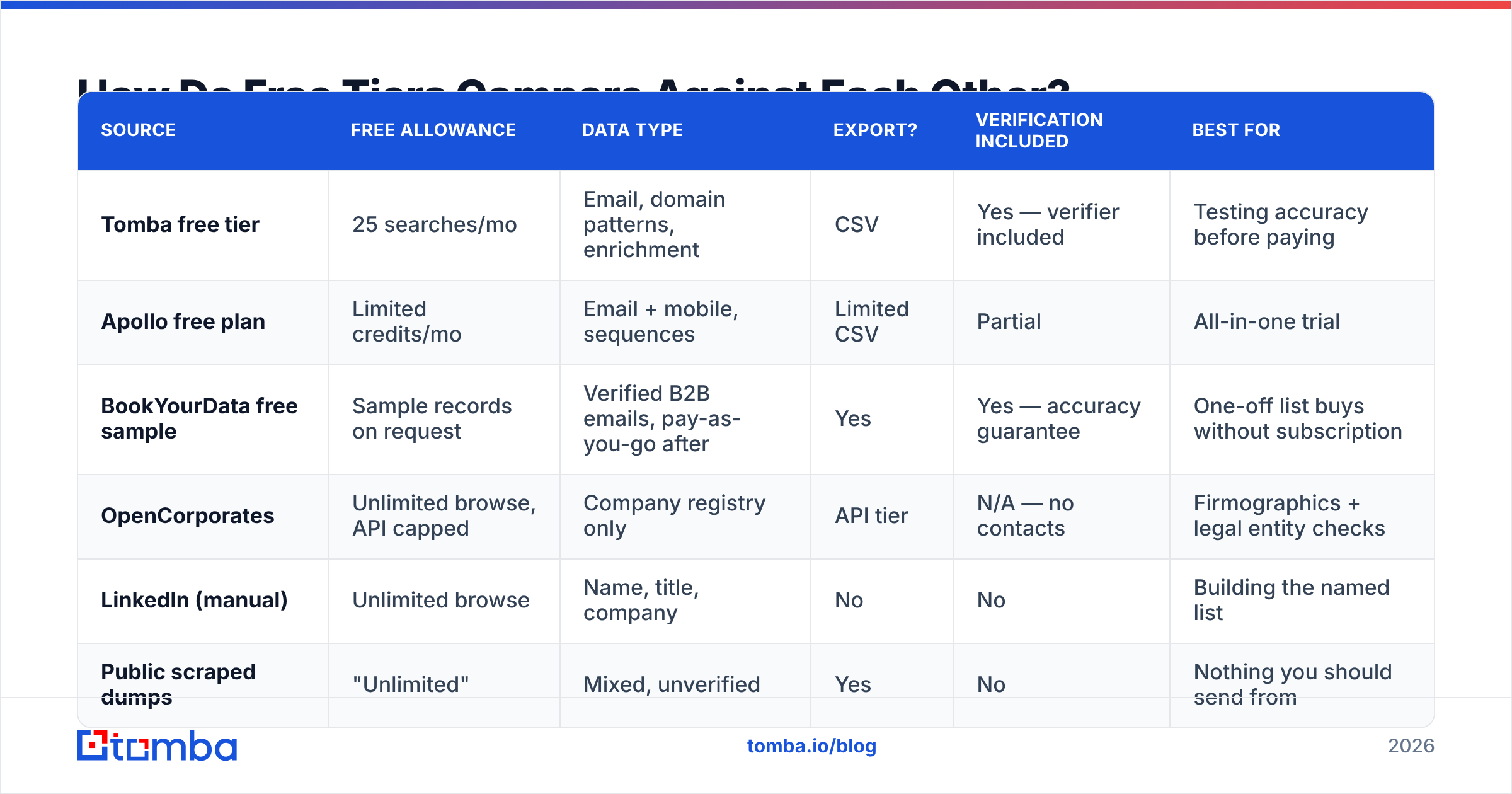
Here is what the main free options actually give you, based on publicly published tier limits as of 2026. Credit definitions differ by vendor — some count a search, others count a returned contact — so read the fine print before comparing raw numbers.
| Source | Free allowance | Data type | Export? | Verification included | Best for |
|---|---|---|---|---|---|
| Tomba free tier | 25 searches/mo | Email, domain patterns, enrichment | CSV | Yes — verifier included | Testing accuracy before paying |
| Apollo free plan | Limited credits/mo | Email + mobile, sequences | Limited CSV | Partial | All-in-one trial |
| BookYourData free sample | Sample records on request | Verified B2B emails, pay-as-you-go after | Yes | Yes — accuracy guarantee | One-off list buys without subscription |
| OpenCorporates | Unlimited browse, API capped | Company registry only | API tier | N/A — no contacts | Firmographics + legal entity checks |
| LinkedIn (manual) | Unlimited browse | Name, title, company | No | No | Building the named list |
| Public scraped dumps | "Unlimited" | Mixed, unverified | Yes | No | Nothing you should send from |
The honest takeaway from that table: the free tiers worth using are the ones attached to a real product. They are small, but the record you get back is the same record a paying customer gets. BookYourData's pay-as-you-go model is a legitimate middle path if you need a one-time list and do not want a monthly subscription — you buy a block of verified records instead of renting a seat. Tomba's free tier plus its domain search is the better fit if what you need is repeatable, pattern-based discovery you can automate later through an API.
Can You Build a Usable List Entirely for Free?#
Yes — up to about 100–150 verified contacts a month, if you are disciplined. Beyond that, the time cost overtakes the license cost.
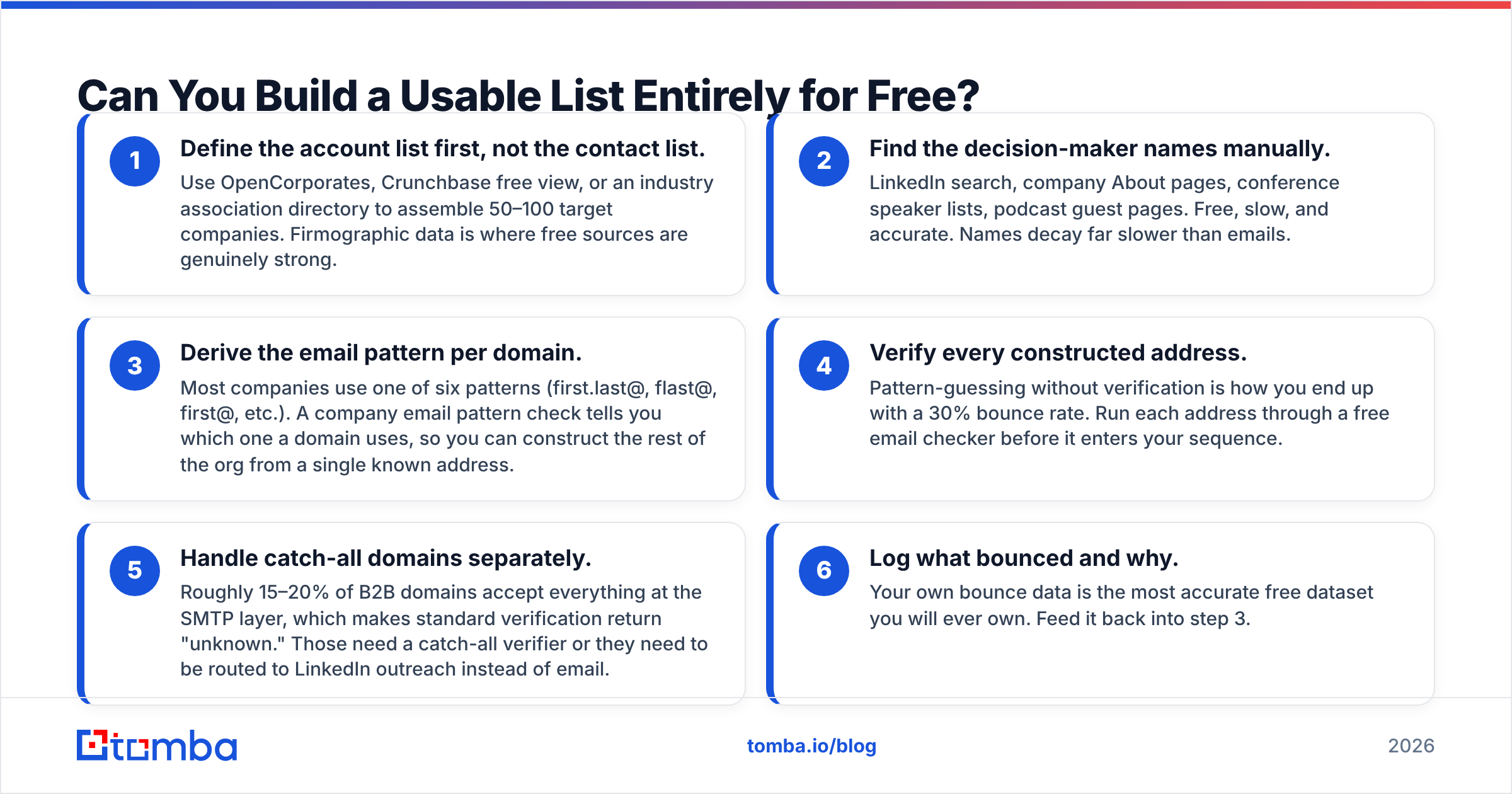
Here is the stack that actually works, in order:
- Define the account list first, not the contact list. Use OpenCorporates, Crunchbase free view, or an industry association directory to assemble 50–100 target companies. Firmographic data is where free sources are genuinely strong.
- Find the decision-maker names manually. LinkedIn search, company About pages, conference speaker lists, podcast guest pages. Free, slow, and accurate. Names decay far slower than emails.
- Derive the email pattern per domain. Most companies use one of six patterns (first.last@, flast@, first@, etc.). A company email pattern check tells you which one a domain uses, so you can construct the rest of the org from a single known address.
- Verify every constructed address. Pattern-guessing without verification is how you end up with a 30% bounce rate. Run each address through a free email checker before it enters your sequence.
- Handle catch-all domains separately. Roughly 15–20% of B2B domains accept everything at the SMTP layer, which makes standard verification return "unknown." Those need a catch-all verifier or they need to be routed to LinkedIn outreach instead of email.
- Log what bounced and why. Your own bounce data is the most accurate free dataset you will ever own. Feed it back into step 3.
That workflow yields a small, clean list. What it does not yield is scale — step 2 alone runs about four minutes per contact once you include verification and CRM entry. At 150 contacts, that is ten hours of work. Price your own time before you decide free is cheaper.
What Does a Free List Actually Cost You?#
The sticker price is zero. The real cost lands in three places.
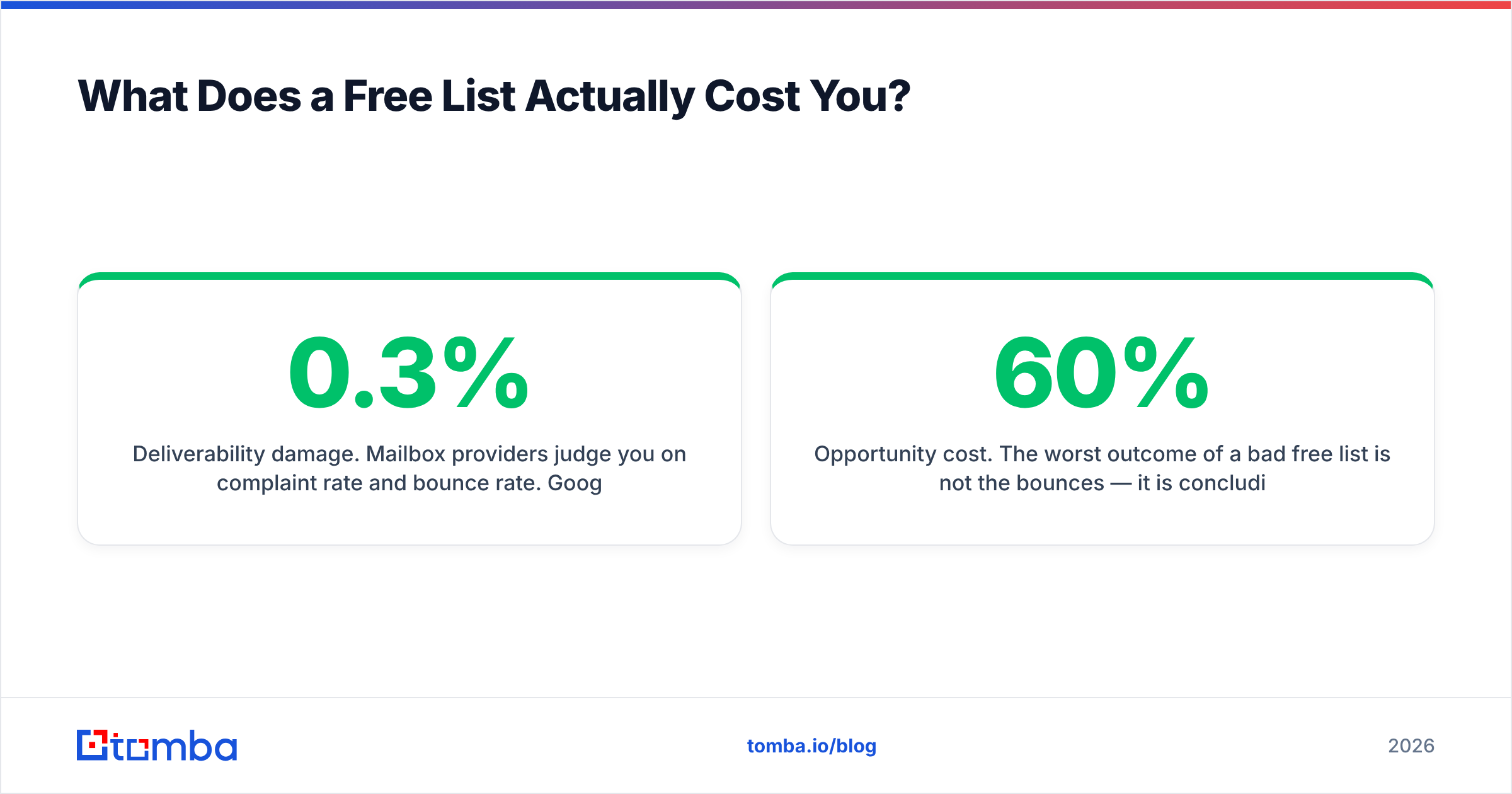
Deliverability damage. Mailbox providers judge you on complaint rate and bounce rate. Google and Yahoo's bulk-sender requirements set a spam complaint threshold of 0.3%, and sustained hard bounces above roughly 2% will throttle a domain. One 5,000-record unverified send at a 20% bounce rate can take weeks of warmup to recover from. If you want the mechanics, the glossary entry on email deliverability covers the signal weighting, and Google's own sender guidelines are the primary source.
Compliance exposure. GDPR does not ban B2B cold email, but it does require a lawful basis and demonstrable provenance for the data. "I downloaded it from a forum" is not provenance. Under CAN-SPAM the penalties attach to the sender, not the list vendor. Vendors that publish their data sources exist partly because buyers now ask this question in procurement.
Opportunity cost. The worst outcome of a bad free list is not the bounces — it is concluding your offer does not work when the real problem was that 60% of the list never received the message. You cannot read a signal through that much noise.
When Should You Stop Using Free Data?#
Three trigger points, all of them concrete.
You cross ~200 contacts a month. Below that, manual assembly is defensible. Above it, you are paying yourself minimum wage to do data entry. Tomba's Starter plan at $49/mo, or Growth at $99/mo, costs less than four hours of an SDR's time.
You need phone numbers. Free sources are essentially useless for direct dials. Mobile numbers are not published anywhere public, are not derivable from a pattern, and decay quickly. If cold calling is in your motion, this is where free ends. A phone finder with a validation layer is the only realistic route.
You need it in a system, not a spreadsheet. The moment enrichment needs to happen inside HubSpot, Salesforce, or a sequencer rather than in a CSV you re-upload weekly, free tiers stop working. That is an API problem, and free tiers rarely include API access at usable rate limits.
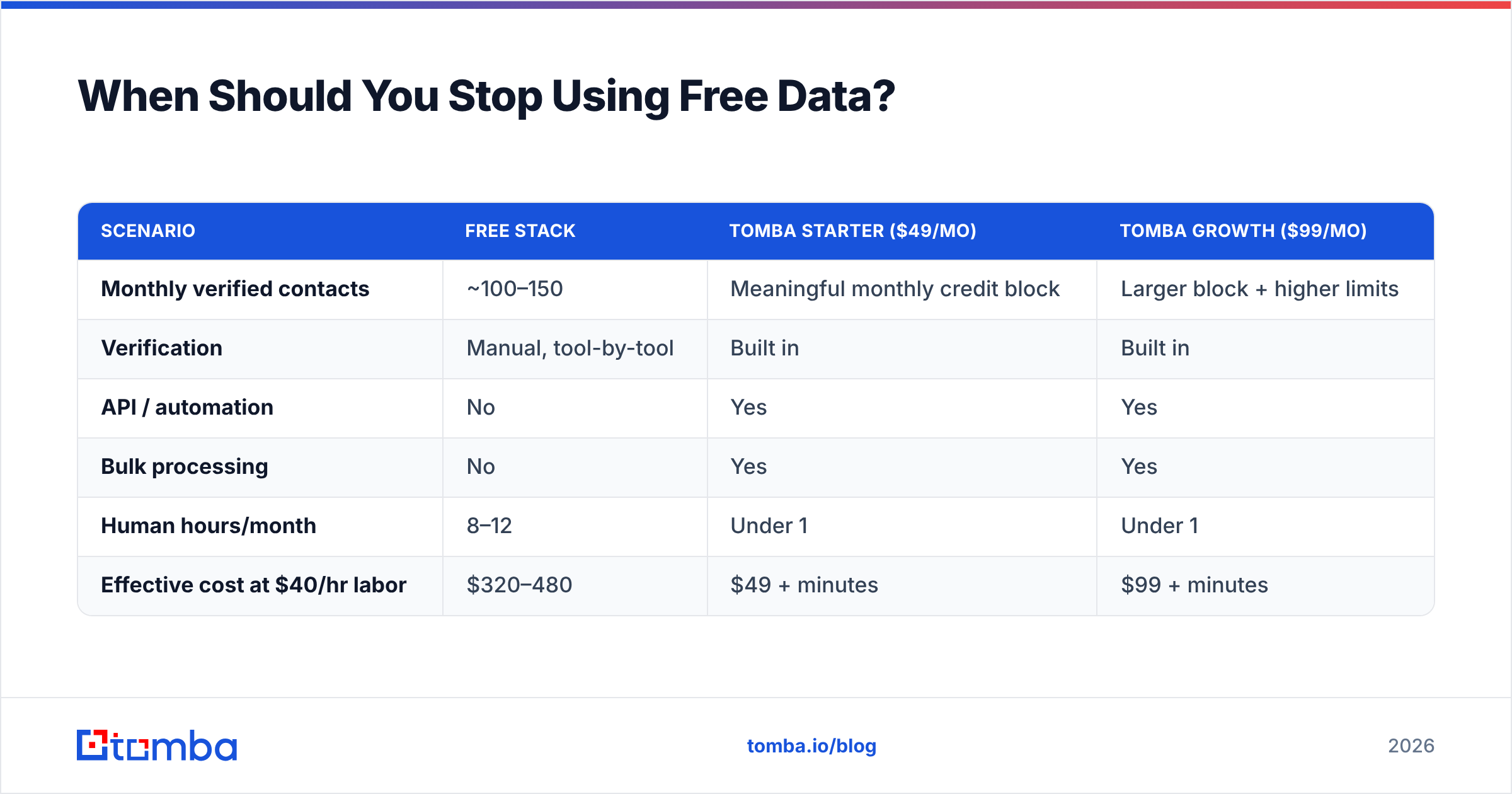
Here is the cost comparison at the point where most teams actually cross over:
| Scenario | Free stack | Tomba Starter ($49/mo) | Tomba Growth ($99/mo) |
|---|---|---|---|
| Monthly verified contacts | ~100–150 | Meaningful monthly credit block | Larger block + higher limits |
| Verification | Manual, tool-by-tool | Built in | Built in |
| API / automation | No | Yes | Yes |
| Bulk processing | No | Yes | Yes |
| Human hours/month | 8–12 | Under 1 | Under 1 |
| Effective cost at $40/hr labor | $320–480 | $49 + minutes | $99 + minutes |
The math flips almost immediately once you value your own hours at anything above a student rate. That is not an argument against free tiers — it is an argument for using them as a quality test, not a supply chain.
How Should You Evaluate Any B2B Data Source?#
Whether free or paid, ask the same five questions. Vendors that answer them clearly are the ones worth trusting.
- Where did this record come from? Public web, opt-in contribution, partner exchange, or purchase. A vendor that cannot say is a vendor that cannot indemnify you.
- When was it last verified? Not "last updated" — verified. Ask for the recency distribution, not the average.
- What is the guaranteed bounce rate? Serious vendors publish a number and credit you for exceeding it. Anything above 5% guaranteed is weak.
- How are catch-all domains handled? "We return them as valid" is the wrong answer. "We flag them separately" is the right one.
- Can I test before I commit? This is the entire legitimate function of a free tier. Run 25 known-good contacts through it and compare against reality.
Third-party review corpora are useful for the parts vendors will not tell you. G2's lead intelligence category and Capterra both surface bounce-rate complaints and billing friction that never appear on a pricing page. Read the 3-star reviews, not the 5-star ones — those are where the real limits get documented.
What Is the Right Free-to-Paid Workflow?#
Use free data for the two jobs it is genuinely good at, and pay for the one job it is bad at.
Job 1 — Account discovery (free wins). Registries, directories, LinkedIn, and news sources are free and current. Building your target account list should cost nothing but time.
Job 2 — Pattern and structure mapping (free mostly wins). Figuring out that a company uses first.last@domain.com, and that it has a VP of Ops rather than a Head of Ops, is free reconnaissance. Tools like an email permutator turn a name plus a pattern into a testable candidate set.
Job 3 — Verification and delivery (pay here). This is the step where free options collapse, and it is also the step that determines whether the campaign works at all. Verified, deliverable, catch-all-aware addresses are the thing worth spending on, because everything upstream is worthless without it.
Structure your spend that way and the monthly bill stays small. You are not buying "contacts" — you are buying the guarantee that the contacts you already found will actually receive the message. That reframing usually cuts a data budget by half while improving reply rates, because you stop paying for volume you were never going to use.
Ready to Test Data Quality Before You Pay for It?#
Start with the Tomba Email Finder free tier — 25 searches a month, no card required, with verification included so you can measure real deliverability instead of trusting a vendor's marketing number. Run your 25 hardest contacts through it, check the results against what you already know, and only then decide whether Starter at $49/mo is worth it. See full Tomba pricing for the tier that matches your volume. That is the correct use of a free business contacts database: as evidence, not as inventory.
Related guides#
Ready to find emails that actually work?
Join 150,000+ professionals who stopped guessing and started sending. Free credits on signup — no credit card required.
Get the Tomba newsletter
Practical outbound tactics and product updates — once every two weeks.
About the author