Free Business Leads: 12 Sources That Actually Convert in 2026
Free lead lists are everywhere, and most of them are recycled junk. Here are the 12 sources that still produce usable B2B contacts in 2026, ranked by real accuracy, volume ceiling, and the hidden cost you pay in bounces and wasted rep time.
TL;DR
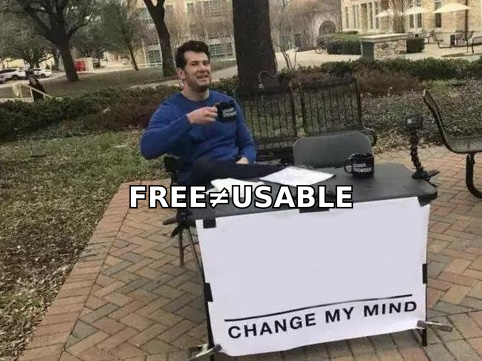
- Free business leads exist, but "free" almost always means you pay in verification, bounces, or manual research time instead of dollars.
- The highest-quality free sources are ones you generate yourself: your own website traffic, your CRM's closed-lost pile, and public company directories you scrape and verify.
- Downloadable "free B2B lead lists" are the worst category. Most are resold, 12-36 months stale, and land you 30-50% bounce rates.
- The realistic model in 2026 is hybrid: source names and companies free, then spend a few cents per contact on a verified email so your domain survives.
- A free tier from a real data vendor (Tomba gives 25 searches/month) beats a 10,000-row CSV of unverified guesses every single time.
What actually counts as a free business lead?#
A free business lead is a named person at a company you can plausibly sell to, obtained without paying a data vendor. That's it. Notice what the definition does not include: a working email address, a valid direct dial, a job title that's still accurate, or any indication the person has a budget.
That gap is where nearly every "free leads" strategy falls apart. You can get names for nothing. Contact data is a different product with a different cost structure, because it decays. B2B contact databases lose roughly 22-30% of their accuracy per year through job changes, company moves, and domain changes. A list assembled in 2024 and passed around as a freebie in 2026 is, statistically, half fiction.
So when you evaluate any free source, grade it on four axes rather than one:
- Acquisition cost — genuinely $0, or $0 plus 6 hours of an SDR's week?
- Volume ceiling — can it produce 50 leads or 5,000 before it dries up?
- Contact completeness — does it give you a company name only, a person, or a person plus a reachable channel?
- Freshness — was this record touched this quarter, or is it a 2023 export with a new filename?
Score every source on those four and the field sorts itself out fast.
Where can you get free business leads that aren't garbage?#
Here are the twelve that hold up, roughly ordered from highest to lowest signal.
- Your own website visitors. Anonymous traffic is the most underused free lead source in B2B. Reverse-IP and visitor identification tools resolve a chunk of that traffic to companies, and you already paid for the traffic. Tomba's website visitor reveal turns anonymous sessions into company records you can then research.
- Closed-lost and dormant CRM records. Free, already qualified, already interested once. Pull everything marked closed-lost 9-18 months ago, check whether the champion has changed jobs, and re-approach. Win rates on revived closed-lost tend to beat cold outbound by a wide margin.
- Company websites (team, about, and press pages). The single most accurate public source of names and roles, because the company maintains it. Slow manually, fast with a domain search that pulls every published address on a domain at once.
- LinkedIn free search and groups. The free tier caps you with commercial-use limits, but for building a 200-account target list with named decision-makers, it's still unmatched for accuracy of title and tenure.
- Public company registries. Companies House (UK), SEC EDGAR (US), and equivalent national registries give you legal entity data, directors, and filing addresses for free. Great for firmographic filtering, useless for email.
- Job boards. A company hiring three RevOps roles is telling you its budget and its pain. Indeed, LinkedIn Jobs, and niche boards are free intent signals, and the hiring manager is usually named.
- Review sites. Public reviewer profiles on G2 and Capterra show you who uses your competitor, with role and company size. That's competitive-displacement targeting for $0.
- Conference and webinar attendee pages. Speaker lists, sponsor directories, and public attendee walls are published, current, and self-selecting for topic interest.
- Podcast and industry-publication guests. People who go on record about a problem are easy to personalize to. Pair the article byline with an author finder to get from name to inbox.
- Trade associations and chamber directories. Membership lists are public in most verticals and skew toward SMBs that are hard to find elsewhere.
- Free tiers from real data vendors. This is the sleeper category. Instead of a stale CSV, you get a small quota of freshly-verified records. Tomba's free plan includes 25 searches a month; vendors like BookYourData offer free sample credits so you can test data quality on your own ICP before committing budget.
- Communities and Slack groups. Slow to scale, but the relationship quality is the highest of anything on this list.
How do free lead sources compare on cost and accuracy?#
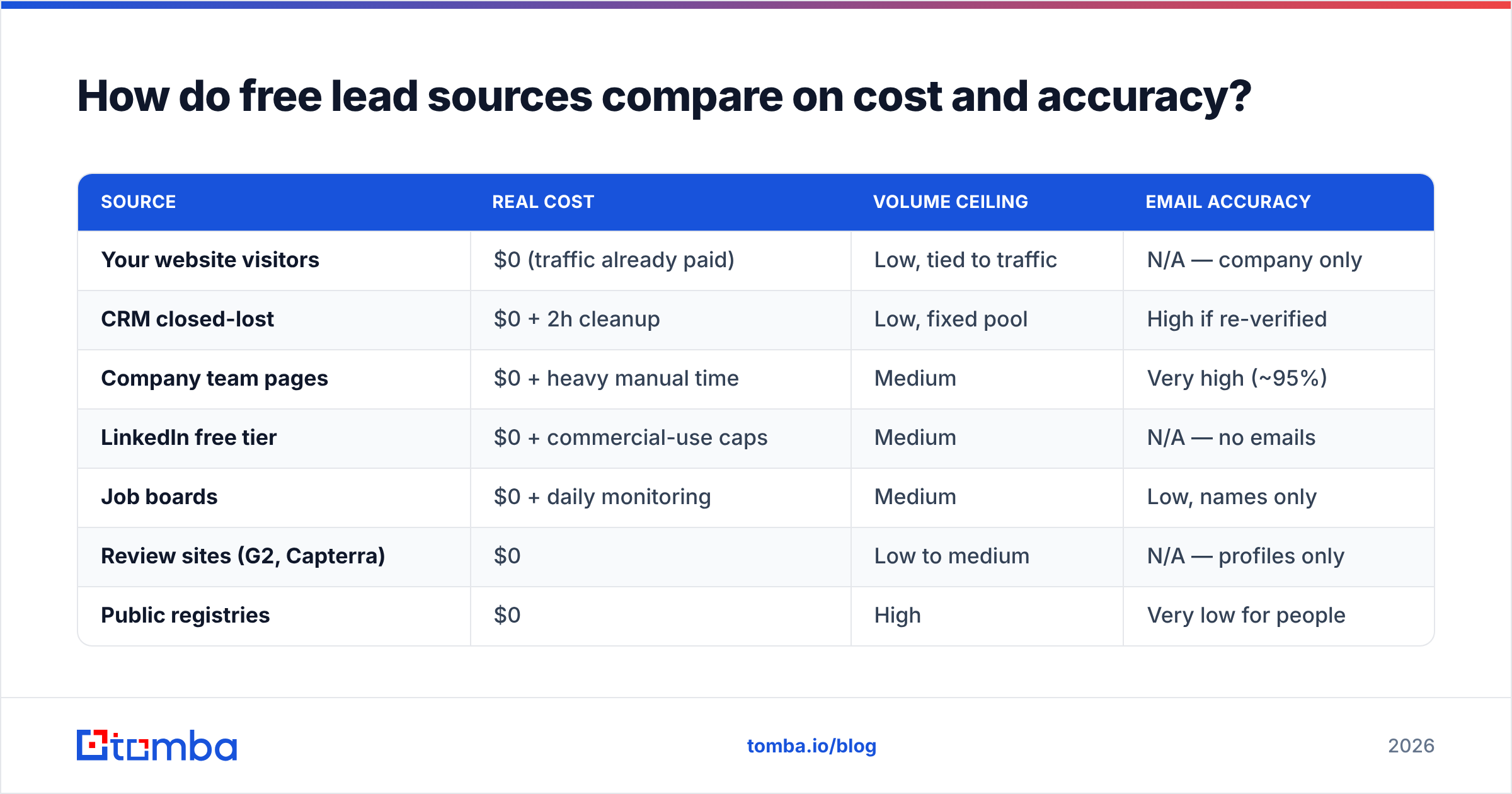
Volume and accuracy pull in opposite directions. The sources that scale fastest are the ones you should trust least.
| Source | Real cost | Volume ceiling | Email accuracy |
|---|---|---|---|
| Your website visitors | $0 (traffic already paid) | Low, tied to traffic | N/A — company only |
| CRM closed-lost | $0 + 2h cleanup | Low, fixed pool | High if re-verified |
| Company team pages | $0 + heavy manual time | Medium | Very high (~95%) |
| LinkedIn free tier | $0 + commercial-use caps | Medium | N/A — no emails |
| Job boards | $0 + daily monitoring | Medium | Low, names only |
| Review sites (G2, Capterra) | $0 | Low to medium | N/A — profiles only |
| Public registries | $0 | High | Very low for people |
| Vendor free tiers | $0 up to quota | 25-100/mo | High, pre-verified |
| Downloadable "free lead lists" | $0 + your sender reputation | Very high | 40-65% at best |
The bottom row is the trap. A 10,000-record free CSV looks like the best deal on this table and is the only one that can permanently damage your business.
Why do free lead lists bounce so hard?#
Three reasons, and they compound.
They're resold, not sourced. The same underlying scrape gets repackaged by a dozen "free lead magnet" sites. If you can download it, so can your competitors, and so did everyone in the last 18 months. Those inboxes are already saturated or already dead.
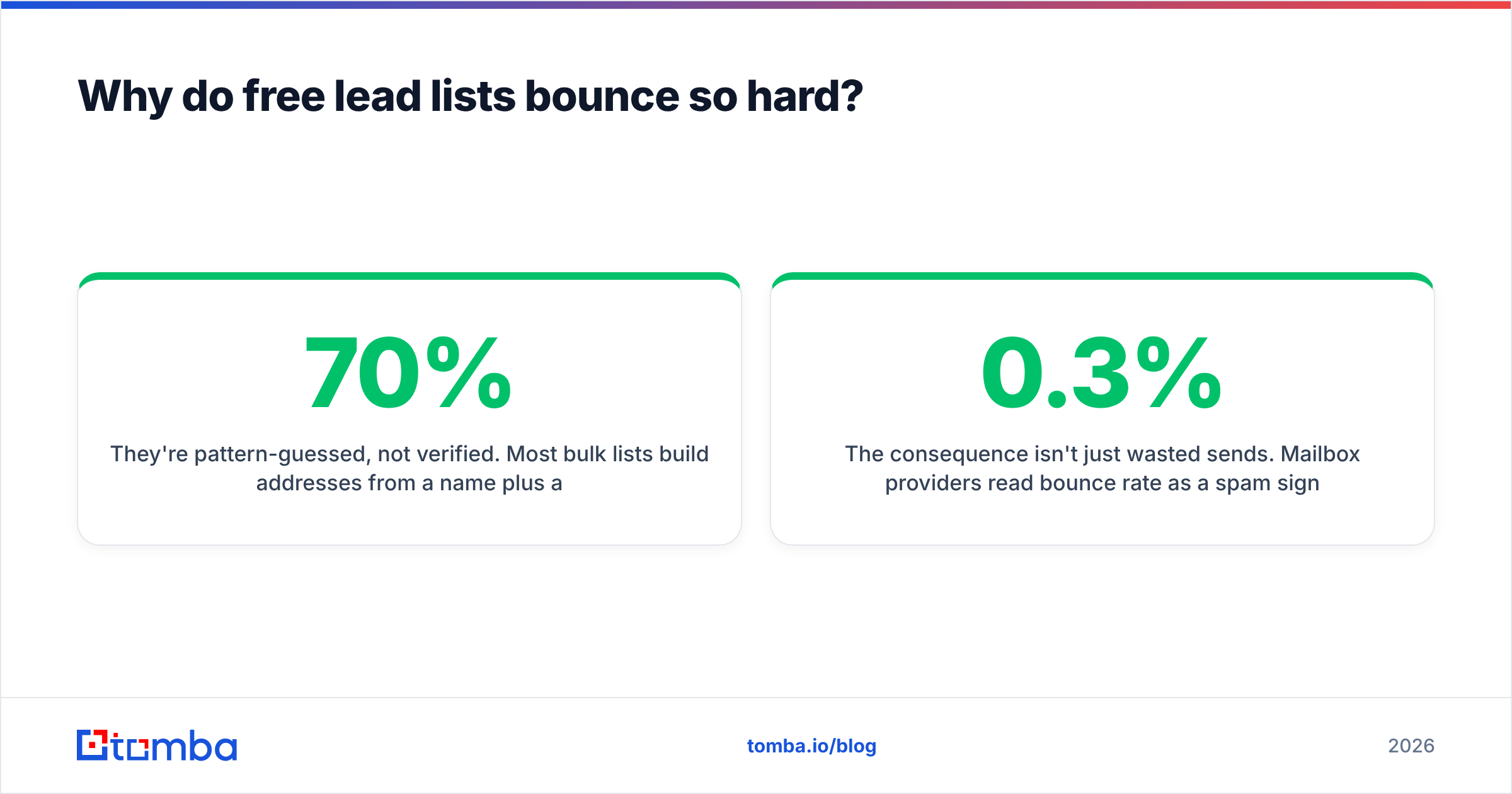
They're pattern-guessed, not verified. Most bulk lists build addresses from a name plus a guessed format (first.last@, flast@). Guessing gets you maybe 60-70% right on companies with predictable patterns and near-zero on companies that don't. Nobody runs SMTP validation before giving a list away for free, because validation costs money.
They ignore catch-all domains. A meaningful share of B2B domains accept every address at the server level, so a naive validator marks garbage as deliverable. You need a dedicated catch-all verifier to separate real mailboxes from domains that just say yes to everything.
The consequence isn't just wasted sends. Mailbox providers read bounce rate as a spam signal. Google and Yahoo's bulk-sender requirements put the spam-complaint threshold at 0.3%, and sustained hard-bounce rates above roughly 2% start degrading placement for your entire domain. One 5,000-record free list at a 40% bounce rate can undo six months of careful email deliverability work.

What does a free lead actually cost you?#
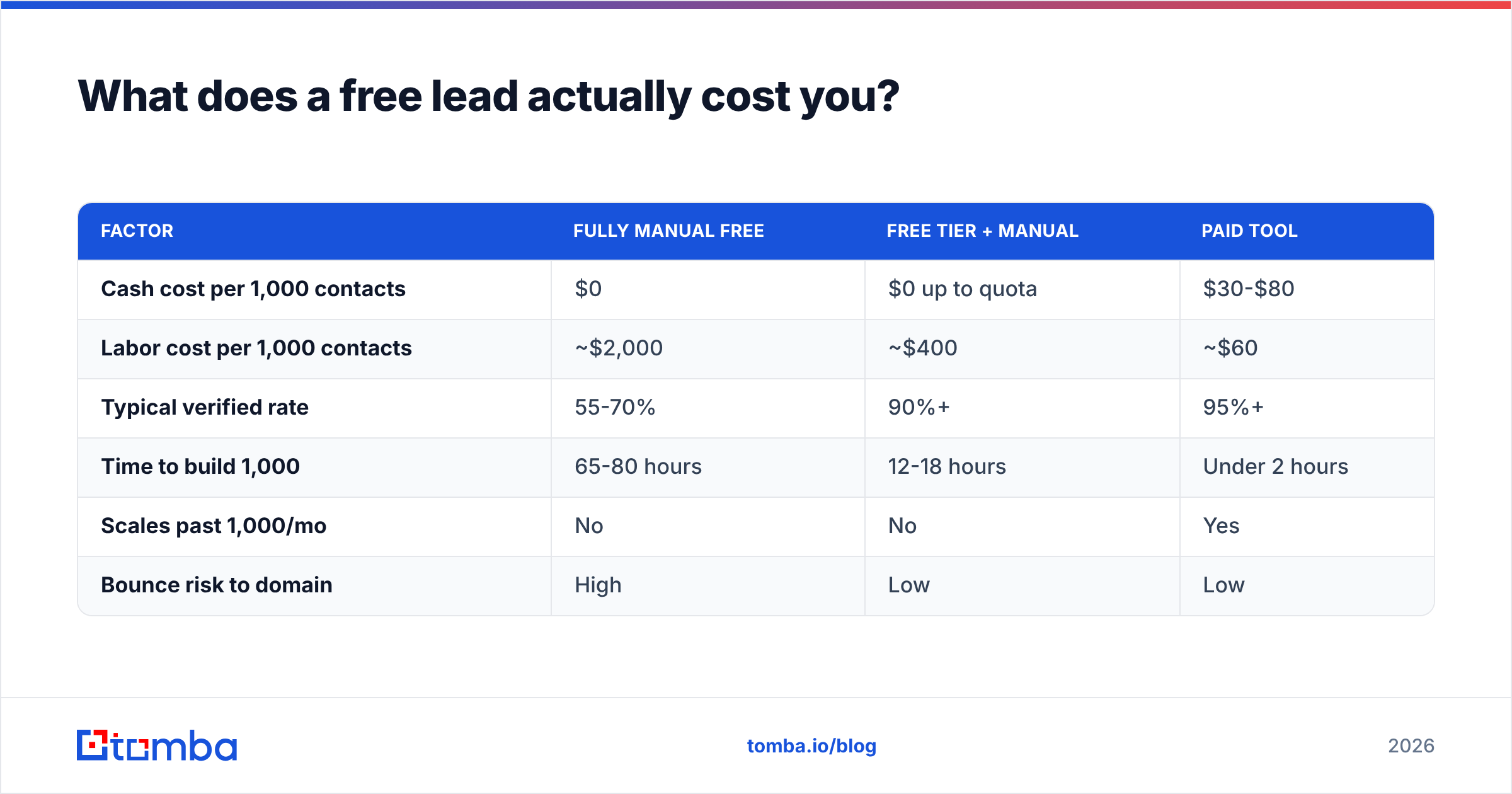
Put a real number on it. Say an SDR earns $60,000 fully loaded, works 2,000 hours, and costs about $30/hour. Manual research on company websites and LinkedIn produces maybe 12-15 complete contacts an hour once you include finding the person, guessing the email, and logging it.
| Factor | Fully manual free | Free tier + manual | Paid tool |
|---|---|---|---|
| Cash cost per 1,000 contacts | $0 | $0 up to quota | $30-$80 |
| Labor cost per 1,000 contacts | ~$2,000 | ~$400 | ~$60 |
| Typical verified rate | 55-70% | 90%+ | 95%+ |
| Time to build 1,000 | 65-80 hours | 12-18 hours | Under 2 hours |
| Scales past 1,000/mo | No | No | Yes |
| Bounce risk to domain | High | Low | Low |
Free wins on cash and loses badly on everything else. That's fine at 50 leads a month and indefensible at 500. HubSpot's research on sales productivity consistently finds reps spend under a third of their time actually selling; manual list-building is one of the biggest thieves of that time, and it's the easiest one to automate away. Their sales statistics roundup is worth reading before you assign anyone 60 hours of copy-paste.
How do you build a free-first workflow that still scales?#
The workable pattern is: free for discovery, paid for contact data, free again for enrichment context. Concretely:
- Step 1 — Build the account list free. Job boards, review sites, registries, and LinkedIn search. Target 100-300 accounts that match a tight ICP. Do not skip the tightness; a narrow list is what makes the later steps cheap.
- Step 2 — Find the people free. Company team pages, LinkedIn, conference pages, article bylines. Name and title only. No email guessing yet.
- Step 3 — Resolve emails properly. This is the one step worth paying for. Run names and domains through an email finder rather than a permutator. Pattern generators produce plausible strings; a finder returns addresses observed in the wild with a confidence score.
- Step 4 — Verify before you send. Every address, every time, including ones a vendor already scored. An email verifier pass costs fractions of a cent and is the difference between a healthy domain and a burned one.
- Step 5 — Enrich free. Company news, funding, tech stack, and recent posts are all public. This is where personalization comes from, and it's genuinely free.
- Step 6 — Suppress and recycle. Maintain a hard-bounce suppression list forever. Re-verify anything older than 90 days before a second touch.
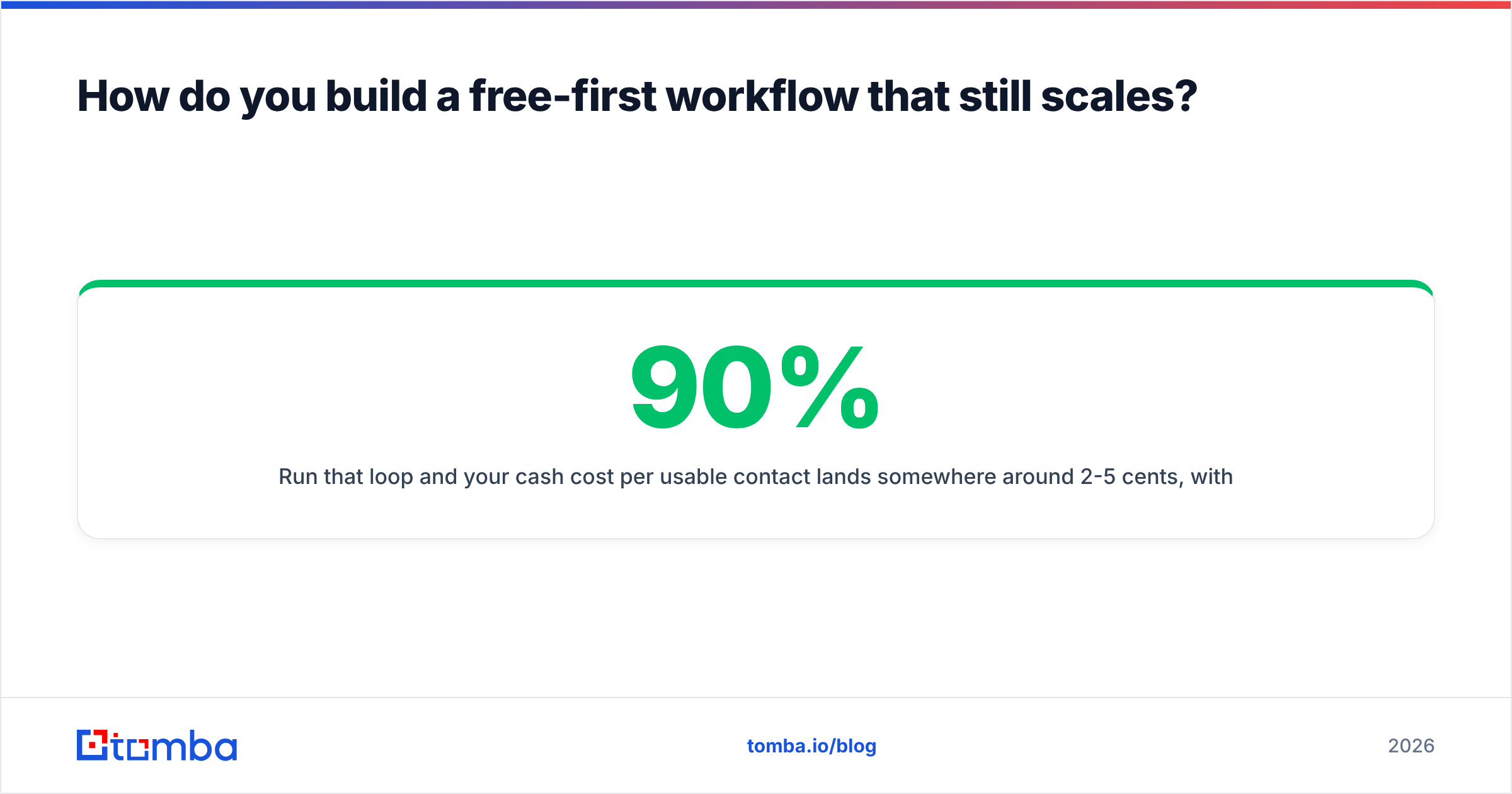
Run that loop and your cash cost per usable contact lands somewhere around 2-5 cents, with a verified rate above 90%. Compare that to $0 and a 45% bounce rate and the math isn't close.
When should you stop using free business leads?#
Three signals tell you free has stopped paying:
- Your reps spend more than 20% of their week on list-building. At that point the labor cost of "free" exceeds any tool's subscription.
- You need more than ~200 new contacts a month. Free sources have hard ceilings. Manual research does not scale linearly; it scales worse, because the easy accounts get done first.
- Your bounce rate crosses 2%. Stop everything, verify your existing lists, and stop ingesting unverified data. Reputation damage takes weeks to repair and costs far more than the tool would have.
Below those thresholds — a solo founder, a new territory, a first outbound test — free is genuinely the right call. Use a vendor free tier for the contact-data step so you never send to a guess, and keep your volume small enough that manual research is honest work rather than a treadmill.
Are free business leads worth it in 2026?#
Yes, with one correction to how most teams use them. Free is excellent for the discovery half of prospecting: figuring out which companies to chase and who inside them matters. It's poor for the contact half, because deliverable contact data is a perishable good that costs money to keep fresh, and anything given away for free has by definition not been kept fresh.
Treat free lead lists the way you'd treat free food left in an office kitchen: fine to look at, risky to consume, and no substitute for buying lunch. Build your account and persona lists for nothing, then spend a small, predictable amount making sure the messages actually arrive.
Start free, then scale without burning your domain#
If you want the free-first workflow above without the 60 hours of copy-paste, start with Tomba's free tier: 25 searches a month, no card, verified results rather than guessed patterns. Drop in a name and a company domain and the Tomba Email Finder returns the address with a confidence score and the sources it was seen on, so you know what you're sending to before you send it. When your volume outgrows the free quota, Tomba pricing starts at $49/month for Starter and $99/month for Growth — still cheaper than one SDR week spent hand-building a list that bounces.
Related guides#
Ready to find emails that actually work?
Join 150,000+ professionals who stopped guessing and started sending. Free credits on signup — no credit card required.
Get the Tomba newsletter
Practical outbound tactics and product updates — once every two weeks.
About the author